

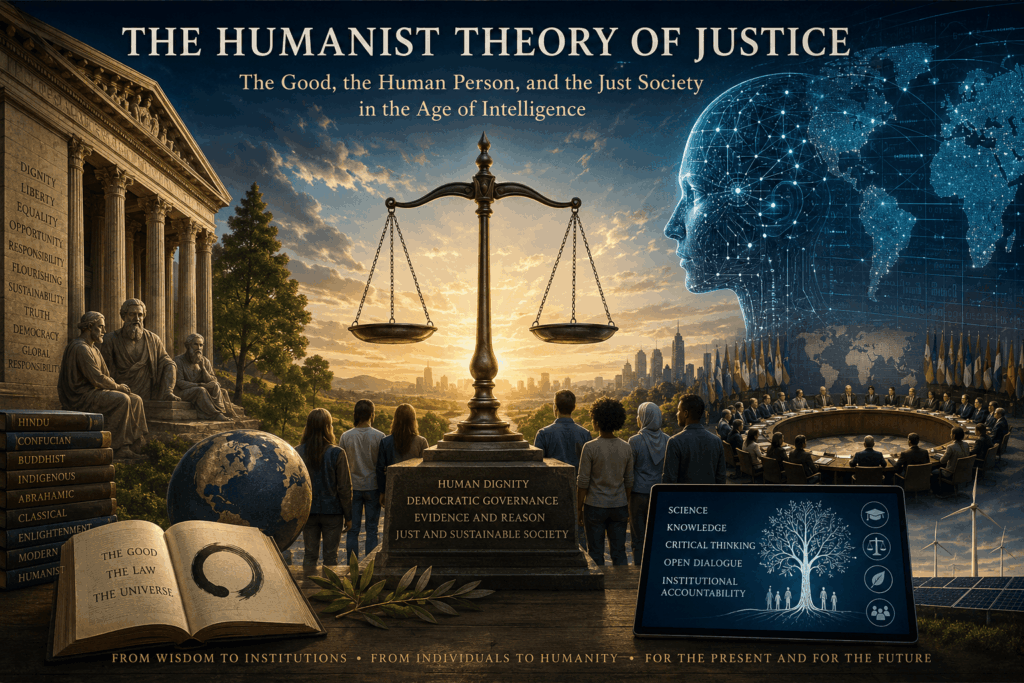
The Humanist Theory of Justice
The Good, the Human Person, and the Just Society in the Age of Intelligence
Table of Contents
Introduction — The Human Search for Justice
Humanity’s enduring search for the principles of a just society
Part I — The Human Person and the Good
The nature of the self and humanity’s search for the Good
1. The Nature of the Self
Zen and the Science of Wholeness
2. Humanity’s Conceptions of the Good
Religious, philosophical, cultural, and Indigenous traditions
3. Kant and the Rational Good
Dignity, autonomy, universal reason, and moral obligation
Part II — From Morality to Knowledge
Ethics, moral universality, and the foundations of reliable judgment
4. Morality and Ethics
From personal moral judgment to public ethics and justice
5. Moral Relativism and Moral Universalism
Culture, universal principles, and critical moral universalism
6. From Subjectivity to Empirical Knowledge
Logic, critical thinking, science, evidence, and ethical judgment
Part III — The State and the Problem of Social Order
Political authority, cooperation, liberty, and collective obligation
7. Why Human Beings Create States
Security, political authority, state capacity, and the limits of power
8. The Social Contract
From Hobbes, Locke, and Rousseau to modern constitutional democracy
9. Utilitarianism
Consequences, collective welfare, and the limits of aggregate utility
10. Idealism and Communitarianism
Community, identity, obligation, and the common good
11. Individualism, Collectivism, and the Human Person
Reconciling individual moral standing with social interdependence
Part IV — The Political Traditions
The major political and economic traditions of the modern world
12. Classical Liberalism
Natural rights, constitutional government, markets, and individual liberty
13. Liberalism and Conservatism
Left and Right, economic and social politics, libertarianism, Green politics, neoliberalism, and neoconservatism
14. Forms of Government
Democracy, republic, monarchy, aristocracy, oligarchy, and the distribution of political power
15. Capitalism and Communism
Markets, ownership, economic coordination, inequality, and concentrated power
16. Socialism, Democratic Socialism, and Social Democracy
Public responsibility, mixed economies, social provision, and institutional balance
Part V — Toward a Science of Government
Evidence-based governance and the Science of Wholeness
17. Political Science and the Science of Government
Evidence, expertise, democratic legitimacy, and institutional learning
18. The Science of Wholeness
The One, the Good, the Law, and the Universe
Part VI — Humanism and the Development of Justice
The historical development of the humanist approach to society
19. Civic Humanism
Citizenship, civic virtue, education, and public responsibility
20. Enlightenment Humanism
Reason, natural rights, liberty, constitutionalism, and political progress
21. Secular and Scientific Humanism
Ethics without theological authority and knowledge accountable to evidence
22. Modern Humanism and Universal Human Rights
Human dignity, international standards, and the Universal Declaration of Human Rights
23. Integrated Humanism
Secularism, Science, Humanism, Democracy, and Global Responsibility
Part VII — The Modern Debate About Justice
Rawls, Sandel, and the relationship between the individual and the community
24. John Rawls and A Theory of Justice
The original position, veil of ignorance, liberty, fair opportunity, and the difference principle
25. Michael Sandel and Liberalism and the Limits of Justice
The socially embedded person, community, obligation, and the common good
26. Rawls, Sandel, and the Unfinished Problem
Individual liberty, social interdependence, and the challenges of the twenty-first century
Part VIII — The Humanist Theory of Justice
An Integrated Humanist framework for justice in the Age of Intelligence
27. Integrated Humanism and a New Theory of Justice
The principles of a Humanist Theory of Justice
Part IX — Justice as Institutional Design
Translating the Humanist Theory of Justice into durable institutions
28. The Civic Humanist System
From philosophical principles to civic and institutional practice
29. Alignment
Aligning incentives, institutions, evidence, and legitimate human interests
30. Economic Balance
Prosperity, opportunity, economic power, social security, and sustainability
31. Global Coordination
Justice, sovereignty, interdependence, and international cooperation
Conclusion — Justice in the Age of Intelligence
Human dignity, knowledge, democratic responsibility, and the continuing work of justice
References
Selected philosophical, political, economic, religious, and humanist sources
About Science Abbey
The intellectual home of Integrated Humanism
About Integrated Humanism
Secularism, Science, Humanism, Democracy, and Global Responsibility
About the Author
D. B. Smith — Founder and Director of Science Abbey
Introduction — The Human Search for Justice
Justice is among the oldest subjects of organized human thought. Long before political philosophy acquired its modern vocabulary, human communities faced the practical challenge of living together under conditions of competing interests and unequal power. Their answers gradually took the form of customs, moral traditions, and systems of law intended to preserve social order while defining what people could reasonably expect from one another.
Religious traditions placed these questions within larger accounts of divine or cosmic order, while philosophers examined whether principles of justice could be established through reason. As political and economic institutions became more complex, the inquiry expanded to include the legitimacy of government and the organization of material life. Across these different approaches lies a persistent question: How can a community balance competing individual interests and unequal power to ensure a stable, fair, and cooperative society? In short, what do human beings owe one another?
The difficulty of answering that question has increased as societies have grown larger and more interconnected. A modern state must establish justice among millions of people whose circumstances, beliefs, and conceptions of the good life differ substantially. Global interdependence has extended the problem beyond the state itself, as economic and technological systems increasingly produce consequences across national borders and over generations.
Modern political traditions have approached this problem from different directions. Liberalism established powerful arguments for individual liberty and constitutional government, while utilitarianism directed attention toward the consequences of political choices for human welfare. Socialist traditions brought economic power and inequality more fully into theories of justice. Communitarian thought subsequently emphasized the social relationships through which individuals develop, while modern human rights established principles intended to protect human dignity across political and cultural boundaries.
Each of these traditions contributes something important to the modern understanding of justice, but they emerged under historical conditions substantially different from those of the twenty-first century. Contemporary societies possess forms of scientific knowledge and technological power unavailable to earlier political thinkers. At the same time, the scale and complexity of modern institutions have created new questions about the distribution and accountability of that power.
Advances in the human and natural sciences have also changed what can be known about the conditions of human life. Psychology has deepened the understanding of cognition and behavior, while biology has revealed the extent to which human wellbeing depends upon larger ecological systems. Political and economic research now permits institutions and policies to be compared across societies and over time. These developments provide increasingly sophisticated ways to examine how social arrangements actually affect the people who live under them.
Information technology has added another dimension to the problem. Digital networks have transformed access to knowledge while creating powerful mechanisms for surveillance and manipulation. Artificial intelligence extends this transformation into intellectual work and decision-making, with consequences for economic organization and political power that are only beginning to become visible. The conditions under which justice must operate are therefore changing alongside the technologies through which societies organize themselves.
Science cannot determine what humanity ought to value. Questions of moral worth remain matters of ethical and philosophical judgment. Empirical knowledge can nevertheless test claims about the consequences of institutions and public policies. A society that formally guarantees equality may still maintain conditions that systematically restrict opportunity, just as legal liberty may provide little practical agency when political or economic power becomes excessively concentrated. The principles proclaimed by institutions must therefore be considered alongside the conditions those institutions actually produce.
Integrated Humanism provides a framework for bringing ethical judgment and empirical knowledge into a common inquiry. Its foundations in secularism, science, humanism, democracy, and global responsibility connect respect for human dignity with a commitment to evidence and democratic legitimacy. They also extend the consideration of justice beyond immediate political interests by recognizing obligations that arise from global interdependence and the consequences inherited by future generations.
Within this framework, justice concerns the conditions under which people can exercise meaningful freedom while participating in societies capable of sustaining human flourishing. Rights establish protections for the individual, while social cooperation creates corresponding responsibilities. Political and economic institutions determine how these principles operate in practice, making their design and accountability central questions for any contemporary theory of justice.
The Humanist Theory of Justice developed here begins with humanity’s historical search for the Good and follows the development of ethical and political thought into the modern debate represented by John Rawls and Michael Sandel. That intellectual inheritance provides the foundation for considering whether Integrated Humanism can contribute a theory of justice suited to the Age of Intelligence. The inquiry begins with the human person, because every theory of justice ultimately depends upon an understanding of the beings whose lives its principles are intended to govern.
Part I — The Human Person and the Good
1. The Nature of the Self
Zen and the Science of Wholeness
Modern Western political philosophy frequently begins with the individual. Individuals possess rights, make choices, enter contracts, own property, vote, form associations, and pursue their own conceptions of happiness. This understanding has been essential to the development of modern liberty and protections against hereditary authority, religious coercion, arbitrary government, and other forms of institutional domination.
The autonomous individual of political theory is nevertheless an abstraction. Every person begins life biologically dependent upon others and develops through relationships with caregivers, families, communities, languages, institutions, and cultures. Even capacities associated with autonomy—reasoning, communication, self-control, moral judgment, and economic independence—develop within social environments. Individuality is real, but it exists within networks of dependence that precede conscious choice.
Buddhist philosophy approaches this problem through the doctrine of anātman, or non-self, which challenges the idea of a permanent, independent self existing separately from the rest of reality. Zen Buddhism develops this insight through contemplative practice, revealing the individual as a changing expression of innumerable causes, conditions, and relationships.
The separate self remains a useful convention for ordinary life and ethical responsibility, but its apparent independence is ultimately illusory: no person exists apart from the biological, social, ecological, and material relationships through which life continuously arises. At the deepest level, interconnectedness is the underlying condition of existence, while separate selfhood is a conceptual distinction made within that larger whole.
Modern science approaches aspects of this question through different methods. Biology places each person within evolutionary and ecological systems. Neuroscience describes perception, memory, emotion, attention, bodily awareness, and decision-making as interacting processes rather than the products of a single immutable center. Developmental psychology demonstrates the importance of relationships and environments in forming cognitive and emotional capacities. Sociology and economics show how institutions, resources, incentives, and social conditions influence individual opportunities and behavior.
These convergences should not be mistaken for proof that modern science validates Buddhist doctrine. They support a more limited and useful conclusion: excessively atomized descriptions of human beings are inadequate. The Science of Wholeness therefore considers the person simultaneously as an organism, a conscious individual, a member of communities, a participant in political and economic institutions, a member of humanity, and part of the biosphere.
This understanding has direct consequences for justice. Individual dignity and liberty remain morally indispensable because suffering, coercion, aspiration, achievement, and loss are experienced by persons. Yet many conditions affecting those experiences arise from systems beyond individual control.
Education, health, infrastructure, environmental stability, access to reliable information, political institutions, and economic opportunity affect the practical freedom available to individuals. Justice must therefore protect the person while examining the systems within which human lives develop.
2. Humanity’s Conceptions of the Good
Every theory of justice depends upon judgments about what matters. Freedom has value because human agency matters; equality becomes significant because arbitrary differences in treatment affect persons whose interests carry moral weight; welfare matters because suffering and flourishing matter. Human civilizations have supplied widely different explanations for these values, yet recurring concerns with reciprocity, responsibility, compassion, honesty, restraint, dignity, social order, and the control of violence appear across many traditions.
Hindu traditions developed the concept of dharma, encompassing duty, right conduct, law, moral order, and the proper relationship of persons to a wider structure of existence. Together with concepts such as karma and moksha, these traditions connected individual conduct with consequences, responsibility, self-knowledge, and liberation. Their history also demonstrates how concepts of social order can preserve hierarchy, as interpretations of caste and inherited duty illustrate. Stability and inherited order therefore cannot by themselves establish justice.
Confucian thought places particular emphasis upon cultivated character and social relationships. Ren, commonly translated as humaneness or benevolence; yi, associated with righteousness; and li, involving appropriate conduct and ritual propriety, describe an ethical system in which personal cultivation and social order develop together. Political authority consequently carries moral responsibilities.
Confucianism contributes an important insight to political theory: institutions depend upon the character and competence of the people who operate them. Laws and constitutional safeguards cannot entirely compensate for corruption, dishonesty, incompetence, or civic indifference.
Buddhist ethics concentrates upon suffering and the conditions that produce it. Greed, hatred, and delusion encourage harmful conduct, while wisdom, compassion, generosity, mindfulness, and ethical restraint contribute to wellbeing. Dependent origination gives this ethical system a relational dimension in which actions emerge from conditions and create further conditions. For a secular Humanist Theory of Justice, these ideas offer useful ways of examining suffering, interdependence, compassion, and the psychological sources of harmful behavior without requiring acceptance of Buddhist cosmology.
Ancient Greek philosophy approached the Good through sustained inquiry into virtue, reason, character, and the purposes of human life. Plato associated the Good with the highest object of philosophical understanding and the ultimate source of intelligibility and value, while Aristotle brought the question more directly into ethics and civic life.
In the Nicomachean Ethics, Aristotle argued that human action ultimately aims toward eudaimonia, commonly translated as flourishing or living well, achieved through the cultivation of virtue and the practical exercise of reason over the course of a life. Because human beings are inherently social and political, Aristotle also connected individual flourishing with the character of the community and its institutions. This relationship between virtue, human flourishing, and the organization of civic life became one of the most enduring contributions of Greek philosophy to later theories of ethics and justice.
Ideas of justice also developed within Indigenous and customary traditions through relationships among community, land, obligation, and inherited law. Ancient Celtic traditions associated justice with customary law, restitution, kinship responsibilities, and the maintenance of social order. Prehistoric and early medieval Nordic societies developed assemblies and legal customs through which disputes could be heard and settlements reached.
Many Native American traditions have emphasized restoration, reciprocity, communal responsibility, and relationships with the natural world, although practices differed greatly among nations. African traditions are similarly diverse, but many have understood justice through communal responsibility, reconciliation, and the restoration of social relationships, principles often associated with concepts such as ubuntu.
Across many customary societies, moral and legal life has involved kinship, reciprocity, hospitality, communal obligation, customary law, stewardship, relationships with land, and responsibilities extending across generations. These traditions demonstrate that ethical knowledge has been preserved through custom, narrative, law, ecological practice, and communal experience as well as formal philosophy. They broaden the history of justice beyond states and written philosophical systems by demonstrating how communities developed sophisticated means of maintaining fairness, resolving conflict, and repairing harm.
The Abrahamic traditions of Judaism, Christianity, and Islam developed influential conceptions of justice within relationships involving God, humanity, law, and community. Despite major theological differences, they contain extensive traditions concerning justice, charity, mercy, moral accountability, care for vulnerable people, economic conduct, and obligations toward others.
The Abrahamic influence upon later ideas of human dignity, equality, conscience, rights, and social responsibility has been substantial. A secular theory can recognize this historical inheritance while evaluating ethical insights independently of claims that depend upon revelation.
Across these traditions, the Good has been understood through cosmic order, virtuous character, liberation from suffering, divine obligation, reciprocity, compassion, honor, wisdom, community responsibility, and human flourishing. Their differences remain philosophically significant. Their shared history also reveals a persistent recognition that individual conduct and social order are connected. Justice emerges from this relationship between the wellbeing and freedom of persons and the larger systems in which they live.
3. Kant and the Rational Good
The European Enlightenment intensified efforts to establish morality through human reason. Immanuel Kant became central to this development by seeking moral principles whose authority did not depend upon personal desire, social convention, political command, or calculations of advantage.
Kant located moral worth in the good will and in action guided by duty. His categorical imperative asked whether the principle underlying an action could coherently be willed as a universal law. Another formulation required humanity, whether in oneself or another person, to be treated as an end and never merely as a means. This approach helped provide a philosophical foundation for later ideas of autonomy, dignity, universal rights, and liberal justice.
Its importance lies partly in protecting the person against instrumental treatment. Human beings cannot ethically be reduced to tools for economic production, political objectives, religious institutions, national ambitions, or aggregate welfare. Universalization also challenges moral systems constructed around privilege: principles governing others must withstand the question of whether they could reasonably govern everyone.
Yet rational consistency alone cannot resolve the full complexity of justice. Human beings live within unequal circumstances, social relationships, institutions, historical conditions, and distributions of power. Laws that appear formally universal can have radically different consequences for different populations. Ethical reasoning therefore benefits from empirical knowledge about how human beings and institutions actually behave.
Kantian ethics are the bedrock of modern frameworks for human rights and liberal political philosophy. By arguing that rationality gives every individual unconditional intrinsic value (dignity) and the capacity for self-governance (autonomy), Kant directly influenced later legal and political concepts of universal human rights, individual liberties, and justice frameworks (such as those later developed by John Rawls).
A Humanist Theory of Justice can retain Kant’s emphasis upon dignity, autonomy, and universal moral consideration while incorporating the resources of modern knowledge. Psychology can examine human reasoning and behavior; economics can study incentives and distributions; political science can compare institutions; history can reveal long-term consequences; and the sciences can investigate conditions affecting human wellbeing.
Humanity’s search for the Good thereby enters a domain in which inherited moral traditions and philosophical reasoning can increasingly be examined alongside evidence about the consequences of human choices and institutions.
Part II — From Morality to Knowledge
4. Morality and Ethics
Morality and ethics are closely related terms, and in ordinary usage they are often interchangeable. For the purposes of a theory of justice, however, a useful distinction can be made between them. Morality concerns beliefs and judgments about right and wrong conduct, while ethics concerns the systematic examination of those beliefs, the principles underlying them, and their application to human behavior and institutions.
Morality exists wherever people make judgments about how they should behave. Ethics begins when those judgments become subjects of sustained reflection and criticism. Human moral systems develop from many sources. Religion, family, culture, law, custom, philosophical reasoning, personal experience, biological dispositions, and social necessity all contribute to judgments about acceptable conduct. Some moral rules vary greatly across societies, while others recur with remarkable regularity.
Prohibitions against arbitrary killing, injury, theft, deception, and betrayal appear widely because communities in which such behavior is unrestricted have difficulty sustaining cooperation and trust. Moral traditions also commonly develop expectations concerning reciprocity, responsibility, care for children, obligations toward kin, and restraints upon violence.
Law overlaps with morality without being identical to it. Governments prohibit some conduct because it threatens public order or violates protected rights, yet many immoral actions are not illegal, and history contains numerous examples of laws that later generations have judged profoundly unjust. Slavery, racial discrimination, religious persecution, political repression, and unequal legal status have all existed within formally constituted legal systems. Legality therefore establishes what an authority permits or prohibits; it cannot independently establish whether the authority or its laws are just.
The distinction becomes particularly important in pluralistic democracies. Citizens may disagree about religion, sexuality, family life, personal conduct, economic arrangements, and the meaning of a good life while remaining members of the same political community. A workable public ethic must allow substantial space for such disagreement while maintaining principles necessary for peaceful coexistence, human dignity, equal citizenship, and legitimate government.
Justice consequently occupies the boundary between personal morality and public institutions. It asks which ethical principles should govern the basic structures under which people with different beliefs must live together. This requires some principles sufficiently universal to protect persons across differences of culture and belief, while remaining open to criticism and revision when evidence or argument exposes injustice.
5. Moral Relativism and Moral Universalism
Moral relativism begins from an important observation: moral beliefs differ across cultures and historical periods. Practices considered normal in one society may be condemned in another, and standards regarded as self-evident by one generation may be rejected by the next. Awareness of this variation encourages humility. It also warns against assuming that the customs of a powerful society constitute universal moral truth.
Relativism becomes more difficult when cultural variation is treated as proof that no moral judgment can extend beyond the society that holds it. If every moral system is valid only within its own cultural setting, criticism of slavery, genocide, torture, systematic oppression, or the subordination of entire classes of people becomes philosophically unstable whenever those practices are accepted locally. The fact that moral beliefs vary demonstrates disagreement; it does not establish that every belief is equally defensible.
Moral universalism holds that at least some ethical principles apply to human beings regardless of culture, nationality, religion, or political system. Modern human rights embody this proposition. The prohibition of torture, equality before the law, freedom of conscience, and recognition of basic human dignity claim a moral standing that transcends local custom.
Universalism carries dangers of its own. Political and religious powers have repeatedly presented their particular values as universal while imposing them upon others. Colonialism, forced conversion, ideological repression, and programs of cultural assimilation demonstrate how claims of moral certainty can accompany domination. A defensible universalism therefore requires intellectual humility and procedures through which moral principles can be questioned, compared, and improved.
Integrated Humanism supports a form of critical moral universalism. Certain principles can be treated as universal because they concern fundamental conditions of human existence: conscious beings can suffer; coercion restricts agency; violence damages bodies and communities; arbitrary discrimination denies equal moral standing; and institutions can create conditions that predictably increase or reduce human flourishing. The interpretation and application of these principles remain subjects of inquiry.
The Universal Declaration of Human Rights represents an important historical example of this approach. It emerged from negotiation among people representing different political, philosophical, religious, and cultural traditions. Its principles were neither discovered as physical laws nor derived from a single theology. They were articulated as shared standards following historical experience of war, authoritarianism, genocide, persecution, and mass displacement. Universal moral principles can therefore develop through accumulated human experience and cross-cultural deliberation without requiring claims of infallibility.
6. From Subjectivity to Empirical Knowledge
The debate between relativism and universalism leads to a deeper question: how can human beings distinguish moral knowledge from preference, convention, ideology, or prejudice? Ethical propositions cannot be tested in exactly the same manner as propositions in physics or chemistry. No experiment can independently demonstrate that liberty ought to be valued or that every person possesses moral dignity. Such judgments require philosophical reasoning and ultimately depend upon values.
This does not make every aspect of moral and political judgment subjective. Once societies identify values they intend to pursue, many questions concerning those values become empirically accessible. If a government claims that a policy reduces poverty, improves education, decreases crime, expands opportunity, protects public health, or increases economic security, evidence can test those claims. Competing institutions can be compared, historical outcomes examined, causal explanations challenged, and unsuccessful policies revised.
Logic and critical thinking provide additional disciplines. Arguments can contain contradictions, rely upon false premises, confuse correlation with causation, generalize from inadequate evidence, or employ emotionally persuasive claims unsupported by facts. Scientific methods strengthen this process by requiring observation, measurement, transparency, replication where possible, and willingness to revise conclusions when evidence changes.
Political and ethical inquiry nevertheless requires caution about what can be measured. Human dignity cannot be reduced to gross domestic product, and wellbeing cannot be represented completely by a single statistical indicator. Quantification can conceal assumptions about which outcomes matter and whose experiences are counted. Evidence must therefore inform ethical judgment without being mistaken for a replacement for it.
The relationship between values and evidence is better understood as reciprocal. Ethical reasoning identifies purposes worth pursuing; empirical inquiry examines the conditions and consequences associated with pursuing them. Evidence can then expose conflicts among values or demonstrate that a favored policy fails to achieve its stated purpose. Ethical judgment determines how such findings should influence future decisions.
This relationship provides an epistemological foundation for Scientific and Integrated Humanism. Human beings will continue to disagree about values, and uncertainty will remain unavoidable. Justice nevertheless improves when beliefs about society are subjected to logic, evidence, critical examination, historical comparison, and open debate. A political system capable of learning from its consequences possesses an advantage over systems in which ideology, tradition, authority, or popular conviction is insulated from correction.
The transition from morality to political philosophy therefore occurs through a practical problem. Human beings possess moral values, imperfect knowledge, conflicting interests, and unequal power, yet they must construct institutions through which they can live together. The state is one of humanity’s principal answers to that problem.
A state is any organized political community living under a single government within a set territory. It holds sovereignty: supreme power to make and enforce laws without outside control. Its authority creates the possibility of law, security, public goods, and coordinated action while simultaneously creating the possibility of coercion, domination, and abuse. A theory of justice must therefore ask why political authority exists, what legitimizes it, and what limits should govern its power.
Part III — The State and the Problem of Social Order
7. Why Human Beings Create States
Political communities arise from a fundamental problem of human association. People benefit from cooperation, but cooperation requires mechanisms for resolving disputes, protecting persons and property, coordinating collective action, and establishing rules that extend beyond immediate relationships. As societies increase in size and complexity, customary authority and informal agreement become insufficient for many of these purposes.
States can provide security, courts, infrastructure, public administration, common standards, education, public health, economic regulation, and other goods difficult to provide through isolated individual action. The same concentration of authority creates serious dangers. States possess coercive powers unavailable to ordinary citizens and can use them for repression, conquest, persecution, corruption, or the protection of entrenched interests. Political philosophy therefore confronts two related problems: human societies require organized authority, and organized authority must itself be controlled.
Thomas Hobbes offered one of the most influential early modern accounts of the first problem. Writing amid political and religious conflict in seventeenth-century England, Hobbes argued that the absence of effective sovereign authority could produce insecurity in which individuals could not reliably protect themselves or their possessions. Political order provided an escape from this condition by concentrating sufficient authority to maintain peace.
John Locke placed greater emphasis on the second problem. Individuals possessed rights that government was established to protect, and political authority derived legitimacy from consent. Government that systematically violated the rights it was created to secure could forfeit its claim to obedience. Locke’s arguments contributed significantly to later constitutionalism and liberal theories of limited government.
The tension between Hobbesian security and Lockean limitation remains central to modern politics. Governments must possess enough capacity to enforce law and provide public goods while remaining constrained enough to preserve liberty and prevent domination. State capacity and limits upon state power are therefore complementary requirements of constitutional government.
8. The Social Contract
Social-contract theory provides a framework for asking why individuals should recognize political authority and what governments owe in return. The contract is generally understood as a philosophical device rather than a description of an actual historical agreement. It asks what terms of political association free persons could reasonably accept.
Jean-Jacques Rousseau transformed the tradition by examining how political authority might preserve freedom within collective life. His concept of the general will sought a form of political association through which citizens participated in making the laws governing them.
Rousseau’s theory also exposed a difficulty that continues to trouble democracy: collective self-government requires some conception of a public interest extending beyond the immediate preferences of individuals and factions.
Modern constitutional democracy incorporates elements from several versions of the social contract. Citizens accept legal obligations, taxation, and limits upon some forms of conduct. In return, legitimate government is expected to protect rights, provide security, administer law impartially, maintain public institutions, and permit meaningful political participation.
Constitutions establish rules through which political authority can be exercised while placing some rights beyond ordinary political majorities.
The social contract has also expanded historically. Political systems once described as representative or republican frequently excluded women, racial and religious minorities, people without property, Indigenous populations, enslaved persons, and other groups. Modern democracy has progressively widened the category of full citizenship. This history demonstrates that a political system may proclaim universal principles long before its institutions apply them universally.
John Rawls would later transform social-contract reasoning by asking which principles people would select if they did not know their own position within society. His contribution will receive fuller treatment in Part VII. For the present argument, the social-contract tradition establishes an essential principle: legitimate political authority requires justification to the persons subject to it.
9. Utilitarianism
Utilitarianism approaches social decisions from their consequences. Jeremy Bentham proposed that actions and institutions should be evaluated according to their effects upon pleasure and pain, while John Stuart Mill developed a more sophisticated account of human welfare, liberty, and the qualitative differences among forms of happiness. The tradition supplied political philosophy with a powerful question: what actually happens to people as a result of a policy?
This consequentialist perspective remains deeply embedded in modern government. Public policy routinely compares costs and benefits, evaluates health outcomes, estimates economic effects, measures educational performance, and considers how scarce resources can produce the greatest public benefit. A government indifferent to consequences could remain faithful to abstract principles while repeatedly producing avoidable suffering.
The difficulty appears when aggregate welfare becomes the sole standard of justice. A policy could theoretically increase total welfare while imposing severe burdens upon a minority. Individual rights become vulnerable whenever sacrificing some people generates sufficiently large benefits for others. Modern constitutional systems therefore commonly combine consequential reasoning with rights and legal protections that restrict what governments may do even in pursuit of popular or socially beneficial objectives.
Utilitarianism contributes an indispensable concern with consequences while demonstrating why consequences alone cannot define justice.
10. Idealism and Communitarianism
Political idealism encompasses several traditions, but a recurring theme is that political life involves purposes extending beyond the aggregation of private interests. Human beings create institutions around ideas of citizenship, responsibility, national purpose, moral development, and the common good. Politics consequently shapes the social environment in which people develop their identities and values.
Communitarian philosophy sharpened this argument in response to modern liberal theories centered on autonomous individuals. Thinkers associated with the communitarian critique emphasized that actual persons are formed within families, languages, histories, cultures, institutions, and communities. People inherit relationships and obligations they did not individually choose, and these relationships frequently contribute to their identities and understanding of the good.
This insight has important consequences for justice. A society cannot be understood completely as a collection of independent rights-holders negotiating arrangements for mutual advantage. Citizens depend upon institutions, social trust, civic norms, inherited knowledge, and public goods created across generations. Communities also make claims that can become oppressive when tradition, conformity, nationalism, religion, or collective identity is allowed to override individual dignity and freedom.
The challenge is therefore to recognize the social constitution of human life while preserving protections for persons who dissent from their communities. This problem would become central to Michael Sandel’s critique of Rawls and to later debates about liberalism and the common good.
11. Individualism, Collectivism, and the Human Person
Individualism and collectivism are often presented as opposing political choices. The history examined so far suggests that each identifies a genuine dimension of human existence. Individuals experience suffering and freedom, form judgments, pursue projects, possess consciences, and require protection from coercive institutions. Societies simultaneously depend upon cooperation, shared infrastructure, collective security, accumulated knowledge, ecological resources, and institutions that no individual creates alone.
Excessive individualism can obscure the social conditions that make individual achievement possible and treat structural disadvantages as purely personal failures. Extreme collectivism creates the opposite danger by subordinating persons to the state, class, nation, religion, race, or some other asserted collective interest. Twentieth-century experience provides abundant evidence of the consequences when governments claim authority to sacrifice individual rights to ideological visions of collective destiny.
The Humanist Theory of Justice begins to emerge between these extremes through a more accurate description of the human person. Individuals possess moral standing and require substantial domains of liberty, privacy, conscience, and self-direction. They also participate in systems of reciprocal dependence that create legitimate obligations toward others and toward the institutions that sustain common life.
Political justice therefore requires continuing negotiation between liberty and obligation, private interest and public goods, personal responsibility and structural conditions, democratic choice and constitutional restraint. These tensions cannot be permanently eliminated because they arise from the dual character of human existence as individual and social.
The political traditions of the modern world represent different attempts to manage these relationships. Liberalism, conservatism, socialism, libertarianism, capitalism, communism, social democracy, and other systems emphasize different forms of freedom, authority, property, equality, continuity, and social responsibility. Understanding their contributions and failures requires separating their philosophical foundations from the partisan labels through which they are commonly encountered today.
Part IV — The Political Traditions
12. Classical Liberalism
Classical liberalism emerged from the political and intellectual transformations of early modern Europe. Its development drew upon natural-rights theory, constitutionalism, religious toleration, commercial society, and resistance to arbitrary authority. John Locke’s defense of natural rights and government by consent became particularly influential, while later thinkers developed arguments concerning individual liberty, private property, free exchange, representative government, and limits upon state power.
The liberal tradition helped transform the relationship between the individual and political authority. Governments increasingly required justification in terms of the interests and rights of citizens rather than divine authority, hereditary status, or inherited privilege. Freedom of conscience, speech, association, and political participation gradually became central components of constitutional government.
Economic liberalism developed alongside these political ideas. Adam Smith demonstrated how decentralized exchange and specialization could coordinate complex economic activity without comprehensive direction from political authorities. Markets could mobilize knowledge, incentives, investment, and individual initiative on a scale difficult for centralized systems to reproduce. Smith’s broader moral philosophy also recognized empathy, justice, institutions, and social obligations, dimensions sometimes lost in later representations of his economic thought.
Classical liberalism established principles that remain foundational to modern democracy. Its limitations emerged partly from the historical societies in which it developed. Formal liberty coexisted with slavery, colonialism, severe economic inequality, restrictions upon voting, and the exclusion of large populations from equal citizenship. Subsequent political traditions would therefore ask whether legal freedom alone provided sufficient conditions for meaningful human liberty.
13. Liberalism and Conservatism
Modern liberalism developed beyond classical doctrines of limited government as industrialization changed the conditions of economic and social life. Many liberals concluded that meaningful freedom required public education, social protections, regulation, and measures addressing poverty and extreme inequality. Liberalism consequently came to encompass both protection against excessive government power and the use of democratic government to expand practical opportunity.
Modern conservatism has similarly contained several traditions. Edmund Burke’s response to the French Revolution emphasized inherited institutions, social continuity, prudence, and skepticism toward attempts to reconstruct complex societies according to abstract theories. Later conservatives variously defended markets, property, religion, national traditions, established institutions, social order, and limited government.
The familiar categories of Left and Right originated in the French Revolution and have since absorbed changing coalitions of political ideas. They remain useful shorthand but poor philosophical classifications. A person may favor market-oriented economic policy while holding liberal social views, or support extensive social programs while maintaining culturally conservative positions. Economic liberalism and social liberalism describe different dimensions, as do economic and social conservatism.
Libertarianism gives particularly strong priority to individual liberty, private property, voluntary association, and limitations upon state coercion. Green politics emphasizes ecological sustainability, environmental responsibility, participatory democracy, and the long-term consequences of economic development. Moderate and centrist traditions generally seek workable combinations of policies rather than strict adherence to ideological poles, although moderation itself provides no guarantee of sound judgment; the appropriate position on a question depends upon evidence and principle rather than its location between competing extremes.
Neoliberalism emerged as an influential late twentieth-century orientation favoring markets, privatization, deregulation, trade liberalization, and reduced direct state involvement in economic activity. Its implementations varied substantially across countries. Neoconservatism developed along a different trajectory, particularly in the United States, combining elements of domestic conservatism with an assertive approach to foreign policy and the use of American power internationally.
These overlapping traditions illustrate why political analysis benefits from separating individual issues from partisan identity. Economic policy, social policy, environmental policy, civil liberties, national security, and foreign affairs involve different questions. Bundling them into Left and Right packages encourages citizens to inherit positions from political coalitions rather than evaluating each issue according to evidence, consequences, and principles of justice.
14. Forms of Government
Political philosophy has long classified governments according to who rules and how authority is exercised. Monarchy concentrates sovereign authority in one ruler, traditionally through hereditary succession. Aristocracy places authority among a comparatively small class understood, at least in its ideal formulation, as especially qualified to govern. Oligarchy similarly concentrates power among a minority, although the term generally carries the implication that this minority governs substantially in its own interests.
Democracy locates ultimate political authority in the people, whether exercised directly or through representatives. A republic establishes government as a public constitutional order rather than the personal possession of a monarch, usually operating through laws and representative institutions. The categories overlap: a state can be both democratic and republican, while constitutional monarchies can maintain highly democratic political systems.
Formal constitutional classification reveals only part of the distribution of power. A democratic republic may contain oligarchic concentrations of wealth, bureaucratic hierarchies, expert administrative institutions, powerful corporations, judicial constraints, and political parties that mediate access to government. A monarchy may possess a ceremonial sovereign while elected institutions exercise effective authority. Understanding justice therefore requires examining how power actually operates in addition to how constitutions describe it.
Modern constitutional democracy attempts to distribute and restrain political power through elections, rights, separation of powers, independent courts, professional administration, a free press, civil society, and the rule of law. Its legitimacy depends upon more than majority preference. Durable democracy requires procedures through which minorities retain rights, governments can be replaced peacefully, public authority remains accountable, and citizens possess meaningful opportunities to participate.
15. Capitalism and Communism
Capitalism organizes much economic activity through private ownership, markets, investment, wage labor, and the pursuit of returns on capital. Its extraordinary productive capacity has contributed to technological innovation, specialization, economic growth, and substantial improvements in material living standards. Market prices can communicate dispersed information and coordinate enormous numbers of decisions without requiring a central authority to determine every transaction.
Capitalist systems also generate recurring problems. Wealth can become highly concentrated, market power can suppress competition, economic inequality can translate into political influence, and transactions can impose costs upon people who are not parties to them. Environmental pollution provides a familiar example of such an externality. Markets also distribute goods according to purchasing power rather than moral need, creating situations in which socially essential goods may remain inaccessible to people unable to afford them.
Communist theory emerged from criticism of capitalism, particularly through the work of Karl Marx and Friedrich Engels. Marx analyzed class relations, ownership of productive resources, labor, accumulation, and the concentration of economic power. Communist movements sought societies in which productive property would cease to function as the basis of private class domination.
Historical communist states demonstrated severe problems of their own. Centralized economic and political authority frequently produced inefficient allocation, weak incentives, restricted information, political repression, and powerful state bureaucracies. Governments claiming to abolish class domination often created new concentrations of authority with limited mechanisms for public accountability or peaceful correction.
The historical record consequently complicates attempts to treat capitalism and communism as simple opposites between which justice must choose. Markets solve some coordination problems remarkably well, while governments and other collective institutions are better suited to others. Ownership, competition, regulation, taxation, public services, labor rights, social insurance, and environmental protections vary enormously among economies commonly described as capitalist.
16. Socialism, Democratic Socialism, and Social Democracy
Socialism encompasses traditions advocating greater social or public control over economic resources and greater equality in the distribution of economic power. Its forms range from revolutionary state ownership to democratic systems combining public enterprises, cooperatives, regulation, social provision, and private markets. The term therefore describes a family of ideas rather than a single economic model.
Democratic socialism seeks socialist economic objectives through democratic institutions and generally rejects authoritarian one-party government.
Social democracy developed toward mixed economies in which private markets operate alongside extensive public institutions, progressive taxation, labor protections, social insurance, healthcare, education, and other universal or broadly available services. Several European political systems became prominent examples of this approach.
The practical distinction is important because modern economies rarely correspond to ideologically pure models. Governments commonly provide infrastructure, currency, courts, education, security, regulation, and social insurance while private firms produce and distribute large portions of goods and services. Public institutions depend upon revenues generated within the wider economy, while markets depend upon legal systems, infrastructure, educated populations, stable currencies, and other publicly maintained conditions.
The central economic question for justice is therefore better framed in terms of institutional design and balance. Markets can support liberty, innovation, choice, and productive efficiency. Public institutions can provide goods markets undersupply, constrain exploitation and monopoly, insure against risks individuals cannot reasonably bear alone, and maintain conditions necessary for genuine opportunity. Both can fail when power becomes concentrated, accountability weakens, or institutional incentives diverge from public purposes.
This conclusion does not make political differences superficial. Decisions concerning taxation, ownership, regulation, social provision, labor, property, and redistribution have substantial consequences for liberty, prosperity, opportunity, and power. It changes the analytical question from which ideology should govern society to which arrangements produce defensible outcomes under particular conditions.
The political traditions examined in this Part constitute an accumulated record of competing insights into human organization. Liberalism recognized individual rights and restraints upon authority; conservatism emphasized continuity, institutional knowledge, and prudence; socialism exposed inequalities of economic power; libertarianism sharpened the defense of personal freedom; Green politics brought ecological limits more fully into political thought; and social democracy demonstrated possibilities for combining markets with extensive social provision. Their failures are equally instructive when principles become insulated from evidence or transformed into rigid ideological identities.
A Humanist Theory of Justice can draw from this accumulated experience without requiring allegiance to an inherited political camp. Doing so requires a method capable of evaluating institutions according to evidence as well as values. The next stage of the inquiry therefore asks whether political science can contribute to a more systematic science of government and whether the Science of Wholeness can provide a framework for understanding the relationships among persons, institutions, economies, societies, and the natural systems upon which all political orders ultimately depend.
Part V — Toward a Science of Government
17. Political Science and the Science of Government
Government has always depended upon knowledge. Ancient rulers counted populations, measured land, collected taxes, maintained records, surveyed resources, and gathered intelligence because political authority could accomplish little without information about the society it governed. Modern states have expanded these practices enormously. Statistics, economics, political science, sociology, public administration, behavioral science, epidemiology, demography, and systems analysis now provide governments with forms of knowledge unavailable to earlier political thinkers.
Political science contributes to this process by examining institutions, political behavior, elections, parties, public opinion, constitutions, international relations, and the distribution of power. Comparative analysis allows researchers to examine why similar policies produce different results under different institutional conditions. Economics provides methods for studying incentives, markets, public finance, employment, productivity, inequality, and the allocation of resources. Sociology and psychology contribute knowledge about groups, institutions, identity, behavior, and decision-making. Public administration examines the practical operation of government itself.
Together, these disciplines make possible something approaching a science of government: the systematic use of evidence to understand how institutions operate and how policies affect human societies. The term requires qualification. Governments cannot be managed as though political questions were engineering problems with uniquely correct technical solutions. Public decisions involve competing values, legitimate interests, uncertainty, and judgments about acceptable risks and tradeoffs. Evidence can clarify the probable consequences of a tax policy, for example, without independently determining which distribution of burdens is morally just.
This distinction defines an important relationship between expertise and democracy. Specialists can provide knowledge concerning climate, public health, economics, engineering, national security, education, technology, and other complex fields. Their expertise deserves serious weight when decisions depend upon technical knowledge. Experts do not acquire unlimited political authority through expertise. Citizens retain legitimate interests in determining the purposes their institutions pursue, while democratic governments remain responsible for balancing competing values and interests.
A Civic Humanist science of government will therefore combine democratic legitimacy with institutional competence. Policies should identify their objectives, use the strongest available evidence, measure outcomes, disclose assumptions, and remain subject to revision. Failed policies should be corrected rather than defended to preserve ideological consistency or partisan reputation. Successful programs should be evaluated continuously because changing conditions can alter their effects.
The same standard applies to political ideas. Capitalism, socialism, liberalism, conservatism, and other traditions contain hypotheses about human behavior and social organization that can be compared with historical experience. Their claims need not be accepted or rejected as indivisible ideological packages. Institutions can instead be evaluated according to their demonstrated effects upon liberty, security, prosperity, opportunity, human dignity, social stability, and other publicly established purposes.
Such an approach remains vulnerable to manipulation if governments control the production or interpretation of evidence. A science of government therefore requires independent research, transparent data, free inquiry, professional standards, a free press, institutional oversight, and citizens capable of critical evaluation. Epistemic integrity becomes part of political integrity because democratic decisions deteriorate when the information environment is systematically corrupted.
18. The Science of Wholeness
The Science of Wholeness extends this empirical orientation beyond individual policies to the relationships among systems. Political decisions operate simultaneously within social, economic, technological, ecological, and international environments. A policy that succeeds according to one measure may create costs elsewhere. Economic growth can improve material welfare while degrading environmental systems; technological innovation can expand access to information while increasing surveillance or displacing labor; national policies can benefit domestic populations while transferring environmental or economic costs abroad.
Wholeness therefore requires analysis across levels and over time. The individual remains morally significant, but individuals exist within communities; communities operate within states; states participate in international systems; economies depend upon ecological resources; and present decisions shape conditions inherited by future generations. Justice must consider these relationships because consequences do not remain confined within the conceptual categories used to make policy.
The philosophical language of the One, the Good, the Law, and the Universe provides a philosophical (Neoplatonic) and moral vocabulary for considering these relationships. The One represents reality understood as an interconnected whole rather than a collection of completely independent parts. The Good concerns the values through which conscious beings evaluate conditions and conduct. The Law encompasses the regularities of nature and, in a different sense, the principles and institutions human societies create to regulate behavior. The Universe establishes the physical reality within which every human culture, economy, political system, and moral philosophy exists.
These concepts should not be confused with scientific propositions merely because they are considered within a Science of Wholeness. Science can investigate relationships among physical and social systems, but philosophical interpretation remains necessary when moving from descriptions of reality to judgments about value. The usefulness of the framework lies in preventing specialized knowledge from obscuring wider relationships.
A society pursuing economic efficiency without considering political power, human welfare, or ecological sustainability sees only part of the system. A government pursuing equality without considering incentives and productive capacity can create different forms of harm. A democracy defending present preferences while ignoring predictable consequences for future generations leaves part of its moral community outside the decision.
the Science of Wholeness therefore provides modern humanism with a method of synthesis; a moral command-and-control. It asks how different domains of knowledge relate and where policies create consequences beyond their immediate objectives. This approach also reconnects modern scientific inquiry with an older humanist ambition: understanding the human being as part of a larger natural and social order while using knowledge to improve the conditions of human life.
That ambition developed through several historical forms of humanism. Civic Humanism emphasized citizenship and public responsibility; Renaissance Humanism recovered and expanded traditions of learning; the Enlightenment connected reason with liberty and universal rights; modern secular and scientific humanism sought ethical foundations compatible with an empirical understanding of the world. Their development provides the immediate intellectual background for Integrated Humanism and its theory of justice.
Part VI — Humanism and the Development of Justice
19. Civic Humanism
Humanism developed through several historical traditions rather than a single continuous doctrine. One of its most important political expressions emerged from the civic culture of Renaissance Italy, drawing heavily upon classical Greek and Roman thought. Civic humanism emphasized citizenship, public service, education, political participation, and the cultivation of virtues considered necessary for maintaining a free republic.
The Renaissance humanists recovered classical texts and promoted the studia humanitatis: grammar, rhetoric, history, poetry, and moral philosophy. Education was understood partly as preparation for active life. Knowledge carried civic responsibilities because republics depended upon citizens capable of judgment, persuasion, leadership, and participation in public affairs.
This tradition contributed an enduring insight to theories of justice. Institutions alone cannot preserve a free society. Constitutional structures depend upon citizens and leaders who understand their responsibilities, possess sufficient knowledge to make political judgments, and maintain norms that support lawful government. Corruption, civic ignorance, factionalism, and the pursuit of private advantage at public expense can weaken even well-designed institutions.
Modern Civic Humanism inherits this concern while operating under very different conditions. Contemporary democracies are larger, more diverse, more technologically complex, and more interconnected than Renaissance republics. Civic competence now requires scientific and media literacy, economic understanding, knowledge of democratic institutions, and the ability to evaluate information within an environment of unprecedented abundance and manipulation.
20. Enlightenment Humanism
The Enlightenment expanded the humanist emphasis on reason and inquiry while challenging inherited political and religious authority. Thinkers across Europe and the Atlantic world examined natural rights, religious toleration, constitutional government, scientific knowledge, freedom of expression, and the legitimacy of political institutions.
The period contributed substantially to modern ideas of universal human equality, although Enlightenment societies frequently failed to apply their principles consistently. Slavery, colonialism, restrictions on women, religious discrimination, and limited political participation existed alongside declarations of natural rights and human liberty. These contradictions became sources of later reform precisely because universal principles could be turned critically upon the societies that proclaimed them.
Enlightenment thought also strengthened the relationship between knowledge and political progress. Scientific inquiry demonstrated the power of systematic observation and reason to correct inherited explanations of nature. Political thinkers increasingly asked whether institutions could likewise be examined, criticized, and deliberately improved.
The resulting constitutional traditions established durable principles of justice: government by consent, equality before law, freedom of conscience, protection against arbitrary authority, and institutional restraints upon power. These principles became foundations upon which later democratic and human rights movements expanded the meaning of equal citizenship.
21. Secular and Scientific Humanism
Modern secular humanism developed as ethical and philosophical thought became increasingly independent of theological authority. It maintained that human beings could reason about morality, organize democratic societies, and pursue meaningful lives without requiring religious revelation as the foundation of public ethics.
Secularism in this context does not require hostility toward religion. Politically, it provides a framework through which people holding different religious and nonreligious worldviews can participate as equal citizens. Government does not need to settle theological disputes in order to protect conscience, establish law, or pursue public welfare. This neutrality becomes particularly important in diverse societies where competing traditions make incompatible claims about ultimate truth.
Scientific humanism adds an explicit commitment to empirical knowledge. Ethical values still require philosophical justification, but beliefs about the world and the consequences of human actions should remain accountable to evidence. Public policies concerning health, environment, economics, education, technology, or social conditions cannot be evaluated responsibly while ignoring the relevant sciences.
Scientific humanism also encourages intellectual fallibility. Scientific knowledge advances because conclusions remain open to criticism and revision. Applied to civic life, this principle opposes the treatment of political ideology as unquestionable doctrine. Institutions and policies should be capable of learning from their failures.
22. Modern Humanism and Universal Human Rights
The twentieth century transformed the question of justice through experiences of world war, totalitarianism, genocide, mass displacement, colonialism, and technological destruction. These events demonstrated the consequences of states claiming nearly unlimited authority over persons and populations. They also strengthened efforts to establish moral and legal standards extending beyond national sovereignty.
The Universal Declaration of Human Rights of 1948 became one of the most important expressions of this development. It articulated rights concerning life, liberty, security, legal equality, conscience, expression, association, political participation, work, education, and an adequate standard of living. Its significance lies partly in bringing civil and political rights together with social and economic conditions necessary for human dignity.
The Declaration did not eliminate disagreement about rights or their implementation. Governments have interpreted, violated, and selectively invoked its principles ever since. Its historical importance remains considerable because it established a shared international vocabulary through which the conduct of states could be evaluated according to standards extending beyond their own laws.
Modern humanist organizations and declarations developed within this wider environment. They emphasized human dignity, reason, democracy, freedom of inquiry, ethical responsibility, and the use of knowledge for human welfare. Humanism increasingly became global in scope because the conditions affecting human flourishing could no longer be understood entirely within individual nations.
23. Integrated Humanism
Integrated Humanism develops from this history while responding to conditions characteristic of the twenty-first century. It is organized around five mutually supporting foundations: Secularism, Science, Humanism, Democracy, and Global Responsibility. Their integration reflects the conclusion that contemporary problems of justice cross philosophical and institutional boundaries that older traditions often considered separately.
Secularism protects freedom of conscience and creates civic space in which people with different metaphysical commitments can participate equally. Science provides the strongest available methods for understanding empirical reality and evaluating consequences. Humanism establishes human dignity, welfare, freedom, and flourishing as central ethical concerns. Democracy supplies political legitimacy through participation, accountability, and peaceful correction of government. Global responsibility recognizes that many consequences of human action extend beyond national borders and present generations.
Each foundation also constrains weaknesses that can arise in the others. Scientific capacity without ethical direction can serve destructive purposes. Humanitarian aspirations detached from evidence can produce ineffective or harmful policies. Democracy without informed citizenship can become vulnerable to manipulation, demagoguery, and misinformation. Secular government without a substantive commitment to human dignity can remain indifferent to injustice. National democratic decisions can impose severe costs upon people elsewhere or upon future generations.
Integrated Humanism consequently treats justice as a problem of relationships among values, knowledge, institutions, and consequences. It does not require the abandonment of earlier political traditions. Liberal protections of liberty and rights, civic humanist ideas of citizenship, social-democratic concerns with material security, conservative attention to institutional continuity, Green concerns with sustainability, and scientific humanist commitments to evidence can all contribute when examined critically rather than accepted as ideological packages.
This approach also changes the role of political disagreement. Disagreement is expected in a pluralistic society because values can conflict and evidence can remain uncertain. A mature political system requires methods for resolving these disputes without treating opponents as enemies or assuming that every problem possesses a predetermined ideological answer. Constitutional rights establish boundaries, democratic procedures confer legitimacy, evidence informs choices, and continuing evaluation allows policies to be corrected.
The resulting conception of justice is both moral and institutional. Human dignity establishes a fundamental ethical concern, while the practical meaning of dignity depends upon the operation of laws, economies, governments, communities, information systems, and international relationships. Justice must therefore be capable of evaluating both the treatment of individuals and the structures that shape their opportunities.
Integrated Humanism reaches this position after a long historical development. Civic Humanism contributed citizenship and public responsibility; Renaissance Humanism emphasized education and human capacity; the Enlightenment advanced reason, rights, and constitutional government; secular humanism established an ethical framework independent of religious authority; scientific humanism strengthened accountability to empirical knowledge; and modern human rights extended moral concern across national and cultural boundaries.
The next stage requires testing this synthesis against modern philosophy’s most influential attempt to formulate justice systematically. John Rawls’s A Theory of Justice provides that point of comparison, while Michael Sandel’s Liberalism and the Limits of Justice exposes important questions about the conception of the person upon which Rawls’s theory depends. Their debate brings the argument back to the question with which this article began: how should a theory of justice understand the relationship between the individual, the community, and the Good?
Part VII — The Modern Debate About Justice
24. John Rawls and A Theory of Justice
When John Rawls published A Theory of Justice in 1971, he offered one of the most influential modern attempts to establish principles for a just democratic society. Rawls sought an alternative to utilitarian approaches that could permit serious disadvantages for some people when those disadvantages increased aggregate welfare. His theory returned to the social-contract tradition and asked what principles free and rational persons would accept under fair conditions.
Rawls constructed a hypothetical situation called the original position. People choosing the fundamental principles of society are placed behind a veil of ignorance, preventing them from knowing their eventual position within that society. They do not know their wealth, social class, race, sex, talents, religion, conception of the good, or particular advantages and disadvantages. They possess general knowledge about human societies but cannot design institutions to favor the circumstances they themselves expect to occupy.
The device converts impartiality into a problem of institutional choice. A person who does not know whether they will be rich or poor, powerful or vulnerable, healthy or disabled, part of a majority or minority has reason to select principles capable of protecting people across these positions. Justice therefore emerges from fair terms of cooperation rather than from the interests of those already advantaged by existing arrangements.
Rawls argued that people in the original position would select two principles of justice. The first guarantees an equal scheme of basic liberties compatible with the same liberties for others. These include political liberty, freedom of conscience, freedom of association, and protections associated with the rule of law. Basic liberties possess priority and cannot simply be exchanged for greater aggregate prosperity.
The second principle addresses social and economic inequalities. Positions carrying advantages should be open under conditions of fair equality of opportunity, and inequalities should operate to the greatest benefit of the least advantaged members of society. This latter requirement became known as the difference principle. Rawls therefore did not require absolute economic equality. Inequality could be justified when institutional arrangements improved the position of those who would otherwise have the least.
His concept of primary goods supplied another important element. Rights, liberties, opportunities, income, wealth, and the social bases of self-respect represent goods people generally require in order to pursue their purposes despite differences in their particular conceptions of the good life. Justice should therefore concern the distribution of the conditions through which people can exercise meaningful agency.
Rawls’s achievement was to combine liberal freedom with a demanding account of social fairness. Formal equality before the law was insufficient if inherited wealth, social position, discrimination, or institutional structures prevented fair opportunity. At the same time, redistributive objectives remained constrained by basic liberties. His theory consequently provided a framework in which freedom and equality could be treated as related dimensions of a just constitutional order.
Important questions remained. The original position deliberately abstracts people from much of what makes them particular human beings. Family, community, history, religious tradition, inherited obligation, nationality, and other attachments are excluded from the choice situation so that principles can be selected impartially. This abstraction gives the theory much of its power, but it also creates the opening for one of its most significant critiques.
25. Michael Sandel and Liberalism and the Limits of Justice
Michael Sandel’s Liberalism and the Limits of Justice, first published in 1982, challenged aspects of the conception of the person underlying Rawls’s theory. Sandel’s argument became associated with a wider communitarian critique of liberalism, although his analysis addressed the philosophical foundations of Rawls more specifically than the political label sometimes suggests.
Sandel questioned whether persons can be understood adequately as selves capable of standing apart from their purposes, attachments, and communities when determining principles of justice. Human beings do not encounter society with identities entirely independent of family, language, religion, history, culture, citizenship, economics, and other relationships. Some commitments are chosen, while others are inherited or discovered as part of one’s identity.
This matters because obligations can arise from relationships that do not resemble voluntary contracts. People commonly recognize responsibilities toward children, parents, communities, institutions, or fellow citizens without having explicitly chosen every obligation involved. Shared histories can also create responsibilities concerning past injustice, inherited institutions, or collective projects. A political theory centered too exclusively upon voluntary choice may have difficulty explaining the moral significance of these attachments.
Sandel’s critique also raises questions about political neutrality toward conceptions of the good. Liberal societies often seek institutional arrangements that allow citizens to pursue different understandings of a worthwhile life. This protects pluralism and freedom of conscience. Yet political communities inevitably make substantive judgments about education, citizenship, markets, public spaces, family policy, military service, environmental responsibility, and the obligations people owe one another. Some conception of the common good therefore enters public life even when institutions attempt to remain neutral among competing moral doctrines.
The communitarian insight carries risks of its own. Communities can oppress their members, preserve unjust hierarchies, enforce conformity, or define outsiders as morally inferior. Tradition can transmit wisdom across generations while also transmitting prejudice and domination. The recognition that people are socially embedded therefore cannot justify giving communities unlimited authority over individuals.
This tension returns to the Science of Wholeness developed earlier in this article. Human beings are distinguishable persons with their own conscious experiences, interests, and moral standing, yet their identities and capabilities develop through relationships and institutions. A defensible theory of justice must account for both dimensions.
26. Rawls, Sandel, and the Unfinished Problem
Rawls and Sandel illuminate different sides of a problem that extends beyond their particular philosophical dispute. Rawls asks how institutions can remain fair when people occupy radically different social positions and hold competing conceptions of the good. Sandel asks whether those persons can be understood apart from the communities, histories, relationships, and purposes through which their identities develop.
Rawls provides powerful tools for protecting individuals against arbitrary disadvantage. The veil of ignorance disciplines self-interest by requiring principles to withstand uncertainty about one’s own position. Equal basic liberties protect persons from political majorities and calculations of aggregate welfare. Fair equality of opportunity and the difference principle direct attention toward institutional structures that determine the prospects of less advantaged citizens.
Sandel identifies what abstraction can leave behind. Actual citizens inherit languages, institutions, debts, public infrastructure, environmental conditions, historical injustices, cultural traditions, and political communities. They depend upon forms of cooperation that cannot be explained entirely through individual choice. Justice therefore concerns relationships and shared purposes as well as distributions among separate persons.
Neither perspective requires the elimination of the other. The moral independence of the individual provides essential protection against oppressive communities, while recognition of social interdependence prevents liberty from being reduced to an imaginary condition of complete self-sufficiency. The challenge is to develop institutions that preserve substantial individual autonomy while acknowledging reciprocal obligations and the conditions upon which autonomy itself depends.
The twenty-first century adds dimensions that neither Rawls nor Sandel could fully anticipate. Climate change creates obligations across generations and borders. Global supply chains connect consumption in one society with labor and environmental conditions in another. Digital platforms influence information environments at planetary scale. Artificial intelligence may transform employment, education, surveillance, political persuasion, and concentrations of economic power. Pandemics, financial instability, cyber conflict, migration, and nuclear risk demonstrate the continuing importance of collective action across sovereign states.
These developments enlarge the community relevant to justice. The original position is generally framed within a political society, but many contemporary decisions affect people who possess no vote or representation in the institutions making them. Future generations are an obvious example. They cannot participate in present democratic decisions, yet they will inherit their environmental, fiscal, technological, and political consequences.
A modern theory must also contend with the increasing ability to measure social outcomes. Rawls and Sandel worked within philosophical traditions concerned primarily with principles, institutions, and conceptions of the person. Contemporary societies possess expanding empirical resources for examining health, education, mobility, inequality, environmental conditions, institutional trust, political participation, and other dimensions of human welfare. These measures cannot define justice independently, but they can reveal whether institutions achieve the purposes used to justify them.
The unresolved problem is therefore larger than the traditional opposition between liberal individualism and communitarian obligation. Justice must protect human dignity and liberty, recognize social interdependence, evaluate material conditions, preserve democratic agency, account for ecological limits, incorporate reliable knowledge, and consider consequences extending across national boundaries and generations.
Integrated Humanism approaches this problem with resources accumulated from the traditions examined throughout this article. The task is now to formulate those resources as a coherent theory. A Humanist Theory of Justice must specify what justice seeks to protect, how competing claims should be evaluated, what obligations arise from human interdependence, and how institutions can translate ethical principles into durable social conditions.
Part VIII — The Humanist Theory of Justice
27. Integrated Humanism and a New Theory of Justice
The traditions examined throughout this article reveal a recurring difficulty in theories of justice. Human beings seek freedom while depending upon others; they value equality while differing in abilities, circumstances, ambitions, and needs; they create governments to protect themselves while those governments acquire powers capable of oppression; they use markets to coordinate productive activity while markets can concentrate wealth and political influence; and they inherit communities that provide identity and social support while sometimes restricting individual autonomy. Justice develops within these tensions rather than beyond them.
Integrated Humanism begins with a conception of the person consistent with this complexity. A human being is a conscious individual possessing distinctive experiences, interests, capacities, relationships, and a finite life. Each person is also biologically, socially, economically, and ecologically interdependent. Human dignity therefore attaches to individuals whose ability to exercise meaningful freedom depends partly upon conditions they do not create alone.
This understanding provides the foundation for a Humanist Theory of Justice. Its purpose is to establish principles through which institutions can protect human dignity, preserve meaningful liberty, distribute opportunities and burdens fairly, sustain the conditions necessary for human flourishing, and coordinate legitimate individual and collective interests across time. These principles remain subject to evidence, criticism, democratic deliberation, and revision because justice is applied within changing human circumstances rather than an ideal society outside history.
Human Dignity
Human dignity provides the primary moral foundation. Every person possesses inherent moral standing independent of wealth, political power, nationality, religion, ethnicity, sex, social status, productivity, intelligence, or usefulness to others. This principle inherits elements of Kantian ethics, modern human rights, religious traditions of human worth, and secular humanism while grounding its political application in equal recognition of persons.
Dignity requires protection against slavery, torture, arbitrary violence, degrading treatment, political persecution, and other practices that reduce persons to instruments of power. It also establishes a standard for institutions. Governments, economies, technologies, and organizations should be judged partly according to how their structures affect the lives and agency of the people subject to them.
Liberty
Human dignity requires meaningful domains of individual liberty. Freedom of conscience, expression, association, inquiry, movement, political participation, privacy, and personal development allow individuals to form and pursue their own purposes. Liberalism’s defense of these freedoms remains one of the indispensable achievements of modern political thought.
Liberty also has material and institutional conditions. A legal right may exist formally while remaining difficult to exercise because of poverty, discrimination, lack of education, coercive employment conditions, political intimidation, or restricted access to information. Justice therefore considers both protection from improper interference and the conditions necessary for people to exercise significant agency over their lives.
No liberty can be unlimited in a society of interdependent persons. Actions can impose harms, costs, and risks upon others. Restrictions upon liberty consequently require public justification, lawful procedures, proportionality, and safeguards against arbitrary authority.
Equality Before Institutions
Justice requires equal moral and legal standing. Laws should apply according to publicly defensible principles rather than wealth, ancestry, political connection, religion, race, or other forms of arbitrary privilege. Courts, administrative systems, elections, public services, and regulatory institutions must therefore be designed to resist capture by powerful individuals and groups.
Institutional equality does not require identical treatment in every circumstance. Different needs can justify different forms of assistance, and legitimate offices can carry different responsibilities and authority. The relevant question is whether distinctions can be justified according to principles that recognize the equal moral standing of those affected.
Fair Opportunity
The circumstances into which people are born profoundly influence education, health, security, social networks, economic prospects, and political influence. A society committed to justice cannot eliminate every difference of circumstance or outcome, nor would complete equalization necessarily respect liberty or human diversity. It can reduce conditions in which inherited disadvantage unnecessarily determines the range of possibilities available to a person.
Fair opportunity therefore requires serious attention to childhood conditions, education, health, discrimination, access to institutions, and the rules governing economic mobility. Rawls’s insistence upon fair equality of opportunity remains important here, strengthened by empirical examination of whether mobility and opportunity actually exist rather than whether laws merely declare them.
Reciprocity and Responsibility
Rights exist within systems of cooperation. Citizens benefit from legal institutions, infrastructure, knowledge, public health, security, economic networks, environmental resources, and accumulated social capital created by other people and previous generations. These benefits generate legitimate responsibilities.
Reciprocity includes compliance with just laws, contribution to shared institutions, respect for the rights of others, responsible participation in civic life, and stewardship of resources upon which others depend. Responsibilities vary according to capacity and circumstance. Justice cannot reasonably demand identical contributions from people possessing radically different resources or abilities.
This principle connects individual liberty with the communitarian insight that human beings inherit obligations through membership in societies. Such obligations remain bounded by human dignity and rights; communities cannot claim unlimited authority over their members in the name of collective purposes.
Human Flourishing
Human flourishing provides a consequential dimension of justice. Institutions should be examined according to their effects upon conditions such as health, education, security, opportunity, meaningful work, social participation, environmental quality, and the ability to pursue worthwhile lives. No single index can capture the full range of human flourishing, and governments should remain cautious about prescribing one official model of happiness.
The concept nevertheless allows evidence to enter the evaluation of justice. If institutions predictably produce preventable suffering, extreme insecurity, systematic exclusion, or severe concentrations of power, those consequences constitute relevant evidence regardless of the ideological language used to defend the system.
Sustainability
Justice extends through time. Present generations inherit natural resources, institutions, knowledge, infrastructure, public debts, technologies, and environmental conditions from previous generations and transmit altered versions of them to those who follow.
Sustainability therefore belongs within justice rather than existing as a separate environmental concern. Economic prosperity achieved through irreversible ecological destruction or the transfer of unmanageable risks to future populations cannot be evaluated solely according to present benefits. Intergenerational justice requires stewardship of the conditions necessary for future people to exercise meaningful freedom and pursue human flourishing.
Epistemic Integrity
A just society requires access to reasonably reliable knowledge. Citizens cannot exercise meaningful democratic agency when public decisions are systematically shaped by deception, censorship, manufactured evidence, hidden conflicts of interest, or information systems optimized for manipulation.
Epistemic integrity includes freedom of inquiry, scientific independence, transparent public data, professional standards, critical education, responsible journalism, and institutions capable of correcting false claims. It does not imply governmental authority to determine unquestionable truth. The protection lies in maintaining open systems through which claims can be examined, challenged, and revised.
This principle becomes increasingly important in the Age of Intelligence. Artificial intelligence, synthetic media, algorithmic communication, mass data collection, and targeted persuasion increase both access to knowledge and the capacity to manipulate perception. The informational conditions of citizenship therefore become part of the institutional conditions of justice.
Democratic Agency
People subject to political institutions should possess meaningful opportunities to influence them. Elections remain central, but democratic agency also depends upon access to information, freedom of expression and association, fair political competition, accountable administration, and protection against concentrations of power capable of overwhelming ordinary citizenship.
Democracy provides a mechanism for peaceful correction as well as political legitimacy. Governments make mistakes, experts can be wrong, and majorities can act unjustly. Constitutional rights, independent institutions, opposition parties, courts, civil society, and free inquiry create multiple mechanisms through which errors and abuses can be challenged.
Democratic agency also imposes responsibilities upon citizens. A system of self-government depends upon some capacity to distinguish evidence from propaganda, understand basic institutions, tolerate legitimate disagreement, and consider interests extending beyond immediate partisan advantage. Civic education is consequently connected to justice because political equality loses substance when citizens lack the informational capacity required for meaningful participation.
Global Responsibility
The moral standing of a person does not disappear at a national border. States remain indispensable institutions of democratic government and collective self-determination, but many contemporary systems distribute consequences internationally. Climate change, trade, financial markets, migration, pandemics, technological networks, armed conflict, and multinational corporations connect populations whose political institutions remain largely national.
Global responsibility does not require eliminating sovereignty or treating every international inequality as an obligation for equalization. It requires acknowledging significant cross-border consequences and developing institutions capable of addressing problems that individual states cannot solve independently. Justice must examine who receives benefits, who bears costs, and who possesses meaningful representation when decisions operate across jurisdictions.
Justice as Dynamic Balance
These principles can conflict. Liberty can conflict with security; economic growth with sustainability; equality with some forms of incentive; national preferences with global responsibilities; democratic majorities with individual rights; immediate welfare with long-term stability. A credible theory of justice must provide a way to reason through such conflicts without assuming that one principle automatically resolves every case.
Integrated Humanism approaches this problem through dynamic balance. Human dignity establishes boundaries that ordinary calculations of advantage should not cross. Within those boundaries, institutions should seek arrangements that preserve liberty, opportunity, reciprocity, flourishing, sustainability, epistemic integrity, democratic agency, and responsible coordination as fully as circumstances permit.
Evidence is used to identify consequences and tradeoffs; democratic processes establish legitimate public choices; constitutional principles protect fundamental rights; and continuing evaluation allows institutions to adapt when outcomes diverge from their purposes.
Justice under this framework is neither a fixed distribution nor an endpoint at which political disagreement disappears. It is a condition maintained through institutions capable of balancing legitimate human interests while learning from experience. The quality of justice can improve or deteriorate as distributions of power, knowledge, resources, opportunity, and risk change.
The Humanist Theory of Justice therefore places the individual within the whole without dissolving either. Human beings retain moral standing as persons while participating in systems of reciprocal dependence extending from families and communities to economies, states, humanity, future generations, and the biosphere. The practical question now becomes institutional: how can societies organize these principles so that justice survives beyond philosophical agreement and becomes part of the durable structure of civilization?
Part IX — Justice as Institutional Design
28. The Civic Humanist System
A theory of justice acquires practical significance through institutions. Principles such as dignity, liberty, fair opportunity, sustainability, and democratic agency influence human life only when they become embedded in laws, norms, organizations, economic arrangements, educational systems, and mechanisms of accountability. The institutional problem is therefore central to the Humanist Theory of Justice.
The Civic Humanist System applies Integrated Humanism to this problem through a coordinated framework concerned with civic education, research, democratic institutions, economic organization, public policy, international cooperation, and long-term governance. Its purpose is to develop institutional capacity for examining complex public problems through the combined perspectives of humanist ethics, empirical knowledge, democratic legitimacy, and global responsibility.
Civic Humanism gives particular importance to citizenship. Democratic institutions ultimately depend upon people capable of using them. Citizens require sufficient knowledge to understand political choices, distinguish credible evidence from manipulation, evaluate competing claims, and participate constructively in public life. Civic education therefore becomes part of the infrastructure of justice rather than an accessory to government.
Institutional competence is equally important. Good intentions do not guarantee good outcomes, and democratic legitimacy cannot compensate indefinitely for administrative failure. Public institutions require professional expertise, reliable information, transparent procedures, ethical standards, oversight, and mechanisms for correcting mistakes. The Civic Humanist approach consequently treats competence and accountability as complementary democratic requirements.
The larger Civic Humanist framework is organized through charters establishing purposes, principles, responsibilities, and institutional relationships. Charters provide continuity while allowing organizations and policies to evolve as knowledge and circumstances change. This constitutional approach reflects a broader principle of justice: durable institutions require stable foundations together with lawful mechanisms for adaptation.
29. Alignment
Human societies contain multiple systems pursuing different objectives. Individuals seek security, freedom, status, prosperity, meaning, and opportunity. Businesses respond to markets, competition, investment, regulation, and profit. Governments respond to elections, laws, bureaucratic incentives, organized interests, and geopolitical pressures. Communities preserve identities and relationships, while technological systems increasingly shape information and behavior.
Justice deteriorates when the incentives governing these systems become persistently misaligned with human and public interests. A corporation can profit by transferring environmental costs to the public. Political actors can gain electoral advantage by spreading misinformation. Government agencies can protect their institutional interests while failing the populations they serve. Individuals acting rationally according to immediate incentives can collectively produce outcomes that few would choose.
Alignment addresses these relationships through institutional design. Laws, markets, professional standards, transparency systems, democratic accountability, education, and cultural norms can alter incentives so that private and institutional interests correspond more closely with legitimate public purposes. Complete alignment is neither possible nor desirable if it requires suppressing pluralism or individual choice. The objective is to reduce systematic conflicts in which institutions reward conduct that predictably damages the conditions they are intended to support.
Alignment also requires measurement. Institutions must be able to determine whether their stated purposes correspond with their actual consequences. Transparent objectives, reliable indicators, independent evaluation, and periodic review allow failures to be identified before they become permanent features of the system. This is the institutional expression of the scientific principle of correction.
30. Economic Balance
Economic organization is among the most consequential areas of institutional design because access to resources affects health, education, security, opportunity, political influence, and individual freedom. The historical debate between capitalism and socialism demonstrates the danger of reducing this complexity to a single principle of ownership or distribution.
The Humanist Theory of Justice approaches economics through Economic Balance. Markets provide powerful mechanisms for coordinating information, encouraging innovation, allocating many goods, and supporting individual initiative. Public institutions establish the legal, physical, educational, monetary, and social conditions within which markets operate. Justice requires attention to the relationship between them.
Economic Balance seeks workable relationships among enterprise, property, competition, labor, public goods, social security, taxation, investment, environmental sustainability, and democratic accountability. Economic inequality becomes especially relevant when it restricts fair opportunity, produces severe insecurity, undermines political equality, or allows concentrated wealth to exercise disproportionate control over institutions.
Balance also requires productive capacity. A system cannot distribute resources sustainably without generating them, maintaining infrastructure, encouraging useful innovation, and adapting to technological change. Economic justice therefore concerns the conditions under which prosperity is created as well as its distribution.
The Integrated Humanist Economic Charter, the International Government Organization for Economic Balance, and the Ethical Economy Council represent institutional applications of this principle within the wider Civic Humanist framework. Their underlying premise is that economic systems should be evaluated according to evidence concerning human welfare, opportunity, sustainability, stability, and distributions of power rather than loyalty to capitalism, socialism, or another inherited ideological identity.
31. Global Coordination
The modern state remains the principal institution through which citizens exercise democratic political authority, but many systems affecting justice extend beyond national jurisdiction. Climate change, financial instability, pandemics, artificial intelligence, cyber conflict, migration, global supply chains, multinational corporations, nuclear weapons, and environmental degradation cannot be managed effectively through isolated national action.
Global Coordination addresses this institutional gap. It does not assume that justice requires a centralized world state. Different societies possess legitimate histories, institutions, cultures, and political preferences, while national democratic government provides forms of accountability difficult to reproduce at global scale. International coordination should therefore respect legitimate sovereignty while developing mechanisms for problems whose consequences cannot be contained within borders.
The principle is subsidiarity combined with responsibility. Decisions should remain as close as practical to the people affected when local or national institutions can manage them effectively. Higher levels of coordination become appropriate when the scale of a problem exceeds the capacity or jurisdiction of lower levels. International institutions should themselves remain transparent, accountable, limited to defined purposes, and subject to continuing evaluation.
This approach also recognizes that power already operates globally even when democratic institutions do not. Financial markets, corporations, digital platforms, supply chains, criminal networks, environmental processes, and military technologies cross borders regardless of political theory. Refusing to develop legitimate forms of international coordination does not eliminate global power; it can leave such power less accountable.
The Civic Humanist System therefore treats global cooperation as a practical requirement of justice in an interdependent civilization. Its Global Coordination Program and related institutions are intended to examine where coordination is necessary, which actors must participate, what evidence should guide decisions, and how international action can remain consistent with human dignity and democratic legitimacy.
The relationship among Civic Humanism, Alignment, Economic Balance, and Global Coordination completes the institutional dimension of the Humanist Theory of Justice. Civic Humanism develops the capacities of citizens and institutions; Alignment examines incentives and consequences across systems; Economic Balance applies these principles to the production and distribution of material resources; and Global Coordination extends responsibility to problems exceeding national jurisdiction.
Together, they express the Science of Wholeness in institutional form. The individual remains the fundamental bearer of human dignity, while justice examines the systems that shape individual possibilities. Communities provide relationships and shared purposes; economies organize material cooperation; states provide law and democratic authority; international institutions address cross-border problems; and ecological systems establish physical limits within which every human institution operates.
Justice consequently becomes an ongoing practice of institutional design, evaluation, correction, and renewal. No constitution, economic arrangement, political ideology, or international organization can permanently solve the problem. Institutions remain just only while they continue to protect persons, distribute power accountably, respond to evidence, preserve future possibilities, and adapt to changing conditions without abandoning their fundamental commitments to human dignity and freedom.
Conclusion — Justice in the Age of Intelligence
Humanity’s search for justice has developed across thousands of years of religious reflection, philosophical inquiry, customary law, political experimentation, economic organization, and social conflict. Hindu, Confucian, Buddhist, Indigenous, Abrahamic, classical, liberal, socialist, utilitarian, Kantian, communitarian, and humanist traditions emerged from different historical circumstances and often reached different conclusions about the Good. Taken together, they constitute an extraordinary accumulated record of human attempts to understand obligation, authority, liberty, responsibility, fairness, suffering, and the organization of social life.
Modern political philosophy inherited this record and transformed it. Constitutional government established protections against arbitrary authority. Liberalism strengthened individual rights and freedom of conscience. Democratic movements expanded political participation. Socialist and social-democratic traditions forced greater attention to economic power and material conditions.
International human rights extended moral concern beyond citizenship and nationality. Rawls developed a systematic account of fairness capable of protecting liberty while confronting unequal opportunity, and Sandel demonstrated the importance of the relationships, communities, and purposes through which actual human beings develop their identities.
The Age of Intelligence changes the conditions under which this inheritance must now operate. Human societies possess unprecedented scientific knowledge, technological capacity, productive power, and access to information. They also possess unprecedented capacities for surveillance, manipulation, environmental disruption, technological displacement, and destruction.
Economic and information systems cross national boundaries with increasing ease, while democratic authority remains primarily organized through states. Decisions made in the present can create consequences extending across the planet and far into the future.
A Humanist Theory of Justice must therefore address both the individual and the larger systems upon which human life depends. It begins with human dignity and the moral standing of every person, while protecting the liberty necessary for meaningful self-direction and ensuring institutional equality and fair opportunity against arbitrary privilege.
Justice also recognizes the reciprocity inherent in social cooperation and evaluates institutions according to their effects on human flourishing. Its responsibilities extend across generations through sustainability and across societies through global responsibility. Epistemic integrity supports the reliable knowledge required for responsible public decisions, while democratic agency preserves political legitimacy, public accountability, and the capacity of societies to recognize and correct their failures.
These principles do not eliminate political disagreement. Liberty, equality, prosperity, security, sustainability, and collective responsibility can conflict, while evidence itself can remain incomplete. Justice consequently requires institutions capable of reasoning through competing claims, measuring consequences, correcting failures, and preserving fundamental protections while circumstances change.
Integrated Humanism approaches this continuing task through secularism, science, humanism, democracy, and global responsibility. Civic Humanism translates those foundations into citizenship and institutional practice, while Alignment, Economic Balance, and Global Coordination address relationships among incentives, resources, political authority, and increasingly interconnected systems.
Justice, from this perspective, is a continuing human achievement. Each generation inherits institutions, knowledge, resources, obligations, and unresolved problems from those before it. Its responsibility is to understand that inheritance, correct its failures, preserve what has proved valuable, and improve the conditions passed forward.
The Humanist Theory of Justice therefore returns to the ancient relationship among the One, the Good, the Law, and the Universe. Human beings are distinct persons within an interconnected reality. The Good concerns the conditions under which conscious life can flourish with dignity. Law gives durable social form to principles governing relationships among persons and institutions. The Universe establishes the larger reality within which every human society exists.
The work of justice is to bring these relationships into progressively greater coherence through knowledge, ethical judgment, democratic responsibility, and institutions capable of learning. In the Age of Intelligence, humanity possesses greater capacity than any previous civilization to undertake that work. Whether it develops the wisdom to use that capacity justly remains one of the defining questions of the century.
References
Primary Philosophical and Political Sources
Aristotle. Nicomachean Ethics. Translated by Terence Irwin. 3rd ed. Indianapolis: Hackett Publishing Company, 2019.
Bentham, Jeremy. An Introduction to the Principles of Morals and Legislation. 1789. Mineola, NY: Dover Publications, 2007.
Burke, Edmund. Reflections on the Revolution in France. 1790. Edited by L. G. Mitchell. Oxford: Oxford University Press, 2009.
Confucius. The Analects. Translated by Edward Slingerland. Indianapolis: Hackett Publishing Company, 2003.
Hobbes, Thomas. Leviathan. 1651. Edited by Richard Tuck. Cambridge: Cambridge University Press, 1996.
Kant, Immanuel. Groundwork of the Metaphysics of Morals. Translated and edited by Mary Gregor and Jens Timmermann. 2nd ed. Cambridge: Cambridge University Press, 2012.
Locke, John. Two Treatises of Government. Edited by Peter Laslett. Cambridge: Cambridge University Press, 1988.
Marx, Karl. Capital: A Critique of Political Economy. Vol. 1. Translated by Ben Fowkes. London: Penguin Books, 1976.
Marx, Karl, and Friedrich Engels. The Communist Manifesto. 1848. Translated by Samuel Moore. London: Penguin Books, 2002.
Mill, John Stuart. On Liberty. 1859. Edited by Elizabeth Rapaport. Indianapolis: Hackett Publishing Company, 1978.
Mill, John Stuart. Utilitarianism. 1861. Edited by George Sher. 2nd ed. Indianapolis: Hackett Publishing Company, 2001.
Plato. Republic. Translated by G. M. A. Grube. Revised by C. D. C. Reeve. 2nd ed. Indianapolis: Hackett Publishing Company, 1992.
Rawls, John. A Theory of Justice. Revised ed. Cambridge, MA: Harvard University Press, 1999.
Rousseau, Jean-Jacques. The Social Contract and Other Later Political Writings. Edited and translated by Victor Gourevitch. 2nd ed. Cambridge: Cambridge University Press, 2019.
Sandel, Michael J. Liberalism and the Limits of Justice. 2nd ed. Cambridge: Cambridge University Press, 1998.
Sen, Amartya. The Idea of Justice. Cambridge, MA: Belknap Press of Harvard University Press, 2009.
Smith, Adam. The Theory of Moral Sentiments. Edited by D. D. Raphael and A. L. Macfie. Indianapolis: Liberty Fund, 1982.
Smith, Adam. An Inquiry into the Nature and Causes of the Wealth of Nations. Edited by R. H. Campbell and A. S. Skinner. Indianapolis: Liberty Fund, 1981.
Religious and Ethical Traditions
Bhagavad Gītā. Translated by Laurie L. Patton. London: Penguin Classics, 2008.
Bodhi, Bhikkhu, ed. In the Buddha’s Words: An Anthology of Discourses from the Pāli Canon. Boston: Wisdom Publications, 2005.
Dōgen. Treasury of the True Dharma Eye: Zen Master Dōgen’s Shōbōgenzō. Translated by Kazuaki Tanahashi and others. 2 vols. Boston: Shambhala, 2010.
Harvey, Peter. An Introduction to Buddhist Ethics: Foundations, Values and Issues. Cambridge: Cambridge University Press, 2000.
Olivelle, Patrick, trans. The Law Code of Manu. Oxford: Oxford University Press, 2004.
Slingerland, Edward. Confucius: Analects, with Selections from Traditional Commentaries. Indianapolis: Hackett Publishing Company, 2003.
Indigenous, Customary, and African Traditions
Borrows, John. Canada’s Indigenous Constitution. Toronto: University of Toronto Press, 2010.
Gyekye, Kwame. Tradition and Modernity: Philosophical Reflections on the African Experience. New York: Oxford University Press, 1997.
Menkiti, Ifeanyi A. “Person and Community in African Traditional Thought.” In African Philosophy: An Introduction, edited by Richard A. Wright, 171–181. 3rd ed. Lanham, MD: University Press of America, 1984.
Meyer, Melissa L. “American Indian Blood Quantum Requirements: Blood Is Thicker than Family.” In Over the Edge: Remapping the American West, edited by Valerie J. Matsumoto and Blake Allmendinger. Berkeley: University of California Press, 1999.
Ó Corráin, Donnchadh. “Irish Law and Society.” In A New History of Ireland, Volume I: Prehistoric and Early Ireland, edited by Dáibhí Ó Cróinín. Oxford: Oxford University Press, 2005.
Salmond, Anne. Tears of Rangi: Experiments Across Worlds. Auckland: Auckland University Press, 2017.
Tutu, Desmond. No Future Without Forgiveness. New York: Doubleday, 1999.
Williams, Robert A., Jr. Linking Arms Together: American Indian Treaty Visions of Law and Peace, 1600–1800. New York: Oxford University Press, 1997.
Humanism, Ethics, and Human Rights
Dewey, John. Human Nature and Conduct: An Introduction to Social Psychology. New York: Henry Holt and Company, 1922.
Fromm, Erich. Man for Himself: An Inquiry into the Psychology of Ethics. New York: Rinehart, 1947.
Humanists International. Amsterdam Declaration 2022. Amsterdam: Humanists International, 2022.
Nussbaum, Martha C. Creating Capabilities: The Human Development Approach. Cambridge, MA: Belknap Press of Harvard University Press, 2011.
Sen, Amartya. Development as Freedom. New York: Alfred A. Knopf, 1999.
United Nations. Charter of the United Nations. San Francisco, 1945.
United Nations General Assembly. Universal Declaration of Human Rights. Resolution 217 A (III), December 10, 1948.
Liberalism, Communitarianism, and Modern Political Thought
Berlin, Isaiah. Four Essays on Liberty. Oxford: Oxford University Press, 1969.
Hayek, F. A. The Constitution of Liberty. Chicago: University of Chicago Press, 1960.
MacIntyre, Alasdair. After Virtue: A Study in Moral Theory. 3rd ed. Notre Dame, IN: University of Notre Dame Press, 2007.
Nozick, Robert. Anarchy, State, and Utopia. New York: Basic Books, 1974.
Sandel, Michael J. Democracy’s Discontent: America in Search of a Public Philosophy. Cambridge, MA: Belknap Press of Harvard University Press, 1996.
Taylor, Charles. Sources of the Self: The Making of the Modern Identity. Cambridge, MA: Harvard University Press, 1989.
Walzer, Michael. Spheres of Justice: A Defense of Pluralism and Equality. New York: Basic Books, 1983.
Political Economy and Institutions
Acemoglu, Daron, and James A. Robinson. Why Nations Fail: The Origins of Power, Prosperity, and Poverty. New York: Crown Business, 2012.
Dahl, Robert A. On Democracy. New Haven, CT: Yale University Press, 1998.
Ostrom, Elinor. Governing the Commons: The Evolution of Institutions for Collective Action. Cambridge: Cambridge University Press, 1990.
Polanyi, Karl. The Great Transformation: The Political and Economic Origins of Our Time. 2nd Beacon Paperback ed. Boston: Beacon Press, 2001.
Sen, Amartya. The Idea of Justice. Cambridge, MA: Belknap Press of Harvard University Press, 2009.
Science, Human Nature, and the Science of Wholeness
Damasio, Antonio. Self Comes to Mind: Constructing the Conscious Brain. New York: Pantheon Books, 2010.
Kahneman, Daniel. Thinking, Fast and Slow. New York: Farrar, Straus and Giroux, 2011.
Meadows, Donella H. Thinking in Systems: A Primer. Edited by Diana Wright. White River Junction, VT: Chelsea Green Publishing, 2008.
Ostrom, Elinor. Understanding Institutional Diversity. Princeton, NJ: Princeton University Press, 2005.
Wilson, Edward O. The Social Conquest of Earth. New York: Liveright, 2012.
International Justice and Global Responsibility
Intergovernmental Panel on Climate Change. Climate Change 2023: Synthesis Report. Geneva: IPCC, 2023.
Nussbaum, Martha C. Frontiers of Justice: Disability, Nationality, Species Membership. Cambridge, MA: Belknap Press of Harvard University Press, 2006.
Rawls, John. The Law of Peoples, with “The Idea of Public Reason Revisited.” Cambridge, MA: Harvard University Press, 1999.
United Nations. Transforming Our World: The 2030 Agenda for Sustainable Development. General Assembly Resolution 70/1. New York: United Nations, 2015.
World Commission on Environment and Development. Our Common Future. Oxford: Oxford University Press, 1987.
About Science Abbey
Science Abbey is an independent humanist institution dedicated to the integration of scientific inquiry, contemplative practice, humanist ethics, and civic responsibility. It serves as the intellectual home of Integrated Humanism and develops educational, philosophical, and institutional frameworks intended to strengthen human understanding, democratic citizenship, ethical leadership, and responsible engagement with the major challenges of the twenty-first century.
Science Abbey approaches knowledge through open inquiry, critical thinking, empirical evidence, historical understanding, and dialogue across intellectual traditions. Its work includes research and writing on science, philosophy, history, religion, humanism, democracy, economics, intelligence, governance, and the development of institutions appropriate to the Age of Intelligence.
About Integrated Humanism
Integrated Humanism is a secular philosophy of personal, civic, and global responsibility organized around four mutually supporting foundations: Secularism, Science, Humanism, and Democracy.
It draws upon the accumulated intellectual resources of human civilization while maintaining that claims about empirical reality should remain accountable to evidence and critical examination.
Integrated Humanism places human dignity and flourishing at the center of ethical concern, and supports democratic institutions as the legitimate basis of public authority. It recognizes that contemporary problems increasingly require cooperation across political, disciplinary, cultural, and national boundaries.
Its political and institutional expression is Civic Humanism, which applies these principles to citizenship, education, governance, economics, public policy, and international cooperation.
About the Author
D. B. Smith is the founder and director of Science Abbey and the principal architect of Integrated Humanism and the Civic Humanist System. A writer, historian, humanist, and lay Sōtō Zen practitioner, his work examines the intersection of science, philosophy, contemplative practice, history, democracy, political institutions, economics, and civic responsibility.
Smith studied political science at the University of Iowa and later served as Librarian and Curator of the George Washington Masonic National Memorial in Alexandria, Virginia. His research and writing for Science Abbey focus on the development of intellectual and institutional frameworks capable of integrating scientific knowledge, humanist ethics, democratic governance, and long-term global responsibility.
His current work includes the development of the Civic Humanist Charter System, the Global Civic Curriculum (GCC), and the Neutral Analytical Vigilance Institute (NAVI). These and other initiatives are intended to strengthen civic knowledge, institutional competence, evidence-based public discourse, and international cooperation in the Age of Intelligence.