
A Civic Humanist Perspective on Our Democratic Civilization
Table of Contents
Introduction
Why Democracy and Freedom Matter More Than Ever
I. Humanity’s Long Search for Freedom
From Tribal Society to Constitutional Government
II. Democracy, Republic, and Liberty
Understanding the Foundations of Free Government
III. The American Dream
The Evolution of an Ideal
IV. Democracy in the Age of Intelligence
New Challenges to an Ancient Aspiration
V. The Civic Humanist Perspective
Freedom Through Knowledge, Character, and Civic Responsibility
VI. Science Abbey and the Future of Freedom
Carrying the American Dream Forward
Conclusion
Democracy Is Never Finished
About the Author
Introduction
Why Democracy and Freedom Matter More Than Ever
Democracy and freedom are among humanity’s greatest achievements. They have transformed subjects into citizens, replaced arbitrary rule with constitutional government, expanded human rights, and created the conditions in which science, education, innovation, and civic life can flourish.
Yet despite their central importance, these ideals are often celebrated without being carefully understood. Political leaders invoke them. Citizens defend them. Nations aspire to them. But their meaning is too often reduced to slogans rather than explored through history, philosophy, and civic experience.
The twenty-first century makes this understanding more important than ever. Artificial intelligence, digital media, globalization, and rapid technological change have created extraordinary opportunities while also placing new pressures on democratic institutions. Misinformation, political polarization, declining civic literacy, and weakening public trust remind us that freedom cannot be sustained by constitutions and elections alone.
A free society depends upon citizens who understand its principles, value its institutions, and accept the responsibilities that accompany their rights.
This article examines the historical development of democracy, republican government, liberty, and the American Dream through the perspective of Integrated Humanism and Civic Humanism. It argues that democracy is more than a political system; it is a continuing civic project requiring knowledge, ethical leadership, scientific understanding, and active participation.
Freedom implies the absence of oppression, but it also means the opportunity to develop one’s abilities, contribute to society, and pursue a meaningful life under the rule of law.
Science Abbey embraces this broader vision of democratic civilization. Through scientific inquiry, humanist ethics, civic education, and lifelong learning, it seeks to strengthen the intellectual and moral foundations upon which free societies depend.
Preserving democracy requires defending its institutions, which requires continually renewing the wisdom, character, and civic responsibility that allow those institutions to endure.
I. Humanity’s Long Search for Freedom
From Tribal Society to Constitutional Government
The history of democracy begins long before the first elections or written constitutions. It begins with humanity’s enduring search for a way to live together in peace, resolve conflict fairly, and protect individuals from the arbitrary use of power.
Early hunter-gatherer societies were small enough for decisions to be made through personal relationships, shared customs, and the wisdom of respected elders. Leadership existed, but it was generally earned rather than inherited, and survival depended upon cooperation as much as authority.
As agriculture gave rise to cities and kingdoms, political power became increasingly centralized. Kings, emperors, and ruling elites governed vast populations through armies, taxation, and religious or hereditary authority. These civilizations produced remarkable advances in law, engineering, science, and culture, but they also demonstrated the dangers of concentrated power when rulers were accountable to no one but themselves.
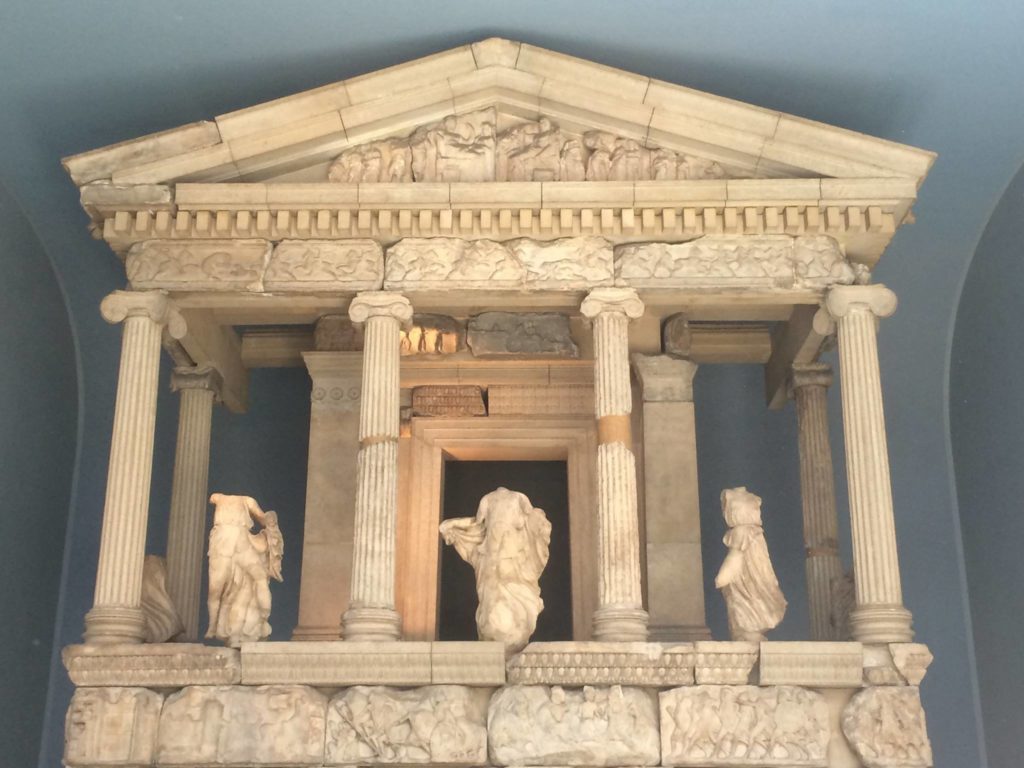
Over time, new ideas began to emerge. Written laws gradually replaced personal rule. Philosophers questioned the nature of justice and government. The Greek city-states introduced citizenship and public participation, while the Roman Republic developed constitutional institutions that balanced competing centers of authority.
Later, the Magna Carta, the Renaissance, the Enlightenment, and the Scientific Revolution, further advanced the principles of limited government, individual rights, and the rule of law.
The American constitutional experiment inherited this long tradition rather than beginning it. It united democratic participation, republican institutions, and constitutional liberty in a form that profoundly influenced the modern world.
The history of freedom is therefore not the story of one nation or one civilization. It is the story of humanity’s gradual discovery that governments are strongest when power is limited by law, institutions are accountable to the people, and every individual is recognized as possessing inherent dignity.
II. Democracy, Republic, and Liberty
Understanding the Foundations of Free Government
Democracy, republic, and liberty are often used as though they mean the same thing. In fact, each describes a different principle of free government, and together they form the constitutional foundation upon which modern democracies are built.
A democracy is a system in which political authority ultimately belongs to the people. Citizens govern either directly or through elected representatives, and governments derive their legitimacy from the consent of the governed rather than from heredity, military force, or religious authority.
A republic describes the structure of government. Public officials exercise authority under a constitution and the rule of law rather than personal or hereditary rule. Power is divided among institutions, limited by law, and subject to accountability. The purpose of a republic is to prevent the concentration of power that so often leads to tyranny.
Liberty is the purpose these institutions are intended to protect. It includes freedom of thought, conscience, speech, religion, association, and lawful enterprise. It also recognizes that rights endure only when citizens accept the responsibilities that accompany them. Freedom without responsibility can become disorder, while authority without liberty can become oppression.
The American constitutional system sought to unite these three principles. Democracy provided the source of political authority. Republican institutions organized and restrained governmental power. Liberty defined the rights and opportunities that government exists to protect.
From the Civic Humanist perspective, these institutions remain essential but incomplete. Democracy depends not only upon elections and constitutions, but also upon educated citizens, scientific literacy, ethical leadership, and a shared commitment to the common good. Free government is ultimately sustained not by documents alone, but by the character, knowledge, and civic responsibility of the people themselves.
III. The American Dream
The Evolution of an Ideal
The American Dream is one of the most enduring ideals in modern history. While often associated with economic success, it has always represented something broader: the belief that every individual should have the freedom and opportunity to build a meaningful life through character, ability, and effort rather than inherited status or privilege.
Its philosophical roots lie in the Enlightenment and the founding principles of the United States. The Declaration of Independence affirmed that all people are created equal and endowed with the rights to life, liberty, and the pursuit of happiness. The Constitution sought to secure those principles through a system of representative government, constitutional law, and individual rights.
Over time, the American Dream became a powerful source of hope for millions. Immigrants crossed oceans seeking religious liberty, economic opportunity, political freedom, and a better future for their families. Entrepreneurs, scientists, educators, artists, and public servants helped shape a society defined by a shared commitment to freedom under law.
The American Dream has never been fully realized. Every generation has confronted new challenges and worked to expand the promises of liberty and equal opportunity. The abolition of slavery, the extension of voting rights, the Civil Rights Movement, and advances in education and scientific research all reflect an ongoing effort to bring national institutions closer to their founding ideals.
The American Dream means the opportunity to accumulate wealth and the opportunity to flourish as a free and responsible citizen. It depends upon strong constitutional institutions, equal justice under law, scientific progress, quality education, and a civic culture that encourages both individual achievement and service to the common good. In this sense, the American Dream remains not only a national aspiration, but an enduring democratic ideal.
IV. Democracy in the Age of Intelligence
New Challenges to an Ancient Aspiration
Every generation must renew democracy under the conditions of its own time. The twenty-first century presents challenges unlike any faced by earlier constitutional societies. Artificial intelligence, global communication networks, biotechnology, and unprecedented access to information are transforming how people learn, work, communicate, and participate in public life.
These advances offer extraordinary opportunities. Scientific collaboration has become increasingly global. Education is more accessible than at any point in history. Medical discoveries, data analysis, and intelligent technologies promise to improve human wellbeing on an unprecedented scale.
At the same time, these technologies introduce new risks. False information can spread more rapidly than verified knowledge. Algorithms may reinforce polarization by rewarding outrage rather than understanding. Foreign influence, cyberattacks, and increasingly sophisticated artificial intelligence challenge democratic institutions in ways that traditional constitutional safeguards were never designed to address.
These developments reveal an enduring truth: democracy depends not only upon technology, but upon the wisdom of the people who use it. No innovation can replace critical thinking, ethical judgment, or informed citizenship. Indeed, the more powerful our technologies become, the more important these human qualities become.
The Age of Intelligence therefore demands a renewed investment in civic education, scientific literacy, media literacy, and evidence-based public discourse. Citizens must be equipped not merely to consume information, but to evaluate it critically, distinguish fact from opinion, and participate responsibly in democratic decision-making.
Technological progress and democratic progress should advance together. Artificial intelligence should strengthen human judgment rather than replace it, expand opportunity rather than diminish it, and support constitutional democracy rather than undermine it. The future of freedom will depend upon the wisdom of our citizens and the resilience of the institutions they choose to build.
V. The Civic Humanist Perspective
Freedom Through Knowledge, Character, and Civic Responsibility
Democracy is often understood as a system of elections and constitutional government. Civic Humanism embraces these institutions but argues that they are only the visible framework of a free society. Their long-term success depends upon something deeper: the knowledge, character, and civic responsibility of the people themselves.
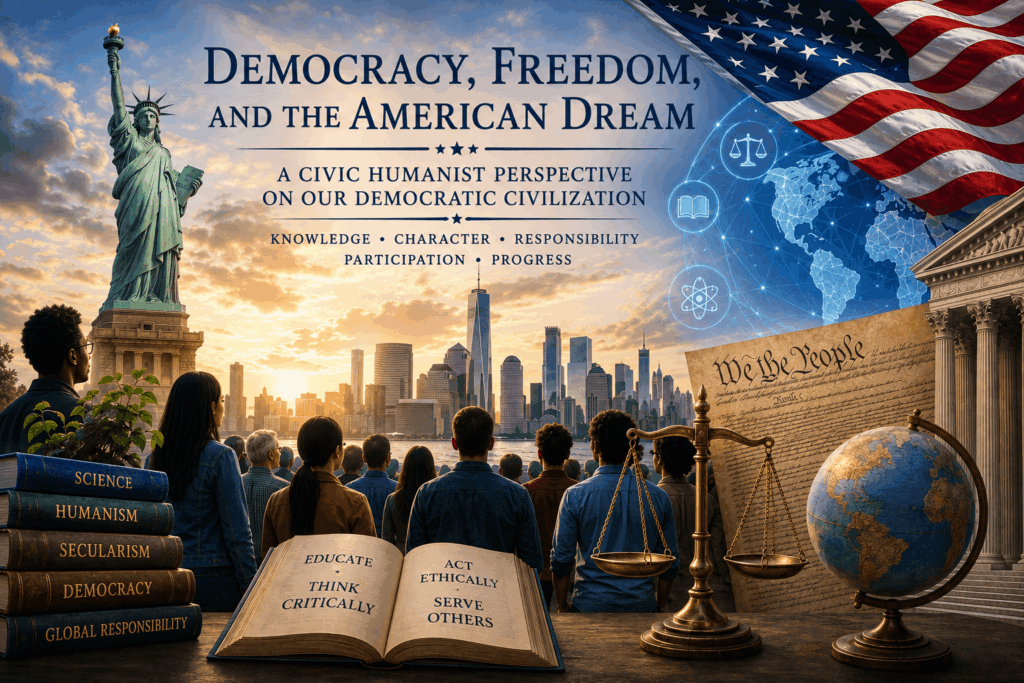
Integrated Humanism identifies five mutually reinforcing pillars of a flourishing civilization: Science, Humanism, Secularism, Democracy, and Global Responsibility. Civic Humanism applies these principles to public life by encouraging citizens to think critically, act ethically, and participate constructively in the institutions that sustain a constitutional republic.
From this humanist perspective, freedom is more than the absence of oppression, it is the ability to develop one’s talents, pursue truth, contribute to society, and live with dignity while respecting the equal rights of others. Such freedom requires more than legal protections. It depends upon quality education, scientific literacy, ethical leadership, trustworthy institutions, and a culture that values evidence over misinformation and dialogue over division.
Civic Humanism also recognizes that rights and responsibilities are inseparable. The right to vote carries the responsibility to become informed. Freedom of speech carries the responsibility to seek truth and engage others with honesty and respect. Democratic citizenship is not a passive condition but an active commitment to the common good.
Civic Humanism aims to strengthen constitutional democracy by renewing the conditions that allow it to work well: informed citizens, resilient institutions, serious public discourse, and decisions grounded in evidence.
Democracy survives only when each generation takes responsibility for it. Its institutions must be understood, its freedoms defended, its weaknesses corrected, and its promise carried forward with greater wisdom than before.
VI. Science Abbey and the Future of Freedom
Carrying the American Dream Forward
Science Abbey was founded on the conviction that a free society absolutely depends upon sound political institutions, educated citizens, ethical leadership, and a lifelong commitment to learning. Democracy flourishes when people possess the knowledge and character necessary to exercise their freedoms wisely.
Through Civic Humanism, Science Abbey seeks to strengthen the intellectual foundations of democratic civilization. Its mission is not partisan and not sectarian. Rather, it promotes scientific inquiry, critical thinking, humanist ethics, contemplative practice, and civic education as essential pillars of a healthy constitutional republic.
This vision extends beyond any single election cycle or political movement. It recognizes that the greatest challenges facing democracy—technological change, misinformation, civic disengagement, and institutional distrust—cannot be solved by legislation alone. They also require stronger educational institutions, better civic habits, and a renewed culture of public service.
The Civic Humanist Charter System represents one practical expression of this vision. Drawing upon the long tradition of constitutional charters, universities, scientific societies, and civic institutions, it seeks to develop organizations dedicated to research, education, ethical leadership, and democratic resilience. Its purpose is not to replace existing governments, but to help strengthen the civic infrastructure upon which free societies depend.
The American Dream has always been more than the pursuit of personal success. At its best, it expresses confidence that free people, working together under constitutional government, can continually improve their society while preserving the liberty and dignity of every individual.
Science Abbey embraces that enduring aspiration. By cultivating knowledge, wisdom, and civic responsibility, it seeks to carry the American Dream forward into the Age of Intelligence—helping ensure that democracy remains not merely an inheritance from the past, but a living promise for future generations.
Conclusion
Democracy Is Never Finished
Democracy is not a destination reached once and for all. It is an ongoing process of learning, adaptation, and renewal. Every generation inherits the institutions, freedoms, and responsibilities secured by those who came before, but every generation must also decide how faithfully it will preserve and strengthen that inheritance.
History demonstrates that free societies do not endure automatically. They flourish when citizens understand the principles of constitutional government, value the rule of law, participate responsibly in civic life, and remain committed to truth, justice, and the common good. They decline when knowledge gives way to ignorance, dialogue to division, and public service to the pursuit of power alone.
The American experiment remains one of humanity’s greatest achievements because it demonstrated that liberty, constitutional government, and democratic self-rule could be joined within a durable political framework. The challenge of the twenty-first century is to ensure that these ideals continue to evolve in a world transformed by science, technology, and global interdependence.
Science Abbey recognizes that the future of freedom depends upon better policies, educated citizens and stronger institutions. Through education, scientific inquiry, ethical leadership, and Civic Humanism, it seeks to contribute to the continued growth of democratic civilization. The work of democracy is never finished, because the work of human progress is never finished.
About the Author
D. B. Smith is the Founder and Director of Science Abbey and the developer of Integrated Humanism and Civic Humanism. His work focuses on the history of ideas, democratic civilization, civic education, constitutional governance, and the development of institutions that promote scientific literacy, ethical leadership, and the long-term flourishing of humanity.