

Imagining Humanity’s Next Great Project: The Temple of Peace
A Blueprint for Humanity’s Future
In an age of uncertainty and fragmentation, a new vision must rise—one not rooted in conquest, fear, or blind tradition, but in a shared, enduring commitment to human dignity, wisdom, and peace.
This vision is the Temple of Peace: a living structure of principles, institutions, and culture designed to guide humanity toward a flourishing future.
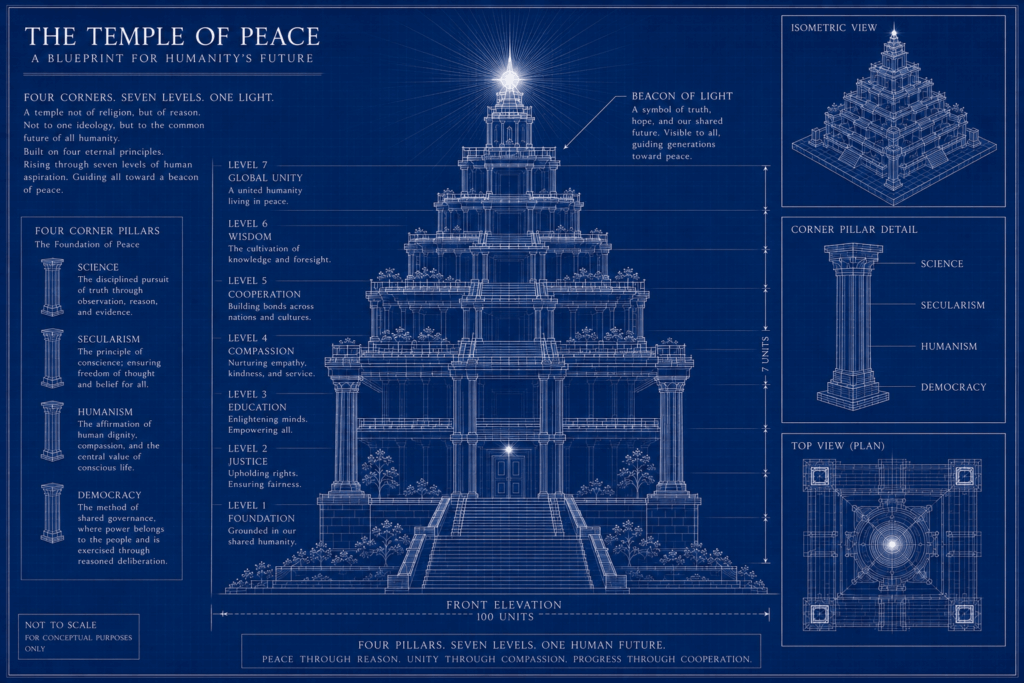
The Temple is not built of stone. It is constructed from ideas, values, and collective will. It stands upon Four mighty Corners, ascends through Seven transformative Levels, and awaits the Builders who will bring it into being.
The 21st century is unfolding as a test of human endurance and imagination.
Rising seas swallow coastlines. Authoritarian regimes erode democratic freedoms. Mass migrations unsettle old borders. Ecological collapse redraws the map of life itself.
Every generation faces a moment when the old ways cannot continue. Ours is no exception. Yet the future is not written. Even now, amid collapse and confusion, another path remains open to us — if we dare to build it.
Imagine a project greater than any empire or war or technology humanity has ever created:
A Temple of Peace.
Not a monument of stone, but a living system — a foundation of laws, cultures, and citizenship grounded in reason, compassion, stewardship, and justice.
A civilization not organized around conquest or survival, but around dignity, knowledge, and peace.
This is not utopia. It is the next necessary stage of human evolution, if we wish to survive the coming centuries with our freedoms, our planet, and our hopes intact.
The work begins with four simple pillars — and the courage to lay the first stones.
Section One: The Four Corner Pillars — Foundations of the Temple
At its base, the Temple rests upon four unshakable foundations:
- Science — the disciplined pursuit of truth through observation, reason, and evidence.
- Secularism — the principle of coexistence, ensuring freedom of thought and belief for all.
- Humanism — the affirmation of human dignity, compassion, and the central value of conscious life.
- Democracy — the method of shared governance, where power belongs to the people and is exercised through reasoned deliberation.
These Four Corners stabilize and elevate the Temple, each essential to the integrity of the whole. Without them, the structure would crumble into ignorance, tyranny, and injustice.
Every enduring structure needs a foundation. The Temple of Peace would rise not on wealth or power, but on four elemental commitments — values drawn not from passing ideologies, but from the hard lessons of human history.
Science must be our first pillar. Without it, there is no reliable defense against ignorance, manipulation, superstition, or fanaticism. Science is the disciplined pursuit of truth through observation, reason, testing, and evidence.
It does not claim infallibility; rather, it advances through humility, correction, and discovery. In an age overwhelmed by misinformation, conspiracy, and ideological distortion, the scientific spirit — the willingness to question, investigate, and adapt to reality — is essential for the survival and progress of civilization.
Secularism is the second pillar. Without it, freedom of conscience cannot endure. Secularism is not hostility toward religion, but the principle of coexistence: a social and political order in which individuals of all beliefs — religious, spiritual, or nonreligious — can live together under equal law and shared civic responsibility.
It protects liberty of thought by preventing any single doctrine from dominating society through coercion or state power. In a pluralistic world of deep diversity, secularism is the framework that allows peace, dialogue, and mutual respect to exist across differences.
Humanism must be the third pillar. Without it, knowledge and power lose their moral direction. Humanism affirms the dignity, well-being, and potential of conscious life. It calls upon us to cultivate compassion, wisdom, and responsibility toward others, recognizing that suffering and hope are universal aspects of the human condition.
Humanism reminds us that progress is not measured merely by wealth or technology, but by the quality of human life, the reduction of suffering, and the expansion of freedom, opportunity, and understanding.
Democracy is the final pillar. Without it, power hardens into domination and corruption. Democracy is the method of shared governance in which authority belongs to the people and is exercised through participation, accountability, open discourse, and reasoned deliberation.
True democracy is more than elections alone; it requires transparent institutions, informed citizens, protection of rights, and equal justice under law. Its purpose is not merely majority rule, but the peaceful and rational coordination of society while safeguarding the dignity and liberties of all people, especially the vulnerable.
Taken together, these Four Pillars form a structure both ancient and new:
Ancient, because these values are whispered in every great tradition; new, because never before has humanity attempted to build an entire planetary civilization consciously around them.
The Temple of Peace begins with these pillars — but it does not end there. They are the foundation. Above them must rise the work of generations: the deliberate construction of a new, living system.
Section Two: The Seven Levels — The Ascent to Peace
Above the Four Corners rise the Seven Levels, each one a necessary stage in the building of a just and enduring world:
- Vision and Constitution
- The clear articulation of humanity’s shared principles and rights.
- The clear articulation of humanity’s shared principles and rights.
- Transitional Governance
- Stewardship through the period of transformation, maintaining stability while reform unfolds.
- Stewardship through the period of transformation, maintaining stability while reform unfolds.
- Education and Cultural Transformation
- The renewal of minds and cultures to embrace critical thinking, empathy, and democratic values.
- The renewal of minds and cultures to embrace critical thinking, empathy, and democratic values.
- Economic Justice and Infrastructure
- The creation of fair, resilient systems that support the material well-being of all.
- The creation of fair, resilient systems that support the material well-being of all.
- Judicial and Law Enforcement Reform
- The establishment of impartial, humane systems of justice and public protection.
- The establishment of impartial, humane systems of justice and public protection.
- Symbolic Unification
- The forging of shared symbols, narratives, and ceremonies that reflect and celebrate human unity.
- The forging of shared symbols, narratives, and ceremonies that reflect and celebrate human unity.
- Minority Protections
- The permanent safeguarding of the rights and dignity of all individuals, especially the vulnerable and marginalized.
- The permanent safeguarding of the rights and dignity of all individuals, especially the vulnerable and marginalized.
These Levels must be built sequentially and patiently; each one lays the necessary groundwork for the next. Together, they form the path to a fully realized society.
The Temple of Peace is not a single leap into a distant utopia. It is a staircase, a deliberate ascent, built level by level over time.
The first level is Vision and Constitution. Every society that hopes to rise must first agree on its foundational commitments. New charters, born not of bloodline or conquest, but of universal principles: freedom of thought, equal dignity, scientific policymaking, and protection of Earth itself. Vision must come before governance — or governance will always serve only the old powers.
From vision follows Transitional Governance. Revolutions often fail because they replace one tyranny with another. Transitional governance requires humility: temporary councils, transparent administrations, monitored elections, and a clear mandate to hand power back to the people under new, just rules. It is the architecture of peaceful transformation, rather than chaos.
The third level is Education and Cultural Transformation. No constitution endures if the citizens cannot think critically or feel empathy. A Global Civic Curriculum would foster scientific literacy, ecological wisdom, and intercultural understanding from the earliest years. Children would grow not into subjects or consumers, but into builders and stewards of a shared future.
The fourth level is Economic Justice and Infrastructure. Without economic foundations — clean water, nourishing food, healthcare, education, access to communication — freedom remains an empty word. Basic human needs must become guaranteed planetary rights, supported by cooperative economies rooted in sustainability, not extraction.
The fifth level is Judicial and Law Enforcement Reform. Justice cannot be a weapon for the powerful. It must be rebuilt to protect the weak, to restore communities rather than punish them, and to hold even the most powerful accountable. Law must be a living promise, not a hollow ceremony.
The sixth level is Symbolic Unification. Humans are meaning-making creatures. We need rituals, holidays, symbols — but they must bind rather than divide. The flags of conquest must be retired, and new symbols — like the Monastery Without Walls and the Temple of Peace — can embody a shared planetary identity.
Finally, the seventh level is Minority Protections. The true test of any society is not how it treats its majority, but how it safeguards its smallest, quietest voices. Every culture, every language, every perspective must be protected, celebrated, and given space to flourish.
Each level reinforces the others. They form a ladder toward a civilization rooted not in fear, but in trust; not in domination, but in cooperation.
Building them is not a project for a single year or a single generation. It is the labor of a century or more.
But it is work that can begin today.
Section Three: The Beacon of Light — Civic Humanism
At the apex of the Temple shines the Beacon of Light:
the establishment of Full Secular Scientific Humanist Democracy, characterized by:
- Universal Citizenship
- Equal Rights and Freedoms for All
- Scientific Policy-Making grounded in evidence and reason
- Lasting Peace and Shared Prosperity across nations and generations
It is not a utopia beyond reach, but the tangible result of collective effort, moral clarity, and unwavering dedication.
Section Three: The Builders of the Temple — The Hands that Shape the Future
The Temple of Peace cannot be imposed; it must be built—by hands and hearts committed to its vision.
The Builders are teachers who ignite minds, artists who move hearts, scientists who expand understanding, legislators who craft just laws, activists who defend the vulnerable, and citizens who stand, day by day, for truth and fairness.
Each act of learning, of compassion, of courage, and of creation lays a stone in the Temple’s rising walls.
There will be trials. There will be resistance. But if humanity holds fast to its highest aspirations, if we honor the Four Corner Pillars, climb the Seven Levels, and continue the patient, devoted work of building, the Beacon will be lit—and its light will guide the world.
The Temple of Peace awaits. It is ours to envision, ours to construct, and ours to sustain. Let us build it—for ourselves, for one another, and for the generations yet to come.
Grand visions often falter because they wait for grand saviors.
The Temple of Peace would not be built by emperors or billionaires.
It would be raised, stone by stone, by citizens — by the quiet builders of every community, every field, every generation.
The first builders will be teachers, who teach not what to think, but how to think.
They will be scientists, who defend the light of inquiry against the darkness of disinformation.
They will be artists, who craft new symbols of belonging to replace the old flags of division.
They will be engineers, who design infrastructures not merely for profit, but for resilience and justice.
They will be judges and lawyers, who repair the broken bridges of law, ensuring justice flows in both directions, not only downward.
They will be farmers and ecologists, who heal the wounded soil, the polluted rivers, the burning forests.
They will be citizens, who show up, who listen, who speak, who hold each other accountable with courage and mercy.
In short: we are the builders.
There will be no perfect moment, no grand unveiling. The Temple will rise in moments both small and momentous:
- In the village that drafts a new civic charter based on human rights and ecological stewardship.
- In the city that reforms its police force into guardians of peace rather than enforcers of fear.
- In the school that teaches a child that truth matters more than ideology.
- In the community that decides to rewild its rivers and share its resources.
Each of these acts will be a stone.
Each stone will be laid not for immediate glory, but for the silent strength of generations yet to come.
The builders must expect to be misunderstood. They must expect setbacks, even heartbreaks. The work is slow, invisible at first.
But every cathedral begins with the first trench dug into rocky ground.
Every civilization worth its name is not proclaimed into existence — it is built, patiently, painfully, lovingly.
The Temple of Peace is no different.
It will be, if it is ever to be, because we build it with our own hands.
Section Four: Lessons for Today
It is tempting, when confronted with a vision so vast, to sigh and turn away.
It sounds beautiful, we tell ourselves, but the real world is messier.
The real world is impatient.
The real world is cruel.
But the real world is also unfinished.
It is still being shaped — by every decision we make, every institution we sustain or reform, every future we choose to imagine.
The Temple of Peace is not a prophecy. It is a possibility.
If we wish to approach it, we must first learn a set of difficult but vital lessons.
First: Patience is revolutionary.
In a culture of instant gratification, patient, steady building is an act of rebellion. The kind of transformation we need — constitutional, educational, cultural, economic — cannot be microwaved into existence. It must be cultivated, protected, and passed forward.
Second: Persistence matters more than purity.
There will be compromises, imperfect victories, incremental reforms. It is better to build an imperfect structure and improve it over time than to wait forever for the perfect plan.
Third: Truth must be defended, even when it is inconvenient.
Scientific integrity, honest governance, and ethical consistency are not luxuries. They are the lifeblood of any system that hopes to endure. A single tolerated lie, a single justified cruelty, weakens the entire foundation.
Fourth: Shared stewardship must replace isolated heroism.
No single nation, ideology, or savior will build the Temple alone. It will require the messy, democratic work of many hands, many minds, and many hearts — across languages, cultures, histories, and traditions.
Finally: Hope must be practiced, not merely felt.
Hope is not passive. It is a discipline, an act of choosing to believe that better is possible, and then acting as if that belief were true.
We cannot leap to the Temple in a single bound.
But we can lay the first stones today.
In our classrooms.
In our courtrooms.
In our city halls.
In our fields and factories and forums.
In our hearts.
The world we inherit is broken, yes.
But it is also astonishingly, terrifyingly, wonderfully still under construction.
Conclusion: The Light We Build
If we have the courage to build it, the Temple of Peace will not be a place, but a way of living.
It will be the silent covenant in every schoolroom that teaches a child to think freely.
It will be the quiet promise in every courtroom that protects the powerless.
It will be the shared breath of citizens planting forests they will never sit beneath, drafting constitutions they will never see completed.
The real miracle is not that humanity might one day live without tyranny, cruelty, and waste.
The real miracle is that we can begin the work now — without permission, without perfect conditions, without certainty of success.
The first stones are already in our hands.
There is no law of history that says civilizations must destroy themselves.
There is only the choice: to build or to collapse.
To ascend or to fall.
To believe, or to despair.
The Temple of Peace is not an idle dream.
It is the unfinished blueprint of humanity’s best self.
It waits for us — not in the heavens, but here, on this fragile, astonishing Earth.
It waits for the Builders.
It waits for us.
A Declaration for the Temple of Secular Scientific Humanist Democracy
Preamble to the Declaration for the Temple of Peace
We, the free peoples of Earth,
united by our shared humanity and common destiny,
grateful for the gifts of life, mind, and planet,
humbled by the lessons of history and the wounds of division,
and resolved to build a future of lasting peace, liberty, and flourishing for all,
do hereby lay the foundation of the Temple of Peace:
a sanctuary of Reason, Compassion, Stewardship, and Justice,
rising level by level toward the Light of Truth,
for the benefit of all peoples, all generations, and all life upon this Earth.
In solemn assembly and with steadfast hope,
we proclaim this Declaration
and pledge ourselves as Builders of the Temple,
that humanity may at last come home to itself.
Introduction to the Declaration for the Temple of Peace
In the long and arduous journey of human civilization, we have known the heights of wonder and the depths of sorrow. We have charted the stars, unlocked the secrets of life, built soaring monuments — and yet we have also plunged ourselves into wars, oppression, and devastation.
Today, standing upon the lessons of history and the aspirations of every generation before us, we declare a new foundation for the human family:
The Temple of Peace.
This Temple is not of stone, but of living spirit — built not by kings or conquerors, but by free citizens of Earth, the Builders of the Temple. It rises not through the exercise of force, but through the steady, patient labor of mind, heart, and hand, guided by four sacred corner Pillars:
- Reason (Science), the pursuit of truth through evidence and inquiry;
- Compassion (Humanism), the unwavering commitment to the dignity of every life;
- Stewardship (Secularism), the sacred duty to protect and nurture the Earth;
- Justice (Democracy), the fair and equal application of law and opportunity to all.
Upon these Four Pillars, humanity now lays the Seven Levels of the Temple — the stages through which lasting peace and flourishing may be secured:
- Vision and Constitution — establishing the guiding principles and sacred rights of all people;
- Transitional Governance — organizing the peaceful, transparent shift to true democracy;
- Education and Cultural Transformation — fostering critical thought, shared values, and planetary citizenship;
- Economic Justice and Infrastructure — ensuring that every person enjoys the basic conditions of life, dignity, and growth;
- Judicial and Law Enforcement Reform — restoring justice as the guardian of the people, not the weapon of the few;
- Symbolic Unification and Reform — healing historical wounds and celebrating our diverse human heritage under common symbols of unity;
- Minority Protections — enshrining the full rights and flourishing of every minority as the final guarantee of true democracy.
At the apex of this Temple stands a light — not of empire, nor of dogma, but of a new covenant among all humanity:
Full Secular Scientific Humanist Democracy, founded on Civic Humanism, committed to Universal Citizenship, Equal Rights and Freedoms, Scientific Policy-Making, and Lasting Peace and Shared Prosperity.
We, the Builders of the Temple of Peace, affirm that no nation, no people, no generation stands alone.
We affirm that our highest loyalty is not to tribe or throne, but to the truth, to each other, and to the future of life on Earth.
We dedicate ourselves to the endless work of building, protecting, and renewing this Temple — for ourselves, for our descendants, and for all beings yet to come.
In this spirit, with full knowledge of the gravity of our task and the hope burning in our hearts, we do now declare the founding of the Temple of Peace.
Let it rise.
Let it shine.
Let it endure.
The Four Pillars
Across history, humanity has constructed temples, palaces, and monuments to embody its highest aspirations. Today, as we face a new era of planetary interconnection and existential risk, it is not temples of stone we must raise, but a temple of principle—a philosophical and practical foundation capable of sustaining a just, flourishing, and intelligent global civilization.
We, the heirs of all human striving, proclaim the foundation of a new Temple—not of stone or empire, but of principle, understanding, and shared destiny.
At the convergence of history and future, four mighty pillars rise: Science, Secularism, Humanism, Democracy. These are the Four Corners of the Temple we must build—together, unyielding against the storms of ignorance, injustice, tyranny, and despair.
I. Science: The Method of Knowing
At the first Corner stands Science, not as an institution or isolated discipline, but as a method of knowing—the systematic pursuit of knowledge through observation, experimentation, and rational evaluation. Science represents humanity’s clearest, most reliable pathway toward truth, correcting for error, bias, and superstition. It is not infallible, but it is self-correcting, adaptive, and endlessly expansive.
In the Temple, Science is the foundation of policy, education, and innovation. It insists that decisions affecting human lives must be grounded in the best available evidence, subjected to open critique, and updated as new knowledge emerges. To honor this Corner is to recognize that humility and curiosity, not dogma, are the engines of human progress.
We affirm that truth is not dictated but discovered.
Science stands as the disciplined pursuit of knowledge: observation refined by reason, evidence weighed without favor, conclusions always open to revision. It teaches humility before the unknown and reverence for the complexity of existence.
In this Temple, Science is the architect of understanding and the custodian of progress. It is the method by which humanity rises above fear and superstition to shape a future guided by wisdom.
II. Secularism: The Method of Coexistence
At the second Corner stands Secularism: the principle that the public sphere must be free from domination by any particular religious or metaphysical system. Secularism does not oppose religion; it simply ensures that no creed—sacred or secular—may claim supremacy in matters of law, governance, or shared resources.
Secularism is the architecture of peaceful coexistence. It creates the space where diverse beliefs and cultures can flourish without coercion or fear. In the Temple, Secularism is the open sky above—a space where plurality is not merely tolerated but celebrated. Without it, the Temple would become a fortress of exclusion rather than a home for humanity.
We affirm that no power—spiritual or temporal—may claim dominion over the conscience of another.
Secularism is the enduring covenant that protects freedom of thought, belief, and expression. It ensures that governance belongs to reason and to the people, not to the commands of sect or ideology.
In this Temple, Secularism is the great open plaza, where many voices may speak, many paths may be followed, and no creed may silence another.
III. Humanism: The Method of Value and Dignity
At the third Corner rises Humanism: the ethical affirmation that human beings possess inherent dignity and worth, and that the flourishing of conscious beings is the ultimate source of value. Humanism situates ethics not in the decrees of deities or the dictates of tradition, but in the lived realities of sentient beings—our capacity to suffer, to dream, to love, to create.
Humanism demands that every life matters, and that policies, institutions, and cultures must be judged by how well they promote freedom, fulfillment, and well-being. In the Temple, Humanism is the light that fills the interior, making the structure not merely strong and stable but humane, beautiful, and alive.
We affirm that the measure of all institutions, laws, and traditions is the well-being of conscious beings.
Humanism stands as the ethical heart of the Temple, holding that each life is an end in itself, not a means to another’s ambition or dogma. It calls us to compassion, to justice, to the pursuit of human flourishing across all boundaries of birth and circumstance.
In this Temple, Humanism is the sacred fire, illuminating every act with the light of empathy, dignity, and care.
IV. Democracy: The Method of Governance
At the fourth Corner stands Democracy: the commitment that power must be accountable to the people, that all individuals must have a voice in shaping the conditions of their lives, and that governance must be based on consent, participation, and open deliberation.
Democracy is not simply voting; it is a living culture of rights, responsibilities, dialogue, and compromise. In the Temple, Democracy is the ground upon which the people walk—open, responsive, and constantly reshaped by those who inhabit it. Without Democracy, the Temple risks becoming a monument to the few, rather than a home for all.
We affirm that power must serve, not rule; that the governed must be the authors of their governance.
Democracy is the perpetual compact that binds us to one another in shared responsibility. It demands voice, vote, transparency, and the tireless renewal of freedom through deliberation and reform.
In this Temple, Democracy is the living foundation, the ground where free people meet, debate, dream, and decide their collective future.
The Temple of Peace: The Seven Levels Toward Secular Scientific Humanist Democracy
In every age, civilizations have raised monuments to their ideals. Today, we are called not to raise monuments of stone, but to construct a living edifice of principles, institutions, and culture: a Temple of Peace, guiding humanity toward lasting freedom, dignity, and prosperity.
The Temple of Peace rises not as a fortress, but as a great stepped pyramid—a tower of seven levels, each built carefully upon the one beneath it. At its summit shines the Final Outcome: a beacon of Full Secular Scientific Humanist Democracy, illuminating the world with universal citizenship, equal rights, scientific policymaking, and enduring peace.
Each level of the Temple represents a critical stage of transformation, a floor upon which the next must be securely built.
Level One: Vision and Constitution
At the broad base of the Temple lies the Vision and Constitution.
Here the foundational principles are declared: the commitment to human dignity, scientific truth, secular governance, and democratic life. A new constitutional framework is articulated—designed to serve not a single people or nation, but humanity as a whole.
Without a clear, compelling vision, there is no structure to build. This first level is the soil from which all growth springs: a common language of rights, responsibilities, and shared purpose.
Level Two: Transitional Governance
Upon the vision must rise Transitional Governance.
This is the scaffolding that bridges the old world and the new—the interim systems that maintain order while making space for transformation. Transitional bodies must be transparent, accountable, and rooted in the guiding principles established at the first level.
They are not the final form of government, but the stewards of change, tasked with protecting the people, building trust, and laying the groundwork for the institutions to come.
Level Three: Education and Cultural Transformation
The third level is Education and Cultural Transformation.
No structure endures without minds to maintain it. Here, public education systems are reformed to foster scientific literacy, ethical reasoning, historical awareness, and democratic habits.
Culture itself is renewed: the arts, philosophy, media, and rituals are transformed to celebrate critical thinking, compassion, plurality, and hope. Through education and cultural evolution, the Temple becomes not just a structure of law, but a living culture of peace.
Level Four: Economic Justice and Infrastructure
The fourth level is Economic Justice and Infrastructure.
Human dignity cannot flourish amid poverty and despair. Economic systems must be reconstructed to ensure fair distribution of opportunity, resources, and reward.
Basic infrastructure—housing, transportation, healthcare, communication—must be made universally accessible. Without material justice, the higher ideals of democracy remain hollow; this level grounds the Temple in the tangible needs of daily life.
Level Five: Judicial and Law Enforcement Reform
The fifth level is Judicial and Law Enforcement Reform.
True peace requires systems of justice that are impartial, humane, and evidence-based. Law enforcement must be restructured as a service to the public good, not as an instrument of oppression.
Courts must defend the rights of all citizens, without prejudice or corruption. The fifth level ensures that justice is not a privilege of the few, but a right of all, enforced with compassion and reason.
Level Six: Symbolic Unification
The sixth level is Symbolic Unification.
A civilization must see itself reflected in symbols, rituals, and shared ceremonies that honor its highest ideals.
Here, new secular symbols are created—flags, monuments, holidays, and narratives that unify the people without erasing their diversity.
Symbolic unification fosters a shared identity rooted not in blood or tribe, but in universal principles and common destiny.
Level Seven: Minority Protections
At the final floor before the apex stands Minority Protections.
No democracy is secure until it defends the rights of its smallest groups as fiercely as those of its largest. Systems must be designed to prevent tyranny of the majority and to ensure that cultural, religious, linguistic, and ideological minorities can flourish freely.
The Temple is completed only when all voices are protected, and difference is embraced as a source of strength rather than suspicion.
The Final Outcome: The Beacon of Light
At the apex of the Temple shines the Beacon of Light:
the realization of Full Secular Scientific Humanist Democracy.
From this summit flow the great fruits of the endeavor:
- Universal Citizenship: Every individual recognized equally before the law of humanity.
- Equal Rights and Freedoms: No person above or below another in dignity or liberty.
- Scientific Policy-Making: Laws and decisions made through transparent, evidence-based processes.
- Lasting Peace and Shared Prosperity: A global society where conflict yields to cooperation, and despair to hope.
The Temple of Peace is not a dream. It is a design. It is a call to all those who dare to build a future worthy of the name “humanity.”
The Path to Construction: Building the Temple Together
The Temple of Secular Scientific Humanist Democracy is not yet complete—it may never be. Like any living project, it requires constant maintenance, reform, and renewal. The Four Pillars must be understood not as abstract ideals but as practical disciplines, demanding education, vigilance, and creativity.
We build this Temple when we invest in scientific literacy, defend secular governance, teach humanist ethics, and practice democratic citizenship. We build it when we listen across differences, when we challenge injustice, when we expand the circle of concern beyond old borders of tribe, class, nation, and creed.
In an age where old structures are crumbling and new ones are yet to be raised, the Four Pillars offer not only a vision but a blueprint—a map toward a future where humanity does not merely survive, but thrives with wisdom, compassion, and shared purpose.
The Call to Build
We declare that no single Corner Pillar can stand alone.
Science without Humanism becomes technocracy.
Secularism without Democracy becomes sterile indifference.
Humanism without Science becomes naive idealism.
Democracy without Secularism becomes mob or theocracy.
Only together do the Four Pillars uphold the Temple; only together can they shelter a future worthy of humanity’s promise.
Let us then lay the stones. Let us lift the beams. Let us raise the spire of a civilization dedicated not to conquest or creed, but to truth, liberty, dignity, and collective wisdom.
The Temple is not yet built. Its foundation is ours to lay. Its walls are ours to raise.
It shall stand—if we will it—for all people, for all time.
The Temple of Peace will not rise by decree. It will not be handed down by kings, nor summoned by wishful thinking. It must be built, stone by stone, by those who believe that humanity can do better—and who are willing to labor for it.
The Builders of the Temple
The builders of the Temple are educators, scientists, artists, lawmakers, activists, parents, and dreamers.
They are everyone who plants a seed of knowledge, defends a principle of fairness, creates a work of beauty, or stands up against injustice.
Each act of teaching, each honest inquiry, each bridge built between divided peoples, each vote cast for human dignity—these are the laying of stones, the raising of beams.
There will be setbacks. There will be storms. There will be moments when the Temple seems no more than a fragile scaffold against the chaos of the world.
But if we hold to the Four Pillars—Science, Secularism, Humanism, Democracy—and if we climb patiently through the Seven Levels, the Beacon will be lit.
And once lit, its light will not belong to one nation, one generation, or one creed.
It will be the common inheritance of all, a guiding star for ages yet unborn.
The Temple of Peace awaits its builders. Let us begin.
Conclusion: The Eternal Ascent
In every age, humanity has sought a home — a place of belonging, of safety, of shared purpose.
Through centuries of division, conflict, and renewal, we have learned that no walls of stone, no thrones of gold, no banners of conquest can give lasting peace.
Peace is not given.
It is built.
It is cultivated by the steady, tireless hands of free and compassionate people.
It is earned by those who dare to hope, to reason, to care, and to endure.
The Temple of Peace we now consecrate is not finished, nor shall it ever be.
It is a living Temple — growing with each act of truth, each work of mercy, each choice of justice over cruelty, of reason over fear.
Each citizen who takes up the work becomes a Builder.
Each generation that raises its stones becomes a Heir to the Light.
Each act of stewardship, each defense of the vulnerable, each moment of wisdom sown into the hearts of children adds to its height and breadth.
We know that trials will come.
We know that darkness will still seek to descend.
But we affirm, now and forever, that the Light atop the Temple — the beacon of Full Secular Scientific Humanist Democracy — shall never be extinguished so long as even one soul carries it forward.
Thus, we leave this Declaration not as a monument to ourselves, but as a living oath to all who follow:
To build where there is ruin.
To unite where there is division.
To heal where there is pain.
To rise where there is despair.
To love where there is fear.
And to ascend, together, into the light that no darkness can overcome.
So let it be written.
So let it be lived.
So let it be built.
The Oath of the Temple of Peace
I stand before the Four Pillars:
Science, Secularism, Humanism, and Democracy.
I lift my heart to the Way of Life,
and set my mind toward the Light of Truth.
Today, in freedom and full conscience,
I pledge myself to the Temple of Peace.
I vow:
To seek and uphold the truth, wherever it may lead,
guided by reason, inquiry, and the scientific spirit.
To treat every being with dignity and care,
recognizing the equal worth of all, and the sacred duty of compassion.
To be a faithful steward of the Earth,
protecting its waters, its forests, its skies, and its living beings,
for this generation and all to come.
To defend justice without fear or favor,
standing against tyranny, oppression, and corruption,
and safeguarding the rights and freedoms of every minority,
every difference, every dreamer.
Upon the Four Pillars, humanity now lays the Seven Levels of the Temple —
the stages through which lasting peace and flourishing may be secured:
I. Vision and Constitution — that we may be bound by common principles and sacred rights;
II. Education and Cultural Transformation — that the mind may be free, the heart open, and the culture wise;
III. Transitional Governance — that power may pass peacefully into the hands of all;
IV. Economic Justice and Infrastructure — that none shall go without what life requires;
V. Judicial and Law Enforcement Reform — that justice may be a shield for the people, not a sword for the few;
VI. Minority Protections — that no one shall be forgotten, silenced, or erased;
VII. Symbolic Unification and Reform — that we may remember together, and dream together, beneath symbols of our shared humanity.
I vow to work not for conquest, but for understanding;
not for dominion, but for cooperation;
not for fleeting pride, but for lasting peace.
I vow to build — with my words, my hands, my mind, and my heart —
the Temple of Peace, a house without walls, open to all humanity.
I accept the sacred duties of planetary citizenship.
I accept the shared joys and burdens of the human family.
I accept the endless task of rising toward the Light.
May my life be a living stone in the Temple.
May my deeds be a light to those who follow.
May we be One in truth, in hope, and in peace.
This I vow, freely and for all time.
Explore the Civic Humanist Charter System — a science-based framework for ethical governance, human flourishing, and the future of civilization.