
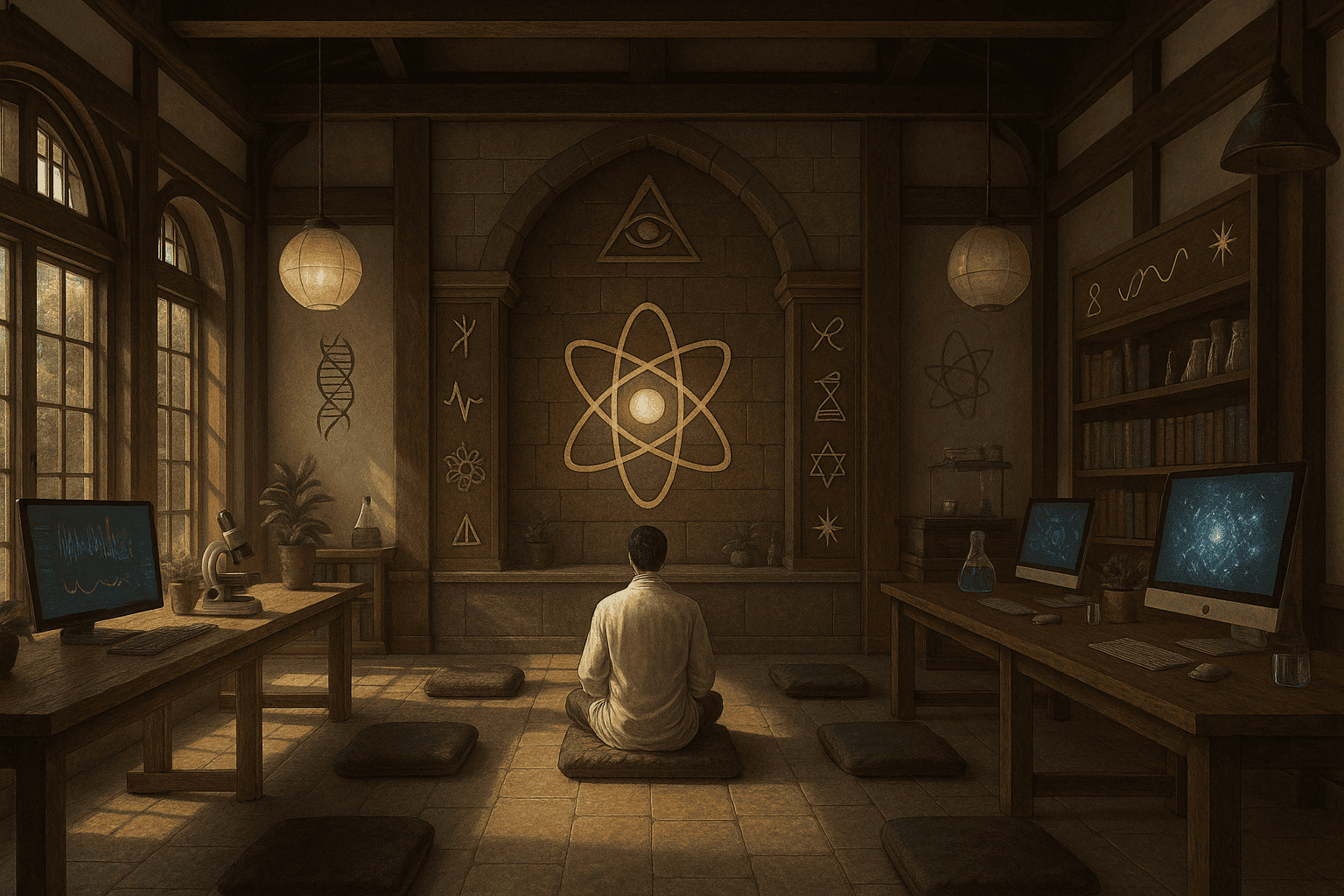
About Science Abbey
Vision, Leadership, History
A Forum for Meditation, Science, and Global Community
At Science Abbey, we believe that any honest worldview today must rise above sectarian ideologies. In an age of rapid change and global interconnection, we are called to be skeptical, compassionate, and evidence-guided observers—citizens of both our local and planetary communities. That includes care for one another and for the natural world—our forests, our water, our air.
Science Abbey is an East-meets-West sanctuary for a secular, global community. We are rooted in science, committed to reason, and informed by the wisdom of world traditions—examined through the lens of contemporary knowledge. In a time that calls for both innovation and introspection, we offer a space for secular meditation, holistic health, scientific inquiry, universal ethics, and civic awareness.

The Global Civic Role of Science Abbey
This is not just about belief—it is about action. Science Abbey encourages active engagement with global affairs and institutions. As contemplatives, scientists, humanists, or citizens, we should participate in the exchange of ideas—and keep a watchful eye on global organizations like the United Nations, World Bank, or World Economic Forum.
We believe in dialogue, not division. In this global tit-for-tat game, the greatest benefit comes through cooperation. That is why interfaith understanding, scientific literacy, and civic responsibility are at the core of what we do.
A Humanist Path through the Sciences and Arts
True understanding of the world comes not from speculation or tradition, but from investigating reality through science and reflection. The scientific disciplines—from mathematics and physics to biology and anthropology—are not dry academics; they are expressions of our deepest questions about life and truth.
- Mathematics reveals universal patterns in thought.
- Physics explores how those principles unfold in space and time.
- Chemistry shows us the building blocks of all material life.
- Astronomy, climatology and geology deepen our understanding of the cosmos and Earth.
- Biology examines the wondrous complexity of living systems.
- Sociology, history, psychology, and law study the human experience.
- The liberal arts help us cultivate empathy, reason, and civic wisdom.
And yes—even religion, when aligned with evidence and ethics rather than dogma, becomes part of a unified and reality-based worldview. Whatever your tradition or philosophy, the universal rights to freedom of belief, conscience, and speech must be upheld. In the spirit of cooperation and mutual respect, we embrace dialogue and reject intolerance.

Illumination Meditation: A Zen for the World
Among the world’s traditions, Buddhism—and especially Soto Zen—has long nurtured both skepticism and goodwill. In the American context, this lineage has evolved into a style of Zen that transcends boundaries of race, nationality, or dogma—a Zen for everyone. It is a Zen rooted in silence, clarity, and mindful engagement with life.
What emerges from this tradition is Illumination Meditation—the contemporary practice analogous to ancient “Silent Illumination.” This approach reflects a sincere discipline that brings insight and ethical living into alignment. This practice is not proprietary, nor institutional. It is offered openly, in service of all beings and future generations.
We do not require a temple or priesthood for this path to flourish. In fact, the best spiritual leadership often comes from those who live simply and lead by quiet example. The Way of the Priest, whether formal or lay, is to look inward—not to command others, but to understand the self and the cosmos alike.

What We Stand For
Science Abbey is centered on meditation, science, and community.
- Meditation grounds us.
- Science guides us.
- Community connects us.
Together, these form a compass for human development in the 21st century. By participating in Science Abbey—by using its resources, sharing its mission, and supporting its vision—you contribute to a wiser, more compassionate, and more united future.
Science Abbey is a platform. A forum. A tool for transformation.
We invite you to join us—to lead, to learn, and to live well.
View the Science Abbey Journal – All Subjects by Category
Start Here
Welcome to the Science Abbey master navigation portal: a guided entry into Integrated Humanism, the broader vision of scientific humanist civilization, and the growing body of articles, manifestos, frameworks, and educational resources designed to support that vision.
This page is intended to help new readers, returning readers, students, researchers, and future organizers find their way into the Science Abbey system in a coherent order. Rather than entering through scattered articles alone, readers can begin with the foundations, move into the major branches of study, and then continue into more advanced tracks.
Science Abbey Overview
Science Abbey is the institutional and educational home of this broader project: a kind of monastery without walls, devoted to the study of science, history, philosophy, ethics, civilization, and global human flourishing. It brings together scholarship, public education, moral reflection, civic responsibility, and future-oriented thinking in one unified framework.
Science Abbey is not merely a website of articles. It is an evolving intellectual and civic ecosystem that includes educational initiatives, philosophical frameworks, governance models, spiritual reinterpretations, and strategic institutions such as NAVI, the Neutral Analytical Vigilance Institute.
A Civic Humanism
Integrated Humanism is a modern scientific humanist worldview that seeks to unite evidence, ethics, civilization, and long-term human development. It grows out of the long history of humanism, science, philosophy, and democratic aspiration, while responding directly to the needs of the modern world: global interdependence, technological acceleration, ecological crisis, political instability, and the rise of artificial intelligence.
It is “integrated” because it does not isolate science from morality, politics from psychology, civilization from ecology, or personal development from public responsibility. It aims instead at a more complete and mature understanding of human beings and the systems we build.
Key Foundational Articles
New readers may wish to begin with a small set of core readings that introduce the spirit, method, and aims of the project. These articles provide the strongest foundation for understanding the rest of the material on this page.
- The Evolution of Humanism: Belief, Reason, and the Next Step for Humanity
- The Hidden Truth: Unbiased Empirical Inquiry in the Age of Intelligence
- Science for the Beginner: A Science Manifesto
- Worldview: Seeking Reality and Meaning in Life
- The Science of Morality: The Moral Compass and How We Know What Is Moral
- The Great Experiment: Religion, Government, and the Evolution of Human Systems
- The New Age of Modern Science
- Integrated Humanism and a Secular Scientific Democratic Humanist Manifesto
- MetaHub
Advanced Study Tracks
After exploring the core foundations, readers can continue into more specialized lines of study. These tracks help organize the Science Abbey corpus into major domains of inquiry and practice.
Links are suggested below.
Governance
This track focuses on law, public institutions, democratic systems, constitutions, civil rights, public service, political reform, and the future of scientific humanist governance. It is suited for readers interested in the structure of states, civic responsibility, justice, and institutional reform.
Suggested topics include:
- constitutional history and analysis
- democratic structure and reform
- human rights and civil liberties
- executive, legislative, and judicial systems
- public administration and civil service
- secular scientific democratic humanist governance
Science
This track explores the scientific foundations of civilization: the natural world, energy, environment, agriculture, infrastructure, engineering, technology, and planetary survival. It is well suited for readers who want to understand how scientific knowledge underlies both civilization and the future of humanity.
Suggested topics include:
- modern science and scientific method
- geology and Earth systems
- energy and nuclear responsibility
- climate change and ecological futures
- farming, extraction, engineering, and infrastructure
- science advocacy and public scientific literacy
Philosophy
This track brings together humanism, morality, history, spirituality, death, meaning, civilization, and the larger philosophical questions of human life. It is especially useful for readers seeking the deeper worldview and ethical framework behind Integrated Humanism.
Suggested topics include:
- the evolution of humanism
- morality and the moral compass
- redefining faith and secular spirituality
- the science of death
- the nature of civilization
- historical inquiry and philosophical method
Intelligence & NAVI
This track examines truth, intelligence, AI, information warfare, disinformation, security, strategic analysis, and the role of neutral empirical inquiry in the Age of Intelligence. It is ideal for readers interested in the future of knowledge, public truth, security, and institutional vigilance.
Suggested topics include:
- the hidden truth and empirical inquiry
- disinformation and conspiracy analysis
- artificial intelligence in global affairs
- neutral intelligence and security
- information warfare and psychological warfare
- NAVI as a truth-centered analytical institution
How to Begin
Readers are encouraged to begin with the foundational essays, then move through the main article structure, and finally pursue one or more advanced study tracks according to their interests. In this way, the Science Abbey portal becomes not just a list of pages, but a guided path into a fuller understanding of humanity, civilization, truth, and the future.
In the Beginning: A Scientific Humanist Introduction to Civilization
Part I — The Origins of the Human Project
1. Science for the Beginner: A Science Manifesto
2. The Art and Science of History: A Comprehensive Manual of Historical Research and Writing
3. The Great Experiment: Religion, Government, and the Evolution of Human Systems
4. The Evolution of Humanism: Belief, Reason, and the Next Step for Humanity
Purpose: Establish epistemology, history, and the long arc of human development.
Part II — Understanding Humanity
5. Anthropology and Sociology: Human Evolution and Social Hierarchy
6. Creaturism: The True Meaning of Humanism
7. The Science of Civilization: Development on a Global Scale
Purpose: Define what humans are, how societies form, and what civilization means.
Part III — The Moral and Philosophical Foundation
8. The Science of Morality: The Moral Compass and How We Know What Is Moral
9. Redefining Faith: The New Scientific Humanist Priesthood
10. The Science of Death: A Scientific and Philosophical Guide to the End of Life
Purpose: Address ethics, meaning, spirituality, and existential questions.
Part IV — The Scientific Worldview
11. The First Scientists: The Greek Philosophers of Ionia
12. The New Age of Modern Science
13. Geology: Science of the Earth
14. The Science of Energy: From Fire to Fusion and Beyond
15. The Science and Future of Nuclear Power: From Fission to Humanist Responsibility
Purpose: Ground the worldview in physical reality and scientific systems.
Part V — Humanity and the Planet
16. Climate Change, Global Warming, and the Future of Life on Earth
17. Solving the Population Crisis: A Scientific Humanist Framework for Solutions
18. A Guide to Family Planning: A Scientific, Social, and Ethical Approach
Purpose: Address existential global challenges.
Part VI — Industry, Economy, and Infrastructure
19. History and Science of Production and Corporations
20. Building the Future Treasury: The Science, History, and Strategy of Ethical Wealth
Purpose: Explain how civilization materially functions.
Part VII — Society, Equity, and Human Development
23. Women in Science and Technology: A Journey of Equity, Empowerment, and Enlightenment
24. History and Science of the Labour Movement and the Trade/Labor Union
25. Philanthropy: From Ancient Charity to Integrated Humanist Giving
Purpose: Address fairness, opportunity, and human dignity.
Part VIII — Knowledge, Truth, and Communication
26. The Hidden Truth: Unbiased Empirical Inquiry in the Age of Intelligence
27. Ignorance and Deception: The Most Outrageous and Most Malicious Conspiracy Theories
29. The Principles and Ethics of Journalism
30. The Science of Science Advocacy
Purpose: Establish truth systems and defend against misinformation.
Part IX — The Intelligence Era
32. Introducing NAVI – Neutral Analytical Vigilance Institute
33. The Science of Security: Neutral Intelligence in the Age of Intelligence
34. The Science of Information Warfare
35. The Science of Advising and Consulting
Purpose: Define the emerging intelligence-driven world.
Part X — Law, Rights, and Justice
36. The Law: Global History, Systems, and the Future of Justice
37. The Limits of Freedom: Human Rights and Democratic Security in an Age of Extremes
38. Law Enforcement and Civil Rights: The Police, Procedure, and Citizens’ Rights
Purpose: Define justice, rights, and constraints of power.
Part XI — Governance and Democracy
39. Integrated Humanism and a Secular Scientific Democratic Humanist Manifesto
40. Secular Scientific Humanist Democracy: Dual Charter – Dual Initiative
41. The New World Order: Why Secular Scientific Humanist Democracy is the Next Step in Human History
Purpose: Present the political system and vision.
Part XII — Case Study: The United States
42. An Integrated Humanist History and Analysis of the U.S. Constitution
43. History of the U.S. Supreme Court and Its Decisions
44. The People’s Work: How the U.S. Congress Shapes America—and How Citizens Can Shape Congress
45. History of the U.S. Presidential Campaigns
46. Guide to the History, Powers, and Procedures of the U.S. President and the Executive Branch
Purpose: Ground theory in real institutional practice.
Part XIII — Global Governance and Administration
47. Guide to the History and Governance of International Organizations
48. The International Civil Servant and Secular Humanist Spirituality
Part XIV — Time, Coordination, and Civilization Systems
49. Time-Keeping: The Calendar, the Clock, and a Universal Solution
Purpose: Show coordination systems of global civilization.
Part XV — Conclusion: The Future of Humanity
Purpose: Envision the future of humanity.
View the Science Abbey Journal – All Subjects by Category