
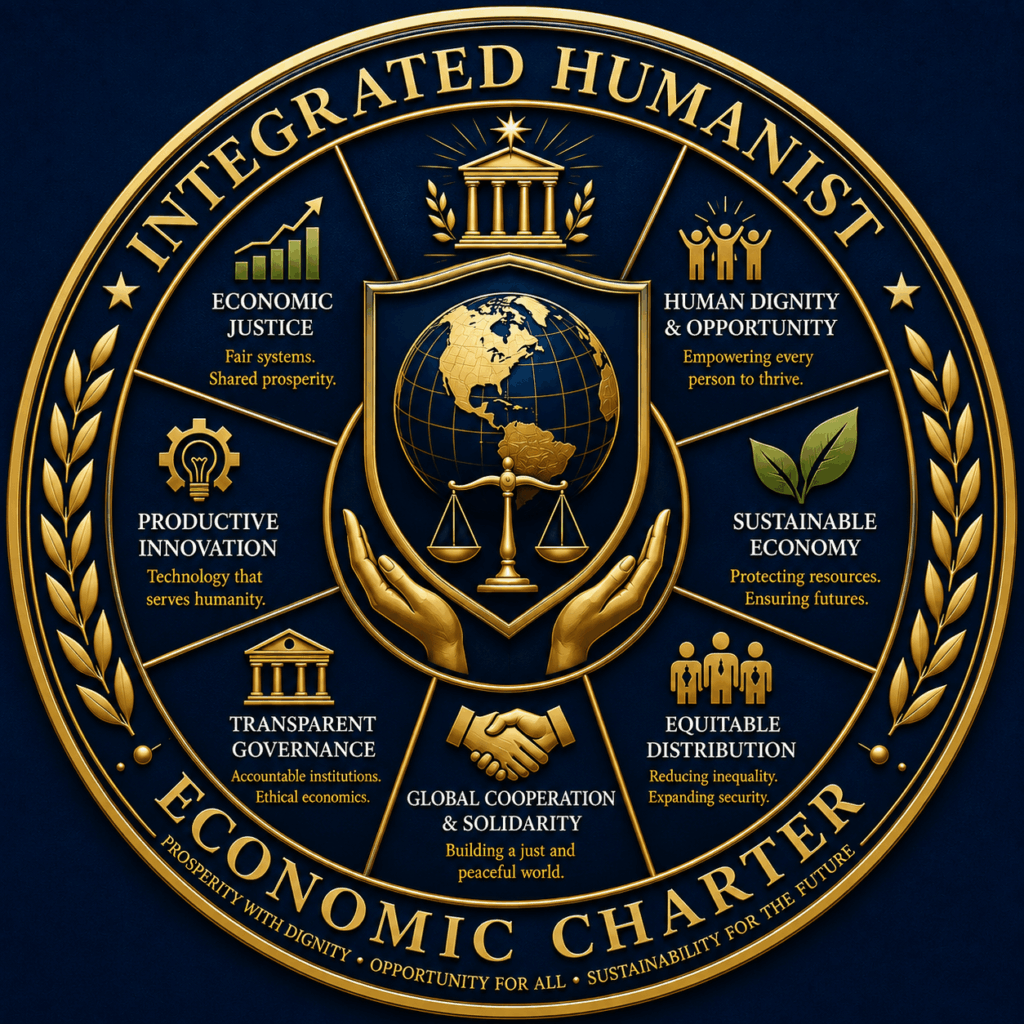
The Integrated Humanist Economic Charter
A Charter for Economic Balance, Human Dignity, and Civilizational Maturity
Preamble
Human civilization has entered an age in which economic systems possess unprecedented power to shape the destiny of nations, ecosystems, institutions, and individual lives. Yet the modern global economy remains fragmented by inequality, ecological overshoot, corruption, short-termism, and the reduction of human value to material accumulation alone.
The purpose of economic life is not merely growth. It is the cultivation of conditions under which human beings and societies may flourish with dignity, freedom, knowledge, health, creativity, stability, and peace.
This Charter establishes the principles of the Integrated Humanist Economic Framework (IHEF): a scientific, ethical, and systems-based approach to economics grounded in evidence, transparency, reciprocity, stewardship, and human development. It affirms that markets, governments, technologies, communities, and institutions must function as complementary systems within the broader equilibrium of civilization and the biosphere.
This Charter further recognizes that:
- economies are living systems, not merely financial mechanisms;
- morality and economics are inseparable in practice;
- trust is a form of capital;
- sustainability is a condition of long-term prosperity;
- technological power without moral maturity threatens civilization itself;
- and human dignity must remain the first principle of all economic governance.
Therefore, the undersigned institutions, governments, organizations, and citizens affirm this Integrated Humanist Economic Charter as a framework for guiding policy, development, and international cooperation in the Age of Intelligence.
Article I — Foundational Principles
Section 1 — Human Dignity
Every person possesses inherent worth and must have meaningful access to:
- food and clean water
- shelter and safety
- healthcare
- education
- communication infrastructure
- economic participation
- legal equality
- civic representation
- opportunity for personal development
No economic system is legitimate if it systematically excludes populations from the means of survival and development.
Section 2 — Reciprocity
Economic systems must balance rights with contribution.
All individuals, institutions, and corporations benefiting from public systems, infrastructure, labor, ecosystems, or shared knowledge possess reciprocal obligations to contribute fairly to the maintenance and advancement of society.
Contribution may include:
- labor
- innovation
- education
- caregiving
- environmental restoration
- scientific advancement
- public service
- taxation
Section 3 — Stewardship
Human civilization holds the Earth and its institutions in trust for future generations.
Economic systems must therefore preserve:
- ecological stability
- biodiversity
- climate integrity
- public trust
- scientific knowledge
- democratic institutions
- long-term social resilience
Short-term extraction that destroys long-term continuity violates the principles of this Charter.
Section 4 — Scientific Governance
Economic policy must be evidence-based, transparent, measurable, and continuously evaluated through empirical observation rather than ideological rigidity.
Governments and institutions should prioritize:
- open data
- scientific literacy
- public accountability
- predictive modeling
- long-term systems analysis
- transparent fiscal reporting
Section 5 — Integrated Humanism
Integrated Humanism affirms that healthy societies require balance among:
- economic efficiency
- social fairness
- ecological sustainability
- civic trust
- human maturity
No single metric—including GDP alone—adequately measures the health of civilization.
Article II — The Purpose of Economic Systems
Economic systems exist to:
- Sustain human life.
- Expand opportunity and capability.
- Encourage productive creativity and innovation.
- Protect freedom and dignity.
- Preserve ecological continuity.
- Reduce unnecessary suffering.
- Increase social trust and cooperation.
- Maintain long-term civilizational resilience.
The accumulation of wealth is not itself the purpose of civilization. Wealth is a tool for sustaining human flourishing.
Article III — Principles of Taxation
Section 1 — Moral Basis of Taxation
Taxation is a reciprocal civic mechanism through which societies maintain shared infrastructure, public goods, institutional continuity, and equal opportunity.
Taxation shall be:
- fair
- transparent
- proportionate
- efficient
- understandable
- resistant to corruption and evasion
Section 2 — Balanced Taxation
Tax systems should:
- encourage productive activity
- discourage predatory extraction
- avoid extreme concentration of wealth and power
- fund essential public goods sustainably
- preserve incentives for innovation and investment
Integrated Humanism rejects both confiscatory economic hostility and oligarchic capture.
Section 3 — Tax Priorities
Governments should prioritize taxation structures that support:
- education
- healthcare
- scientific research
- infrastructure
- environmental restoration
- digital access
- anti-corruption systems
- emergency resilience
- public transparency systems
Section 4 — Transparency
All major public budgets, public debts, subsidies, and tax expenditures should be publicly accessible in understandable form whenever national security does not require confidentiality.
Article IV — Monetary Systems and Interest Rates
Section 1 — Monetary Stability
Monetary systems exist to facilitate productive exchange, preserve trust, and stabilize long-term economic coordination.
Central banks and monetary authorities should balance:
- inflation control
- employment stability
- productive investment
- debt sustainability
- financial-system resilience
- long-term purchasing power
Section 2 — Ethical Finance
Financial systems should support:
- productive enterprise
- scientific and technological development
- housing
- infrastructure
- education
- sustainable development
- small and medium enterprises
Financial speculation detached from productive value should not dominate economic systems.
Section 3 — Interest Rates
Interest rates must be evaluated according to their real effects on:
- households
- employment
- investment
- inflation
- housing affordability
- debt burdens
- intergenerational stability
No single interest-rate doctrine is universally correct independent of circumstance.
Section 4 — Alternative Finance Systems
The Charter recognizes the legitimacy of multiple ethical financial traditions, including:
- conventional banking
- cooperative finance
- public banking
- mutual-credit systems
- ethical investment systems
provided they uphold transparency, fairness, accountability, and human dignity.
Article V — Production, Industry, and Technology
Section 1 — Productive Civilization
A healthy economy must maintain real productive capacity in:
- agriculture
- manufacturing
- infrastructure
- science and technology
- logistics
- communications
- energy
- healthcare systems
- education systems
Nations that consume without producing become strategically fragile.
Section 2 — Human-Centered Innovation
Technological innovation must enhance:
- human capability
- sustainability
- education
- resilience
- cooperation
- quality of life
rather than merely increasing extraction, surveillance, or concentration of power.
Section 3 — Automation and Artificial Intelligence
As automation expands, societies must ensure that productivity gains benefit civilization broadly rather than concentrating exclusively among narrow ownership classes.
The Charter supports exploration of:
- civic dividends
- automation dividends
- universal basic services
- lifelong education systems
- public technology trusts
- cooperative ownership structures
Article VI — The Human Economic Equilibrium Framework (HEEF)
Section 1 — Equilibrium Principles
The Human Economic Equilibrium Framework evaluates societies across five integrated dimensions:
- Wealth Equity
- Social Health
- Ecological Sustainability
- Human Maturity
- Civic Trust
Together these form the Equilibrium Score (EqS), a multidimensional measure of societal balance and long-term stability.
Section 2 — Human Maturity
The Charter recognizes moral and psychological development as economic variables.
Education systems should cultivate:
- emotional intelligence
- critical thinking
- scientific literacy
- ethical reasoning
- civic responsibility
- systems thinking
- media literacy
- intercultural understanding
Section 3 — Civic Trust
Trust is recognized as a foundational form of civilizational capital.
Governments and institutions shall therefore strengthen:
- transparency
- accountability
- rule of law
- anti-corruption systems
- public participation
- information integrity
Article VII — Ecological Stewardship
Section 1 — Biospheric Responsibility
All economies operate within ecological limits.
Governments, corporations, and institutions shall pursue:
- carbon reduction
- renewable energy
- sustainable agriculture
- biodiversity protection
- circular economic systems
- regenerative infrastructure
Section 2 — Intergenerational Accounting
Long-term ecological and infrastructural costs must be incorporated into economic decision-making.
Economic growth that destroys future resilience constitutes systemic imbalance.
Article VIII — Global Coordination and Cooperation
Section 1 — International Cooperation
The Charter encourages international coordination in:
- climate stability
- anti-corruption enforcement
- tax transparency
- scientific cooperation
- AI governance
- financial stability
- humanitarian development
- pandemic preparedness
Section 2 — Proposed Institutions
The Charter supports the development of international systems aligned with equilibrium principles, including the proposed:
- International Government Organization for Economic Balance (IGOEB)
- Global Equilibrium Index (GEI)
- Equilibrium Data Ledger (EDL)
- Ethical Economy Council (EEC)
Article IX — Education, Culture, and Civilization
Section 1 — Economic Literacy
Economic literacy should be considered a foundational civic competency.
Citizens should understand:
- taxation
- debt
- inflation
- monetary systems
- public budgets
- investment
- sustainability
- digital systems
- misinformation
Section 2 — Culture and Moral Development
A sustainable civilization requires cultures that encourage:
- empathy
- honesty
- moderation
- creativity
- cooperation
- scientific thinking
- civic responsibility
Economic systems cannot remain healthy if moral and informational systems collapse.
Article X — Rights and Responsibilities of Institutions
Section 1 — Corporate Responsibility
Corporations and large institutions possess obligations to:
- employees
- communities
- ecosystems
- public truth
- long-term stability
Corporate structures should not externalize costs onto society while privatizing gains.
Section 2 — Public Accountability
Institutions receiving public benefit or protection must remain accountable to public oversight mechanisms.
Article XI — Transition and Implementation
Section 1 — Evolutionary Reform
The Charter supports evolutionary, evidence-based transition rather than violent upheaval.
Transformation should occur through:
- phased reforms
- democratic legitimacy
- public education
- institutional adaptation
- international cooperation
- transparent experimentation
Section 2 — Long-Term Horizon
The Charter recognizes that civilizational maturity develops over generations.
Economic systems should therefore prioritize:
- continuity over short-term gain
- resilience over speculation
- wisdom over domination
- integration over fragmentation
Final Declaration
We affirm that:
- science without morality becomes dangerous;
- morality without evidence becomes blind;
- economics without human dignity becomes exploitation;
- technology without wisdom becomes destabilizing;
- and civilization without equilibrium becomes unsustainable.
Therefore, we commit ourselves to the pursuit of a scientific, humane, transparent, sustainable, and balanced civilization governed by intelligence, conscience, and shared human flourishing.
Explore the Civic Humanist Charter System — a science-based framework for ethical governance, human flourishing, and the future of civilization.