

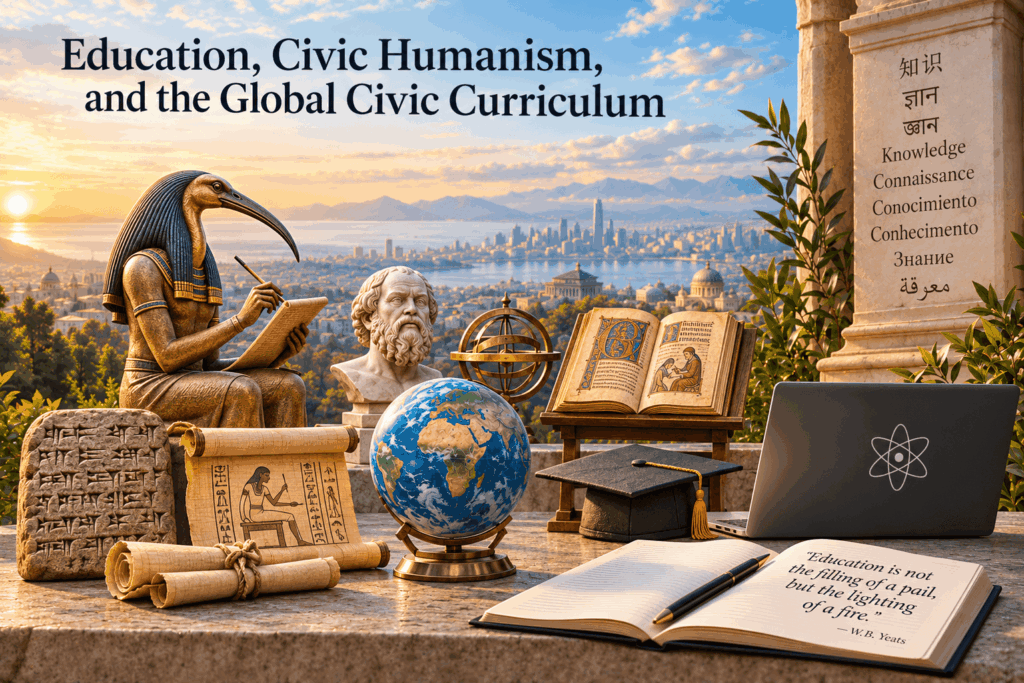
Learning, Citizenship, and the Education of a Democratic Civilization
Contents
Introduction — Education at the Core of Civilization
I. From Scribes to Citizens: A Brief History of Education
II. Education, Economy, and Political Power
III. Paying for Opportunity: Tuition, Grants, and Student Debt
IV. The Science of Learning
V. What Should Students Learn? Comparing the World’s Curricula
VI. Testing Knowledge, Reasoning, and Academic Potential
VII. A Civic Humanist Education Policy
VIII. The Global Civic Curriculum
Conclusion — Educating the Free Citizen
Sources and Further Reading
Introduction — Education at the Core of Civilization
Education is one of civilization’s greatest achievements. Every generation inherits knowledge developed over centuries of experience and discovery. Through education, that inheritance becomes available to new minds capable of extending it. The quality of this process influences individual opportunity and the future development of society.
Education is fundamental to civilization itself. Derived from the Latin civis (citizen) and civitas (city), civilization refers to a complex society characterized by urban settlements, organized government, developed cultural institutions, specialized occupations, and writing. Education enables such societies to preserve and transmit the knowledge necessary for their continuity and advancement.
The expansion of public education transformed the modern world. Literacy became widespread, universities opened to populations previously excluded from advanced study, and scientific knowledge entered ordinary classrooms. Yet educational opportunity remains unequal. Students born into different circumstances frequently encounter profoundly different possibilities for developing their abilities.
Education also raises fundamental questions about society. What knowledge should every person possess? How should schools develop independent judgment? What responsibilities do governments have for educational opportunity, and how can institutions determine whether students are genuinely learning?
Civic Humanism regards education as a foundation of individual freedom and democratic society. It seeks to advance educational opportunity through evidence-based policy and the proposed Global Civic Curriculum (GCC). By strengthening scientific literacy and independent thought, Civic Humanism aims to develop informed citizens capable of improving democratic institutions and contributing to a better world.
This article examines the historical development of education, the science of learning, and the economic conditions shaping educational opportunity. It compares major educational systems and approaches to assessment before developing a Civic Humanist education policy and the foundations of the Global Civic Curriculum.
I. From Scribes to Citizens: A Brief History of Education
Education existed long before schools. Children acquired knowledge through participation in the activities of their communities, learning practical skills from experienced adults. Oral traditions preserved collective memory and cultural understanding. The emergence of writing and organized states gradually transformed education into a specialized activity.
Ancient Mesopotamia and Egypt developed schools for scribes whose literacy supported administration and commerce. In China, Confucian scholarship became central to education, eventually influencing imperial examinations used to select government officials. Although access remained unequal, examinations introduced a means of advancement that was not based exclusively upon hereditary privilege.
Ancient Greece contributed an influential understanding of education through paideia, which connected intellectual development with the cultivation of character and civic judgment. Philosophers such as Plato and Aristotle examined how education shaped the qualities of citizens and the political institutions they sustained.
Religious institutions subsequently played important roles in preserving and transmitting knowledge. Buddhist monasteries supported scholarship across Asia, while Islamic educational institutions contributed to developments in mathematics and medicine. Christian monasteries and cathedral schools helped maintain scholarly traditions in medieval Europe, although religious authority also established boundaries around intellectual inquiry.
The medieval university introduced a recognizable institutional framework for advanced study. Bologna became influential in legal education, while Paris developed as a center of theology and philosophy. Oxford and Cambridge emerged within the same expanding European tradition. Academic qualifications and organized courses of study became increasingly established features of higher education.
The Scientific Revolution changed the foundations of intellectual authority. Observation and experimentation challenged inherited explanations of nature, while the Enlightenment encouraged wider examination of reason and individual liberty. Education gradually acquired a stronger relationship with independent inquiry and the development of knowledge through evidence.
Industrialization accelerated the expansion of public schooling. Modern economies required greater literacy and mathematical competence, while governments increasingly assumed responsibility for educating their populations. During the nineteenth century, compulsory education became established across much of Europe and North America.
The development of democratic institutions gave education additional political significance. Citizens required access to information and sufficient understanding to evaluate public decisions. Governments also recognized that schools could shape national identity and political loyalty, creating an enduring tension between education for independent citizenship and education as an instrument of state authority.
During the twentieth century, secondary and university education became accessible to much larger populations. Women’s educational opportunities expanded, while civil rights reforms challenged longstanding systems of exclusion. Technical institutions and vocational programs developed alongside universities, providing additional pathways into skilled employment.
Digital technology has further transformed access to knowledge. Educational materials can now circulate internationally through online courses and research publications. Artificial intelligence introduces possibilities for individualized instruction, although the reliability of generated information and its effects upon independent learning require careful evaluation.
The history of education reveals a gradual expansion of intellectual opportunity. Knowledge once concentrated within privileged institutions has become increasingly available to the wider population. Civic Humanism seeks to continue this development by improving educational quality and making meaningful learning accessible throughout society.
II. Education, Economy, and Political Power
Education has become a major influence upon economic opportunity. Modern economies depend upon specialized knowledge, and educational qualifications frequently determine access to employment. Higher educational attainment is generally associated with stronger employment prospects and earnings, although these relationships vary considerably across occupations and national economies.
Family circumstances strongly influence educational achievement. Children from prosperous households often have access to better-resourced schools and additional educational support. Differences in preparation accumulate over time, affecting opportunities for advanced study long before students apply to universities.
Consequently, formal access to education does not necessarily establish equality of opportunity. Students may attend school under substantially different conditions, with unequal access to qualified teachers and suitable learning environments. Civic Humanism seeks to reduce disadvantages that prevent capable individuals from developing their abilities.
Education and Economic Development
Education contributes to economic development by improving the capabilities of the workforce. Skilled workers can use technologies more effectively, while universities and research institutions help develop new knowledge. Economic prosperity also enables societies to invest greater resources in education, creating a relationship that can reinforce long-term development.
Educational investment must nevertheless respond to actual needs. Expanding university enrollment does not automatically improve productivity, particularly when qualifications become requirements for occupations that could be entered through less expensive forms of preparation.
This problem is known as credential inflation. Employers may increasingly require degrees because applicants commonly possess them, even when the knowledge necessary for the work has changed relatively little. The resulting competition can impose substantial costs upon individuals without producing equivalent economic benefits.
Technical education and apprenticeships provide important alternatives. Skilled occupations frequently require extensive preparation, but that preparation need not always follow a conventional university pathway. Educational systems should recognize demonstrated competence and maintain respected opportunities for professional development.
Education as a Public and Private Good
Education benefits individuals through improved employment opportunities and greater capacity for independent decision-making. Its effects also extend throughout society. Businesses depend upon an educated workforce, while scientific discoveries can generate benefits far beyond the institutions responsible for them.
These wider benefits justify substantial public investment. Educational opportunities determined entirely by household purchasing power would exclude individuals whose abilities could contribute to society. Public financing helps address this problem, although the appropriate distribution of costs depends upon the circumstances of each educational system.
Education also serves purposes whose value cannot be measured through earnings. Historical scholarship improves understanding of political institutions, while philosophy examines the assumptions underlying public decisions. The humanities contribute to intellectual development even when their immediate economic benefits are difficult to quantify.
A well-developed educational system should therefore provide opportunities for specialized professional preparation within a broader intellectual foundation. People encounter questions throughout their lives that require understanding beyond their occupations. Education should equip them to continue learning as those circumstances change.
Education and Political Power
Education has a particularly important relationship with democratic government. Citizens require knowledge of the institutions exercising authority over their lives. Literacy historically expanded access to political information, while modern citizenship increasingly requires the ability to interpret scientific evidence and economic arguments.
Governments have legitimate reasons to establish civic education. Students should understand their constitutional institutions and the procedures available for political participation. Yet control over education also creates opportunities for ideological interference.
Authoritarian governments have frequently used schools to promote official political doctrines. Democratic societies face related dangers when political movements attempt to restrict historical inquiry or determine which conclusions educators may present. Academic freedom provides an important safeguard against these pressures.
Scientific instruction should reflect credible research, while historical claims should remain accountable to evidence. Students should encounter competing interpretations where genuine scholarly disagreement exists. These standards allow educational institutions to maintain intellectual rigor without requiring conformity to a particular political ideology.
This principle applies equally to Civic Humanism. Its educational philosophy must remain open to criticism and revision. Students should be able to examine Civic Humanist principles independently rather than being expected to accept them as established doctrine.
Education for a Free Society
Education strengthens the practical exercise of freedom. Constitutional rights establish legal protections, but informed participation also requires an understanding of the institutions through which those rights operate. Knowledge enables individuals to evaluate decisions affecting their lives and exercise greater independence.
Economic opportunity and democratic participation are therefore connected through education. The ability to acquire useful skills can expand personal independence, while civic understanding supports responsible participation in government. Both depend upon educational institutions capable of developing genuine competence.
For Civic Humanism, educational success must ultimately be measured through what people understand and can accomplish with that knowledge. Enrollment figures and qualifications provide useful information, but they cannot fully establish whether education has developed the capabilities necessary for independent judgment.
III. Paying for Opportunity: Tuition, Grants, and Student Debt
Education requires substantial investment. Schools and universities depend upon qualified teachers, suitable facilities, and resources that support effective learning. The arrangements through which these costs are financed influence educational quality and determine which opportunities are realistically available to students.
Most countries recognize primary and secondary education as a public responsibility. Higher education presents a more complicated question because its benefits extend to both individuals and society. University graduates may enjoy higher earnings, while their knowledge contributes to economic development. Countries have consequently developed different approaches to distributing educational costs.
The United States illustrates these challenges particularly clearly. Its higher-education system includes public universities, community colleges, and private institutions with widely varying tuition. Financial assistance can reduce the amount students pay, but educational decisions often remain dependent upon family resources and access to grants or loans.
Grants, Loans, and Educational Access
Grants expand educational opportunity without requiring repayment. In the United States, federal Pell Grants provide assistance to eligible undergraduate students with financial need, supplemented by state programs and institutional scholarships. Their effectiveness depends upon whether students can afford the full cost of attendance, including necessary living expenses.
Student loans allow individuals to finance education through anticipated future earnings. Borrowing can be reasonable when costs remain proportionate to the opportunities a qualification is likely to provide. Problems arise when students accumulate substantial debt without completing their programs or enter occupations offering lower earnings than expected.
These risks are especially consequential because educational decisions are often made before students possess substantial professional experience. Financial obligations can influence important choices long after graduation. An effective financing system should recognize this uncertainty rather than transferring disproportionate financial risk to young adults.
The Price of Educational Credentials
Financial assistance cannot independently resolve rising educational costs. Increasing borrowing limits may improve immediate access while allowing institutions to maintain expensive programs. Governments must therefore examine institutional expenditure and the educational value students receive.
Completion rates and employment outcomes provide useful evidence, although they cannot capture every benefit of higher education. Universities also support research and intellectual development whose value extends beyond immediate earnings. Nevertheless, institutions receiving substantial public support should provide reliable information about costs and educational outcomes.
Credential inflation creates additional difficulties. When employers require degrees for occupations that could be entered through other forms of preparation, students may pursue increasingly expensive qualifications primarily to remain competitive. Apprenticeships and technical certification can provide more appropriate pathways where extensive academic study is unnecessary.
Learning from Different Financing Systems
International experience demonstrates that higher education can be financed through different combinations of taxation and student contributions. Some European countries maintain relatively low tuition at public universities, while other systems rely more heavily upon student payments supported by grants or income-contingent loans.
The effectiveness of these arrangements depends upon educational quality and financial sustainability. Low tuition offers limited benefit when institutions lack adequate resources, while generous lending arrangements may produce poor outcomes if students enter expensive programs offering inadequate preparation.
Germany and Switzerland provide influential examples of vocational systems combining classroom instruction with workplace training. In the United States, community colleges offer comparatively affordable routes into technical employment and further university study. These alternatives demonstrate that educational opportunity need not depend upon a single academic pathway.
The American Workforce Pell framework, introduced in 2026, extends federal grant eligibility to qualifying short-term workforce programs. Its effectiveness will depend upon whether participating programs provide valuable qualifications and satisfactory employment outcomes.
A Civic Humanist Approach to Educational Finance
Civic Humanism begins with the principle that financial circumstances should not unnecessarily prevent capable individuals from obtaining valuable education. Public investment is justified where it expands meaningful opportunity, particularly for students whose economic circumstances would otherwise restrict their development.
Such investment requires institutional accountability. Governments should evaluate whether financial assistance improves educational outcomes and whether institutions provide reasonable value. Need-based grants can protect access, while carefully structured loans may help distribute remaining costs over the years in which graduates benefit economically.
Educational financing should also recognize the importance of lifelong learning. Technological change can alter occupational requirements, creating demand for further training throughout adulthood. Employers and public institutions may reasonably share responsibility for making these opportunities accessible.
The objective is a financing system that enables individuals to pursue education appropriate to their abilities without assuming unnecessary financial risk. Public resources should support effective institutions and expand opportunities whose benefits justify their costs. Education represents a long-term investment in human capabilities, and its financing should reflect that broader social value.
IV. The Science of Learning
Modern research has substantially improved our understanding of how people learn. Cognitive psychology and neuroscience have contributed important findings concerning memory and the development of expertise, while educational research examines how these processes operate in classrooms.
The distinction between encountering information and learning it is fundamental. A student may understand an explanation while reading it yet struggle to recall the material later. Familiarity can create confidence without producing lasting knowledge. Effective education must therefore consider what students retain and can apply after instruction has ended.
Attention, Memory, and Knowledge
Attention places an immediate constraint upon learning. Human working memory can manage only a limited amount of unfamiliar information simultaneously. Teachers can reduce unnecessary cognitive demands by organizing explanations carefully and introducing difficult concepts in manageable stages.
Prior knowledge strongly influences this process. A student familiar with basic biology possesses a foundation for understanding genetics, while someone lacking that preparation must first acquire the necessary concepts. Educational knowledge is cumulative, making early gaps in understanding particularly consequential.
Memory also develops through active retrieval. Students often reread material because familiarity makes it appear well understood. Research demonstrates that attempting to recall information without consulting the answer can produce stronger retention. Practice questions and self-explanation help students identify gaps while reinforcing what they have learned.
Spacing, Practice, and Understanding
The timing of study affects how long knowledge is retained. Concentrated preparation immediately before an examination may produce satisfactory short-term performance, but distributed practice generally supports more durable learning. Returning to material after some forgetting has occurred requires effort that can strengthen subsequent recall.
Research reviewed by John Dunlosky and colleagues identifies practice testing and distributed practice among the most effective widely applicable learning techniques. Work by Shana Carpenter and colleagues further examines how spacing and retrieval can support learning across different educational settings.
Practice must also develop understanding. Repeating a familiar mathematical procedure may improve performance on similar exercises without preparing students to recognize when that procedure is appropriate. Deeper learning becomes apparent when students can apply knowledge to unfamiliar problems.
Feedback supports improvement by helping learners understand their errors. Effective feedback provides information students can use during subsequent practice. Assessment therefore contributes to education when it identifies misunderstandings and informs further instruction.
Knowledge and Critical Thinking
Expertise develops through sustained engagement with a subject. Experienced practitioners recognize meaningful relationships because they possess organized knowledge acquired through study and practice. This enables them to approach problems more efficiently and concentrate upon unfamiliar difficulties.
The relationship between knowledge and reasoning has important educational consequences. Students cannot critically evaluate arguments about scientific or historical questions without understanding the relevant evidence. General reasoning skills remain valuable, but their effectiveness depends substantially upon subject knowledge.
Scientific education should therefore explain established findings alongside the methods through which they were obtained. Historical education should develop knowledge of events while teaching students to evaluate sources within their circumstances. Critical thinking becomes meaningful when exercised through substantive intellectual inquiry.
Motivation and the Learning Environment
Learning is influenced by the conditions in which it occurs. Persistent stress and inadequate sleep can interfere with concentration, while supportive educational environments can encourage sustained effort. Teachers must recognize these influences without abandoning academic expectations.
Students also differ in prior preparation and the time required to master particular concepts. Effective instruction responds to meaningful differences while maintaining clear objectives. Popular theories concerning fixed visual, auditory, or kinesthetic learning styles lack convincing scientific support, despite their widespread influence upon educational practice.
Instruction should instead reflect the demands of the subject. Diagrams may help students understand spatial relationships, while carefully structured explanations can support the acquisition of unfamiliar concepts. The appropriate method depends upon what students need to learn.
Human Maturity and the Human Maturity Initiative
Education must also address the development of human maturity. Academic achievement alone does not ensure that individuals can regulate their emotions, exercise sound judgment, or act responsibly toward others. Human maturity involves the progressive development of emotional self-regulation and intellectual independence, enabling individuals to govern their own conduct while recognizing their responsibilities within society.
Science Abbey’s Human Maturity Initiative, established as part of the Global Civic Curriculum, seeks to cultivate these capacities through secular, scientific, and philosophical education. Its approach recognizes maturity as a lifelong developmental process, supported by reflective practice and meaningful engagement with others. The initiative emphasizes emotional resilience, intellectual humility, and ethical reasoning as foundations for responsible participation in democratic society.
The initiative proposes a modular curriculum extending from childhood through adulthood, supported by communities of practice and partnerships with educational institutions. Its research component would evaluate developmental outcomes and improve instructional methods through empirical evidence. These programs are intended to make maturity education accessible across different cultures while respecting individual freedom and diversity.
From a Civic Humanist perspective, the capacity for self-governance is closely connected to the quality of democratic government. Citizens and public officials must be capable of examining their own assumptions and responding constructively to disagreement. The Human Maturity Initiative therefore treats personal development as a continuing educational responsibility, contributing to the cultivation of informed citizens and a more responsible democratic society.
Education in the Age of Artificial Intelligence
Artificial intelligence introduces opportunities for individualized educational assistance. Students can obtain alternative explanations and receive feedback while practicing unfamiliar material. These capabilities may extend access to support that would otherwise require personal tutoring.
Their educational value depends upon how they are used. An AI system can complete an assignment without requiring the student to understand the material. Such assistance may produce apparently successful work while concealing substantial gaps in learning.
Artificial intelligence also makes independent knowledge increasingly important. Generated explanations can contain plausible errors, and users unfamiliar with a subject may struggle to recognize them. Students therefore require sufficient understanding to evaluate automated information rather than accepting it uncritically.
Educational institutions should distinguish assistance that supports learning from assistance that replaces intellectual effort. Supervised assessments and oral explanations can help establish individual competence, while appropriate AI-supported activities may provide useful opportunities for practice.
Evidence-Based Education
Educational research offers practical guidance, but its findings require careful interpretation. Results obtained in controlled studies may not transfer perfectly across different classrooms or age groups. Teachers need professional judgment informed by research and experience.
This principle applies to debates between traditional and progressive educational methods. Direct instruction can be effective when students are acquiring foundational knowledge, while independent investigation becomes increasingly useful as their understanding develops. The choice of method should reflect the educational objective and available evidence.
Governments have a corresponding responsibility to evaluate reforms before adopting them widely. New technologies and instructional approaches frequently attract enthusiasm before their effectiveness has been established. Educational policy should encourage innovation while requiring credible evidence of improvement.
For Civic Humanism, scientific research provides the means to improve educational practice, while ethical judgment and democratic deliberation establish its purposes. Effective education develops lasting knowledge and the capacity to examine that knowledge independently. Institutions should organize teaching around these objectives, revising their methods as understanding advances.
V. What Should Students Learn? Comparing the World’s Curricula
Every educational system must determine what knowledge students should acquire. These decisions reflect a society’s intellectual traditions and expectations concerning citizenship. Although scientific knowledge crosses national boundaries, the organization of education varies considerably among countries.
Curriculum development presents a persistent challenge. The amount of available knowledge continues to expand, while the time students can devote to formal education remains limited. Schools must establish priorities that provide a coherent foundation for further learning without allowing their programs to become collections of disconnected subjects.
National Curricula and Educational Standards
Countries differ in how they establish educational standards. England maintains a National Curriculum for most state-maintained schools, defining subjects and expectations at successive stages of education. Academies possess greater curricular freedom, although they remain subject to other educational requirements.
The United States follows a more decentralized approach. States establish educational standards, while local districts exercise substantial responsibility for instruction. The Common Core State Standards introduced shared expectations in mathematics and English language arts for participating states, generating debate concerning educational quality and government authority.
The United Kingdom maintains distinct educational systems in England, Scotland, Wales, and Northern Ireland. England’s National Curriculum establishes subject requirements and attainment expectations for state-maintained schools, while academies enjoy greater curricular independence. Scotland follows its Curriculum for Excellence, emphasizing broad learning and the development of knowledge and skills. Wales and Northern Ireland maintain their own curricular frameworks.
The Cambridge International curriculum provides another influential model, particularly in international schools. Developed by Cambridge International Education, part of the University of Cambridge, it offers a continuous educational pathway from primary school through Cambridge IGCSE qualifications, generally taken around age 16, to Cambridge International AS and A Levels, typically completed between ages 16 and 19.
These upper-secondary qualifications prepare students for university admission and are widely recognized internationally. The curriculum combines internationally established academic standards with flexibility in subject selection, allowing schools to adapt their programs to different educational contexts.
Finland combines a national core curriculum with considerable local discretion. Municipalities and schools develop curricula within a common framework, while teachers exercise substantial professional responsibility. This arrangement depends partly upon the preparation and institutional standing of educators.
Singapore maintains a more centralized system, supported by nationally coordinated curricula and teacher development. Its students have performed strongly in international assessments, particularly in mathematics and science. Singapore’s experience demonstrates the potential value of carefully structured instruction, although its institutional arrangements cannot simply be transferred unchanged to other countries.
China maintains a nationally coordinated educational system under the Ministry of Education, which establishes curriculum standards for compulsory primary and lower-secondary education. The curriculum emphasizes Chinese language and literature, mathematics, science, history, and moral and political education, with increasing attention to practical skills and interdisciplinary learning.
At the upper-secondary level, students generally follow either academic or vocational pathways, with academic students preparing for the gaokao, the national university entrance examination. Recent reforms have sought to reduce excessive academic pressure while strengthening educational quality. China’s system combines rigorous academic expectations with explicit instruction in national identity and socialist political values, illustrating how curriculum design reflects both educational priorities and government objectives.
These systems illustrate different approaches to educational governance. Common standards can protect continuity, while local discretion allows institutions to respond to their circumstances. Civic Humanism favors clearly established educational objectives supported by professional independence and reliable evaluation.
International Education and the International Baccalaureate
The International Baccalaureate (IB), established in 1968, provides an influential model of education designed for use across national boundaries. Its Diploma Programme combines advanced subject study with requirements intended to develop independent inquiry.
Students complete an extended essay and participate in Theory of Knowledge, which examines how knowledge is developed and justified. The program has become internationally recognized, providing qualifications accepted by universities in many countries.
The IB demonstrates how educational institutions can establish common academic expectations while operating within different national systems. Its international orientation is particularly relevant to the proposed Global Civic Curriculum, although participation remains uneven and may involve substantial costs.
Other international qualifications, including Cambridge International programs, provide pathways through which students can obtain recognized academic credentials. These arrangements facilitate educational mobility while preserving different approaches to curriculum design.
Universities and International Educational Cooperation
Higher education has also developed mechanisms for international coordination. The European Bologna Process, initiated in 1999, sought to improve the comparability of qualifications and support academic mobility across participating countries.
Its development contributed to the European Higher Education Area, encouraging more compatible degree structures and systems for recognizing academic achievement. These reforms demonstrate how governments and universities can cooperate without establishing a single international university curriculum.
International coordination nevertheless requires attention to institutional differences. Qualifications that share similar titles may represent different educational experiences. Recognition systems must therefore consider academic standards alongside formal credentials.
The Global Civic Curriculum could learn from these arrangements by establishing common educational objectives while allowing institutions to retain responsibility for implementation. International cooperation is most useful when it improves access to reliable knowledge without unnecessarily restricting academic independence.
The Humanities, Science, and Civic Education
Scientific and technological education has become increasingly important to economic development. Students need sufficient scientific knowledge to understand contemporary technologies and evaluate public questions involving research. Mathematics provides essential foundations for these capabilities.
The humanities remain equally relevant to intellectual development. Historical education explains how contemporary institutions emerged, while philosophy develops the examination of arguments concerning knowledge and ethical responsibility. Literature provides opportunities to understand experiences beyond those encountered in ordinary life.
These subjects should be taught through rigorous intellectual methods. Historical claims require evidence, while philosophical arguments should be evaluated through reasoned examination. The educational value of a discipline depends upon the understanding it develops rather than its traditional prestige.
Civic education deserves particular attention because democratic government depends upon informed participation. Students should understand their constitutional institutions and the procedures through which political decisions are made. Comparative political study can then provide a broader perspective on different systems of government.
Such instruction must preserve intellectual independence. Students should learn the principles underlying democratic institutions while retaining the freedom to criticize their operation. Civic education should develop the capacity for informed participation rather than require allegiance to a political ideology.
A Civic Humanist Curriculum
Civic Humanism seeks an educational foundation that enables individuals to understand the world and continue developing their knowledge. Literacy and mathematics provide the foundation for further study, while scientific education develops an understanding of the natural world. Critical thinking and civic education equip citizens to evaluate information, exercise independent judgment, and make informed economic and political decisions.
Curricula should reflect an overview of the relationships among the various subjects. Historical knowledge helps explain contemporary political institutions, while scientific understanding informs public decisions concerning technology and the environment. Students benefit when these connections are made intelligible.
Digital literacy now requires particular attention. Students must understand how information is produced and how automated systems can influence public understanding. These capabilities should develop through substantive academic instruction rather than isolated lessons about technology.
The proposed Global Civic Curriculum would complement national educational systems by providing a common foundation for understanding critical thinking, science, basic humanist ethics, and global interdependence. While its fundamental ideals are immutable and must be upheld, its content should be developed through scholarly cooperation, and remain open to revision as knowledge advances.
The objective is an education that provides students with the knowledge necessary for independent judgment while allowing them to pursue more specialized interests. A coherent curriculum should prepare individuals for continued learning throughout their lives.
VI. Testing Knowledge, Reasoning, and Academic Potential
Assessment enables educational institutions to determine what students have learned. Teachers use examinations to identify difficulties and guide instruction, while universities use qualifications to evaluate applicants. Professional institutions may also require assessments demonstrating competence in particular fields.
These purposes are related but not identical. A classroom examination measures achievement within a course, while an admissions test attempts to identify readiness for further study. The value of an assessment depends upon whether it provides reliable information for the decisions it is intended to support.
The Development of Educational Examinations
Formal examinations have a long history. Imperial China developed examination systems for selecting government officials, emphasizing mastery of classical scholarship. Although access to preparation remained unequal, examinations offered an alternative to selection based exclusively upon hereditary position.
European universities subsequently established examinations for academic qualifications. During the nineteenth century, expanding public education increased demand for standardized measures of achievement.
Modern educational testing developed alongside advances in psychology and statistics. Researchers sought methods for measuring cognitive performance and academic preparation, eventually producing assessments used in school placement and university admissions.
Standardized procedures can reduce arbitrary judgment by requiring candidates to complete comparable tasks. Their legitimacy nevertheless depends upon the validity of the tests and the interpretation of their results.
Achievement, Aptitude, and Intelligence
Educational assessments measure different aspects of performance. Achievement tests examine knowledge acquired through instruction, while aptitude tests have historically attempted to estimate readiness for future learning. Intelligence tests measure particular cognitive abilities through standardized tasks.
These categories overlap considerably. Performance on aptitude tests depends partly upon prior education, while achievement examinations often require reasoning beyond simple recall. A single score cannot adequately represent the full range of an individual’s abilities.
The SAT illustrates these developments. Originally associated with aptitude testing, it has undergone substantial revisions and now assesses reading, writing, and mathematical skills relevant to university preparation. The ACT provides another widely used measure of academic readiness.
In the United Kingdom, universities frequently rely upon A-level qualifications alongside course-specific selection procedures. Oxford’s adoption of the Test of Academic Reasoning for Admissions (TARA) for certain courses illustrates the continuing development of assessments intended to evaluate reasoning and academic preparation.
The usefulness of such tests must be established through evidence. Institutions should examine whether results predict academic performance and whether the information they provide improves upon existing admissions measures.
Standardized Testing and Educational Opportunity
Standardized examinations can contribute to fairness by establishing common expectations for applicants from different schools. They may provide valuable information where grading standards differ substantially among institutions.
However, test performance also reflects differences in educational opportunity. Students attending well-resourced schools may receive stronger preparation, while prosperous families can purchase supplementary instruction. Scores therefore demonstrate performance under particular conditions rather than an exact measure of underlying potential.
Eliminating standardized testing does not necessarily resolve these inequalities. School grades and recommendation letters can also reflect differences in educational resources. Universities must evaluate the limitations of each measure rather than assuming that one method is inherently fair.
American universities have adopted different policies concerning standardized testing. Many suspended requirements during the COVID-19 pandemic, and some subsequently maintained test-optional admissions. Others reinstated requirements after examining evidence concerning the predictive value of test scores.
A Civic Humanist approach would encourage universities to publish the evidence supporting their admissions policies. Where standardized tests provide meaningful information, they may deserve a role. Their influence should reflect demonstrated usefulness rather than ideological preference.
Academic Records and Contextual Admissions
School grades provide information accumulated over extended periods. They can demonstrate sustained achievement and improvement, offering a perspective different from performance during a single examination.
Grading standards nevertheless vary among schools. Universities may therefore examine the difficulty of available courses and the educational circumstances in which applicants earned their qualifications.
Personal essays and recommendation letters can provide additional information, but they introduce subjective judgments. Applicants may receive unequal assistance with written materials, while recommendations can reflect differences in institutional familiarity with admissions procedures.
Contextual admissions attempts to recognize the circumstances affecting academic achievement. Students who obtain strong results despite substantial disadvantage may demonstrate capabilities not fully reflected in conventional measures.
Such policies require careful evaluation. Universities must maintain appropriate academic standards while recognizing that applicants have not enjoyed equal opportunities for preparation. Preparatory programs and academic support can help admitted students succeed when their earlier educational experiences have been inadequate.
International Approaches to University Admissions
Countries organize university admissions according to their educational traditions. China’s gaokao provides a prominent example of a high-stakes national examination, with results playing a major role in access to higher education.
The United Kingdom places considerable emphasis upon subject qualifications, supplemented by institutional requirements for particular courses. Oxford and Cambridge also conduct academic interviews designed to assess how applicants approach unfamiliar problems. Interviewers may present puzzling questions or unexpected scenarios, asking candidates to explain their reasoning and respond to new information. The emphasis is upon intellectual curiosity, analytical thinking, and the ability to develop an argument rather than simply recalling memorized answers.
Germany relies heavily upon the Abitur qualification, although admission to competitive programs may involve additional selection procedures. These systems demonstrate how admissions practices reflect the organization of secondary education. A common examination may provide a useful basis for selection where students follow comparable curricula, while more decentralized systems may require additional information.
International comparisons should therefore consider the entire educational pathway. The fairness of university selection cannot be separated from the opportunities students receive during childhood and secondary schooling.
Assessment and the Purpose of Education
Assessment influences instruction because examination requirements shape what teachers and students prioritize. Tests emphasizing narrow forms of recall may encourage preparation that produces limited understanding. More demanding assessments can evaluate the application of knowledge, although their design and scoring require care.
Classroom assessment also supports learning directly. Practice tests can strengthen memory, while feedback helps students identify errors. These formative uses should be distinguished from examinations intended primarily to certify achievement.
Governments frequently use examination results to evaluate schools. Such comparisons can reveal important differences, but they must account for the circumstances of the students being educated. Otherwise, institutions may be rewarded or penalized for factors beyond their control.
Civic Humanism favors assessments that provide reliable information while supporting genuine educational development. Universities should identify applicants prepared for their programs, and schools should use assessment to improve instruction.
The ultimate objective is to recognize achievement fairly and enable capable students to pursue education suited to their abilities. Assessment should serve that purpose through transparent procedures and evidence-based evaluation, maintaining academic standards while recognizing the unequal circumstances in which learning occurs.
VII. A Civic Humanist Education Policy
Education is among the most consequential responsibilities of democratic government. Its effects extend across generations, influencing individual opportunity and the capacity of societies to develop. Public policy must therefore consider the quality of learning alongside the institutions through which education is provided.
Civic Humanism approaches education through Integrated Humanism, which recognizes the relationship between scientific understanding and ethical responsibility. Its objective is to develop knowledgeable individuals capable of exercising independent judgment and contributing meaningfully to society. Educational institutions should support this development while respecting the intellectual freedom upon which genuine learning depends.
Education as a Public Responsibility
The justification for public education rests partly upon its contribution to individual opportunity. Children do not choose their economic circumstances, yet those circumstances can profoundly influence their educational prospects. Public provision helps prevent access to essential knowledge from depending entirely upon family resources.
Education also produces benefits extending beyond individual students. An educated population contributes to scientific advancement and the effective operation of democratic institutions. These wider benefits provide a substantial justification for public investment.
Civic Humanism favors universal access to quality primary and secondary education, supported by institutions capable of evaluating educational outcomes. Governments should establish reliable standards while allowing appropriate professional independence. Public responsibility does not necessarily require direct government administration of every school.
Meaningful access must extend beyond enrollment. Students require qualified teachers and suitable learning environments. Public resources should address persistent educational disadvantages, with particular attention to institutions serving communities where inadequate preparation limits opportunities for further study.
Early Childhood Education and Development
Educational inequality frequently begins before formal schooling. Differences in early learning opportunities can influence children’s preparation for school, although these circumstances do not determine their future achievement.
Research on early childhood development demonstrates the importance of responsive relationships and developmentally appropriate learning. High-quality early education can support children’s development, particularly where economic disadvantage limits available opportunities.
Public investment should prioritize programs supported by credible evidence. Their effectiveness must be evaluated over time, recognizing that immediate improvements in school readiness do not necessarily guarantee lasting academic benefits.
Early childhood policy should also acknowledge the circumstances of families. Educational institutions operate within broader conditions affecting children’s development, including economic security and access to appropriate services. Effective programs should support families while respecting their responsibilities.
Teachers and Professional Responsibility
Teachers occupy a central position within educational institutions. Curriculum standards establish expectations, but effective instruction depends substantially upon educators’ subject knowledge and professional judgment.
Teacher preparation should combine disciplinary competence with research-informed instructional methods. Practical classroom experience remains essential because teaching requires decisions that cannot be fully anticipated through theoretical study.
Professional development should continue throughout a teacher’s career. Collaboration among educators can help identify instructional difficulties and evaluate improvements. Schools should provide opportunities for teachers to examine evidence and refine their practice.
Teacher evaluation requires similar care. Student achievement provides relevant information, but outcomes also reflect prior preparation and circumstances outside the classroom. Evaluation should identify ineffective practices while recognizing the limitations of available measures.
Educational quality also depends upon attracting and retaining capable teachers. Governments must consider whether professional conditions provide sufficient opportunities for development and allow institutions to maintain an experienced workforce.
Academic Freedom and Secular Education
Educational institutions require sufficient independence to investigate questions and communicate established knowledge. Academic freedom protects legitimate inquiry from inappropriate political interference while maintaining the professional responsibilities of educators.
Secular public education provides an important foundation for freedom of conscience. Students should be able to study religious traditions as historical and cultural subjects without being required to accept their theological claims.
Political ideology requires comparable safeguards. Civic Humanism may inform the ethical objectives of educational policy, but it should never become compulsory doctrine. Students must remain free to examine its assumptions and disagree with its conclusions.
Public accountability and academic independence can coexist. Governments may establish educational objectives and evaluate institutional performance without determining the conclusions of scholarly inquiry.
Higher Education, Research, and Lifelong Learning
Universities contribute to society through advanced education and the development of knowledge. Scientific research frequently produces benefits extending beyond the institutions responsible for it, providing substantial justification for public support.
Research funding should recognize the importance of investigations whose practical applications remain uncertain. Governments may reasonably direct resources toward urgent problems, but independent inquiry requires sufficient support to explore questions whose future significance cannot yet be established.
Universities should also maintain appropriate relationships with private enterprise. Commercial partnerships can help translate discoveries into useful technologies, although conflicts concerning publication and research independence require transparent oversight.
Educational policy must recognize pathways beyond conventional university study. Technical institutions and apprenticeships provide valuable preparation for skilled occupations. Their qualifications should reflect demonstrated competence and offer opportunities for professional advancement.
Technological change also makes continuing education increasingly important. Workers may need additional training throughout their careers, requiring flexible arrangements suited to adult responsibilities. Employers and public institutions can share responsibility for making these opportunities accessible.
Technology and Educational Responsibility
Digital technology has expanded access to educational materials and created new possibilities for instruction. Online courses can reach students unable to attend conventional institutions, while adaptive software may support individual learning.
Artificial intelligence introduces additional opportunities, but its educational value depends upon whether students acquire genuine understanding. Institutions should establish clear expectations concerning appropriate assistance and independent academic work.
Technological innovation also creates responsibilities concerning privacy and unequal access. Students without reliable devices or internet connections may face disadvantages when educational programs depend heavily upon digital resources.
Civic Humanism supports educational innovation grounded in evidence. New technologies should be adopted when they improve learning or meaningful access, with their consequences evaluated through transparent procedures.
Democratic Accountability and Educational Reform
Education policy must remain subject to democratic scrutiny. Governments exercise substantial influence through public financing and curriculum requirements, while universities may receive donations from corporations, foreign governments, and other entities seeking to influence academic priorities or educational content.
Protecting academic independence therefore requires transparency concerning institutional funding and safeguards against inappropriate external influence. Public accountability is essential to maintaining the integrity of education and its contribution to democratic civilization.
Educational reforms should establish achievable objectives and allow sufficient time for evaluation. Changes in teacher preparation or curriculum may require years before their effects become apparent. Frequent political reversals can disrupt institutions before earlier policies have been properly assessed.
A Civic Humanist approach would preserve effective practices while revising arrangements that evidence demonstrates to be inadequate. Educational policy should improve through experience rather than follow the changing preferences of political administrations.
The central objective is to develop institutions capable of providing meaningful educational opportunities. Scientific understanding can improve instructional methods, while democratic responsibility establishes the public purposes those improvements should serve.
VIII. The Global Civic Curriculum
The expansion of education has occurred alongside increasing connections among societies around the world. Scientific discoveries circulate internationally, while economic and environmental developments influence communities far removed from their origins. Understanding contemporary public affairs consequently requires knowledge extending beyond the institutions of any single country.
National educational systems remain responsible for preparing students to participate in their own societies. They teach the history and constitutional arrangements through which public authority is exercised. These responsibilities remain essential, but they cannot encompass every relationship affecting modern citizenship.
The proposed Global Civic Curriculum (GCC) addresses this educational need. Developed within the framework of Integrated Humanism, it would provide a common foundation for understanding critical thinking, humanist ethics, global interdependence and the responsibilities arising from relationships among societies.
The GCC is conceived as a complementary educational framework rather than a replacement for national curricula. Its purpose is to make relevant knowledge accessible across different educational systems while respecting their institutional independence.
The Intellectual Foundation of Global Citizenship
Human societies have maintained relationships beyond their immediate communities throughout history. Trade and migration connected distant populations long before the emergence of modern states. Scientific and technological developments have subsequently increased the scale of these interactions.
The global economy demonstrates the practical significance of these relationships. Products frequently depend upon resources and labor originating in several countries, while financial developments can influence economic conditions across national boundaries.
Ecological systems provide an even more fundamental example. The atmosphere and oceans connect human communities through physical processes that operate independently of political borders. Scientific understanding reveals how activities within one jurisdiction can influence environmental and health conditions elsewhere.
These relationships create responsibilities that cannot always be addressed through national decisions alone. Governments remain accountable to their citizens, but international cooperation becomes necessary when shared problems exceed the capacity of individual states.
Global civic education should help students understand these circumstances without requiring them to abandon national identities. Knowledge of international relationships provides a broader perspective through which existing civic responsibilities can be understood.
Scientific Literacy and the Understanding of Evidence
Scientific literacy provides an essential foundation for global civic education. Many contemporary public questions involve evidence concerning natural systems and technological developments. Citizens require sufficient understanding to evaluate the claims presented by governments and other institutions.
The GCC would emphasize how scientific knowledge is developed through observation and the testing of explanations. Students should understand why scientific conclusions can be reliable while remaining open to revision when new evidence becomes available.
Instruction should also address the interpretation of research in public debate. Scientific findings may be presented selectively or extended beyond what the evidence supports. Students need opportunities to distinguish documented results from unsupported claims about their significance.
Scientific evidence can inform public decisions, but it cannot independently determine their ethical objectives. The GCC would therefore connect scientific understanding with responsible democratic judgment, recognizing the different roles of empirical inquiry and public deliberation.
Human Rights and Constitutional Democracy
The development of international human rights principles provides an important subject for civic education. Students should examine the historical circumstances surrounding the Universal Declaration of Human Rights and the institutions through which rights are protected.
They should also understand the distinction between declarations and binding treaties. International commitments operate through different legal arrangements, while their practical effectiveness depends upon institutions capable of implementation and enforcement.
Comparative constitutional education would provide additional context. Democratic governments organize political authority through different systems, and constitutional provisions do not always correspond to the actual exercise of rights.
Students should examine these arrangements through historical evidence and institutional analysis. The GCC should encourage informed criticism while respecting legitimate disagreement concerning particular constitutional structures.
Economic Interdependence and Public Responsibility
Economic literacy is increasingly important to democratic participation. Public debates concerning employment and government expenditure frequently depend upon concepts that are poorly understood outside specialized education.
The GCC would introduce fundamental economic relationships, including the operation of markets and the responsibilities of public institutions. Students should examine international trade and the ways economic developments in one country can influence conditions elsewhere.
Economic education should distinguish empirical questions from ideological commitments. National economies combine public and private institutions in different proportions, providing opportunities to compare the consequences of alternative arrangements.
The objective is to develop citizens capable of evaluating economic arguments through evidence. Understanding economic institutions enables individuals to participate more meaningfully in decisions affecting their communities.
Ecological Responsibility
Environmental education provides a direct example of the relationship between scientific knowledge and public responsibility. Ecological systems connect human activity with the conditions necessary for life, making environmental decisions consequential across generations.
The GCC would develop understanding of ecosystems and the effects of human activities upon environmental conditions. Students should examine established scientific findings while learning to evaluate proposed policies according to their likely consequences.
Environmental decisions also involve economic circumstances. Communities depend upon productive activities that consume resources, and effective policies must consider available alternatives. Scientific understanding can clarify these choices without eliminating the ethical judgments involved.
Ecological responsibility provides a strong justification for international educational cooperation because environmental processes cross political boundaries. A common scientific foundation can improve public understanding of problems that governments must address collectively.
History and the Development of Civilizations
Historical education contributes to global understanding by explaining how contemporary societies developed. Political institutions and cultural traditions emerged through long processes of interaction among civilizations.
The GCC would encourage comparative historical study grounded in credible scholarship. Students should examine the contributions of different societies while recognizing the conflicts and inequalities that accompanied historical development.
Historical inquiry requires careful interpretation of evidence. Documents and archaeological findings must be understood within their circumstances, while competing explanations should be evaluated according to their scholarly foundations.
The curriculum should avoid presenting history as an inevitable progression toward a particular contemporary political system. Understanding the uncertainties and choices of earlier generations can improve judgment concerning present institutions.
Critical Inquiry and Information Literacy
Modern citizens encounter enormous quantities of information through digital communication. This availability expands opportunities for learning while increasing the importance of evaluating sources.
The GCC will develop practical methods for examining claims. Students should learn to identify original evidence and recognize how selective presentation can influence interpretation. Statistical literacy would help them evaluate numerical comparisons frequently used in public arguments.
Artificial intelligence introduces additional challenges because generated explanations can appear authoritative without being reliable. Students must understand the need for independent verification, particularly when information influences consequential decisions.
These capabilities should develop through substantive academic subjects. Evaluating historical claims requires historical knowledge, just as interpreting scientific research depends upon understanding the relevant field. Information literacy becomes most effective when connected to genuine intellectual inquiry.
Structure and Implementation of the GCC
The Global Civic Curriculum would require a structure capable of accommodating different national educational systems. A common framework could establish learning objectives while allowing participating institutions to determine how those objectives are incorporated into existing programs.
Development should begin through cooperation among educators and researchers. Academic review would help establish the reliability of instructional materials and identify subjects appropriate to different stages of learning.
The curriculum should also accommodate different languages and institutional resources. International accessibility requires materials that can be adapted without assuming identical teaching methods or technological capabilities.
A phased implementation will allow the GCC to be evaluated before wider adoption. Pilot programs can examine whether students acquire the intended knowledge and whether the materials function effectively within different educational settings.
Assessment should concentrate upon understanding rather than philosophical conformity. Students might demonstrate their ability to interpret evidence or explain international institutions, while remaining free to develop their own political conclusions.
Governance will require comparable safeguards. Transparent academic review should protect educational quality, while participating institutions retain appropriate authority over implementation. The curriculum must remain open to correction as knowledge and educational research advance.
The Global Civic Curriculum and Civic Humanism
The GCC represents an educational application of Integrated Humanism. It begins with the recognition that individuals live within relationships extending beyond their immediate communities and that understanding those relationships can improve public decisions.
Its connection with Civic Humanism concerns the development of informed democratic citizenship. The curriculum would provide knowledge relevant to public responsibility while preserving the intellectual independence of students.
This independence is essential to its legitimacy. The GCC should never require students to endorse Civic Humanism or any political organization. Its purpose is to provide an intellectual foundation through which individuals can examine public questions for themselves.
The long-term ambition of the Global Civic Curriculum is to make global civic knowledge accessible beyond institutions currently providing specialized international education. Through voluntary cooperation and continued evaluation, it could help establish a common educational foundation for understanding the relationships connecting communities throughout the world.
Conclusion — Education and the Future of Human Civilization
The history of education reflects humanity’s expanding capacity to preserve knowledge and make it available to succeeding generations. From ancient systems of specialized instruction to modern public schools and universities, educational institutions have developed alongside changes in society. Their expansion has created opportunities that earlier generations could scarcely have imagined.
Scientific research has improved our understanding of learning, providing evidence that can make education more effective. Yet reliable teaching methods cannot guarantee that students will benefit from them. Educational opportunity continues to depend upon institutional quality and the resources available to individuals.
Economic inequality remains a substantial obstacle. Children encounter different educational circumstances long before they make decisions about advanced study, while the costs of higher education can influence the opportunities they pursue. Public policy must therefore examine how educational systems distribute access and whether their financing arrangements produce sustainable results.
The relationship between education and democracy is equally important. Citizens require knowledge to understand the institutions exercising authority over their lives. Educational systems can develop that understanding, but they can also become instruments of political influence when intellectual independence is neglected.
Civic Humanism approaches education as a public responsibility grounded in the development of human potential. Scientific evidence should inform educational methods, while democratic institutions remain responsible for determining public objectives. This relationship requires educational policies that can be evaluated through their consequences and improved through experience.
The Global Civic Curriculum extends these principles to the conditions of an interconnected world. National education remains essential, but contemporary citizens also need to understand relationships extending beyond their own countries. International cooperation can help make this knowledge more widely available without diminishing the independence of national educational institutions.
The enduring value of education lies in the freedom that understanding makes possible. A society that provides meaningful educational opportunity expands the possibilities available to its people and strengthens their capacity to improve the institutions they inherit. For Civic Humanism, this is fundamental to the development of a secular, scientific, and humanist democracy capable of building a better world.
Sources and Further Reading
Science Abbey and the Global Civic Curriculum
Science Abbey. “The Science of Learning and Education: How We Learn, Why We Teach, and What Education Can Become.” Science Abbey, June 22, 2025.
https://www.scienceabbey.com/2025/06/22/the-science-of-learning-and-education/
Science Abbey. “Global Civic Curriculum (GCC).” Science Abbey.
https://www.scienceabbey.com/global-civic-curriculum-gcc/
Education, Economics, and Educational Opportunity
Organisation for Economic Co-operation and Development (OECD). Education at a Glance 2025: OECD Indicators. Paris: OECD Publishing, 2025.
https://www.oecd.org/en/publications/education-at-a-glance-2025_1c0d9c79-en.html
OECD. “What Are the Earnings Advantages to Education?” Education at a Glance 2025, 2025.
https://www.oecd.org/en/publications/education-at-a-glance-2025_1c0d9c79-en/full-report/what-are-the-earnings-advantages-to-education_7a7e64e0.html
U.S. Department of Education. “Federal Pell Grants.” Federal Student Aid.
https://studentaid.gov/understand-aid/types/grants/pell
U.S. Department of Education. “Workforce Pell Grant Program.” 2026.
https://www.ed.gov/about/news/press-release/us-department-of-education-issues-final-rule-create-new-workforce-pell-grant-program
The Science of Learning
Carpenter, Shana K., Steven C. Pan, and Andrew C. Butler. “The Science of Effective Learning with Spacing and Retrieval Practice.” Nature Reviews Psychology 1 (2022): 496–511.
https://doi.org/10.1038/s44159-022-00089-1
Dunlosky, John, Katherine A. Rawson, Elizabeth J. Marsh, Mitchell J. Nathan, and Daniel T. Willingham. “Improving Students’ Learning with Effective Learning Techniques: Promising Directions from Cognitive and Educational Psychology.” Psychological Science in the Public Interest 14, no. 1 (2013): 4–58.
https://doi.org/10.1177/1529100612453266
National Academies of Sciences, Engineering, and Medicine. How People Learn II: Learners, Contexts, and Cultures. Washington, DC: National Academies Press, 2018.
https://doi.org/10.17226/24783
Dehaene, Stanislas. How We Learn: Why Brains Learn Better Than Any Machine . . . for Now. New York: Viking, 2020.
Willingham, Daniel T. Why Don’t Students Like School? A Cognitive Scientist Answers Questions About How the Mind Works and What It Means for the Classroom. 2nd ed. San Francisco: Jossey-Bass, 2021.
Curricula and International Education
International Baccalaureate Organization. “Diploma Programme Curriculum.”
https://www.ibo.org/programmes/diploma-programme/curriculum/
International Baccalaureate Organization. “Theory of Knowledge.”
https://www.ibo.org/programmes/diploma-programme/curriculum/dp-core/theory-of-knowledge/
International Baccalaureate Organization. “Extended Essay.”
https://www.ibo.org/programmes/diploma-programme/curriculum/dp-core/extended-essay/
Finnish National Agency for Education. “National Core Curriculum for Primary and Lower Secondary (Basic) Education.”
https://www.oph.fi/en/education-and-qualifications/national-core-curriculum-primary-and-lower-secondary-basic-education
Singapore Ministry of Education. “21st Century Competencies.”
https://www.moe.gov.sg/education-in-sg/21st-century-competencies
Cambridge International Education. “Cambridge Pathway.”
https://www.cambridgeinternational.org/programmes-and-qualifications/
European Commission. “The Bologna Process and the European Higher Education Area.”
https://education.ec.europa.eu/education-levels/higher-education/inclusive-and-connected-higher-education/bologna-process
Testing, Reasoning, and University Admissions
University of Oxford. “Admissions Tests.” Undergraduate Admissions, 2026.
https://www.ox.ac.uk/admissions/undergraduate/applying/guide-for-applicants/admissions-tests
UAT-UK. “TARA: Test of Academic Reasoning for Admissions.”
https://esat-tmua.ac.uk/about-the-tests/tara/
College Board. “What’s on the SAT.” SAT Suite of Assessments.
https://satsuite.collegeboard.org/sat/whats-on-the-test
College Board. “The Digital SAT.” SAT Suite of Assessments.
https://satsuite.collegeboard.org/digital
Education, Democracy, and Human Development
Dewey, John. Democracy and Education: An Introduction to the Philosophy of Education. New York: Macmillan, 1916.
Freire, Paulo. Pedagogy of the Oppressed. Translated by Myra Bergman Ramos. New York: Continuum, 1970.
Nussbaum, Martha C. Not for Profit: Why Democracy Needs the Humanities. Princeton: Princeton University Press, 2010.
Sen, Amartya. Development as Freedom. New York: Alfred A. Knopf, 1999.
UNESCO. Reimagining Our Futures Together: A New Social Contract for Education. Paris: UNESCO, 2021.
https://unesdoc.unesco.org/ark:/48223/pf0000379707
United Nations. “Universal Declaration of Human Rights,” Article 26. 1948.
https://www.un.org/en/about-us/universal-declaration-of-human-rights
United Nations. “Sustainable Development Goal 4: Quality Education.”
https://sdgs.un.org/goals/goal4
About the Author
D. B. Smith, historian and former curator, is the founder of Science Abbey, an educational initiative dedicated to the integration of science, meditation, and secular humanism. A graduate of the University of Iowa, where he studied Business and Political Science, his work explores the relationship between education, scientific knowledge, and democratic civilization.