
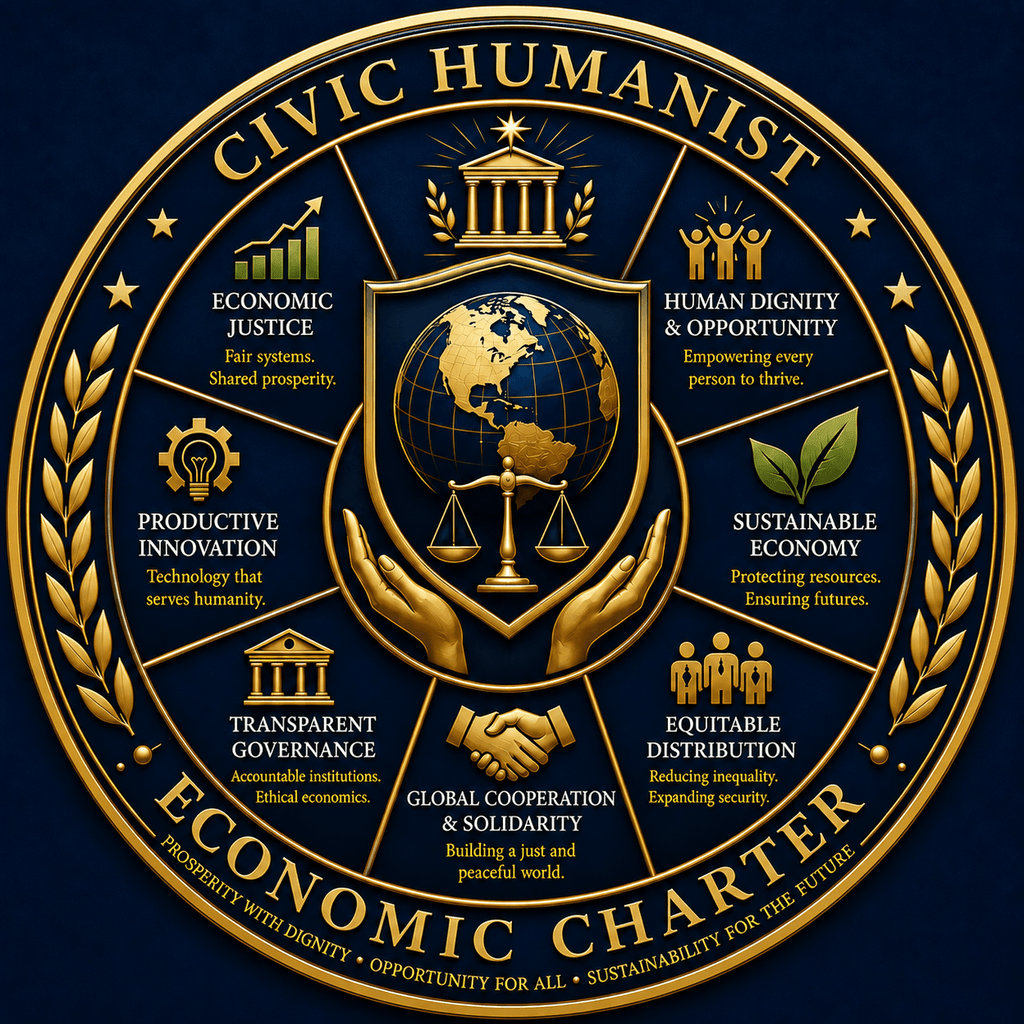
The Civic Humanist Economic Charter
A Charter for Economic Balance, Human Dignity, and Global Prosperity
Preamble
The purpose of an economic system is to provide the material conditions necessary for human flourishing. Economic institutions must enable individuals to develop their capabilities, participate productively in society, and enjoy the benefits of civilization while preserving the natural resources upon which future generations depend.
Modern economic development has produced extraordinary improvements in productivity, medicine, communications, and material living standards. Yet these achievements coexist with persistent poverty, extreme concentrations of wealth, environmental degradation, and unequal access to economic opportunity. The increasing integration of the global economy requires institutions capable of addressing problems that extend beyond national jurisdictions.
The Civic Humanist Economic Charter establishes a framework for organizing economic life according to the principles of secular humanism, scientific inquiry, democratic governance, and global responsibility. It recognizes private enterprise, public institutions, and cooperative economic arrangements as legitimate components of a balanced economic system, subject to their demonstrated contributions to human welfare.
This Charter affirms the right to private property and economic participation while recognizing that economic rights carry corresponding responsibilities. The accumulation of wealth is legitimate insofar as it remains consistent with the rights of others and the preservation of a just economic order. No individual or institution possesses an unlimited entitlement to accumulate economic power at the expense of society.
Economic policy must remain open to scientific examination and democratic revision. The fundamental ethical commitments of this Charter shall provide continuity, while the specific mechanisms of taxation, monetary regulation, public investment, and wealth distribution shall be evaluated and improved according to changing circumstances.
Accordingly, this Charter establishes the principles of Civic Humanist economics and provides a foundation for national legislation, international cooperation, and the development of institutions dedicated to global economic balance.
Article I — Foundational Economic Principles
Section 1 — Human Dignity and Economic Rights
Every person possesses inherent dignity and an equal claim to fundamental human rights. Economic institutions shall respect these rights and support meaningful access to the necessities of life, including adequate nutrition, clean water, housing, healthcare, and education.
Economic opportunity shall not be restricted by arbitrary discrimination or inherited social status. Governments shall establish conditions under which individuals can pursue productive livelihoods and participate in economic life without exploitation.
Section 2 — Economic Freedom and Responsibility
Individuals shall enjoy the freedom to own property, establish enterprises, engage in lawful trade, and pursue economic advancement.
These freedoms shall operate within a framework of public law that protects competition and prevents the abuse of economic power. Private economic activity shall remain accountable for its effects upon workers, consumers, communities, and the environment.
Section 3 — Reciprocity
Individuals and institutions that benefit from public infrastructure, legal protections, scientific knowledge, and shared natural resources possess corresponding obligations to contribute to their maintenance.
Taxation and other lawful contributions shall be determined according to principles of fairness, economic capacity, and the public interest.
Section 4 — Scientific Economic Governance
Economic policy shall be informed by empirical evidence and evaluated according to measurable outcomes. Governments shall maintain reliable economic statistics and provide public access to information necessary for democratic accountability.
Economic theories and policy instruments shall remain subject to critical examination. No particular arrangement of public and private ownership shall be regarded as universally appropriate independent of its consequences.
Section 5 — Global Responsibility
National economies operate within an interconnected international system. Economic decisions that produce substantial consequences beyond national borders create responsibilities requiring international cooperation.
The development of global economic institutions shall respect democratic sovereignty while establishing common standards where independent national regulation is insufficient.
Article II — The Purpose and Organization of Economic Systems
Section 1 — Human Flourishing
The primary purpose of economic activity shall be to sustain and improve the material conditions of human life.
Economic growth shall be evaluated according to its contribution to human welfare rather than treated as an independent objective. Measures of national prosperity shall account for living standards, economic security, public health, and environmental sustainability.
Section 2 — A Balanced Economic System
The Civic Humanist economic framework recognizes the complementary roles of private enterprise, public institutions, and cooperative ownership.
Markets can coordinate production and encourage innovation, while public institutions provide essential services and establish the legal conditions necessary for fair competition. Cooperative arrangements may offer additional opportunities for shared ownership and democratic participation in economic life.
The appropriate distribution of responsibilities among these institutions shall be determined through evidence-based public policy.
Section 3 — Productive Wealth
The creation of wealth through productive enterprise, innovation, and investment shall be encouraged.
Economic policy shall distinguish between activities that create lasting economic value and practices that extract wealth through fraud, coercion, corruption, or anticompetitive conduct.
Section 4 — Economic Security
Governments shall establish reasonable protections against poverty and economic insecurity while preserving incentives for productive participation.
Social protection systems shall be designed according to demonstrated public needs, fiscal sustainability, and the principle of equal human dignity.
Article III — Private Property and the Regulation of Wealth
Section 1 — The Right to Private Property
The right to acquire, possess, use, and transfer private property shall be protected by law.
Restrictions upon property rights shall require legitimate public purposes, transparent legal standards, and appropriate procedural safeguards. Economic regulation shall not authorize arbitrary confiscation or political discrimination.
Section 2 — The Concentration of Economic Power
The concentration of private wealth may create economic and political power extending beyond the legitimate purposes of private ownership.
Governments shall therefore maintain institutions capable of preventing monopolistic practices, unlawful market manipulation, and the use of concentrated economic resources to undermine democratic governance.
Section 3 — The Global Private Wealth Ceiling
This Charter establishes the Global Private Wealth Ceiling Proposal (GPWCP) as a proposed mechanism for limiting excessive concentrations of individual private wealth through coordinated international law.
The GPWCP shall seek to establish a maximum permissible level of individual net wealth based upon economic research, international consultation, and democratic legal authorization.
The ceiling shall not be determined arbitrarily. Its level and implementation shall be informed by analysis of global wealth distribution, productive investment, economic mobility, and the effects of concentrated wealth upon democratic institutions.
Section 4 — Determination of the Wealth Ceiling
An international economic research process shall evaluate alternative wealth ceilings and their likely consequences.
The proposed ceiling shall account for differences in national economic conditions and purchasing power. Its application shall require consistent standards for the valuation of assets, liabilities, beneficial ownership, and economic control.
Periodic reviews shall determine whether the ceiling continues to serve its intended purposes without imposing disproportionate economic costs.
Section 5 — Enforcement and Legal Protections
Any binding wealth ceiling shall be implemented through legislation consistent with applicable constitutional and international legal obligations.
Enforcement shall include independent review, protection against arbitrary decisions, and accessible judicial remedies.
The treatment of wealth exceeding the established ceiling shall be determined by law, with consideration given to taxation, regulated divestment, and other lawful mechanisms.
Article IV — Taxation and Public Finance
Section 1 — The Purpose of Taxation
Taxation provides the financial foundation for public institutions and shared services. It constitutes a reciprocal obligation arising from participation in an organized society.
Tax systems shall be transparent and designed to distribute public obligations fairly while supporting sustainable economic activity.
Section 2 — Progressive Taxation
The Charter recognizes progressive taxation as a legitimate means of distributing fiscal obligations according to economic capacity.
Tax policy shall consider the combined effects of income, consumption, property, inheritance, and capital taxation. Rates and thresholds shall be evaluated according to their consequences for public revenue, economic opportunity, investment, and wealth concentration.
Section 3 — International Tax Cooperation
Governments shall cooperate to reduce unlawful tax evasion and improve transparency concerning cross-border financial holdings.
International agreements should establish compatible standards for beneficial ownership and financial reporting while respecting lawful privacy protections.
Section 4 — Public Financial Accountability
Public budgets, government borrowing, and major expenditures shall be subject to independent audit and democratic oversight.
Government financial information shall be accessible in forms that permit meaningful public examination, subject to narrowly defined legal exceptions.
Article V — Monetary Systems, Banking, and Finance
Section 1 — Monetary Stability
Monetary institutions shall support stable economic exchange and preserve confidence in national financial systems.
Monetary policy shall account for inflation, employment, financial stability, and the long-term purchasing power of money, consistent with the lawful mandates of monetary authorities.
Section 2 — Banking and Credit
Banking institutions shall provide reliable financial services and facilitate productive investment.
Financial regulation shall address systemic risk, deceptive practices, excessive leverage, and conflicts of interest that threaten depositors or the wider economy.
Section 3 — Interest Rates and Debt
Interest-rate policy shall be evaluated according to prevailing economic conditions rather than fixed ideological assumptions.
Public and private debt arrangements shall be governed by transparent terms and appropriate protections against predatory lending.
Section 4 — Ethical Financial Institutions
The Charter recognizes the legitimacy of private banking, public banking, cooperative finance, and other lawful financial arrangements.
Their performance shall be evaluated according to financial sustainability, public accountability, and their contribution to productive economic activity.
Article VI — Production, Labor, and Technological Development
Section 1 — Productive Economic Capacity
Governments shall support the conditions necessary for productive enterprise and economic resilience.
Public investment may be directed toward infrastructure, scientific research, and other activities where demonstrable public benefits justify the expenditure.
Section 2 — Labor and Economic Participation
Workers shall enjoy fundamental labor rights and protection against unsafe or exploitative employment practices.
Economic policy shall encourage productive employment and provide opportunities for continuing education as technology changes the organization of work.
Section 3 — Scientific and Technological Innovation
Scientific research and technological development shall be recognized as important sources of economic progress.
Governments shall support research and innovation while maintaining appropriate safeguards against harmful applications and excessive concentration of technological control.
Section 4 — Automation and Artificial Intelligence
The economic benefits of automation shall be evaluated in relation to productivity, employment, income distribution, and public welfare.
Governments may examine mechanisms such as employee ownership, public technology trusts, and social dividends where evidence demonstrates their effectiveness.
Article VII — The Economic Balance Framework
Section 1 — Principles of Economic Balance
Economic balance shall refer to conditions under which productive capacity, private wealth, public resources, and ecological sustainability remain compatible with long-term human welfare.
The objective shall not be absolute equality of wealth or income, but the prevention of economic arrangements that produce persistent deprivation or excessive concentrations of power.
Section 2 — The Human Economic Equilibrium Framework
The Human Economic Equilibrium Framework (HEEF) shall provide a proposed method for examining economic and social conditions across the dimensions of wealth equity, social health, ecological sustainability, human development, and civic trust.
These dimensions may inform the development of an Equilibrium Score, provided that its methodology is transparent and independently validated.
Section 3 — Public Resource Allocation
Public resources shall be allocated according to demonstrated needs, expected social benefits, and long-term fiscal sustainability.
Governments shall evaluate competing expenditures using transparent methods that consider both immediate outcomes and future obligations.
Section 4 — Economic Measurement
Economic performance shall be assessed through multiple indicators rather than gross domestic product alone.
Measurement systems shall distinguish observed conditions from normative judgments and disclose the assumptions underlying composite economic indices.
Article VIII — Ecological Stewardship
Section 1 — Ecological Responsibility
Economic activity shall respect the environmental conditions necessary to sustain human civilization and the wider biosphere.
Governments shall establish regulations addressing pollution, resource depletion, and other environmental harms according to scientific evidence and applicable law.
Section 2 — Sustainable Development
Economic development shall seek to improve human living standards without imposing unjustifiable environmental costs upon future generations.
Public and private investment decisions shall account for material ecological risks and the long-term costs of environmental damage.
Section 3 — Intergenerational Responsibility
The benefits of present economic activity shall be considered alongside its consequences for future populations.
Governments shall incorporate long-term environmental and infrastructural obligations into public planning and financial assessments.
Article IX — International Economic Cooperation
Section 1 — Global Economic Coordination
Participating governments shall pursue international cooperation where common economic challenges cannot be adequately addressed through independent national action.
Such cooperation may include financial transparency, economic stability, sustainable development, and the regulation of cross-border concentrations of wealth.
Section 2 — International Government Organization for Economic Balance
The Charter recognizes the proposed International Government Organization for Economic Balance (IGOEB) as a potential institution for coordinating economic research and facilitating international agreements concerning economic balance.
Its authority, membership, and responsibilities shall require separate legal definition and agreement among participating governments.
Section 3 — Economic Research and Accountability
The proposed Global Equilibrium Index and Equilibrium Data Ledger may provide mechanisms for comparative economic analysis and public reporting.
Their development shall require independently reviewed methodologies and appropriate protections for confidential information.
Section 4 — Ethical Economy Council
The proposed Ethical Economy Council shall provide a forum for examining the ethical implications of economic policy and institutional development.
Its advisory responsibilities shall remain distinct from the legislative authority of democratically accountable governments.
Article X — Economic Education and Civic Responsibility
Section 1 — Economic Literacy
Economic education shall be recognized as an important component of civic participation.
Educational institutions should provide opportunities to understand the principles of taxation, monetary systems, public finance, investment, and economic policy.
Section 2 — Scientific and Ethical Reasoning
Economic education shall encourage critical examination of competing theories and their practical consequences.
Citizens shall be equipped to distinguish empirical evidence from ideological assertions and evaluate economic proposals according to their likely effects.
Section 3 — Responsible Economic Participation
Individuals and institutions shall be encouraged to consider the consequences of their economic decisions for others.
Public education shall promote an understanding of economic interdependence without imposing compulsory adherence to a particular economic ideology.
Article XI — Institutional Rights and Responsibilities
Section 1 — Corporate Responsibility
Corporations shall operate within the law and remain accountable for their obligations to employees, consumers, shareholders, and affected communities.
Corporate governance shall incorporate appropriate mechanisms for financial transparency and the prevention of unlawful or harmful conduct.
Section 2 — Public Institutions
Government economic institutions shall remain subject to democratic oversight and independent legal review.
Public authority shall not be used to confer arbitrary economic privileges or suppress lawful competition.
Section 3 — Prevention of Economic Capture
Governments shall maintain safeguards against corruption and the improper influence of concentrated economic interests.
Regulatory institutions shall operate under transparent procedures and disclose relevant conflicts of interest.
Article XII — Implementation and International Legal Development
Section 1 — Progressive Implementation
The principles of this Charter shall be advanced through lawful, democratic, and evidence-based institutional reform.
Implementation shall account for national economic conditions and the administrative capacity of participating jurisdictions.
Section 2 — Economic Research Program
A comprehensive research program shall examine the practical requirements of global economic balance, including the proposed private wealth ceiling.
Its findings shall be published for independent review before the adoption of binding international obligations.
Section 3 — International Convention
Participating governments may negotiate a Convention on Global Private Wealth and Economic Balance establishing common definitions, reporting standards, and legally enforceable obligations.
The convention shall specify its relationship to existing international agreements and provide procedures for ratification, amendment, and withdrawal.
Section 4 — Domestic Legislation
International commitments shall be implemented through the lawful legislative processes of participating states.
National legislation shall establish administrative responsibilities, enforcement procedures, and protections for affected persons.
Section 5 — Periodic Review
The economic consequences of implementing this Charter shall be evaluated at regular intervals.
Policy mechanisms may be revised in response to reliable evidence, provided that revisions remain consistent with the Charter’s foundational commitments to human dignity and democratic accountability.
Article XIII — Interpretation and Amendment
Section 1 — Foundational Commitments
The principles of human dignity, equal rights, scientific inquiry, democratic legitimacy, and responsibility toward future generations shall guide the interpretation of this Charter.
These commitments shall provide continuity across changing economic circumstances.
Section 2 — Policy Revision
Specific economic mechanisms, including taxation structures and the proposed private wealth ceiling, shall remain open to amendment through established democratic procedures.
Scientific findings shall inform such revisions without displacing public deliberation concerning legitimate ethical and political choices.
Section 3 — Relationship to International Law
Nothing in this Charter shall be interpreted as independently creating binding obligations under international law.
Such obligations shall arise only through applicable legal instruments and the lawful consent of participating states.
Final Declaration
The Civic Humanist Economic Charter affirms that economic systems are institutions created and maintained for the benefit of society. Their legitimacy rests upon their capacity to protect fundamental rights while enabling people to participate meaningfully in economic life.
Private property and productive enterprise remain essential components of economic freedom. Their protection must be reconciled with the responsibility to prevent concentrations of economic power that threaten democratic institutions or undermine the public interest.
The increasing interdependence of national economies requires a corresponding development of international economic cooperation. The regulation of private wealth, the responsible allocation of public resources, and the preservation of ecological stability must be examined within a common framework of economic balance.
The enduring purpose of this Charter is to establish the principles through which economic institutions may be improved as scientific knowledge and human civilization advance.
We affirm an economic order in which wealth serves human flourishing, economic power remains accountable to law, and prosperity contributes to the development of a better world.
Explore the Civic Humanist Charter System — a science-based framework for ethical governance, human flourishing, and the future of civilization.