
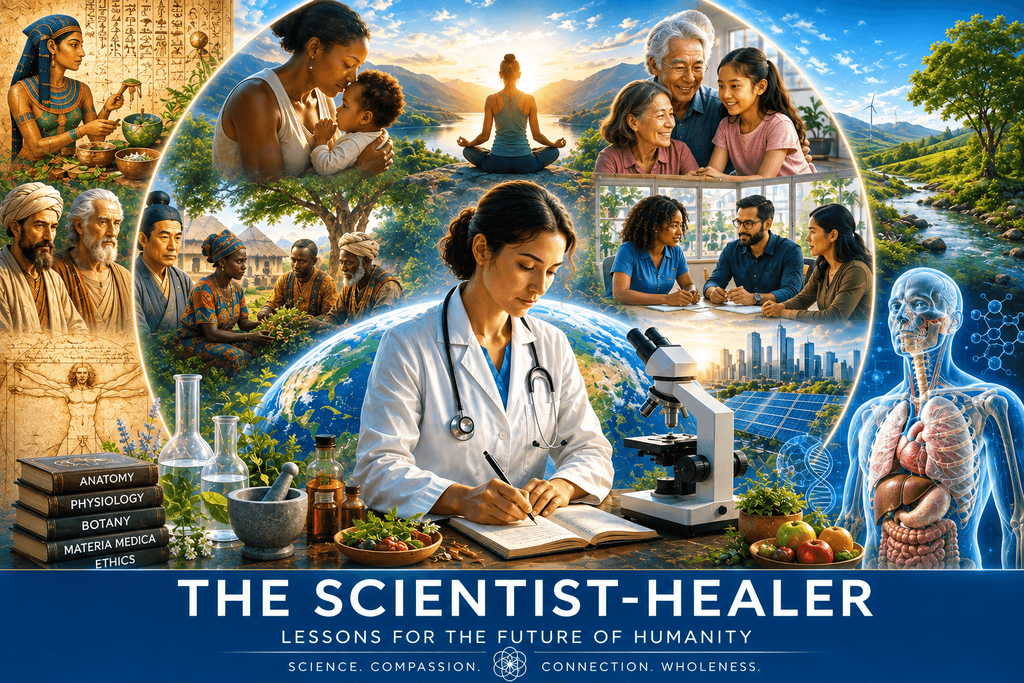
The Scientist-Healer
Lessons for the Future of Humanity
Introduction
Long before medicine became a profession, people cared for the sick and injured. The healer is one of humanity’s oldest social roles. Across human societies, people acquired practical knowledge of recovery through experience. They learned to tend wounds and recognize useful plants. They also discovered that rest and the presence of a trusted caregiver could make suffering easier to bear.
Healers also tried to explain illness. Some explanations reflected close observation; others invoked supernatural causes that modern science has not substantiated. The history of healing is not simply the replacement of superstition by science. It is a record of people learning from experience, sometimes drawing sound conclusions and sometimes mistaking coincidence for causation. Modern medicine emerged as methods for testing those conclusions became more reliable.
A secular scientific humanist approach can inherit this entire history without being bound by its mythology. The healer of the future need not choose between the laboratory and the ancient human art of care. The scientist-healer brings them together. The scientist-healer combines an interest in what evidence can establish with an obligation to understand the person receiving care. Scientific knowledge guides treatment, while the experience of illness gives that knowledge its immediate purpose.
The First Healers
The earliest healing traditions grew out of the demands of survival. Knowledge of injury, illness, childbirth, and the natural environment accumulated through observation and was passed between generations. In many Indigenous societies, healing was embedded in communal life rather than separated into a technical profession.
Traditions differ greatly, but some understand illness in relation to the person’s social and environmental circumstances. Research on Indigenous health continues to examine these relationships, without assuming that every traditional explanation is scientifically valid.
Traditional healing often combined useful observation with symbolic explanation. A plant may have a measurable pharmacological effect even when the theory used to explain it is mistaken. A ceremony may offer reassurance without demonstrating the supernatural claims associated with it. The scientist-healer distinguishes an intervention’s observed effects from the beliefs surrounding it.
Egypt, India, China, and Greece
Ancient Egypt left some of the earliest extensive medical records. Its practitioners documented clinical conditions and treatments, particularly the care of wounds. Practical observation existed alongside religious and magical explanations of disease.
Ancient India developed an especially systematic medical culture through Ayurveda, literally the “knowledge” or “science of life.” By roughly the first millennium BCE, Indian medicine increasingly emphasized observation, reasoning, diagnosis, prevention, diet, lifestyle, pharmacology, and surgery. The Charaka Samhita became associated particularly with medicine, while the Sushruta Samhita preserved an important surgical tradition. Ancient Indian physicians were expected to undergo extensive training and observe ethical standards.
Ayurveda gave considerable attention to the patient’s daily life and the prevention of illness. Its classical theory of doshas, however, is not equivalent to modern physiology. A historical tradition can offer worthwhile observations without all of its explanatory claims being correct.
Chinese medicine developed another sophisticated tradition of observation, herbal medicine, diet, movement practices, massage, moxibustion, and acupuncture. The Huangdi Neijing, assembled through a long textual history beginning more than two millennia ago, became one of its foundational works. Early Chinese practitioners developed substantial practical knowledge. Nevertheless, classical concepts such as qi and meridians should not be treated as anatomical structures verified by modern science.
The scientific question is instead whether particular practices produce measurable benefits. Acupuncture, for example, has been extensively investigated, with evidence varying considerably by condition and outcome. Its possible effects can be investigated through neurophysiology, sensory stimulation, expectation, contextual effects, and pain modulation without first accepting the classical metaphysical explanation.
Ancient Greek medicine made another decisive contribution. The Hippocratic tradition increasingly treated illness as a natural phenomenon that could be observed, described, predicted, and treated without assuming divine causation. The famous Hippocratic discussion of epilepsy argued explicitly that the “sacred disease” had natural causes like other illnesses. Greek humoral theory was ultimately wrong, but the methodological transition was profound: disease became something nature could explain. That principle remains foundational to the scientist-healer.
The Healer Across Cultures
Medical knowledge also developed across Mesopotamia and the Persian and Islamic worlds. Practitioners drew upon local experience and inherited scholarship, sometimes combining effective care with supernatural interpretations. Celtic communities undoubtedly treated illness and injury, but the evidence for specific Druidic medical practices is limited. Later accounts of sacred wells and ritual healing should not be read uncritically as descriptions of ancient medicine.
Similar caution is necessary for Nordic and Germanic traditions. Surviving texts mention practical healing alongside charms, but much of the written evidence postdates the events described. Modern reconstructions cannot substitute for historical sources.
Indigenous healing traditions throughout the world preserve knowledge developed in particular environments. Their remedies deserve careful scientific study, and the communities that sustain this knowledge deserve respect for their rights and intellectual contributions. Neither romanticization nor wholesale dismissal is a sound method of evaluation.
This is increasingly close to the position being adopted internationally. The World Health Organization’s Global Traditional Medicine Strategy 2025–2034 calls for preserving valuable knowledge while strengthening scientific evidence, safety, professional standards, regulation, and appropriate integration into health systems. It explicitly states that longevity of use is not itself evidence that a treatment is effective. That is an important principle: tradition deserves investigation, not automatic belief or automatic dismissal.
From Traditional Healing to Organized Medicine
As civilizations became larger and more interconnected, healing gradually developed from knowledge held primarily within families, communities, temples, courts, and local traditions into increasingly organized systems of medical practice. This development did not occur along a single line from one civilization to another. Medical knowledge moved through trade, migration, conquest, translation, and scholarly exchange, while different societies continued to develop methods suited to their own environments and understandings of the human body.
Africa developed many distinct medical traditions, drawing on local ecological knowledge and practical experience. Some traditions also explained illness through spiritual beliefs. Their therapeutic claims can be evaluated without treating the continent as a single medical culture or accepting every inherited explanation.
An especially important center of medical development emerged in the medieval Middle East and Persian world. Scholars including al-Razi and Ibn Sina worked within an intellectual culture that translated and studied Greek medical literature while incorporating knowledge from Persian, Indian, and other traditions.
Physicians developed extensive writings on diagnosis, pharmacology, surgery, infectious illness, and clinical practice, while hospitals became important centers for treatment and medical learning. Their achievement was not simply the preservation of ancient knowledge. Medical ideas were compared, criticized, reorganized, and extended before later circulating into European medical schools and becoming part of the inheritance from which modern medicine developed.
Japan provides another example of medicine evolving through cultural exchange. Early Japanese healing incorporated local practices alongside medical knowledge transmitted from China and Korea. Chinese-derived herbal medicine eventually developed into the distinct Japanese tradition known as Kampō, while acupuncture, moxibustion, massage, and other forms of treatment were adapted within Japanese society.
During the early modern period, increasing contact with European medicine introduced new approaches to anatomy and surgery. Japanese medicine therefore became a particularly clear example of medical traditions changing when practitioners encountered competing explanations of the body and new forms of evidence.
In Europe, anatomical research and experimental physiology gradually challenged established medical theories. Germ theory eventually transformed the explanation of infectious disease. Hospitals also changed from institutions devoted largely to refuge and care into centers of clinical investigation and treatment.
The development of professional nursing transformed another ancient dimension of healing: sustained care for the sick. Nursing existed long before it became a modern profession, but its professionalization during the nineteenth and twentieth centuries brought systematic training, sanitation, observation, record keeping, and evidence-based practice into the continuous care of patients.
Nursing also made clear that successful treatment depends on more than a physician’s intervention. Patients need competent daily care, and failures in that care can undermine otherwise effective medicine. Physical therapy and rehabilitation extended this understanding by making recovery an active process. Carefully prescribed movement can help restore function after injury or illness. The patient is not merely the recipient of treatment but a participant in rebuilding capacity.
During the twentieth century, medical specialization expanded rapidly. It made possible advances that no general practitioner could have achieved alone, but it also divided responsibility for the patient among different professionals. Coordinating their work became a central challenge.
This created one of the central problems to which the scientist-healer responds. The answer is not to abandon specialization or return nostalgically to the traditional village healer. Modern medicine became specialized because specialized knowledge works. The challenge is to preserve that knowledge while recovering the ability to see how its different parts belong to the life of a single human being.
The scientist-healer therefore represents not a return to premodern medicine, but a further development of the healer’s historical role. The accumulated knowledge of specialists remains indispensable. What must be restored is the capacity to understand healing as a process involving the whole person and to coordinate knowledge around that person rather than expecting the person to fit the divisions through which modern healthcare has organized itself.
From Healer to Medical Scientist
Modern medicine changed most profoundly when methods of testing claims became more rigorous. Earlier healers relied on accumulated experience and inherited theories. Scientific medicine increasingly demanded evidence that an intervention actually changed outcomes.
Anatomical research gave physicians a more accurate understanding of the body, while experimental physiology helped explain its functions. Work on circulation and cellular biology gradually displaced theories that could not withstand observation. These advances made it possible to test medical explanations against the structure and behavior of living tissues.
In the nineteenth century, germ theory demonstrated the role of microorganisms in many infectious diseases. Antiseptic methods reduced surgical infections, while anesthesia made complex procedures more tolerable and feasible. Together, these developments changed both the safety of treatment and the understanding of disease.
Vaccination established the enormous value of prevention. Antibiotics later transformed treatment of bacterial infection, and epidemiology helped researchers understand disease across populations. Medical progress increasingly depended on explanations that could be tested.
The development of controlled clinical trials extended this principle directly to treatment. A therapy could no longer be considered effective simply because a physician believed that patients improved after receiving it. Treatments could be compared with alternatives, placebos, or existing standards of care, while statistical methods helped researchers determine whether apparent improvements were likely to represent genuine effects. Evidence-based medicine developed from this larger effort to connect clinical decisions with the best available research rather than relying primarily upon tradition, authority, or personal experience.
During the twentieth and twenty-first centuries, medical imaging, genetics, molecular biology, immunology, neuroscience, and increasingly sophisticated laboratory methods have allowed medicine to investigate the living body at levels earlier healers could scarcely have imagined. The mechanisms of disease can now be studied from populations and whole organs down to cells, proteins, genes, and molecular interactions. These advances have produced treatments of extraordinary precision and effectiveness, while also revealing how much remains unknown.
The scientific approach also established that no treatment deserves exemption from scrutiny. Whether a practice is ancient or newly developed, its benefits and risks must be established through appropriate evidence. A convincing explanation alone cannot substitute for evidence of clinical benefit.
Science therefore changes the relationship between healer and knowledge. The scientist-healer does not inherit a fixed body of medical truth, but participates in a continually corrected understanding of the human organism. Some traditional practices survive investigation and acquire better explanations. Others prove ineffective or harmful and should be abandoned. Modern treatments are subject to the same standard and may likewise be revised or replaced when better evidence emerges.
The willingness to revise a belief is a strength of scientific medicine. Professional authority should depend on demonstrated competence and the capacity to acknowledge uncertainty, rather than claims of infallibility. When findings change, responsible practice must change with them.
The Rediscovery of the Body
Rehabilitation has brought renewed attention to the body’s capacity for adaptation. Physical therapy demonstrates how guided activity can restore function that illness or injury has impaired. Recovery often depends on sustained practice rather than a single intervention.
Modern exercise science has made this principle particularly clear. Aerobic exercise and resistance training affect cardiovascular function, muscle, bone, metabolism, balance, cognition, mood, and functional independence. Reviews associate resistance training with improved physical function and lower mortality risk, while large analyses also find substantial evidence that exercise can reduce symptoms of depression.
A qualified personal trainer can help people improve physical capacity, although training is not a substitute for diagnosis or clinical rehabilitation. The distinction matters: useful work in support of health does not confer the authority to treat disease. Clear professional boundaries protect patients while allowing different practitioners to contribute to their well-being.
Therapeutic massage represents another ancient practice surviving within modern health culture. Touch can relax muscle, modify the experience of pain, provide sensory stimulation, and create a period of focused interpersonal care. Scientific evidence suggests that massage can provide short-term relief for some musculoskeletal pain conditions, although evidence is weaker than promotional claims sometimes imply and durable benefits are not established for many conditions.
Massage therefore need not be explained through invisible energies, toxins being “released,” or other poorly supported mechanisms. Its legitimate effects are interesting enough without disproven beliefs. Claims about massage should remain proportionate to what clinical studies actually demonstrate.
Healing the Mind
The history of psychological healing followed a similar trajectory. People have always sought relief from grief, fear, traumatic experience, despair, unusual perceptions, compulsions, interpersonal conflict, and emotional suffering. Earlier societies variously interpreted such conditions through possession, moral failure, imbalance, divine intervention, temperament, or bodily disease. Modern psychiatry, psychology, neuroscience, and psychotherapy gradually developed more testable models.
Psychotherapy provides one particularly revealing example of what scientific healing can mean. Different therapies use different techniques, but research repeatedly finds that the therapeutic alliance—the quality of the collaborative relationship between practitioner and patient—is associated with better outcomes. One major meta-analysis involving more than 30,000 patients found this relationship across different forms of psychotherapy and different countries.
What Actually Heals?
Healing does not depend on a universal mysterious force. The body has multiple mechanisms for responding to injury and adapting to changing demands. Tissue repair and immune responses are biological processes; rehabilitation also depends on the nervous system’s capacity to learn. Treatment can support these processes, but it does not make them unlimited.
Recovery is influenced by a person’s circumstances and by the care they receive. Different interventions work through different mechanisms, and their effectiveness must be assessed for the condition being treated. The course of illness also varies, so improvement following treatment does not by itself establish that the treatment caused it.
Even the placebo effect has become scientifically interesting. Expectations, conditioning, therapeutic ritual, attention, and interactions with clinicians can influence pain and other symptoms through measurable neurobiological processes, including endogenous opioid and other signaling systems. These effects are most clearly demonstrated for subjective experiences such as pain, anxiety, and fatigue; they should not be mistaken for evidence that thought can simply eliminate tumors, kill pathogens, mend major injuries, or cure every disease.
Mental activity has physical effects because it arises from the nervous system and influences bodily processes. Recognizing this connection does not justify treating every illness as a product of thought. The relevant mechanisms must still be investigated rather than presumed.
Dispelling the Myths of Healing
The scientist-healer rejects unsupported explanations without dismissing every practice associated with them. Concepts such as qi and prana may have cultural significance, but they should not be presented as verified biological mechanisms. Natural origin does not guarantee safety. Plants can contain useful medicines, but they can also be toxic. Traditional remedies require the same attention to evidence and possible harm as other treatments.
Symptom relief and treatment of the underlying disease are not always the same. A patient may experience less pain while the cause remains untreated. Clinical claims must distinguish between these outcomes.
Personal accounts can suggest questions worth studying, but they rarely establish what caused an improvement. Many conditions fluctuate or resolve without treatment. Controlled studies help determine whether a remedy provides benefits beyond what would otherwise occur.
Healing the Interconnected Whole
The Science of Wholeness begins with the recognition that no person lives in isolation. Individual health is influenced by relationships and by the conditions of the surrounding society. The study of healing is incomplete when it ignores these influences.
This does not mean every illness has a social cause. A fracture still requires appropriate clinical care, and a genetic disorder cannot be explained by family dynamics. The point is to identify the scale at which a problem arises and choose an intervention suited to it.
At the personal level, healing concerns the physical and psychological well-being of the individual. Yet the family and household can profoundly affect recovery. A supportive home may help someone follow treatment, while persistent conflict may contribute to distress. When the home environment is part of the problem, individual care alone may be insufficient.
At the community level, health depends partly on the circumstances of everyday life. People exposed to unsafe housing or persistent pollution face risks that personal discipline cannot remove. Improving these conditions requires collective action, making public health a civic responsibility as well as a medical concern.
Organizations shape the well-being of the people who depend on them. Poor management and unsafe working conditions can contribute to chronic stress or injury. When the source of suffering lies in institutional practice, the remedy may require organizational reform rather than another demand that individuals adapt.
The ecosystem provides the physical conditions upon which human health depends. Pollution and ecological degradation can create disease risks that extend far beyond a single patient. Environmental protection is therefore relevant to prevention, while ecological restoration can help repair damage already done.
At the scale of civilization, threats such as war and pandemics can damage health across entire populations. No clinician can resolve these dangers through individual treatment. Reducing their consequences depends on effective public institutions and the capacity for international cooperation.
Human civilization is part of the biosphere and depends on its continuing stability. A society might improve its ability to treat disease while damaging the environmental conditions necessary for life. Advanced medicine alone would not make such a society healthy.
This broader view does not make every healer an expert in public policy or environmental science. Specialization remains essential. The practical obligation is to recognize the limits of one’s competence and work with others when a patient’s needs extend beyond it.
Wholeness requires no supernatural explanation. The relationships between health and the surrounding world can be observed and studied. Their effects differ from case to case, so the presence of a connection should never be confused with proof of a particular cause.
A modern healer must see the patient clearly while remaining alert to conditions that treatment alone cannot change. Sometimes the appropriate response is clinical care; sometimes it is a referral or an effort to improve the environment in which illness develops. The Science of Wholeness examines how the conditions of life influence health and recovery across interconnected systems. Its purpose is to help practitioners identify where intervention can make a real difference, without losing sight of the person who needs care.
The Scientist-Healer
The scientist-healer is not a new medical license or an alternative practitioner claiming special powers. It is an approach to care grounded in scientific evidence and professional responsibility. The scientist-healer recognizes the person as an integrated biological, psychological, social, and environmental organism. The aim is not merely the absence of disease, nor an undefined mystical state called wellness. The aim is to increase the conditions under which healthy regulation, adaptation, recovery, function, autonomy, and flourishing become possible.
Several practical obligations follow from this approach. A practitioner must first listen carefully and investigate before offering an explanation. Treatment should respond to the person’s actual condition rather than to a favored theory.
Basic conditions of health deserve sustained attention. Appropriate sleep and physical activity can support recovery, although neither should be promoted as a universal cure. Movement can be therapeutic when it is matched to a person’s abilities and medical circumstances. Exercise and rehabilitation should be progressive and remain within the practitioner’s competence.
Therapeutic touch may provide comfort or short-term relief in some circumstances. Practitioners should describe these benefits accurately rather than inventing physiological mechanisms. Mindfulness and other psychological techniques can help some people manage distress. They are skills that may complement appropriate treatment, not substitutes for medical care.
A trustworthy therapeutic relationship can improve the experience of care and support treatment adherence. Its value depends on respect and honest communication, not on misleading patients about what an intervention can achieve. Knowing when to refer is fundamental to safe practice. Unexplained or serious symptoms require assessment by appropriately qualified professionals. Good intentions do not replace clinical competence.
Practitioners should assess whether treatment is helping, using outcomes that matter to the patient and are appropriate to the condition. When an approach fails, it should be reconsidered. Every practitioner must remain willing to revise a method when evidence changes. The obligation to learn does not end with professional training. Taken together, these practices make healing a disciplined responsibility rather than a claim to secret knowledge.
The Science of Healing Today
The emerging science of healing is increasingly interdisciplinary. It draws upon many fields because human health cannot be adequately understood from the perspective of any single discipline. Medicine provides the foundations for understanding disease and physical repair, while neuroscience, immunology, psychology, nutrition, exercise science, and rehabilitation have progressively revealed how biological and behavioral processes interact in maintaining health and recovering function.
Public health research shows that the circumstances of daily life influence who becomes ill and who can recover. These findings connect the treatment of individual patients with the responsibility to improve conditions beyond the clinic.
Traditional medicine is increasingly subject to formal scientific assessment. The WHO strategy calls for stronger evidence and appropriate safeguards before practices are integrated into health systems. The opportunity for the scientist-healer is to preserve the achievements of specialized medicine while restoring attention to the patient’s wider experience. This requires better coordination, not a return to an imagined medical past.
Lessons for the Future of Humanity
For much of history, healers occupied an important place in community life because illness makes dependence on others unavoidable. That need has not disappeared with the growth of modern medicine. Modern medicine can accomplish things earlier generations could scarcely imagine. Its technical achievements have saved lives and restored capacities that once seemed permanently lost.
Specialization can nevertheless divide care among professionals who see different aspects of the same patient. The challenge is to coordinate their expertise without sacrificing its precision. The scientist-healer applies evidence without losing sight of suffering. This approach values the historical experience of caregiving while remaining prepared to reject any treatment that fails careful investigation.
The history of healing shows how much can be learned about recovery and how much remains uncertain. Not every illness can be cured. Even when treatment cannot reverse a condition, competent and compassionate care can still reduce suffering. The scientist-healer uses the best available knowledge in the service of the person who needs help. That is the enduring purpose of healing, and the standard by which its future progress should be judged.
About the Author
D. B. Smith is the founder of Science Abbey, a historian and writer, and a lifelong practitioner of contemplative and physical disciplines. A competitive gymnast in his youth, he became nationally licensed in therapeutic massage, neuromuscular stretching, and nutrition before attending college, and subsequently worked as a professional personal trainer. During this period, he also began a lifelong practice of Zen meditation, qigong, tai chi, yoga, and martial arts, developing a sustained interest in the relationship between physical health and mental well-being.
He later studied political science at the University of Iowa and served as Librarian and Curator of the George Washington Masonic National Memorial. A lay Sōtō Zen practitioner and 32° Scottish Rite Freemason, his work at Science Abbey explores the integration of scientific knowledge, humanist philosophy, and contemplative practice in the development of a better world.