

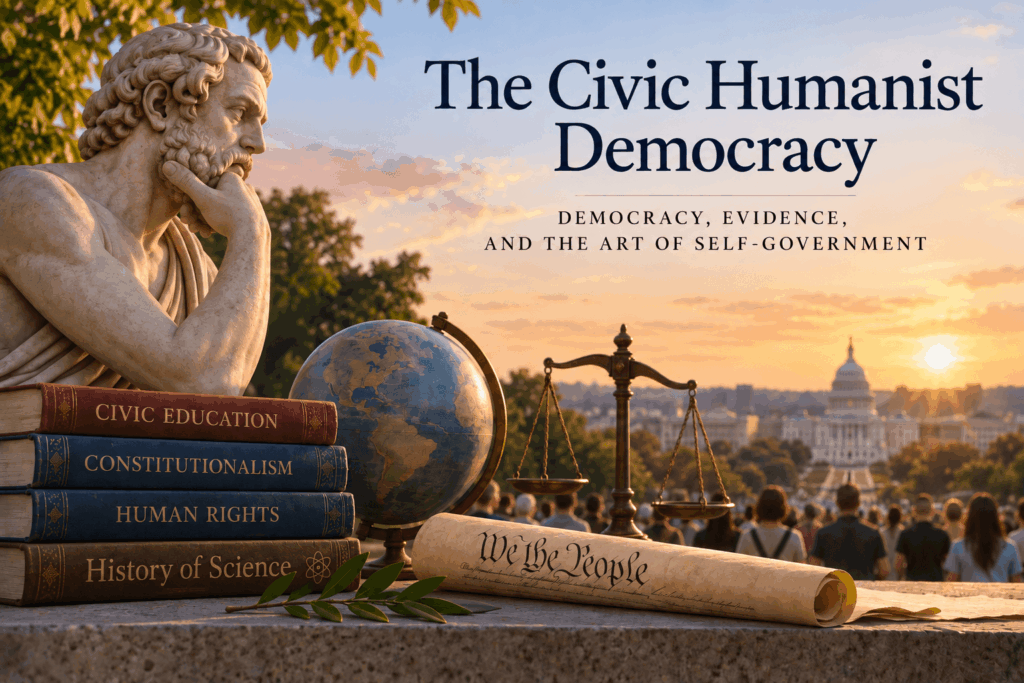
The Civic Humanist Democracy
Democracy, Evidence, and the Art of Self-Government
Contents
Introduction — Democracy and Self-Government
I. The Long Experiment in Democracy
II. Democracy’s Achievement—and Its Danger
III. The Civic Humanist Model
IV. Democracy as Collective Intelligence
Sources
Introduction — Democracy and Self-Government
Modern democracy ordinarily includes competitive elections and political freedoms that allow citizens to participate in public life. Yet democracy alone does not guarantee good government. Majorities can be mistaken, citizens can be misinformed, and even legitimately elected governments can threaten the rights of minorities.
Public judgment can also be distorted by powerful interests or deliberate manipulation. The challenge is therefore not merely to make government democratic. Democratic authority must operate within constitutional restraints and remain responsive to reliable knowledge, while institutions must be capable of governing effectively over the long term.
The Long Experiment in Democracy
Democracy takes many forms. Ancient Athens developed the best-known early system of direct democracy. Eligible male citizens participated personally in assemblies and voted on important public questions. Some officials were elected, while others were chosen by lot rather than entrusted permanently to a professional political class.
Other civilizations developed traditions of collective decision-making without necessarily creating what we would now call democracy. The Roman Republic established a particularly influential mixed constitution. Authority was divided among magistrates, popular assemblies, and the Senate, although political influence remained distributed very unequally throughout Roman society.
The Magna Carta was not a democratic document itself, but it served as the foundational catalyst for modern constitutional democracy. When King John of England signed the charter in 1215, he had no intention of giving power to the ordinary citizen. Instead, it was a treaty to protect wealthy barons from a tyrannical king.
However, “The Great Charter” introduced a revolutionary concept: the ruler is subject to the law, not above it. Over centuries, this principle evolved into the democratic legal systems that protect universal human rights around the world today.
Medieval and early-modern Europe produced numerous experiments in divided political authority. Parliaments and representative estates gradually constrained rulers in some kingdoms, while municipal republics and Swiss communities developed other traditions of collective government. These institutions eventually contributed to the development of modern representative democracy.
The modern democratic transformation accelerated during the Enlightenment and the political revolutions that followed. Constitutional government increasingly challenged inherited political authority. During the nineteenth and twentieth centuries, the gradual expansion of suffrage transformed representative institutions that had originally been accessible to only a relatively narrow population.
Political rights consequently expanded to populations that earlier governments had excluded. Women eventually obtained the vote throughout most democratic societies, while racial and other legal barriers to citizenship were progressively challenged. Decolonization later extended the principle of national self-government across much of the world.
This history produced several ways of organizing democratic government. In direct democracy, citizens themselves decide particular public questions, most commonly through referendums. Representative democracy instead entrusts ordinary governing decisions to elected officials who remain politically accountable to the citizens from whom their authority ultimately derives.
Participatory and deliberative democracy seek to deepen public involvement without necessarily replacing representative institutions. Citizens may participate in assemblies, consultations, or other forums between elections. These approaches treat democracy as an ongoing process of public participation rather than an activity confined primarily to periodically choosing political representatives.
Liberal constitutional democracy adds another essential dimension. Popular government operates within a legal framework that protects individual rights and limits the exercise of state power. Independent courts can enforce those limits. Democratic legitimacy therefore does not mean that every question must be decided by temporary political majorities.
Democracy’s Achievement—and Its Danger
The historical accomplishments of democracy are considerable. Democratic institutions have given ordinary people a peaceful means of choosing their leaders and removing governments that lose public confidence. They have also made political authority more accountable, creating opportunities for citizens to challenge injustice and gradually expand their rights.
Just as importantly, democratic societies can recognize political mistakes without requiring the collapse of the state. Elections can replace unsuccessful governments, while established legislative processes allow failed policies to be revised. Political correction can therefore occur through institutions rather than requiring violence or revolutionary upheaval.
The same history provides ample warnings. Ancient Athens sometimes made disastrous collective decisions. Modern democracies proclaimed popular sovereignty while tolerating profound injustice, including slavery and racial exclusion. Their history demonstrates that democratic institutions do not automatically ensure that everyone subject to political power will be treated justly.
Democratic politics is also susceptible to manipulation and intense factional conflict. Demagogues can exploit public fears, while misinformation can undermine informed political judgment. In extreme cases, movements that gain power through democratic institutions have subsequently weakened the safeguards that allowed genuine political competition to exist.
Democracy therefore cannot mean simply that 51 percent of the population may do whatever it wants. Constitutional rights place limits upon majoritarian power, while the rule of law constrains government itself. Authority can also be divided among institutions so that temporary political victories do not become absolute power.
Democratic government must protect the political freedom on which it depends. An electoral victory gives a majority the authority to govern for a time, not permanent control of the political system. Its opponents must remain free to criticize the government, organize against it, and compete for power in future elections.
The Civic Humanist Model
A Civic Humanist Democracy builds upon this historical experience rather than attempt to replace it. Political authority ultimately remains with the people and is ordinarily exercised through representative institutions. Citizens retain the freedom to oppose their government and peacefully replace those who govern them.
What distinguishes the Civic Humanist model is its focus on universal human rights and its strong commitment to secular and evidence-informed democratic government. This is deliberately different from scientific government. Scientific knowledge should strongly inform decisions involving empirical questions. Expertise, however, does not give scientists or other professionals an independent right to govern society.
Science is extraordinarily useful for understanding how the physical and social world actually works. In fact, it is the most useful method we have for explaining how things work. It can determine whether the climate is warming or whether a medical treatment reduces mortality. Similar methods can investigate environmental dangers and examine the measurable consequences of public policies after their implementation.
Scientific inquiry also helps distinguish reliable conclusions from unsupported claims. It can estimate probabilities and test competing explanations against evidence. Democratic governments can therefore use science to understand the circumstances in which political choices are being made and to anticipate their likely consequences more intelligently.
Science cannot, however, determine every legitimate political value. Evidence may clarify the consequences of increasing government surveillance, but it cannot decide how much privacy citizens should sacrifice for greater security. That decision requires political and ethical judgment informed by evidence rather than dictated by it.
The same distinction applies to environmental policy. Science can describe ecological risks and estimate how different policies might affect them. Citizens must still decide what responsibilities the present generation owes to future generations. Empirical knowledge can clarify the choice without eliminating the underlying question of values.
Expertise therefore has an important but limited place in Civic Humanist Democracy. Specialists should inform public decisions when their knowledge is relevant. Their responsibility is to explain what the available evidence supports and where important uncertainties remain, rather than presenting political preferences as conclusions demanded by science.
Experts should not acquire political sovereignty merely because they possess specialized knowledge. Citizens and their elected representatives remain responsible for choosing among legitimate political ends. An uninformed majority cannot make a false proposition true by voting for it, but expertise cannot determine everything that citizens ought to value.
Democracy as Collective Intelligence
The potential of Civic Humanist Democracy lies in bringing different kinds of knowledge into a common democratic process. Citizens possess experience and local knowledge that professional expertise cannot replace. Specialists contribute forms of knowledge that ordinary citizens cannot reasonably be expected to master independently in every complex field.
A healthy democracy therefore depends upon institutions that approach public questions from different directions. Legislatures deliberate and make law, while courts interpret constitutional limits. Universities and journalism can independently investigate political claims. Their different functions make it more difficult for any single institution to monopolize public knowledge.
Deliberative institutions could strengthen this process further. Citizens’ assemblies can give ordinary people time to study difficult questions before reaching conclusions. Participants can hear competing arguments and question specialists directly. Properly designed, these institutions can supplement representative democracy rather than attempting to replace elected government.
The quality of democracy also depends upon civic education. An educated electorate is better equipped to understand its institutions, evaluate evidence, recognize manipulation, and judge competing political arguments. Widespread ignorance makes democratic government more vulnerable to demagoguery and misinformation because citizens still possess political power without the knowledge needed to exercise it responsibly.
The ideal Civic Humanist Democracy is therefore neither rule by an impulsive majority nor government by an educated elite. It is self-government by an informed and constitutionally constrained citizenry. Its institutions should improve the quality of democratic judgment without transferring legitimate political agency from citizens to experts.
Humanism gives this democracy its fundamental concern for human beings and their capacity to flourish. Science improves its understanding of the world in which political decisions must operate. Constitutional government limits the exercise of power, while democracy leaves citizens ultimately responsible for their common political future.
Civic Humanist Democracy seeks institutions in which political disagreement can occur within a common respect for evidence and the constitutional procedures governing legitimate political change. Citizens need not agree about policies or values, but they must share a political framework that allows disagreements to be resolved peacefully while preserving the freedom to continue debating them.
Citizens will still make mistakes, as will experts and governments. Democracy does not guarantee wisdom. Its strength lies partly in making correction possible: unsuccessful leaders can be replaced and failed policies reconsidered. Society can learn from experience without surrendering the fundamental principle that people govern themselves.
That capacity for correction may be among democracy’s greatest strengths. Civic Humanist Democracy seeks to cultivate it while preserving government by the people. Better knowledge makes democratic choices more meaningful and keeps public policy grounded in reality, helping citizens govern an increasingly complex society without sacrificing their political freedom.
Sources
Stanford Encyclopedia of Philosophy. “Democracy.” A philosophical overview of the definition, justification, institutions, and limitations of democratic government.
Democracy — Stanford Encyclopedia of Philosophy
Herre, Bastian, Esteban Ortiz-Ospina, and Lucas Rodés-Guirao. “The Rise of Electoral Democracy.” Our World in Data, 2026. Historical data on the spread of elections, universal suffrage, electoral competition, and democratic government during the past two centuries.
The Rise of Electoral Democracy — Our World in Data
Our World in Data. “Democracy.” Comparative data and research concerning electoral democracy, liberal democracy, autocracy, political rights, and the historical expansion and recent contraction of democratic government.
Democracy — Our World in Data
International IDEA. Direct Democracy: The International IDEA Handbook. International Institute for Democracy and Electoral Assistance, 2008. Comparative examination of referendums, citizens’ initiatives, recall procedures, and other institutions of direct democracy.
Direct Democracy — International IDEA
OECD. Building Capacity for Evidence-Informed Policy-Making. OECD Publishing, 2020. Defines evidence-informed policymaking as the systematic use of research, statistics, evaluation, and other evidence in the development and revision of public policy.
Building Capacity for Evidence-Informed Policy-Making — OECD
OECD. Government at a Glance 2025: Citizen Participation and Deliberation. OECD Publishing, 2025. Reviews citizens’ assemblies, juries, public dialogues, and other deliberative institutions that can complement representative democracy, including 716 documented deliberative processes across 28 OECD countries between 1979 and 2023.
Citizen Participation and Deliberation — OECD
About the Author
D. B. Smith, historian, is the founder of Science Abbey, an initiative dedicated to the integration of science, meditation, and humanism. A graduate of the University of Iowa, where he studied Political Science, his work examines the application of scientific knowledge and Enlightenment principles to contemporary political institutions, with particular emphasis on Civic Humanism and the development of secular, evidence-informed democracy.
A 32° Scottish Rite Freemason and longtime practitioner of Zen Buddhism, Smith has served as an officer in a Masonic lodge in Washington, DC, and as librarian and curator of the George Washington Masonic National Memorial. His writing explores constitutional government, human rights, and the relationship between scientific understanding and democratic self-government, advancing a vision of informed citizenship and responsible public institutions.