

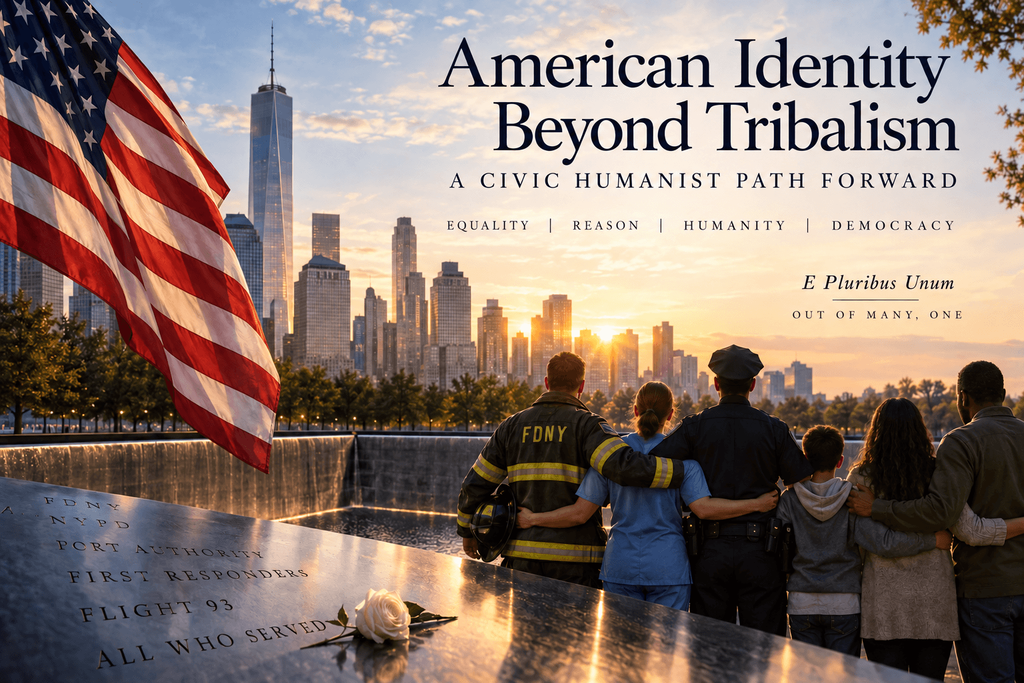
American Identity Beyond Tribalism
A Civic Humanist Path Forward (Complete Version)
Contents
Introduction — What Does It Mean to Be American?
I. American Identity: Nation, Idea, and Unfinished Project
II. The Many Tribes of America
III. How Tribalism Changes Political Reality
IV. The Machinery of Polarization
V. The American Culture Wars
VI. Patriotism, Nationalism, and the Meaning of America
VII. A Civic Identity Larger Than the Tribe
VIII. Civic Humanism and a New American Identity
Conclusion — E Pluribus Unum for the Twenty-First Century
Sources
Introduction — What Does It Mean to Be American?
America is simultaneously a country, a constitutional republic, a collection of communities, and an idea about how different people can govern themselves. From the beginning, Americans have disagreed about what the nation represents and who fully belongs within it. Race, religion, class, region, immigration, and political ideology have repeatedly shaped those disagreements. Yet American identity has never depended entirely upon common ancestry, religion, or culture.
Identity itself is not the problem. Human beings naturally understand themselves through families, communities, traditions, beliefs, and histories. These affiliations can provide meaning, solidarity, and a sense of belonging. Tribalism begins when identity divides the world into opposing camps whose members are judged primarily by group membership rather than as individuals.
In politics, this transformation turns disagreement into moral suspicion. Political opponents no longer appear merely mistaken but threatening, dishonest, or fundamentally un-American. Contemporary American politics provides abundant evidence of this problem. In 2025, Pew Research Center found that 80 percent of Americans believed Republican and Democratic voters could not agree on basic facts about important national issues.
Yet the electorate is considerably more complicated than its partisan extremes suggest. Majorities have described both political parties as too extreme, while substantial numbers of Americans report that neither party represents them particularly well. Political visibility is not necessarily numerical strength. The loudest voices can dominate public attention without representing the beliefs of most citizens.
The 2018 Hidden Tribes study provided an influential portrait of this complexity. Its seven-group model identified strongly ideological wings but placed roughly two-thirds of Americans within an “Exhausted Majority” characterized by greater flexibility, willingness to compromise, and frustration with political conflict. Its categories and percentages should not be treated as a permanent map of an electorate that has changed since 2018. Its broader insight remains valuable: many Americans do not fit comfortably within the ideological camps that dominate political debate.
Polarization nevertheless extends far beyond disagreements between Republicans and Democrats. Americans divide over racial justice and policing, immigration and national borders, religion and secularism, gender and sexuality, economic systems, free speech, and American history. Increasingly, these positions overlap and reinforce one another. As political, cultural, and social identities align, disagreement becomes more personal and compromise becomes more difficult.
The contemporary information environment magnifies these divisions. News organizations, partisan commentators, advocacy groups, influencers, and social platforms compete for attention. Anger, fear, moral condemnation, and sensational claims often attract that attention more effectively than careful explanation. Political extremes can therefore appear more representative of American society than they actually are.
Technology is an amplifier rather than a complete explanation. Research shows that algorithms influence what people encounter online, but changing those algorithms does not automatically eliminate political polarization. Americans bring existing identities, grievances, fears, and loyalties into digital environments. The machinery of polarization works because it interacts with conflicts already present in society.
The deeper challenge is the weakening of a common civic identity capable of containing these differences. A pluralistic democracy cannot require citizens to abandon racial, religious, cultural, regional, or ideological identities. Neither can it survive indefinitely if those identities become competing claims to ownership of the nation. Americans need a way to remain different while continuing to regard themselves as members of the same political community.
American history provides both warnings and resources for this task. The nation proclaimed equality while permitting slavery, celebrated liberty while excluding much of its population from political power, and promised opportunity while repeatedly restricting access to it. Yet Americans also invoked those same national principles to challenge exclusion. Abolition, Reconstruction, women’s suffrage, civil rights, and other democratic reforms progressively expanded the meaning of We the People.
The most defensible American identity is therefore neither a romantic return to an imagined past nor a rejection of the national project because its principles were imperfectly realized. America can instead be understood as an unfinished democratic experiment organized around freedom, equality, opportunity, agency, and responsibility. These ideals do not describe everything the United States has been. They provide standards by which the country can judge what it is and decide what it should become.
Civic Humanism develops this understanding by grounding political community in shared humanity rather than tribal membership. It joins scientific inquiry and critical thinking with humanist ethics, democratic government, and civic responsibility. Institutions can then be judged by their contribution to human dignity, justice, agency, and flourishing. Americans need not agree about religion, culture, economics, or every question of public policy to share those civic foundations.
The goal is therefore not an America without tribes. It is an America with an identity larger than any tribe, capable of preserving genuine diversity without allowing difference to harden into permanent political enmity. The old national aspiration, E pluribus unum—out of many, one—remains appropriate precisely because the many were never supposed to disappear. The challenge for the twenty-first century is determining what the one can mean when Americans remain profoundly and legitimately different.
I. American Identity: Nation, Idea, and Unfinished Project
American identity has always contained a paradox. The United States is a particular country with borders, institutions, territory, history, and national interests, yet its identity has also been expressed through universal ideas. Equality, liberty, representative government, and individual rights were never exclusively American discoveries, but they became central to the nation’s understanding of itself. America consequently developed as both a place and a political proposition.
Unlike national identities based primarily upon common ancestry, American identity has always contained the possibility that someone can become American. Immigration made this characteristic increasingly important as people from Europe, Africa, Asia, Latin America, and elsewhere entered the national community. Naturalization formally converts a foreign national into an American citizen without requiring a change of race or ancestry. This civic dimension has allowed American identity to expand far beyond the population that created the original republic.
The Founding Contradiction
The founding principles of the United States were more universal than the society that proclaimed them. The Declaration of Independence asserted human equality while slavery remained deeply embedded in American life. The Constitution created representative government while political participation was largely restricted to men and while enslaved people remained outside meaningful citizenship. Indigenous nations were displaced as the country expanded across the continent.
These contradictions should neither be concealed nor used to dismiss the founding principles themselves. The proposition that human beings possess rights does not become false because Thomas Jefferson owned slaves; instead, slavery reveals how radically American practice contradicted the principle Jefferson helped articulate. Later generations could therefore use the language of equality and liberty against institutions inherited from the founding era. The contradiction became one of the forces driving American political development.
Frederick Douglass demonstrated this power when he challenged the nation to apply its professed principles to Black Americans. Abolitionists, suffragists, labor reformers, and civil-rights leaders repeatedly made similar arguments. They did not always reject the American project; often they demanded inclusion within its promises. American ideals became instruments for criticizing American reality.
Expanding We the People
The meaning of American citizenship consequently changed over time. The Reconstruction Amendments abolished slavery, established national citizenship and equal protection, and prohibited racial discrimination in voting. Women’s suffrage expanded political membership further, while the civil-rights movement challenged segregation and discriminatory barriers that survived long after emancipation. Subsequent struggles continued over immigration, disability, religious liberty, sex discrimination, and the rights of gay and lesbian Americans.
This history makes it difficult to identify any single period as the moment of “authentic” America. Returning to the eighteenth century would restore constitutional principles but also a society that denied political equality to much of its population. Returning to the 1950s might recover certain forms of social stability while restoring racial segregation and severe restrictions on women and sexual minorities. Every American era contains achievements worth understanding and injustices that later generations attempted to correct.
A mature national identity therefore cannot depend upon nostalgia. Historical memory should preserve accomplishments without converting the past into mythology, while criticism should acknowledge injustice without reducing American history to oppression. Both tendencies select evidence according to the emotional story they want the nation to tell. Serious history requires holding achievement and failure within the same account.
Equality, Freedom, and Opportunity
Three principles have been particularly persistent in American self-understanding: equality, freedom, and opportunity. Their meanings have changed as Americans argued over who possessed them and what they required. Equality gradually expanded from a limited political ideal toward equal citizenship and equality before the law. Freedom developed beyond protection from government coercion to include broader debates over civil rights, personal autonomy, economic liberty, and meaningful participation in society.
Opportunity became closely associated with the American promise that birth should not permanently determine destiny. Immigration, geographic mobility, public education, entrepreneurship, and economic expansion helped sustain that ideal, although access to opportunity has never been equally distributed. Poverty, discrimination, inherited wealth, education, family circumstances, and geography all influence what opportunities are realistically available. The ideal remains valuable precisely because it provides a standard against which these barriers can be examined.
These principles can also conflict. Freedom can produce unequal outcomes, while efforts to create equality can restrict some forms of liberty. Opportunity requires room for individual agency but may also require public institutions capable of ensuring that circumstances of birth do not become permanent barriers. Democratic politics exists partly to negotiate these tensions rather than pretending that one principle can always override the others.
Immigration and the Meaning of Belonging
Immigration tests whether American identity is genuinely civic. If Americanness depends primarily upon ancestry, religion, or an inherited culture, newcomers can remain outsiders for generations. If it depends upon citizenship and participation in a constitutional community, people from very different backgrounds can become fully American. The country’s long immigration history has repeatedly forced Americans to choose between these understandings.
This does not mean that a civic nation must abandon borders or accept unlimited immigration. A democratic government has legitimate authority to establish immigration rules, protect national security, and determine the conditions of legal entry and citizenship. It may also expect immigrants to obey the law and participate in the civic institutions of the country they join. These requirements concern membership in a political community rather than racial or religious conformity.
Integration therefore need not mean cultural erasure. Immigrants can retain languages, religions, foods, family traditions, and connections to ancestral cultures while developing an American civic identity. This pattern has occurred repeatedly as groups once regarded as foreign gradually became ordinary parts of American society. A pluralistic nation becomes stronger when common citizenship can contain cultural difference rather than requiring its disappearance.
Competing Claims to the “Real America”
Political tribalism often turns national identity into a struggle over who represents the “real America.” On the political right, authentic Americanness can become associated with Christianity, traditional social values, military service, rural life, or an idealized national past. These traditions are legitimate parts of American culture, but they cannot define the whole country without excluding millions of citizens whose lives follow different patterns.
The political left can make a different mistake by interpreting American identity primarily through structures of race, class, gender, colonialism, and historical oppression. These perspectives reveal injustices that older national narratives often neglected, but they become reductive when power relations are treated as the primary meaning of the American experience. A country cannot build common citizenship around either historical innocence or permanent collective guilt.
Civic Humanism rejects both reductions. America is neither a sacred inheritance belonging to one cultural tradition nor merely a hierarchy of competing identity groups. It is a political community containing people with different histories who nevertheless share institutions, rights, responsibilities, and consequences. National identity must be broad enough to include those differences without making any one of them the standard of authentic citizenship.
America as an Unfinished Project
The strongest interpretation of American identity may therefore be aspirational rather than ancestral. The United States can be understood as an unfinished effort to bring political reality closer to principles that the country has never perfectly achieved. Equality becomes more meaningful as exclusion is reduced; freedom expands as previously denied rights become secure; opportunity becomes more credible as arbitrary barriers are removed. Progress does not require believing that history moves automatically toward justice, only that societies can learn and change.
This understanding permits patriotism without mythology and criticism without nihilism. Americans can value constitutional government, scientific achievement, economic creativity, cultural innovation, and democratic reform while acknowledging slavery, segregation, Indigenous dispossession, discrimination, political corruption, and other failures. Love of country does not require pretending that the country has always been right. It can instead create responsibility for improving what one has inherited.
America’s capacity for self-correction may ultimately be one of its most important traditions. Constitutional amendments, elections, judicial decisions, legislation, protest movements, journalism, scientific inquiry, and civic organization have repeatedly allowed Americans to challenge established arrangements. These mechanisms do not guarantee progress, and they can themselves fail. They nevertheless provide peaceful means by which an imperfect society can recognize errors and attempt to correct them.
American identity is therefore best understood not as a finished definition but as an ongoing experiment in unity without uniformity. The country contains many cultures, religions, regions, classes, and political traditions, none of which can reasonably claim exclusive ownership of the nation. What binds them together is not sameness but participation in a common civic project. The continuing task is to make the promise of We the People increasingly truthful for the people who actually constitute America.
II. The Many Tribes of America
Americans rarely possess a single identity. A person may understand herself through race, religion, family, profession, class, region, gender, generation, political philosophy, and nationality. These identities overlap and change in importance according to circumstances. A pluralistic society allows them to coexist without requiring any one affiliation to define the entire person.
Tribalism develops when identity becomes a primary boundary between us and them. People increasingly interpret events through the interests of their group and assign generalized characteristics to outsiders. The problem becomes especially serious when several identities align along the same political divide. Disagreement between Democrats and Republicans can then become simultaneously a conflict over culture, religion, geography, education, race, and class.
Race and the American Experience
Race remains consequential because racial classifications were embedded in American history. Slavery, segregation, discriminatory housing, and restrictions on political participation created inequalities whose effects did not simply disappear when discriminatory laws were abolished. Racial identity can therefore provide historical understanding and reveal patterns that might otherwise remain hidden. Ignoring race entirely can make genuine discrimination harder to recognize.
Yet racial categories become tribal when treated as comprehensive descriptions of individuals. No racial group possesses a single political interest, economic condition, historical experience, or worldview. Civic Humanism therefore combines empirical attention to racial inequality with a universal principle: individuals should not be assigned inherited guilt, innocence, authority, or moral worth according to race. The objective is not better competition among racial tribes, but a society in which race increasingly ceases to determine rights and opportunities.
Religion and Secular Identity
Religion provides another powerful source of belonging. For many Americans, religious tradition shapes family life, morality, community, and personal identity, while secular Americans may derive meaning from humanism, philosophy, science, civic service, or other sources. Freedom of conscience allows these approaches to coexist. Conflict begins when religious or secular identity becomes a test of authentic citizenship.
Christian nationalism can imply that Christianity possesses a privileged relationship with American identity, while aggressive secularism can treat religious belief as evidence of ignorance or political backwardness. A secular constitutional government offers a better framework by protecting both religious practice and nonbelief. Religious citizens remain free to bring moral convictions into public debate, but government should not impose theological authority. Public policy must ultimately be defensible through evidence, constitutional principles, and reasons accessible beyond a particular revelation.
Class and Economic Identity
Social class is less immediately visible than race or religion, but it profoundly influences how Americans experience their country. Income, education, occupation, housing, family wealth, and economic security shape both opportunity and perceptions of government. A professional in a prosperous metropolitan area may encounter a very different America from a factory worker in a declining industrial town. These differences can produce legitimate differences in political priorities.
Tribalism converts economic differences into caricatures. Wealthy Americans become inherently greedy, poor Americans become either helpless victims or personally irresponsible, and educated professionals become detached elites. Civic Humanism instead asks what evidence explains poverty, mobility, inequality, and economic security. Class matters, but ideological stereotypes are poor substitutes for understanding how people actually live.
Gender, Sexuality, and Generational Change
Gender and sexuality have become prominent identities during a period of rapid cultural change. Women’s equality and civil rights for gay and lesbian Americans transformed institutions that had historically restricted individual freedom. More recent debates surrounding gender identity involve additional questions about equal treatment, medicine, education, athletics, parental authority, and sex-based protections. These subjects involve human dignity while also leaving legitimate questions of evidence and policy open to debate.
Tribalism makes those distinctions difficult. Skepticism toward a particular policy can be interpreted as hostility toward an entire group, while concern for a group can be mistaken for endorsement of every claim made on its behalf. Civic Humanism separates respect for persons from agreement about propositions. Respect for persons does not require suspension of inquiry.
Generational change adds another dimension. Americans shaped by the Depression, Cold War, civil-rights era, post-9/11 world, or digital age encountered different economic and cultural environments. Younger Americans tend to be more diverse and secular, while older generations often retain stronger connections to institutions and conventions formed during earlier periods. Some apparent ideological conflict is therefore also disagreement between different experiences of America.
Geography and Cultural Sorting
Place shapes political identity as well. Urban, suburban, small-town, and rural Americans experience different economies, institutions, population densities, and social environments. These differences become politically dangerous when reduced contact allows stereotypes to replace experience. Rural Americans become caricatured as backward, while urban Americans are portrayed as elitist or detached from traditional values.
A healthy national identity should make room for these different Americas. The needs of an agricultural county in Iowa will not always resemble those of Los Angeles or New York City, and federalism partly reflects the value of governing across such differences. Geographic diversity becomes tribal only when communities begin competing over which of them represents the “real America.” No region possesses exclusive ownership of national identity.
When Party Becomes Identity
Political parties become especially divisive when they absorb other identities. Americans increasingly encounter Republicans and Democrats not merely as people supporting different policies but as recognizable social types. Party affiliation can influence friendships, relationships, media consumption, neighborhoods, and assumptions about another person’s morality. Elections consequently acquire emotional significance far beyond the policies immediately at stake.
This contributes to affective polarization: hostility toward opposing partisans that exceeds ordinary policy disagreement. Citizens may know little about another person’s actual beliefs while inferring them from party affiliation. Republicans imagine Democrats through their most radical activists, while Democrats imagine Republicans through theirs. Exceptional figures become mental representatives of millions of ordinary people.
Negative partisanship reinforces the pattern. Voters may remain loyal to a party primarily because the alternative appears intolerable, giving political organizations incentives to exaggerate the threat posed by opponents. Fear can sustain coalition loyalty even when citizens are dissatisfied with their own leaders. Politics gradually becomes less about choosing a preferred government than preventing a feared tribe from gaining power.
The Majority Between the Camps
The 2018 Hidden Tribes report challenged the assumption that America consists primarily of two coherent ideological armies. Its seven-group model identified strongly ideological wings but placed roughly two-thirds of respondents within what it called the “Exhausted Majority.” These Americans generally displayed greater ideological flexibility and frustration with political conflict. The study suggested a country more complicated than its most visible political combatants.
Its categories and percentages should not be treated as a permanent map of American opinion. Elections, social movements, demographic change, and political events have altered the landscape since 2018. The more enduring insight is that political visibility does not necessarily indicate numerical strength. Millions of Americans hold combinations of beliefs that fit poorly within either partisan package.
A citizen may favor stronger border enforcement while supporting legal immigration, support police while demanding accountability, or favor market capitalism alongside a substantial social safety net. Such combinations are ordinary even when partisan institutions present them as inconsistent. The American electorate contains considerable ideological cross-pressure. A red-and-blue political map inevitably conceals much of it.
Identity Without Enmity
America’s many identities are not evidence of national failure. Diversity becomes dangerous when partial identities become total identities and citizens lose meaningful relationships across their boundaries. When race, religion, geography, class, culture, and party increasingly align, the country can begin to resemble two incompatible societies. Tribalism thrives when citizens stop encountering one another as complicated individuals.
Civic Humanism offers a simple alternative: identity should enrich the person without imprisoning the person. Americans can value heritage, religion, community, economic interests, and political philosophy while recognizing obligations beyond them. Shared civic identity does not require these affiliations to disappear. It places them within a larger commitment to equal citizenship and democratic life.
The problem is not that America contains many tribes. A free nation of hundreds of millions of people will inevitably contain countless communities and competing beliefs. The danger begins when Americans can no longer imagine belonging to anything together. The next chapter examines how that loss of common belonging changes political judgment itself.
III. How Tribalism Changes Political Reality
Political disagreement is normal in a democracy. Citizens have different interests, experiences, values, and ideas about government. Tribalism changes the character of those disagreements by making political positions markers of social identity. The central question gradually shifts from Is this policy right? to Which side are you on?
Once politics becomes tribal, opponents are more easily interpreted as enemies. People assume that those who vote differently are ignorant, selfish, dishonest, or dangerous before considering what they actually believe. Political disputes become judgments about character and belonging. Compromise becomes harder because cooperation with the opposing side can itself appear morally suspect.
When Opponents Become Enemies
Affective polarization describes the growing tendency of Americans to dislike and distrust opposing partisans beyond their disagreements over policy. Conservatives may imagine liberals through radical activists, while liberals imagine conservatives through their most inflammatory public figures. Media and political organizations make such figures highly visible because conflict attracts attention. Ordinary members of both coalitions consequently appear more extreme than they often are.
This perception can become self-reinforcing. If citizens believe the opposing side poses an extraordinary threat, aggressive behavior by their own coalition begins to appear defensive and necessary. Opponents interpret that behavior as confirmation of their original fears and respond in kind. Each side can therefore experience itself as defending the country from escalation initiated by the other.
Competing Narratives of Threat
American political coalitions increasingly organize themselves around different narratives of danger. The left tends to emphasize racial inequality, economic concentration, discrimination, environmental threats, and restrictions on personal autonomy. The right more often emphasizes crime, uncontrolled immigration, cultural disruption, government overreach, and threats to traditional institutions. Both narratives contain legitimate concerns alongside exaggerations encouraged by political conflict.
Tribalism becomes especially powerful when acknowledging one concern is treated as denying another. Evidence of racial discrimination need not negate concern about crime, just as concern about border security need not eliminate humanitarian obligations toward migrants. Complex societies routinely confront several legitimate interests at once. Political reasoning deteriorates when citizens are required to choose which reality their tribe is permitted to recognize.
Competing narratives of victimhood reinforce this problem. Groups naturally remember injuries committed against them more clearly than injuries committed in their name. Historical suffering can become central to collective identity while responsibility for the suffering of others receives less attention. Everyone can become the victim in their own story and the oppressor in someone else’s.
Identity-Protective Reasoning
Human beings do not evaluate political information as neutral observers. We are generally more receptive to evidence supporting existing beliefs and more critical of evidence threatening them. When beliefs become connected to identity, changing one’s mind may also carry a social cost. Accepting contrary evidence can feel like betraying friends, family, religion, community, or political allies.
Education and intelligence do not automatically eliminate this tendency. Knowledgeable people may simply become more skilled at constructing arguments for conclusions they already prefer. Critical thinking therefore requires more than finding weaknesses in opposing claims. It requires applying comparable standards of evidence to conclusions that benefit one’s own side.
Civic Humanism treats this discipline as essential to democratic citizenship. Scientific inquiry offers a useful model because conclusions remain provisional and should change when better evidence appears. Political values cannot always be tested scientifically, but factual claims about the consequences of policies often can. A healthy political culture should therefore reward correction rather than treating every admission of error as defeat.
The Struggle Over Shared Reality
Tribal politics becomes especially dangerous when citizens lose confidence in common methods for establishing facts. Journalism, science, courts, universities, elections, and government statistics perform different functions, but each provides methods for testing claims about reality. These institutions are imperfect and sometimes fail seriously. Their failures justify scrutiny and reform rather than abandonment of verification itself.
Without common standards, every tribe can construct its own authorities. Citizens choose commentators, experts, institutions, or political leaders whose conclusions already resemble their own and dismiss conflicting evidence as propaganda. Disagreement then becomes difficult to resolve because the parties no longer agree about how claims should be tested. Facts themselves acquire partisan identities.
This does not mean institutions deserve blind trust. Skepticism is essential to scientific inquiry and democratic accountability. The relevant question is whether skepticism follows consistent standards or changes according to which conclusion is politically convenient. Epistemic integrity requires demanding evidence from one’s own tribe as readily as from its opponents.
Moral Certainty and Political Complexity
Politics frequently involves genuine moral questions, but difficult public problems usually contain several legitimate values. Immigration involves sovereignty and security alongside humanitarian obligations; criminal justice involves public safety as well as individual rights and accountability. Economic policy must consider prosperity, opportunity, security, and distribution. Treating any one value as the whole problem can produce morally confident but practically inadequate policy.
Democratic government exists partly because free citizens disagree about how such values should be balanced. Compromise does not mean treating every position as equally reasonable or dividing every disagreement in half. It means recognizing that people who share basic civic principles may still reach different conclusions about difficult questions. Intellectual humility allows disagreement without requiring moral indifference.
There are nevertheless limits to compromise. Constitutional rights, equal citizenship, and democratic procedures cannot simply disappear whenever a majority finds them inconvenient. Pluralism requires tolerance of substantial disagreement within a framework that protects fundamental rights. Without that framework, compromise can become submission to power rather than democratic negotiation.
Madison’s Problem of Faction
The problem is older than contemporary partisan politics. In Federalist No. 10, James Madison described factions as groups united by interests or passions that could threaten the rights of others or the common good. He recognized that faction arises naturally from differences in human opinions, circumstances, and interests. Eliminating its causes would require either destroying liberty or imposing an impossible uniformity.
Madison therefore sought to control the effects of faction. A large republic containing many competing interests would make domination by a single faction more difficult, while representative institutions could moderate temporary public passions. The constitutional system assumed that Americans would remain divided. Its task was to make political division compatible with republican government.
Modern tribalism complicates that solution when many identities align into two enormous coalitions. Religious, regional, economic, racial, and cultural divisions become absorbed into the same partisan conflict. Instead of numerous factions checking one another, political life begins to resemble a struggle between two competing societies. The danger lies not merely in strong parties, but in the concentration of many forms of identity within them.
Negative Partisanship
This environment encourages negative partisanship, in which citizens support their coalition largely because they fear the alternative. A candidate’s weaknesses become tolerable if the opposing candidate appears dangerous enough. Elections shift from choosing among competing programs toward preventing catastrophe. Political organizations have obvious incentives to encourage this perception.
The consequences extend beyond campaigns. Citizens may excuse behavior from their own leaders that they would immediately condemn in opponents. Institutional principles become conditional upon which party benefits from them. Democratic norms weaken when loyalty to the coalition becomes stronger than loyalty to the rules governing competition.
A democracy cannot remain healthy if every election is understood as the last legitimate opportunity to save the country. Political victories must remain temporary, and electoral defeat must remain survivable. Citizens who believe the opposition has no legitimate right to govern will eventually question the procedures that allow it to win. Tribalism thus turns ordinary political competition into a problem of democratic legitimacy.
Recovering Political Judgment
Moving beyond tribalism does not require political neutrality. Citizens can hold strong conservative, progressive, libertarian, socialist, humanist, religious, or other convictions while remaining capable of independent judgment. The distinction lies between having principles and allowing group identity to determine conclusions in advance. Political commitment should guide inquiry without replacing it.
Greater precision in political language is part of this discipline. Conservatism is not automatically authoritarianism, just as progressivism is not automatically extremism. Ignorance is not identical to malice, disagreement is not necessarily hatred, and criticism of a policy is not automatically hostility toward the people affected by it. Accurate distinctions reduce conflict because they make criticism more specific.
Civic Humanism therefore asks for epistemic humility without moral surrender. Citizens can defend conclusions supported by strong evidence while recognizing the limits of their knowledge. They can oppose policies without denying the humanity or citizenship of those who support them. Democratic reasoning depends upon preserving both capacities.
The central danger of tribal politics is ultimately the loss of independent judgment. When identity determines whom citizens trust, which facts they accept, and what conduct they excuse, coalition loyalty begins to replace democratic reasoning. This transformation does not occur through psychology alone. Political institutions, media systems, and digital technologies can all reward and amplify it, creating the machinery of polarization examined in the next chapter.
IV. The Machinery of Polarization
American polarization cannot be explained by a single cause. Political institutions, economic incentives, media systems, digital technologies, and human psychology interact to intensify divisions that already exist. None created tribalism by itself, and none can eliminate it alone. Together, however, they form a powerful machinery for converting disagreement into sustained conflict.
This machinery often rewards behavior that a healthy democracy needs to restrain. Politicians benefit from mobilizing supporters, media organizations compete for audiences, digital platforms measure engagement, and citizens favor information that confirms existing beliefs. Each participant may be responding rationally to immediate incentives. The collective result can nevertheless be deeply polarizing.
Political Incentives for Conflict
Democratic elections necessarily involve competition, but competition does not always reward careful governance. Fear and anger can motivate voters more effectively than detailed policy proposals, encouraging candidates to portray opponents as dangerous rather than merely mistaken. An election framed as an existential struggle can generate turnout, donations, and party loyalty. Permanent crisis therefore becomes an effective political strategy.
Primary elections can strengthen these incentives when highly engaged voters exercise disproportionate influence over candidate selection. Geographic sorting and gerrymandering can also create districts where the meaningful competition occurs within one party rather than between parties. Politicians may then face greater danger from compromise than ideological rigidity. Institutions designed for political competition can inadvertently reward polarization.
The Economics of Attention
The digital revolution gave Americans access to more information than any previous generation. It lowered barriers to publication, allowed citizens to communicate directly, and weakened traditional control over public debate. These changes produced genuine democratic benefits. They also created an enormous market in which countless sources compete for the scarce resource of human attention.
Attention does not necessarily flow toward the most accurate information. Novelty, fear, conflict, humor, and moral outrage can be more compelling than careful explanation. Exceptional events consequently receive disproportionate visibility and can become representative of entire communities. A shocking crime, violent protest, or outrageous political statement may shape public perception precisely because it is unusual.
Conflict can therefore become profitable without requiring a conspiracy. Media organizations need audiences, advocacy groups need supporters, campaigns need donors, and influencers need engagement. When inflammatory material consistently attracts attention, producers learn what their audiences reward. Citizens participate in the same system whenever they share provocative material because it confirms their beliefs or attacks their opponents.
Mainstream Media and Fragmented Reality
Criticism of “the media” often treats very different institutions as a single actor. Newspapers, television networks, wire services, local journalists, opinion writers, and entertainment programs operate under different standards and incentives. Reporting should also be distinguished from analysis and commentary. Serious media literacy begins by recognizing these differences rather than assigning one political identity to an entire industry.
Traditional journalism nevertheless faces structural problems. The decline of local news has reduced sustained coverage of municipal and state institutions while national political conflict increasingly fills the gap. Americans who once encountered politics partly through local communities now receive more information through national partisan narratives. Local questions can consequently become absorbed into conflicts originating elsewhere.
Bias also operates through selection rather than explicit falsehood. News organizations decide which events deserve attention, which experts appear, and which facts belong in headlines. A report may contain accurate information while still creating a distorted impression through emphasis or omission. Evaluating media therefore requires asking not only whether a claim is true, but whether its presentation accurately represents the larger reality.
Misinformation and Selective Truth
Political misinformation is not always fabricated. Effective propaganda often uses genuine facts stripped of context or examples whose importance is exaggerated. A video can be authentic while giving a false impression of how frequently an event occurs. A statistic can be correct while omitting another statistic necessary to understand it.
Citizens therefore need more than a simple distinction between “true” and “false.” They should ask who produced a claim, what evidence supports it, what relevant context may be missing, and whether independent sources reach similar conclusions. Material designed to provoke immediate anger deserves particular scrutiny before it is shared. Emotional intensity is not evidence of importance or accuracy.
A useful test is: What evidence would cause me to change my mind? If the answer is nothing, a political belief has become resistant to ordinary inquiry. That does not establish that the belief is false, but it reveals a problem with the method used to defend it. Civic reasoning requires conclusions that can, at least in principle, be revised.
Algorithms and Echo Chambers
Social media algorithms influence political life by helping determine what people encounter online. Recommendation systems select material according to previous behavior, predicted interest, popularity, and engagement. They can reinforce preferences and repeatedly expose users to emotionally compelling content. Yet the familiar image of an impenetrable ideological echo chamber oversimplifies the evidence.
A major 2023 Facebook experiment substantially reduced users’ exposure to politically like-minded sources without measurably reducing affective polarization or ideological extremity. The intervention changed the information people encountered but did not produce the expected transformation in their political attitudes. Polarization therefore cannot be explained simply by excessive exposure to one’s own side. Social identities and political conflicts exist beyond the algorithm.
Algorithms are better understood as amplifiers within an already divided society. They influence which issues become visible and which voices receive disproportionate attention, but users bring existing grievances and loyalties to the platforms. Changes in platform design may improve the information environment. They cannot substitute for political and civic reform.
Influencers and Alternative Media
The decline of traditional gatekeeping has allowed independent journalists, researchers, podcasters, activists, and ordinary citizens to reach enormous audiences. This has exposed institutional failures and introduced valuable perspectives into public debate. Expertise and insight no longer require permission from a major newspaper or television network to become influential. That democratization of communication has genuine value.
The same environment allows personalities to acquire authority without meaningful accountability. Influencers may move between reporting, commentary, speculation, and entertainment while audiences treat each as equally reliable. Loyalty to a personality can become another form of tribal identity. Confidence and audience intimacy can easily be mistaken for expertise.
Alternative and established media should therefore face comparable standards. Reliable sources provide evidence, distinguish fact from opinion, acknowledge uncertainty, and correct significant errors. Institutional status alone does not guarantee these qualities, but independence does not guarantee them either. Credibility should follow methods and performance rather than political branding.
Foreign Manipulation
Foreign governments and organized influence operations can exploit American polarization by amplifying existing conflicts. They do not need to invent grievances or persuade citizens to adopt a particular ideology. Encouraging distrust, confusion, hostility, and fragmentation may be sufficient. A divided democracy becomes easier to manipulate.
The most effective defense is not indiscriminate censorship. Open societies need political debate, and government control of expression creates dangers of its own. Resilience depends more upon transparency, investigative capacity, digital literacy, and citizens who verify provocative claims before spreading them. Manipulation becomes less effective when domestic political culture is harder to provoke.
Foreign interference also reveals an important limitation of blaming outsiders. Racial conflict, religious tension, economic anxiety, and partisan hostility are not foreign inventions. External actors succeed by exploiting fractures already present in American society. Strengthening democratic resilience therefore requires addressing both manipulation and the conditions that make it persuasive.
Institutional Trust
Polarization is intensified by declining confidence in institutions. Government, journalism, universities, corporations, religious organizations, and other established bodies have all faced significant public skepticism. Some distrust reflects partisan hostility, but some has been earned through incompetence, secrecy, corruption, ideological conformity, or uncorrected mistakes. Institutions cannot restore confidence merely by demanding that citizens trust them.
Trustworthiness must be demonstrated through competence, transparency, accountability, and correction of error. Citizens nevertheless need to distinguish justified criticism from blanket rejection. An institution can fail without every statement it produces becoming false. Skepticism becomes tribal when credibility depends primarily upon whether an institution appears politically aligned with one’s own side.
A functioning democracy therefore needs both critical citizens and trustworthy institutions. Citizens should question authority, while institutions should operate in ways that make justified confidence possible. Without that relationship, every source of knowledge can be interpreted through partisan loyalty. Shared factual reality becomes increasingly difficult to maintain.
Changing the Incentives
The machinery of polarization is powerful because it emerges from ordinary incentives rather than central design. Politicians seek votes, media organizations seek audiences, platforms seek engagement, and citizens seek information that feels meaningful. Reform must therefore address systems as well as individual behavior. Condemning polarization while continuing to reward it will accomplish little.
Better incentives can favor accuracy, accountability, cooperation, and transparency. Stronger local journalism can reconnect political information with actual communities, while media literacy can improve citizens’ ability to evaluate competing claims. Digital platforms can consider the effects of recommendation systems without becoming official arbiters of political truth. Political reforms can likewise make coalition-building less costly.
None of these changes will eliminate conflict, nor should they. Democracy requires disagreement because free citizens possess different values and interests. The objective is to prevent institutions from systematically converting those differences into hostility and distorted perceptions of reality. Understanding this machinery makes it easier to recognize its effects in America’s culture wars, where disputes over policy increasingly become struggles over national identity.
V. The American Culture Wars
America’s culture wars are sometimes dismissed as distractions from more important political problems. Yet disputes over race, immigration, religion, gender, economics, and speech concern fundamental questions about rights, belonging, morality, and national identity. The problem is not that Americans care deeply about these subjects. Tribalism makes them harder to discuss by turning complicated questions into contests between morally incompatible camps.
Culture-war politics also compresses different issues into a single ideological divide. A person’s position on immigration may generate assumptions about race, religion, gender, policing, or economic policy. Citizens who disagree on one subject are expected to disagree on nearly everything else. Political identity becomes a package rather than a series of conclusions reached independently.
Race, Policing, and Black Lives Matter
Race remains central to American political conflict because racial injustice is both historical and contemporary. Slavery and segregation shaped American institutions, while continuing disparities in wealth, criminal justice, housing, education, and health raise legitimate questions about equality. The killing of George Floyd in 2020 brought police conduct and racial justice into an extraordinary period of national attention. Black Lives Matter became both a movement for reform and a symbol interpreted very differently across political tribes.
Supporters emphasized police misconduct and unequal treatment, while critics pointed to riots, attacks on police, rising crime in some communities, and proposals to reduce police funding. Tribal politics often demanded that Americans choose which concerns mattered. A more coherent standard can condemn unjustified police violence, protect peaceful protest, punish political violence, and recognize the necessity of effective law enforcement. Justice and security are complementary human needs.
A person unjustly treated by police has suffered a failure of government, but so has someone left vulnerable because public institutions cannot provide security. Police therefore require sufficient authority and resources alongside appropriate training, oversight, and accountability. The meaningful question is not whether one supports police or racial justice. It is how public safety can be both effective and just.
Immigration, Borders, and Human Dignity
Immigration produces a similar false choice. One narrative emphasizes sovereignty, border enforcement, crime, economic pressures, and the government’s authority to control entry. Another emphasizes refugees, family unity, economic contribution, discrimination, and the dignity of migrants. Both contain legitimate concerns that become distorted when either side denies the other.
A nation has the right to maintain borders and establish lawful conditions for immigration. Without meaningful enforcement, immigration policy loses credibility and governments cannot reliably determine who enters or remains within their territory. Yet unauthorized immigration does not erase a person’s humanity. Migrants remain entitled to humane treatment and applicable legal protections.
Civic Humanism therefore separates policy judgment from human worth. Citizens can support stricter border enforcement without regarding immigrants as inferior, just as they can defend migrants from abuse without supporting unrestricted immigration. Policy should consider security, economic needs, administrative capacity, humanitarian obligations, and effects on receiving communities. Tribal labels make these practical judgments unnecessarily difficult.
Religion, Secularism, and Political Power
Religion occupies a complicated place in American identity. Religious communities have contributed to charitable work, education, civil rights, and social reform, while religious liberty protects citizens whose beliefs differ radically from one another. A pluralistic society need not treat religious conviction as incompatible with modern citizenship. The difficulty begins when religious identity becomes a claim to political privilege.
Christian nationalism, in its stronger forms, links authentic Americanness with Christianity and weakens the distinction between religious belief and governmental authority. The opposite mistake is to treat secularism as hostility toward religion. A secular constitutional government instead protects freedom of conscience by refusing to establish one theology over others. Believers and nonbelievers remain equal citizens.
Religious Americans are free to bring moral convictions into public debate, as are citizens guided by secular philosophies. Government, however, must ultimately justify its authority through constitutional principles and publicly accessible reasoning rather than religious revelation alone. Separation of religious authority from government protects religious diversity precisely because the state does not decide which faith is true.
Gender, Sexuality, and Social Change
Attitudes toward gender and sexuality have changed rapidly. Women gained freedoms once widely denied to them, while gay and lesbian Americans achieved greater legal equality and public acceptance. More recent debates over gender identity involve additional questions concerning equal treatment, medicine, minors, athletics, privacy, parental authority, and sex-based protections. These questions cannot all be resolved by a single political principle or slogan.
Tribalism makes necessary distinctions difficult. Criticism of a particular policy may be interpreted as hostility toward transgender people, while concern for transgender people may be portrayed as rejection of biological reality. Civic Humanism separates human dignity from factual and policy claims. People are entitled to dignity; claims remain open to evidence, and policies remain open to evaluation.
This principle allows genuine disagreements to remain discussable. Scientific evidence should inform medical questions, constitutional and legal reasoning should inform rights disputes, and policy should consider foreseeable consequences for everyone affected. Respect does not require agreement on every proposition. Disagreement does not justify contempt for the people involved.
Capitalism, Socialism, and Economic Tribes
Economic language has likewise become tribalized. Capitalism may signify freedom, entrepreneurship, and prosperity to one group while representing inequality and concentrated corporate power to another. Socialism may suggest social protection and economic fairness to some Americans while evoking authoritarian government and failed command economies to others. People can therefore argue intensely while using the same terms to describe very different systems.
Modern developed democracies, including the United States, operate mixed economies. Private markets organize much economic activity, while governments regulate commerce, maintain infrastructure, provide public services, and establish social protections. The useful questions concern where markets work well, where they fail, and which public interventions improve human welfare without creating greater problems. Ideological labels often obscure these practical judgments.
Civic Humanism treats both markets and governments as instruments. Markets can generate innovation and prosperity while producing externalities, monopolies, or severe inequality; governments can provide essential public goods while becoming inefficient, coercive, or corrupt. Neither deserves ideological immunity from evaluation. Economic institutions should ultimately be judged by their contribution to opportunity, security, sustainability, and human flourishing.
Free Speech and Political Correctness
Free-speech disputes reflect another conflict between legitimate values. Social norms of courtesy can reduce unnecessary humiliation and adapt as society becomes more aware of language historically used to demean people. Such norms are not inherently threats to freedom. Problems arise when respect becomes ideological enforcement or reasonable disagreement carries disproportionate professional and social penalties.
Claims of free speech can also be abused. Constitutional protection from government censorship does not create a right to harass others or require private organizations to provide unlimited platforms. Freedom of expression includes substantial room for criticism, including criticism of the speech itself. A mature society must distinguish legal rights from social expectations.
The 2018 Hidden Tribes report found considerable disagreement over political correctness while also revealing many Americans between the most restrictive and permissive positions. That middle ground remains valuable. Democratic culture should protect broad freedom of inquiry while encouraging responsible exercise of that freedom. A society confident in its ideas should normally answer bad arguments with better arguments.
Ideological Alliances and Misleading Labels
Tribal politics encourages labels that combine very different people into threatening coalitions. The expression “Red-Green Alliance,” for example, has been used to describe cooperation between elements of the political left and Islamist movements around particular causes. Such alliances can exist and deserve scrutiny when politically significant. The term becomes misleading when it collapses progressives, social democrats, democratic socialists, communists, ordinary Muslims, and Islamists into one ideological force.
The same precision should apply across the political spectrum. Conservatism is not synonymous with fascism, Christianity with Christian nationalism, immigration concern with racism, or racial-justice advocacy with approval of political violence. Making these distinctions does not weaken legitimate criticism. It identifies more accurately what should be criticized.
Precision is one of the first casualties of tribalism. Broad labels allow citizens to associate ordinary opponents with the most frightening members of their coalition. Careful analysis works in the opposite direction by distinguishing ideas, movements, institutions, and individuals. Democratic judgment improves when Americans describe one another accurately.
Culture War Without Cultural Civil War
Culture-war questions cannot simply be removed from politics. Americans will continue to disagree about race, immigration, religion, gender, economic policy, and speech because these subjects involve genuine differences in interests and values. Democratic pluralism does not promise agreement. It provides a framework within which disagreement need not become permanent social warfare.
Citizens can distinguish people from propositions, moral worth from political opinion, and empirical questions from statements of identity. They can recognize legitimate concerns within opposing arguments without accepting the conclusions that follow from them. Human dignity provides a common ethical floor, while evidence helps determine which policies actually work. Neither political coalition should receive an exemption from those standards.
The culture wars ultimately concern more than the policies being contested. Beneath them lies a struggle over who belongs, whose values define the nation, and what Americans owe one another despite their differences. Those questions lead directly to the distinction between patriotism and nationalism. Understanding that distinction is essential to determining whether American identity can become larger than the tribes competing within it.
VI. Patriotism, Nationalism, and the Meaning of America
National identity is not inherently tribal. Affection for one’s country can encourage civic responsibility, public service, historical awareness, and concern for future generations. A democratic nation needs citizens who believe their common institutions are worth maintaining. The danger begins when national belonging becomes a way of deciding which citizens are more authentically American than others.
This distinction separates civic patriotism from exclusionary nationalism. Patriotism can acknowledge national failures while remaining committed to the country and its improvement. Nationalism becomes dangerous when the nation is imagined as belonging primarily to a particular race, religion, culture, or ancestral population. Patriotism says, This is our country, and we are responsible for it. Exclusionary nationalism asks, Which of us truly owns it?
Patriotism Without Mythology
Patriotism does not require an idealized version of American history. The United States created an enduring constitutional republic, expanded political liberty, became a major center of scientific and technological achievement, and contributed substantially to global culture and prosperity. It also practiced slavery and segregation, displaced Indigenous peoples, restricted immigration and citizenship, and repeatedly failed to extend its stated principles equally.
A mature national identity can hold these realities together. Historical achievements need not be denied because injustices occurred, and injustice should not be minimized because the country also accomplished extraordinary things. Mythology and cynicism make the same mistake from opposite directions: each selects the history needed to sustain a predetermined judgment about America.
Historical knowledge offers a better foundation for patriotism. Citizens inherit institutions and traditions they did not create, along with unresolved problems produced by earlier generations. Understanding that inheritance turns national identity into stewardship rather than worship. The purpose of studying American history is not to prove that the country is either uniquely virtuous or uniquely corrupt, but to understand what has been built and what still requires improvement.
Who Counts as American?
Arguments about national identity frequently become arguments about belonging. Throughout American history, groups have been treated as insufficiently American because of race, religion, language, ancestry, political belief, or place of origin. Definitions of the “real American” have changed repeatedly as previously excluded populations became accepted members of national life.
A civic nation provides a more durable standard. American identity can include cultural traditions, historical memories, and affection for the country, but citizenship cannot depend upon ancestry or theology. A naturalized citizen born abroad can be as fully American as someone whose family arrived centuries earlier. The political community is reproduced through citizenship and participation rather than bloodline.
This does not make citizenship meaningless or borders irrelevant. A civic nation can establish immigration laws, maintain secure borders, require lawful naturalization, and expect citizens to respect constitutional government. Membership matters precisely because citizenship creates rights and responsibilities within a particular political community. What it cannot legitimately create is a hierarchy among citizens based upon inherited identity.
Equality and National Belonging
Equal citizenship does not require Americans to possess identical wealth, beliefs, abilities, or life outcomes. It means that government recognizes no class of citizens as inherently entitled to greater political or moral standing. Race, religion, sex, ancestry, and partisan identity cannot determine whose rights matter more. Equality establishes the civic relationship among people who otherwise remain profoundly different.
Whether formal equality produces genuine opportunity is an empirical question. Discrimination, poverty, educational inequality, geographic isolation, or inherited disadvantage may create barriers that law should address. At the same time, unequal outcomes do not by themselves prove injustice. Good policy requires investigation into causes rather than assumptions derived from ideology.
This principle also limits identity politics. Historical injustice can create present obligations without assigning personal guilt according to ancestry, just as membership in a historically disadvantaged group does not confer automatic moral authority. Citizens should be judged as individuals while institutions remain attentive to demonstrable patterns of unequal treatment. Civic equality must be universal if it is to remain equality.
Freedom in a Pluralistic Nation
A free society will contain substantial disagreement about religion, morality, family, culture, economics, and politics. Difference is a predictable consequence of liberty. Americans cannot simultaneously demand extensive personal freedom and expect everyone to use that freedom to reach the same conclusions.
Pluralism therefore requires more than tolerating harmless differences. Citizens must sometimes coexist with beliefs they consider deeply mistaken. Religious conservatives, secular humanists, socialists, libertarians, progressives, and traditionalists will not agree about the good society. Constitutional liberty provides space for these disagreements while preventing any faction from imposing complete ideological conformity.
Freedom is sustainable only when reciprocal. Citizens who demand freedom of speech must protect it when opponents speak; those who defend religious liberty must recognize freedom from religious coercion. Rights become tribal privileges when people support them only for their own coalition. Civic patriotism instead treats constitutional liberty as a common inheritance.
Opportunity and the American Promise
Opportunity has long occupied a central place in American identity. The national ideal holds that birth should not permanently determine destiny and that individuals should have meaningful possibilities for education, work, enterprise, family life, and civic participation. Immigration has reinforced this image by making America a destination for people seeking lives different from those available where they were born.
Opportunity does not guarantee equal outcomes. People make different choices and possess different abilities, ambitions, circumstances, and luck. Yet a society committed to opportunity should examine barriers that prevent talent and effort from mattering. Education, discrimination, economic mobility, public safety, health, and family stability can all influence how much practical freedom individuals possess.
The traditional argument between personal responsibility and structural conditions therefore presents another false choice. Human beings exercise agency within environments they did not choose. Good institutions expand the range within which responsible choices can produce meaningful results. A civic nation should seek both individual agency and social conditions that allow it to matter.
Responsibility: The Other Side of Citizenship
American political culture often speaks more clearly about rights than responsibilities. Rights are indispensable because they protect individuals from government and from political majorities. Yet democratic institutions also depend upon citizens accepting obligations that cannot be reduced to personal entitlement. A republic requires people willing to preserve systems that protect others as well as themselves.
Civic responsibility includes obeying legitimate laws, participating in democratic life, evaluating information carefully, and respecting constitutional procedures even when political outcomes are disappointing. It also means protecting institutions when an opponent benefits from them. Elections, courts, free expression, and due process cannot remain stable if each faction supports them only while winning.
Citizens also shape the political culture they criticize. Every person who shares false information, rewards political cruelty, or treats opponents as enemies contributes to the environment in which public institutions operate. National renewal is therefore not solely a task for presidents, legislators, judges, or journalists. Democratic culture is reproduced through ordinary civic behavior.
American Exceptionalism and Comparative Learning
Americans have often described their country as exceptional. The United States does possess distinctive historical features, including its constitutional development, scale of immigration, federal structure, economic influence, and unusual continuity as a republic. Recognizing these characteristics need not imply that the United States is superior in every respect.
Claims of uniqueness become counterproductive when they prevent comparative learning. Other democracies may develop better approaches to particular problems in health care, education, infrastructure, election administration, or social policy. Scientific reasoning encourages comparison because institutions can be evaluated by evidence rather than national pride. A successful foreign practice does not become un-American merely because Americans did not invent it.
Patriotism should therefore ask how America can become a better country, not how Americans can prove that it already is the best. National confidence is compatible with learning. Indeed, a society secure in its identity should be especially capable of examining its weaknesses without interpreting criticism as disloyalty.
America First and Global Responsibility
Governments have special obligations toward their own citizens. American officials are elected to protect the security, rights, and interests of the American people, and acknowledging that responsibility is not inherently nationalist. A government that neglected its own population in favor of abstract global interests would fail a basic democratic obligation.
Special responsibility does not imply indifference toward everyone else. Economic systems, climate, infectious disease, migration, scientific research, technological risks, and international security cross national boundaries. American flourishing increasingly depends upon cooperation with people and institutions beyond the United States. National interest and global responsibility therefore overlap more often than political slogans suggest.
Civic Humanism places national responsibility within a wider human framework. Citizens can possess stronger obligations to family, community, and country while recognizing that foreigners possess the same fundamental human dignity. Patriotism becomes dangerous only when special responsibility is transformed into moral superiority or hostility toward outsiders.
Patriotism Large Enough for Everyone
A pluralistic democracy needs a form of patriotism that does not depend upon ethnicity, religion, or ideological conformity. Citizens should be able to love their country while disagreeing about its policies and interpreting its history differently. Criticism can itself be patriotic when it seeks to bring institutions closer to the principles they claim to represent.
Civic patriotism offers an alternative to both exclusionary nationalism and fragmented identity politics. Nationalism can make the country the possession of a favored group, while extreme identity politics can divide citizens into competing communities with little common political identity. Civic patriotism instead treats America as a shared republic jointly inherited by people whose histories and beliefs remain different.
The United States does not need agreement about a single culture, religion, or way of life. It needs sufficient agreement about the civic relationship among people who disagree. Americans must be able to recognize one another as equal participants in a common political project even when their identities and convictions remain far apart.
That requires a national identity larger than any tribe. The next chapter develops what such a civic identity might mean: one capable of preserving America’s many communities without allowing any of them to become the measure of who fully belongs.
VII. A Civic Identity Larger Than the Tribe
The answer to tribalism is not the elimination of identity. Americans will continue to belong to families, religions, ethnic communities, professions, regions, political movements, and cultural traditions. These affiliations provide meaning and social connection. A civic identity serves a different purpose: it establishes the relationship among people who remain different.
Cultural identity asks where we come from, what traditions shaped us, and which communities matter to us. Civic identity asks how people with different answers to those questions can govern a country together. It does not compete with other identities for emotional supremacy. It provides the common framework within which they can coexist.
Many Identities, One Citizenship
Multiple identities can actually restrain tribalism when they cross political boundaries. A conservative may also be an immigrant, environmentalist, union member, or atheist; a progressive may be religious, rural, entrepreneurial, or strongly patriotic. Human beings rarely fit perfectly within political categories. These overlapping affiliations make it harder to divide society permanently into two kinds of people.
The danger increases when identities become politically aligned. If race, religion, geography, education, class, culture, and party increasingly point toward the same division, political opponents can begin to appear socially foreign. Citizens encounter fewer people who complicate their assumptions about the other side. Political polarization then becomes a form of social separation.
Civic identity cuts across these divisions by establishing one relationship that all citizens share. It does not require people to rank citizenship above family, faith, or community in their private lives. It requires something more limited but politically essential: when citizens meet within the democratic system, they meet as political equals.
The Individual Before the Category
Demographic categories remain useful for understanding society. Researchers can study differences in income, health, education, voting, criminal justice, or discrimination among populations. Governments sometimes need such information to identify unequal treatment or evaluate policy. Rejecting tribalism does not require pretending that social groups have no measurable significance.
Statistical categories, however, are not complete descriptions of persons. Knowing someone’s race, religion, sex, income, or political affiliation may reveal probabilities about experience or opinion, but it does not establish what that individual believes or deserves. Historical privilege does not create automatic personal guilt, just as historical victimization does not create automatic virtue.
The fundamental moral unit of humanism is the human person, not the tribe. Individuals should therefore be evaluated according to their conduct and circumstances rather than presumed group characteristics. This principle protects minorities from prejudice while also preventing identity-based politics from reproducing the same logic in a different moral language.
Universalism Without Blindness
Universal principles can themselves become inadequate if applied without attention to circumstances. Declaring everyone equal before the law does not reveal whether the law is administered equally in practice. Formal freedom means less when discrimination or severe deprivation prevents people from exercising it. Civic universalism must therefore remain capable of recognizing patterns of disadvantage.
The solution is to combine universal rights with empirical investigation. Where evidence demonstrates discrimination or institutional barriers, policy can address those problems without declaring permanent moral categories of oppressors and victims. Remedies should be directed toward identifiable harms and evaluated by their results. Universalism supplies the ethical standard; evidence determines where that standard is not being met.
This approach avoids two opposite errors. One ignores group patterns because only individuals are considered real, while the other allows group identity to overwhelm individuality. Civic Humanism recognizes that people live within social structures but remain persons rather than representatives of categories.
Recovering the Common Good
Tribal politics encourages citizens to ask what benefits their group. Democratic citizenship requires another question: What serves the common good? This does not imply that every American possesses identical interests. It asks citizens to consider the conditions under which people with different interests can flourish together.
Many such conditions cross tribal boundaries. Americans need physical security, functional infrastructure, trustworthy institutions, economic opportunity, environmental stability, and protection of basic rights. They may disagree sharply about how these goods should be achieved, but their shared dependence upon them provides a basis for political cooperation.
Concern for the common good also changes the meaning of political victory. A governing coalition inherits responsibility for people who voted against it. Majorities have authority to govern, but they do not acquire ownership of the country. Democratic leadership should therefore be judged partly by whether it can govern fairly for citizens outside its coalition.
Shared Reality as Civic Infrastructure
A common civic identity requires some capacity to reason about a common world. Americans do not need identical opinions, but they need methods for distinguishing stronger evidence from weaker evidence. Science, professional research, investigative journalism, courts, public records, and transparent statistics provide different forms of verification. Their conclusions remain open to criticism, but criticism must itself answer to evidence.
Shared reality does not mean government-approved belief. It means agreement about methods through which factual disputes can be investigated. Citizens can disagree about the appropriate tax rate while consulting the same economic data, or disagree about environmental regulation while examining the same measurements. Democratic argument becomes possible because evidence provides something beyond tribal assertion.
Epistemic integrity is therefore a civic responsibility as well as an intellectual virtue. Citizens should correct significant errors, distinguish uncertainty from ignorance, and resist spreading claims merely because they harm an opponent. A political community unable to establish even provisional facts eventually loses the ability to make collective decisions rationally.
Freedom of Conscience and the Right to Disagree
A common civic identity will not resolve America’s deepest moral disagreements. Religious and secular citizens will continue to hold incompatible beliefs about ultimate reality, while conservatives and progressives will disagree about social norms and the purposes of government. Pluralism exists precisely because these differences cannot be settled by requiring everyone to adopt the same worldview.
Tolerance in this sense does not mean approval. It means recognizing another person’s right to hold and express beliefs one may consider profoundly mistaken, subject to the ordinary limits necessary to protect the rights of others. A free society must leave substantial room for citizens to be wrong in one another’s eyes.
Reciprocity provides a practical test. Before supporting a restriction on an opponent’s freedom, citizens should ask whether they would accept the same power in the hands of their opponents. Political rules that appear reasonable only when one’s own coalition controls them are unlikely to provide a stable foundation for pluralistic democracy.
Civic Education and Democratic Continuity
Civic identity must be learned. No generation is born understanding constitutional government, the history of American institutions, or the responsibilities of citizenship. A democracy that neglects civic education should not be surprised when citizens increasingly understand politics through partisan media and cultural identity instead.
Good civic education should neither romanticize American history nor teach national self-condemnation. Students should understand the country’s constitutional principles alongside the conflicts through which those principles developed. They should encounter achievements and injustices as parts of the same historical inheritance.
Modern citizenship also requires skills that earlier civic education could largely ignore. Media literacy, logical reasoning, scientific understanding, and evaluation of evidence have become essential to democratic participation. The objective is not to teach students what political conclusions to hold. It is to give them better tools for reaching conclusions themselves.
The American Civic Table
One way to imagine civic identity is as a common table. Americans arrive carrying different histories, religions, cultures, economic interests, and political philosophies. No participant is required to abandon those identities before taking a seat. No group, however, owns the table.
The rules of the table are civic rather than tribal. Participants possess equal standing, disagreements are addressed through democratic procedures, fundamental rights remain protected, and factual claims remain answerable to evidence. Majorities may decide policy, but minorities do not cease to belong when they lose.
This metaphor captures something essential about democratic life. The purpose of politics is not to eliminate opponents from the national community but to make continued coexistence possible despite serious disagreement. Every political generation temporarily occupies seats at a table that must remain usable by the next.
Democracy as a Shared Enterprise
Democracy is more than a procedure for counting votes. It is an agreement that political authority belongs ultimately to the people and that no faction possesses a permanent right to rule. Elections transfer temporary authority rather than determining which citizens truly represent the nation.
This understanding makes political defeat survivable. Losing an election can be painful and consequential, but it should not mean exclusion from the political community. The defeated retain rights, representation, and the opportunity to persuade fellow citizens and compete again. The winners inherit authority constrained by the same system that allowed them to win.
A strong civic identity provides the emotional foundation for accepting this arrangement. Citizens are more likely to protect an opponent’s rights and accept legitimate electoral defeat when they continue to regard opponents as members of the same political community. Democracy becomes fragile when losing power feels equivalent to losing one’s country.
Transcending Without Erasing
To transcend tribal identity does not mean abolishing it. It means placing particular identities within a larger frame. Americans can remain attached to their communities while recognizing that those communities exist within a shared republic and, beyond it, within a common humanity.
The traditional ideal E pluribus unum captures this relationship precisely because the many remain. Unity is not sameness. A democratic nation becomes one by creating institutions and civic principles through which different people can live together without surrendering the characteristics that make them different.
Beneath political divisions also lie many shared human aims. People generally seek security, meaningful relationships, opportunity, freedom, and lives they consider worth living. They disagree about how those goods should be understood and achieved, but the underlying human concerns cross political boundaries. Recognizing them makes opponents easier to understand without requiring agreement.
A civic identity larger than the tribe is therefore more than a strategy for reducing polarization. It is a conception of what citizenship means in a diverse democratic society. The final chapter turns to Civic Humanism as a framework for strengthening that identity through human dignity, reason, science, freedom, democracy, and the pursuit of human flourishing.
VIII. Civic Humanism and a New American Identity
America cannot overcome tribalism simply by allowing one coalition to defeat the others. Electoral victories change governments, but they do not resolve the deeper problem of how people with conflicting identities and beliefs can share a country. A pluralistic democracy requires principles that remain legitimate regardless of which faction temporarily holds power.
Civic Humanism offers such a framework by placing human beings, rather than tribes or ideologies, at the center of political life. Science helps us understand reality, humanism provides an ethical orientation, democracy distributes political authority, and civic responsibility connects individual freedom with the common good. Institutions can then be judged by how well they enable people to live secure, free, meaningful, and flourishing lives.
Human Beings Before Categories
Human dignity begins with a universal proposition: every person possesses moral worth independent of race, religion, sex, class, nationality, or political affiliation. Social categories remain important for understanding history and inequality, but they do not determine the value of the individual. No tribe possesses a monopoly on dignity.
This principle challenges political habits across the ideological spectrum. National, religious, or racial majorities cannot claim superior rights because of historical dominance, while historically disadvantaged groups cannot acquire greater intrinsic moral worth through suffering. Justice may require different remedies for different circumstances, but the underlying value of the persons involved remains equal.
Universal dignity does not eliminate accountability. Individuals and institutions remain responsible for harmful conduct, and societies must protect themselves from violence, exploitation, discrimination, and corruption. Humanism simply rejects the transformation of accountability into dehumanization. Justice should respond to what people do rather than what political mythology says their tribe represents.
Science and the Discipline of Reality
Many political disputes contain questions that can be investigated empirically. Economic policies produce measurable consequences, medical interventions can be evaluated, environmental conditions can be observed, and social programs can be compared. Political values influence what outcomes we consider desirable, but factual claims about the world remain subject to evidence.
Science contributes methods rather than a political ideology. Observation, measurement, experimentation, statistical analysis, peer criticism, and replication help distinguish reliable conclusions from intuition or partisan preference. These methods remain imperfect because scientists are human, but their capacity for correction is precisely what gives science its strength.
Scientific thinking also encourages humility. Conclusions should reflect the quality of available evidence and change when better evidence appears. This principle is difficult in tribal politics because changing one’s mind can be interpreted as weakness or betrayal. Civic Humanism instead treats correction as evidence that reasoning is functioning properly.
Reason Without Ideological Ownership
No political faction possesses exclusive ownership of reason. Conservatives can identify genuine failures in progressive policies, progressives can identify genuine failures in conservative institutions, and people outside both traditions can contribute insights unavailable within either coalition. Ideas should therefore be evaluated according to evidence, logic, ethical consequences, and practical results rather than their ideological origin.
Civic Humanism should not be confused with political centrism. The midpoint between two positions is not automatically correct, and evidence may support substantial change as readily as incremental reform. Some policies deserve preservation, others require modification, and some should be abandoned entirely. Reason asks which conclusion is justified rather than where it sits on a partisan spectrum.
This distinction is important because tribal politics often mistakes independence for moderation. A genuinely independent political philosophy may agree strongly with one coalition on one issue and oppose it just as strongly on another. Intellectual consistency should arise from principles and evidence rather than loyalty to a political package.
Freedom and Human Agency
Human dignity requires more than protection from mistreatment. People also need sufficient freedom to direct their own lives. Agency describes this capacity to make meaningful choices, pursue goals, form relationships, develop abilities, and participate in decisions that affect one’s future.
Political liberty is essential to agency, but formal rights alone may not always make agency meaningful. A child denied adequate education, a citizen unable to obtain reliable information, or a person living under severe insecurity may possess legal freedoms that are difficult to exercise. Civic Humanism therefore considers the conditions that allow people to use freedom effectively.
This does not justify unlimited paternalism. Government can undermine agency when it unnecessarily controls choices that individuals are capable of making themselves. The opposite extreme is equally inadequate: radical individualism can ignore the social conditions upon which meaningful freedom depends. Civic Humanism seeks institutions that expand people’s practical capacity to shape their lives.
Freedom and Reciprocity
Freedom in a pluralistic democracy must operate reciprocally. A citizen cannot reasonably demand liberty for a preferred religion while denying comparable freedom to another faith, or defend political expression only when it advances familiar ideas. Rights become durable when people protect them even when opponents benefit.
Reciprocity offers a useful test for political rules. Citizens should ask whether they would accept a particular governmental power if their political opponents controlled it. A power that appears harmless only when exercised by one’s own coalition deserves special scrutiny.
This principle does not resolve every dispute about the boundaries of liberty. Rights can conflict, and governments must sometimes regulate conduct to protect others. Reciprocity nevertheless creates a discipline against tribal exceptions. It asks citizens to design rules for a society they share rather than for one they permanently expect to control.
Equality Without Sameness
Civic Humanism understands equality primarily as equal human worth and equal citizenship. People differ in abilities, circumstances, choices, ambitions, cultures, and outcomes. A humane society need not erase those differences. It must ensure that they do not become a justification for arbitrary domination or unequal political standing.
Economic and social disparities require investigation rather than automatic ideological conclusions. Some arise from discrimination or institutional barriers, others from differences in circumstances and behavior, and many result from several causes operating together. Effective policy depends upon identifying those causes accurately.
This approach allows government to address genuine inequality without dividing citizens into permanent moral blocs. Universal principles can coexist with targeted remedies when evidence demonstrates particular harms. The purpose of such remedies should be greater freedom and opportunity, not the indefinite reproduction of tribal categories.
Opportunity and Human Flourishing
American political debate often treats economic growth as an end in itself. Prosperity matters because material resources expand what individuals and societies can accomplish, but wealth is ultimately instrumental. A successful civilization should also ask whether people are able to live healthy, secure, meaningful, and self-directed lives.
Human flourishing provides this broader measure. It includes the material conditions necessary for life while recognizing the importance of relationships, education, creativity, health, participation, purpose, and freedom. Different people will define a good life differently, and government should not manufacture a single approved model of happiness.
The civic task is therefore to create conditions within which diverse forms of flourishing become possible. Markets, public institutions, education, infrastructure, health systems, and social protections should be evaluated partly by this standard. Economic efficiency remains important, but efficiency is a means to human ends.
Democracy as Shared Ownership
Democracy translates human agency into political form. Citizens are not subjects receiving government from a permanent ruling class; they participate, directly or indirectly, in determining who exercises public authority. No political tribe therefore possesses a natural right to govern.
This principle makes both victory and defeat temporary. Winning an election confers legitimate authority within constitutional limits, not ownership of the nation. Losing an election does not reduce the citizenship of those who opposed the winners. Democratic government depends upon both sides accepting this distinction.
Civic Humanism consequently rejects political movements that subordinate democratic procedures to permanent ideological victory. Institutions can and should be reformed, but reform should strengthen equal political agency rather than entrench one faction. A democratic system must remain capable of producing outcomes its current rulers do not prefer.
Epistemic Integrity in the Information Age
The digital information environment makes epistemic integrity increasingly important. Citizens now confront enormous quantities of information alongside misinformation, selective framing, propaganda, and increasingly sophisticated synthetic media. Access to information has expanded faster than the human capacity to evaluate it.
A Civic Humanist culture should therefore value evidence, transparency, correction, and appropriate uncertainty. Citizens need to distinguish reporting from commentary, expertise from popularity, and confidence from reliability. Institutions likewise need to explain how conclusions were reached and correct significant errors openly.
The difficult test comes when unreliable information benefits one’s own political side. Tribalism encourages people to scrutinize opposing claims while sharing favorable ones with little examination. Epistemic integrity requires the same standards regardless of political usefulness. Without that discipline, shared reality becomes another casualty of partisan competition.
A Nation Capable of Self-Correction
Science and democracy share an important principle: fallibility. Neither assumes that human beings possess final answers. Scientific knowledge advances through criticism and revision, while democratic institutions allow laws and leaders to be changed without overthrowing the political order.
This offers a useful way to understand American identity. The United States does not need to be historically perfect to remain worthy of commitment. Its strongest traditions include mechanisms through which earlier failures can be recognized and corrected. Abolition, constitutional amendments, expanded suffrage, civil-rights reform, and changing legal protections demonstrate that national continuity can coexist with substantial change.
Self-correction should not become a presumption that every new idea represents progress. Traditions may preserve accumulated wisdom, while reforms can produce unintended consequences. Civic Humanism therefore subjects both inheritance and innovation to examination. The relevant question is not whether an idea is old or new, but whether it remains justified.
American Identity Within Human Identity
Civic Humanism recognizes the legitimacy of national community without treating nationality as the boundary of moral concern. American citizens have particular responsibilities toward their country and one another. Those obligations coexist with the recognition that people outside the United States possess the same fundamental human dignity.
Modern problems make this relationship increasingly practical. Economic networks, environmental systems, infectious disease, scientific research, technological development, migration, and international security cross borders. National flourishing cannot be permanently separated from the condition of the wider world.
Human beings therefore belong simultaneously to several levels of community. Family, neighborhood, nation, humanity, and the biosphere create different relationships and responsibilities. These commitments need not cancel one another. A mature civic identity can be strongly American without forgetting that America exists within an interconnected human civilization.
A New American Identity
A Civic Humanist American identity does not require conservatives to become progressives, religious citizens to become secular, or rural communities to resemble cities. Immigrants and native-born Americans need not erase their different histories. Political and cultural pluralism remain features of the society rather than problems to be eliminated.
What Americans require is a common civic foundation beneath those differences. Human dignity establishes equal worth. Science and reason discipline our understanding of reality, freedom and agency protect individual self-direction, democracy establishes shared political authority, and civic responsibility directs these principles toward a society in which people can flourish.
Civic Humanism must not become another tribe competing for ownership of the country. Its principles have meaning only if they apply to those who reject the label as well as those who embrace it. Its standards of evidence must constrain its own advocates, its defense of liberty must protect opponents, and its commitment to dignity must survive political hostility.
The objective is therefore not ideological consensus. Americans will continue to argue about taxes, borders, religion, policing, social policy, foreign affairs, and the meaning of justice. A healthy democracy does not eliminate those conflicts. It provides ethical and institutional conditions under which people can disagree without ceasing to recognize one another as fellow citizens.
The central Civic Humanist proposition is ultimately simple: people who do not think alike can build a flourishing society together. That proposition offers an American identity capable of containing disagreement without surrendering either individuality or common purpose. We are citizens together. We are also human beings together. The future of American democracy may depend upon remembering both.
Conclusion — E Pluribus Unum for the Twenty-First Century
America has always contained tribes. Religious communities, racial and ethnic groups, regions, economic classes, political movements, and competing philosophies have shaped the country from its beginning. Their existence is not a failure of democracy. Diversity becomes dangerous when belonging requires hostility toward people outside the group.
Modern polarization illustrates that transformation. Partisanship increasingly operates as a social identity, encouraging Americans to distrust opposing voters as people rather than simply disagree with their policies. The 2018 Hidden Tribes study offered a useful reminder that the citizens most deeply engaged in ideological conflict do not necessarily represent the country as a whole. Political visibility should never be mistaken for numerical strength.
The deeper problem is the erosion of a common civic world. In 2025, 80 percent of Americans told Pew Research Center that Republican and Democratic voters could not agree on basic facts about important issues. Among those perceiving this divide, 67 percent attributed it in large part to different interpretations of the same information, while 53 percent pointed to people receiving different information altogether. Democracy becomes increasingly difficult when citizens disagree not only about what should be done, but about the reality to which policy must respond.
Technology contributes to this environment without fully explaining it. Digital platforms can amplify provocative material and surround people with congenial information, but experimental research on Facebook found that substantially reducing exposure to like-minded sources did not measurably reduce affective polarization or ideological extremity. Polarization is embedded more deeply in political incentives, social identities, institutions, information habits, and human psychology.
The problem of faction itself is much older. In Federalist No. 10, James Madison recognized that factions arise naturally from differences in human interests and opinions. Their causes could not simply be eliminated without sacrificing liberty. The democratic task was therefore to control their destructive effects while preserving the freedom that allows differences to exist.
That remains the American challenge. A free society will never produce complete agreement about religion, economics, immigration, race, gender, morality, or the proper role of government. Nor should it. The question is whether those disagreements occur among fellow citizens who recognize one another as legitimate participants in the same political community.
Civic Humanism offers a framework for doing so. It begins with human dignity rather than tribal identity, uses science and reason to discipline factual claims, protects freedom and human agency, and understands democracy as shared political ownership. Its larger purpose is human flourishing: creating conditions in which different people can build meaningful lives without requiring everyone else to become like them.
Civic Humanism must therefore resist becoming another tribe. Its principles matter only if they constrain its own adherents as well as their opponents. A commitment to evidence means accepting inconvenient evidence; a commitment to liberty means protecting the liberty of people with whom one disagrees; a commitment to dignity means refusing dehumanization even when political conflict becomes intense.
This approach offers a defensible meaning of American identity. To be American need not require membership in a particular race, religion, ancestry, culture, or political movement. America can instead be understood as an unfinished civic project: a continuing attempt to build a society in which freedom, equality, opportunity, democratic agency, and responsibility extend increasingly across the population.
The traditional motto E pluribus unum therefore remains remarkably appropriate. Out of many, one does not require the many to disappear. Unity in a pluralistic democracy means belonging without uniformity and cooperation without ideological conformity. Americans can remain different while accepting responsibility for institutions, rights, and a future they share.
Epilogue — September 11, 2001–2026
This article is published on September 11, 2026, twenty-five years after one of the defining tragedies of modern American history. For younger generations, 9/11 is increasingly history rather than memory. Yet for millions of Americans and people around the world, the events of that morning remain deeply personal.
On September 11, 2001, nineteen al-Qaeda terrorists hijacked four commercial airliners. Two struck the World Trade Center in New York City, a third struck the Pentagon, and United Airlines Flight 93 crashed near Shanksville, Pennsylvania, after passengers and crew fought back. The attacks killed 2,977 people from more than 90 nations.
Among the dead were 343 members of the FDNY, 23 NYPD officers, and 37 Port Authority police officers. We also remember the airline crews and passengers, military and civilian personnel, emergency medical workers, medical professionals, and the many others who responded. Thousands survived, while families lost parents, children, spouses, siblings, colleagues, and friends. Many responders and survivors later suffered illnesses associated with exposure to the toxic environment surrounding Ground Zero.
September 11 changed America and the world. It brought remarkable solidarity and courage, but also war, expanded security and surveillance, and difficult debates about liberty and national responsibility. Fear sometimes produced unjust suspicion toward Muslim, Arab, Sikh, and South Asian Americans. That history reminds us why a nation must distinguish genuine threats from tribal prejudice and collective blame.
Yet 9/11 also demonstrated something more enduring. Firefighters climbed upward while thousands escaped downward. Police officers, medical personnel, public servants, volunteers, coworkers, and strangers helped people without first asking their race, religion, politics, or social identity. In the extremity of that morning, the humanity beneath our categories became unmistakable.
On this twenty-fifth anniversary, we remember those who died, those who came to their aid, those who survived, and the families who carried the loss forward.
May we honor them through remembrance and by building a country worthy of their memory, where our common humanity remains greater than our divisions.
In memory of the 2,977 lives taken on September 11, 2001; in honor of those who came to their aid; and with enduring respect for the survivors, responders, families, and communities who carried the consequences forward.
Take a moment of silence. May they be remembered.
Sources
More in Common. Hidden Tribes: A Study of America’s Polarized Landscape. 2018. The year-long project surveyed more than 8,000 Americans and developed the seven-group model and concept of the “Exhausted Majority” discussed in this article.
Hidden Tribes project
Madison, James. “The Federalist Number 10.” November 22, 1787. Founders Online, National Archives. Madison’s analysis of faction provides an important historical foundation for understanding political tribalism within republican government.
Federalist No. 10 — Founders Online
Iyengar, Shanto, Yphtach Lelkes, Matthew Levendusky, Neil Malhotra, and Sean J. Westwood. “The Origins and Consequences of Affective Polarization in the United States.” Annual Review of Political Science 22 (2019): 129–146. The review examines partisanship as social identity and the growing dislike and distrust between American political camps.
Annual Review of Political Science article
Pew Research Center. “Most Americans Say Republican and Democratic Voters Cannot Agree on Basic Facts.” July 30, 2025. Provides the recent findings on perceived factual disagreement between Republican and Democratic voters and its possible causes.
Pew Research Center — Partisan Disagreement on Basic Facts
Pew Research Center. “Americans’ Trust in One Another.” May 8, 2025. Examines the long-term decline in interpersonal trust and the social experiences associated with trust and distrust.
Pew Research Center — Americans’ Trust in One Another
Pew Research Center. “What Makes Someone ‘Truly’ Belong in a Country? Views Differ on Importance of Language, Birthplace, Other Factors.” January 28, 2025. Provides comparative evidence about national identity, including substantial ideological differences among Americans over what constitutes national belonging.
Pew Research Center — National Identity and Belonging
Nyhan, Brendan, Jaime Settle, Emily Thorson, Magdalena Wojcieszak, Pablo Barberá, et al. “Like-minded Sources on Facebook Are Prevalent but Not Polarizing.” Nature 620 (2023): 137–144. Reports the large-scale Facebook experiment discussed in Chapter IV and cautions against simple causal accounts linking like-minded online exposure to political polarization.
Nature — Like-minded Sources on Facebook
The Portrait of George Washington by William Williams: AI reconstruction as a photorealistic digital image.