

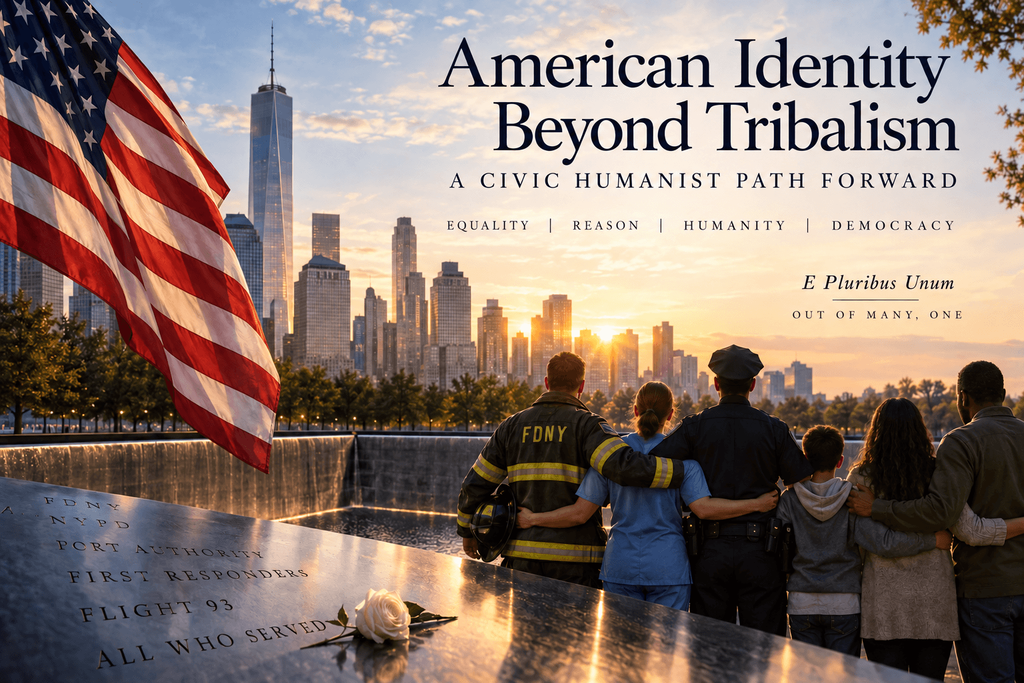
American Identity Beyond Tribalism
A Civic Humanist Path Forward (Summary Version)
Contents
Introduction — What Does It Mean to Be American?
I. American Identity: Nation, Idea, and Unfinished Project
II. The Many Tribes of America
III. How Tribalism Changes Political Reality
IV. The Machinery of Polarization
V. The American Culture Wars
VI. Patriotism, Nationalism, and the Meaning of America
VII. A Civic Identity Larger Than the Tribe
VIII. Civic Humanism and a New American Identity
Conclusion — E Pluribus Unum for the Twenty-First Century
Epilogue — September 11, 2001–2026
Sources
Introduction — What Does It Mean to Be American?
What does it mean to be American? The United States is simultaneously a country, a constitutional republic, a collection of remarkably different communities, and an idea about how people who disagree can govern themselves together. Americans differ by race, religion, ancestry, region, class, profession, generation, and political philosophy. These identities enrich the nation. The danger begins when identity becomes tribalism—when belonging to one group increasingly requires regarding another as an enemy.
That danger now reaches beyond ordinary political disagreement. Americans increasingly differ over whom they trust, which institutions they consider legitimate, and even which claims about reality they accept as factual. Political parties have become social identities, while disputes over race, immigration, religion, gender, economics, history, and speech become tests of cultural allegiance. Digital media can intensify these divisions, but technology is an amplifier of a deeper problem: the weakening of a common civic identity.
America does not need to eliminate its tribes. A free and pluralistic society could not do so without eliminating much of what makes it free. The challenge is instead to recover an identity large enough to contain them.
Civic Humanism offers such a framework. It begins with the human person rather than the tribe and joins scientific reasoning with human dignity, freedom, equality, democratic agency, and responsibility for the common good. Its question is not which group should own America, but how profoundly different people can build a flourishing society together.
I. American Identity: Nation, Idea, and Unfinished Project
American identity has always contained a paradox. The United States is a particular nation with borders, institutions, traditions, and a distinctive history, yet its political identity rests heavily upon principles presented as universal. The Declaration of Independence spoke of equality and unalienable rights rather than ancestry or ethnicity. The Constitution began with “We the People.” These ideals helped create the possibility of an American identity based increasingly upon citizenship rather than descent.
The contradiction was present from the beginning. A republic proclaiming liberty permitted slavery. Women lacked equal political standing, Indigenous peoples were displaced, and citizenship was restricted by race and other inherited categories. Yet these failures did not make the principles meaningless. They made the distance between American ideals and American reality impossible to ignore.
Much of American history can therefore be understood as an argument over who belongs within We the People. Abolition, Reconstruction, women’s suffrage, the civil-rights movement, and subsequent struggles for equal citizenship repeatedly appealed to principles already embedded in the American experiment. The country’s ideals became instruments for criticizing and reforming the country itself.
This history suggests that American identity is strongest when understood neither as ancestry nor as mythology, but as an unfinished civic project. Americans need not pretend that their history is innocent, nor conclude that it is merely a history of oppression. A mature patriotism can acknowledge extraordinary achievements and profound injustices at the same time.
The resulting national identity is aspirational. Equality means equal human worth and citizenship, not sameness. Freedom protects conscience, expression, association, and meaningful personal agency. Opportunity expresses the hope that the circumstances of birth should not permanently determine the possibilities of a life. These principles sometimes conflict, and democratic politics exists partly to negotiate those tensions.
America can therefore remain a real nation—with borders, laws, traditions, obligations, and a particular history—without defining authentic membership through race, religion, or ideological conformity. Its unity can rest instead upon citizenship, constitutional government, reciprocal rights, and responsibility for a shared future.
That conception does not require Americans to abandon their other identities. It requires something more difficult: learning how to possess them without allowing any one of them to become the complete measure of themselves or their fellow citizens. America contains many communities, and increasingly those communities have sorted themselves into competing political camps. To understand contemporary tribalism, we must first understand the tribes themselves.
II. The Many Tribes of America
Americans rarely possess a single identity. A person may simultaneously identify with a race, religion, profession, region, economic class, generation, family tradition, and political philosophy. These affiliations provide community and meaning. They become tribal when the boundary between us and them begins determining whom we trust, whose suffering matters, and which arguments we are willing to hear.
Race remains especially consequential because American history made it consequential. Slavery, segregation, discriminatory laws, and unequal access to political and economic institutions left effects that cannot be understood by pretending race never mattered. Yet racial categories become intellectually and morally dangerous when treated as complete descriptions of individuals. No race possesses a single interest, worldview, experience, or moral character.
Religion can similarly provide ethical community and profound meaning while becoming divisive when political belonging is tied to theological conformity. Class, education, geography, gender, sexuality, and generation add further dimensions. Urban professionals and rural workers may inhabit very different social worlds even while sharing citizenship and many basic aspirations.
Partisanship increasingly gathers these identities into two large coalitions. Political disagreement can consequently become personal: the opposing party appears not merely mistaken but culturally alien. Americans may choose neighborhoods, friendships, media, and even romantic partners partly according to political identity, while the most provocative representatives of each coalition become caricatures of everyone within it.
Yet America is more complicated than its loudest factions. The 2018 Hidden Tribes study divided Americans into seven political-cultural groups and placed roughly two-thirds within an “Exhausted Majority” less ideologically rigid than the opposing activist wings. The categories should not be mistaken for a permanent map of American opinion, but the underlying lesson remains useful: political visibility is not the same as numerical strength.
The challenge, then, is not diversity itself. A healthy society permits people to belong deeply to communities while recognizing the individuality and equal citizenship of people outside them. Identity should enrich the person without imprisoning the person. Tribalism begins when those partial identities become total explanations of who we are—and who our enemies must be.
III. How Tribalism Changes Political Reality
Political disagreement is normal in democracy. Tribalism changes its character. Instead of asking whether a policy is effective, constitutional, just, or supported by evidence, citizens increasingly ask a simpler question: Which side is this on? Once politics becomes part of social identity, changing one’s mind can feel less like correcting an error than betraying one’s community.
This encourages what researchers call affective polarization: growing dislike and distrust of members of the opposing political party. Each coalition also develops narratives about what threatens the country. Progressives may emphasize discrimination, concentrated wealth, environmental danger, or restrictions on personal autonomy. Conservatives may emphasize crime, uncontrolled immigration, cultural disruption, government overreach, or the erosion of traditional institutions. Many of these concerns contain legitimate questions. Tribalism makes acknowledging the validity of another group’s concern appear to weaken one’s own.
The result is identity-protective reasoning. Evidence supporting the tribe is welcomed; inconvenient evidence receives extraordinary scrutiny. Political scandals become unforgivable when committed by opponents and explainable when committed by allies. Citizens may sincerely believe they are defending democracy while applying democratic principles differently depending upon who benefits.
James Madison recognized the underlying problem in Federalist No. 10. Faction arises naturally because human beings possess different interests, passions, and opinions. Eliminating those differences would require destroying liberty or imposing an impossible uniformity. The task of republican government is therefore not to abolish faction, but to prevent any faction from dominating the whole.
Modern America complicates Madison’s solution because many once-crosscutting identities increasingly align along the same partisan boundary. Race, religion, geography, education, culture, and media consumption can reinforce one another, making political opponents seem like members of an entirely different society.
A democratic alternative requires epistemic humility without moral surrender. Citizens can hold strong convictions while recognizing that their coalition can be wrong, their opponents can sometimes be right, and complicated problems rarely conform perfectly to partisan narratives. Critical thinking begins with the willingness to apply the same standards of evidence and conduct to one’s own tribe that one demands of everyone else.
The danger of tribalism is therefore not simply that Americans disagree. It is that tribal loyalty can gradually replace independent political judgment. Modern institutions and technologies have learned how to amplify that tendency.
IV. The Machinery of Polarization
American polarization has no single cause. Political institutions, economic incentives, media fragmentation, digital technology, and ordinary human psychology interact to reward conflict. Politicians discover that fear and anger mobilize supporters; media organizations compete for attention; citizens naturally prefer information that confirms existing beliefs. Individually understandable choices can therefore produce a collectively unhealthy political culture.
The modern information economy intensifies this problem because attention has value. Outrage, novelty, fear, and conflict often travel farther than qualification or context. A shocking crime, offensive statement, or confrontation can be presented to millions of people until an exceptional event begins to seem representative of an entire population. Information need not even be false to mislead. A genuine video, statistic, or quotation can create a distorted impression when stripped of context.
Social-media algorithms contribute to this environment, but blaming algorithms alone is too simple. A major 2023 Facebook experiment found that substantially reducing exposure to politically like-minded sources changed what users encountered without measurably reducing affective polarization or ideological extremity. Technology is better understood as an amplifier operating within an already divided society.
The resulting information environment makes epistemic integrity a civic necessity. Citizens should ask where a claim originated, what evidence supports it, what context may be missing, and whether independent sources corroborate it. An especially useful question is: What evidence would cause me to change my mind? If the answer is “nothing,” the belief has ceased functioning as an evidence-based conclusion.
Institutions must earn trust as well. Journalism, science, universities, government agencies, and courts can make mistakes or become politicized. The proper response is transparency, accountability, correction, and reform—not replacing shared methods of verification with separate realities for competing tribes.
V. The American Culture Wars
These forces converge in America’s culture wars, where disagreements about policy become struggles over morality, belonging, and national identity. Race and policing illustrate the pattern. The history of racial discrimination and contemporary cases of police misconduct demand serious attention, while communities also require effective law enforcement and protection from violence. A Civic Humanist approach refuses the false choice: justice and security are complementary human needs. Police require legitimate authority and resources as well as professional standards, oversight, and accountability.
Immigration produces a similar collision of legitimate concerns. Nations have the right to maintain borders, regulate entry, enforce immigration law, and consider security and economic capacity. At the same time, undocumented status does not erase human dignity, and migrants cannot reasonably be reduced to either criminals or victims as a class. Humane policy must distinguish judgments about law and policy from judgments about human worth.
Religion, gender, and sexuality generate especially intense disputes because they touch fundamental beliefs about morality and identity. A secular constitutional government should neither establish religious privilege nor treat religious citizens as politically suspect. Likewise, people deserve dignity regardless of sex, sexual orientation, or gender identity, while medical, educational, athletic, and legal claims remain legitimate subjects for evidence and democratic deliberation. Respect for persons does not require suspension of inquiry.
Economic language also becomes tribal. “Capitalism” and “socialism” are frequently used less as precise descriptions than as signals of political allegiance. In practice, modern democracies combine markets, private property, public infrastructure, regulation, taxation, and social programs in different proportions. Civic Humanism treats economic systems as instruments rather than sacred identities: their institutions should be judged by how well they promote opportunity, security, sustainability, innovation, and human flourishing.
Even free speech becomes distorted by tribal logic. Constitutional protection against government censorship is not immunity from criticism, while social expectations of courtesy should not become ideological demands for conformity. A pluralistic democracy requires considerable room for disagreement, including speech that some citizens find mistaken or offensive.
Across these controversies, tribalism encourages imprecision. Concern about immigration is not automatically racism; advocacy for racial justice is not endorsement of political violence. Conservatism is not synonymous with authoritarianism, nor progressivism with extremism. Christianity should not be equated with Christian nationalism, just as Islam should not be equated with Islamism. Precision is one of the first casualties of tribalism.
The culture wars cannot be solved by pretending their underlying disagreements are trivial. They involve real conflicts among rights, interests, evidence, traditions, and competing visions of the good society. The democratic task is to conduct those disagreements without turning fellow citizens into enemies.
Ultimately, the culture wars are arguments about who belongs, whose values define the nation, and who has the authority to speak for “real America.” That makes the distinction between patriotism and nationalism central to any effort to construct an American identity larger than the tribe.
VI. Patriotism, Nationalism, and the Meaning of America
National identity need not be tribal. Patriotism can express gratitude, responsibility, affection for place, and commitment to a shared future. The danger arises when national belonging becomes a contest over who is authentically American. Patriotism says, This is our country, and we are responsible for it. Exclusionary nationalism asks, Which of us truly owns it?
A mature patriotism also requires an honest relationship with history. Americans can honor constitutional government, scientific and economic achievement, cultural creativity, military sacrifice, and movements that expanded freedom while acknowledging slavery, segregation, Indigenous displacement, discrimination, and failed policies. Neither mythology nor cynicism provides an adequate national history. Patriotism should make citizens responsible for improving their inheritance, not defending every part of it.
A civic nation therefore defines belonging principally through citizenship rather than ancestry, race, or religion. This does not make national membership meaningless. Borders, laws, naturalization, constitutional obligations, and civic responsibilities matter precisely because citizenship matters. But no ethnic, religious, regional, or political faction possesses a superior claim to the country.
Such patriotism accommodates disagreement because difference is a predictable consequence of liberty. Americans can dispute abortion, immigration, taxation, religion, gender, foreign policy, and the meaning of justice while remaining participants in the same national project. The challenge is not achieving one American worldview, but maintaining a civic relationship strong enough to survive competing ones.
VII. A Civic Identity Larger Than the Tribe
A workable American identity must therefore be larger than race, religion, class, party, or ideology without requiring any of them to disappear. People can remain members of particular communities while meeting one another politically as equal citizens.
Civic Humanism begins with the individual human being. Demographic categories remain important for understanding discrimination, inequality, health, voting, and other social patterns, but statistical categories are not complete persons. Historical privilege does not confer inherited guilt, just as membership in a historically disadvantaged group does not confer automatic moral authority. The fundamental moral unit of humanism is the human person, not the tribe.
Universalism need not mean blindness to unequal conditions. Equal rights can coexist with empirical investigation of disparities and targeted remedies for demonstrated injustice. The important distinction is between recognizing patterns and reducing individuals to them.
A larger civic identity also requires shared methods for determining reality. Citizens need not agree about religion, morality, or political philosophy, but democratic deliberation becomes impossible if evidence itself is entirely tribal. Science, independent journalism, transparent public data, courts, historical scholarship, and open debate are imperfect institutions and practices, yet they provide methods through which claims can be challenged and corrected.
The civic principle is ultimately reciprocal: defend rights that must also belong to opponents, accept election rules when one’s side loses, and preserve institutions one would want preserved under an opposing government. Democracy works when citizens understand that no faction owns the civic table.
VIII. Civic Humanism and a New American Identity
Civic Humanism brings these principles together into a political ethic suited to a pluralistic society. It places human dignity before tribal status, science and reason before ideological convenience, freedom alongside responsibility, and democracy within the larger goal of human flourishing. Institutions and policies should ultimately be judged by what they enable human beings to become and how well they allow different people to live together.
This does not make Civic Humanism a doctrine of automatic compromise. The midpoint between two positions is not necessarily true or just. Evidence may strongly favor one policy, constitutional rights may limit what majorities can decide, and some conduct deserves unequivocal condemnation. The objective is independent judgment: evaluating claims according to evidence and ethical principles rather than their partisan origin.
Freedom within this framework means more than absence of restraint. Human agency requires meaningful opportunities to learn, work, participate, form relationships, pursue purposes, and make consequential choices about one’s life. Equality means equal human worth and citizenship, not identical abilities, circumstances, beliefs, or outcomes. Democracy extends that agency into political life by recognizing that authority ultimately belongs to citizens rather than to a permanent ruling tribe.
Most importantly, Civic Humanism must resist becoming another identity faction. Its commitment to liberty means defending liberty when opponents exercise it. Its commitment to evidence means accepting inconvenient findings. Its commitment to dignity means refusing dehumanization even when directed toward people whose ideas we strongly oppose.
A Civic Humanist American identity can therefore accommodate conservatives and progressives, religious believers and secular citizens, immigrants and the native-born, rural communities and great cities. It asks none of them to surrender every difference. It asks them to recognize a deeper proposition beneath those differences:
People who do not think alike can build a flourishing society together.
That may be the American experiment at its best. E pluribus unum does not mean transforming the many into sameness. It means creating one civic community in which the many remain free to be many.
Conclusion — E Pluribus Unum for the Twenty-First Century
America has never been a nation without tribes, and it never will be. Madison understood that faction arises naturally wherever free people possess different interests, beliefs, and ways of life. The democratic challenge is not to eliminate those differences, but to prevent them from becoming instruments of domination and mutual hostility.
The United States therefore needs neither cultural uniformity nor an identity based upon ancestry, religion, race, or political ideology. It needs a civic identity capable of holding profound differences within a common framework of human dignity, equal citizenship, freedom, evidence, democratic responsibility, and shared concern for the future.
That is the promise contained in E pluribus unum: out of many, one. The many need not disappear for the one to exist.
America remains an unfinished experiment in whether people who differ profoundly can nevertheless govern themselves together. Civic Humanism answers that challenge by placing our common humanity beneath—and ultimately above—our competing political identities.
Epilogue — September 11, 2001–2026
This article is published on September 11, 2026, twenty-five years after one of the defining tragedies of modern American history. For younger generations, 9/11 is increasingly history rather than memory. Yet for millions of Americans and people around the world, the events of that morning remain deeply personal.
On September 11, 2001, nineteen al-Qaeda terrorists hijacked four commercial airliners. Two struck the World Trade Center in New York City, a third struck the Pentagon, and United Airlines Flight 93 crashed near Shanksville, Pennsylvania, after passengers and crew fought back. The attacks killed 2,977 people from more than 90 nations.
Among the dead were 343 members of the FDNY, 23 NYPD officers, and 37 Port Authority police officers. We also remember the airline crews and passengers, military and civilian personnel, emergency medical workers, medical professionals, and the many others who responded. Thousands survived, while families lost parents, children, spouses, siblings, colleagues, and friends. Many responders and survivors later suffered illnesses associated with exposure to the toxic environment surrounding Ground Zero.
September 11 changed America and the world. It brought remarkable solidarity and courage, but also war, expanded security and surveillance, and difficult debates about liberty and national responsibility. Fear sometimes produced unjust suspicion toward Muslim, Arab, Sikh, and South Asian Americans. That history reminds us why a nation must distinguish genuine threats from tribal prejudice and collective blame.
Yet 9/11 also demonstrated something more enduring. Firefighters climbed upward while thousands escaped downward. Police officers, medical personnel, public servants, volunteers, coworkers, and strangers helped people without first asking their race, religion, politics, or social identity. In the extremity of that morning, the humanity beneath our categories became unmistakable.
On this twenty-fifth anniversary, we remember those who died, those who came to their aid, those who survived, and the families who carried the loss forward.
May we honor them through remembrance and by building a country worthy of their memory, where our common humanity remains greater than our divisions.
In memory of the 2,977 lives taken on September 11, 2001; in honor of those who came to their aid; and with enduring respect for the survivors, responders, families, and communities who carried the consequences forward.
Take a moment of silence. May they be remembered.
Sources
More in Common. Hidden Tribes: A Study of America’s Polarized Landscape. 2018. The project drew on research involving more than 8,000 Americans and examined political polarization, seven political-cultural groupings, the “Exhausted Majority,” and areas of common ground.
The Hidden Tribes of America
Madison, James. “The Federalist Number 10.” November 22, 1787. The Federalist. Founders Online, National Archives. Madison examines the causes and dangers of faction and argues that destroying faction would require either destroying liberty or imposing an impossible uniformity of opinion and interest.
Federalist No. 10 — Founders Online
Iyengar, Shanto, Yphtach Lelkes, Matthew Levendusky, Neil Malhotra, and Sean J. Westwood. “The Origins and Consequences of Affective Polarization in the United States.” Annual Review of Political Science 22 (2019): 129–146. The review examines growing partisan dislike and distrust and the role of partisanship as a social identity.
Annual Review of Political Science — Affective Polarization
Nyhan, Brendan, Jaime Settle, Emily Thorson, Magdalena Wojcieszak, Pablo Barberá, et al. “Like-minded Sources on Facebook Are Prevalent but Not Polarizing.” Nature 620 (2023): 137–144. The field experiment involving 23,377 Facebook users found that reducing exposure to like-minded sources by approximately one-third altered information exposure but produced no measurable change in the study’s preregistered measures of affective polarization or ideological extremity.
Nature — Like-minded Sources on Facebook
Pew Research Center. “Most Americans Say Republican and Democratic Voters Cannot Agree on Basic Facts.” July 30, 2025. Eight in ten U.S. adults said voters from the two major parties could not agree on basic facts concerning important issues, illustrating the erosion of a commonly accepted factual environment.
Pew Research Center — Partisan Disagreement on Basic Facts
National September 11 Memorial & Museum. Educational and historical resources on the September 11 attacks, victims, survivors, first responders, rescue and recovery workers, and the continuing consequences of 9/11.
National September 11 Memorial & Museum
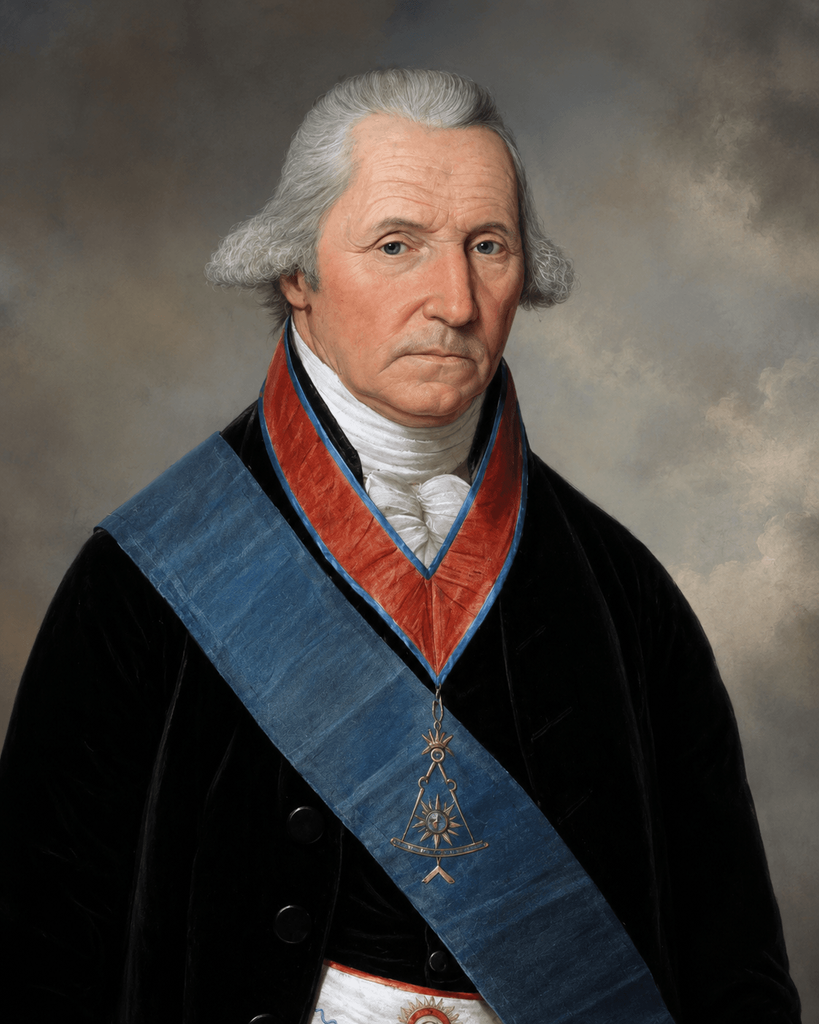
The Portrait of George Washington by William Williams: AI reconstruction as a photorealistic digital image.