
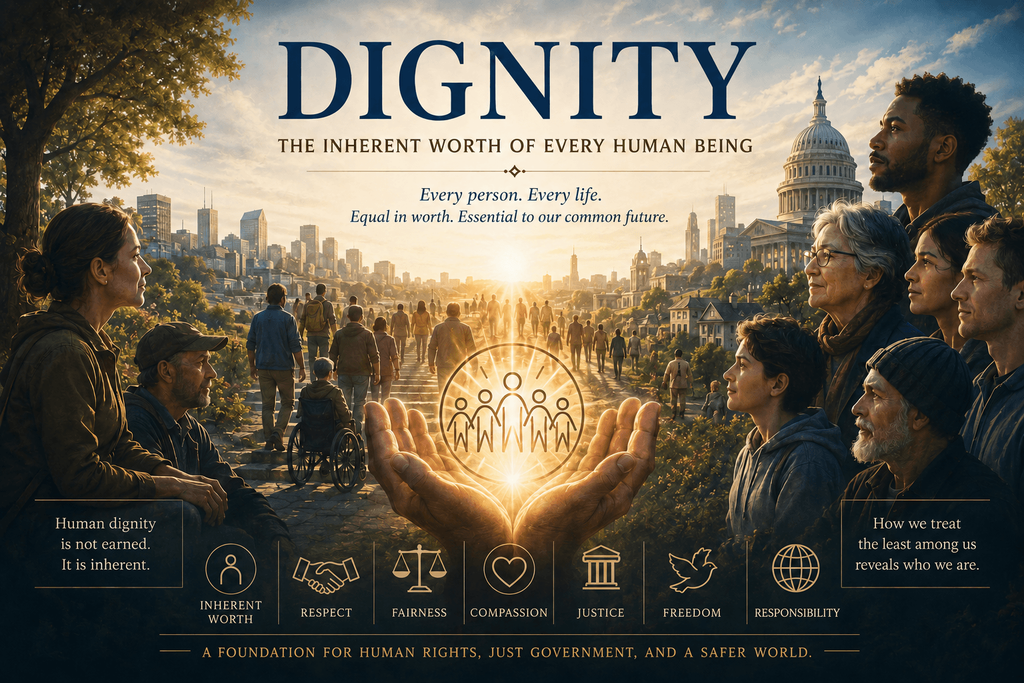
Human dignity is the principle that every human being possesses a fundamental worth that demands recognition and respect. Dignity is expressed personally through self-respect and integrity, but its political meaning reaches further: a person’s basic value does not depend upon wealth, nationality, intelligence, social status, usefulness, belief, or political power. Human beings matter because they are human.
The idea has a long philosophical history. Ancient Greek and Roman thinkers associated dignity with rational nature, virtue, citizenship, and honorable conduct, although ancient societies did not generally extend equal status to everyone. Stoic philosophy moved closer to universality by emphasizing a common rational nature shared across humanity. Religious traditions subsequently developed related ideas through concepts such as the sacredness of human life and the moral equality of persons.
Modern philosophy transformed dignity into a more explicitly universal principle. Immanuel Kant argued that persons possess dignity rather than merely a price because rational beings are ends in themselves. A person therefore should never be treated merely as an instrument for another person’s purposes. This distinction helped establish an important foundation for modern conceptions of autonomy, moral equality, and individual rights.
The catastrophic abuses of the twentieth century gave dignity a new constitutional and international importance. The 1948 Universal Declaration of Human Rights begins by recognizing the “inherent dignity” and equal and inalienable rights of all members of the human family. Its first article declares that all human beings are born free and equal in dignity and rights. Dignity thereby became more than a philosophical ideal: it became a foundational principle of the developing international human-rights system.
In government, dignity establishes a moral boundary around the exercise of power. Democratic institutions must recognize people not merely as taxpayers, workers, voters, consumers, subjects of administration, or statistical units, but as persons whose lives possess value. Government violates dignity when it dehumanizes people, arbitrarily discriminates among them, subjects them to degrading treatment, or sacrifices fundamental rights solely for institutional convenience.
Dignity does not eliminate the need for justice or security. Humanism requires all three because each protects a different dimension of human life. Dignity recognizes the inherent worth of persons; justice establishes fair rules, rights, responsibilities, and consequences; security protects people and institutions against violence, coercion, predation, and disorder. None is sufficient by itself.
Justice therefore does not mean the absence of punishment. A person who seriously harms another may justly lose certain freedoms, including through imprisonment. Respect for the offender’s dignity requires due process, proportional punishment, humane treatment, and recognition of basic rights; it does not require society to ignore the dignity and security of victims or expose others to preventable harm. Indeed, refusing to restrain dangerous conduct can itself become an injustice.
The same principle applies to self-defense. Humanism values human life, but this does not create an obligation to submit passively to violence. A person may use necessary and proportionate force to protect themselves or another person. The tragedy of such circumstances does not disappear because the defensive act is justified. Humanist ethics seeks to minimize unnecessary violence while recognizing that sometimes force is required to prevent greater harm.
At the political level, societies inevitably encounter disagreements that cannot always be reconciled. Human beings have historically formed families, tribes, communities, states, nations, political parties, religious communities, nonprofit organizations, and other associations partly because people cooperate most effectively around certain shared interests, identities, institutions, or values. Political pluralism consequently produces both cooperation and division. The existence of disagreement is not itself a failure of humanism.
Some conflicts concern values; others concern limited land, resources, opportunities, authority, or competing claims of justice. Government exists partly because such disputes require institutions capable of establishing rules, adjudicating claims, protecting rights, enforcing legitimate decisions, and maintaining public order. Human dignity constrains this authority, but does not make authority unnecessary.
The same reasoning extends to national security and war. Peace should remain a fundamental objective because warfare causes extraordinary destruction of human life and dignity. Yet a state may face aggression that cannot reasonably be stopped through diplomacy or other peaceful measures.
Just as an individual possesses a right of self-defense, states possess a recognized right of individual and collective self-defense. The humanist objective is therefore not pacifism at any cost, but the prevention of unnecessary conflict, the limitation of necessary force, the protection of civilians, and the restoration of a just and durable peace.
Dignity, justice, and security should therefore be understood as mutually reinforcing principles within a larger humanist philosophy of government. Dignity without justice can become impunity; justice without dignity can become cruelty; security without either can become authoritarianism. Conversely, dignity without sufficient security may become impossible to protect.
It is the task of simple Civic Humanism is to hold these principles together: to construct governments strong enough to protect people and uphold law, restrained enough to respect human dignity, and just enough to command legitimate public trust. A humane society is not one without boundaries, consequences, disagreements, or defensive power. It is one that exercises these necessities rationally, proportionately, lawfully, and always with human beings—their rights, safety, freedom, and flourishing—as their ultimate purpose.
Dignity becomes especially important where institutions or traditions exercise great power over vulnerable people. It does not require governments to abandon security, punishment, cultural diversity, or religious freedom. It requires that these purposes remain bounded by the recognition that no human being loses fundamental moral worth.
In war, dignity distinguishes legitimate military necessity from dehumanization. Combatants may lawfully be opposed with force under the laws of armed conflict, but wounded soldiers, prisoners of war, civilians, and those who surrender remain persons rather than objects of vengeance. This principle underlies prohibitions against torture, rape, deliberate attacks on civilians, hostage-taking, degrading treatment, and unnecessary suffering. Even an enemy retains human dignity.
In imprisonment, dignity means that lawful punishment does not erase personhood. A government may restrict liberty after due process, but imprisonment does not provide unlimited authority over the prisoner. Humane living conditions, adequate food and medical care, protection from abuse, access to legal process, and freedom from torture or degrading punishment follow from the recognition that prisoners remain human beings with rights. Rehabilitation also reflects dignity by recognizing the continuing possibility of moral agency, learning, and reintegration.
In lawmaking, dignity functions both as a standard and a limit. Legislators should ask not only whether a policy is efficient, popular, or administratively convenient, but whether it treats the people affected as persons of equal moral standing. Laws that arbitrarily classify populations as inferior, deny basic legal personality, impose degrading conditions, or instrumentalize individuals for collective purposes can violate dignity even when enacted through formally legitimate procedures. Democratic majorities therefore remain constrained by fundamental rights.
The relationship between dignity and cultural or religious practices requires particular care. Civic Humanism should defend freedom of religion, conscience, cultural association, and pluralism while rejecting the proposition that tradition automatically legitimizes harm. Practices involving slavery, forced marriage, sexual violence, severe corporal punishment, coercive bodily alteration, persecution of dissenters, or systematic denial of fundamental rights cannot be immunized from ethical examination simply by describing them as traditional or sacred.
This principle should be applied universally rather than selectively. Every society—including secular and democratic societies—contains inherited practices that may deserve criticism or reform. The appropriate question is not whether a practice is foreign, ancient, religious, or culturally unfamiliar, but whether it subjects human beings to coercion, cruelty, degradation, or unjustifiable domination.
Dignity therefore provides Civic Humanism with a common ethical threshold across very different circumstances. War does not eliminate the humanity of the enemy; crime does not eliminate the humanity of the prisoner; democratic authority does not give lawmakers unlimited power; and culture or religion does not eliminate the humanity of the individual. The institutions and traditions of civilization remain legitimate only insofar as their exercise of power remains compatible with the fundamental worth of the persons subject to them.
Dignity is thus both a principle of restraint and a principle of aspiration. It tells civilization what must never be done to human beings and what political institutions should enable human beings to become.
Dignity applies to citizens and migrants alike. At the same time, it does not erase the distinction between lawful and unlawful immigration, or negate a state’s legitimate authority to control its borders. A humane government may establish immigration limits, determine eligibility for residence, adjudicate asylum claims, prevent unlawful entry, deport people without a legal right to remain, and prioritize public safety. Dignity governs how these powers are exercised, not whether government may exercise them.
In Europe, tensions surrounding migration from Muslim-majority societies illustrate the need to balance dignity with integration and democratic constitutional order. Muslim migrants should not be treated as collectively responsible for terrorism, extremism, crime, or the conduct of other Muslims. They deserve religious liberty, equality before the law, physical security, and protection from discrimination.
At the same time, dignity also protects women, children, religious minorities, former Muslims, LGBT people, and other members of society whose freedoms can conflict with illiberal cultural or religious practices. Freedom of religion cannot justify forced marriage, violence, intimidation, terrorism, or overriding democratically established civil law. Integration should therefore involve reciprocal obligations: the state protects the migrant’s rights while expecting respect for the rights and laws governing everyone else.
The contemporary United States presents a related problem involving large numbers of migrants from Latin America and elsewhere. People who enter or remain unlawfully do not thereby lose their human dignity. Immigration enforcement should provide legally required process, humane detention conditions, protection against unnecessary force, meaningful consideration of valid asylum claims, and particular safeguards for children and vulnerable people. Enforcement should distinguish between immigration status and criminal dangerousness rather than rhetorically transforming an entire migrant population into criminals or enemies.
The same standard applies to ICE and other enforcement agencies. Immigration officers perform a legitimate governmental function and are themselves entitled to dignity and physical security. They should not be collectively demonized for enforcing laws enacted by democratic institutions. At the same time, state power carries heightened responsibility: allegations of abuse, degrading detention, unlawful arrest, excessive force, or denial of legally required process should be independently investigated and remedied when substantiated.
Civic Humanism therefore rejects two extremes: dehumanizing migrants in the name of security and abandoning effective immigration law in the name of compassion. A sustainable immigration system requires enforceable borders, realistic admission rules, functioning asylum procedures, integration into civic society, protection of citizens and lawful residents, and humane treatment of people whose applications are rejected or whose removal is legally required.
The underlying principle is the same one that applies to criminal justice and war: dignity limits the manner in which legitimate power is exercised; it does not abolish legitimate power. A person can be denied admission, detained when legally necessary, or deported without being humiliated or treated as less than human. Conversely, recognizing a migrant’s dignity does not require a society to surrender its laws, security, constitutional values, or right to determine the conditions of membership in its political community.
The principle of dignity becomes most consequential precisely where political order is breaking down. International humanitarian law does not require belligerents to abandon legitimate defense, but it does require distinction between civilians and combatants, proportionality, humane treatment of detainees, protection of the wounded, and limits on methods of warfare. Human dignity therefore provides a common standard that applies regardless of which population, government, army, or political cause is involved.
In Ukraine, preserving dignity requires recognition of Ukraine’s sovereignty and legitimate security while simultaneously protecting civilians and persons who have ceased participating in hostilities. UN monitors recorded at least 437 civilians killed and 2,610 injured in July 2026 alone, the highest monthly civilian casualty total they had documented since March 2022. (ukraine.ohchr.org)
Both Russian and Ukrainian forces remain bound by international humanitarian law. Prisoners of war must not be tortured, executed, humiliated, or subjected to retaliation, while civilians in occupied territories retain legal protections regardless of their nationality or political loyalties. UN monitoring has documented particularly extensive violations against Ukrainian POWs and civilian detainees held by Russian authorities, while also recording mistreatment of Russian POWs by Ukrainian authorities. (ukraine.ohchr.org)
In Israel and the Palestinian territories, dignity requires simultaneously recognizing Israeli civilians’ right to security and Palestinian civilians’ inherent worth and rights. Deliberately attacking civilians and taking hostages cannot be justified by political grievance. Allegations of indiscriminate and disproportionate attacks against Palestinians should be considered in light of history, national security, and universal human rights. Hostages must be released, detainees treated humanely, civilians protected, humanitarian assistance facilitated, and alleged violations independently investigated. OHCHR has specifically emphasized humane treatment and respect for the inherent dignity of persons deprived of liberty. (Human Rights Office)
The civil war in Sudan demonstrates why dignity cannot be separated from security. UN human-rights mechanisms have reported allegations involving indiscriminate attacks, killings, executions, disappearances, torture, sexual violence, destruction of civilian infrastructure, displacement, and obstruction of humanitarian assistance. Preserving dignity requires all armed forces and militias to protect civilians regardless of ethnic or political affiliation, permit humanitarian relief, prohibit rape and torture absolutely, and subject perpetrators to credible investigation and prosecution.
The conflicts in eastern Democratic Republic of the Congo present another dimension: armed competition over territory, political authority, communities, and resources must never transform civilians into instruments of war. Recent UN communications concerning areas where M23 operates include allegations of arbitrary detention, torture, abduction, intimidation, and attacks against human-rights defenders. Dignity requires protection of civilians, accountability for atrocities, humane treatment of captives, protection against sexual violence, and political settlements in which affected communities are treated as participants rather than possessions.
These conflicts differ profoundly in their origins, legal circumstances, responsibility, and geopolitical context. Humanism should not erase those differences by declaring all sides morally equivalent. Universal dignity means universal standards, not identical judgments. Evidence should determine responsibility, law should determine permissible conduct, and accountability should follow demonstrated violations.
Dignity must also be factually preserved, rather than merely proclaimed. Governments and armed forces should translate it into military rules of engagement, civilian-harm tracking, independent detention inspections, identification of the dead, communication with families, humanitarian corridors where legally and operationally appropriate, protection of hospitals and relief personnel, investigation of alleged war crimes, and reparations or other remedies where responsibility is established.
This produces an important Civic Humanist principle: the humanity of an adversary does not invalidate the necessity of defending against them. A soldier may remain a legitimate military target while retaining human dignity. Once that soldier surrenders, the legal situation changes. A criminal may deserve imprisonment without deserving torture. A hostile state may have to be militarily resisted without its civilian population becoming an enemy population.
Dignity consequently imposes discipline upon power rather than abolishing power. It asks governments, armies, political movements, and citizens to make distinctions that hatred tends to erase: between an enemy and a civilian, guilt and identity, punishment and cruelty, defense and revenge, military necessity and dehumanization.
That distinction may be one of dignity’s greatest contributions to government. Human beings will continue to disagree over territory, resources, security, religion, ideology, sovereignty, and political order. Humanism cannot promise a world without conflict. It can insist that even when conflict becomes unavoidable, human beings never cease to be human beings.
About the Author
D. B. Smith is the founder and director of Science Abbey, a writer, historian, and humanist whose work explores the relationship between science, philosophy, ethics, democracy, and human civilization. He is the developer of Integrated Humanism and Civic Humanism, frameworks that seek to apply scientific knowledge, humanist ethics, democratic principles, and long-term thinking to the challenges of governance and human flourishing.