
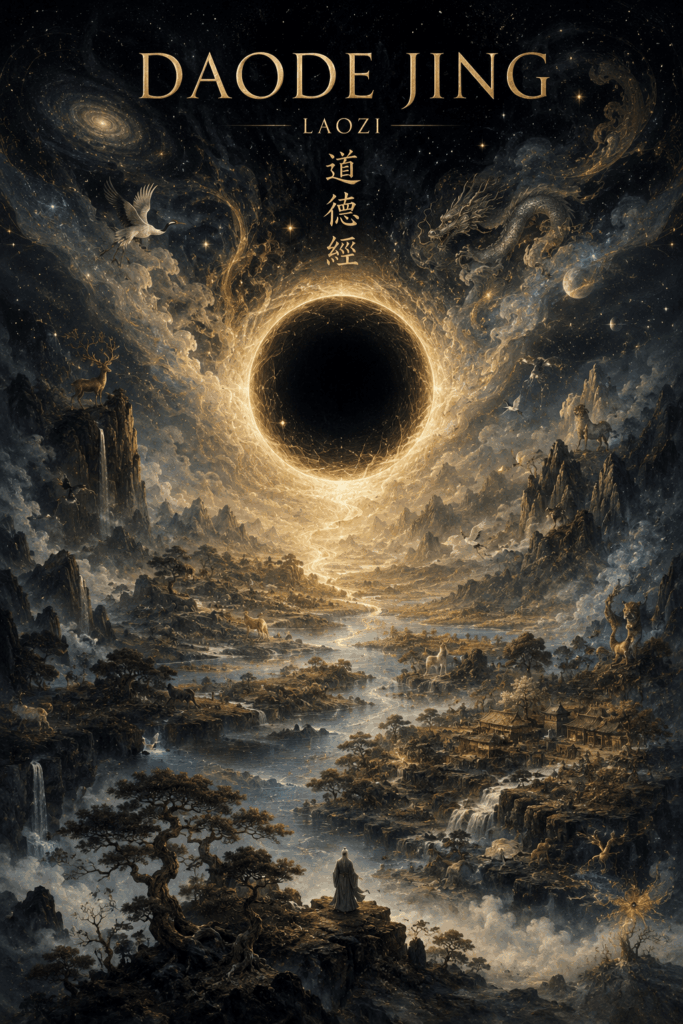
Introduction — Laozi and the Daoist Tradition
The Daodejing, traditionally attributed to the ancient Chinese sage Laozi, is one of the foundational works of Chinese philosophy and one of the most influential texts in world intellectual history. Composed in brief, poetic passages, it examines reality, human conduct, government, knowledge, desire, conflict, and the possibility of living wisely within a world of continual change.
Its title, 道德經 (Dàodéjīng), is commonly translated as The Classic of the Way and Its Virtue. Dao 道 means “way” or “path,” but in the text it also describes the underlying Way of nature: the nameless origin of the universe and the process through which all things arise, transform, and return.
De 德, conventionally translated as “virtue,” has a broader range of meanings than the English word sometimes suggests. It can indicate integrity, character, potency, or the particular power through which the Dao becomes expressed in individual beings. The relationship between Dao and De therefore concerns both the nature of reality and how one lives within it.
The philosophy associated with Laozi emphasizes simplicity, naturalness, humility, moderation, and harmony with natural processes. One of its central principles is wuwei 無為, usually translated as “non-action” or “effortless action.” It does not simply mean inactivity, but acting without unnecessary force, interference, or compulsive striving.
The Daodejing repeatedly develops this philosophy through observations of nature. Water is soft and yielding, yet gradually wears away stone. The empty center makes a wheel useful, just as the hollow interior gives a vessel its function. Such images present reality as dynamic and relational rather than as something human beings can completely control.
Over the centuries, ideas associated with Laozi contributed to philosophical and religious Daoism, meditation, monasticism, Chinese alchemy, qigong, medicine, poetry, landscape painting, and the internal martial arts. Daoist thought also formed part of the Chinese intellectual environment in which Indian Buddhism was interpreted and transformed, contributing to the world from which Chan and later Zen Buddhism emerged.
The Daodejing remains relevant because many of the problems it addresses remain recognizably human. Individuals and governments continue to struggle with ambition, conflict, excessive consumption, competition, inequality, the accumulation of power, and attempts to control complex systems. Laozi asks whether greater force, wealth, knowledge, and activity necessarily produce wiser outcomes.
A Science Abbey reading approaches the Daodejing historically and critically while remaining open to its philosophical and contemplative insights. Ancient cosmology need not be accepted as modern science, and later Daoist doctrines need not be projected backward onto Laozi. The objective is to understand the text within its historical world while examining what it may still teach about nature, psychology, governance, self-cultivation, and the limits of control.
The inquiry begins in ancient China, during an age of political fragmentation, social transformation, and extraordinary intellectual creativity. From this environment emerged not only the ideas associated with Laozi and Daoism, but some of the most enduring philosophical traditions of Chinese civilization.
Ancient China
The Daodejing emerged from one of the most intellectually creative periods in Chinese history. The Zhou dynasty had established political authority over much of ancient China during the eleventh century BCE, but over succeeding centuries its central power weakened. Regional rulers became increasingly independent, creating a political landscape characterized by competing states, changing alliances, social transformation, and recurrent warfare.
The later Zhou period is conventionally divided between the Spring and Autumn period (770–476 BCE) and the Warring States period (475–221 BCE). Political fragmentation produced tremendous violence, but it also encouraged intellectual experimentation. Thinkers attempted to understand how individuals should live, how rulers should govern, why societies collapse, and what principles might restore order.
This intellectual flowering became known as the era of the Hundred Schools of Thought. Confucian thinkers emphasized ethical cultivation, education, ritual, family relationships, and responsible government. Mohists advocated impartial concern, social utility, and opposition to unnecessary warfare, while Legalist thinkers concentrated on institutions, law, political authority, and techniques for maintaining state power.
The thinkers later identified with Daoism approached these questions differently. Rather than beginning with the construction of an ideal social order, they questioned whether excessive attempts to impose order might themselves create disorder. The Daodejing repeatedly suggests that governments become dysfunctional when rulers interfere excessively, multiply unnecessary regulations, pursue luxury, glorify warfare, or impose their ambitions upon the population.
Behind these political observations was a larger philosophy of nature. Ancient Chinese thinkers understood existence through patterns of transformation involving Heaven, Earth, seasons, living organisms, human communities, and the processes of birth and death. Later Chinese cosmology would systematize concepts such as yin and yang and the Five Phases, but the Daodejing already reflects a world understood through relationship, transformation, complementarity, and return.
The text’s political philosophy therefore cannot be separated entirely from its understanding of nature. A ruler should govern well for much the same reason that water flows around obstacles rather than attempting to destroy them. The strongest society may not be the one subjected to the greatest control, just as the strongest organism is not necessarily the most rigid.
This helps explain the Daodejing‘s recurring suspicion of artificial distinctions and excessive sophistication. Civilization creates names, institutions, technologies, hierarchies, desires, and systems of knowledge that can be useful, but they can also separate human beings from simpler realities. Laozi repeatedly asks what happens when the instruments created to serve human life begin instead to govern it.
The historical circumstances surrounding the composition of the Daodejing remain uncertain. Traditional accounts place Laozi around the sixth century BCE, making him an older contemporary of Confucius. Modern scholarship generally regards the received text as the product of a longer process of composition and transmission, with much of its material probably taking shape during the late Warring States period.
Ancient manuscript discoveries have made the history more complicated rather than less interesting. Versions found at Mawangdui and portions preserved among the Guodian bamboo manuscripts demonstrate that sayings associated with the Daodejing circulated in different arrangements before the received text acquired its familiar form. The work appears to have emerged from a living philosophical tradition rather than appearing fully formed at a single moment.
Whatever its precise origins, the Daodejing belongs to an age in which Chinese thinkers were asking fundamental questions about civilization. How much government is necessary? What produces social stability? What is the relationship between human institutions and nature? What constitutes genuine wisdom? These questions provided the historical environment in which the figure of Laozi came to represent an alternative Way.
Who Was Laozi?
Laozi 老子 literally means “Old Master” or “Old Teacher.” Chinese tradition remembers him as the author of the Daodejing and one of the foundational sages of Daoism. Yet separating the historical person from the philosophical symbol is difficult, because the earliest accounts combine possible historical memories with stories that increasingly acquired legendary and religious significance.
The most influential early biography appears in Sima Qian’s Records of the Grand Historian, written around the first century BCE. Sima Qian identifies Laozi with a man commonly called Li Er, who served as a keeper of archival records associated with the Zhou court. According to this tradition, Laozi became renowned for his wisdom and was consulted by Confucius concerning ritual and proper conduct.
The famous story of Laozi’s departure from civilization became central to his legend. Disillusioned with the decline of Zhou society, he supposedly traveled westward toward the frontier. At the pass, a guardian named Yin Xi recognized him as a sage and asked him to leave behind a record of his teaching before disappearing into the wilderness.
Laozi then composed a work of approximately five thousand Chinese characters explaining the Dao and De. Having completed the text, he departed, and the historical record lost sight of him. This became the traditional origin story of the Daodejing: a final teaching left behind by a sage who preferred obscurity to public authority.
The story beautifully reflects the philosophy of the work attributed to him, but its historical reliability is uncertain. Even Sima Qian reported competing traditions about Laozi’s identity. Modern scholars have consequently questioned whether Laozi was a single identifiable author, a historical teacher around whom traditions accumulated, or a personification of teachings developed by several generations of thinkers.
The Daodejing itself provides little assistance. It contains no conventional autobiography and rarely presents its teaching through identifiable historical events. Its speaker appears instead as a voice of accumulated wisdom, observing the behavior of rulers, ordinary people, natural processes, warfare, knowledge, desire, and the recurring tendency of human beings to create difficulties through excessive intervention.
The uncertainty surrounding authorship does not diminish the importance of the text. Many ancient works developed through oral transmission, compilation, editing, and commentary before reaching their surviving forms. What later generations called the Daodejing may therefore preserve several layers of early Daoist thought organized into a remarkably coherent philosophical work.
The figure of Laozi subsequently developed far beyond the possible historical philosopher. Within religious Daoism he became Lao Jun, the Lord Lao, and eventually Taishang Laojun, the Supreme Lord Lao. Some traditions regarded him as a divine manifestation of the Dao itself, appearing repeatedly throughout history to transmit teachings appropriate to different ages.
For the purposes of this translation, “Laozi” can therefore be understood in two related senses. It refers to the traditional sage associated with the Daodejing, but it also names the philosophical voice preserved within the text. Whether that voice belonged to one historical author or developed through a longer tradition, it articulated one of civilization’s most distinctive understandings of nature, power, wisdom, and the Way.
Philosophical Daoism
The term “philosophical Daoism” is commonly used to describe the ideas associated principally with the Daodejing and Zhuangzi. Chinese scholars later classified these traditions as Daojia 道家, the “School of the Way.” The category is useful, although the sharp modern distinction between philosophical and religious Daoism can obscure the more complicated historical relationship between Chinese philosophy, spirituality, ritual, meditation, and religion.
At the center of this philosophy is the Dao 道. The character originally refers to a road, path, or way, and by extension to a method or course of conduct. In the Daodejing, however, the concept becomes more fundamental. Dao describes both the ultimate origin of things and the Way through which the processes of existence naturally unfold.
The Dao cannot be adequately reduced to an object, personality, or creator deity. Before particular things can be distinguished and named, there is the undifferentiated reality from which distinctions emerge. Once the “ten thousand things” arise, the Dao remains present as the Way of their development, transformation, relationship, and return.
This is why the Daodejing begins by warning that the Dao which can be spoken is not the constant Dao. Language divides reality into categories so that human beings can think and communicate about it. Those distinctions are useful, but they should not be mistaken for the whole reality they describe.
Dao and De
The second major concept is De 德, conventionally translated as “virtue.” In modern English, virtue commonly refers to moral goodness, but De has a wider meaning. It can describe character, integrity, efficacy, potency, or the particular power through which the Dao becomes expressed in a person or thing.
The Sage possesses De not primarily because he obeys a list of moral rules, but because his life has become aligned with the Way. His actions are appropriate to circumstances without being dominated by ambition, pride, greed, or unnecessary interference. Virtue in this sense is less something displayed than something embodied.
The relationship between Dao and De therefore connects cosmology with ethics. Dao concerns the underlying Way of reality; De concerns the manner in which that Way becomes manifest through particular existence. The Daodejing asks what human character and government might look like if they developed in greater harmony with this larger natural order.
Wuwei and Ziran
One of the most characteristic Daoist concepts is wuwei 無為. Literally “without action” or “non-doing,” it has sometimes been misunderstood as passive withdrawal from life. The Daodejing instead uses it to describe action without unnecessary forcing, contrivance, or interference.
A person practicing wuwei still acts, but does not multiply action beyond what circumstances require. The skilled ruler governs without attempting to control every detail of society. The Sage accomplishes necessary work without claiming possession of the result. Effective action becomes quieter because less energy is wasted fighting against conditions that have been poorly understood.
Closely related is ziran 自然, literally “self-so” or “so of itself,” commonly translated as naturalness or spontaneity. Something is ziran when it develops according to its own inherent conditions rather than being forced into an artificial form. The Dao itself ultimately models nothing beyond itself: it is simply what it is, of itself.
Being, Nonbeing, and Emptiness
The Daodejing repeatedly explores the relationship between you 有, being or presence, and wu 無, nonbeing or absence. These should not necessarily be understood as two separate metaphysical substances. Rather, they describe complementary aspects of experience that become meaningful through their relationship.
A wheel requires spokes, but its usefulness depends upon the empty hub. Clay forms the walls of a vessel, but the empty interior is what can contain something. A room requires walls, yet doors and windows make it accessible. Being provides form; nonbeing provides possibility.
Emptiness therefore does not simply mean nothingness. It can represent openness, receptivity, potential, and the absence of obstruction. The valley becomes a recurring Daoist image because its low and empty character allows it to receive what flows into it. What appears deficient may possess a different kind of power.
Softness, Humility, and Return
Water provides perhaps the most famous natural model in the Daodejing. It is soft, yielding, and seeks low places, yet it nourishes life and gradually overcomes harder substances. Its strength comes not from rigidity but from adaptability, persistence, and responsiveness.
The same principle applies to human character. Laozi repeatedly values humility over self-promotion, moderation over excess, and flexibility over rigid strength. The newborn infant, uncarved wood, valley, water, and feminine principle become images of potential that has not yet been exhausted through excessive differentiation or control.
All things also participate in return. Life emerges, develops, reaches maturity, declines, and returns to its source. The attempt to preserve growth indefinitely violates this pattern. Wisdom therefore includes knowing when to stop, when to withdraw, and when accomplishment has reached its natural completion.
The Sage and Government
The ideal human figure of the Daodejing is the Sage, or shengren 聖人. The Sage observes the Way and applies its principles to personal conduct and government. He does not dominate others unnecessarily, advertise his accomplishments, accumulate beyond what is sufficient, or mistake social prestige for genuine worth.
This gives Daoist political philosophy its characteristic preference for limited intervention. Laozi often portrays excessive taxation, warfare, luxury, bureaucracy, and regulation as symptoms of rulers who have lost alignment with the Way. Good government creates conditions in which society can function without constant coercion.
The political teaching should not simply be equated with a modern ideology. The Daodejing emerged from an ancient monarchical society and addresses rulers rather than democratic citizens. Yet its questions concerning concentrated power, unintended consequences, excessive regulation, militarism, and the limits of centralized control remain recognizable.
Philosophical Daoism ultimately proposes a discipline of relationship rather than domination. Human beings cannot stand outside nature and command its processes indefinitely. We participate in systems larger than ourselves. Wisdom begins by observing those systems carefully enough to know when to act, when to yield, and when to leave things alone.
Religious Daoism
Daoism did not remain only a body of philosophical literature. Over centuries it developed into diverse religious traditions containing temples, priesthoods, rituals, scriptures, meditation systems, ethical teachings, cosmologies, healing practices, communities, and monastic institutions. Collectively these traditions came to be known as Daojiao 道教, the “Teaching of the Dao.”
The distinction between philosophical Daojia and religious Daojiao should not be made too sharply. Religious Daoists revered Laozi and the Daodejing, while philosophical concepts such as Dao, De, wuwei, naturalness, emptiness, and return continued to shape religious practice. At the same time, organized Daoism incorporated developments that appeared centuries after the earliest layers of the Daodejing.
One important beginning occurred with the Way of the Celestial Masters during the second century CE. Associated with Zhang Daoling, the movement created organized religious communities with ethical rules, ritual specialists, systems of confession and healing, and a distinctive religious administration. Laozi increasingly came to be understood not merely as an ancient philosopher but as a divine manifestation of the Dao.
Later movements greatly expanded Daoist religious literature and practice. Shangqing, or “Highest Clarity,” developed sophisticated visualization and meditation traditions, while Lingbao incorporated elaborate ritual systems and ideas influenced partly by Buddhism. Over time an enormous body of scriptures accumulated, eventually forming the Daoist Canon, or Daozang.
Religious Daoism developed a richly populated sacred cosmos containing deities, immortals, celestial officials, perfected beings, spirits, and divine manifestations. Some traditions envisioned the human body itself as a microcosm containing correspondences with the larger universe. Meditation could therefore become an exploration of both consciousness and an internal sacred landscape.
These traditions pursued several overlapping goals. Some emphasized health and longevity, others ethical cultivation, ritual harmony, communion with divine powers, spiritual transformation, or immortality. The concept of immortality itself ranged from aspirations for extraordinary physical longevity to increasingly spiritual interpretations of transformation and union with the Dao.
Daoist Monasticism
Although hermits and solitary practitioners had long been associated with Daoist cultivation, organized monasticism developed gradually and was influenced in part by the example of Chinese Buddhist institutions. Daoist monasteries eventually became centers of meditation, ritual, education, scripture, community life, and disciplined self-cultivation.
The Quanzhen, or “Complete Perfection,” tradition became particularly important from the twelfth century onward. It combined Daoist cultivation with a strongly disciplined monastic life and incorporated intellectual influences from Buddhism and Confucianism. Celibacy, meditation, ethical discipline, simplicity, and internal alchemy became important features of Quanzhen practice.
Monastic Daoism demonstrates how far the tradition developed beyond the image of the solitary sage wandering through mountains. Daoism could include both withdrawal and community, spontaneity and disciplined training. The objective remained cultivation of a life increasingly aligned with the Dao, although the methods became considerably more elaborate than those described in the ancient Daodejing.
Daoist Alchemy
Chinese alchemy developed from ancient attempts to understand transformation in nature and to cultivate health, longevity, and immortality. Daoist alchemy eventually took two major forms: waidan 外丹, or external alchemy, and neidan 內丹, internal alchemy. Both used transformation as a model for the refinement of human life.
External alchemists experimented with minerals and chemical compounds in attempts to produce elixirs of longevity or immortality. Their work contributed to Chinese knowledge of substances and chemical transformations, but some preparations contained mercury, arsenic, and other toxic materials. Several historical figures are believed to have suffered or died from consuming supposed elixirs.
Internal alchemy transformed much of this language into a system of bodily and contemplative cultivation. Rather than refining substances in an external furnace, practitioners described the body as the laboratory. Jing 精, qi 氣, and shen 神—often translated as essence, vital energy, and spirit—became central elements within elaborate theories of internal transformation.
Practices could involve breathing, visualization, meditation, bodily awareness, sexual cultivation, circulation exercises, and concentration upon internal centers such as the dantian. Alchemical language described a process of refinement through which ordinary consciousness and vitality were progressively transformed and ultimately returned toward their primordial source.
From a modern scientific perspective, these traditional models should not be confused with established anatomy, physiology, chemistry, or physics. Concepts such as qi belong to historical Chinese systems of understanding the body and cosmos. Their associated practices may produce measurable physiological or psychological effects without requiring every traditional explanation of those effects to be literally correct.
Daoist alchemy nevertheless represents an important chapter in humanity’s history of self-cultivation. Its central metaphor is transformation: the human being is not regarded as a finished object but as a process capable of refinement. In later Daoism, the ancient philosophical movement of returning to the Source became an elaborate contemplative discipline directed toward transformation of the whole person.
Moving Meditation and Martial Arts
Daoist cultivation has never been limited to seated meditation. Chinese traditions developed numerous methods combining posture, breathing, attention, visualization, and controlled movement. Today many of these practices are grouped under the broad term qigong 氣功, although the practices themselves are much older than the modern name.
Qi 氣 is one of the most important and difficult concepts in traditional Chinese thought. Depending upon context, it can refer to breath, vitality, material force, atmospheric influence, or the dynamic processes through which life functions. Gong 功 refers to skill or accomplishment developed through sustained practice. Qigong may therefore be understood broadly as disciplined cultivation involving breath, body, and attention.
Ancient Chinese antecedents include breathing exercises and daoyin 導引, practices involving guided stretching and movement. Archaeological evidence demonstrates that systems of therapeutic and cultivation exercises existed in China more than two thousand years ago. Over succeeding centuries, such methods interacted with Daoist cultivation, Chinese medicine, Buddhist meditation, martial training, and popular health practices.
The modern category of qigong consequently contains considerable diversity. Some practices emphasize health and gentle physical conditioning, while others emphasize meditation, breathing, martial ability, or traditional concepts of internal energy. Their movements commonly coordinate breathing and attention with relaxed, deliberate patterns of muscular activity.
Scientific study can examine qigong without requiring acceptance of every traditional explanation of qi. Slow movement, controlled breathing, balance training, relaxation, focused attention, and regular physical activity can influence measurable aspects of physiological and psychological functioning. Traditional energy models and scientifically demonstrated mechanisms should nevertheless remain conceptually distinct.
Neigong and Internal Cultivation
Closely related to qigong is neigong 內功, or “internal skill.” The term describes forms of internal cultivation intended to develop qualities such as coordination, structural alignment, breathing, relaxation, concentration, balance, and whole-body integration. The boundaries between qigong and neigong are not fixed, and terminology varies considerably between traditions.
Within Daoist contexts, internal cultivation could also incorporate ideas derived from meditation and internal alchemy. The body was understood not simply as a mechanical instrument but as an integrated field of transformation. Stillness and movement became complementary methods through which the practitioner cultivated greater awareness and control.
This integration reflects a recurring principle of Chinese contemplative traditions: the mind and body are not treated as completely separate domains. Posture influences attention, breathing influences emotional state, intention influences movement, and repeated patterns of behavior influence character. Cultivation therefore concerns the whole person rather than an isolated mental faculty.
Neijia and the Internal Martial Arts
The term Neijia 內家, meaning “internal school” or “internal family,” became associated with Chinese martial arts emphasizing internal coordination rather than reliance primarily upon muscular force. In modern usage, the principal internal martial arts are generally identified as Taijiquan, Xingyiquan, and Baguazhang.
These arts developed in historical settings much later than Laozi, and their relationship to ancient Daoism should not be exaggerated. Popular traditions sometimes attribute Taijiquan to the legendary Daoist Zhang Sanfeng or portray the internal martial arts as direct survivals of ancient Daoist combat systems. The historical evidence for such simple genealogies is weak.
Their principles nevertheless display meaningful affinities with Daoist philosophy. Taijiquan particularly emphasizes yielding, sensitivity, balance, rootedness, continuity, relaxation, and the redirection of force. Rather than meeting strength with greater strength, the practitioner seeks to understand the direction and structure of an opponent’s action and respond economically.
This recalls the Daodejing’s repeated observation that the soft can overcome the hard and the yielding can overcome the rigid. The similarity does not prove direct historical descent from Laozi, but it helps explain why Daoist language became so natural within later interpretations of the internal martial arts.
Taijiquan also became a form of “meditation in movement.” Performed slowly, its sequences require sustained attention to posture, breathing, balance, weight transfer, spatial orientation, and continuous motion. The boundary between physical training and contemplative practice can consequently become difficult to define.
From the Science Abbey perspective, these traditions are particularly interesting where ancient cultivation intersects with contemporary investigation. Their traditional theories belong to Chinese intellectual history, while their practices can also be studied through biomechanics, exercise physiology, psychology, neuroscience, and research on meditation. Neither perspective requires eliminating the other.
Legacy
Few ancient Chinese works have exercised an influence comparable to the Daodejing. Its ideas entered philosophy, religion, politics, poetry, painting, medicine, meditation, alchemy, martial culture, and popular understandings of nature. Laozi himself evolved from an elusive ancient sage into one of the central cultural and religious figures of Chinese civilization.
The philosopher Zhuangzi developed many themes associated with the Daoist tradition in a more expansive literary form. His writings explored perspective, language, spontaneity, transformation, death, freedom, and the limitations of conventional knowledge. Together, the Laozi and Zhuangzi became the two great classical texts through which philosophical Daoism was understood.
Later commentators substantially shaped how the Daodejing was read. The third-century thinker Wang Bi interpreted it through a sophisticated philosophy of being and nonbeing, while the commentary associated with Heshang Gong emphasized cultivation and government. Later religious traditions found within the same verses teachings concerning meditation, longevity, internal transformation, and the sacred structure of the cosmos.
Daoist influence became especially visible in Chinese aesthetics. Landscape painting frequently portrayed human beings as small participants within vast mountains, rivers, clouds, forests, and empty spaces. The composition itself could express a philosophical judgment: humanity belonged within nature rather than occupying its center.
Poetry similarly celebrated mountains, hermitages, moonlight, flowing water, seasonal change, wine, friendship, solitude, and withdrawal from artificial social ambition. Daoist imagery provided a vocabulary through which writers could explore freedom, impermanence, simplicity, and the relationship between cultivated human consciousness and the natural world.
Daoism also contributed to Chinese approaches to health and self-cultivation. Breathing practices, meditation, diet, movement, sexual cultivation, medicine, and alchemy became intertwined in complex historical ways. Some practices survived because they offered practical forms of bodily discipline even when their traditional cosmological explanations changed.
The political legacy is equally complex. The Daodejing has been interpreted as a manual for rulers, an argument for minimal government, a philosophy of anarchism, a strategy of political survival, and a critique of coercive power. No single modern ideology adequately captures a text produced within the political conditions of ancient China.
Its continuing political relevance instead lies in the questions it raises. How much intervention improves a complex system before intervention itself becomes disruptive? When does the pursuit of power undermine legitimate authority? Why does force produce resistance? How can leaders accomplish necessary work without making themselves the center of everything they govern?
The ecological implications of Daoist thought have also attracted modern attention. The Daodejing does not contain environmental science in the contemporary sense, but it presents human beings as participants within a larger natural order. Its suspicion of excess and domination offers a philosophical counterpoint to models of civilization based upon limitless extraction and consumption.
The legacy of Laozi is therefore not a single doctrine transmitted unchanged through history. It is a continuing conversation between an ancient text and successive generations that have interpreted it according to changing philosophical, religious, political, artistic, and scientific concerns.
Daoism, Chan, and Zen
One of the most consequential developments in Chinese intellectual history occurred when Buddhism entered China from India and Central Asia. Buddhist texts introduced unfamiliar concepts, practices, monastic institutions, and philosophical systems. Translators and teachers faced the difficult task of explaining these ideas through a Chinese language already shaped by Confucian and Daoist thought.
Early translators sometimes employed familiar Daoist terminology to render Buddhist concepts. This practice, later called geyi or “matching concepts,” could make foreign teachings intelligible while also creating philosophical ambiguities. Over time, Chinese Buddhists developed a more precise vocabulary, but the encounter had already begun a long process of mutual cultural influence.
Chan Buddhism emerged from this Chinese Buddhist environment. Traditionally associated with Bodhidharma and a lineage extending back to the historical Buddha, Chan emphasized meditation, direct realization, disciplined practice, and the limitations of purely conceptual understanding. Its mature forms were thoroughly Buddhist while also distinctly Chinese in language, imagery, and cultural expression.
Parallels with Daoist thought are readily apparent. Both traditions could praise simplicity and naturalness, distrust excessive conceptualization, employ paradox, and draw upon images of mountains, valleys, water, emptiness, and spontaneous action. Chan literature often possesses a directness and earthiness quite different from the philosophical vocabulary of Indian Buddhist scholasticism.
These similarities should not be reduced to the claim that Chan was simply Buddhism mixed with Daoism. Central Chan teachings concerning Buddha-nature, emptiness, awakening, karma, monastic discipline, and the bodhisattva path developed within Mahayana Buddhism. Daoist culture helped shape the Chinese environment in which those teachings were understood and expressed.
The influence also moved in the opposite direction. Chinese Buddhism contributed to the development of Daoist monasticism, institutional organization, scriptures, cosmology, ritual, and contemplative systems. By the medieval period, Buddhism and Daoism had existed alongside one another for centuries, sometimes competing and sometimes borrowing from one another.
Chan eventually spread throughout East Asia. It developed as Seon in Korea, Thiền in Vietnam, and Zen in Japan. Within Japanese Zen, the Soto tradition associated with Dogen placed particular emphasis upon zazen and shikantaza, or “just sitting,” as the direct expression of awakening rather than merely a technique for obtaining it.
For Science Abbey, the relationship between Daoism and Zen is especially significant because both traditions developed disciplined approaches to direct experience. Their philosophical foundations are not identical, but each questions the assumption that reality can be understood through conceptual thought alone. Observation, stillness, embodied practice, and the transformation of perception become forms of inquiry.
Across this long history, an ancient Chinese word—Dao, the Way—continued to provide a language for understanding processes larger than the individual self. Its meaning changed as philosophers, monks, alchemists, artists, martial practitioners, and Buddhist contemplatives encountered it. Yet the fundamental question remained: how might human beings live more intelligently within the reality of which they are already a part?
The Text
The work now known as the Daodejing is a remarkably short book. The received Chinese text contains approximately five thousand characters arranged into eighty-one chapters, many consisting of only a few sentences. Its brevity, however, conceals considerable philosophical density. Individual lines have generated centuries of commentary and substantially different translations.
The work was also known simply as the Laozi, after its traditional author. The title Daodejing means approximately The Classic of the Way and Its Virtue: Dao 道 is the Way, De 德 is virtue, integrity, or inherent power, and jing 經 identifies an authoritative classic. The title reflects the two principal divisions into which the received work came to be organized.
The Daodejing is not constructed like a modern philosophical treatise. It does not establish definitions and then develop a continuous argument from chapter to chapter. Instead, ideas recur through aphorisms, poetry, paradoxes, political observations, natural images, instructions to rulers, descriptions of the Sage, and reflections on the nature of existence.
This structure was particularly suited to an intellectual culture in which teachings could circulate orally or as relatively independent written units. Certain passages resemble sayings intended for memorization, while others appear to belong to traditions of political counsel or contemplative instruction. Repetition and variation may preserve traces of the processes through which the text developed.
The resulting work nevertheless possesses a recognizable philosophical unity. Again and again it returns to the Dao, naturalness, non-action, simplicity, humility, emptiness, non-contention, moderation, softness, return, and the dangers of excessive desire. The individual chapters illuminate one another even where their precise historical relationship remains uncertain.
The Daojing and Dejing
The received Daodejing is traditionally divided into two books. Chapters 1 through 37 form the Daojing 道經, or Classic of the Way, while chapters 38 through 81 form the Dejing 德經, or Classic of Virtue. Together they produce the familiar title Dao-de-jing.
The distinction should not be interpreted too rigidly. Discussions of De appear within the first portion, while discussions of Dao continue throughout the second. Both parts address personal cultivation, government, knowledge, conflict, natural processes, and the characteristics of the Sage.
The first chapter opens with the impossibility of completely capturing the constant Dao in language. From there, the Daojing develops many of the concepts most closely associated with Laozi: being and nonbeing, wuwei, emptiness, the Mysterious Female, water, the uncarved block, softness, humility, non-contention, and return.
The Dejing begins by questioning conventional ideas of virtue and develops the ethical and political consequences of living in accordance with the Way. Its later chapters continue to examine leadership, warfare, knowledge, desire, simplicity, and the paradoxical strength of what appears weak.
This Science Abbey presentation begins with the thirty-seven chapters of the Daojing. The decision preserves a historically established division within the traditional work rather than presenting these chapters as though they constituted the entire Daodejing. The Dejing, chapters 38 through 81, forms the natural second part of the complete translation.
The Received Text and Ancient Manuscripts
For many centuries, knowledge of the Daodejing depended primarily upon transmitted editions accompanied by influential commentaries. Among the most important was the version associated with Wang Bi, the brilliant third-century philosopher whose interpretation profoundly shaped subsequent readings of Laozi.
Wang Bi emphasized the philosophical relationship between being and nonbeing and understood the multiplicity of existence in relation to an underlying unity. His commentary became so influential that the Wang Bi textual tradition provides much of the foundation for the received Daodejing familiar to modern readers.
Another important tradition is associated with Heshang Gong, the “Old Man of the River.” This commentary gives greater attention to government, self-cultivation, longevity, and practices later associated with religious Daoism. The contrast demonstrates how early the Daodejing became capable of sustaining multiple interpretive traditions.
Modern archaeology transformed understanding of the text. In 1973, excavations at Mawangdui in Hunan province uncovered two silk manuscript versions of the Laozi in a tomb sealed in 168 BCE. These texts are substantially recognizable as the work known today, but contain differences in wording, organization, and chapter sequence.
Most strikingly, the Mawangdui manuscripts place the material conventionally called the Dejing before the Daojing. This has led scholars to use the designation Dedaojing when discussing their arrangement. The discovery demonstrated that the familiar sequence of the received text was not the only ancient ordering.
An even earlier discovery followed at Guodian in Hubei province, where a tomb excavated in 1993 contained bamboo slips dating to around 300 BCE. Among them were passages corresponding to portions of the received Daodejing. These are the earliest surviving manuscript witnesses to material associated with Laozi.
The Guodian texts do not contain the entire received work, and their passages appear in a different arrangement. Scholars continue to debate whether they represent selections from a larger Laozi, independent collections of sayings from which the later text developed, or another stage in a complex process of textual formation.
These discoveries make it increasingly difficult to imagine the Daodejing simply as a book written once by a single author and copied unchanged thereafter. The evidence instead suggests a textual tradition that developed through transmission, collection, arrangement, editing, and interpretation before reaching the familiar eighty-one-chapter form.
This does not diminish the traditional text. It makes its survival more remarkable. The received Daodejing represents the outcome of an ancient intellectual tradition whose teachings were preserved because generations of readers considered them worth copying, studying, debating, and transmitting.
A Note on This Translation
Translating the Daodejing presents unusual difficulties. Classical Chinese can communicate through extraordinary compression, frequently omitting grammatical information that English requires. A short line may permit several plausible relationships between its characters, and meanings that remain productively ambiguous in Chinese can become artificially fixed when rendered into English.
The text also employs terms for which no single English equivalent is adequate. Dao may mean path, method, teaching, natural course, or the ultimate Way. De can mean virtue, integrity, potency, or inherent power. Wuwei literally suggests “non-action,” but its philosophical meaning commonly concerns action without forcing or unnecessary interference.
For this reason, the Science Abbey translation does not attempt mechanical word-for-word substitution. Its objective is to remain faithful to the philosophical meaning of the Chinese while producing English that can be read as coherent philosophical poetry. Literal alternatives are explained where they materially affect interpretation.
Important Chinese terms are retained where translation would conceal more than it reveals. Their meanings are established through notes and context rather than assuming that an English equivalent can reproduce their full historical range. Pinyin romanization is used as the modern standard, while older forms such as Tao, Te, and Tai Chi may be mentioned where familiarity makes them useful.
The translation also distinguishes the ancient text from later interpretations. Daoist alchemy, internal cultivation, qigong, religious cosmology, and meditation can illuminate ways in which later Daoists understood Laozi. They should not automatically be treated as the intended meaning of passages composed centuries before those traditions reached their mature forms.
Likewise, modern scientific concepts should not be inserted into the text where they do not belong. Dao is not simply another word for the laws of physics, qi is not automatically equivalent to a scientifically demonstrated form of energy, and ancient Chinese cosmology should not be rewritten as though it anticipated contemporary science.
At the same time, historical fidelity does not require treating the Daodejing as a museum object. Its observations about complex systems, psychological desire, political power, conflict, adaptability, ecological relationship, moderation, and the unintended consequences of excessive intervention can be examined in conversation with contemporary knowledge.
The present translation therefore follows three complementary principles: respect the ancient text, acknowledge interpretive uncertainty, and write intelligible contemporary English. Where certainty is impossible, ambiguity should remain visible rather than being concealed beneath false precision.
Laozi begins by warning that the Way expressed in words is not the constant Way. Every translation therefore begins with an appropriate humility. Words can direct attention toward reality, but they cannot substitute for it. What follows is an attempt to make an ancient voice intelligible while preserving enough openness for the reader to encounter the Way for themselves.