

Table of Contents
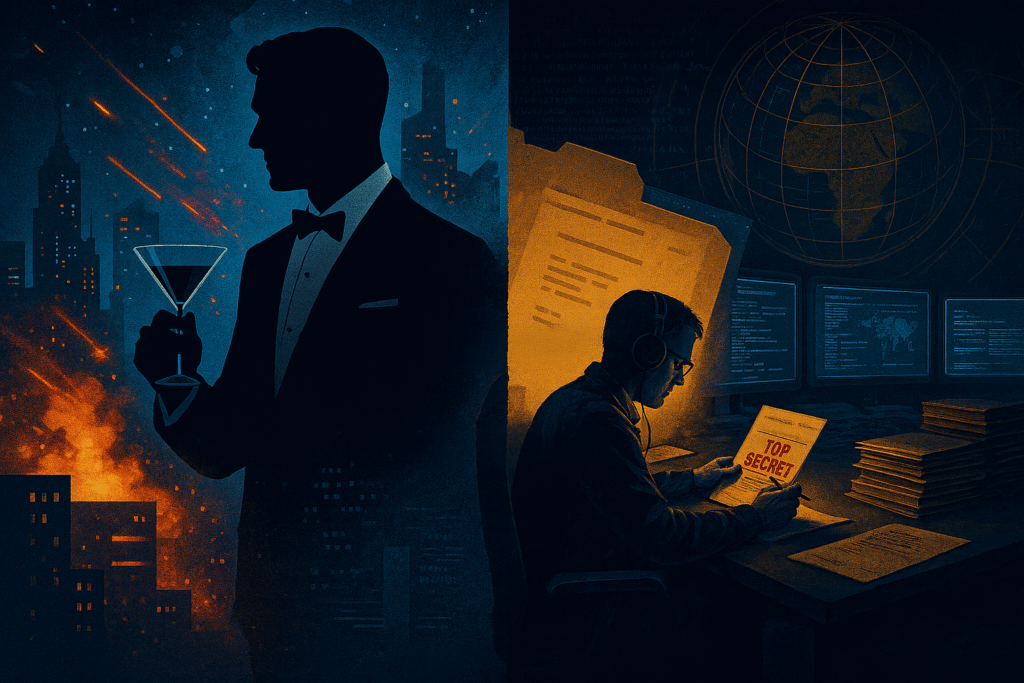
Citizen’s Guide to the Real World of Intelligence: “Spytainment” Versus Spy Facts
- Introduction: The Spy in the Popular Imagination
Why citizens must separate entertainment myths from the real world of intelligence. - Part I. Spytainment: Spies in Fiction, Film, and Popular Culture
From biblical scouts to James Bond and Jason Bourne: the literary and cinematic evolution of the spy. - Part II. The Real Intelligence Professions
Field officers, analysts, cryptologists, and counterintelligence—what real intelligence work looks like.
- Case Study: Bletchley Park and the Enigma Code — Fact vs. Fiction
- Case Study: The Cambridge Five — Fact vs. Fiction
- Case Study: Operation Mincemeat — Fact vs. Fiction
- Case Study: Bletchley Park and the Enigma Code — Fact vs. Fiction
- Part III. The Culture of Secrecy
Classification, compartmentalization, oversight, and the struggle between secrecy and democracy.
- Case Study: CIA Coups — Fact vs. Fiction
- Case Study: CIA Coups — Fact vs. Fiction
- Part IV. Myths vs. Facts — Spytainment Debunked
Comparing common myths from popular culture with the realities of intelligence work. - Part V. Careers and Citizens’ Engagement
Intelligence as a profession, ethical dilemmas, and the responsibilities of democratic oversight. - Conclusion: Beyond Spytainment — Intelligence in the Age of Citizenship
Intelligence as a human, fallible enterprise, accountable to informed citizens.
Introduction: The Spy in the Popular Imagination
The word “spy” conjures images of shadowy figures slipping through alleys, glamorous operatives sipping martinis, or lone heroes armed with gadgets that can topple empires. From Kipling’s Kim to James Bond and Jason Bourne, literature and film have given us a thrilling mythology of espionage—an imaginative world where secrets are uncovered in a flash, betrayals unfold in dramatic confrontations, and intelligence services operate with omniscient precision.
But this is not the real world of intelligence. Beyond the screen lies a profession defined not by glamour but by patience, analysis, and bureaucracy. Most intelligence work is neither cinematic nor solitary. It is team-based, paper-heavy, and carried out in secure offices as much as in foreign streets. Victories are often invisible, measured not in explosions or headlines but in crises averted, warnings heeded, and decisions quietly informed.
Why does this matter to citizens? Because intelligence services do not operate only in novels or films; they shape the world we live in. They influence wars, diplomacy, security, and even the freedoms we enjoy or lose. Yet secrecy makes them difficult to scrutinize, and myths often substitute for facts. A democracy cannot afford such illusions. To be an informed citizen in the twenty-first century is to know the difference between “spytainment” and spy fact, between entertainment and reality.
This guide is written to illuminate that difference. It explores the history of spies in literature and film, the real work of intelligence professionals, the culture of secrecy that governs their world, the myths that distort public understanding, and the role of citizens in keeping intelligence accountable. It is a call not to romanticize the shadows, but to understand them—so that secrecy serves democracy, rather than democracy being swallowed by secrecy.
Part I. Spytainment: Spies in Fiction, Film, and Popular Culture
From the earliest stories of hidden watchers and secret messengers, human societies have been fascinated with the figure of the spy. Part adventurer, part traitor, part patriot, the spy embodies both fear and admiration: the person who sees what is not meant to be seen, who crosses borders unseen, who moves in the shadows of power. Long before intelligence agencies were formally established, literature and drama gave shape to the archetypes that still color our imagination of espionage today.
Ancient and Early Modern Precursors
Spying as a theme runs deep in classical texts. The Book of Joshua describes scouts sent into Jericho to prepare Israel’s conquest. In China, Sun Tzu’s Art of War dedicated a full chapter to the value of “secret agents,” arguing that “foreknowledge cannot be elicited from spirits or gods” but only from human sources. During the Elizabethan age, espionage crossed from life into art: playwright Christopher Marlowe, whose dramas stirred political intrigue, may himself have served as an intelligence courier before his violent death. These episodes show that the spy has always been as much a cultural symbol as a state asset.
19th-Century Spies in Literature
The modern spy novel emerged in the 19th century, when global empires and national rivalries made espionage a permanent feature of statecraft. In America, James Fenimore Cooper’s The Spy (1821) dramatized a secret agent working during the Revolutionary War, portraying espionage as a patriotic duty. In Britain, Rudyard Kipling’s Kim (1901) captured the romance of the “Great Game”—the strategic rivalry between Britain and Russia in Central Asia—through the story of a streetwise boy turned intelligence courier. At the same time, Sir Arthur Conan Doyle created in Mycroft Holmes the quintessential “armchair spy”: the brother of Sherlock Holmes who, without leaving his club, gathered and processed secrets for the British government.
These tales presented espionage as a mixture of adventure, duty, and mental acuity. They established narrative tropes that endure: the orphan hero, the hidden network, the bureaucrat-genius behind the curtain.
20th-Century Spy Fiction and Film
As global war and the Cold War reshaped politics, spy fiction flourished.
- Graham Greene infused moral ambiguity into espionage tales like The Quiet American and Our Man in Havana, exploring how intelligence work blurred the lines between service and cynicism.
- John Buchan’s The Thirty-Nine Steps (1915) offered chase, conspiracy, and the solitary hero trying to prevent catastrophe, a direct ancestor of modern thrillers.
- Ian Fleming’s James Bond, beginning in the 1950s, became the cultural juggernaut: suave, well-armed, traveling from casino to jungle, equally adept at seduction and sabotage. Bond’s world was fantasy, yet it cemented an image of spies as glamorous adventurers with infinite gadgets.
- Len Deighton provided a counterpoint in The IPCRESS File (1962), portraying spies as civil servants drowning in bureaucracy, paperwork, and low pay.
- John le Carré took this further: novels like The Spy Who Came in from the Cold (1963) and the George Smiley series captured espionage as a world of compromise, betrayal, and gray moralities, far from Bond’s martinis and Aston Martins.
Together these authors mapped the spectrum of “spytainment”—from fantasy to realism—creating a literary mirror against which real intelligence professionals often bristled or sighed.
Late 20th and 21st Century Pop Icons
In the late 20th century, spy heroes adapted to new anxieties. Robert Ludlum’s Jason Bourne embodied the fear of rogue intelligence programs and dehumanizing covert experiments. Tom Clancy’s techno-thrillers, beginning with The Hunt for Red October (1984), highlighted the fusion of espionage with military technology and geopolitics. On television, series like Alias, Homeland, and The Americans dramatized shifting threats from terrorism, counterinsurgency, and Cold War legacies.
Streaming-era shows and films continue to refresh the archetypes: the conflicted mole, the double agent, the hacker-spy, the global surveillance conspiracy. These stories, though fictional, shape how the public perceives intelligence—often more strongly than official accounts ever could.
Conclusion
From the Bible to Netflix, spies have served as narrative lenses on power, secrecy, and loyalty. They are adventurers, patriots, cynics, and rogues. Yet they are also illusions—crafted for entertainment, simplified for plot, dramatized for effect. The real world of intelligence, as we will see, is neither Bond’s glittering casino nor le Carré’s fog-bound London, but a complex professional ecosystem of analysts, agents, and institutions that work quietly in the shadows of national life.
Part II. The Real Intelligence Professions
Behind the cultural image of martinis, chase scenes, and secret gadgets lies a professional world more akin to civil service than cinema. Intelligence, in practice, is a collective discipline—slow, methodical, and bureaucratic—focused less on derring-do and more on detail, patience, and precision. Its central mission is not thrill but foresight: to provide governments with information, warning, and context so that leaders may act wisely.
1. Field Agents and Case Officers
Popular fiction imagines the “secret agent” as a lone wolf operating deep in enemy territory. In reality, field officers—especially those working for services like the CIA’s Directorate of Operations or Britain’s MI6—function as case officers. Their job is not usually to infiltrate themselves, but to recruit and manage human sources (HUMINT).
Day-to-day work includes:
- Establishing and maintaining cover identities.
- Building trust with foreign nationals who have access to valuable information.
- Running clandestine meetings and communicating securely.
- Filing long reports for headquarters, which then cross into the analytic cycle.
Contrary to the Bond archetype, most field operations involve waiting, relationship management, and avoiding attention. Successful intelligence is measured not by explosions or escapes but by not being noticed at all.
2. Analysts
If field officers are the scouts, analysts are the interpreters and mapmakers. In modern intelligence communities—particularly the U.S., which employs tens of thousands of analysts—this role is central. Analysts are tasked with:
- Collecting information from multiple streams (HUMINT, SIGINT, open sources, imagery).
- Evaluating reliability and cross-checking facts.
- Synthesizing data into assessments and forecasts for policymakers.
Analysts employ structured analytic techniques to counter bias. Richards Heuer’s Analysis of Competing Hypotheses (ACH) remains a touchstone: a systematic way of weighing evidence for and against multiple explanations before drawing conclusions. Analysts work within layers of review, knowing that a misjudgment can shape wars, treaties, or crises.
Daily life is less cloak-and-dagger than cubicle-and-conference: poring over databases, drafting papers, briefing officials, and participating in interagency working groups.
3. Cryptologists and Signals Intelligence (SIGINT)
If analysis is the brain and HUMINT the eyes and ears, cryptology and SIGINT form the nervous system of intelligence.
From Bletchley Park’s cracking of the Enigma code to the National Security Agency’s global intercepts, cryptologists have been at the cutting edge of secret work. Their tasks include:
- Breaking encrypted messages.
- Protecting their own nation’s codes.
- Monitoring electromagnetic emissions, communications, and digital traffic.
Historic examples abound:
- “On the Roof Gang” (1920s–30s U.S. Navy specialists trained to intercept Japanese naval codes).
- Bletchley Park in World War II, where Alan Turing and colleagues revolutionized codebreaking and computing.
- The Cold War NSA, developing ever more advanced listening posts and satellites.
Modern cryptologists and SIGINT officers are far more likely to be computer scientists, mathematicians, or linguists than adventurers. Their offices are filled with servers, not martinis.
Case Study: Bletchley Park and the Enigma Code — Fact vs. Fiction
The Real Operation (1939–1945)
At a Victorian estate in Buckinghamshire, Britain assembled one of history’s most extraordinary secret workforces. Bletchley Park was the headquarters of the Government Code and Cypher School (GC&CS), charged with breaking the German Enigma cipher. Thousands of mathematicians, linguists, classicists, engineers, and clerical workers labored around the clock. Alan Turing and his colleagues designed electromechanical “Bombe” machines to test possible keys, while parallel teams worked on naval codes, weather systems, and traffic analysis.
The work was arduous: endless rows of messages, incomplete intercepts, and trial-and-error analysis. Success required not only genius but also discipline, organization, and the contributions of thousands—many of them young women from Oxford and Cambridge or members of the Women’s Royal Naval Service (Wrens).
Fictionalized Versions
- The Imitation Game (2014) dramatized Alan Turing’s role, portraying him as a lone, tortured genius battling both the machine and his colleagues.
- Earlier films and novels romanticized codebreaking as a race against time, often condensing years of labor into a single breakthrough moment.
- Popular accounts underplay the bureaucratic tedium: shift work, filing, statistical analysis, and the grinding monotony of testing false leads.
Lessons in Myth vs. Reality
- Myth: A single prodigy cracked Enigma overnight.
- Fact: Thousands worked for years, and victories were incremental. Turing was central but part of a large collaborative team.
- Myth: Codebreaking was glamorous.
- Fact: It was exhausting, repetitive, and deeply secret—so much so that participants were sworn to silence for decades.
- Myth: Breaking Enigma won the war outright.
- Fact: It shortened the war significantly, especially the Battle of the Atlantic, but it was one element among many Allied operations.
Why It Matters
Bletchley Park exemplifies the tension between spytainment and spy fact. While cinema elevates genius and drama, the true achievement was organizational: the harnessing of intellect, bureaucracy, and teamwork under strict secrecy. The quiet labor of thousands, not the brilliance of one, turned the tide.
4. Counterintelligence
No side in espionage has a monopoly on deception. Counterintelligence is the art of identifying, neutralizing, and sometimes exploiting the spies of others.
Classic cases:
- GC&CS (Government Code and Cypher School)—Britain’s interwar hub for codebreaking and counterintelligence, precursor to GCHQ.
- The XX Committee (Double-Cross Committee)—a British body in WWII that ran double agents to feed false information to Nazi Germany, turning captured spies into controlled conduits.
- Cold War examples such as Kim Philby, Aldrich Ames, and Robert Hanssen demonstrate the devastating impact of moles within an intelligence service.
Counterintelligence work is slow and psychological. It demands painstaking verification, deception planning, and endless paperwork. In practice, it often involves convincing an adversary’s agent to serve two masters—or catching them before they do.
Case Study: The Cambridge Five — Fact vs. Fiction
The Real Operation (1930s–1960s)
In the 1930s, at the height of ideological ferment in Europe, a group of privileged young men at Cambridge University were recruited by Soviet intelligence. Kim Philby, Guy Burgess, Donald Maclean, Anthony Blunt, and John Cairncross rose through Britain’s elite institutions—diplomacy, intelligence, and the arts—while secretly passing vast amounts of classified material to Moscow.
The damage was profound:
- Philby, embedded in MI6, compromised Allied operations and even betrayed anti-Soviet networks.
- Maclean and Burgess, exposed in 1951, defected dramatically to the USSR.
- Blunt, later revealed as a Soviet agent, was Keeper of the Queen’s Pictures.
- Their activities hindered British-American cooperation and undermined trust across NATO.
Counterintelligence efforts were hampered by class bias: suspicion was often deflected because the men came from the “right schools” and social backgrounds. Loyalty was assumed where it should have been tested.
Fictionalized Versions
- Popular novels and films often depict the “mole” as a solitary, tormented figure—Tinker, Tailor, Soldier, Spy by John le Carré (itself inspired by Philby) paints a chessboard world of betrayal and doubt.
- In cinematic retellings, the drama centers on tense interrogations, brilliant deductions, and dramatic revelations.
- The lived reality was slower and more bureaucratic: years of suspicion, botched investigations, missed warnings, and bureaucratic turf wars.
Lessons in Myth vs. Reality
- Myth: Double agents are caught in thrilling confrontations.
- Fact: They are usually uncovered through dull but relentless cross-checking of files, finances, and travel records.
- Myth: Betrayal is the result of personal weakness.
- Fact: The Cambridge Five were motivated by ideology and a sense of history—loyal not to Britain but to communism.
- Myth: Intelligence services are immune to bias.
- Fact: Class privilege and old-boy networks allowed these men to avoid scrutiny for years.
Why It Matters
The Cambridge Five illustrate that espionage is not only about daring fieldwork but also about human frailty, ideology, and institutional blind spots. Their betrayal shook the foundations of the British intelligence establishment and left a legacy that continues to haunt counterintelligence today.
5. The Intelligence Workforce as a Whole
The intelligence community (IC) is vast and specialized. In the U.S., for example, 18 organizations comprise the IC, ranging from the CIA and NSA to the Department of Energy’s nuclear intelligence office and the Treasury’s financial intelligence unit. In Britain, MI5, MI6, and GCHQ divide domestic, foreign, and signals roles.
Within these bureaucracies, the real day-to-day intelligence “tradecraft” looks less like Bond and more like a large, highly secretive civil service:
- Recruiters and trainers ensure new personnel are vetted and prepared.
- Engineers and IT experts secure classified networks.
- Linguists and cultural specialists provide interpretation.
- Policy liaisons ensure intelligence reaches decision-makers.
Together, these professionals form a system of knowledge collection, protection, and dissemination. Their success is measured in avoiding surprise and enabling wise choices—not in cinematic drama.
Case Study: Operation Mincemeat — Fact vs. Fiction
The Real Operation (1943)
During World War II, British intelligence devised one of history’s most successful deception plans. Known as Operation Mincemeat, it involved planting falsified invasion documents on the body of a dead man, set adrift off the Spanish coast. The aim: to convince Nazi Germany that the Allies would invade Greece instead of Sicily. The plan worked; German forces redeployed away from Sicily, easing the Allied invasion there.
Key points:
- Crafted by the XX Committee (Double-Cross System).
- Required meticulous attention to detail: personal letters, receipts, and photos were planted to make the identity believable.
- Success hinged not on gadgets or shootouts, but on bureaucratic plausibility and Nazi trust in captured papers.
Fictionalized Versions
- The story inspired the 1953 book and film The Man Who Never Was, which dramatized the operation as a suspense thriller, emphasizing cloak-and-dagger intrigue.
- Netflix’s 2021 Operation Mincemeat retold the story with romantic subplots and heightened drama.
- In “spytainment,” the ingenuity is often overshadowed by personal heroics or romance, while the real operation was a triumph of paperwork, teamwork, and meticulous staging.
Lessons in Myth vs. Reality
- Myth: Brilliant individual masterminds and daring field agents pulled off the deception.
- Fact: The operation was a collective effort involving planners, clerks, and naval officers, executed with bureaucratic precision.
- Myth: Espionage is a dramatic game of bluff and peril.
- Fact: Espionage success often depends on unglamorous details: an authentic-looking bus ticket, the right ink on forged letters, a convincing backstory for a nonexistent man.
Why It Matters
Operation Mincemeat exemplifies the gulf between spytainment and spy fact. Real intelligence victories often hinge on quiet cunning, administrative realism, and collaboration, not cinematic exploits.
Conclusion
The real world of intelligence is bureaucratic, professional, and intensely specialized. It requires patience, precision, and discretion far more than glamour or violence. If the fictional spy is a romantic outlaw, the real intelligence professional is a civil servant in the shadows—no less important, but profoundly different from the figure sold to us on screen.
Part III. The Culture of Secrecy
Secrecy is the lifeblood of intelligence. It shields sensitive sources, protects fragile operations, and prevents adversaries from learning what a nation knows—or what it does not know. Yet secrecy is also a double-edged sword. While it enables security, it can stifle accountability, breed mistrust, and obscure the line between prudent protection and unnecessary concealment. To understand the real world of intelligence, citizens must grasp how secrecy works, how it is structured, and how governments balance—or fail to balance—it with democratic transparency.
1. Government Secrets and Classification
Modern classification systems divide information into categories such as Confidential, Secret, and Top Secret. But the labels are only the beginning. Truly sensitive information is further cordoned off into Sensitive Compartmented Information (SCI), available only to those with specific clearance and a “need to know.” SCI is managed within specialized facilities known as SCIFs—windowless, shielded rooms where phones are banned, conversations are monitored, and paper is tightly controlled.
At the heart of the U.S. system sits the Information Security Oversight Office (ISOO), an agency within the National Archives tasked with monitoring classification, declassification, and safeguarding. Each year, ISOO issues reports tracking how many documents are created, classified, or released. These reports provide one of the few public windows into a system otherwise designed to remain closed.
2. Oversight and Reform Efforts
Recognizing the dangers of excessive secrecy, governments have periodically commissioned reviews. One notable example was the Moynihan Commission on Government Secrecy (1990s), a bipartisan “blue-ribbon committee” convened to study how classification had grown unwieldy. The Commission warned that secrecy often functions not as protection but as “a mode of regulation,” used to withhold information unnecessarily and sometimes counterproductively.
Reform efforts have ebbed and flowed, but secrecy remains deeply embedded in intelligence culture. While classification is justified to protect lives and operations, it can also conceal errors, shield bureaucracies from embarrassment, and limit public debate on controversial actions.
3. Freedom of Information and Declassification
The Freedom of Information Act (FOIA), enacted in 1966 in the U.S., was a watershed for democratic oversight. It gave journalists, scholars, and citizens the right to request government records. FOIA has pried open once-closed files on covert operations, surveillance programs, and historical intelligence activities. Yet the process is slow, subject to broad exemptions, and often results in heavily redacted documents.
Declassification, too, is an imperfect mechanism. Documents can take decades to reach the public, long after their relevance to current debates has faded. Still, declassified intelligence records—such as World War II codebreaking or Cold War covert actions—have reshaped our understanding of history.
Sidebar Case Study: CIA Coups — Fact vs. Fiction
The Real Operations (1953–1973)
During the Cold War, the CIA engaged in covert operations to topple governments deemed hostile to U.S. interests. These campaigns relied not on cinematic heroics but on propaganda, bribery, and manipulation.
- Iran, 1953 (Operation Ajax): Removed Prime Minister Mohammad Mossadegh after he nationalized oil, restoring the Shah’s rule.
- Guatemala, 1954 (Operation PBSUCCESS): Overthrew Jacobo Árbenz through disinformation, rebel support, and economic pressure.
- Chile, 1973: Supported opposition movements that helped destabilize Salvador Allende’s government before a coup brought Augusto Pinochet to power.
Fictionalized Versions
Spy thrillers often depict coups as daring raids or the work of a single operative. In reality, they were bureaucratic, policy-driven operations spanning years, conducted by teams of diplomats, propagandists, and financiers.
Lessons in Myth vs. Reality
- Myth: A lone agent changes history.
- Fact: Bureaucracies, committees, and entire agencies shape covert action.
- Myth: Coups are clean and surgical.
- Fact: They leave legacies of repression and instability that endure for generations.
Why It Matters
These coups exemplify the darker side of secrecy: not only hiding operations but obscuring whole foreign policies. Citizens who imagine espionage as cinematic adventure miss the reality—policy by covert means, carried out in silence, with consequences far beyond the screen.
4. The Intelligence Community’s Culture of Secrecy
Secrecy within the intelligence world is not only structural but cultural. Analysts, case officers, and cryptologists are trained to compartmentalize: to share only what is necessary, to avoid discussing work outside secure rooms, and to live with constant vigilance. The ethos of “need to know” extends beyond documents into professional identity.
This culture has benefits—it builds trust within secure circles and protects operations from leaks. But it also has drawbacks: it can isolate personnel, discourage collaboration, and limit the ability of outsiders, including legislators and citizens, to oversee intelligence effectively.
As historian Richard Heuer observed, secrecy influences not only what analysts can say but how they think. The habit of compartmentalization shapes analysis itself, often narrowing perspectives and reinforcing institutional biases.
Conclusion
Secrecy is indispensable to intelligence, but it is also one of its greatest weaknesses. The challenge for democratic societies is not to abolish secrecy—an impossible and dangerous idea—but to regulate it, to distinguish between what must be hidden and what should be shared. Spytainment sells secrecy as thrilling, mysterious, and heroic. The reality is more sobering: secrecy is a bureaucratic system, both protective and corrosive, that must be carefully overseen if intelligence is to serve the people rather than obscure the truth from them.
Part IV. Myths vs. Facts — Spytainment Debunked
Entertainment has done more to shape public perceptions of espionage than official histories ever could. From James Bond’s gadgets to Jason Bourne’s amnesia-driven chase scenes, “spytainment” constructs a world where intelligence is fast, glamorous, and decisive. The reality is slower, subtler, and far more bureaucratic. To understand the true face of intelligence, citizens must separate enduring myths from the facts.
1. Myth: Intelligence Officers Are Lone Wolves
Spytainment version: The spy is an independent hero who acts on instinct, breaking rules to save the day.
Reality: Intelligence work is collective. Field officers report to headquarters, analysts work in teams, and operations pass through layers of bureaucratic approval. Even the most clandestine activities are rarely decided by one person—they are policy choices carried out by organizations.
2. Myth: Spies Live in a World of Gadgets and Glamour
Spytainment version: Exploding pens, invisible cars, and martinis in exotic hotels define the lifestyle.
Reality: While intelligence does develop specialized technology—secure phones, drones, cyber tools—the bulk of work involves computers, databases, and ordinary communication systems. Far from glamorous, much of the job resembles an office or research position, with added restrictions on what can be said or shared.
3. Myth: Espionage Produces Instant Results
Spytainment version: A single breakthrough or intercepted message turns the tide of history overnight.
Reality: Intelligence assessments are incremental, built from many small pieces of data. Analysis often requires weeks, months, or even years of corroboration. Even spectacular operations like Enigma codebreaking or Operation Mincemeat were the product of prolonged teamwork, not instantaneous epiphanies.
4. Myth: Double Agents Are Always Unmasked in Dramatic Confrontations
Spytainment version: The mole is cornered in a climactic scene, their betrayal revealed by a brilliant sleuth.
Reality: Most double agents are discovered through tedious record-checking, financial audits, or chance defections. The Cambridge Five, for example, eluded detection for years due to institutional blind spots and class prejudice—not because they were particularly cinematic in their cunning.
5. Myth: Intelligence Agencies Are Omniscient
Spytainment version: Agencies know everything—satellites see all, supercomputers predict every move.
Reality: Intelligence is always incomplete. Analysts face gaps in information, deception by adversaries, and the limits of human foresight. Failures—from Pearl Harbor to 9/11—demonstrate that even vast intelligence communities cannot achieve total awareness.
6. Myth: Secrecy Guarantees Security
Spytainment version: As long as secrets are locked away, the nation is safe.
Reality: Excessive secrecy can backfire, concealing mistakes and preventing information-sharing that might avert crises. The Moynihan Commission warned that classification often functions as over-regulation, with more documents hidden than necessary, creating risk rather than reducing it.
Comparative Table
| Spytainment Myth | Spy Fact | Example |
| Lone wolf saves the day | Teams, bureaucracy, oversight | CIA field officers managed by HQ |
| Glamorous gadgets | Mostly mundane tools, databases | Bond’s car vs. real SCIF |
| Instant results | Slow accumulation, cross-checking | Enigma cracked over years |
| Dramatic mole-hunts | Boring record audits, class bias | Cambridge Five |
| Omniscient agencies | Constant gaps and failures | Pearl Harbor, 9/11 |
| Secrecy = safety | Over-classification creates risk | Moynihan Commission findings |
Conclusion
Spytainment provides drama; real intelligence provides data, context, and policy advice. The danger is not that entertainment exaggerates—art always does—but that citizens mistake the myth for reality. Democracies depend on informed oversight, and oversight depends on the public knowing that spies are not superhuman heroes but ordinary professionals engaged in extraordinary, often unglamorous, work.
Part V. Careers and Citizens’ Engagement
Understanding the intelligence profession is not only about dispelling myths; it is also about recognizing that intelligence is a career path and a civic institution. For those considering service, the realities are far removed from “spytainment.” For those outside the profession, there remains a responsibility to oversee, question, and engage with intelligence as citizens in a democracy.
1. Entering the Profession
Most intelligence professionals do not begin as would-be James Bonds. They arrive from diverse backgrounds—military service, academia, law, computer science, linguistics, economics, or area studies. Agencies seek individuals with sharp analytical minds, discretion, and specialized skills.
- Pathways: Many enter through civil service exams, military assignments, internships, or lateral moves from technical fields.
- Skills in demand: foreign languages, cybersecurity, data science, geopolitics, and regional expertise.
- Recruitment filters: background investigations, polygraph tests, and character references emphasize reliability and discretion above glamour.
The roles vary widely: an imagery analyst at the National Geospatial-Intelligence Agency (NGA), a case officer for the CIA, a linguist for the Defense Intelligence Agency (DIA), or a financial intelligence specialist at the Treasury.
2. Life Inside the Community
Daily work in the intelligence community is highly structured:
- Analysts prepare daily briefings and long-range assessments for policymakers.
- Field officers cultivate sources while balancing the logistics of surveillance and communication.
- Engineers secure networks and develop surveillance tools.
- Lawyers review the legality of operations.
Most work takes place in secure facilities, often windowless, where laptops are air-gapped and conversations are monitored. Hours can be long, pay relatively modest, and recognition scarce—because the most important victories are invisible.
3. Ethical Questions and Civic Responsibility
Working in intelligence also means confronting moral dilemmas:
- How much secrecy is justified?
- When do covert actions undermine democracy abroad?
- What safeguards exist against abuse at home?
Citizens outside the agencies face the same questions. Oversight mechanisms—parliamentary committees, congressional intelligence committees, inspector generals, and courts—exist to balance security with liberty. But they only function when citizens understand the stakes and demand accountability.
4. Why Citizens Must Engage
A democratic intelligence community cannot remain the preserve of insiders. Citizens have responsibilities, too:
- Stay informed: Read declassified reports, follow oversight hearings, and distinguish myth from fact.
- Exercise rights: Use FOIA and public archives to understand past operations.
- Demand accountability: Support watchdog organizations, journalists, and legislators who monitor intelligence activities.
- Value transparency: Recognize that not all secrecy is bad, but that unchecked secrecy erodes democracy.
Intelligence services exist to protect the public. In return, the public must insist that protection does not become overreach, that secrecy does not become impunity, and that intelligence serves open societies rather than undermining them.
Conclusion
Careers in intelligence are neither glamorous nor easy. They are demanding, disciplined, and often thankless. Yet they are vital to the functioning of states and the safety of societies. For citizens, engagement with intelligence is less about becoming spies and more about understanding how secrecy and oversight shape public life. To be an informed citizen in the 21st century is to recognize that intelligence is not the world of spytainment, but a human enterprise—fallible, complex, and accountable—woven into the very fabric of democracy.
Conclusion: Beyond Spytainment — Intelligence in the Age of Citizenship
The world of intelligence has always existed in shadow. From biblical scouts to Bletchley Park, from the Cambridge Five to modern cyber units, secrecy and deception have been tools of survival and strategy. Yet as this guide has shown, the daily reality of intelligence is not the glamour of spytainment but the grit of bureaucracy: analysts parsing fragments of data, case officers cultivating sources with patience, cryptologists running endless codebreaking cycles, and overseers wrestling with secrecy’s double edge.
The stories we tell about spies—Bond, Bourne, or Smiley—reveal our fascination with hidden power, but they also obscure the truth. Intelligence is not omniscient, not instant, not heroic in the cinematic sense. It is slow, incremental, and human. It is conducted by professionals whose victories are measured not in explosions but in briefings that prevent wars, in files that reveal plots, and in judgments that warn leaders before it is too late.
For citizens, understanding this reality is more than a matter of curiosity. In democratic societies, intelligence services wield extraordinary powers—surveillance, covert action, the classification of truth itself. Such powers can protect, but they can also corrode. The Freedom of Information Act, the Moynihan Commission, and countless blue-ribbon reviews have taught the same lesson: secrecy without oversight is corrosive, secrecy balanced with transparency is protective.
An Integrated Humanist perspective insists that intelligence must be brought into alignment with universal human dignity and civic responsibility. This means:
- Safeguarding rights while defending against threats.
- Supporting professionals who work in secrecy, while ensuring they remain accountable to the public they serve.
- Educating citizens so that intelligence is not left to myths or hidden abuses but is recognized as a vital, human, and fallible enterprise.
In the Age of Intelligence, the challenge is not to abolish secrecy—it is indispensable—but to regulate it wisely. To replace myths with facts, fear with knowledge, and cynicism with responsible oversight. The true hero in intelligence is not the fictional lone agent, but the engaged citizen who understands that power in shadow must always answer to the light.
This is the citizen’s guide to intelligence: not to become spies ourselves, but to be guardians of the balance between secrecy and freedom, between security and democracy, between the world as it is and the better world we strive to build.