
Introduction
Morals and Dogma Revisited
In 1871, Albert Pike published what would become one of the most influential and controversial books in the history of Freemasonry: Morals and Dogma of the Ancient and Accepted Scottish Rite of Freemasonry. Spanning more than eight hundred pages, the work explored philosophy, religion, mythology, ethics, symbolism, and the mysteries of human existence. Intended primarily as a guide for Scottish Rite Freemasons, it eventually became one of the most widely discussed books in the Western esoteric tradition.
For generations, Morals and Dogma has inspired admiration, confusion, criticism, and fascination. Some readers have viewed it as a treasury of ancient wisdom. Others have regarded it as an overwhelming labyrinth of obscure references and speculative scholarship. Many Masons have displayed the book on their shelves without ever reading it in its entirety. Even among those who have studied it carefully, interpretations vary widely.
Part of the challenge is that Pike wrote during a unique period of intellectual history. The nineteenth century witnessed extraordinary advances in archaeology, philology, comparative religion, and historical scholarship. Ancient texts were being translated, civilizations were being rediscovered, and scholars increasingly sought universal patterns connecting the world’s religions and philosophies. Pike attempted to synthesize this vast body of knowledge into a single grand vision.
His ambition was remarkable. He sought to demonstrate that beneath the diversity of human cultures lay common principles of morality, wisdom, and spiritual aspiration. Egyptian priests, Hindu sages, Hebrew prophets, Greek philosophers, Christian mystics, and Masonic initiates all appeared, in Pike’s interpretation, to be participating in a shared search for truth.
More than a century later, however, our understanding of history, religion, psychology, and science has changed dramatically. Archaeology has transformed our knowledge of the ancient world. Anthropology has revealed the complexity of human cultures. Cognitive science has illuminated how myths and symbols function within the human mind. Evolutionary biology has provided new explanations for morality, cooperation, and belief. Historical scholarship has corrected many assumptions that were widely accepted during Pike’s lifetime.
Yet despite these changes, Morals and Dogma remains important.
Its importance lies not in whether every historical claim is correct, nor in whether its esoteric theories withstand modern scrutiny. Rather, its enduring value lies in the questions it asks. What is truth? How do human beings discover meaning? Why do cultures create myths and symbols? What qualities make a person virtuous? Can humanity find common ethical ground despite differences in religion, nationality, and philosophy?
These questions remain as relevant today as they were in Pike’s era.
“It is most true, that Truth is a Divine attribute and the foundation of every virtue. To be true, and to seek to find and learn the Truth, are the great objects of every good Mason.”
– Albert Pike
This article approaches Morals and Dogma from the perspective of Scientific Humanism and Integrated Humanism. Humanism, broadly understood, is the tradition that places human reason, dignity, flourishing, and responsibility at the center of ethical and intellectual life. It seeks understanding through inquiry rather than authority and measures ideas by their consequences for human well-being.
Integrated Humanism extends this tradition through three fundamental commitments. It is secular in its reliance upon freedom of conscience and the separation of belief from public knowledge. It is scientific in its commitment to evidence, critical thinking, and continual revision of understanding. It is democratic in its affirmation of universal human rights, equality before the law, and the shared responsibility of citizens to participate in shaping society.
From this perspective, religious traditions, philosophical systems, and symbolic teachings are neither dismissed nor accepted uncritically. Instead, they are examined as humanity’s collective effort to understand reality, cultivate virtue, and construct meaningful civilizations.
This approach is especially appropriate for Pike’s work. At its best, Morals and Dogma is not a demand for belief but an invitation to study, reflect, compare, and think. It encourages readers to look beyond sectarian divisions and search for deeper patterns within human experience.
The purpose of this article is therefore neither to praise Pike uncritically nor to dismiss him as a relic of nineteenth-century esotericism. Rather, it is to revisit his great work with the tools of modern scholarship, science, and humanist philosophy. We will examine what Pike understood correctly, where his interpretations were limited by the knowledge of his time, and how his central insights might be reinterpreted for the twenty-first century.
In doing so, we will discover that Morals and Dogma is more than a Masonic book. It is a snapshot of humanity’s ongoing attempt to understand itself—a monumental effort to weave together the many threads of history, philosophy, religion, morality, and symbolism into a coherent vision of human development.
Whether one approaches the work as a Freemason, a student of religion, a historian, a philosopher, or simply a curious reader, the challenge remains the same: to separate enduring wisdom from historical error, and to continue the search for light with the best tools available to our age.
Part I
Albert Pike, Freemasonry, and the Age of Grand Synthesis
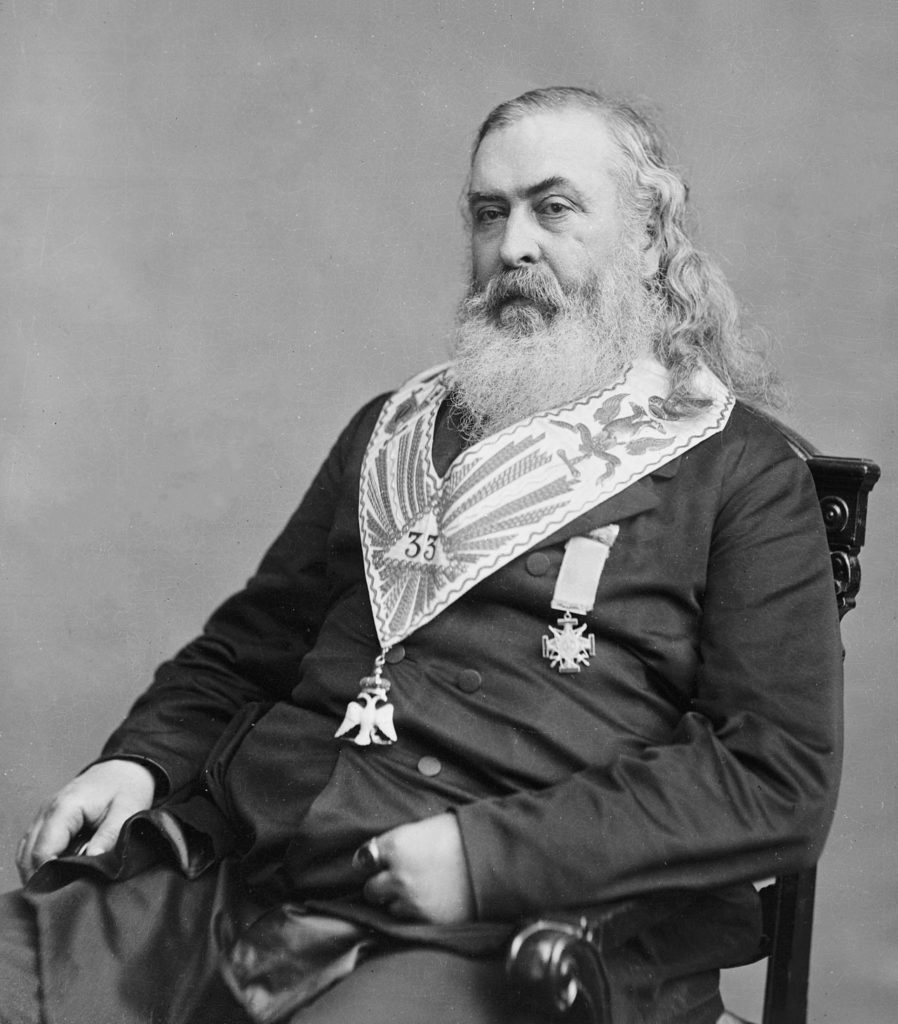
Albert Pike remains one of the most influential and debated figures in the history of Freemasonry. More than a century after his death, his name continues to evoke admiration, controversy, curiosity, and misunderstanding. For many Scottish Rite Freemasons, he is remembered primarily as the author of Morals and Dogma. For historians of religion and esotericism, he represents one of the nineteenth century’s most ambitious attempts to synthesize the world’s wisdom traditions into a unified philosophical vision.
To understand Morals and Dogma, however, one must first understand the man who wrote it and the intellectual environment in which it emerged.
Albert Pike was born in Boston, Massachusetts, in 1809, at a time when the United States was still a young republic. The nineteenth century would become an era of extraordinary change. Scientific discoveries challenged traditional beliefs. Archaeologists uncovered forgotten civilizations. Ancient texts were translated into European languages for the first time. Scholars increasingly sought connections between religions, cultures, and historical traditions that had previously been studied in isolation.
Pike came of age amid this intellectual ferment.
Although he demonstrated remarkable academic ability, financial circumstances prevented him from pursuing a traditional university education. Like many great autodidacts of history, he became largely self-taught. Throughout his life he immersed himself in literature, philosophy, law, history, comparative religion, mythology, and languages. His intellectual appetite was immense, and his writings reveal a mind constantly searching for larger patterns behind seemingly unrelated ideas.
After traveling westward, Pike eventually settled in Arkansas, where he built a successful legal career and became active in journalism and politics. He was a prolific writer long before his Masonic fame emerged. During the American Civil War he served the Confederacy, a fact that remains a subject of legitimate historical criticism and controversy. Modern readers should neither ignore nor excuse this aspect of his life. Historical figures must be understood within their full contexts, including both achievements and failures.
It was through Freemasonry that Pike made his most lasting contribution.
By the middle of the nineteenth century, Freemasonry had become one of the most influential fraternal organizations in the Western world. Masonic lodges existed throughout Europe, North America, and beyond. They brought together men from diverse religious, political, and social backgrounds in pursuit of moral improvement, fellowship, and symbolic instruction.
The Scottish Rite had emerged as one of the most elaborate branches of Freemasonry. Its system of degrees employed rich symbolism, dramatic narratives, and philosophical themes. However, much of this material had accumulated over time without a consistent interpretive framework. Different degrees often reflected different historical influences and sometimes appeared disconnected from one another.
Pike undertook the monumental task of providing coherence.
In 1859 he became Sovereign Grand Commander of the Supreme Council of the Scottish Rite, Southern Jurisdiction. Over the following decades he revised rituals, reorganized educational materials, and developed a philosophical system intended to unify the Rite’s teachings. The result was Morals and Dogma of the Ancient and Accepted Scottish Rite of Freemasonry, published in 1871.
The book was not originally intended for the general public. It was distributed primarily to Scottish Rite members as a guide to the philosophical lessons associated with each degree. Yet Pike’s ambitions extended far beyond ritual commentary. The work became an encyclopedic exploration of religion, mythology, philosophy, ethics, symbolism, and history.
To modern readers, the title itself can be misleading.
The word “dogma” suggests rigid doctrines demanding unquestioning belief. In reality, Pike frequently argues the opposite. Throughout the book he encourages intellectual inquiry, comparative study, and independent judgment. Although he occasionally expresses strong convictions, his larger project is exploratory rather than authoritarian. He invites readers to examine many traditions and search for common truths rather than accept a single creed.
This distinction is important because one of the most persistent misconceptions about Morals and Dogma is that it serves as a doctrinal text of Freemasonry.
It does not.
Freemasonry possesses no universal theological system, no official interpretation of all symbols, and no mandatory philosophical doctrine. Pike’s work represents the reflections of an extraordinarily learned Mason attempting to explain the symbolism of the Scottish Rite. His interpretations became highly influential, but they never became binding upon the fraternity as a whole.
Another common misconception is that Pike was preserving a secret body of ancient knowledge passed unchanged through the centuries.
This belief was common among many nineteenth-century scholars and esoteric writers. Pike frequently suggested connections among ancient mystery schools, religious traditions, philosophical systems, and Masonic symbolism. Modern scholarship, however, has demonstrated that many of these connections were far more complex—and often more tenuous—than Pike believed.
Nevertheless, it would be a mistake to dismiss his work simply because some historical claims proved inaccurate.
Pike was participating in one of the great intellectual projects of his age: the search for a universal philosophy. During the nineteenth century, many scholars, philosophers, and religious thinkers sought to identify common patterns among the world’s traditions.
Comparative religion was emerging as an academic discipline. Archaeological discoveries were transforming understandings of Egypt, Mesopotamia, India, and the ancient Mediterranean. New translations of sacred texts introduced Western audiences to ideas previously inaccessible to them.
Pike absorbed all of this material and attempted to weave it together into a grand synthesis.
In many ways, Morals and Dogma reflects the strengths and weaknesses of this intellectual movement.
Its strengths are considerable. Pike recognized that wisdom is not confined to a single culture or religion. He appreciated the importance of symbolism as a vehicle for moral and philosophical insight. He emphasized the cultivation of virtue, self-discipline, and lifelong learning. He sought common ground among traditions that others viewed as irreconcilably opposed.
Its weaknesses are equally apparent. Pike often relied upon speculative scholarship that has since been superseded. He sometimes accepted romantic theories about ancient civilizations and hidden wisdom traditions without sufficient evidence. Like many nineteenth-century thinkers, he occasionally confused symbolic parallels with historical relationships.
Yet these limitations should not obscure the larger significance of his work.
From a Scientific Humanist perspective, Pike occupies an important transitional position in intellectual history. He stands between two worlds. One world was rooted in mythology, symbolism, religious authority, and esoteric speculation. The other was increasingly shaped by archaeology, historical criticism, anthropology, and scientific inquiry.
Pike attempted to bridge these worlds.
He sought to preserve the moral and symbolic richness of ancient traditions while embracing reason, study, and intellectual exploration. Although his methods differed from those of modern scholarship, his underlying aspiration remains recognizable: to discover universal principles capable of uniting humanity across differences of culture, religion, and history.
This aspiration continues to resonate today.
In an age characterized by ideological polarization, information overload, and cultural fragmentation, Pike’s central question remains profoundly relevant: Is there a common foundation beneath humanity’s diverse beliefs and traditions?
The remainder of this article explores that question. We will examine Pike’s philosophy, symbolism, comparative religion, and moral teachings. We will consider where modern scholarship confirms his insights, where it challenges his conclusions, and how his ideas might be reinterpreted through the lenses of science, humanism, and contemporary knowledge.
Only then can we properly assess the enduring value of Morals and Dogma and its place within the continuing human search for truth.
Part II
The Core Philosophy of Morals and Dogma
The Search for Universal Truth
At its core, Morals and Dogma is an attempt to answer one of humanity’s oldest questions: Is there a universal truth underlying the diverse religions, philosophies, and cultures of the world?
Albert Pike believed that there was.
Throughout the book, he argues that beneath the apparent differences between civilizations, religious traditions, and philosophical systems lie recurring principles concerning morality, wisdom, justice, self-mastery, and humanity’s relationship with reality. Although cultures express these ideas through different symbols, myths, rituals, and languages, Pike believed they reflected a common human effort to understand existence.
This conviction shaped the entire structure of Morals and Dogma. Pike drew material from ancient Egypt, Persia, Greece, India, Judaism, Christianity, and numerous other traditions because he believed each preserved fragments of a larger truth. His purpose was not merely to compare religions but to demonstrate their underlying unity.
Modern scholarship approaches this question differently. Historians, anthropologists, and religious scholars generally do not assume the existence of a single hidden doctrine connecting all traditions. Instead, they examine how different cultures respond to similar human experiences and challenges. Questions concerning suffering, mortality, justice, leadership, cooperation, family, and meaning arise in every society, often producing comparable ethical and philosophical responses.
From a Scientific Humanist perspective, Pike’s insight remains valuable even if his explanation requires refinement. Humanity’s wisdom traditions may not derive from a single secret source, but they do emerge from common features of human nature and social life. People everywhere must confront uncertainty, mortality, conflict, cooperation, and the search for purpose. Consequently, it is not surprising that similar themes appear across cultures separated by geography and time.
The significance of Pike’s argument lies not in proving a hidden ancient doctrine, but in recognizing that wisdom is not confined to a single tradition. This remains one of the most important lessons of Morals and Dogma.
Truth and Its Many Garments
One of Pike’s recurring themes is that truth often appears in symbolic form. Religious myths, sacred narratives, philosophical allegories, and ritual dramas may differ in their details while pointing toward similar underlying principles.
Pike frequently compared religious traditions in an effort to identify these shared themes. He observed recurring symbols of light, rebirth, sacrifice, wisdom, death, renewal, and moral struggle. To him, such similarities suggested that humanity was repeatedly discovering and expressing the same fundamental truths.
Modern anthropology offers a different but complementary interpretation. Human beings share similar psychological structures, cognitive tendencies, and social needs. As a result, cultures often develop analogous stories and symbols even when they have no direct historical connection. Myths concerning heroes, floods, journeys, transformation, death, and renewal appear throughout the world because they address universal aspects of human experience.
Scientific Humanism views these symbolic systems as important cultural technologies. They preserve knowledge, transmit values, reinforce social cohesion, and help individuals make sense of complex realities. Their significance does not depend upon their literal truth. Rather, their value lies in their ability to communicate insights about human life, morality, and society.
In this sense, Pike correctly recognized that symbolic traditions deserve study and interpretation. Where modern scholarship differs is in its insistence that symbolic meaning and historical fact are not the same thing. A myth may contain profound psychological or ethical wisdom without being a literal account of historical events.
Light as Knowledge
Few symbols appear more frequently in Freemasonry than light.
The candidate seeking initiation is described as seeking light. The newly initiated Mason is said to receive light. Throughout Masonic literature, light symbolizes knowledge, wisdom, understanding, and moral awareness.
Pike adopted this symbolism as one of the central themes of Morals and Dogma. For him, ignorance was a form of darkness, while education and understanding represented illumination. Human progress depended upon the continual expansion of knowledge and the willingness to question assumptions.
This emphasis reflects the influence of Enlightenment thought upon Pike’s worldview. The eighteenth-century Enlightenment promoted reason, inquiry, education, and scientific investigation as tools for overcoming ignorance and superstition. Although Pike also drew heavily from religious and esoteric traditions, he shared the Enlightenment conviction that human beings should actively seek understanding rather than passively accept inherited beliefs.
Modern Scientific Humanism embraces this principle while grounding it more firmly in evidence-based inquiry. Knowledge is not acquired through revelation alone, nor through appeals to authority. It emerges through observation, experimentation, critical thinking, open debate, and continual revision.
The Masonic search for light can therefore be interpreted as a symbolic expression of humanity’s broader pursuit of knowledge. Science, education, journalism, historical scholarship, and philosophical inquiry all participate in this ongoing effort to illuminate reality.
The Building of Character
Although Morals and Dogma discusses history, religion, symbolism, and philosophy at great length, Pike’s ultimate concern is ethical rather than intellectual.
Knowledge, by itself, is not enough.
A person may possess considerable learning while lacking integrity, compassion, courage, or wisdom. Pike repeatedly emphasizes that intellectual development must be accompanied by moral development. The purpose of education is not merely to increase knowledge but to improve character.
This emphasis places Pike within a long tradition of virtue ethics stretching from ancient Greece through the Renaissance and into modern moral philosophy. Thinkers such as Aristotle argued that ethical excellence is not primarily a matter of obeying rules but of cultivating habits and qualities that enable human flourishing.
Pike adopts a similar perspective. He praises honesty, justice, courage, self-discipline, responsibility, and fidelity to duty. These virtues are presented not as arbitrary commandments but as essential qualities of a mature and capable individual.
Contemporary psychology provides substantial support for many of these ideas. Research consistently demonstrates that traits such as self-control, empathy, honesty, resilience, and cooperation contribute significantly to both individual well-being and healthy social relationships. While modern science explains these qualities differently than Pike did, it largely confirms their importance.
From an Integrated Humanist perspective, moral development remains one of the central tasks of education. A society that advances technologically while neglecting ethical development risks creating increasingly powerful forms of ignorance, corruption, and harm.
The Temple as a Model of Human Development
One of the most important symbols in Freemasonry is the Temple.
Historically, the Temple of Solomon served as a central symbol within Masonic ritual and symbolism. Pike expanded this symbol into a comprehensive model of personal and social development.
On one level, the Temple represents the individual. The Mason works to improve himself, transforming the rough ashlar into a more perfect stone through education, discipline, and ethical conduct.
On another level, the Temple represents society. Human communities require continual effort to establish justice, maintain order, preserve knowledge, and promote the common good.
On a still broader level, the Temple represents civilization itself. Humanity collectively participates in an ongoing project of cultural, scientific, ethical, and institutional development.
This interpretation aligns remarkably well with modern concepts of social progress. Civilization is not a static achievement but a continuing process. Each generation inherits knowledge, institutions, technologies, and moral traditions from those who came before. Each generation must then decide how to improve, preserve, or transform that inheritance.
From a Scientific Humanist perspective, the Temple can be understood as a symbol of humanity’s collective project of civilization-building. Science, education, democratic governance, human rights, and ethical institutions all contribute to this ongoing construction.
Initiation and Human Transformation
Pike frequently describes Freemasonry as an initiatic tradition. Modern readers often misunderstand this concept, associating initiation primarily with secrecy or exclusive membership.
For Pike, however, initiation is fundamentally about transformation.
The initiate begins a journey of self-development. Through study, reflection, discipline, and experience, he gradually acquires greater understanding of himself and the world around him. The goal is not possession of secret information but growth in wisdom and character.
Modern developmental psychology offers a useful framework for understanding this concept. Human beings pass through stages of cognitive, emotional, social, and moral development throughout their lives. Education, mentorship, community participation, and life experience all contribute to this process.
Seen in this light, initiation represents a structured approach to personal growth. Its symbols and rituals provide a framework through which individuals can reflect upon their responsibilities, values, and aspirations.
This interpretation allows Pike’s concept of initiation to remain relevant even within a scientific worldview. The language may be symbolic, but the underlying principle reflects a genuine aspect of human development.
Scientific Humanist Assessment
When stripped of its nineteenth-century scholarship and esoteric speculation, the philosophical core of Morals and Dogma proves surprisingly straightforward.
Pike believed that wisdom exists across cultures, that knowledge liberates, that character matters more than dogma, and that humanity participates in a continuing project of moral and civilizational development.
Modern science neither fully confirms nor entirely rejects these ideas. Rather, it reframes them. Anthropology explains cultural similarities through common human experiences. Psychology examines moral development through empirical research. Cognitive science investigates symbolism and meaning-making. Sociology studies the institutions that sustain cooperation and social order.
Yet despite these differences in method and explanation, many of Pike’s central concerns remain relevant.
Human beings still seek truth.
Knowledge remains essential to progress.
Character remains essential to ethical life.
Civilization remains an unfinished project.
These themes form the philosophical foundation of Morals and Dogma and explain why the book continues to attract readers more than a century after its publication. They also provide the bridge to the next major topic: Pike’s fascination with symbols, myths, rituals, and the remarkable role they play in shaping the human mind.
It is necessary to say, that, even in the ordinary affairs of life we are governed far more by what we believe than by what we know; by FAITH and ANALOGY, than by REASON.
Part III
Symbolism, Myth, and the Human Mind
Among the many subjects explored in Morals and Dogma, none occupies a more central position than symbolism. Albert Pike believed that symbols constituted the language through which humanity had preserved its deepest insights across centuries and civilizations.
Temples, myths, rituals, sacred stories, architectural forms, geometric figures, and ceremonial actions were, in his view, not merely cultural artifacts but vehicles for communicating truths that could not easily be expressed through ordinary language.
To modern readers, especially those raised in scientific and technological societies, this emphasis on symbolism can appear antiquated. We often assume that facts, data, and direct explanation are superior to allegory and myth.
Yet one of the most surprising developments of the past century is that many fields of modern research have reinforced Pike’s broader intuition. Psychology, cognitive science, anthropology, neuroscience, and educational theory have all demonstrated that symbolic thinking is not a relic of humanity’s past. It is one of the defining features of the human mind.
Pike’s historical explanations were often speculative, and many of his claims regarding the origins of specific symbols no longer withstand scholarly scrutiny. Nevertheless, his central insight remains highly relevant: human beings understand themselves and their world not only through facts and logic, but also through stories, symbols, rituals, and shared meanings.
Symbolism and the Architecture of Human Consciousness
Human beings live simultaneously in two worlds. The first is the physical world of matter, energy, biology, and natural law. The second is the symbolic world of language, culture, values, institutions, identities, and ideas. While animals navigate primarily through instinct and immediate experience, humans possess the remarkable ability to create symbolic systems that allow us to imagine realities far beyond what we can directly perceive.
Money, nations, laws, religions, corporations, universities, constitutions, and human rights all exist because human beings collectively agree upon symbolic meanings. A dollar bill is physically little more than paper or polymer. Its value derives from a shared symbolic understanding. A national flag is a piece of cloth, yet it can inspire loyalty, sacrifice, and profound emotional attachment because it symbolizes something larger than itself.
Language itself is symbolic. Every word on this page is a symbol representing an idea, object, relationship, or experience. Mathematics is a symbolic language. Music is a symbolic language. Art is a symbolic language. Civilization, in many respects, may be understood as a vast network of shared symbolic systems.
Modern cognitive science suggests that symbolic thinking played a decisive role in human evolution. The ability to create and share symbols allowed early humans to preserve knowledge, coordinate large groups, transmit cultural values, and imagine future possibilities. These abilities transformed small bands of hunter-gatherers into civilizations capable of constructing cities, governments, religions, and scientific institutions.
Pike did not possess the scientific vocabulary to describe these processes, yet he recognized their significance. He understood that symbols were not merely decorative additions to human culture. They were fundamental tools through which human beings organized experience and transmitted knowledge across generations.
Freemasonry as a Symbolic Educational System
This insight helps explain the structure of Freemasonry itself.
Unlike many educational institutions, Freemasonry does not primarily teach through lectures, doctrines, or formal textbooks. Instead, it teaches through symbols. The square and compasses, the rough and perfect ashlars, the pillars, the Temple, the working tools, and the allegorical dramas of initiation all function as symbolic frameworks for reflection and learning.
Pike devoted enormous attention to these symbols because he believed they encouraged a form of education that extended beyond the memorization of facts. Symbols invite contemplation. They encourage interpretation. They allow individuals to revisit the same lesson repeatedly and discover new meanings at different stages of life.
A young Mason may view the rough ashlar simply as a symbol of self-improvement. Decades later, he may understand it as a symbol of lifelong development, intellectual humility, and the recognition that no human being ever reaches complete perfection. The symbol remains the same, yet its meaning deepens as experience accumulates.
Modern educational psychology provides support for this approach. Research consistently demonstrates that people learn more effectively when information is connected to narrative, imagery, emotional engagement, and personal reflection. Abstract principles are often remembered more readily when they are embodied in stories and symbols.
In this respect, Freemasonry may be viewed as an educational system designed to cultivate moral and philosophical reflection through symbolic experience. Pike’s explanations may not always have been historically accurate, but his appreciation for the pedagogical power of symbolism remains remarkably insightful.
Myth, Ritual, and the Development of Civilization
Pike’s fascination with mythology and ritual was closely connected to his understanding of symbols. He viewed myths not merely as entertaining stories but as symbolic expressions of humanity’s efforts to understand reality, morality, suffering, death, leadership, and the purpose of life.
Modern scholarship generally approaches mythology in a similar manner, although with different methods and assumptions.
Few historians today would regard myths as literal accounts of historical events. Their importance lies elsewhere. Myths preserve collective memory, transmit cultural values, provide models of behavior, and help societies address fundamental questions about existence. They function as symbolic maps through which communities interpret the world. The same is true of ritual.
Throughout history, rituals have marked births, deaths, marriages, initiations, harvests, coronations, treaties, and countless other transitions. These ceremonies do more than commemorate events. They create shared experiences that reinforce social bonds, cultural identity, and collective values.
Modern anthropology has demonstrated that rituals serve important social functions. They strengthen group cohesion, establish trust, communicate norms, and help individuals navigate periods of change and uncertainty. Neuroscientific research suggests that ritualized behavior can also influence attention, memory, emotional regulation, and social connection.
Pike lacked access to these scientific findings, but he understood the practical importance of ritual. Freemasonry’s ceremonies were valuable to him not because they revealed supernatural secrets but because they provided structured opportunities for reflection, moral instruction, and personal transformation.
In this respect, ritual may be understood as one of humanity’s earliest educational technologies.
The Lost Word and Humanity’s Search for Meaning
Among the many symbols that appear in Masonic tradition, few are more significant than the Lost Word. Pike returned repeatedly to this theme because he believed it represented humanity’s search for ultimate truth and understanding.
Historically, various interpretations have been proposed. Some viewed the Lost Word as hidden knowledge preserved through initiation. Others understood it as a symbol of divine wisdom, spiritual enlightenment, or forgotten truths from antiquity.
From a Scientific Humanist perspective, the symbol acquires a different but equally profound meaning.
Human beings are unique in their persistent search for understanding. We seek explanations for the origins of the universe, the nature of consciousness, the foundations of morality, and the meaning of existence. Every generation expands the boundaries of knowledge while simultaneously discovering new questions that remain unanswered.
Science itself reflects this process. Each major discovery solves certain mysteries while revealing others. The pursuit of understanding never truly ends.
The Lost Word can therefore be interpreted as a symbol of humanity’s unfinished quest for knowledge. It reminds us that certainty is often temporary, that understanding evolves, and that intellectual humility is one of the essential virtues of genuine inquiry.
Even if the Lost Word symbolizes the eternal and unchanging source of all existence, it remains Ineffable—beyond complete human comprehension—and thus reminds us that the goal is not to possess final truth, but to participate responsibly and humbly in the ongoing search for deeper understanding.
Symbolism in the Age of Intelligence
The rise of modern science has not eliminated symbolism. If anything, it has revealed how deeply symbolic thinking remains embedded within human life.
Scientific institutions rely upon symbols, traditions, ceremonies, and narratives. Universities conduct graduation rituals. Nations construct monuments. Courts employ symbolic architecture and ceremonial procedures. Even scientific theories are frequently communicated through models, metaphors, and visual representations that help human beings grasp complex realities.
The challenge of the modern world is therefore not whether symbols should or should not be used. The challenge is learning to interpret them wisely.
Symbols can inspire cooperation, ethical conduct, and intellectual curiosity. They can also be manipulated to promote tribalism, fanaticism, misinformation, and authoritarianism. History provides abundant examples of both possibilities.
For this reason, Scientific Humanism seeks neither to reject symbolism nor to surrender to it uncritically. Instead, it seeks to understand symbols through the combined insights of history, psychology, anthropology, philosophy, and science. Symbols should illuminate reality rather than obscure it. They should encourage inquiry rather than demand unquestioning belief.
This approach preserves one of Pike’s most important insights while grounding it in modern knowledge.
Scientific Humanist Assessment
Even when stripped of its nineteenth-century assumptions about ancient mystery schools and secret traditions, Pike’s theory of symbolism remains surprisingly durable. Human beings are symbolic creatures. We construct identities, cultures, institutions, and civilizations through shared systems of meaning. Myths, rituals, symbols, and narratives remain indispensable tools for organizing human experience.
Modern science has largely confirmed this conclusion, even as it has challenged many of Pike’s explanations for how symbols originated and evolved.
The lasting value of Pike’s contribution lies in his recognition that symbols are not merely ornaments of religion or relics of the past. They are among the primary mechanisms through which human beings learn, communicate, remember, cooperate, and search for meaning.
For Freemasonry, this insight remains foundational. For Scientific Humanism, it provides an important bridge between ancient wisdom traditions and modern cognitive science. Both perspectives ultimately point toward the same conclusion: symbols are most valuable not when they replace truth, but when they help human beings pursue it more effectively.
This understanding leads naturally to the next major theme of Morals and Dogma: Pike’s ambitious attempt to compare the world’s religions and philosophical traditions in search of common principles underlying human civilization.
Part IV
Comparative Religion and the Wisdom Traditions
One of the most ambitious aspects of Morals and Dogma is Albert Pike’s attempt to survey the religious and philosophical traditions of humanity and identify common principles underlying them. Long before the emergence of modern comparative religion as an academic discipline, Pike was attempting to place the world’s wisdom traditions into dialogue with one another.
This effort reflected one of the defining intellectual movements of the nineteenth century. Scholars, archaeologists, linguists, theologians, and philosophers were increasingly discovering that civilizations previously thought to be isolated had developed sophisticated systems of morality, cosmology, symbolism, and philosophy. Ancient texts were being translated, forgotten cultures were being rediscovered, and the intellectual horizons of Europe and America were expanding rapidly.
Pike embraced this expanding world of knowledge with enthusiasm. He drew extensively from Egyptian religion, Greek philosophy, Hindu traditions, Judaism, Christianity, Zoroastrianism, and numerous other sources. His objective was not merely historical. He sought to demonstrate that beneath humanity’s diverse religious expressions existed recurring themes concerning wisdom, morality, self-mastery, justice, and humanity’s place within the cosmos.
Modern scholarship approaches these questions with far more rigorous methods than were available to Pike. Archaeology, anthropology, textual criticism, linguistics, and religious studies have corrected many of his historical assumptions. Yet his broader question remains compelling. Why do civilizations separated by vast distances and centuries often arrive at similar moral insights? Why do certain symbols, ethical principles, and philosophical concerns appear repeatedly throughout human history?
The answers are more complex than Pike imagined, but the questions remain worthy of investigation.
Ancient Egypt and the Quest for Order
Few civilizations fascinated Pike more than ancient Egypt. Throughout Morals and Dogma, Egypt appears as a source of profound symbolic and philosophical wisdom. Like many nineteenth-century scholars, Pike often viewed Egypt as a kind of primordial repository of ancient knowledge from which later traditions derived inspiration.
Modern archaeology paints a more nuanced picture. Egypt was not the singular source of all later wisdom traditions, nor was it the keeper of a universal secret doctrine. It was, however, one of the most remarkable civilizations in human history. For more than three millennia, Egyptian society developed sophisticated systems of governance, architecture, mathematics, astronomy, literature, religion, and symbolic thought.
Perhaps the most important Egyptian contribution was its emphasis on cosmic and social order. The concept of Ma’at represented truth, justice, balance, harmony, and right conduct. Maintaining Ma’at was regarded as a responsibility shared by rulers, priests, and ordinary citizens alike.
From a Scientific Humanist perspective, this concern with order reflects a recurring challenge faced by every civilization. Human societies require systems that promote cooperation, reduce conflict, and establish predictable standards of conduct. Although cultures express these principles differently, the underlying problem remains remarkably consistent.
Pike correctly recognized that ancient civilizations wrestled with many of the same questions that continue to occupy modern societies.
India and the Exploration of Consciousness
If Egypt represented the search for cosmic order, the traditions of India represented one of humanity’s most sustained explorations of consciousness and selfhood.
Pike frequently cited Hindu texts and philosophical traditions as evidence of profound spiritual and intellectual inquiry. Although nineteenth-century Western scholars often misunderstood aspects of Indian thought, they correctly recognized its extraordinary philosophical sophistication.
The Upanishads, the Bhagavad Gita, and the various schools of Hindu philosophy addressed questions that remain central to contemporary philosophy and cognitive science. What is consciousness? What constitutes personal identity? How should individuals live ethical lives? What is the relationship between the individual and the larger reality in which they exist?
These questions continue to challenge philosophers, neuroscientists, psychologists, and theologians today.
From a Scientific Humanist perspective, one of the most remarkable aspects of Indian traditions is their willingness to examine the mind itself as an object of systematic inquiry. Long before modern psychology emerged as a discipline, Indian philosophers and contemplatives developed sophisticated methods for observing thought, attention, emotion, and subjective experience.
Pike may not have fully understood these traditions according to modern standards, but he recognized that they contained important insights into the human condition.
Buddhism and the Problem of Human Suffering
Among the world’s major wisdom traditions, Buddhism occupies a particularly interesting position from a Scientific Humanist perspective.
Unlike many religious systems, Buddhism begins not with cosmology or divine revelation but with a practical observation: human beings experience suffering, dissatisfaction, anxiety, loss, and impermanence. Understanding these experiences is essential to living wisely.
Pike was attracted to Buddhism because of its emphasis on self-discipline, ethical conduct, contemplation, and personal transformation. Although his knowledge of Buddhism was limited by the scholarship available during his time, he recognized its profound concern with human psychology.
Modern scientific research has increasingly explored many of the same subjects. Psychologists study attention, emotional regulation, cognitive habits, resilience, and well-being. Neuroscientists investigate meditation, awareness, and consciousness. Clinical researchers examine mindfulness-based interventions for anxiety, depression, and stress.
These developments do not validate every Buddhist doctrine, nor do they transform Buddhism into a science. They do, however, illustrate how certain ancient observations about the mind can be investigated through modern empirical methods.
Pike sensed that some traditions contained valuable insights into human experience that transcended their historical and cultural origins. In this respect, his intuition was often ahead of his era.
Judaism, Christianity, and the Moral Dimension of History
The traditions that most directly influenced Freemasonry—and Pike himself—were Judaism and Christianity.
Throughout Morals and Dogma, Pike repeatedly returns to biblical narratives, prophetic teachings, and Christian moral philosophy. He viewed these traditions as major contributors to humanity’s ethical development.
One of their most significant contributions was the idea that history possesses moral significance. Human actions matter. Justice matters. The treatment of the vulnerable matters. Individuals and societies alike bear ethical responsibilities.
The Hebrew prophets challenged corruption, oppression, and injustice. They insisted that moral conduct mattered more than ritual observance alone. Christianity expanded many of these themes through its emphasis on compassion, forgiveness, service, and universal human dignity.
From a Scientific Humanist perspective, these traditions may be appreciated without requiring acceptance of their supernatural claims. Their historical significance lies not only in theological doctrines but also in their influence upon law, ethics, education, charity, human rights movements, and social reform.
Like all traditions, they contain both wisdom and historical limitations. Yet their contributions to humanity’s moral vocabulary remain substantial.
Pike understood this clearly. His goal was not to dismiss older traditions but to extract enduring ethical principles from them.
Greece and the Rise of Reason
If religion sought wisdom through revelation, mythology, and tradition, the Greeks increasingly sought wisdom through reasoned inquiry.
Pike devoted considerable attention to Greek philosophy because he regarded it as one of humanity’s greatest intellectual achievements. Thinkers such as Pythagoras, Socrates, Plato, Aristotle, and the Stoics attempted to understand reality through observation, logic, debate, and systematic analysis.
Many of the questions they explored remain foundational today. What constitutes knowledge? What is justice? How should societies be governed? What is virtue? What is the nature of reality?
The Greek contribution to civilization cannot be overstated. Philosophy, logic, mathematics, political theory, and early scientific inquiry all benefited from Greek innovations. Modern universities, scientific institutions, and democratic systems continue to operate within intellectual traditions partly shaped by Greek thought.
Integrated Humanism inherits much from this legacy. The commitment to critical thinking, open inquiry, intellectual humility, and evidence-based reasoning can all be traced, at least in part, to philosophical traditions that Pike greatly admired.
The Recurring Themes of Human Civilization
Despite the vast differences among religions and philosophies, Pike believed they shared certain common concerns. Modern scholarship generally supports this observation, though it explains it differently.
Across cultures and historical periods, humanity repeatedly returns to similar questions.
- How should individuals conduct themselves?
- What obligations do people owe one another?
- How can societies maintain justice and stability?
- What is wisdom?
- How should power be used?
- What gives life meaning?
The answers vary, but the questions persist.
Likewise, certain virtues appear repeatedly throughout human history. Honesty, courage, compassion, self-discipline, fairness, wisdom, and responsibility are valued in remarkably diverse societies. Their specific interpretations differ, yet their recurrence suggests that they address fundamental aspects of human social life.
Pike interpreted these similarities as evidence of a universal wisdom tradition.
Modern anthropology and evolutionary psychology offer a different explanation. Human beings share similar biological needs, cognitive capacities, emotional structures, and social challenges. Consequently, cultures often develop comparable ethical systems because they confront comparable realities.
The result is not a hidden doctrine but a shared human experience.
A Global Archive of Human Experience
One of Pike’s most enduring contributions was his willingness to treat humanity’s religious and philosophical traditions as part of a larger conversation rather than as isolated or competing systems.
Modern scholarship has corrected many of his conclusions. We now possess a far more accurate understanding of history, archaeology, and religious development. Yet his broader intellectual attitude remains admirable.
He looked beyond the boundaries of tribe, nation, and creed.
He sought connections rather than divisions.
He searched for wisdom wherever it might be found.
Scientific Humanism continues this project, though by different methods. Rather than searching for a hidden ancient doctrine, it examines humanity’s traditions as a vast archive of experiments in meaning, morality, social organization, and personal development.
Some ideas proved beneficial. Others proved harmful. Many contain a mixture of insight and error. All contribute to humanity’s ongoing effort to understand itself.
This perspective allows us to appreciate the world’s wisdom traditions without surrendering critical thinking. It encourages respect without dogmatism, curiosity without gullibility, and openness without abandoning standards of evidence.
These principles provide a foundation for understanding both Pike’s strengths and his limitations. They also prepare us for the next stage of our inquiry: a careful examination of which of Pike’s major insights have been supported by modern scholarship and which have not.
Part V
What Pike Got Right
A serious examination of Morals and Dogma requires a balance between admiration and criticism. Albert Pike was neither an infallible sage nor a misguided eccentric. He was a nineteenth-century scholar attempting to answer questions that remain relevant today using the knowledge available to him at the time.
The previous sections have explored Pike’s philosophy, his understanding of symbolism, and his survey of the world’s wisdom traditions. The question now becomes more specific: which of Pike’s major insights have survived the scrutiny of modern scholarship?
The answer is surprisingly encouraging.
Although many of Pike’s historical claims have been challenged or abandoned, several of his core observations about human nature, morality, education, symbolism, and civilization have been reinforced by developments in psychology, anthropology, sociology, cognitive science, and philosophy. In some cases, modern research has provided scientific explanations for phenomena that Pike understood primarily through symbolic or philosophical reasoning.
The purpose of this section is not to vindicate Pike uncritically. Rather, it is to identify the enduring ideas within Morals and Dogma that continue to offer value to contemporary readers.
Humanity Shares Common Moral Questions
One of Pike’s central convictions was that the world’s religions and philosophies repeatedly grapple with similar ethical concerns. Although traditions differ in language, ritual, and doctrine, they often address the same fundamental questions.
- How should human beings treat one another?
- What constitutes justice?
- What obligations do individuals owe to society?
- What makes a person honorable?
- How should power be exercised?
- What responsibilities accompany freedom?
Modern scholarship strongly supports this observation.
Anthropologists have documented enormous cultural diversity, yet they have also identified recurring concerns that appear throughout human societies. Every civilization must develop ways to regulate conflict, encourage cooperation, raise children, establish trust, distribute resources, and maintain social order. Consequently, many cultures independently develop ethical principles concerning honesty, reciprocity, fairness, responsibility, and compassion.
Evolutionary psychology offers a complementary explanation. Human beings evolved as intensely social creatures. Cooperation often increased survival and reproductive success. Behaviors such as trustworthiness, reciprocity, and group loyalty therefore acquired adaptive value within human communities.
Pike interpreted these similarities as evidence of universal wisdom traditions. Modern science explains them through biology, psychology, and social evolution. Yet both perspectives arrive at a similar conclusion: beneath humanity’s cultural diversity lie common moral challenges that shape the development of civilizations.
This remains one of Pike’s most enduring insights.
The Importance of Character
Throughout Morals and Dogma, Pike repeatedly emphasizes character. Knowledge, intelligence, social status, and power are all regarded as insufficient unless accompanied by integrity, self-discipline, courage, justice, and responsibility.
This emphasis places Pike within a long tradition of virtue ethics extending from Aristotle and the Stoics to modern moral philosophy. Rather than focusing exclusively on rules or consequences, virtue ethics asks what kind of person one should strive to become.
Modern psychology increasingly supports the importance of this perspective.
Research consistently demonstrates that traits such as conscientiousness, emotional regulation, honesty, resilience, empathy, and self-control contribute significantly to both personal well-being and social functioning. Studies of leadership, education, and organizational behavior likewise suggest that character often predicts long-term success more reliably than intelligence alone.
This does not mean that virtue can be reduced to psychological traits. Ethical life remains more complex than any scientific model can fully capture. Nevertheless, contemporary research broadly supports Pike’s conviction that character development is an essential component of human flourishing.
In an age often preoccupied with information, credentials, and technological advancement, Pike’s emphasis on character remains particularly relevant.
Education begins with the burning of our intellectual and moral idols: our prejudices, notions, conceits, our worthless or ignoble purposes. Especially it is necessary to shake off the love of worldly gain.
Education as Transformation
Pike viewed education as something far deeper than the acquisition of information.
Throughout Morals and Dogma, learning is portrayed as a transformative process through which individuals expand their understanding, refine their judgment, and cultivate wisdom. The Masonic concept of initiation reflects this broader vision. The initiate is not simply given knowledge; he is expected to become a different kind of person through study, reflection, and experience.
Modern educational theory increasingly supports this distinction.
The most effective forms of education do not merely transmit facts. They develop critical thinking, intellectual curiosity, ethical reasoning, communication skills, and the capacity for lifelong learning. Education is increasingly understood as a process of human development rather than simple information transfer.
This perspective aligns closely with Pike’s broader philosophy.
Although his methods were rooted in symbolism and ritual, his underlying objective was educational. He sought to cultivate reflective, morally responsible individuals capable of contributing positively to society.
Scientific Humanism shares this aspiration. The primary difference lies in methodology. Where Pike relied heavily upon symbolic traditions, contemporary education increasingly incorporates insights from psychology, neuroscience, and learning science.
The goal, however, remains remarkably similar: the development of wiser and more capable human beings.
Symbolism as a Cognitive Tool
One of the most significant developments of the modern era has been the scientific study of symbolic thought.
Pike believed that symbols possessed extraordinary educational and philosophical power. To many nineteenth-century readers, this belief seemed self-evident. To many twentieth-century critics, it appeared overly mystical. Today, cognitive science provides a more nuanced understanding.
Human beings do not think exclusively through abstract logic. We think through metaphors, narratives, mental models, images, and symbolic associations. Language itself is symbolic. Scientific theories are often communicated through symbolic representations. Mathematical notation functions as a symbolic system. Political and religious institutions rely heavily upon symbols to communicate identity and meaning.
Modern research suggests that symbols help individuals organize information, remember complex concepts, and connect intellectual understanding with emotional experience. Educational psychologists have demonstrated that narratives, metaphors, and visual representations often improve learning and retention.
Pike’s explanations for the origins of particular symbols may not always withstand scrutiny. Yet his broader insight—that symbols play an essential role in human learning and meaning-making—has been strongly supported by contemporary research.
This is perhaps one of the most striking examples of a nineteenth-century intuition receiving unexpected confirmation from modern science.
The Search for Wisdom Beyond Sectarian Boundaries
Another aspect of Pike’s work that has aged remarkably well is his willingness to engage seriously with traditions outside his own cultural and religious background.
At a time when many scholars still viewed non-Western traditions through highly limited frameworks, Pike sought wisdom wherever he believed it could be found. He studied Hindu philosophy, Buddhist teachings, ancient Egyptian religion, Greek philosophy, Judaism, Christianity, and numerous other traditions.
His interpretations were often imperfect. In some cases, they reflected the misunderstandings and biases of nineteenth-century scholarship. Yet the broader impulse deserves recognition. Pike approached humanity’s intellectual heritage as a shared resource rather than a collection of isolated or competing camps.
This attitude aligns closely with modern scholarship and with the principles of Integrated Humanism. Knowledge advances through openness, dialogue, comparison, and critical examination. Valuable insights may emerge from many cultures and traditions.
Scientific Humanism does not require the acceptance of all claims as equally valid. Evidence, logic, and critical inquiry remain essential. Yet it also recognizes that wisdom can emerge from diverse sources.
Pike’s commitment to intellectual exploration across cultural boundaries remains one of his most admirable qualities.
The Public Opinion of the civilized world is International Law.
Civilization as a Moral Project
Perhaps the most profound idea running through Morals and Dogma is Pike’s conception of civilization as an ongoing moral undertaking.
The symbolism of the Temple illustrates this vision. The Temple is not merely an ancient building or a Masonic allegory. It represents humanity’s collective effort to construct a more enlightened, just, and harmonious society.
This concept resonates strongly with modern Scientific Humanism.
Civilization is not a finished achievement. It is an evolving process shaped by countless generations. Scientific knowledge accumulates. Institutions improve or decline. Moral standards develop. Educational systems expand. Human rights advance or retreat. Democratic systems strengthen or weaken.
Every generation inherits unfinished work from those who came before and contributes to the conditions faced by those who follow.
Pike understood that personal development and social development are inseparable. A civilization cannot flourish without educated, ethical, and responsible citizens. Likewise, individuals cannot fully flourish within dysfunctional social systems.
Modern sociology, political science, and economics all support aspects of this insight. Human flourishing depends upon both individual virtues and healthy institutions. The Great Work, in this sense, extends beyond Freemasonry. It becomes the ongoing project of civilization itself.
Scientific Humanist Assessment
The enduring value of Morals and Dogma lies less in Pike’s historical conclusions than in the questions he asked and the principles he emphasized.
- He recognized that human beings share common moral concerns.
- He understood the importance of character development.
- He viewed education as a transformative process.
- He appreciated the cognitive power of symbols.
- He sought wisdom across cultural boundaries.
- He regarded civilization as an unfinished moral project requiring continual effort and improvement.
Modern scholarship often explains these ideas differently than Pike did. Anthropology, psychology, sociology, and cognitive science provide explanations that were unavailable during his lifetime. Yet many of his central observations have proven remarkably resilient.
This does not make Pike a prophet of modern science. It does, however, suggest that he was grappling with enduring aspects of human nature and civilization.
For contemporary readers, the challenge is to preserve these insights while subjecting them to the standards of evidence, critical thinking, and intellectual humility that define modern scholarship.
Doing so allows us to appreciate Pike not as an unquestionable authority, but as an important participant in humanity’s ongoing effort to understand itself. That effort continues today, and it is precisely here that we must begin examining the limitations of Pike’s work and the areas where modern knowledge has moved beyond his conclusions.
Part VI
Where Pike Was Mistaken
Albert Pike was one of the most learned Freemasons of the nineteenth century. His intellectual ambition was extraordinary, and his desire to place humanity’s wisdom traditions into conversation with one another was both admirable and ahead of its time.
Yet no serious Scientific Humanist analysis can stop at appreciation alone. Every thinker must be evaluated not only according to what he understood correctly, but also according to where his conclusions were limited by the knowledge, assumptions, and intellectual environment of his era.
This is especially important in the case of Morals and Dogma.
Many readers approach the book with one of two extremes. Some treat it as an authoritative repository of timeless wisdom. Others dismiss it entirely because portions of its scholarship have not survived modern scrutiny. Both approaches miss the larger picture.
Pike was neither entirely right nor entirely wrong. Like most influential thinkers, he was a product of a particular historical moment. His greatest insights often emerged alongside significant errors. Understanding both is essential to appreciating the true value of his work.
The Limitations of Nineteenth-Century Scholarship
One of the most important facts to remember when reading Morals and Dogma is that Pike wrote before many of the major discoveries that transformed modern historical scholarship.
When Pike was writing, archaeology was still a young discipline. Many ancient languages had only recently been deciphered. Large portions of Egyptian, Mesopotamian, Indian, and Near Eastern history remained poorly understood. Anthropology had not yet developed modern field methods. Evolutionary theory itself was still controversial and in its infancy.
As a result, scholars often relied upon incomplete evidence, speculative reconstructions, and broad historical generalizations.
This was not unique to Pike. Many respected nineteenth-century intellectuals embraced theories that modern scholarship has since abandoned. Historical knowledge is cumulative. Each generation works with the evidence available to it.
Pike’s interpretations must therefore be understood within this context. He frequently attempted to connect civilizations, symbols, and traditions that modern historians would treat more cautiously. What appeared to him as direct historical relationships often prove, under modern investigation, to be more complicated, indirect, or entirely unrelated.
Scientific Humanism does not regard this as a moral failure. It is simply a reminder that all knowledge remains provisional and subject to revision as evidence improves.
The Myth of a Universal Secret Doctrine
Perhaps the most significant weakness in Pike’s work is his tendency to assume the existence of a hidden body of ancient wisdom underlying many of the world’s religions and philosophies.
Throughout Morals and Dogma, Pike frequently suggests that ancient priests, philosophers, initiates, and mystery schools preserved fragments of a common esoteric tradition. According to this view, religious differences largely conceal a deeper and more universal truth transmitted through symbolic systems.
This idea was highly attractive to many nineteenth-century scholars and esoteric thinkers. It offered an elegant explanation for similarities among cultures and traditions. Modern scholarship, however, generally rejects the existence of such a universal secret doctrine.
The similarities Pike observed are real. Different cultures often develop comparable myths, ethical principles, symbols, and philosophical concerns. Yet contemporary anthropology, psychology, and religious studies explain these parallels differently.
Human beings share common biological needs, cognitive structures, emotional capacities, and social challenges. Consequently, cultures frequently arrive at similar solutions to similar problems. Comparable ethical systems do not necessarily require a hidden common source. They may emerge independently because people everywhere confront many of the same realities of existence.
The distinction is important. Pike’s observations regarding similarities were often insightful. His explanation for those similarities was frequently unsupported.
Symbolic Similarity Is Not Historical Connection
A related problem appears throughout Morals and Dogma whenever Pike encounters similar symbols in different cultures.
For Pike, symbolic parallels often suggested historical relationships or shared origins. If two traditions employed similar images of light, rebirth, sacrifice, wisdom, or cosmic order, he frequently interpreted this as evidence of direct transmission or common ancestry.
Modern comparative scholarship approaches such questions more cautiously.
Human beings possess limited cognitive architectures. Certain symbols emerge repeatedly because they reflect universal human experiences. Light naturally becomes associated with knowledge because vision is one of our primary means of perceiving reality. Darkness naturally becomes associated with uncertainty. Journeys become symbols of personal growth because human life itself unfolds through stages and transitions.
These recurring patterns do not necessarily indicate historical borrowing. They may instead reflect common features of human cognition and experience. This distinction represents one of the most important methodological advances in modern scholarship. Similarity alone does not prove connection.
Scientific Humanism therefore encourages careful evaluation of evidence rather than assuming historical relationships based solely upon symbolic resemblance.
The Problem of Esoteric Certainty
Although Pike frequently encouraged inquiry and independent thought, he occasionally displayed a level of confidence that modern scholarship would regard as unwarranted.
Like many intellectuals of his era, he sometimes presented speculative interpretations with greater certainty than the evidence justified. Complex historical questions were occasionally treated as though they possessed definitive answers.
This tendency is understandable. Human beings naturally seek coherent explanations, and Pike was engaged in an ambitious project of synthesis. Yet modern scientific thinking emphasizes the importance of uncertainty, probability, and intellectual humility.
Knowledge advances not only through the accumulation of answers but also through recognition of what remains unknown.
One of the defining strengths of science is its willingness to revise conclusions in response to new evidence. Scientific Humanism extends this principle beyond science itself. Historical interpretations, philosophical theories, political assumptions, and cultural narratives should all remain open to reconsideration.
Pike often valued inquiry, but he sometimes underestimated the degree to which inquiry must remain unfinished.
The Romanticization of Antiquity
Another characteristic feature of nineteenth-century thought was the tendency to idealize ancient civilizations.
Many intellectuals of Pike’s era viewed the distant past as a repository of lost wisdom. Ancient Egypt, Greece, India, Persia, and various mystery traditions were often imagined as possessing profound insights that modern societies had forgotten.
Pike frequently participated in this tendency.
There is some truth in the idea that ancient cultures developed valuable philosophical, ethical, and symbolic insights. Humanity’s intellectual heritage deserves serious study and respect. However, modern scholarship has demonstrated that ancient societies were neither uniformly wise nor uniquely enlightened.
They struggled with many of the same problems that confront contemporary societies:
- Violence.
- Political corruption.
- Social inequality.
- Superstition.
- Tribal conflict.
- Economic exploitation.
- Human ignorance.
Scientific Humanism rejects both chronological snobbery and romantic nostalgia. The past should neither be dismissed nor idealized. Ancient traditions deserve careful examination, appreciation, and critique.
Wisdom can emerge in any era.
So can error.
The Limits of Moral Universalism
Pike was deeply committed to the idea that humanity shares certain moral principles. As discussed in the previous section, modern scholarship largely supports this intuition.
However, Pike sometimes underestimated the complexity of moral diversity.
Cultures may share broad ethical concerns while differing significantly regarding their interpretation and application. Justice, freedom, equality, duty, authority, and virtue have been understood in dramatically different ways throughout history.
Scientific Humanism acknowledges both commonality and diversity. Human beings share many moral intuitions, yet ethical systems remain subject to cultural evolution, philosophical debate, and empirical evaluation.
Universal human rights, for example, represent a modern ethical achievement that emerged through centuries of intellectual development. They are not simply ancient truths rediscovered but evolving principles refined through historical experience.
Pike occasionally treated moral convergence as more complete than the evidence suggests.
Modern scholarship reveals a more complex picture.
Scientific Humanist Assessment
The limitations of Morals and Dogma are real and significant. Pike often relied upon incomplete scholarship, speculative historical connections, romantic assumptions about antiquity, and theories of esoteric transmission that modern evidence does not support.
Yet these weaknesses should not obscure the broader significance of his work.
Most of Pike’s errors concern explanation rather than aspiration.
- He was often mistaken about how traditions became connected.
- He was often mistaken about the historical origins of symbols.
- He was often mistaken about the existence of hidden doctrines linking civilizations.
But he was asking important questions.
- Why do human societies develop similar moral systems?
- Why do symbols recur across cultures?
- How do myths preserve meaning?
- How should individuals cultivate wisdom and character?
- Can humanity discover common principles despite cultural differences?
These questions remain central to contemporary scholarship.
The difference is that modern science, archaeology, anthropology, psychology, and historical research provide better tools for investigating them.
In this sense, Pike’s greatest limitation was not intellectual failure but historical circumstance. He stood at the threshold of modern knowledge, attempting to answer questions that later generations would continue to explore with more powerful methods and richer evidence.
Scientific Humanism therefore neither canonizes nor dismisses Pike. It recognizes him as an important transitional thinker whose work reflects both the strengths and limitations of a remarkable period in intellectual history.
Having identified both Pike’s enduring insights and his major errors, we are now prepared to address the final and most important question: what remains of Morals and Dogma after its nineteenth-century assumptions are removed? What can be preserved, refined, and carried forward into the twenty-first century? The answer lies in an Integrated Humanist reinterpretation of Pike’s Great Work.
Part VII
Toward an Integrated Humanist Freemasonry
Having examined both the strengths and limitations of Morals and Dogma, we arrive at the central question of this article: what remains after the historical errors, speculative theories, and nineteenth-century assumptions are set aside?
This question is not unique to Albert Pike. Every major philosophical, religious, and intellectual tradition faces a similar challenge. As knowledge advances, older frameworks must either adapt or become increasingly disconnected from reality. Traditions that survive are rarely those that resist change entirely. Rather, they are those capable of preserving enduring insights while revising outdated assumptions.
The enduring value of Morals and Dogma lies not in its historical claims about ancient mystery schools, hidden doctrines, or symbolic lineages. Its lasting contribution is found in its commitment to moral development, lifelong learning, intellectual curiosity, symbolic reflection, and the pursuit of wisdom. These principles remain relevant because they address permanent features of the human condition.
The task of the twenty-first century is therefore not to preserve Pike’s system unchanged. It is to reinterpret and refine it in light of modern knowledge.
This is where Integrated Humanism enters the conversation.
Humanism and the Masonic Tradition
Humanism is often misunderstood as a rejection of religion, spirituality, or tradition. Historically, however, humanism is better understood as a commitment to human dignity, reason, education, ethical development, and the improvement of society.
From the Renaissance onward, humanists argued that human beings possess the capacity to learn, grow, create, cooperate, and contribute meaningfully to civilization. Education was viewed not merely as vocational preparation but as the cultivation of wisdom and character. Knowledge was valued not only for practical purposes but because it expanded human freedom and possibility.
In many respects, these goals overlap substantially with the stated aims of Freemasonry.
Both traditions emphasize self-improvement.
Both value education and intellectual development.
Both encourage ethical conduct.
Both seek to cultivate responsible citizens.
Both aspire to contribute to the betterment of society.
The relationship is not accidental. Freemasonry emerged during the Enlightenment, an era deeply influenced by humanist thought. Many of the ideals celebrated within Masonic symbolism—reason, tolerance, liberty, education, and moral development—are also central themes within the broader humanist tradition.
Integrated Humanism builds upon this foundation while incorporating the insights of modern science and democratic governance.
From Esoteric Knowledge to Open Inquiry
One of the most significant differences between Pike’s worldview and a modern Scientific Humanist perspective concerns the nature of knowledge itself.
Pike frequently interpreted wisdom as something preserved through symbols, traditions, and initiatory systems. While he encouraged study and independent thought, his work often assumes that profound truths have been transmitted across generations through esoteric channels.
Modern science offers a different model. Knowledge advances not primarily through secrecy but through openness. Scientific discoveries become valuable because they are published, tested, challenged, replicated, and improved. Progress depends upon transparency, peer review, evidence, and collective inquiry.
This does not diminish the value of symbolic traditions. Freemasonry remains a powerful educational system precisely because it encourages reflection, contemplation, and moral development. Yet the purpose of symbolism should not be to conceal truth. Its purpose should be to illuminate truth.
Integrated Humanism therefore reframes initiation itself. The goal is not access to hidden knowledge unavailable to others. The goal is the development of intellectual maturity, ethical judgment, and a lifelong commitment to learning. The initiate does not become part of a secret elite. He becomes a participant in humanity’s ongoing search for understanding.
Science as Organized Light
Throughout Morals and Dogma, Pike repeatedly returns to the symbolism of light.
For Freemasons, light traditionally represents wisdom, knowledge, understanding, and enlightenment. The candidate seeks light because he seeks greater awareness of himself and the world.
Integrated Humanism preserves this symbolism while expanding its meaning.
Science may be understood as one of humanity’s most powerful methods for generating light. Through observation, experimentation, critical analysis, and open inquiry, scientific institutions have dramatically expanded human understanding of the universe, life, health, psychology, history, and society.
Science does not answer every question. It does not determine all moral values, nor does it eliminate the need for philosophy, ethics, or contemplation. Yet it remains humanity’s most reliable tool for understanding objective reality.
In this sense, science becomes organized light.
The Masonic quest for light and the scientific quest for knowledge are not opposing projects. They are complementary expressions of humanity’s desire to understand reality more clearly.
MAN IS SUPREME OVER INSTITUTIONS, AND NOT THEY OVER HIM.
The Temple of Humanity
Pike frequently employed the symbolism of the Temple to represent individual and collective development. Integrated Humanism extends this symbolism beyond the boundaries of Freemasonry.
The Temple becomes humanity itself. Its foundations consist of knowledge, education, ethics, and cooperation. Its pillars include justice, liberty, human rights, and responsible governance. Its builders are not merely Masons but all individuals who contribute to the advancement of civilization.
Scientists contribute to the Temple through discovery.
Educators contribute through teaching.
Journalists contribute through the pursuit of truth.
Public servants contribute through responsible governance.
Artists contribute through cultural expression.
Citizens contribute through ethical participation in society.
This interpretation transforms the Great Work from a specifically fraternal undertaking into a universal human project. Every generation inherits an unfinished Temple. Every generation contributes to its construction.
Human Rights as Moral Architecture
One area in which modern thought has advanced significantly beyond Pike’s era concerns human rights. Although Pike valued justice, liberty, and human dignity, he lived before the development of modern international human rights frameworks. The twentieth century witnessed unprecedented efforts to articulate universal principles protecting individuals from oppression, discrimination, and abuse.
Documents such as the Universal Declaration of Human Rights emerged from hard historical lessons concerning war, tyranny, racism, and authoritarianism. Integrated Humanism regards these developments as among humanity’s most important moral achievements.
If the Temple symbolizes civilization, then human rights form part of its moral architecture. They provide standards against which institutions, governments, and social systems can be evaluated. They establish protections for individual dignity while promoting conditions necessary for human flourishing. This represents not a rejection of Pike’s moral vision but an extension of it.
Freemasonry in the Age of Intelligence
The twenty-first century presents challenges that Pike could scarcely have imagined.
Artificial intelligence, biotechnology, social media, information warfare, climate change, globalization, and unprecedented technological power have transformed the conditions of human civilization. The ethical questions facing humanity are increasingly global in scope and increasingly complex in their implications.
Yet these developments make the underlying concerns of Freemasonry more relevant rather than less.
- How should knowledge be used?
- What responsibilities accompany power?
- How can individuals cultivate wisdom amid information overload?
- How can societies balance liberty and security?
- How can diverse peoples cooperate despite differences?
- How can civilization advance without losing its ethical foundations?
These are fundamentally Masonic questions, even when expressed in modern language.
An Integrated Humanist Freemasonry therefore remains committed to moral development, education, critical thinking, and service. It embraces scientific knowledge while preserving the symbolic and philosophical richness of the Craft. It values tradition without becoming captive to it. It seeks truth through inquiry rather than authority.
Most importantly, it recognizes that the Great Work continues.
Integrated Humanist Assessment
When viewed through a Scientific Humanist lens, Morals and Dogma appears neither as a sacred text nor as an obsolete relic. It becomes something more interesting: a transitional work standing between older symbolic traditions and the modern age of science.
Pike looked backward toward mythology, religion, philosophy, and ancient wisdom. Integrated Humanism looks forward toward evidence-based inquiry, global cooperation, human rights, and scientific understanding. Yet both share a common aspiration.
The pursuit of truth.
The cultivation of wisdom.
The development of character.
The improvement of humanity.
These goals remain as important today as they were in Pike’s time.
The challenge is not to preserve the past unchanged. The challenge is to carry forward what is best within it.
That, perhaps, is the deepest lesson of Morals and Dogma. The Great Work is never finished. Every generation receives an inheritance of knowledge, symbols, institutions, and ideals. Every generation must decide what to preserve, what to revise, and what to build anew.
In that sense, the Temple remains under construction, and the search for light continues.
Conclusion
Continuing the Work
Few books in the history of Freemasonry have generated as much admiration, debate, criticism, and fascination as Morals and Dogma. More than a century after its publication, Albert Pike’s great work continues to occupy a unique place within Masonic literature. It remains one of the most ambitious attempts ever undertaken to synthesize religion, philosophy, mythology, symbolism, ethics, and human development into a unified vision.
Yet the true significance of Morals and Dogma does not lie in its claims about ancient mystery schools, hidden doctrines, or lost traditions. Time and scholarship have challenged many of those assumptions. Archaeology, anthropology, psychology, religious studies, and historical research have transformed our understanding of the ancient world and corrected numerous theories that Pike accepted as fact.
If the value of the book depended solely upon historical accuracy, its importance would have diminished long ago.
Instead, its enduring influence arises from something deeper.
Pike recognized that human beings are engaged in a continuous search for truth. He understood that education is more than the accumulation of information. He emphasized the importance of character, wisdom, and self-discipline. He appreciated the power of symbols to communicate meaning and the importance of traditions in preserving moral and philosophical insights. Most importantly, he sought common ground among humanity’s diverse cultures and wisdom traditions.
These concerns remain profoundly relevant.
Pike’s enduring contribution was his recognition that moral development cannot be separated from intellectual development. Knowledge without wisdom can become dangerous. Power without ethical restraint can become destructive. Education without character can produce highly capable individuals who lack the judgment necessary to use their abilities responsibly.
Modern history has repeatedly confirmed this lesson.
The twentieth century witnessed extraordinary scientific achievements alongside unprecedented violence and destruction. The twenty-first century presents similar opportunities and dangers. Humanity possesses increasingly powerful tools, yet the question of how those tools should be used remains unresolved.
In this respect, the symbolism of Freemasonry retains its relevance.
The rough ashlar continues to symbolize human potential.
The square and compasses continue to symbolize ethical conduct and self-regulation.
The Temple continues to symbolize the unfinished work of civilization.
The search for light continues to symbolize humanity’s pursuit of knowledge and understanding.
These symbols need not depend upon nineteenth-century theories of esoteric transmission or ancient secret doctrines. Their value lies in their ability to communicate enduring truths about human growth, responsibility, and cooperation.
From a Scientific Humanist perspective, the future of Freemasonry does not depend upon preserving every historical interpretation offered by Pike. Rather, it depends upon preserving the deeper principles that animated his work.
- Intellectual curiosity.
- Lifelong learning.
- Ethical development.
- Respect for evidence.
- Freedom of inquiry.
- Human dignity.
- Service to humanity.
These principles align not only with the highest aspirations of Freemasonry but also with the broader goals of Scientific Humanism.
The task before modern readers is therefore neither to worship Pike nor to discard him. It is to engage with his work critically, respectfully, and constructively. Like all great thinkers, Pike should be understood within the context of his time while remaining open to reinterpretation in light of new knowledge.
The true spirit of inquiry demands nothing less.
Perhaps this is the most important lesson of Morals and Dogma. The pursuit of wisdom is never complete. Every generation inherits traditions, symbols, institutions, and ideas from the past. Every generation must evaluate them, refine them, and adapt them to new realities.
The Great Work is not finished. It never has been.
It is the ongoing effort to expand knowledge, cultivate virtue, strengthen civilization, and improve the human condition. Whether one approaches this work as a Freemason, a scientist, a philosopher, a humanist, or simply a thoughtful citizen, the responsibility remains the same.
The Temple is still under construction. The tools remain in our hands. The search for light continues.

Appendix A
A Degree-by-Degree Summary of Morals and Dogma
One of the challenges facing modern readers of Morals and Dogma is its sheer size. The original work exceeds eight hundred pages and follows the structure of the Scottish Rite degrees. Pike used each degree as a starting point for exploring broader themes in philosophy, religion, ethics, history, and symbolism. The result is less a ritual manual than a vast intellectual journey through humanity’s search for wisdom.
The following summary is not intended to replace Pike’s original text. Rather, it provides a concise overview of the central lesson or theme associated with each degree as interpreted through the lens of this article.
Readers should remember that Pike’s explanations often extend far beyond the actual ritual content of the degrees. The summaries below focus primarily upon the enduring philosophical and ethical ideas that remain relevant today.
Lodge of Perfection (4°–14°)
4° Secret Master
Theme: Responsibility and Fidelity
The Secret Master teaches that trust, discretion, and faithfulness are essential qualities of leadership and service. Pike uses the degree to explore duty, honor, and the importance of safeguarding what is valuable.
5° Perfect Master
Theme: Integrity and Remembrance
This degree emphasizes loyalty to principles and respect for those who have contributed to the common good. Pike reflects upon memory, gratitude, and moral continuity across generations.
6° Intimate Secretary
Theme: Curiosity and Discernment
The degree explores the desire for knowledge and the responsibilities that accompany it. Pike examines the difference between wisdom and mere curiosity.
7° Provost and Judge
Theme: Justice and Impartiality
Pike discusses law, fairness, and the obligations of those entrusted with authority. Justice is presented as a foundational requirement for civilized society.
8° Intendant of the Building
Theme: Labor and Competence
This degree celebrates productive work, discipline, and the practical skills required to build both structures and institutions.
9° Elu of the Nine
Theme: Accountability
The degree addresses wrongdoing and the pursuit of justice. Pike uses it to examine moral responsibility and the consequences of unethical conduct.
10° Elu of the Fifteen
Theme: Persistence in the Pursuit of Justice
Justice is portrayed not as a single act but as a continual effort requiring courage and perseverance.
11° Elu of the Twelve
Theme: Public Service
Pike emphasizes civic responsibility and the duty to contribute to society beyond personal interests.
12° Master Architect
Theme: Knowledge and Design
The Master Architect symbolizes intellectual development. Pike celebrates learning, science, philosophy, and the pursuit of understanding.
13° Royal Arch of Solomon
Theme: The Search for Truth
The discovery of hidden treasures symbolizes humanity’s search for deeper wisdom and understanding.
14° Perfect Elu
Theme: Moral Perfection as an Ideal
The degree teaches that perfection is not a destination but a continual aspiration toward wisdom, justice, and self-mastery.
Chapter of Rose Croix (15°–18°)
15° Knight of the East
Theme: Liberation
Pike interprets the return from exile as a symbol of liberation from ignorance, oppression, and limitation.
16° Prince of Jerusalem
Theme: Leadership and Civic Virtue
The degree explores responsible governance and the obligations of leaders to serve the common good.
17° Knight of the East and West
Theme: Reconciliation of Opposites
Pike examines the relationship between reason and faith, action and contemplation, and the diverse paths through which individuals seek truth.
18° Knight Rose Croix
Theme: Universal Love and Human Brotherhood
One of the most important degrees in Pike’s system, the Rose Croix emphasizes compassion, tolerance, forgiveness, and humanity’s shared moral destiny.
Council of Kadosh (19°–30°)
19° Grand Pontiff
Theme: Moral Authority
The degree examines ethical leadership and the responsibilities associated with influence and power.
20° Master of the Symbolic Lodge
Theme: Self-Governance
Pike argues that individuals must first govern themselves before they can contribute meaningfully to society.
21° Noachite
Theme: Justice Beyond Tribe
The Noachite explores universal ethical principles that transcend nationality, religion, and social status.
22° Prince of Libanus
Theme: Labor and Human Achievement
Pike praises productive work and the dignity of craftsmanship.
23° Chief of the Tabernacle
Theme: Sacred Responsibility
The degree emphasizes stewardship and faithful service.
24° Prince of the Tabernacle
Theme: Order and Structure
Pike explores the role of institutions, traditions, and systems in preserving civilization.
25° Knight of the Brazen Serpent
Theme: Transformation
The symbolism of healing and renewal becomes a meditation on personal growth and moral development.
26° Prince of Mercy
Theme: Compassion and Forgiveness
Justice must be balanced by mercy if societies are to remain humane.
27° Knight Commander of the Temple
Theme: Duty and Sacrifice
Pike reflects upon dedication to principles larger than oneself.
28° Knight of the Sun
Theme: Enlightenment
One of Pike’s most philosophical degrees, it surveys religion, philosophy, and science in search of wisdom.
29° Scottish Knight of Saint Andrew
Theme: Courage and Conviction
The degree celebrates perseverance in the defense of truth and principle.
30° Knight Kadosh
Theme: Freedom and Resistance to Tyranny
Pike presents the Knight Kadosh as a defender of liberty, justice, and moral integrity against corruption and oppression.
Consistory (31°–32°)
31° Inspector Inquisitor
Theme: Judgment and Self-Examination
The degree emphasizes critical reflection and the continual evaluation of one’s actions and motives.
32° Master of the Royal Secret
Theme: Unity Through Cooperation
The Royal Secret is not a hidden doctrine but a principle of harmony, cooperation, and coordinated effort directed toward the common good.
The Supreme Council
33° Inspector General Honorary
Theme: Service to Humanity**
Pike treats the highest degree not as a reward for superiority but as recognition of service, leadership, and dedication to the advancement of civilization.
The ultimate lesson of the Scottish Rite is not secret knowledge. It is the responsibility to apply wisdom, character, and experience in service to others.
Scientific Humanist Interpretation
Viewed as a whole, Pike’s degree system presents a progressive model of human development.
The early degrees focus upon personal discipline, integrity, and self-improvement.
The middle degrees expand outward toward justice, leadership, compassion, and civic responsibility.
The higher degrees address wisdom, freedom, moral courage, and service to humanity.
Although Pike expressed these themes through religious symbolism, historical allegory, and esoteric language, the underlying structure remains surprisingly modern. The degrees may be understood as stages in the development of a mature human being—one who seeks knowledge, cultivates character, serves society, and contributes to the advancement of civilization.
From an Integrated Humanist perspective, this remains the enduring value of Morals and Dogma. Its greatest lesson is not the preservation of hidden doctrines but the cultivation of wisdom in the service of humanity.
In this sense, Pike’s Great Work and the broader project of Scientific Humanism ultimately converge upon the same aspiration: the continual improvement of the individual, society, and civilization itself.
Appendix B
Key Symbols Explained
One of the enduring strengths of Freemasonry is its use of symbolism as a vehicle for moral, philosophical, and educational instruction. Symbols possess the ability to communicate multiple layers of meaning simultaneously, allowing lessons to remain relevant throughout different stages of life. Albert Pike devoted much of Morals and Dogma to exploring these symbols and their possible interpretations.
The explanations below are not intended as definitive or exclusive meanings. Rather, they represent interpretations that have proven influential within Masonic thought and remain valuable from a Scientific Humanist perspective.
The Square and Compasses
The square and compasses are the most recognizable symbols of Freemasonry.
The square traditionally represents morality, honesty, fairness, and ethical conduct. To “act upon the square” is to behave with integrity and justice.
The compasses symbolize self-restraint, discipline, wisdom, and the ability to regulate one’s desires and impulses.
Together they represent the balance between ethical conduct and self-mastery. From an Integrated Humanist perspective, the symbol may also be understood as the relationship between personal freedom and personal responsibility.
The Rough Ashlar
The rough ashlar symbolizes the individual at the beginning of the journey of self-development.
Like an unshaped stone, every person begins life incomplete. Education, experience, discipline, and reflection gradually refine character and understanding.
The symbol reflects one of the central themes of both Freemasonry and Scientific Humanism: human beings are capable of continual growth and improvement.
The Perfect Ashlar
The perfect ashlar represents the ideal toward which individuals strive.
No human being achieves perfection in an absolute sense. Rather, the symbol represents continual improvement, increasing wisdom, ethical maturity, and responsible conduct.
Pike frequently emphasized that perfection should be understood as an aspiration rather than a final achievement.
The Temple
The Temple of Solomon occupies a central place in Masonic symbolism.
Historically, it serves as the setting for many Masonic allegories. Symbolically, it represents the individual, society, and civilization itself.
Each Mason participates in the construction of the Temple through personal development and service to others.
From an Integrated Humanist perspective, the Temple may be understood as humanity’s collective project of building a more enlightened, just, and flourishing civilization.
The Pillars
The two pillars that stand at the entrance of the Temple symbolize stability, balance, and duality.
Throughout history they have been interpreted as representing strength and wisdom, action and contemplation, justice and mercy, or other complementary principles.
The pillars remind us that healthy societies and mature individuals require balance among competing values.
The Blazing Star
The Blazing Star has been interpreted in numerous ways throughout Masonic history.
Traditionally it symbolizes divine guidance, truth, enlightenment, and the pursuit of wisdom.
Modern readers may view it more broadly as a symbol of knowledge itself—a guiding light directing individuals toward greater understanding.
The All-Seeing Eye
The All-Seeing Eye symbolizes awareness, vigilance, conscience, and accountability.
Historically associated with divine observation, it may also be understood as a reminder that actions carry consequences and that ethical conduct requires continual self-examination.
Scientific Humanism interprets the symbol less as supernatural surveillance and more as the cultivation of self-awareness and moral responsibility.
The Lost Word
The Lost Word is among the most profound symbols within Freemasonry.
Pike often associated it with lost wisdom, hidden truth, and humanity’s search for ultimate understanding.
From a modern perspective, it may symbolize both the unknowable origin of the cosmos and the continuing pursuit of knowledge. The value of the symbol lies not in possessing final answers but in maintaining a commitment to inquiry and learning.
The Working Tools
The various working tools of Freemasonry—the gavel, level, plumb, trowel, and others—represent practical methods of self-improvement and social contribution.
Unlike purely theoretical symbols, the working tools emphasize action. Wisdom must be applied. Character must be practiced. Knowledge must be used responsibly.
The tools remind Masons that the Great Work requires effort.
Light
No symbol appears more frequently in Masonic literature than light.
Light represents knowledge, wisdom, truth, understanding, and enlightenment. The candidate seeks light because he seeks greater awareness of reality and his place within it.
For Scientific Humanism, light symbolizes humanity’s ongoing effort to understand the world through evidence, reason, education, and inquiry.
The search for light remains one of the most powerful and enduring themes of Freemasonry.
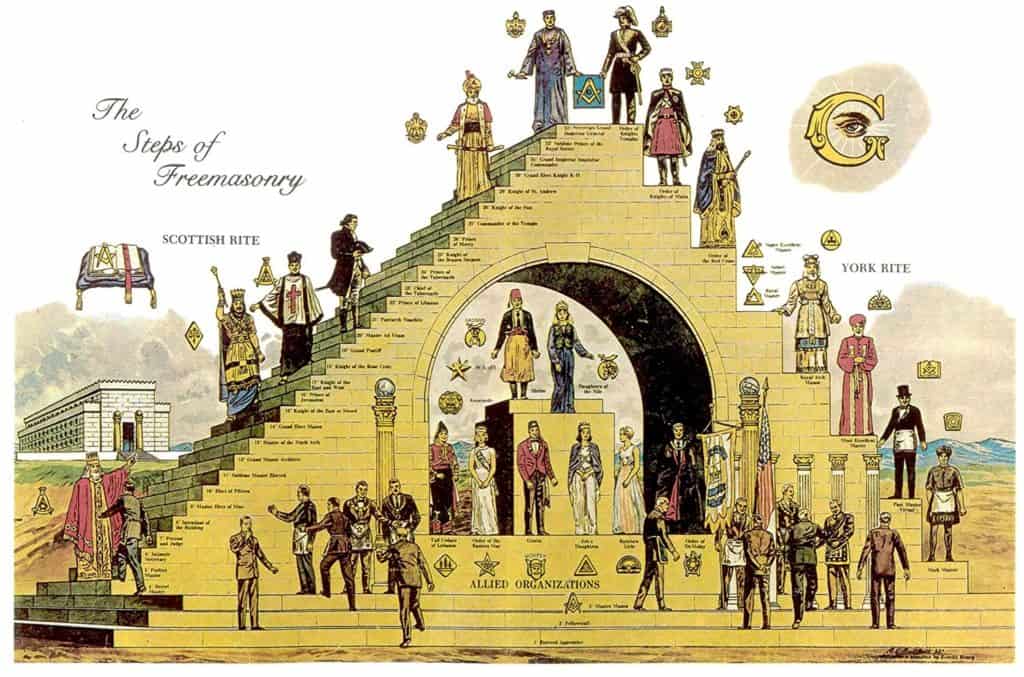
Appendix C
Major Influences on Albert Pike
Albert Pike was not an isolated thinker. His work reflects the influence of numerous philosophical, religious, literary, and intellectual traditions. Understanding these influences helps explain both the strengths and limitations of Morals and Dogma.
Classical Philosophy
Plato
Plato’s influence appears throughout Pike’s work. The belief that reality possesses deeper dimensions beyond immediate appearances, the emphasis on moral development, and the pursuit of wisdom all reflect Platonic themes.
Aristotle
Although Pike was more attracted to symbolism and metaphysics than Aristotle’s empirical methods, Aristotelian virtue ethics strongly influenced his emphasis on character and moral development.
The Stoics
The writings of Epictetus, Marcus Aurelius, and other Stoic philosophers reinforced Pike’s admiration for self-mastery, duty, resilience, and rational conduct.
Western Esotericism
Hermeticism
Pike drew extensively from Hermetic literature and traditions associated with ancient wisdom, symbolic interpretation, and philosophical mysticism.
Kabbalah
Jewish mystical traditions influenced Pike’s understanding of symbolism, sacred language, and the search for hidden meanings.
Rosicrucianism
Rosicrucian literature contributed to Pike’s interest in spiritual transformation, symbolic education, and the pursuit of wisdom.
Comparative Religion
Ancient Egyptian Religion
Pike regarded Egypt as one of the great symbolic civilizations and frequently drew upon Egyptian mythology and religious concepts.
Hindu Philosophy
The Upanishads, Vedic traditions, and Hindu philosophical schools influenced Pike’s reflections on consciousness, reality, and self-development.
Buddhism
Although his understanding was limited by nineteenth-century scholarship, Pike admired Buddhism’s emphasis on discipline, contemplation, and ethical conduct.
Judaism and Christianity
These traditions provided much of the moral and symbolic framework upon which Pike built his larger philosophical system.
Enlightenment and Nineteenth-Century Scholarship
Pike was deeply influenced by the intellectual climate of his era.
Comparative religion, archaeology, philology, Romanticism, and Enlightenment rationalism all shaped his worldview. His strengths and weaknesses alike often reflect the assumptions of nineteenth-century scholarship.
Freemasonry
Albert G. Mackey
Mackey’s scholarship on Masonic symbolism, ritual, and history provided an important foundation for Pike’s work.
Earlier Scottish Rite Traditions
Pike inherited and reorganized a rich body of symbolic material already present within the Scottish Rite.
His achievement was not creating the system from nothing but synthesizing and expanding it into a comprehensive philosophical framework.
Appendix D
Recommended Reading
The following works provide useful context for readers interested in exploring the themes discussed throughout this article.
Freemasonry
Albert Pike
Morals and Dogma of the Ancient and Accepted Scottish Rite of Freemasonry
Pike’s monumental work remains essential reading for understanding the philosophical foundations of the Scottish Rite.
Albert G. Mackey
The Symbolism of Freemasonry
One of the most influential studies of Masonic symbolism and its historical development.
Manly P. Hall
The Lost Keys of Freemasonry
A philosophical interpretation of Masonic symbolism written for modern readers.
W. L. Wilmshurst
The Meaning of Masonry
One of the finest explorations of Freemasonry as a system of personal and spiritual development.
W. Kirk MacNulty
The Way of the Craftsman
A modern classic that interprets Freemasonry as a symbolic system of personal transformation, moral development, and lifelong learning.
Comparative Religion
Joseph Campbell
The Hero with a Thousand Faces
A landmark study of world mythology that explores the universal “Hero’s Journey” pattern found across cultures.
The Masks of God Series
A comprehensive four-volume survey of the world’s mythological traditions.
The Power of Myth
An accessible introduction to mythology and symbolism exploring the continuing relevance of myths in modern life.
Karen Armstrong
A History of God
A highly accessible overview of the development of Judaism, Christianity, and Islam.
Huston Smith
The World’s Religions
A classic introduction to the major religious traditions of humanity.
Mircea Eliade
The Sacred and the Profane
An influential examination of myth, symbolism, ritual, and religious experience.
Science and Humanism
Carl Sagan
The Demon-Haunted World
A powerful defense of scientific thinking, skepticism, and intellectual inquiry.
E. O. Wilson
Consilience
Wilson’s argument for the integration of knowledge across disciplines reflects themes central to Integrated Humanism.
Steven Pinker
Enlightenment Now
An examination of human progress through science, reason, humanism, and democratic institutions.
Michael Shermer
The Moral Arc
A study of the historical expansion of human rights, ethical progress, and social development.
Philosophy
Plato
The Republic
One of the foundational works of Western philosophy, addressing justice, leadership, education, and the ideal society.
Aristotle
Nicomachean Ethics
The classic statement of virtue ethics and moral development.
Epictetus
The Enchiridion
A concise guide to Stoic philosophy emphasizing self-mastery and resilience.
Marcus Aurelius
Meditations
Reflections on duty, virtue, leadership, and personal conduct by the Roman emperor-philosopher.
Scientific Humanist Companion Reading
Readers interested in extending Pike’s project into the twenty-first century may also wish to explore the Science Abbey Journal and other works on psychology, cognitive science, anthropology, ethics, education, and human development. These disciplines provide many of the empirical tools necessary to evaluate, refine, and expand the philosophical questions that Pike explored through symbolism and comparative religion.
In this sense, the study of Morals and Dogma need not end with Pike. It can serve as the beginning of a broader inquiry into humanity’s continuing search for knowledge, wisdom, and the improvement of civilization.
Final Note:
On Albert Pike’s Personal Library
One of Pike’s lesser-known but most tangible contributions to public education was the establishment of what became the first free public library in Washington, D.C. In 1888, while serving as Sovereign Grand Commander of the Scottish Rite, he directed that his personal library be opened for the use of the general public through the Scottish Rite’s library at the House of the Temple.
At a time when the Library of Congress was not yet organized for general public access, this represented a significant milestone in the democratization of knowledge. The collection, now known as the Albert Pike Library, remains housed at the House of the Temple today and continues to serve researchers, Masons, and visitors from around the world.
Although Washington’s first tax-supported municipal public library was the Carnegie Library, which opened in 1903 and later evolved into the District of Columbia Public Library system, Pike’s library holds the distinction of being the city’s first free public library accessible to the public.
The significance of this institution extends into the present. The founder of Science Abbey and author of this article, D. B. Smith, received part of his professional training as a librarian within the Albert Pike Library while serving at the House of the Temple, during the time he worked as Librarian and Curator at the George Washington Masonic Memorial. This personal connection offers a unique perspective on Pike’s enduring legacy and his commitment to scholarship, education, and the public sharing of knowledge.
D. B. Smith
D. B. Smith is an independent historian, ritualist, and comparative religion scholar specializing in the intersections of Western esotericism, Freemasonry, and Eastern contemplative traditions. He formerly served as Librarian and Curator at the George Washington Masonic National Memorial, overseeing historically significant artifacts and manuscripts, including those connected to George Washington’s personal life.
Initiated into The Lodge of the Nine Muses No. 1776, a philosophically focused lodge in Washington, D.C., Smith studied under influential figures in the Anglo-American Masonic tradition. His work has been featured in national and international Masonic publications, and his efforts have helped inform exhibits, lectures, and televised documentaries on the history and symbolism of Freemasonry.
Smith’s parallel study and practice of Soto Zen Buddhism—including ordination as a lay practitioner in the Katagiri-Winecoff lineage—has led him to investigate convergences between ritual, mindfulness, symbolic systems, and the evolving role of spiritual practice in secular societies. He is the founder of Science Abbey, a platform for interdisciplinary inquiry across religion, philosophy, science, and cultural history.