
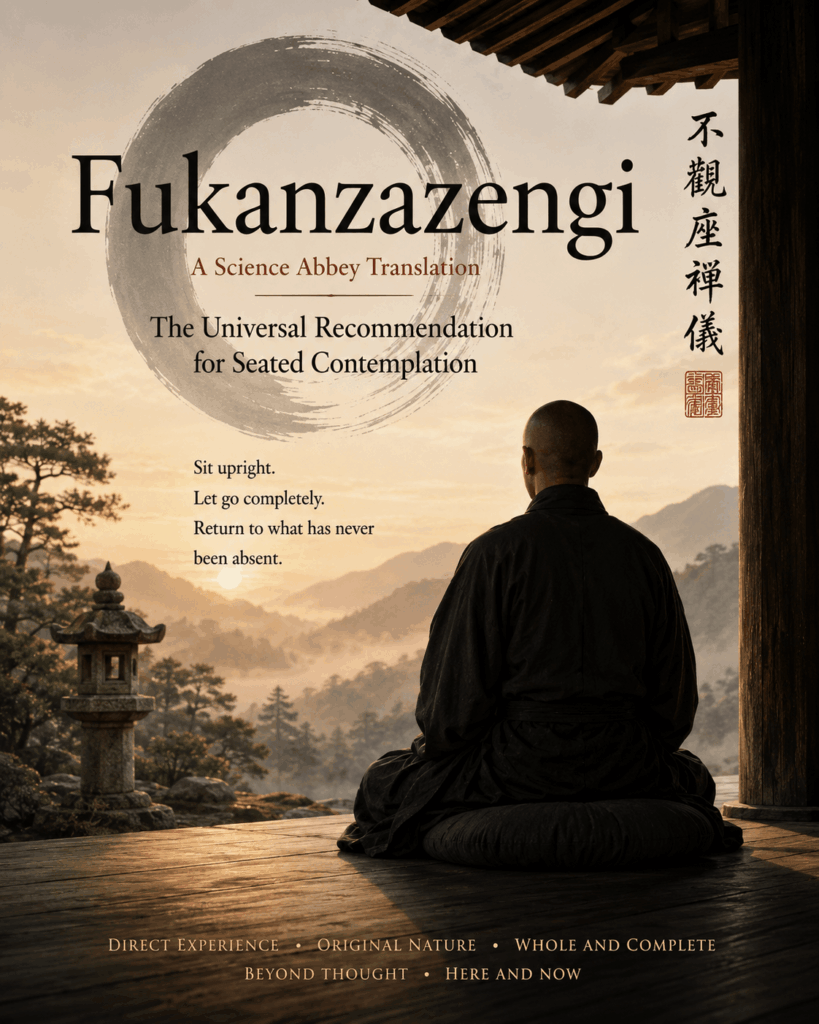
Fukanzazengi
Universal Recommendation for Seated Meditation
By Master Dogen
A Science Abbey Translation
Introduction
The Buddha and Buddhism
Buddhism traces its origins to Siddhartha Gautama, a spiritual teacher who lived in northern India during the fifth century BCE. Born into privilege, Siddhartha became deeply concerned with the realities of aging, illness, and death. Leaving behind wealth and status, he undertook a quest to understand the causes of suffering and the possibility of human liberation.
After years of study and meditation, he attained awakening beneath the Bodhi Tree and became known as the Buddha, meaning “the Awakened One.” Rather than presenting a system of beliefs to be accepted on faith, the Buddha taught a practical path of investigation, ethical living, meditation, and wisdom. His teachings focused on understanding the nature of the mind, the causes of dissatisfaction, and the possibility of freedom through direct insight.
Over the centuries, Buddhism spread throughout Asia and developed into many traditions and schools. While differing in culture, philosophy, and practice, these traditions share a common emphasis on awakening, compassion, mindfulness, and the direct examination of experience. Among the many forms Buddhism would take, one of the most influential was Chan Buddhism in China, from which Zen Buddhism later emerged.
Chan Buddhism
Chan Buddhism emerged in China between the sixth and eighth centuries CE as a distinctive school of Mahāyāna Buddhism. Influenced by Indian Buddhist meditation traditions and Chinese philosophical currents, particularly Daoism, Chan emphasized direct experience over scripture, realization over ritual, and personal insight over intellectual speculation. Its central teaching is that awakening is not something distant to be acquired but the true nature already present within all beings.
Soto Zen Buddhism
Zen Buddhism developed from Chan as it spread to Japan. Among its major schools, Soto Zen became known for its emphasis on seated meditation as the direct expression of awakening. Rather than viewing meditation as a technique for attaining enlightenment in the future, Soto Zen teaches that sincere practice itself embodies awakening. This approach became one of the defining features of Japanese Zen.
Dōgen Zenji
Dōgen Zenji was the founder of the Japanese Soto Zen tradition and one of the most profound philosophers in Buddhist history. Dissatisfied with superficial answers to spiritual questions, he traveled from Japan to China in search of authentic teaching. There he studied under the Chan master Tiantong Rujing and experienced a transformative realization. Returning to Japan, Dōgen devoted his life to teaching the unity of practice and awakening. His writings remain among the most important works of world contemplative literature.
Zazen
Zazen, literally “seated meditation,” is the foundational practice of Zen Buddhism. In zazen, practitioners sit upright and attentive, allowing thoughts, emotions, and sensations to arise and pass without attachment. The purpose is not to enter a trance, escape the world, or achieve extraordinary experiences, but to experience reality directly and intimately as it is.
Shikantaza
The form of zazen most closely associated with Soto Zen is shikantaza, often translated as “just sitting.” In shikantaza there is no mantra, visualization, object of concentration, or goal to attain. One simply sits with complete awareness, allowing reality to reveal itself naturally. Dōgen regarded this practice not as preparation for awakening but as awakening itself in action.
The Fukanzazengi
The Fukanzazengi (“Universal Recommendation for Seated Meditation”) is Dōgen’s concise guide to the philosophy and practice of zazen. Written in the thirteenth century, it remains one of the foundational texts of Soto Zen. In a few short pages, Dōgen explains the nature of the Way, the purpose of meditation, the posture of zazen, and the principle of non-thinking.
More than a meditation manual, it is a profound statement of the Zen understanding that reality is already whole and complete, and that sincere practice is the direct expression of that completeness.
The translation presented here seeks to preserve Dōgen’s meaning while rendering his teachings in clear and accessible contemporary English. It is offered in the spirit of inquiry, contemplation, and direct experience that lies at the heart of both Zen Buddhism and the broader Science Abbey tradition.
Fukanzazengi
Universal Recommendation for Seated Meditation
Part I — The Way and the Necessity of Practice
The Way is originally whole and complete, extending everywhere without obstruction. If this is so, why should realization depend upon practice? The Dharma Vehicle is already present and functioning. Why should one exhaust oneself striving to attain it?
Furthermore, the body of reality is free from the dust and confusion of delusion. Why should we imagine that it must be polished clean? The Way is never separate from where we stand at this very moment. Why then should we wander elsewhere in search of it?
Yet if the slightest distinction arises, the distance becomes as great as that between heaven and earth. The moment attraction and aversion appear, the mind becomes lost in confusion. One may possess great knowledge, flashes of insight, profound understanding, and lofty aspirations.
One may believe oneself awakened and imagine that one has grasped the deepest truths. One may clarify the mind, attain remarkable insight, and raise one’s spirit toward the heavens. Yet all of this may amount to little more than standing at the gate. The vital path of complete liberation still remains.
Consider Shakyamuni Buddha. Though naturally illumined, he sat upright in meditation for six years, and the influence of that practice remains with us today. Consider Bodhidharma, who transmitted the Buddha Mind and sat facing a wall for nine years. If such masters practiced in this way, how can we fail to do likewise?
Therefore, cease pursuing understanding through words and concepts alone. Turn the light around and illuminate yourself. Take the backward step that returns awareness to its source. Then body and mind naturally fall away, and your original face appears. If you wish to realize reality directly, devote yourself to its practice immediately.
For the practice of zazen, choose a quiet place. Eat and drink in moderation. Set aside worldly concerns and allow the countless affairs of life to come to rest. Do not dwell upon good and evil. Do not become entangled in judgments of right and wrong. Cease chasing thoughts, opinions, memories, and plans. Stop measuring experience through the operations of intellect and imagination.
Do not sit with the ambition of becoming a Buddha.
Do not become attached even to the posture itself.
The Way is not limited to sitting, standing, walking, or lying down.
Part II — The Posture and Art of Zazen
For seated contemplation, prepare a stable seat. Traditionally, a thick mat is placed upon the floor and a round cushion upon it. Sit either in the full-lotus posture or the half-lotus posture.
In the full-lotus posture, place the right foot upon the left thigh and the left foot upon the right thigh. In the half-lotus posture, simply place the left foot upon the right thigh.
Wear clothing that is loose, comfortable, and orderly.
Place your right hand upon your left foot and your left hand, palm upward, in your right palm. Let the tips of the thumbs lightly touch, forming a circle of balance and attention.
Sit upright. Do not lean to the left or right. Do not incline forward or backward.
Let the ears align with the shoulders and the nose align with the navel. Rest the tongue lightly against the roof of the mouth. Keep the lips and teeth gently closed. Leave the eyes naturally open.
Allow the breath to pass quietly through the nose.
Having established the posture, exhale fully and let the body settle. You may gently sway from side to side before becoming completely still. Then sit firmly and steadily, like a mountain.
Now attend to not thinking.
How does one attend to not thinking?
Through non-thinking.
This is the essential art of zazen.
Zazen is not a meditation technique for manufacturing enlightenment. It is not a method for becoming something other than what you are. It is not a gradual process of constructing Buddhahood. Rather, zazen is the direct expression of awakened reality itself.
It is the Dharma Gate of profound ease and joy. It is complete realization manifesting in the present moment. It is reality revealing itself directly, free from entanglement.
When its meaning is understood, one is like a dragon entering the water or a tiger returning to the mountains. The true Dharma naturally manifests itself. Dullness dissolves. Distraction falls away.
Part III — Practice, Realization, and the Living Transmission
When you rise from sitting, move slowly and deliberately. Do not stand abruptly or carelessly.
Throughout history, those who have realized the Way have transcended the ordinary distinctions of ignorance and enlightenment, life and death, sitting and standing. Such freedom does not arise through intellectual understanding. It is revealed through the power of samadhi—the collected, unified, and undistracted mind of Zazen.
The discriminating intellect alone cannot comprehend how the Buddhas and Ancestors taught the Dharma. How could the awakened activity of a raised finger, a staff, a shout, a whisk, a fist, a nod, or a silent gesture be understood through conceptual analysis? Such actions do not belong to the realm of ordinary reasoning.
Nor can the Way be measured by supernatural powers, mystical visions, or extraordinary experiences. The activity of awakening exists before the mind divides reality into categories. It is deportment beyond hearing and seeing. Is it not prior to knowledge and perception?
Therefore, make no distinction between the clever and the dull, the learned and the unlearned. Do not concern yourself with superior intelligence or inferior capacity.
Wholehearted practice itself is the Way.
This practice-realization is fundamentally undefiled. Practice is just ordinary day-to-day living.
The Buddhas and Ancestors of all times and places have carefully preserved this living transmission. In India, in China, and throughout the generations, they equally keep the Buddha Seal. All have shared one essential characteristic, the teaching of this school, the wholehearted devotion to the practice of Zazen.
Part IV — The Precious Opportunity
Why abandon the seat of practice and wander aimlessly through the dusty distractions of the world? A single misstep may cause you to overlook what stands plainly before your eyes.
You have already received the rare opportunity of human life. Do not waste it. Do not allow your days and nights to pass unnoticed. Do not spend your years chasing lesser things while neglecting the great matter that lies before you.
Having encountered the Buddha Way, why devote yourself to pursuits that vanish like sparks from a struck stone? The body is fragile, like a dewdrop resting upon a blade of grass.
Life itself is fleeting, like a flash of lightning across the evening sky.
In an instant it appears.
In an instant it is gone.
Honored students of the Way, do not remain satisfied with partial understanding. Do not cling to fragments of truth while missing the whole. Like blind describing different parts of an elephant, many become attached to limited views and mistake them for complete understanding.
Do not fear the True Dragon.
Direct your effort toward the Way that points directly to absolute reality itself.
Honor those who have gone beyond mere knowledge and entered full realization. Accord with your original nature. Take your place within the living lineage of samadhi transmitted by the Buddhas and Ancestors. If you continue in this way, you will be a person such as they. Your treasury of wisdom will open of itself and you will use it at will.
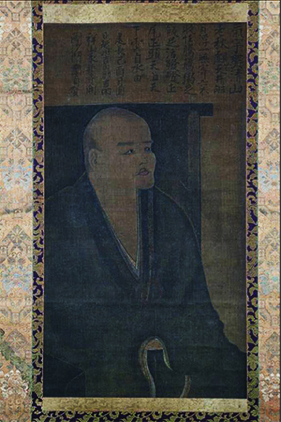
In memoriam
Dainin & Tomoe Katagiri