

From Ancient Factions to 21st Century Campaigns
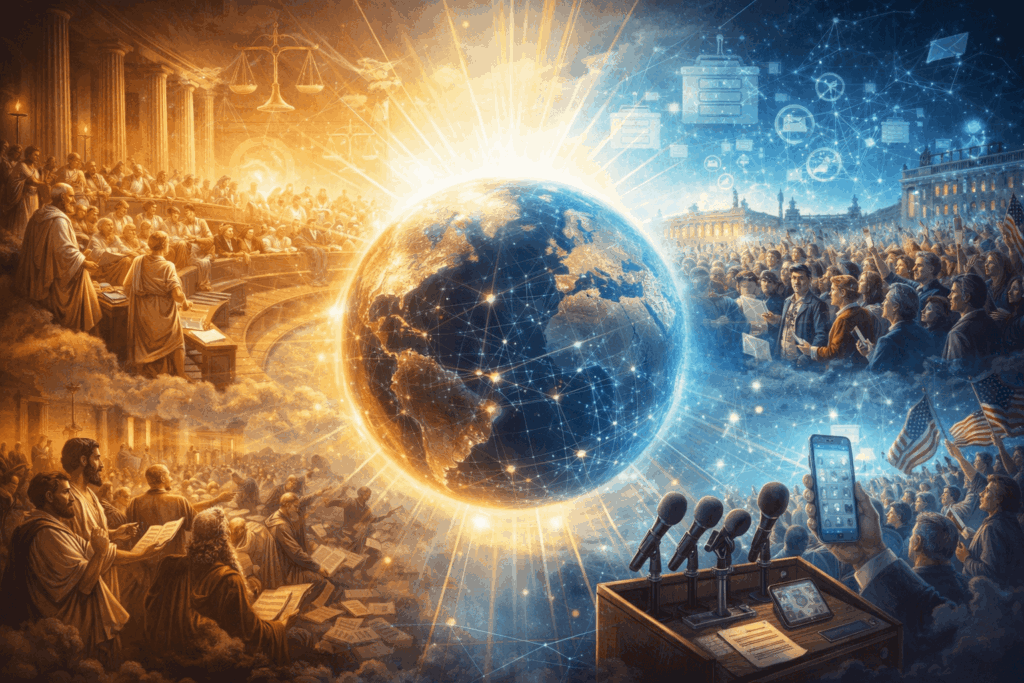
Table of Contents
Introduction
Why Political Parties Matter and How They Shape Our World
Part I: The Origins of Political Parties
From Ancient Assemblies to the Birth of Modern Politics
- Ancient Precursors
Factions, Assemblies, and Republics - The First Modern Parties
1600s–1800s: Britain, America, and the Invention of Party Politics - Global Expansion and Ideological Foundations
1800s–1945: Class, Empire, Revolution, and the Mass Party
Part II: Political Parties in the World Today (2025)
The Global Landscape of Power and Partisanship
- Survey of Major Political Parties by Region
From Washington to New Delhi, from Beijing to Brasília - Global Trends in Party Politics
Populism, Polarization, Technocracy, and the Green Wave
Part III: The Science of Political Party Formation
Why Humans Form Parties—Biology, Strategy, and Power
- Biological and Psychological Factors
Tribalism, Morality, and the Psychology of Belonging - Economic and Class-Based Forces
Capital, Labor, Inequality, and the Roots of Representation - Biographical and Charismatic Leadership Models
How Leaders Create—and Sometimes Destroy—Parties - Strategic and Organizational Theory
The Machinery Behind the Message
Part IV: Democracy and Party Systems
How Parties Function Within—and Sometimes Against—Democracy
- Liberal, Social, and Direct Democracies
Three Models of Representation and Party Behavior - Campaign Finance and Party Corruption
Money, Power, and the Architecture of Influence - Elections and Voting Systems
How the Rules Shape the Players
Part V: Campaigning, Misinformation, and Civic Knowledge
How Parties Win, How the Public Loses, and How Democracy Can Be Saved
- The Evolution of Campaigning
From Rhetoric to Algorithms - Information Warfare and the Party System
Propaganda, Polarization, and the Weaponization of Narrative - The Role of Civic Education
The Last Defense Against Democratic Decline
Conclusion
Reforming the Engine Before It Breaks the Vehicle
Introduction
Why Political Parties Matter and How They Shape Our World
Political parties are among the most powerful and enduring institutions in modern history. They organize ideology, mobilize citizens, contest elections, form governments, and shape the destinies of nations. But what exactly is a political party and why do they seem both essential and problematic at the same time?
At their core, political parties are organized groups of people who share common values, policy goals, or ideological commitments. They seek to gain and exercise power through elections, policymaking, and governance. Parties often provide structure in democratic societies, but they also exist in authoritarian regimes, where they may serve to consolidate control, suppress dissent, or simulate legitimacy.
The story of political parties is not just one of formal institutions. It is a story of human psychology, economic interests, tribal identity, charismatic leaders, and strategic evolution. From the salons of Enlightenment Europe to the parliaments of postcolonial Africa, from revolutionary cadres to populist movements, political parties have adapted to nearly every cultural and technological context. They have been tools for human progress—and instruments of oppression.
In the 21st century, the role of political parties has become even more complex. Trust in institutions is declining. Disinformation and polarization are rising. Scientific challenges like climate change and artificial intelligence demand long-term planning, while many parties are trapped in short-term election cycles. Yet, new forms of political organization are emerging: green parties, science-based parties, transnational alliances, and grassroots movements that seek to reshape the relationship between citizens and state.
This article explores the full arc of political party development:
- their historical origins across cultures,
- their present-day structures and key players,
- the psychological and sociopolitical forces that form and fracture them,
- and their future in an age where science, technology, and democracy intersect in urgent and unpredictable ways.
By examining the history and science of political parties, we aim to understand not only how these institutions work, but how they must evolve if humanity is to meet the challenges of the future with wisdom, justice, and reason.
Part I: The Origins of Political Parties
From Ancient Assemblies to the Birth of Modern Politics
1. Ancient Precursors: Factions, Assemblies, and Republics
Long before the term “political party” was coined, human beings gathered into factions, coalitions, and ideological camps within councils, tribes, and courts. In ancient Athens, political life centered around the ekklesia (popular assembly) and boule (council of 500), where citizens debated and voted, but informal alignments often formed around military leaders, aristocratic patrons, or populist reformers. Though these groupings lacked formal party structures, they foreshadowed the competing interest groups of modern parliaments.
In the Roman Republic, optimates (aristocratic conservatives) and populares (reformers appealing to the common people) represented the first clear ideological divisions in a representative body. These factions vied for power through elected magistracies, legislation, and military alliances, often using rhetoric and spectacle to win support. Figures like Cicero, Julius Caesar, and Cato the Younger navigated this factional world with a blend of ambition and ideology that still resonates today.
Medieval Europe saw the rise of court factions, guild alliances, and ecclesiastical power blocs. In Renaissance Florence, the Medici family’s control over the republic was enabled not through a formal party, but through patronage networks and factional dominance. Across cultures, from imperial China’s Confucian bureaucratic factions to pre-Islamic Arabian tribal councils, we find proto-party formations wherever organized political deliberation took place.
These early systems demonstrate a basic truth: wherever humans govern themselves, they divide into competing groups to represent differing interests, values, and strategies. Political parties, though modern in form, arise from ancient instincts.
2. The First Modern Parties (1600s–1800s)
The political party as we know it began to emerge in post-Civil War England, where the struggle between Parliament and monarchy birthed the two enduring camps of the Whigs and the Tories. The Whigs generally supported constitutional limits on royal power and greater representation for property-owning citizens. The Tories favored royal prerogative, the established Church, and traditional social order. These two groups evolved into today’s Liberal and Conservative parties, respectively—demonstrating remarkable institutional continuity in British politics.
→ (VisitHeritage: History of British Political Parties)
In the United States, the Founding Fathers initially opposed the idea of political parties. George Washington famously warned against “the baneful effects of the spirit of party.” But by the 1790s, deep divisions over federal power, foreign policy, and economic policy had already birthed the first American parties: the Federalists, led by Alexander Hamilton, and the Democratic-Republicans, led by Thomas Jefferson.
→ (Bill of Rights Institute: U.S. Party History)
Across Europe and Latin America in the 18th and 19th centuries, political parties gradually emerged alongside revolutions, parliaments, and the spread of suffrage. In France, ideological parties formed around monarchy, republicanism, socialism, and secularism. In Latin America, independence movements gave rise to parties centered on caudillos (strongmen) or liberal reformers. Many of these early parties revolved around personalities or military power before evolving into ideological institutions.
The Industrial Revolution added a new element: class. As working-class consciousness rose, so too did labor parties, socialist parties, and agrarian movements, seeking to give political voice to those traditionally excluded from governance.
3. Global Expansion and Ideological Foundations (1800s–1945)
The 19th and early 20th centuries saw the rise of the great ideological pillars of party politics: liberalism, conservatism, socialism, nationalism, and later fascism and communism. These ideologies helped define and polarize party systems across the globe.
In Germany, Otto von Bismarck’s statecraft coexisted with rising socialist and Catholic parties. In Italy, newly unified in the 1860s, party politics fractured along regional, ideological, and religious lines. In Japan, the Meiji era introduced limited party politics under an imperial constitutional framework, while in India, the Congress Party began its transformation from elite debate society into an anti-colonial mass movement.
The early 20th century introduced the modern mass party: centrally organized, ideologically driven, and equipped with newspapers, manifestos, and national branches. Communist parties, inspired by the 1917 Russian Revolution, spread through Europe, Asia, and Latin America, often with direct support from the Soviet Union. These parties adopted strict internal discipline and revolutionary rhetoric, aiming to abolish capitalism and the bourgeois state.
Meanwhile, fascist parties—most infamously Mussolini’s in Italy and Hitler’s in Germany—married nationalism, authoritarianism, and mass spectacle to devastating effect. These movements showed how parties could become instruments not of democracy, but of totalitarianism.
By World War II, nearly every major country had developed recognizable political parties, even if their structures varied wildly. The era had firmly established the political party as a fundamental building block of modern governance—an institution that could serve liberty, equality, ideology, or empire.
Part II: Political Parties in the World Today (2025-26)
The Global Landscape of Power and Partisanship
4. Survey of Major Political Parties by Region
In 2025, political parties remain the dominant vehicles of political expression, governance, and opposition across nearly all regions of the world—though their structures, ideologies, and legitimacy vary widely. Below is a regional survey of major parties and coalitions shaping the present global political order.
North America
- United States:
The two-party system continues to dominate, with the Democratic Party embracing a centrist-to-progressive agenda emphasizing climate action, healthcare, and social reform, while the Republican Party has shifted toward populist nationalism and cultural conservatism. Minor parties like the Libertarian and Green parties remain marginal but vocal.
Ongoing debates around voting rights, redistricting, and electoral reform continue to challenge democratic resilience. - Canada:
A more balanced multiparty system, led by the centrist Liberal Party, the conservative Conservative Party, and the progressive New Democratic Party (NDP). The Bloc Québécois and Green Party also play influential regional or environmental roles. - Mexico:
Dominated by MORENA—the National Regeneration Movement—founded by President Andrés Manuel López Obrador, which blends left-populism with nationalism. Opposition includes the Institutional Revolutionary Party (PRI), once hegemonic, and the center-right National Action Party (PAN).
Europe
- United Kingdom:
The Conservative Party and the Labour Party continue to alternate power, with rising pressure from the Liberal Democrats, Scottish National Party (SNP), and emerging green and populist voices. Brexit has redrawn political fault lines, amplifying nationalist sentiment and regional autonomy demands. - Germany:
The post-Merkel era is shaped by a multiparty coalition including the Christian Democratic Union (CDU), Social Democrats (SPD), Greens, and Free Democrats (FDP), while the far-right AfD and post-Marxist Die Linke challenge from the fringes. - France:
President Macron’s centrist Renaissance party faces pressures from both the far-right National Rally (RN) under Marine Le Pen and the left-wing La France Insoumise (LFI). Traditional parties like Les Républicains and the Socialists have declined but retain influence. - Eastern Europe:
Populist-nationalist parties hold sway in Hungary (Fidesz), Poland (Law and Justice), and increasingly in Slovakia and Serbia. Pro-European opposition parties exist but often struggle under rule-of-law constraints.
Asia
- India:
The Bharatiya Janata Party (BJP) under Narendra Modi dominates, advancing a Hindu nationalist agenda and a technocratic economic vision. The Indian National Congress has weakened but retains historical weight. Numerous regional parties (DMK, AAP, TMC) play vital roles in coalition dynamics. - China:
The Chinese Communist Party (CCP) remains the world’s most powerful single-party regime, ruling with no legal opposition, controlling media, and using advanced surveillance and AI to maintain social order and ideological uniformity. - Japan:
The Liberal Democratic Party (LDP) continues its long-running dominance, though opposition forces like the Constitutional Democratic Party and Japan Innovation Party are gaining traction in urban areas. - Thailand and Indonesia:
Thailand’s Pheu Thai Party, rooted in Thaksin Shinawatra’s populism, returned to influence in a tense alliance with conservative military elements. In Indonesia, the PDI-P and Gerindra define electoral dynamics, blending populist nationalism with pragmatic policy.
Africa
- South Africa:
The African National Congress (ANC) remains in power despite growing corruption scandals and service failures. The leftist Economic Freedom Fighters (EFF) and centrist Democratic Alliance (DA) provide stark ideological alternatives. - Nigeria:
The two-party system of the All Progressives Congress (APC) and People’s Democratic Party (PDP) dominates, though regional movements and ethnic tensions often shape party allegiance more than policy. - Tanzania, Kenya, Ghana:
Democratic multiparty competition exists but often faces challenges from authoritarian entrenchment, electoral irregularities, and patronage politics.
Latin America
- Brazil:
A polarized landscape: Workers’ Party (PT) of Luiz Inácio Lula da Silva promotes social inclusion and environmental stewardship, while the far-right PL and other conservative parties echo global authoritarian trends. - Mexico:
As above, MORENA leads under a populist banner, with older parties weakened but persistent. - Argentina, Bolivia, Colombia:
Populism, both left and right, continues to shape electoral politics. The MAS party in Bolivia and Peronist factions in Argentina reflect Latin America’s strong tradition of charismatic party leadership.
Middle East
- Israel:
A deeply fragmented landscape dominated by Likud and shifting coalitions. Religious and nationalist parties, such as Shas and Religious Zionism, now play major kingmaking roles, while centrist and Arab parties struggle for coherence. - Turkey:
The ruling AKP under Recep Tayyip Erdoğan holds power via populist nationalism, Islamic conservatism, and increasing authoritarian measures. The CHP and HDP form the main opposition blocs. - Iran:
Controlled by a theocratic regime with tightly controlled factions: Principlists, Reformists, and increasingly military-affiliated technocrats. These operate under the Supreme Leader’s oversight, not as free parties.
5. Global Trends in Party Politics (2025)
Despite regional diversity, several cross-cutting trends are shaping the evolution of political parties worldwide:
- Populism and Polarization:
Parties built around anti-elite rhetoric, nationalism, and cultural grievance—both left and right—continue to rise, often at the expense of institutional stability and fact-based policymaking. - Green and Climate Parties:
Environmental urgency has given rise to strong Green parties in Germany, the Nordics, New Zealand, and parts of Latin America. These movements often struggle with electoral systems designed for traditional parties. - Science-Based and Technocratic Parties:
Emerging across Europe and Asia, these new parties prioritize data, innovation, and non-ideological solutions to global problems. Some are offshoots of academic, entrepreneurial, or citizen science movements. - Transnational and Diaspora Movements:
As migration and communication technologies globalize identity, new parties and coalitions are forming across borders—such as the Volt Europa party, or diaspora-led advocacy in African and Arab contexts. - Digital and Disinformation Challenges:
Many parties now operate as hybrid political-marketing machines, using AI, data analytics, and social media manipulation to shape opinion—raising urgent ethical concerns addressed later in this article.
Part III: The Science of Political Party Formation
Why Humans Form Parties—Biology, Strategy, and Power
The political party is not merely an ideological invention—it is a product of human nature, social dynamics, and strategic necessity. This section analyzes the formation and functioning of political parties from five key perspectives: biological, psychological, economic, biographical, and strategic.
6. Biological and Psychological Factors
Why do people group together in tribes, factions, or parties? The answer lies deep in our evolutionary past. Human beings are social animals, wired to seek safety and influence through collective identity. From hunter-gatherer alliances to modern legislatures, we align ourselves with those who share our values, fears, and goals.
- Tribalism and Group Identity:
Evolutionary psychology suggests that humans naturally form in-groups and out-groups. Parties provide a psychological structure for this instinct—offering a sense of belonging and a clear “us vs. them” narrative. - Moral Psychology of Ideology:
Research by Jonathan Haidt and others reveals how moral intuitions differ across the political spectrum. Liberals tend to emphasize care and fairness, while conservatives prioritize loyalty, authority, and sanctity. Parties capitalize on these cognitive frameworks to attract loyal followers. - Cognitive Biases and Echo Chambers:
Confirmation bias, motivated reasoning, and the Dunning-Kruger effect all play roles in how people adopt and stick to political identities. Parties can manipulate these biases—or help counteract them through principled education and dialogue. - Charisma and Emotional Leadership:
Leaders who embody the emotional needs of their followers—hope, fear, anger, belonging—often become the symbolic core of a party. This explains the rise of leader-centric movements from Donald Trump to Lula da Silva to Viktor Orbán.
7. Economic and Class-Based Forces
Historically, many political parties formed in response to class-based conflict and material inequality. The economic lens reveals how the distribution of wealth, labor, and capital underpins political behavior.
- Marxist Analysis:
Political parties, from a Marxist view, reflect the interests of different economic classes. The rise of socialist and labor parties in the 19th and 20th centuries was a direct response to capitalist exploitation and working-class mobilization. - Modern Inequality and Economic Insecurity:
In the 21st century, wage stagnation, job automation, and wealth disparity continue to shape party formation—fueling both left-wing calls for redistribution and right-wing populist resentment of “global elites.” - Donor Classes and Policy Influence:
The structure and agenda of many parties today are heavily shaped by donors, lobbyists, and corporate interests. Campaign finance—explored in detail later—is often the invisible engine behind official party platforms. - Labor Unions, Trade Networks, and Economic Coalitions:
Parties often rise from or ally with organized labor, trade associations, or industry alliances. These economic blocs provide not only money but a ready-made voter base.
8. Biographical and Charismatic Leadership Models
Political parties are often reflections of their founders. Around the world, some of the most influential parties began as vehicles for charismatic individuals whose biographies shaped national histories.
- Founders as Symbols:
Figures like Nehru (India’s Congress), Mandela (South Africa’s ANC), and Chavez (Venezuela’s PSUV) built parties around their personal legacies. Even posthumously, their mythologies define their movements. - Authoritarian Personalism:
In more autocratic contexts, leaders often eliminate internal party dissent and turn the party into an extension of their will—e.g., Putin’s United Russia, Erdoğan’s AKP, or Xi Jinping’s domination of the CCP. - Dynastic Parties:
In countries like the Philippines, India, Pakistan, and Argentina, family lineage plays a powerful role in party continuity. These dynastic tendencies reveal deep sociopolitical entanglements between kinship and power. - Anti-Party Founders:
Ironically, many anti-establishment leaders (e.g., Trump, Zelenskyy, Berlusconi) rise by attacking “the system” while forming highly personalized parties or movements—often lacking deep organizational roots.
9. Strategic and Organizational Theory
Beyond ideology or personality, parties function as strategic machines designed to win and wield power. Political science and management theory offer insight into how they operate and evolve.
- Rational Choice and Game Theory:
Parties position themselves ideologically and strategically to maximize votes, balance coalitions, and dominate policy debates. Strategies include triangulation (adopting opposing ideas to steal voters) and wedge issues (exploiting divisions within opponents). - Party Infrastructure and Logistics:
A successful party requires strong local chapters, fundraising networks, legal teams, data analysts, social media experts, and canvassing operations. In the digital age, this infrastructure is increasingly centralized and algorithm-driven. - Movement vs. Machine:
Some parties function more like spontaneous movements—fluid, idealistic, grassroots. Others function as hierarchical machines with top-down control and rigid procedures. The former can inspire; the latter can endure. - Coalition Building and Mergers:
Especially in parliamentary systems, parties often merge or form governing coalitions. This forces compromises, hybrid platforms, and creative power-sharing models. Strategic flexibility becomes a survival trait.
Political parties, then, are neither simple nor static. They are living institutions at the intersection of biology, psychology, economics, narrative, and strategic innovation. They mirror our strengths and weaknesses as a species—and their design determines much of our collective future.
Part IV: Democracy and Party Systems
How Parties Function Within—and Sometimes Against—Democracy
Political parties are often described as the “engines of democracy,” but their role can vary dramatically depending on the type of system in which they operate. This section explores the different models of democracy, how party systems adapt or distort them, and how money and rules shape political competition.
10. Liberal, Social, and Direct Democracies
Liberal Democracy
Liberal democracy emphasizes individual rights, representative government, and constitutional limits on power. Political parties in liberal democracies are expected to represent broad segments of the population, negotiate compromise, and participate in peaceful transfers of power. Examples include the U.S., Canada, Germany, and Japan.
- Party Role: Channeling public opinion into policy through elections and legislative processes
- Challenges: Polarization, voter disengagement, and party capture by elite interests
Social Democracy
A more economically egalitarian form of liberal democracy, social democracy emphasizes collective well-being, social welfare, and labor rights. Common in Scandinavian countries and parts of Western Europe, it often involves multi-party coalitions and proportional representation.
- Party Role: Representing labor unions, social movements, and welfare interests
- Challenges: Fragmentation of the left, technocratic drift, populist backlash
Direct Democracy and Participatory Models
In places like Switzerland and many U.S. states, referendums and citizen initiatives allow voters to bypass parties and vote directly on laws. Technology is also enabling new forms of digital direct democracy and crowd-sourced platforms.
- Party Role: Often reduced or challenged by grassroots or issue-based movements
- Challenges: Low participation, demagoguery, information gaps
11. Campaign Finance and Party Corruption
Money is the bloodstream of modern politics—and its regulation (or lack thereof) often determines whether parties remain accountable to voters or become puppets of donors.
Campaign Finance Systems
- Public Financing: Some democracies, like Germany and Sweden, provide state funding to parties based on vote share or seat count, reducing dependence on private donations.
- Private and Hybrid Systems: In the U.S., campaign finance is largely privatized, regulated through contribution limits, Super PACs, and loopholes—leading to a high-stakes fundraising arms race.
Dark Money and Influence
- Untraceable donations (often via nonprofits) allow wealthy individuals and corporations to fund ads and advocacy without disclosure.
- Foreign interference often exploits these systems to influence party platforms or sow discord.
Corruption Scandals
From Brazil’s Operation Car Wash to South Korea’s presidential impeachment, many parties have been exposed for kickbacks, bribery, and influence peddling. In weakly institutionalized democracies, party corruption can become endemic and self-reinforcing.
Reform Movements
- Electoral commissions, transparency laws, and grassroots watchdogs are attempting to reform party finance systems.
- Science Abbey supports evidence-based reform through its Take Political Action for Science initiative, which promotes integrity, transparency, and scientific literacy in political advocacy.
12. Elections and Voting Systems
The type of electoral system a country adopts has a major influence on party behavior, power concentration, and voter choice. The mechanics of voting often determine whether parties cooperate or compete, fragment or polarize.
First-Past-the-Post (FPTP)
Used in the U.S., UK, India, and Canada, FPTP awards victory to the candidate with the most votes—even without a majority. It favors two-party systems and encourages strategic voting.
- Effect: Simplicity, but poor representation of minority views and wasted votes
- Critics: Claim it perpetuates duopolies and reduces competition
Proportional Representation (PR)
Used in most of Europe and Latin America, PR allocates seats based on the percentage of votes a party receives.
- Effect: Encourages multiparty systems, coalitions, and issue-based platforms
- Critics: Can produce unstable governments and empower fringe parties
Ranked Choice Voting (RCV)
Voters rank candidates in order of preference. If no one gets a majority, the lowest-ranked candidates are eliminated and votes reallocated.
- Effect: Reduces negative campaigning, encourages consensus candidates
- Growing use: Australia, Ireland, some U.S. cities and states
Runoff Systems and Mixed Systems
Some countries (e.g., France) use two-round systems to ensure majority winners. Others, like Germany and Japan, blend FPTP and PR.
Science Abbey’s How to Vote Quickguide
For those navigating complex systems, the How to Vote Quickguide offers simple, nonpartisan instruction on making your vote count—regardless of country or method.
Political parties play vastly different roles in different democratic systems. Their accountability, inclusiveness, and functionality depend not only on ideology but on rules—how elections are run, how money is regulated, and how citizens are educated.
Part V: Campaigning, Misinformation, and Civic Knowledge
How Parties Win, How the Public Loses, and How Democracy Can Be Saved
Political parties no longer simply win elections through door-knocking and newspaper ads. In the 21st century, they deploy armies of strategists, data scientists, and digital tacticians—often engaging in psychological manipulation, disinformation warfare, and algorithmic targeting. In such an environment, the strength of a democracy depends on an informed, critically thinking citizenry, and on a political culture that prizes truth over tactics.
13. The Evolution of Campaigning
Political campaigns have undergone a radical transformation in the past century—from public rallies and radio speeches to televised debates, social media blitzes, and AI-generated microtargeting.
Stages of Campaigning Evolution:
- The Orator Era (pre-1950):
Rhetoric, physical presence, and party loyalty defined campaigns. Word of mouth, town halls, and printed leaflets were dominant. - The Broadcast Era (1950s–1990s):
Television and radio brought image, personality, and soundbites into play. Candidates became celebrities, and advertising became central. - The Internet Era (2000s–2010s):
Email lists, online fundraising, and websites gave campaigns new flexibility. Barack Obama’s 2008 campaign pioneered digital grassroots mobilization. - The Algorithmic Era (2020s–present):
Today, campaigns employ real-time data analytics, social media bots, AI-generated content, deepfakes, and behavioral profiling. These tools are used not only to persuade—but to enrage, confuse, and mobilize through outrage.
Campaigning Tactics:
- Microtargeting: Personalized ads based on browsing history and psychographic data
- “Astroturfing”: Fake grassroots support, often driven by bots
- Geofencing: Sending specific messages to voters in narrowly defined locations
- Sentiment Engineering: Testing emotional responses to phrases, symbols, and images
Campaigns have become digital laboratories of human influence—sometimes outpacing the public’s ability to resist manipulation.
14. Information Warfare and the Party System
The rise of information warfare—domestic and foreign—has transformed political parties from ideological institutions into communication machines battling for narrative dominance.
Disinformation and Propaganda:
- Fake News and Deepfakes:
False or misleading information crafted to look credible, often shared without verification. - Troll Farms and Bot Networks:
Coordinated campaigns to amplify divisive content and sow distrust; used both by political actors and foreign intelligence services. - Algorithmic Echo Chambers:
Social media platforms reinforce user beliefs by showing them similar content, making it harder to encounter opposing views.
Party Complicity:
Some political parties embrace disinformation as a campaign strategy. Others suffer from it, targeted by smear campaigns or hacked materials. The ethical line has blurred between persuasion and deception.
Geopolitical Actors:
Foreign states, especially Russia and China, have exploited social media to influence elections abroad, often favoring extremist or polarizing candidates who weaken liberal democracies.
Institutional Response:
- Electoral commissions, fact-checkers, and civic tech groups attempt to combat disinformation.
- However, enforcement lags behind innovation, and many democracies lack robust digital defense laws.
15. The Role of Civic Education
In the face of polarization, propaganda, and algorithmic manipulation, civic education may be the last line of defense for democratic societies. A citizenry equipped with critical thinking, historical understanding, and participatory skills is essential.
What Is Civic Education?
- Teaching the structure and principles of government
- Cultivating respect for democratic norms and human rights
- Encouraging debate, media literacy, and fact-checking
- Promoting active participation: voting, organizing, contacting representatives
Global Status of Civic Education:
- Strong in places like Finland, Germany, and South Korea
- Patchy or partisan in the U.S., UK, India, and Latin America
- Actively suppressed in authoritarian regimes
Challenges:
- Underfunded public schools
- Politicized curricula
- Misinformation spread by influencers, not educators
- Youth disengagement and cynicism about politics
Integrated Humanist Approach:
Science Abbey calls for a Global Civic Curriculum (GCC) grounded in scientific reasoning, human rights, and planetary ethics. Empowering future citizens requires education not only in institutions—but through media, culture, and everyday life.
→ See also: Take Political Action for Science
Conclusion: The Future of Political Parties
Reforming the Engine Before It Breaks the Vehicle
Political parties are both a solution and a problem. They can bring order to chaos, organize citizens, and give voice to movements—but they can also entrench corruption, polarize society, and undermine the very ideals they claim to defend. As the world confronts crises of climate, inequality, war, technological disruption, and democratic backsliding, the evolution of political parties will determine the path forward.
The 21st century has already revealed a hard truth: our current party systems are not built for the future.
- They are structured for short-term victories, not long-term planning.
- They are incentivized to divide rather than unite.
- They are vulnerable to money, disinformation, and authoritarian drift.
- And in many countries, they still exclude, marginalize, or suppress large segments of the population.
Yet, hope remains.
New movements are emerging that challenge the party duopoly, demand transparency, embrace science, and seek global solidarity. Technology—while dangerous in the wrong hands—can also empower voter participation, improve access to civic education, and enhance democratic responsiveness. Integrated Humanism offers a framework for a future in which political parties serve reason, justice, sustainability, and dignity: not just victory.
For this to happen, three reforms are essential:
- Redesign the Rules
Voting systems, campaign finance, and party registration laws must be reformed to promote fairness, competition, and accountability. - Rebuild Civic Culture
Through education, media, and community life, we must rekindle a spirit of thoughtful engagement, respectful debate, and commitment to shared truth. - Realign the Purpose of Parties
Political parties must evolve from interest machines into institutions of long-term stewardship. They must embrace evidence-based policy, science-informed leadership, and a planetary moral compass.
The fate of democracy is not sealed. But it will be shaped—again and again—by how we build, challenge, and transform the political parties that act in our name.