

Table of Contents
- Introduction
The 250th Birthday of the U.S. Army and the Enduring Principles of War - Part I: The Foundations of Warfare
Historical Roots and the Nine Principles of War - Part II: The Infantry — The Core of Land Warfare
Role, Organization, Tactics, and Modern Developments - Part III: Other Branches and Their Roles in Warfare
Armor, Artillery, Engineers, Cavalry, Navy, Marines, Air Force, Space Force, and Cyber - Part IV: Principles of Joint and Combined Warfare
Unity of Command, Domain Integration, Coalition Operations, and Hybrid Threats - Part V: Ethics, Law, and the Human Dimension
Rules of Engagement, Law of Armed Conflict, Soldier’s Burden, and Technology - Part VI: The Future of Warfare
Great Power Competition, Emerging Technologies, Climate Security, and the Human Factor - Conclusion
The Enduring Compass of the Principles of Warfare
Introduction
In 2025, the United States Army marks its 250th birthday. Born in June 1775 as the Continental Army under George Washington, it was created to unify thirteen rebellious colonies against the might of the British Empire. From those humble beginnings—farmers and craftsmen carrying muskets and marching in borrowed boots—the Army has grown into a professional force that projects American power across the globe.
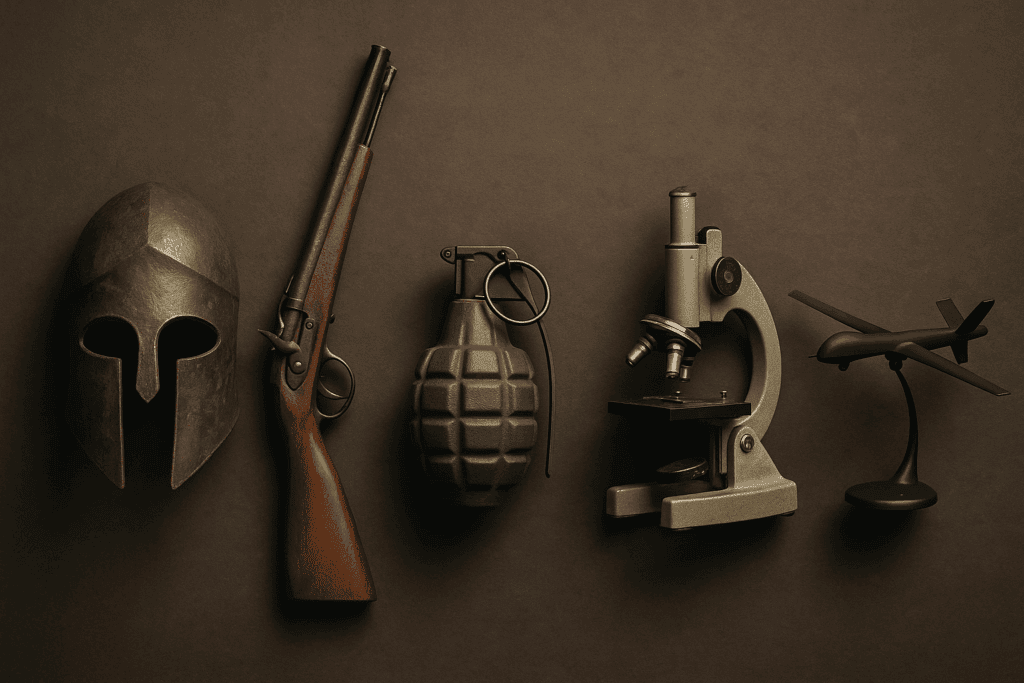
This milestone provides an opportunity not only to celebrate history but to reflect on the enduring principles of warfare. While weapons and technologies change—rifled muskets yielding to tanks, aircraft carriers, satellites, and cyber systems—the fundamentals of military art remain. Wars are still fought for objectives, still require unity of command, and still hinge on surprise, maneuver, and morale.
Understanding these principles matters for more than soldiers and strategists. Citizens of a democracy are the ultimate stewards of military power. By grasping how the armed forces think about warfare—across land, sea, air, space, and cyberspace—citizens can better appreciate both the costs of conflict and the responsibility of wielding force in the modern world.
This guide begins with the classic foundations of warfare, then examines how each branch of the U.S. military applies those principles in its own domain. It considers the evolution of infantry, armor, artillery, naval power, air and space dominance, and the new frontier of cyber warfare. Finally, it looks ahead to the future of conflict, where enduring principles will collide with disruptive technologies and changing global conditions.
Part I: The Foundations of Warfare
1. Historical Roots
Warfare has been studied for as long as humans have fought. Great thinkers have tried to distill the chaos of battle into principles that can guide commanders:
- Sun Tzu (The Art of War, c. 5th century BCE): Emphasized deception, intelligence, and winning without fighting. His aphorisms—“Know your enemy and know yourself”—remain foundational.
- Carl von Clausewitz (On War, 1832): Stressed the political nature of war, calling it “the continuation of politics by other means.” He highlighted friction, fog of war, and the primacy of morale.
- Antoine-Henri Jomini (19th century): Advocated systematic principles of maneuver and concentration of force.
- Sir David Dundas (Principles of Military Movements, 1795): Shaped 18th-century linear tactics, where disciplined ranks of infantry maneuvered and fired in unison.
The United States inherited these traditions, blending European theory with the practical experience of frontier warfare, civil conflict, and later, global operations.
2. The Nine Principles of War (U.S. Army Doctrine)
Codified in U.S. Army doctrine, the Nine Principles of War remain the cornerstone of military education and planning. They are not rigid formulas but guiding truths, flexible enough to apply from small-unit tactics to national strategy.
- Objective – Direct every military operation toward a clearly defined, decisive, and attainable goal.
- Offensive – Seize, retain, and exploit the initiative.
- Mass – Concentrate combat power at the decisive place and time.
- Economy of Force – Allocate minimum essential combat power to secondary efforts.
- Maneuver – Place the enemy in a position of disadvantage through flexible application of combat power.
- Unity of Command – Ensure unity of effort under one responsible commander.
- Security – Never permit the enemy to acquire unexpected advantage.
- Surprise – Strike the enemy at a time, place, or in a manner for which they are unprepared.
- Simplicity – Prepare clear, uncomplicated plans and concise orders.
3. Enduring Relevance
Despite centuries of technological change, these principles endure. In the age of muskets, they guided Washington’s Continentals; in the nuclear age, they guide joint commanders managing satellites, stealth aircraft, and cyber defense. Even as artificial intelligence and robotics reshape warfare, commanders still ask the same essential questions:
- What is the objective?
- How can we surprise the enemy?
- How do we mass our strengths against their weaknesses?
The principles of war endure because they reflect human nature—the limits of perception, the uncertainty of conflict, and the necessity of clarity, unity, and willpower.
Part II: The Infantry — The Core of Land Warfare
1. Role and Function
Infantry has always been the heart of land combat. Known as the “Queen of Battle,” infantry forces are tasked with the most fundamental—and dangerous—missions: closing with the enemy, seizing and holding ground, and fighting in environments where tanks, aircraft, or ships cannot operate.
From the Continental Army’s ragged lines at Bunker Hill in 1775 to modern mechanized brigades in Iraq and Afghanistan, infantry has represented both the Army’s backbone and the soldier’s most personal encounter with war.
2. Organization
Infantry structure is designed for flexibility and cohesion:
- Squad: 8–12 soldiers led by a sergeant. The smallest unit capable of fire and maneuver.
- Platoon: 3–4 squads, about 30–40 soldiers, led by a lieutenant.
- Company: 3–5 platoons, 100–200 soldiers, commanded by a captain.
- Battalion: 3–5 companies, 300–1,000 soldiers, commanded by a lieutenant colonel.
- Brigade/Regiment: 3–5 battalions, 3,000–5,000 soldiers, commanded by a colonel.
This structure allows small units to operate independently while scaling upward into larger formations.
3. Principles of Infantry Tactics
Infantry tactics have evolved, but their foundations remain consistent across centuries:
- Fire and Maneuver: One element lays down suppressive fire while another advances.
- Defensive Operations: Establishing strongpoints, using cover, and counterattacking.
- Ambush and Patrolling: Surprise, reconnaissance, and disrupting enemy supply lines.
- Urban Combat: Fighting in cities and villages, where close-quarters engagements and civilian presence complicate operations.
Historic doctrine, such as Sir David Dundas’ Principles of Military Movements (1795), emphasized strict drill and linear formations. Modern doctrine, by contrast, prioritizes dispersion, cover, and combined-arms integration.
4. The Infantry in Battle
The U.S. Army’s classic manual Infantry in Battle (1939) stressed the unpredictability of combat. Infantry leaders must balance doctrine with adaptability, improvising under the “fog of war.” Successful infantry action depends not just on weapons, but on morale, initiative, and the bond between soldiers.
5. Modern Developments
The infantry of the 21st century incorporates advanced technologies:
- Precision Weapons: From rifles to shoulder-fired missiles capable of defeating armored vehicles and aircraft.
- Robotics: Unmanned ground vehicles (UGVs) and drones providing reconnaissance, logistics, and fire support.
- Exoskeletons and Wearables: Enhancing soldier endurance and situational awareness.
- Networking: Digital systems link infantry to artillery, armor, air, and cyber assets in real time.
Yet despite these innovations, the essential truth remains: victory often depends on soldiers with rifles occupying ground. The infantry embodies the principle that war is ultimately fought not only with machines but with people.
Part III: Other Branches and Their Roles in Warfare
While infantry remains the core of land combat, modern warfare requires the integration of multiple arms and services. Each branch brings unique strengths, shaping how the principles of war are applied in practice.
1. Armor
- Role: Tanks and mechanized forces provide shock action, mobility, and protection.
- Function: Breakthrough enemy lines, exploit gaps, and support infantry in offensive and defensive operations.
- Historical Impact: From World War II’s Sherman tanks to the M1 Abrams, armor has defined decisive battles by massing power at critical points.
2. Artillery
- Role: Known as the “King of Battle.”
- Function: Deliver massed firepower, ranging from cannons and rocket artillery to precision-guided munitions.
- Principle Connection: Concentrates force (Mass) and creates conditions for maneuver.
- Modern Use: Integration of GPS-guided shells and long-range fires capable of striking deep into enemy territory.
3. Engineers
- Role: Provide mobility, survivability, and counter-mobility.
- Tasks: Construct bridges, clear minefields, build fortifications, and demolish obstacles.
- Strategic Importance: Enable maneuver and protect forces, embodying the principle of Security.
4. Cavalry and Reconnaissance
- Traditional Role: Mounted units providing speed, scouting, and shock.
- Modern Role: Armored and aerial reconnaissance units gather intelligence, screen movements, and disrupt enemy plans.
- Connection to Principles: Reconnaissance directly supports Surprise and Security.
5. Navy
- Role: Control of the seas, power projection, and protection of commerce.
- Core Assets: Aircraft carriers, submarines, destroyers, and amphibious ships.
- Operational Reach: Navy fleets ensure access to global chokepoints and secure supply lines.
- Principle Connection: Offensive action, maneuver, and surprise through mobility across oceans.
6. Marine Corps
- Role: Rapid-response expeditionary force.
- Mission: Seizing and holding beachheads, projecting force from sea to land.
- Specialization: Amphibious operations and integration with the Navy.
- Culture: Known for speed, adaptability, and esprit de corps.
7. Air Force
- Role: Control of the skies and rapid global mobility.
- Functions: Air superiority, strategic bombing, airlift, and intelligence.
- Key Assets: Stealth fighters, bombers, transport aircraft, and drones.
- Principle Connection: Mass and maneuver applied through precision and speed.
8. Space Force
- Role: Security in the orbital domain.
- Missions: Satellite operations, missile warning, global communications, and navigation (GPS).
- Strategic Value: Modern warfare depends on space-based systems; their loss would cripple command and control.
- Principle Connection: Security and unity of effort across all domains.
9. Cyber Command
- Role: Conducts operations in cyberspace.
- Offensive Missions: Disrupt enemy communications, infrastructure, and propaganda.
- Defensive Missions: Protect U.S. military and civilian networks from attack.
- Strategic Significance: Cyber operations blur peace and war, allowing strikes without physical battle.
- Principle Connection: Surprise and economy of force, as small teams can achieve strategic effects.
Part IV: Principles of Joint and Combined Warfare
Modern conflicts are rarely won by one branch of the military acting alone. The complexity of today’s security environment demands that the principles of warfare be applied through integration—both across the U.S. armed services (joint warfare) and with allies and partners (combined warfare).
1. Unity of Command
The principle of unity of command lies at the heart of joint operations. By ensuring a single commander is responsible for a mission, the U.S. military prevents fragmentation of effort. Unified Combatant Commands (COCOMs), such as CENTCOM in the Middle East or INDOPACOM in the Pacific, exemplify this principle: they bring together Army, Navy, Air Force, Marine Corps, Space Force, and Cyber units under one headquarters.
2. Integration of Domains
- Land, Sea, Air, Space, and Cyber are no longer separate battlefields—they form a single, interconnected operational space.
- An infantry battalion may rely on drones for reconnaissance, artillery for fire support, naval vessels for logistics, space-based GPS for navigation, and cyber defense to protect communications.
- Success depends on seamless integration across domains, with each service amplifying the strengths of the others.
3. Coalition Operations
The U.S. rarely fights alone. Alliances such as NATO, partnerships in the Indo-Pacific, and ad hoc coalitions for counterterrorism embody the principle of unity of effort across nations.
- Advantages: Shared resources, global legitimacy, interoperability of forces.
- Challenges: Differing rules of engagement, political will, and technological standards.
- Example: NATO operations in Afghanistan required coordination among dozens of nations with varying capabilities and caveats.
4. Asymmetric and Hybrid Warfare
Not all adversaries fight conventionally. Modern warfare increasingly involves asymmetric and hybrid tactics:
- Insurgencies and Guerrilla Warfare: Enemies avoid direct battle, using ambushes and improvised explosives.
- Terrorism: Small groups inflict strategic damage by targeting civilians or infrastructure.
- Hybrid Tactics: Blending conventional force with cyberattacks, propaganda, and proxy militias (as seen in Ukraine).
In such conflicts, traditional principles—mass, maneuver, security, and surprise—are adapted to counter irregular threats while minimizing harm to civilians.
5. The Information Dimension
- Modern wars are fought as much in the information space as on battlefields.
- Control of narrative, psychological influence, and rapid communication shape outcomes.
- This makes simplicity and clarity of message as important as clarity of orders on the battlefield.
6. Case Study: The Gulf War (1991)
Operation Desert Storm showcased the power of joint and combined warfare:
- Army and Marine Corps forces advanced on the ground.
- Air Force and Navy aircraft achieved air superiority and precision strikes.
- Naval forces secured sea lanes and launched Tomahawk cruise missiles.
- Coalition partners added legitimacy and global support.
- The unity of command under U.S. Central Command ensured coherence.
This campaign reflected nearly all the classic principles of war in a modern, integrated setting.
Part V: Ethics, Law, and the Human Dimension
War is more than a clash of weapons and strategies—it is a profoundly human experience. Every application of military power raises questions of ethics, law, and responsibility. The principles of warfare may guide commanders, but it is law and conscience that shape how those principles are carried out.
1. Rules of Engagement (ROE)
- ROE are directives that define when and how force may be used.
- They are designed to balance military necessity with protection of civilians.
- ROE vary depending on the mission—combat operations, peacekeeping, or humanitarian assistance—but always aim to keep actions within legal and ethical bounds.
2. Law of Armed Conflict
- The U.S. military operates under the Uniform Code of Military Justice (UCMJ) and international agreements such as the Geneva Conventions.
- Principles include:
- Distinction: Differentiating between combatants and civilians.
- Proportionality: Using only the level of force necessary to achieve a military objective.
- Humane Treatment: For prisoners of war and noncombatants.
- Distinction: Differentiating between combatants and civilians.
3. The Soldier’s Burden
Behind every principle of war stands the human being who must enact it.
- Courage and Fear: Combat requires facing mortal danger while remaining effective.
- Fatigue and Sacrifice: Long deployments, separation from family, and physical strain test endurance.
- Moral Choice: Soldiers must make life-or-death decisions in seconds, often with incomplete information.
As the Army celebrates its 250th birthday, the stories of countless soldiers remind us that the principles of war are lived out by individuals who carry both physical and moral weight.
4. Technology and Responsibility
Emerging technologies create new ethical dilemmas:
- Drones and Remote Warfare: Do they make war too easy, lowering the threshold for conflict?
- Autonomous Weapons: Should machines ever be trusted with lethal decisions?
- Cyber Warfare: Attacks on infrastructure could harm civilians as surely as bombs.
Technology may change the tools, but it does not remove the responsibility of leaders and citizens to ensure war remains subject to human judgment and moral restraint.
5. Accountability and Oversight
- Civilian Control: Elected leaders must guide and restrain military force.
- Military Justice: Courts-martial and investigative bodies enforce discipline and punish misconduct.
- Public Awareness: In a democracy, citizens must remain engaged, holding leaders accountable for how war is waged in their name.
Part VI: The Future of Warfare
As the U.S. Army celebrates its 250th birthday in 2025, the military stands at a crossroads. Warfare is evolving rapidly, shaped by new technologies, geopolitical rivalries, and global challenges. Yet even in this shifting landscape, the time-tested principles of war remain a compass for commanders and citizens alike.
1. Great Power Competition
- China: Expanding its navy, building artificial islands in the South China Sea, developing hypersonic weapons, and competing in space.
- Russia: Using hybrid warfare in Ukraine—combining conventional force with cyber, propaganda, and proxy militias—while maintaining a vast nuclear arsenal.
- Allies and Partnerships: NATO, AUKUS (Australia–UK–U.S.), and Indo-Pacific coalitions will shape the balance of power.
These rivalries make principles like unity of command, security, and surprise more relevant than ever.
2. Hybrid and Asymmetric Threats
Future wars may not follow the traditional mold. Instead, adversaries will mix:
- Cyberattacks: Disrupting power grids, financial systems, and communications.
- Information Warfare: Manipulating public opinion and elections.
- Terrorism and Insurgency: Persisting in fragile states.
- Proxy Conflicts: Powerful nations using smaller groups to fight indirectly.
In such wars, simplicity and clarity of mission become essential amid confusion and disinformation.
3. Emerging Technologies
- Artificial Intelligence (AI): Supporting decision-making, logistics, and intelligence.
- Autonomous Systems: Drone swarms and robotic vehicles could change how battles are fought.
- Hypersonic Missiles: Traveling at over five times the speed of sound, they reduce reaction time and challenge missile defense.
- Quantum Computing: May revolutionize encryption, intelligence, and secure communications.
- Biotechnology: Potential applications in medicine, resilience, and—more dangerously—in weapons.
These innovations promise to alter tactics and strategies, but the principle of economy of force will remain: using the right tool at the right time.
4. Climate and Humanitarian Security
- Climate Change: Rising seas, droughts, and storms could fuel instability, resource competition, and migration.
- Arctic Competition: Melting ice opens new trade routes and strategic areas contested by Russia, China, and NATO.
- Disaster Relief: Increasingly, militaries will be called on for humanitarian aid, not just combat.
Here, the principle of objective ensures that missions remain focused—whether saving lives or securing resources.
5. The Human Factor Endures
Even as machines take on more tasks, warfare remains a human endeavor. Decisions of courage, leadership, and morality cannot be automated. Soldiers, sailors, airmen, Marines, Guardians, and Coast Guardsmen will continue to embody the principles of unity, security, and initiative.
6. The Enduring Compass
The future battlefield may be faster, more complex, and more dangerous—but the principles of warfare endure because they reflect enduring truths:
- The need for clarity of purpose.
- The value of initiative and maneuver.
- The importance of unity, security, and morale.
On its 250th birthday, the U.S. Army—and the wider U.S. military—reminds us that while technology transforms the means of war, it does not erase its principles. The challenge for citizens and leaders alike is to ensure those principles guide us wisely into an uncertain future.
Conclusion
From the disciplined ranks of the Continental Army in 1775 to today’s globally integrated joint force, the U.S. military has grown in size, sophistication, and reach. Yet across two and a half centuries, one truth remains: warfare is governed not only by weapons and technology, but by enduring principles.
The principles of warfare—objective, offensive, mass, economy of force, maneuver, unity of command, security, surprise, and simplicity—have guided generations of soldiers, sailors, airmen, Marines, Guardians, and Coast Guardsmen. They have shaped victories, exposed failures, and provided a compass amid the fog of war.
As new domains emerge—space, cyberspace, and the information environment—the challenge for the 21st century is to apply these timeless principles wisely, adapting them to technologies and conflicts that the founders of the Army could scarcely have imagined.
The Army’s 250th birthday is not only a commemoration of past battles fought, but a reminder of the responsibilities of citizenship. In a democracy, military power belongs not to generals or politicians alone, but to the people. To wield it wisely, citizens must understand both its principles and its limits.
The future of warfare will test our ingenuity and our ethics. But as long as we remember that war is ultimately a human endeavor—bound by law, shaped by conscience, and guided by principles—we will remain prepared not only to fight, but to seek peace with strength and wisdom.