
What Would a Zen Renaissance Look Like?
Like the European Renaissance, it would not be a return to the past. It would be a creative rebirth.
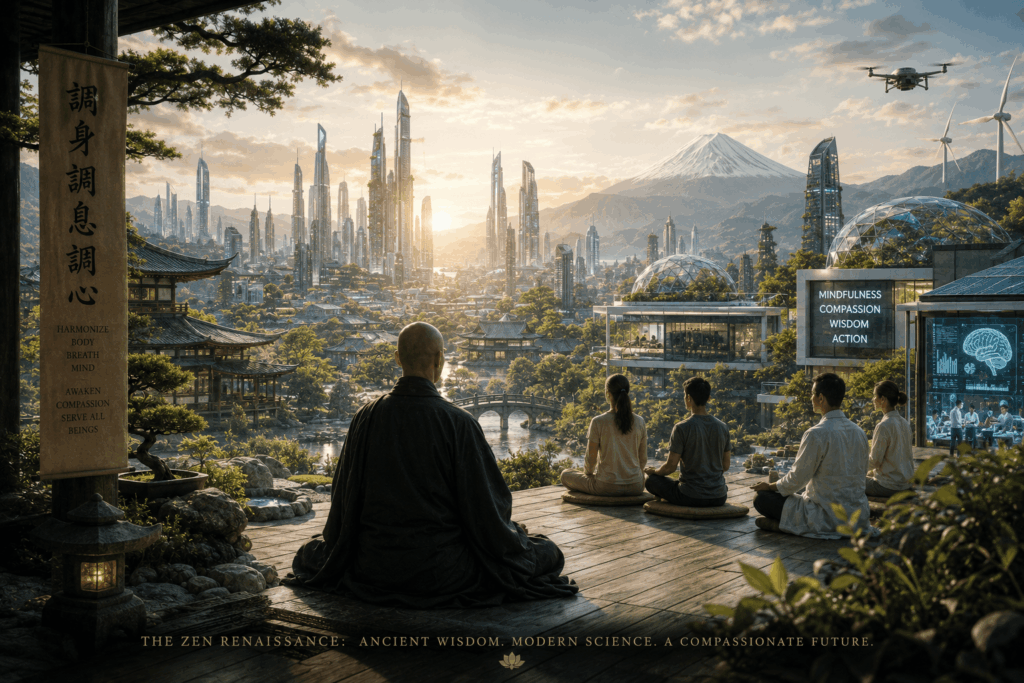
A true global Zen Renaissance would not simply be a growth in the number of Zen centers or meditation practitioners. It would represent a civilizational shift in which the essential insights of Zen—direct experience, contemplative discipline, simplicity, interdependence, and compassionate action—become integrated into education, healthcare, science, technology, governance, and daily life.
The average person would not necessarily identify as Buddhist. Many might never enter a Zen temple. Yet Zen principles would increasingly influence society.
Mindfulness and contemplative training would become normal parts of education.
Hospitals would employ meditation specialists alongside physicians and psychologists.
Scientific research on attention, well-being, consciousness, and compassion would continue expanding.
Workplaces would increasingly value focus, clarity, and emotional regulation rather than constant distraction.
Technology would be designed to support human flourishing rather than addiction.
People would spend less time reacting and more time observing. Less time being consumers and more time being creators and cultivators. The result would not be a “Zen society” in a religious sense. It would be a more reflective society.
The Rebirth of Monasticism
A Zen Renaissance would likely include a revival of monastic life. Not necessarily large medieval monasteries. Rather, new forms of contemplative communities.
Urban monasteries.
Rural retreat centers.
Scientific monasteries.
Digital monasteries.
Communities where people devote significant portions of their lives to meditation, study, service, and environmental stewardship.
Some would be traditional Buddhist institutions.
Others would be secular.
The distinction would become less important than the quality of practice.
Science and Zen
One of the most distinctive features of a future Zen Renaissance would be the partnership between contemplative practice and science.
Historically, Zen developed through disciplined observation of the mind.
Science developed through disciplined observation of nature.
Both traditions value direct investigation over unquestioned belief.
Future neuroscientists may spend time in meditation retreats. Zen teachers may study cognitive science. Universities may establish contemplative research institutes.
Questions concerning consciousness, attention, perception, and human flourishing would increasingly be explored through both first-person and third-person methods.
This is already beginning.
Education
The educational system would change profoundly.
Students would learn:
- attention training
- emotional regulation
- mindfulness
- compassion practices
- critical thinking
- scientific reasoning
alongside mathematics, literature, and history.
The purpose of education would expand beyond economic productivity. It would include the cultivation of wisdom. Ancient monasteries once served as centers of learning. Future secular educational systems may rediscover some traditionally monastic functions.
Healthcare
A Zen Renaissance would transform healthcare.
Meditation would not replace medicine.
It would complement it.
Programs would increasingly address:
- stress
- chronic pain
- anxiety
- depression
- trauma
- end-of-life care
through evidence-based contemplative methods.
Hospitals could include meditation halls alongside chapels.
Patients would receive support not only for their diseases but for their relationship to suffering itself.
Architecture and Environment
Zen aesthetics would likely experience a revival.
Not as decoration. As a philosophy of space.
Buildings would emphasize:
- natural light
- simplicity
- sustainability
- silence
- beauty
- harmony with nature
Urban environments would include contemplative spaces just as they currently include parks and libraries.
The principles of the Zen garden might influence future ecological design.
Technology and Artificial Intelligence
A Zen Renaissance could emerge during the Age of Intelligence. This may prove decisive.
Human beings are increasingly surrounded by technologies designed to capture attention.
Zen offers methods for reclaiming attention.
The future challenge may not be access to information. It may be the ability to remain conscious amid information abundance.
Zen could become one of the most important disciplines for maintaining human agency in an AI-driven world.
Future AI systems might even serve as meditation instructors, contemplative companions, or educational assistants. Yet the central practice would remain human awareness itself.
How Would It Begin?
Most renaissances begin quietly.
The European Renaissance did not begin with a proclamation.
It began with scholars preserving texts, artists experimenting with new ideas, and communities rediscovering forgotten knowledge.
A Zen Renaissance would likely begin similarly.
Not through a single movement.
Not through a single teacher.
Not through a single organization.
It would emerge through many converging streams.
1. Scientific Validation
Growing research on meditation, well-being, and contemplative practices.
2. Social Need
Rising loneliness, anxiety, distraction, and polarization create demand for practices that cultivate stability and meaning.
3. Institutional Adoption
Schools, hospitals, universities, and workplaces increasingly incorporate contemplative methods.
4. Digital Dissemination
Meditation teachings become globally accessible through technology.
5. New Communities
Fresh forms of lay and monastic communities emerge that are adapted to modern life.
The Role of Science Abbey
Science Abbey represents one possible model for such a Renaissance.
Historically, monasteries preserved learning during periods of social change. A modern scientific monastery would preserve and advance:
- science
- philosophy
- ethics
- meditation
- civic responsibility
while remaining open to people of many backgrounds. In this vision, Zen is not only a religious tradition. It becomes one component of a broader culture of human flourishing.
The Future
A global Zen Renaissance would not create a world of monks. Nor would it create a world of Buddhists. It would create a world in which more people possess the ability to pause, observe, reflect, and respond wisely.
The ultimate achievement of such a renaissance would not be the construction of temples. It would be the cultivation of human beings who are calmer, wiser, more compassionate, and more capable of living consciously in an increasingly complex world.
In that sense, the future of Zen may not lie in returning to the past. It may lie in helping humanity learn how to remain fully human, even in the most uncertain of times.
About the Author
D. B. Smith is a writer, historian, Zen practitioner, and the Founder of Science Abbey. His work explores the intersection of Buddhism, science, philosophy, ethics, and contemplative practice, with a particular interest in making traditional wisdom accessible to modern readers.
Smith has spent decades studying religious traditions, history, philosophy, and human development. His Buddhist training began in the Korean Soen (Zen) tradition, where he received the Dharma name Wu Yi (Mui), “Depends on Nothing,” in 2004. He later became a practitioner of Soto Zen and has remained committed to the study and practice of meditation, mindfulness, and Buddhist ethics.
In addition to his Buddhist studies, Smith has worked as a librarian, archivist, curator, educator, and historian.
Through Science Abbey, Smith promotes a vision of Integrated Humanism that seeks to unite scientific inquiry, ethical responsibility, contemplative practice, and lifelong learning. His writings range from Buddhist translations and commentaries to works on history, science, education, civic responsibility, and human flourishing.