

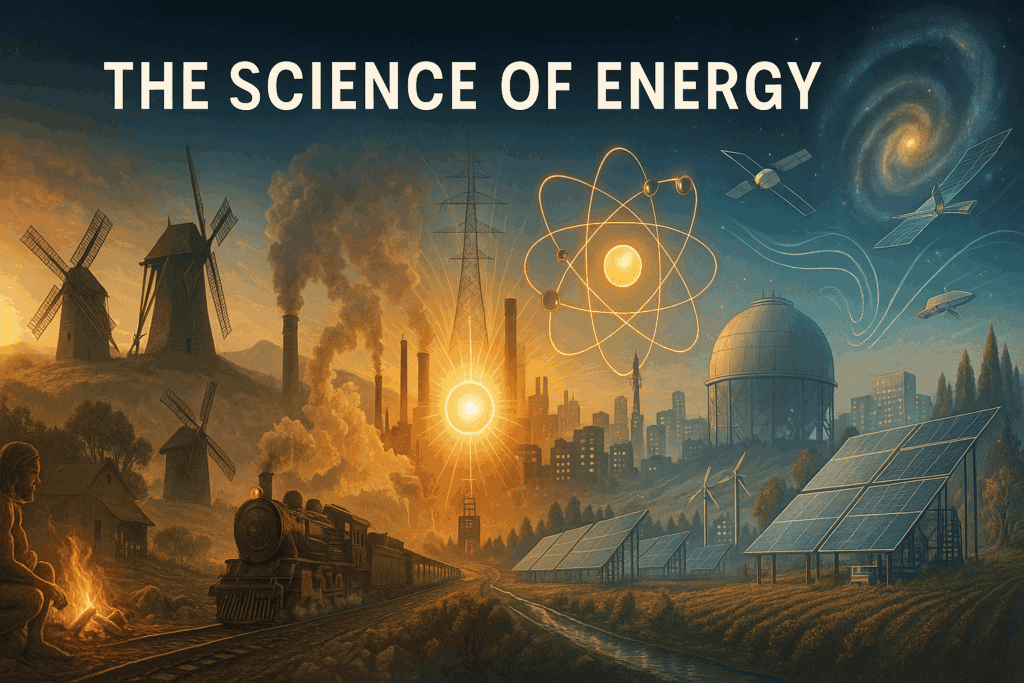
Table of Contents
- Introduction
Why energy matters; the role of energy in nature, civilization, and the future - Core Concepts and Definitions
Energy, work, power, thermodynamics, conservation, and efficiency - The Evolution of Energy Use
From muscle and fire to steam, fossil fuels, and the industrial revolution - Categories of Energy Forms
A comprehensive breakdown of all known forms of energy:
- 4.1 Mechanical Energy
- 4.2 Thermal (Heat) Energy
- 4.3 Chemical Energy
- 4.4 Electrical Energy
- 4.5 Magnetism
- 4.6 Hydroelectric Energy
- 4.7 Solar Energy
- 4.8 Nuclear Energy
- 4.9 Batteries and Electrochemical Energy
- 4.10 Geothermal Energy
- 4.11 Tidal and Wave Energy
- 4.12 Sound and Vibrational Energy
- 4.13 Elastic and Potential Energy
- 4.14 Kinetic Energy
- 4.15 Radiant Energy
- 4.16 Plasma Energy
- 4.17 Quantum and Dark Energy
- 4.1 Mechanical Energy
- Energy Conversion and Storage
Transforming, storing, and transmitting energy across systems - The Global Energy System Today
Fossil fuels, renewables, energy access, climate, and infrastructure - The Future of Energy
Innovation, fusion, electrification, equity, and planetary resilience - The Human Meaning of Energy
Energy’s biological, historical, cultural, and moral significance - An Integrated Humanist Perspective
Ethics, science, equity, and a vision for sustainable global energy systems - Conclusion: From Fire to Future
A call to wisdom, responsibility, and collective transformation
1. Introduction
Energy is the lifeblood of the universe and the engine of civilization. It powers our bodies, fuels our machines, lights our cities, and animates the stars. From the crackling campfires of early humans to the fusion experiments of modern physics, the story of energy is the story of human development itself—a story of discovery, ingenuity, and transformation.
At its most basic, energy is the capacity to do work. But its implications ripple far beyond the textbook definition. Energy is what separates life from inertia, growth from decay, and progress from stagnation. It drives every natural process and every technological advance, from the tides and winds to the heartbeats of organisms and the hum of artificial intelligence.
Throughout history, the search for new energy sources has sparked revolutions—in agriculture, industry, transportation, and communication. Societies that mastered the dominant energy technologies of their time gained prosperity and power, while others fell behind. Yet each energy breakthrough has also carried consequences: pollution, war, inequality, and environmental strain.
Today, humanity stands at a turning point. As fossil fuels destabilize the climate and geopolitical tensions rise over energy control, we are forced to rethink our relationship with energy. The quest for cleaner, more sustainable, and more democratic energy systems is no longer optional—it is existential.
This article explores the full landscape of energy: what it is, how it works, where it comes from, and where it is taking us. We will examine every major form of energy—past, present, and future—from muscle and fire to solar panels and nuclear reactors. Along the way, we will trace the evolution of energy use, the science behind energy transformations, and the moral questions that shape energy policy in a globalized world.
In understanding energy, we come to understand not just the mechanics of the universe, but the choices that will define the future of life on Earth. Let us begin with the fundamentals.
2. Core Concepts and Definitions
Before we explore the various forms and histories of energy, we must first understand the foundational concepts that define it. Energy is one of the most fundamental and universal ideas in science—yet it can be surprisingly abstract without clear explanation. This section outlines the essential definitions and principles at the heart of energy science.
2.1 What Is Energy?
Energy is defined as the capacity to do work or produce change. It is a conserved quantity, meaning it can be transformed from one form to another but cannot be created or destroyed. All physical, chemical, and biological processes involve energy in some form.
- SI unit: Joule (J)
- Other units: kilowatt-hour (kWh), calorie, electronvolt (eV), British thermal unit (BTU)
There are many forms of energy—such as thermal, kinetic, potential, chemical, nuclear, and electromagnetic—each representing energy stored or expressed in different ways.
2.2 What Is Work?
Work is the transfer of energy through force and movement. It is done when a force causes an object to move in the direction of that force.
- Formula:
Work=Force×Distance\text{Work} = \text{Force} \times \text{Distance} - Example: Lifting a box requires work because a force (your muscles) moves the object a certain distance upward.
Work and energy are measured in the same unit—joules—because they are essentially two sides of the same physical process.
2.3 What Is Power?
Power is the rate at which work is done or energy is transferred.
- Formula:
Power=WorkTime\text{Power} = \frac{\text{Work}}{\text{Time}} - SI unit: Watt (W)
1 watt = 1 joule per second
In practical terms, power tells us how quickly energy is being used or produced. A 100-watt light bulb consumes energy more quickly than a 60-watt bulb.
2.4 The Law of Conservation of Energy
One of the most fundamental laws in physics, the law of conservation of energy states:
Energy cannot be created or destroyed, only transformed from one form to another.
This means that in a closed system, the total amount of energy remains constant, though it may change form—from motion to heat, from light to electricity, and so on. This principle underlies all of thermodynamics and modern energy science.
2.5 Other Key Terms
- Efficiency: The ratio of useful energy output to total energy input. No process is 100% efficient—some energy is always lost as heat or waste.
- Entropy: A measure of disorder in a system. In energy systems, entropy tends to increase, meaning energy spreads out and becomes less useful over time unless work is done to concentrate it again.
- Heat: A form of energy associated with the motion of atoms and molecules. Heat flows spontaneously from hotter to colder bodies.
- Energy Storage: Technologies and methods (like batteries, flywheels, pumped hydro) used to retain energy for future use.
- Energy Transmission: The process of moving energy (often electricity) from its source to where it is needed—e.g., through power lines or pipelines.
With these basic principles in mind, we can now turn to the historical journey of energy—beginning with humanity’s earliest sources of power.
3. The Evolution of Energy Use
The story of energy is inseparable from the story of civilization. As human societies evolved, so did their ability to harness and transform energy—first from their own bodies, then from nature, and finally from the atom and the stars. This section traces the major phases of energy development in human history, from the earliest uses of fire to the industrial revolutions and beyond.
3.1 Prehistoric and Ancient Energy
Human and Animal Muscle Power
For tens of thousands of years, the only available energy came from the muscles of humans and animals. Early humans burned calories—chemical energy from food—to hunt, gather, build, and survive. Domestication of animals extended human capability by providing mobile and renewable labor power.
- Examples: Carrying loads, pulling carts, grinding grain, plowing fields
Fire and Combustion
The controlled use of fire marked one of the earliest energy revolutions. Fire provided warmth, protection, light, and the ability to cook food—transforming nutrition and society. Later, it became central to metalworking and pottery.
- Sources: Wood, animal fat, dried dung
- Applications: Cooking, heat, ritual, metallurgy
Simple Mechanical Tools
Leveraging gravity and friction, ancient civilizations invented tools to redirect and amplify human energy: wheels, levers, pulleys, screws. These devices laid the groundwork for more complex mechanical energy systems.
- Examples: Irrigation pumps, siege engines, weights and counterweights in temples
3.2 Pre-Industrial Mechanical Energy
Water Power
By 200 BCE, water wheels were used to grind grain and power machines in Rome, China, and the Islamic world. Flowing water provided renewable mechanical energy by turning wheels and cranks.
- Applications: Mills, hammers, bellows, textile machinery
- Legacy: Proto-industrialization in medieval Europe and the Islamic Golden Age
Wind Power
Windmills emerged in Persia and China by the 7th century CE and spread to Europe. They converted wind’s kinetic energy into mechanical motion for milling and irrigation.
- Applications: Pumping water, grinding grain, powering ships (sails)
- Limitations: Intermittent and location-dependent
Charcoal and Early Heat Chemistry
Charcoal, produced by slow-burning wood in low oxygen, became vital for metallurgy. Ancient Indian, Chinese, and Mediterranean civilizations used it to smelt copper, tin, iron, and steel.
- Applications: Blacksmithing, weapon-making, art
- Environmental cost: Deforestation
3.3 The Industrial Revolution
Coal and the Steam Engine
The 18th century marked a seismic shift: coal-powered steam engines mechanized production, transport, and warfare. James Watt’s improvements to the steam engine unlocked previously unimaginable power.
- Transformations: Factories, trains, steamships, mechanized labor
- Scientific breakthroughs: Thermodynamics, engine efficiency
Fossil Fuel Dominance
Coal was followed by oil and natural gas. The 19th and 20th centuries saw fossil fuels power an explosive rise in industrial output, urbanization, and global connectivity—but also pollution and climate instability.
- Applications: Electricity generation, automobiles, aviation, plastics
- Consequences: CO₂ emissions, geopolitical conflict
As this section shows, human civilization has been shaped by energy revolutions—each unlocking new possibilities while introducing new challenges. The next sections will categorize and explain the full spectrum of energy forms used across history and science, from ancient muscle to atomic nuclei and future quantum fields.
4.1 Mechanical Energy
Mechanical energy is the energy associated with motion and position. It is the form of energy most familiar to us in everyday life—visible in spinning wheels, swinging pendulums, moving vehicles, and falling objects. It can be divided into two primary types: kinetic energy and potential energy.
Kinetic Energy
Kinetic energy is the energy of motion. Any object in motion—whether a speeding bullet, a flowing river, or a spinning turbine—possesses kinetic energy proportional to its mass and the square of its velocity.
- Formula:
KE=12mv2KE = \frac{1}{2}mv^2
where m is mass and v is velocity - Examples of Use:
- Moving vehicles (cars, trains, planes)
- Wind and water flow (used in windmills and hydro turbines)
- Machinery and tools
- Sports and biomechanics
- Moving vehicles (cars, trains, planes)
Kinetic energy can be converted into other forms such as electrical energy (in generators), heat (from friction), or stored potential energy (as in spring compression).
Potential Energy
Potential energy is stored energy due to an object’s position, configuration, or condition. It has the potential to be converted into kinetic energy when released.
- Types:
- Gravitational Potential Energy: Stored when an object is elevated
PE=mghPE = mgh (mass × gravity × height) - Elastic Potential Energy: Stored in stretched or compressed materials (springs, rubber bands, bows)
- Mechanical Potential Energy: Stored in systems under tension (catapults, suspended weights)
- Gravitational Potential Energy: Stored when an object is elevated
- Examples of Use:
- Hydropower dams (elevated water released to turn turbines)
- Clocks (weights falling to power gears)
- Archery and crossbows (elastic tension)
- Trampolines and shock absorbers
- Hydropower dams (elevated water released to turn turbines)
Elastic Energy
This is a subtype of potential energy specific to deformable systems. When elastic materials like rubber, steel springs, or tendons are stretched or compressed, they store mechanical energy.
- Examples of Use:
- Springs in mechanical clocks and toys
- Trampolines, slingshots
- Suspension systems in vehicles
- Athletic gear and prosthetics
- Biological systems (e.g., tendon recoil in kangaroo legs)
- Springs in mechanical clocks and toys
Applications and Conversions
Mechanical energy often serves as the first link in a chain of energy transformations:
- In hydropower, gravitational potential energy becomes kinetic as water falls, and then spins turbines to produce electricity.
- In engines, combustion produces expanding gases (thermal energy) that push pistons (mechanical motion).
- In generators, mechanical motion is used to induce electromagnetic fields, generating electricity.
Mechanical energy is also foundational to engineering, construction, transportation, and biomechanics.
Efficiency and Losses
Although mechanical systems can be highly efficient, friction and air resistance often convert useful energy into waste heat. Understanding these losses led to innovations such as lubrication, aerodynamic design, and regenerative braking.
With mechanical energy explored, we now turn to a more chaotic but equally fundamental form: thermal energy, or the energy of heat.
4.2 Thermal (Heat) Energy
Thermal energy is the internal energy of a system due to the random motion of its atoms and molecules. It manifests as heat—the flow of energy from a warmer object to a cooler one. It plays a central role in natural systems, industrial processes, and everyday life.
What Is Thermal Energy?
At the atomic level, all matter is in motion. Even solid objects have vibrating atoms. The faster these particles move, the more thermal energy the substance contains. This energy is invisible, but we feel it as heat or observe its effects—such as expansion, melting, or combustion.
- Measured in: Joules (energy) or degrees (temperature is a related measure)
- Direction: Always flows from hotter to colder bodies until equilibrium is reached
Sources of Thermal Energy
1. Combustion
- The burning of fuels (wood, coal, gas, oil) in oxygen produces heat.
- This was the earliest and most transformative human use of thermal energy.
2. Solar Radiation
- Sunlight warms the Earth’s surface, oceans, and atmosphere.
- Passive solar heating (e.g., greenhouses) and active systems (solar thermal plants) use this directly.
3. Geothermal Heat
- Heat stored within the Earth from radioactive decay and residual planetary formation.
- Tapped via hot springs, geothermal wells, or magma reservoirs.
4. Friction and Resistance
- Mechanical motion (rubbing, braking) and electrical resistance generate heat.
- Often considered waste heat, though recoverable in some systems.
Historical Applications
- Fire: The earliest tool for warmth, cooking, protection, and metallurgy.
- Smelting and Blacksmithing: Transforming metals from ore.
- Bathhouses and Hypocausts: Roman underfloor heating.
- Baking and Ceramics: Cultural and economic importance in all ancient civilizations.
Industrial Applications
Steam Engines
- Heated water becomes steam, which expands and pushes pistons or turns turbines.
- Sparked the Industrial Revolution, replacing animal and water power.
Heat Engines and Turbines
- Convert thermal energy into mechanical motion.
- Power plants burn coal, gas, or oil to produce steam and spin turbines for electricity.
Refrigeration and Heat Pumps
- Use cycles of evaporation and compression to remove or transfer heat.
- Foundation of modern cooling and HVAC systems.
Modern and Emerging Uses
- Geothermal plants: Tapping subterranean heat to run turbines or heat homes.
- Solar thermal plants: Concentrated sunlight heats fluids to produce steam.
- Waste heat recovery: Capturing lost heat from engines or factories to generate more energy.
Efficiency and Limits
Thermal systems are governed by the laws of thermodynamics:
- First Law: Energy is conserved.
- Second Law: Heat cannot flow spontaneously from cold to hot; some energy is always lost as disorder (entropy).
- As a result, heat engines have theoretical efficiency limits. No heat engine can be 100% efficient.
Thermal energy is the oldest form of power known to humanity, and it remains vital—yet often wasteful. As we strive toward efficiency and sustainability, how we capture and utilize heat remains a key challenge.
Next, we’ll explore the tightly bound, high-potential world of chemical energy, the invisible fuel of life and industry.
4.3 Chemical Energy
Chemical energy is the energy stored in the bonds of atoms and molecules. When these bonds are broken or rearranged during a chemical reaction, energy is released or absorbed. This form of energy powers both the living world and much of modern industry—from food metabolism to explosions, from gasoline engines to batteries.
What Is Chemical Energy?
Chemical energy resides in the potential energy of molecular structures. It is released in exothermic reactions (like burning fuel) or absorbed in endothermic reactions (like photosynthesis). The key to unlocking this energy is the reconfiguration of atomic bonds.
- Unit: Joules (J) or kilojoules/mole (kJ/mol) in chemistry
- Nature: Stored energy, released only through chemical transformation
Natural and Biological Examples
Cellular Respiration
- Living organisms extract chemical energy from food (glucose, fats) and convert it into ATP (adenosine triphosphate), the energy currency of cells.
- This process fuels all biological activity—from movement to thinking.
Photosynthesis
- Plants and some microorganisms absorb sunlight and store it as chemical energy in glucose molecules.
- Basis of the food chain: chemical energy from sunlight powers all life.
Industrial and Technological Uses
Combustion
- Fuels like wood, coal, oil, and gas release energy when oxidized (combined with oxygen).
- Historically used for fire, later for engines, stoves, furnaces, and turbines.
Batteries (Electrochemical Cells)
- Convert stored chemical energy into electricity via redox (reduction–oxidation) reactions.
- Primary batteries: single-use (alkaline, lithium)
- Secondary batteries: rechargeable (lead-acid, lithium-ion)
Explosives
- Chemical reactions that release energy extremely rapidly.
- Applications: mining, demolition, weaponry, space propulsion
Industrial Chemistry
- Synthetic processes harness chemical energy transformations: plastics, fertilizers, pharmaceuticals, fuels.
Examples of Chemical Fuels
| Fuel Type | Source | Use |
| Wood | Biomass | Heating, cooking, charcoal |
| Coal | Fossilized plant matter | Electricity, metallurgy |
| Petroleum | Fossil hydrocarbon | Gasoline, diesel, plastics |
| Natural Gas | Fossil methane | Cooking, heating, power plants |
| Biofuels | Ethanol, biodiesel | Renewable transport fuels |
| Hydrogen | Water electrolysis/fuel | Clean fuel in fuel cells, rockets |
Energy Density and Advantages
- High energy density: Many chemical fuels pack large amounts of energy in small volumes.
- Portable: Easy to transport and store (especially liquids like gasoline).
- Controllable: Energy release can be precise or explosive, depending on application.
Limitations and Environmental Impact
- Pollution: Burning fossil fuels releases CO₂, NOₓ, and particulates, contributing to climate change and air pollution.
- Finite Resources: Most fossil fuels are non-renewable.
- Waste: Battery disposal, chemical runoff, and synthetic byproducts pose environmental challenges.
Innovations and Future Directions
- Green Chemistry: Designing chemical processes that minimize harm.
- Bioengineering: Creating high-efficiency biofuels and synthetic enzymes.
- Hydrogen Economy: Using hydrogen as a clean, abundant energy carrier.
- Solid-State Batteries: Safer, denser, longer-lasting battery technologies.
Chemical energy is a cornerstone of life and industry. From firelight to lithium cells, it has powered humanity’s greatest leaps—and its most urgent environmental crises. The challenge ahead is to harness this form of energy more wisely and sustainably.
Up next, we’ll examine Electrical Energy, the most flexible and widely distributed form of modern power.
4.4 Electrical Energy
Electrical energy is the energy of moving electric charges—one of the most versatile and widely used forms of energy in the modern world. It flows through wires, powers cities, drives digital technology, and connects the global economy. Unlike chemical or thermal energy, electrical energy is easily transmitted over long distances and instantly converted into other forms of energy.
What Is Electrical Energy?
Electrical energy arises from the movement of electrons in a conductor or from the accumulation of charge. In physics, electricity is fundamentally an expression of electromagnetic force—one of the four fundamental forces of nature.
- Current (I): Flow of electric charge, measured in amperes (A)
- Voltage (V): Electric potential difference, measured in volts (V)
- Power:
P=VIP = VI
Power (watts) equals voltage times current
Generation of Electricity
Electricity is not a primary energy source—it must be generated from other energy forms:
1. Mechanical Generation
- Turbines (spun by steam, water, or wind) rotate magnets within coils to induce current.
- Examples: Hydropower plants, wind farms, steam turbines
2. Chemical Generation
- Batteries and fuel cells create electricity via redox (electrochemical) reactions.
3. Photovoltaic Generation
- Solar panels convert light (photons) directly into electricity using semiconductors (e.g., silicon).
4. Thermoelectric Devices
- Convert temperature differences into electrical voltage (used in some spacecraft, sensors).
Key Applications of Electrical Energy
Lighting
- From incandescent bulbs to LEDs, electricity revolutionized human activity after dark.
Motors
- Electric motors convert electricity into mechanical motion.
- Used in appliances, vehicles, elevators, fans, tools, and robots.
Information Technology
- Powers all digital systems: computers, smartphones, networks, AI infrastructure.
Urban Infrastructure
- Water pumps, HVAC systems, mass transit, street lighting—all depend on reliable electricity.
Electric Vehicles
- EVs convert stored battery power into motion, dramatically reducing emissions from transport.
Storage and Transmission
- Batteries: Store electricity for mobile or off-grid use.
- Capacitors: Temporarily store and release bursts of electrical energy.
- Grid Systems: High-voltage power lines carry electricity from centralized plants to distant consumers.
- Smart Grids: Use sensors and AI to optimize energy flow and reduce waste.
Advantages of Electricity
- Instantaneous: Travels near the speed of light.
- Clean at point of use: No emissions during consumption.
- Versatile: Can be transformed into light, heat, sound, motion, or data.
- Controllable: Switches, transformers, and digital systems allow precision.
Challenges and Future Directions
- Losses in Transmission: Long-distance transmission leads to energy loss as heat.
- Storage Limitations: Grid-scale battery solutions are improving but remain costly and complex.
- Generation Sources: Sustainability depends on whether electricity is generated from fossil fuels or renewables.
Innovation Areas:
- Superconductors (zero-resistance materials)
- Solid-state batteries and ultra-capacitors
- Wireless power transfer
- Decentralized microgrids and peer-to-peer energy sharing
Electrical energy is the backbone of modern life. Clean, efficient, and adaptive, it is central to the transition from fossil fuels to a sustainable energy future. But its power depends on how—and from what—it is generated.
Next, we’ll explore a subtler but intimately related force: magnetism.
4.5 Magnetism
Magnetism is a physical phenomenon arising from the motion of electric charges. Closely linked with electricity through the principles of electromagnetism, magnetism plays a vital role in many technologies that generate, store, and use energy—especially in motors, generators, and data systems.
What Is Magnetism?
At its core, magnetism is a force generated by moving charges—typically electrons orbiting atomic nuclei or spinning within atoms. Materials like iron, cobalt, and nickel have atomic structures that allow these tiny magnetic effects to align, producing a strong collective magnetic field.
There are two main types of magnetism in practical use:
- Permanent Magnetism: Natural or artificial magnets that maintain a stable magnetic field.
- Electromagnetism: Magnetic fields produced by electric currents; the basis for all electric motors and generators.
Electromagnetism and Maxwell’s Equations
James Clerk Maxwell unified electricity and magnetism into a single theoretical framework in the 19th century. His equations showed that:
A changing electric field creates a magnetic field, and a changing magnetic field induces an electric field.
This interaction is the basis for electromagnetic induction—how most of the world’s electricity is generated.
Applications of Magnetism
Motors
- Use magnetic fields to convert electrical energy into mechanical motion.
- Common in appliances, electric vehicles, robotics, fans, and pumps.
Generators and Dynamos
- Convert mechanical motion into electrical energy by rotating magnets near coils of wire.
- Fundamental to hydroelectric, wind, and fossil-fuel-based power plants.
Data Storage
- Magnetic materials store digital information in hard drives, credit cards, and tapes.
Magnetic Levitation (Maglev)
- Uses powerful magnets to lift and propel trains without friction.
- Enables ultra-fast, low-resistance transportation.
Medical Imaging
- MRI (Magnetic Resonance Imaging) uses strong magnetic fields and radio waves to image internal structures of the body.
Magnetic Materials
| Material | Magnetic Type | Examples/Uses |
| Iron, Cobalt | Ferromagnetic | Motors, transformers, MRI machines |
| Ferrites | Ceramic magnetic compounds | Antennas, wireless charging pads |
| Rare Earths | Neodymium, samarium | High-performance magnets for EVs, wind turbines, headphones |
Emerging Magnetic Technologies
- Spintronics: Exploits electron spin for ultra-fast memory and logic chips.
- Magnetic Refrigeration: Uses magnetic fields instead of gas compression for cooling.
- Superconducting Magnets: Enable high-intensity magnetic fields with no energy loss—crucial for fusion research and particle accelerators.
The Deep Connection with Energy
Magnetism is not just a curious force—it’s a key to energy transformation. Every time you plug in a device, start a car, or charge a battery, magnetic fields are likely involved. And as we move toward more sustainable energy systems, magnetism will remain a cornerstone of efficient motion, storage, and conversion.
Next, we’ll explore Hydroelectric Energy—a grand-scale application of gravity, motion, and water.
4.6 Hydroelectric Energy
Hydroelectric energy is the conversion of the kinetic and potential energy of moving water into electricity. It is one of the oldest and most widely used forms of renewable energy on Earth, drawing upon the natural water cycle powered by solar radiation and gravity.
What Is Hydroelectric Energy?
Hydroelectric power uses flowing or falling water to spin turbines connected to generators. As water moves from higher to lower elevations, its gravitational potential energy is transformed into kinetic energy, which turns mechanical rotors and produces electricity via electromagnetic induction.
- Primary input: Moving water (from rivers, dams, tides)
- Output: Electricity (via turbines and generators)
- Efficiency: Among the highest of any power generation method (up to 90%)
Types of Hydroelectric Systems
1. Impoundment (Dam-Based)
- A large reservoir is created by damming a river.
- Water is released in controlled amounts through turbines.
- Examples: Hoover Dam (USA), Three Gorges Dam (China)
2. Run-of-River
- Uses natural river flow without a large reservoir.
- Smaller environmental footprint, but less control over output.
- Examples: Many installations in mountainous regions or small rivers
3. Pumped-Storage Hydropower
- Functions like a giant battery: pumps water uphill when excess electricity is available and releases it downhill to generate power during peak demand.
- Crucial for grid stability and renewable integration.
Advantages of Hydroelectric Energy
- Renewable and Clean: Powered by the water cycle; no direct emissions
- Flexible and Scalable: Small micro-hydro setups to vast grid-scale plants
- Dispatchable: Can be turned on/off quickly to meet energy demand
- Co-benefits: Reservoirs can support irrigation, flood control, recreation, and drinking water supplies
Challenges and Environmental Concerns
- Habitat Disruption: Dams alter aquatic ecosystems, affect fish migration, and submerge natural landscapes
- Displacement: Large reservoirs have displaced millions of people globally
- Methane Emissions: Decomposing vegetation in tropical reservoirs can release greenhouse gases
- Drought Sensitivity: Output declines during dry seasons or climate-induced water shortages
Technological Innovations
- Fish-Friendly Turbines: Reduce mortality of migrating species
- Floating Solar-Hydro Hybrids: Use dam reservoirs for co-located solar panels
- Tidal and Wave Integration: Combine gravitational and ocean-based systems
The Global Picture
Hydroelectricity accounts for about 16% of global electricity and over 60% of all renewable power. Countries with mountainous terrain and abundant rivers—such as Norway, Brazil, and Canada—generate much of their electricity from hydro sources.
Hydroelectric power is one of the most time-tested, efficient, and responsive forms of renewable energy. When developed responsibly, it remains a vital bridge to a cleaner energy future.
Next, we’ll ascend to the skies and examine the radiant power of the sun in Section 4.7: Solar Energy.
4.7 Solar Energy
Solar energy is the radiant energy emitted by the sun—an immense fusion reactor at the heart of our solar system. Every hour, Earth receives more energy from the sun than the entire human population uses in a year. Solar energy is the most abundant and widely distributed renewable energy source on Earth.
What Is Solar Energy?
Solar energy arrives in the form of electromagnetic radiation, primarily visible light, ultraviolet (UV), and infrared (IR) waves. It can be converted into useful forms of energy in two main ways:
- Photovoltaic (PV): Converts sunlight directly into electricity using semiconductors.
- Solar Thermal: Captures heat from sunlight for heating fluids, buildings, or for power generation.
Forms and Technologies
1. Photovoltaic (PV) Solar Power
- Uses silicon-based or thin-film solar cells to convert sunlight into electric current.
- Modular and scalable—from rooftop panels to massive solar farms.
- Applications: Residential power, solar streetlights, satellites, portable devices
2. Solar Thermal Energy
- Concentrated Solar Power (CSP): Mirrors or lenses focus sunlight onto a receiver, heating a fluid to produce steam that drives turbines.
- Solar Water Heaters: Circulate water or antifreeze through rooftop collectors.
- Passive Solar Design: Building orientation, materials, and windows optimized to capture heat and light without active technology.
Advantages of Solar Energy
- Renewable and Infinite: The sun will shine for billions of years
- Low Operating Costs: After installation, energy is essentially free
- Silent and Non-Polluting: No moving parts, no emissions during use
- Scalable and Decentralized: Can empower remote communities and individual homes
Challenges and Limitations
- Intermittency: Dependent on weather and daylight; requires storage or grid backup
- Energy Storage: Batteries or thermal storage needed for night or cloudy days
- Land Use: Utility-scale solar farms require large areas
- Resource Intensity: PV cell production requires rare materials and energy inputs
Innovations and Emerging Technologies
- Perovskite Solar Cells: Promising high-efficiency, low-cost materials
- Bifacial Panels: Capture sunlight on both sides to boost output
- Solar Skins and Transparent Panels: Aesthetic and architectural integration
- Solar Roads and Windows: Infrastructure-integrated generation
- Floating Solar Farms: Deploy panels on water bodies to reduce land use and cool the panels
Global Impact and Growth
Solar power is the fastest-growing energy source globally, with plummeting costs and increasing efficiency. It plays a central role in the energy transitions of countries like India, China, and Germany—and offers a powerful path to energy independence and climate resilience for developing nations.
Solar energy represents not only technological ingenuity but also a return to the most ancient and natural source of life and power. Harnessing the sun allows us to live more harmoniously with the rhythms of nature while powering the world’s future.
Next, we will delve into the powerful and controversial world of nuclear energy in Section 4.8.
4.8 Nuclear Energy
Nuclear energy is the energy stored in the nucleus—the core—of atoms. When this energy is released through fission (splitting atoms) or fusion (combining them), it produces vast amounts of heat, which can then be used to generate electricity. Nuclear reactions are among the most energy-dense processes known to science.
What Is Nuclear Energy?
Nuclear energy is governed by the principle of mass–energy equivalence described by Einstein’s famous equation:
E=mc2E = mc^2
Even a small amount of matter (m) can be converted into a tremendous amount of energy (E), because c² (the speed of light squared) is such a large number.
Types of Nuclear Energy
1. Nuclear Fission
- Process: A heavy atomic nucleus (usually uranium-235 or plutonium-239) splits into smaller nuclei, releasing neutrons and heat.
- Chain Reaction: Released neutrons cause more atoms to split, sustaining the reaction.
- Used in: Nuclear power plants, submarines, and weapons.
2. Nuclear Fusion
- Process: Two light nuclei (e.g., hydrogen isotopes) fuse into one heavier nucleus (e.g., helium), releasing energy.
- Occurs naturally: In stars, including our sun.
- Goal of research: Clean, safe, virtually limitless energy—but not yet commercially viable.
Fission Power Plants
Nuclear power plants use the heat from fission to boil water, create steam, and turn turbines. Common designs include:
- Pressurized Water Reactors (PWR)
- Boiling Water Reactors (BWR)
- Advanced Generation IV Reactors (under development for enhanced safety and waste reduction)
- Fuel: Uranium fuel rods (often enriched to 3–5% U-235)
- Cooling systems: Prevent overheating and meltdowns
- Containment: Reinforced structures to prevent radiation leaks
Advantages of Nuclear Energy
- High Energy Density: One uranium pellet produces the same energy as a ton of coal.
- Low Carbon Emissions: Near-zero emissions during operation.
- Reliable Baseline Power: Operates continuously, unlike solar or wind.
- Land Efficiency: Requires far less space than renewables for equal output.
Disadvantages and Risks
- Radioactive Waste: Requires secure storage for thousands of years.
- Accidents: Rare but catastrophic (e.g., Chernobyl, Fukushima).
- Proliferation: Nuclear technology can be diverted for weapons.
- High Costs and Long Lead Times: Expensive to build, maintain, and decommission.
Fusion Energy: The Holy Grail
- Projects: ITER (France), NIF (U.S.), private fusion startups
- Advantages:
- No long-lived radioactive waste
- Abundant fuel (hydrogen isotopes)
- No carbon emissions
- No meltdown risk
- No long-lived radioactive waste
- Challenges:
- Containing ultra-hot plasma (millions of degrees)
- Net-positive energy gain not yet achieved
- Containing ultra-hot plasma (millions of degrees)
Emerging Nuclear Technologies
- Small Modular Reactors (SMRs): Factory-built, scalable reactors with enhanced safety.
- Thorium Reactors: More abundant fuel with lower waste output.
- Molten Salt Reactors: Operate at high efficiency and low pressure.
- Fast Breeder Reactors: Generate more fuel than they consume.
The Global Role of Nuclear
- About 10% of global electricity comes from nuclear energy.
- Key players: U.S., France, China, Russia, South Korea, Canada
- Some nations (e.g., Germany) are phasing it out; others are expanding investment
Nuclear energy remains one of the most powerful, controversial, and high-stakes frontiers of energy science. It offers the promise of vast, clean power—but only if humanity can wield it with wisdom, safety, and long-term responsibility.
Next, we’ll examine the portable, rechargeable world of electrochemical energy in Section 4.9: Batteries and Electrochemical Energy.
4.9 Batteries and Electrochemical Energy
Electrochemical energy refers to the energy stored and released by chemical reactions that involve the movement of electrons. Batteries are the most common application of this principle, converting chemical energy directly into electrical energy. They have revolutionized portable power and are central to the future of clean energy, electric vehicles, and smart grids.
What Is Electrochemical Energy?
Electrochemical systems work by separating positive and negative charges through a chemical reaction. Electrons are forced to travel through an external circuit—providing usable electricity—while ions move through an internal electrolyte to balance the reaction.
- Key components:
- Anode (negative electrode)
- Cathode (positive electrode)
- Electrolyte (ion-conducting medium)
- Anode (negative electrode)
This system enables direct conversion between chemical and electrical energy, with no need for combustion or mechanical transformation.
Primary vs. Secondary Batteries
- Primary batteries: Non-rechargeable; designed for single-use (e.g., alkaline batteries).
- Secondary batteries: Rechargeable; used in phones, laptops, EVs, and grid storage (e.g., lithium-ion, lead-acid, nickel-metal hydride).
Common Battery Chemistries
| Type | Characteristics | Applications |
| Lead-Acid | Low cost, reliable, heavy | Cars, backup power systems |
| Nickel-Cadmium | Durable, good performance in cold temperatures | Aviation, industrial tools |
| Nickel-Metal Hydride | Higher capacity than NiCd, less toxic | Hybrid vehicles, consumer electronics |
| Lithium-Ion | High energy density, light weight, rechargeable | Smartphones, laptops, electric vehicles |
| Solid-State | Next-generation tech, safer, longer life | Experimental; future EVs and devices |
Fuel Cells
Fuel cells generate electricity through a continuous supply of fuel (typically hydrogen) and an oxidizing agent (often oxygen), without combustion.
- Advantages:
- Only byproduct is water
- Silent operation
- High efficiency
- Only byproduct is water
- Applications: Spacecraft, backup systems, vehicles, remote installations
Advantages of Electrochemical Energy
- Portability: Enables mobile electronics, electric mobility, and remote systems
- Scalability: Ranges from small batteries to grid-scale storage installations
- Rapid Deployment: Can be manufactured and installed faster than large power plants
- Modular Design: Easily integrated into diverse systems and use cases
Limitations and Challenges
- Resource Intensity: Mining of lithium, cobalt, and rare earths can be environmentally and ethically problematic
- Lifespan: Batteries degrade over time and must be recycled or replaced
- Storage Limits: Current batteries store relatively small amounts of energy per unit weight compared to fossil fuels
- Safety Risks: Thermal runaway, especially in lithium-ion cells, can cause fires or explosions
Innovations and Future Directions
- Solid-State Batteries: Safer, more energy-dense, and longer-lasting
- Lithium-Sulfur and Lithium-Air: Experimental chemistries with high theoretical capacities
- Sodium-Ion and Zinc-Based Batteries: Alternatives to lithium with abundant raw materials
- Redox Flow Batteries: Ideal for grid storage; scale easily by increasing fluid volume
- Battery Recycling and Closed-Loop Supply Chains: Reduce environmental impact and resource demand
The Role of Batteries in Energy Transition
Batteries are not just for gadgets—they are essential to enabling renewable energy. Solar and wind are intermittent, and batteries smooth out the supply, store excess energy, and allow distributed energy systems to thrive. As battery performance improves and prices fall, they will become a pillar of clean, decentralized, and resilient energy systems.
Next, we’ll turn to Earth’s inner fire: Geothermal Energy, in Section 4.10.
4.10 Geothermal Energy
Geothermal energy is the heat that originates within the Earth itself. This internal heat flows outward from the planet’s core and can be harnessed as a renewable energy source for heating, electricity, and industrial processes. It is consistent, weather-independent, and virtually inexhaustible on human timescales.
What Is Geothermal Energy?
Geothermal energy comes from the natural radioactive decay of elements like uranium, thorium, and potassium in the Earth’s mantle, as well as residual heat from Earth’s formation. This heat slowly rises toward the surface, where it can be accessed through natural geothermal features or engineered wells.
Sources of Geothermal Energy
- Hot Springs and Geysers: Natural surface manifestations of geothermal activity.
- Geothermal Reservoirs: Underground pockets of hot water or steam.
- Dry Hot Rock: Heat trapped in impermeable rock layers, requiring enhanced systems to access.
Types of Geothermal Systems
- Direct Use
- Geothermal heat is used directly for bathing, agriculture, industrial drying, and building heating.
- Found in places with natural hot springs or shallow wells.
- Geothermal heat is used directly for bathing, agriculture, industrial drying, and building heating.
- Geothermal Heat Pumps
- Use the Earth’s near-constant subsurface temperature (around 10–20°C) for heating and cooling buildings.
- Highly efficient and applicable almost anywhere in the world.
- Use the Earth’s near-constant subsurface temperature (around 10–20°C) for heating and cooling buildings.
- Electricity Generation
- Dry Steam Plants: Use natural steam to turn turbines.
- Flash Steam Plants: Use high-pressure hot water that flashes to steam as it rises.
- Binary Cycle Plants: Transfer heat to a secondary fluid with a lower boiling point, which then drives a turbine—ideal for lower-temperature sites.
- Dry Steam Plants: Use natural steam to turn turbines.
Advantages of Geothermal Energy
- Renewable and Sustainable: Continuous source of heat
- Low Emissions: Minimal greenhouse gases released
- Stable Output: Not dependent on sunlight or wind
- Small Land Footprint: Requires less surface area than solar or wind
Challenges and Limitations
- Geographic Restrictions: Most accessible in volcanic or tectonically active regions (e.g., Iceland, Indonesia, New Zealand)
- High Upfront Costs: Drilling and exploration are expensive and risky
- Risk of Induced Seismicity: Deep drilling can sometimes trigger minor earthquakes
- Potential for Resource Depletion: Overuse of a geothermal reservoir can reduce output if not managed sustainably
Innovations and Emerging Technologies
- Enhanced Geothermal Systems (EGS): Use hydraulic fracturing to create artificial geothermal reservoirs
- Closed-Loop Systems: Circulate fluids through underground pipes without interacting with groundwater
- Hybrid Plants: Combine geothermal with solar or biomass for improved efficiency
- Geothermal Desalination: Using geothermal heat to produce fresh water from saltwater
The Global Role of Geothermal
Geothermal power currently supplies a small but growing share of global electricity. Countries such as Iceland, Kenya, the Philippines, and the United States are leaders in geothermal deployment. As technologies improve and drilling costs fall, geothermal energy has the potential to provide clean, reliable baseload power in more regions.
4.11 Tidal and Wave Energy
The oceans are in constant motion, driven by gravitational forces, wind, and planetary rotation. Tidal and wave energy harness this movement to produce electricity—providing clean, predictable, and underutilized sources of renewable energy. Though still in early stages of development, these technologies hold great promise for coastal and island nations.
Tidal Energy
Tidal energy derives from the gravitational pull of the moon and sun acting on Earth’s oceans. As water moves with the rise and fall of tides, its kinetic and potential energy can be converted into electricity.
Main Approaches:
- Tidal Range Systems (Barrage)
- Dams or barriers trap water at high tide and release it at low tide, turning turbines.
- Similar in design to hydroelectric dams.
- Highly predictable but can disrupt ecosystems and sediment flow.
- Dams or barriers trap water at high tide and release it at low tide, turning turbines.
- Tidal Stream Generators
- Submerged turbines placed in fast-moving tidal currents or channels.
- Less intrusive than barrages and more flexible in deployment.
- Submerged turbines placed in fast-moving tidal currents or channels.
- Dynamic Tidal Power (Experimental)
- Large T-shaped structures extending into the ocean to exploit both tidal flow and range, without reservoirs.
- Large T-shaped structures extending into the ocean to exploit both tidal flow and range, without reservoirs.
Advantages:
- Predictable and consistent: Tides follow astronomical cycles
- Low emissions and long lifespan of infrastructure
- High energy density relative to wind or solar
Limitations:
- High capital costs and complex underwater construction
- Limited to specific coastal geographies with strong tides
- Potential impact on marine habitats and navigation
Wave Energy
Wave energy captures the kinetic energy of surface waves, which result from wind blowing over open water. Waves contain energy in both their height (potential) and motion (kinetic), and can be harvested using various technologies.
Main Technologies:
- Point Absorbers
- Floating buoys that move with waves and convert motion into electricity using hydraulic or mechanical systems.
- Floating buoys that move with waves and convert motion into electricity using hydraulic or mechanical systems.
- Oscillating Water Columns
- Partially submerged chambers where rising and falling water levels push air through turbines.
- Partially submerged chambers where rising and falling water levels push air through turbines.
- Attenuators
- Long, segmented devices aligned parallel to wave direction; convert wave flexing into mechanical energy.
- Long, segmented devices aligned parallel to wave direction; convert wave flexing into mechanical energy.
- Overtopping Devices
- Capture water from waves in elevated reservoirs and release it through turbines.
- Capture water from waves in elevated reservoirs and release it through turbines.
Advantages:
- Massive global potential: Especially along western coastlines of large landmasses
- Minimal visual impact when submerged
- Compatible with offshore wind farms and floating solar platforms
Limitations:
- Still in experimental or pilot phases
- Vulnerable to storm damage and marine corrosion
- Difficult maintenance in remote ocean conditions
The Future of Ocean Energy
While tidal and wave energy currently account for a tiny fraction of global electricity, ongoing advancements in materials, engineering, and environmental design are making these technologies more feasible. Coastal nations with strong tides or wave patterns may soon rely on these sources to diversify their renewable energy portfolios.
Tides and waves offer a natural rhythm of energy—clean, recurring, and global in scope. Tapping the oceans effectively may become one of the 21st century’s most elegant energy solutions.
Next, we’ll explore the subtler world of acoustic and vibrational energy in Section 4.12: Sound and Vibrational Energy.
4.12 Sound and Vibrational Energy
Sound energy, also known as acoustic energy, is the energy carried by the vibration of matter. It travels as mechanical waves through solids, liquids, or gases and is one of the most immediate and familiar forms of energy to human experience. While not often used for large-scale power generation, sound and vibrational energy have important applications in sensing, communication, and experimental energy harvesting.
What Is Sound Energy?
Sound is produced when an object vibrates, causing nearby particles to oscillate. These oscillations propagate through a medium (air, water, or solid) as longitudinal waves, compressing and rarefying the medium. The amount of energy a sound wave carries depends on its amplitude and frequency.
- Amplitude: Related to loudness
- Frequency: Related to pitch
Sound does not travel through a vacuum, as it requires a physical medium for wave propagation.
Applications of Sound and Vibrational Energy
Communication and Signaling
- Human speech, music, and animal calls all rely on acoustic energy.
- Underwater sonar (Sound Navigation and Ranging) uses reflected sound waves to detect objects and map the seafloor.
- Ultrasound is used for imaging in medical diagnostics and nondestructive testing of materials.
Structural and Environmental Monitoring
- Vibrational sensors detect earthquakes, bridge stress, or infrastructure fatigue.
- Smart materials can convert tiny vibrations into electric signals for wireless sensing.
Experimental Energy Harvesting
- Piezoelectric materials produce small electric charges when compressed or vibrated.
- Used in:
- Wearable tech that generates power from walking
- Pressure sensors and microphones
- Vibration-powered electronics in remote or embedded systems
- Wearable tech that generates power from walking
Limitations
- Sound waves carry relatively low energy compared to other forms, making them impractical for large-scale energy production.
- Sound energy dissipates quickly and is highly dependent on the medium and distance.
- Noise pollution—unwanted sound energy—is a growing concern in urban and natural environments.
Innovative Research and Future Uses
- Energy-Harvesting Flooring: Converts foot traffic in buildings or stations into small amounts of electricity.
- Acoustic Levitation and Manipulation: Uses high-frequency sound waves to move and suspend objects without contact.
- Thermoacoustic Engines: Use sound waves in gas to convert heat to motion—potential for low-cost energy in remote areas.
- Microvibration Harvesters: Being explored to power small medical implants and IoT devices.
Though sound may not light our homes or run our cities, its subtle power plays a crucial role in sensing, signaling, and small-scale energy harvesting. In the future, acoustic technologies may become essential tools in smart materials, medical devices, and ambient energy ecosystems.
Next, we’ll examine more classical mechanical systems with Section 4.13: Elastic and Potential Energy.
4.13 Elastic and Potential Energy
Elastic and potential energy are forms of stored mechanical energy. Unlike kinetic energy, which depends on motion, these forms are based on the configuration or position of objects and systems. When released, they can be converted into kinetic energy or other useful work. These energy types are central to many machines, natural systems, and energy storage technologies.
What Is Potential Energy?
Potential energy is the energy possessed by an object due to its position, configuration, or internal stress. It represents a kind of “latent” energy, which can be released when the system changes or moves.
The two most prominent types are:
- Gravitational Potential Energy: Energy an object has due to its height above a reference point.
PE=mghPE = mgh
(mass × gravitational acceleration × height) - Elastic Potential Energy: Energy stored in stretched or compressed elastic materials (e.g., springs, rubber bands).
Elastic Energy in Practice
Elastic energy is present in any object that obeys Hooke’s Law, which states that the force needed to extend or compress a spring is proportional to the distance it is stretched:
F=−kxF = -kx
Where:
- F is the force applied
- k is the spring constant
- x is the displacement from the equilibrium position
Common Applications:
- Mechanical watches and clocks
- Archery bows and crossbows
- Suspension systems in vehicles
- Trampolines and exercise equipment
- Spring-loaded toys and tools
- Tendons and ligaments in biological motion
Gravitational Potential Energy
This form of energy plays a key role in:
- Hydroelectric dams (elevated water reservoirs)
- Roller coasters and pendulums
- Lifting and lowering mechanisms (cranes, elevators)
- Pumped hydroelectric storage (energy stored by lifting water to a higher reservoir)
Gravitational systems are especially important in energy storage and load balancing for electrical grids, where energy can be stored in elevated masses and recovered when needed.
Advantages
- Reversible and Reliable: Easy to release and recapture under controlled conditions
- Simple Mechanisms: Springs and pulleys require no fuel or complex systems
- Scalable: Potential energy systems can range from handheld tools to massive hydroelectric facilities
Limitations
- Limited Energy Density: Not suited for high-energy applications unless scaled up significantly (e.g., dams)
- Friction and Material Fatigue: Repeated use leads to energy loss and wear
- Environmental Constraints: Gravitational systems often require large space and elevation
Emerging Uses and Concepts
- Gravity Batteries: Large-scale systems that lift and lower heavy blocks to store and release energy—promising for long-duration grid storage
- Kinetic Recovery Systems: In hybrid vehicles and bicycles, braking energy is stored in springs or flywheels
- Regenerative Orthotics: Prosthetic limbs and exoskeletons that store and reuse energy during walking
Elastic and potential energy systems reveal how much power can be drawn from tension, compression, and position. Though low-tech in appearance, these mechanisms form the backbone of thousands of tools, machines, and systems that convert rest into motion with elegant efficiency.
Next, we’ll explore the constantly moving world of kinetic energy in Section 4.14.
4.14 Kinetic Energy
Kinetic energy is the energy of motion. It is one of the most basic and observable forms of energy, present whenever objects move—from rolling stones and falling raindrops to spinning turbines and orbiting planets. Kinetic energy powers both natural phenomena and mechanical systems, and it is often the active result of releasing stored forms of energy such as chemical, thermal, or potential energy.
What Is Kinetic Energy?
Kinetic energy is mathematically defined as:
KE=12mv2KE = \frac{1}{2}mv^2
Where:
- m is the object’s mass
- v is its velocity
This equation shows that kinetic energy increases rapidly with speed; doubling the velocity quadruples the energy. Any moving object, no matter how small, possesses kinetic energy.
Types of Kinetic Energy by Context
- Translational: Straight-line motion (e.g., a car on a highway)
- Rotational: Spinning motion (e.g., a wheel, flywheel, turbine)
- Vibrational: Oscillating motion (e.g., molecules in a solid, tuning fork)
- Thermal: Microscopic kinetic motion of atoms and molecules, leading to heat
Examples of Kinetic Energy in Action
- Vehicles: Automobiles, trains, aircraft, and bicycles
- Projectiles: Arrows, bullets, sports balls
- Turbines: Wind turbines, hydroelectric generators, gas turbines
- Biological motion: Walking, swimming, muscle movement
- Natural systems: River currents, avalanches, windstorms, tectonic plates
Conversions from Kinetic Energy
Kinetic energy is often produced by other forms of energy and can also be transformed into them:
- Chemical to Kinetic: In combustion engines
- Gravitational to Kinetic: In falling objects or hydroelectric dams
- Electrical to Kinetic: In electric motors
- Kinetic to Electrical: In generators and dynamo systems
It can also be absorbed or dissipated:
- Converted into heat via friction or impact
- Stored in flywheels or mechanical springs
Kinetic Energy and Energy Efficiency
Kinetic energy recovery is a growing field in energy management:
- Regenerative Braking: In hybrid and electric vehicles, braking motion is converted back into electrical energy
- Flywheel Energy Storage: Stores kinetic energy in a rotating mass for high-speed, high-efficiency energy delivery
- Tidal and Wind Energy: Convert the kinetic motion of water and air directly into electrical power
Limitations and Challenges
- Frictional Losses: Moving objects encounter resistance, converting kinetic energy into heat
- Control and Safety: High kinetic energy (e.g., high-speed collisions) can cause destructive forces
- Intermittency: Kinetic sources like wind and waves require consistent motion, which may vary with environmental conditions
Kinetic energy is at the heart of energy in motion. It is the form through which many other types of energy ultimately express themselves—turning stored potential into action, powering everything from ancient windmills to the International Space Station.
Next, we’ll explore radiant energy, the energy of light and electromagnetic waves, in Section 4.15.
4.15 Radiant Energy
Radiant energy is the energy carried by electromagnetic waves, including visible light, radio waves, infrared, ultraviolet, X-rays, and gamma rays. Unlike mechanical waves, electromagnetic radiation can travel through the vacuum of space, making radiant energy the medium by which Earth receives energy from the sun.
This form of energy is central to physics, astronomy, telecommunications, and numerous industrial and biological processes.
What Is Radiant Energy?
Electromagnetic waves consist of oscillating electric and magnetic fields traveling through space. The amount of energy a wave carries depends on its frequency and wavelength:
- Higher frequency (e.g., X-rays) = more energy
- Lower frequency (e.g., radio waves) = less energy
Light, though often treated as waves, also behaves like particles—called photons—in quantum theory. Each photon carries a discrete packet of radiant energy.
The Electromagnetic Spectrum
The electromagnetic spectrum includes:
| Type | Wavelength Range | Applications |
| Radio waves | > 1 mm | Radio, TV, wireless communication |
| Microwaves | 1 mm – 1 cm | Cooking, radar, satellite links |
| Infrared (IR) | 700 nm – 1 mm | Heat lamps, thermal cameras, sensors |
| Visible light | 400 – 700 nm | Human vision, photosynthesis, optics |
| Ultraviolet (UV) | 10 – 400 nm | Sterilization, tanning, astronomy |
| X-rays | 0.01 – 10 nm | Medical imaging, material testing |
| Gamma rays | < 0.01 nm | Nuclear medicine, astrophysics |
Natural and Technological Sources
- Sunlight: The dominant source of radiant energy on Earth; drives photosynthesis, weather, and climate.
- Lasers: Produce coherent, focused beams for cutting, communication, medicine.
- LEDs and Incandescent Bulbs: Convert electrical energy into visible light.
- Antennas and Transmitters: Generate radio and microwave radiation for communication systems.
- Radiative Decay: Gamma rays from radioactive materials or cosmic sources.
Applications of Radiant Energy
- Solar Power: Photovoltaic cells convert solar radiation directly into electricity.
- Photosynthesis: Plants use visible light to convert CO₂ and water into sugars.
- Medical Imaging and Therapy: X-rays and gamma rays are used for diagnosis and treatment.
- Optical Technology: Cameras, fiber optics, lenses, microscopes, telescopes.
- Remote Sensing and Communication: Satellites use radiant energy to map Earth and transmit data.
Advantages
- Can travel across space: No medium required
- High-speed: Always moves at the speed of light in a vacuum (approx. 299,792 km/s)
- Versatile: Carries energy, data, and information
- Foundational to renewable energy: Especially in solar and photosynthetic systems
Challenges and Risks
- Radiation Exposure: UV, X-rays, and gamma rays can damage biological tissues
- Efficiency Limits: Many systems (e.g., solar panels) lose energy as heat
- Line-of-Sight Requirements: Some forms (like lasers or infrared) are blocked by obstacles or weather conditions
Radiant energy forms the invisible infrastructure of both the natural world and modern society. From the photons that sustain life on Earth to the radio waves connecting smartphones, it is a pervasive and essential energy form—traveling across the cosmos and into our daily lives.
Next, we’ll explore the dynamic and often extreme energy of plasma, in Section 4.16: Plasma Energy.
4.16 Plasma Energy
Plasma energy is the energy associated with the fourth state of matter: plasma. Found in stars, lightning, and fusion reactors, plasma is a hot, ionized gas made of free electrons and ions. It is electrically conductive, magnetically responsive, and capable of producing immense energy under the right conditions.
Plasma is central to the fields of astrophysics, nuclear fusion, and advanced materials science—and it may hold the key to humanity’s future energy independence.
What Is Plasma?
Plasma forms when a gas is heated or energized to the point that electrons break free from atoms, creating a mixture of ions and electrons. Unlike solids, liquids, or gases, plasma:
- Conducts electricity
- Responds strongly to electromagnetic fields
- Emits light (often visibly as a glow)
More than 99% of visible matter in the universe is in the plasma state, including stars, nebulae, and the sun.
Natural Examples
- Stars and the Sun: Massive balls of plasma undergoing nuclear fusion
- Lightning: A high-energy discharge creating a temporary plasma channel
- Auroras: Plasma interactions between solar wind and Earth’s magnetic field
- Solar Flares: Eruptions of plasma from the sun’s surface
Technological and Industrial Uses
- Fusion Research: Plasma is the medium for nuclear fusion in reactors like ITER and tokamaks
- Plasma TVs and Displays: Use small cells of ionized gas to emit light
- Plasma Torches: Industrial cutting tools reaching extremely high temperatures
- Sterilization: Cold plasma used to kill bacteria on medical devices
- Surface Treatment: Alters the properties of materials for improved adhesion or resistance
Plasma in Fusion Energy
Nuclear fusion—the process of joining light atomic nuclei to release energy—can only occur under the extreme temperatures and pressures where matter exists as plasma. Fusion reactors aim to:
- Confine and sustain high-temperature plasma using magnetic fields (magnetic confinement)
- Compress fuel pellets using lasers (inertial confinement)
Success in achieving net-positive fusion—more energy out than in—would revolutionize global energy systems.
Advantages of Plasma Energy
- Incredible Energy Density: Especially in fusion reactions (millions of times more than chemical fuels)
- Clean Fusion Fuel: Hydrogen isotopes are abundant, and the primary byproduct is helium
- No Long-Term Waste: Unlike nuclear fission, fusion produces minimal radioactive waste
- No Carbon Emissions: Fusion and plasma-based technologies can be carbon-free
Challenges and Limitations
- Containment: Plasma must be confined without touching material surfaces (millions of degrees Celsius)
- Energy Input: So far, more energy is required to create and maintain fusion plasmas than has been recovered
- Material Science Limits: Few materials can withstand the extreme plasma environment
- Complexity and Cost: Fusion reactors remain highly experimental and expensive
Plasma energy represents both the power of the stars and the frontier of human energy technology. As research accelerates, especially in the realm of controlled nuclear fusion, plasma may offer a future of clean, virtually limitless energy—if we can solve the formidable challenges of harnessing it.
Next, we will venture into the cutting edge of theoretical science with Section 4.17: Quantum and Dark Energy.
4.17 Quantum and Dark Energy
At the frontiers of physics lie forms of energy that challenge our understanding of nature itself. Quantum energy and dark energy are not sources we currently use for practical purposes, but they represent the deep structure of the universe. These energy forms raise fundamental questions about matter, space, time, and the future of cosmic evolution.
Quantum Energy
Quantum energy refers to energy at the smallest scales of matter and light, governed by the laws of quantum mechanics. In contrast to classical physics, quantum systems behave probabilistically, with energy existing in discrete “quanta” or packets.
Key Concepts:
- Quantum Fluctuations: Temporary changes in energy due to the Heisenberg uncertainty principle, even in a vacuum.
- Zero-Point Energy: The lowest possible energy that a quantum mechanical system can have, even at absolute zero temperature.
- Quantum Tunneling: Allows particles to pass through energy barriers they seemingly shouldn’t be able to cross.
- Quantum Entanglement: A phenomenon where two particles become linked, so the state of one instantly influences the other, regardless of distance.
Potential Applications (Mostly Theoretical or Experimental):
- Quantum Computers: Use energy transitions at atomic and subatomic levels to perform complex calculations.
- Quantum Batteries: Hypothetical devices that charge and discharge based on quantum states.
- Vacuum Energy Harvesting: Highly speculative idea of drawing energy from quantum fluctuations.
- Casimir Effect: Demonstrates the reality of quantum vacuum energy between uncharged plates in a vacuum.
While promising, most quantum energy applications remain conceptual or limited to the lab, due to challenges in scalability and control.
Dark Energy
Dark energy is one of the greatest mysteries in modern cosmology. It is a hypothetical form of energy thought to permeate all of space and drive the accelerating expansion of the universe.
Characteristics:
- Invisible and Non-Interactive: Cannot be seen or measured directly
- Uniform Distribution: Unlike matter, dark energy does not clump
- Estimated Contribution: Constitutes about 68% of the total energy content of the universe, based on astrophysical observations
Theories and Models:
- Cosmological Constant (Λ): Introduced by Einstein; represents a constant energy density in space.
- Quintessence: A dynamic field that changes over time and space.
- Modified Gravity: Some theories suggest that what we interpret as dark energy is actually a sign that Einstein’s theory of gravity is incomplete.
Implications for Physics and Energy Science
- Limits of Our Knowledge: Dark energy may redefine our understanding of spacetime, energy conservation, and fundamental forces.
- Energy Beyond Extraction: Even if dark energy exists, there is no known way to harness it with current or foreseeable technology.
- Cosmic Destiny: Dark energy influences the long-term fate of the universe—whether it continues to expand forever, slows down, or tears itself apart.
Quantum and dark energy represent the edge of what we know—and a vast territory of what we don’t. While not currently practical for powering machines or homes, they are critical to understanding the nature of reality, the limits of science, and the future of the cosmos.
With this, we complete our survey of the major and speculative forms of energy. Next, in Section 5, we will explore how these energies are converted, stored, and transmitted across the systems we rely on every day.
5. Energy Conversion and Storage
Energy is rarely used in its original form. To power our lives, we must convert energy from one form to another—chemical to electrical, thermal to mechanical, or radiant to kinetic. Equally important is the ability to store energy for later use, ensuring reliability across varying supply and demand.
This section explores how energy is transformed, stored, and made available in practical systems, from ancient mills to smart grids and space technology.
5.1 Energy Conversion
Energy conversion lies at the heart of every power system. While energy cannot be created or destroyed, it can be transformed across physical states and mechanisms:
| From | To | Examples |
| Chemical | Mechanical | Gasoline engine, gunpowder propulsion |
| Chemical | Electrical | Batteries, fuel cells |
| Thermal | Mechanical | Steam turbines, heat engines |
| Mechanical | Electrical | Wind turbines, hydroelectric generators |
| Electrical | Mechanical | Electric motors |
| Radiant (Solar) | Electrical | Photovoltaic cells |
| Gravitational | Mechanical | Water falling in dams |
| Kinetic | Electrical | Regenerative braking in vehicles |
No conversion process is 100% efficient; waste heat is typically the major byproduct.
5.2 Efficiency and Losses
Efficiency is the ratio of useful energy output to total energy input:
Efficiency=Useful OutputTotal Input×100%\text{Efficiency} = \frac{\text{Useful Output}}{\text{Total Input}} \times 100\%
Examples:
- Incandescent light bulbs: ~5% efficient (most energy lost as heat)
- Electric motors: ~85–95% efficient
- Steam turbines: ~40–60% efficient, depending on design
Entropy and the Second Law of Thermodynamics dictate that all real processes involve some irrecoverable energy loss—usually as heat.
5.3 Energy Storage
Energy storage allows energy to be saved and used at different times or places. Storage systems vary in mechanism, timescale, and application:
Mechanical Storage
- Pumped Hydro Storage: Water pumped uphill during low demand; released through turbines during peak demand
- Flywheels: Store rotational kinetic energy; quick discharge and recharge
- Compressed Air Energy Storage (CAES): Stores air in underground caverns to drive turbines when released
Electrochemical Storage
- Batteries: From alkaline and lead-acid to advanced lithium-ion and solid-state designs
- Flow Batteries: Liquid electrolytes circulate through cells, scalable for grid applications
Thermal Storage
- Molten Salt: Used in solar thermal power plants to store heat for night-time generation
- Phase-Change Materials: Store and release heat through melting/freezing transitions
Hydrogen and Chemical Storage
- Hydrogen Fuel Cells: Convert stored hydrogen into electricity, with water as the only byproduct
- Power-to-Gas: Surplus electricity is used to create synthetic methane or hydrogen, which can be stored and reconverted
Emerging Concepts
- Gravity Batteries: Raise and lower heavy blocks or masses to store energy mechanically
- Supercapacitors: Store electrical energy with high speed but limited capacity
5.4 Transmission and Distribution
After conversion and storage, energy—especially electricity—must be delivered efficiently:
- High-Voltage Power Lines: Minimize energy loss during long-distance transmission
- Transformers: Step voltage up or down for safe and efficient delivery
- Smart Grids: Use digital systems to optimize energy flow, integrate renewables, and monitor usage in real-time
- Wireless Transmission (Emerging): Technologies like microwave or laser-based power transfer are being developed for remote or space-based systems
Efficient conversion and storage are essential for building a stable, sustainable, and responsive energy infrastructure. As global demand grows and sources diversify, the systems that manage energy must be as advanced as the sources themselves.
Next, we’ll examine how all these energy forms and systems come together in the current global energy system, in Section 6.
6. The Global Energy System Today
The modern world runs on energy—every nation, economy, and civilization depends on it. Yet the ways we produce, distribute, and consume energy differ dramatically across regions, industries, and technologies. This section examines the current global energy landscape, the dominance of fossil fuels, the rise of renewables, and the pressing challenges of sustainability, equity, and resilience.
6.1 Fossil Fuels: Dominant but Declining
As of the early 2020s, fossil fuels—coal, oil, and natural gas—still account for nearly 80% of global primary energy consumption.
Advantages:
- High energy density
- Established infrastructure and technology
- Transportable and storable
Costs and Consequences:
- Major source of carbon dioxide (CO₂) emissions and global warming
- Causes air and water pollution, health problems, and habitat destruction
- Geopolitical tensions and resource competition (e.g., oil politics, pipeline wars)
- Finite resources; extraction becomes more damaging as reserves dwindle
Coal is declining fastest due to pollution and climate policy. Oil remains dominant in transportation. Natural gas, though cleaner-burning, still contributes to emissions and methane leakage.
6.2 Renewable Energy: Rapid Growth
Renewables now account for about 30% of global electricity generation, and are growing rapidly thanks to falling costs, innovation, and public demand for cleaner alternatives.
| Source | Characteristics |
| Solar | Scalable, clean, but intermittent |
| Wind | High output in the right locations |
| Hydropower | Stable, efficient, but geographically limited |
| Biomass | Versatile, but land- and water-intensive |
| Geothermal | Consistent, location-specific |
Renewables are increasingly competitive—even cheaper than fossil fuels in many markets—but require energy storage, transmission upgrades, and new economic models.
6.3 Energy Access and Inequality
- Nearly 1 billion people still lack reliable electricity.
- Billions more rely on dirty fuels (wood, charcoal, kerosene) for cooking and heating.
- Energy poverty impacts education, health, water access, and economic opportunity.
Developing nations face a double burden: expand access while avoiding high-emission infrastructure.
Decentralized solutions—like solar microgrids, solar lanterns, or small hydro—are key to reaching remote communities sustainably.
6.4 Climate Change and Emissions
The global energy system is the primary driver of anthropogenic climate change:
- ~73% of greenhouse gas emissions come from energy production and use.
- To meet climate goals (e.g., Paris Agreement), we must rapidly reduce fossil fuel use and decarbonize electricity, heating, transport, and industry.
- Major emitters (e.g., China, the U.S., the EU) are under pressure to lead energy transitions.
6.5 Energy Security and Geopolitics
Energy access and control shape global power dynamics:
- Oil and gas pipelines determine alliances and conflicts.
- Energy trade is central to foreign policy and economic stability.
- Cyberattacks on energy infrastructure are a growing threat.
Energy independence, resilience, and diversification are key national strategies.
6.6 Innovation and Integration
Global systems are evolving toward more intelligent, flexible, and efficient models:
- Smart Grids: Real-time data, demand-response, and decentralized power
- Electric Vehicles (EVs): Reducing oil dependency and urban pollution
- Green Hydrogen: A flexible fuel for industry, transport, and storage
- Digitalization: AI and IoT enable predictive maintenance and load balancing
6.7 The Role of Policy and Investment
- Subsidies still heavily favor fossil fuels (over $400 billion globally in some years).
- Carbon pricing, emissions trading, and green finance are changing the economics.
- International frameworks (e.g., COP summits) shape national commitments.
- Private sector and philanthropic capital are critical for energy innovation and equity.
The global energy system is in the midst of a profound transformation—from centralized fossil-fueled empires to decentralized, cleaner, smarter networks. The choices we make today will determine whether that transition is fast, fair, and future-proof.
Next, we look toward the horizon in Section 7: The Future of Energy.
7. The Future of Energy
Humanity stands at a historic crossroads. Energy, the force that has driven civilization forward, now poses both the greatest opportunity and the greatest risk to our collective future. As climate pressures intensify and demand rises, the global energy system must become cleaner, smarter, more equitable, and more sustainable. This section explores the promising frontiers, transformative innovations, and ethical imperatives shaping the energy future.
7.1 Toward Clean, Renewable, and Circular Energy
The central goal of future energy systems is decarbonization: eliminating or radically reducing carbon emissions from all sectors.
- Electrification of Everything: Transition from combustion-based systems to electric-powered systems—vehicles, stoves, heating, industry
- Grid Integration of Renewables: Achieving stable power with solar, wind, and hydro supported by storage and flexible demand
- Circular Energy Economy: Reuse of materials, waste-heat recovery, and closed-loop manufacturing
This transformation is not just technical—it is social, economic, and political.
7.2 Advanced Energy Technologies
Fusion Power
- If achieved, fusion could provide nearly limitless clean energy using hydrogen isotopes.
- Major experiments: ITER (France), NIF (USA), and private startups
- Key challenges: net energy gain, sustained plasma control, materials science
Next-Generation Solar
- Perovskite solar cells with higher efficiency and lower cost
- Building-integrated photovoltaics: solar windows, facades, road surfaces
- Printable solar panels and flexible materials
Smart and Resilient Grids
- Real-time energy markets
- AI-controlled distribution and outage response
- Peer-to-peer energy trading and blockchain-enabled microgrids
Green Hydrogen
- Hydrogen produced via electrolysis using renewable electricity
- Can replace fossil fuels in steelmaking, shipping, and long-term storage
Carbon Capture and Storage (CCS)
- Technologies to remove CO₂ from emissions or directly from the air
- Controversial, but potentially useful for hard-to-decarbonize sectors
7.3 Energy for Development and Equity
The future of energy must be inclusive. Billions still live without reliable access, while the global north consumes far more than its share.
- Universal energy access: Mini-grids, solar lanterns, off-grid renewables
- Just transitions: Supporting workers, regions, and industries affected by the fossil fuel phase-out
- Feminist and Indigenous energy movements: Centering equity, autonomy, and ecological knowledge
Energy justice must address not only carbon, but who benefits, who pays, and who decides.
7.4 Space-Based Energy Systems
- Space Solar Power: Collecting solar energy in orbit and beaming it back to Earth via microwaves
- Lunar Helium-3 Fusion: A theoretical fuel source for future fusion reactors
- Powering Space Exploration: Nuclear and solar energy systems for planetary missions, lunar bases, and deep space travel
Space technologies may eventually solve Earth-based challenges or serve as energy systems for off-world societies.
7.5 The Energy-Climate Feedback Loop
- As global temperatures rise, energy demand for cooling increases
- Droughts and storms threaten hydropower, grids, and fuel transport
- Melting permafrost may release methane—amplifying climate and energy crises
Adapting energy systems to climate volatility is now as important as making them clean.
7.6 The Role of Culture, Ethics, and Vision
Future energy choices are not just about physics and finance. They are about values.
- Efficiency vs. consumption
- Community vs. monopoly
- Ecological harmony vs. extraction
- Long-term resilience vs. short-term gain
Science and technology offer options—but human vision, cooperation, and responsibility determine the path.
The future of energy is not inevitable—it is a landscape of decisions. The tools for a clean, abundant, and equitable energy world are within reach. Whether we use them wisely is the question of our time.
Next, in Section 8, we will reflect on the human meaning of energy, beyond technologies and systems.
8. The Human Meaning of Energy
Energy is not just a scientific concept or a commodity. It is a fundamental condition of life—the means by which we move, build, grow, connect, and imagine. From ancient fire circles to artificial suns in fusion laboratories, our relationship with energy has shaped not only our technologies but our civilizations, our cultures, and our consciousness.
8.1 Energy and Life
In biology, energy is the currency of survival. Every cell in every living organism requires energy to function, drawn ultimately from the sun through photosynthesis or consumed as food. The story of evolution is in many ways a story of energy efficiency, competition, and innovation—from muscle-powered insects to warm-blooded mammals and brain-intensive humans.
Human metabolism, too, is a form of energy transformation: chemical to mechanical, chemical to thought. Our very aliveness is a flow of energy through matter.
8.2 Energy and Civilization
The history of human civilization can be read as a series of energy revolutions:
- Fire enabled cooking, culture, and extended life spans.
- Agriculture turned sunlight into stored calories and surplus.
- The waterwheel and windmill enabled the first machines.
- The steam engine powered the industrial age.
- Electricity rewired society, bringing artificial light and global communication.
- Nuclear fission and space exploration revealed both our power and fragility.
Each advance brought new freedoms—and new responsibilities.
8.3 Energy, Power, and Politics
Control over energy has long meant control over people, resources, and futures.
- Empires grew from wood, coal, oil, and uranium.
- Wars have been fought over fuel and pipelines.
- Energy poverty still defines the boundaries of inequality.
Yet new forms of energy—decentralized, renewable, and cooperative—offer the possibility of distributing power more justly.
Energy can be a tool of domination, or of liberation.
8.4 Energy and Culture
In every human tradition, energy has also been spiritual, symbolic, and artistic:
- In Daoism and Yoga, life energy (qi, prana) flows through body and cosmos.
- In physics, energy is conserved—eternal in transformation.
- In poetry and language, energy describes passion, inspiration, and vitality.
- In visual art and architecture, energy animates space and form.
To study energy is to touch both the material and the mystical aspects of being.
8.5 A Moral Perspective on Energy
In the age of climate crisis and global interdependence, energy is no longer a private choice. It is a moral act.
- What we burn, we breathe.
- What we waste, others may go without.
- What we power, we prioritize.
Energy ethics means thinking not only in terms of efficiency and profit, but in terms of justice, sustainability, and compassion.
Energy is not just what runs our machines. It is what moves our minds, our societies, and our hopes. To understand energy deeply is to better understand life—and to envision a future where power serves not just the few, but the whole.
9. An Integrated Humanist Perspective
The science of energy reveals more than how the world works—it reveals how we live, what we value, and what kind of future we are building. An Integrated Humanist perspective on energy recognizes that the pursuit of power, technology, and economic growth must be grounded in ethics, reason, compassion, and planetary stewardship.
Energy is not just a physical quantity. It is a social force, a political choice, and a moral concern.
9.1 Energy and Human Dignity
Access to energy is a foundation for human rights. It enables clean water, education, healthcare, and livelihood. Without reliable energy, billions are trapped in cycles of poverty, vulnerability, and dependence.
A humanist energy policy must guarantee:
- Universal access to safe, affordable, and sustainable energy
- Prioritization of public health and ecological balance
- Autonomy and participation in energy decision-making for all communities
9.2 Science and Reason in Energy Policy
An Integrated Humanist approach insists on evidence-based solutions. It rejects superstition, corruption, and short-termism in favor of long-term, scientifically guided planning.
This includes:
- Accelerating clean energy innovation
- Phasing out harmful and outdated systems with urgency and care
- Educating the public with transparent data on costs, risks, and benefits
Good energy policy must be rooted in physics, economics, and ethics, not political convenience or private profit alone.
9.3 Democracy, Equity, and Energy Justice
Energy must empower—not exploit. It must decentralize control, not entrench inequality. It must serve human freedom, not corporate monopolies.
Energy justice calls for:
- Democratic oversight of utilities and infrastructure
- Fair distribution of energy costs and benefits
- Protection of vulnerable communities from pollution and displacement
- Restorative policies for those harmed by extractive industries
Equity must be built into the energy transition—globally, nationally, and locally.
9.4 Cultural and Spiritual Renewal
Energy is not just technical—it is cultural and philosophical. A humanist energy revolution requires a deeper shift in values:
- From consumption to conservation
- From domination to partnership with nature
- From short-term extraction to long-term regeneration
Ancient wisdom traditions spoke of harmony with the elements—sun, wind, water, fire. Today’s science confirms what they intuited: that balance, not excess, sustains life.
Energy must be reclaimed not just as a commodity, but as a sacred commons, a shared inheritance of Earth and cosmos.
9.5 The Science Abbey Vision
Science Abbey envisions a world where energy systems are:
- Sustainable: Powered by sun, wind, water, and fusion
- Ethical: Governed by human rights, environmental law, and scientific transparency
- Democratic: Decentralized, participatory, and fair
- Integrated: Designed to support human flourishing, not merely economic expansion
This vision is not utopian—it is achievable. The science exists. The resources exist. What is needed is the moral courage and shared resolve to act.
Energy is the heartbeat of civilization. From fire to fusion, from fossil fuels to flourishing futures, how we generate and govern energy will define the destiny of the human species.
Let us choose wisely. Let us choose humanely. Let us choose together.
10. Conclusion: From Fire to Future
Energy is the invisible thread that weaves together all aspects of life—from the beating of a heart to the lighting of a city, from ancient myths of fire to the equations of modern physics. It powers our movements, our machines, our minds, and our civilizations.
In learning about energy, we do more than master a subject in science—we uncover a deeper understanding of how the world works, how societies evolve, and how the future can unfold.
We have seen:
- How energy exists in many forms—mechanical, thermal, chemical, electrical, radiant, nuclear, and more.
- How each form has been harnessed across history, with expanding scope and consequence.
- How energy shapes not only our economies, but our ecosystems, politics, ethics, and health.
- How the global energy system, as it stands, is both the foundation of modern life and the central cause of our most urgent planetary crisis.
We now face a choice:
Will we continue along a path of unsustainable extraction, concentration of control, and environmental destruction?
Or will we build a new energy future—renewable, distributed, intelligent, and just?
The answer lies not only in technology, but in vision. In the ability to connect science with conscience. To match innovation with inclusion. To ensure that energy does not simply power machines, but elevates humanity.
The age of intelligence demands a new relationship with energy—one based on understanding, stewardship, and solidarity. And that begins with education, dialogue, and shared commitment.
This is why Science Abbey exists: to inform, to inspire, and to help build a civilization in balance with itself and the Earth.
The energy we choose to use is, ultimately, the energy we choose to become.