

Table of Contents
- Introduction – What Is Electronics?
How electronics powers modern life and defines the digital age. - Electronics and Engineering – Foundations of a Technological Era
The essential role of electronics across every engineering discipline. - The Basics of Electronics – Understanding Circuits and Components
A primer on electrical flow, components, and the logic of systems. - A Brief History of Electricity and Electronics
From static sparks to microchips: the evolution of electronic science. - The Evolution of the Electronics Industry
How innovation, war, globalization, and design shaped today’s global market. - Global Leaders in Electronics – A Survey of Top Companies
The innovators and manufacturers defining the global electronics economy. - The Future of Electronics – What’s Next?
Smart systems, green design, and quantum leaps in computing. - Publications and Media in Electronics – Knowledge, News, and Innovation
Where professionals and enthusiasts stay informed, inspired, and connected. - Conclusion – Circuits of the Future: Why Electronics Matters
The promise and responsibility of electronics in shaping tomorrow.
1. Introduction – What Is Electronics?
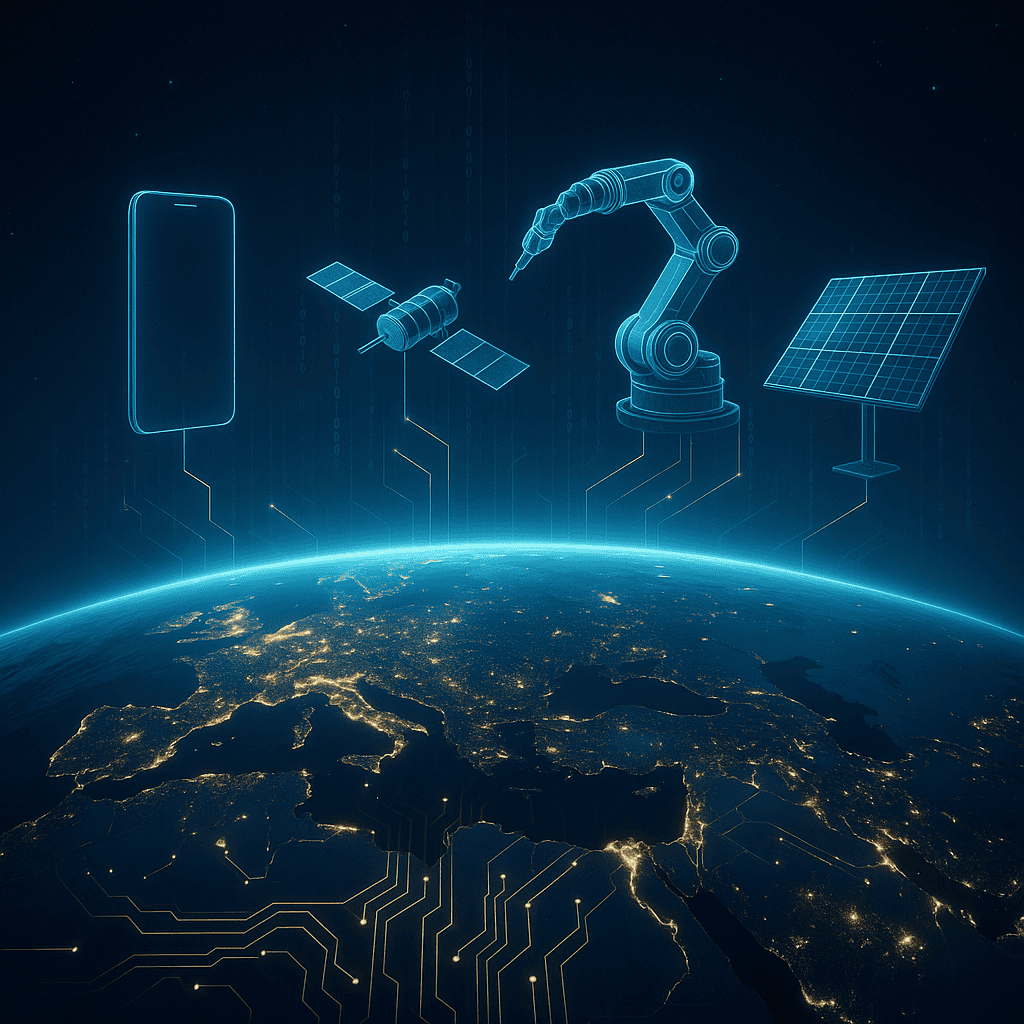
In the modern world, electronics are everywhere—quietly embedded in the machines that run our cities, the devices in our pockets, and the satellites orbiting above. From lighting a room to decoding human genomes, from powering electric cars to enabling a conversation across continents, electronics is the invisible architecture behind the digital age.
At its core, electronics is the science and engineering of controlling electrical energy through circuits, components, and systems. But more than that, it is the language of modern technology. Electronics enables computation, communication, automation, and artificial intelligence. It is the foundation of innovation in nearly every field—medicine, defense, entertainment, manufacturing, space travel, and beyond.
The story of electronics is both scientific and industrial. It begins with the mysteries of static electricity and culminates in nanoscale semiconductors and vast global supply chains. Along the way, it has transformed human life more profoundly than perhaps any other technological force, shaping how we live, work, think, and connect.
This article explores the science behind electronics and the vast industry that produces and distributes it. We’ll begin with the basics—what electronics are and how they work—then dive into its history, its current giants, and its promising future. Whether you’re an aspiring engineer, a curious consumer, or a policy thinker shaping tomorrow’s tech landscape, understanding electronics is essential to understanding the modern world.
2. Electronics and Engineering – Foundations of a Technological Era
Electronics is not just a field of study—it is a foundation of modern engineering. As a branch of applied science, electronics focuses on designing and manipulating devices that control the flow of electric current. But within engineering, it plays a far greater role: it powers the nervous system of technology.
Electronics is embedded in nearly every branch of engineering. Electrical engineering, its closest relative, deals broadly with the generation, transmission, and use of electric power. But electronics zooms in on control—on systems that process signals, store data, automate tasks, and make decisions. In this way, electronics is more aligned with intelligence than with raw energy. It enables a thermostat to regulate temperature, a heart monitor to interpret cardiac rhythms, and a Mars rover to navigate autonomously.
In mechanical engineering, electronics governs sensors and actuators. In civil engineering, it underpins smart infrastructure and traffic systems. In aerospace, it guides navigation, communication, and avionics. In biomedical engineering, it drives imaging machines, neural interfaces, and implantable devices. And in software engineering, it provides the hardware upon which every code runs.
From printed circuit boards in consumer gadgets to complex embedded systems in spacecraft, electronics is both a physical science and an abstract design discipline. Engineers working in this space must understand physics, materials science, signal processing, logic, and systems thinking. Increasingly, they must also collaborate with AI specialists, ethicists, and environmental scientists as electronics grows ever more integrated into human life and planetary systems.
The future of engineering is the future of electronics. As devices become smarter, smaller, and more sustainable, the field of electronics will continue to shape how engineers solve problems and design the world of tomorrow.
3. The Basics of Electronics – Understanding Circuits and Components
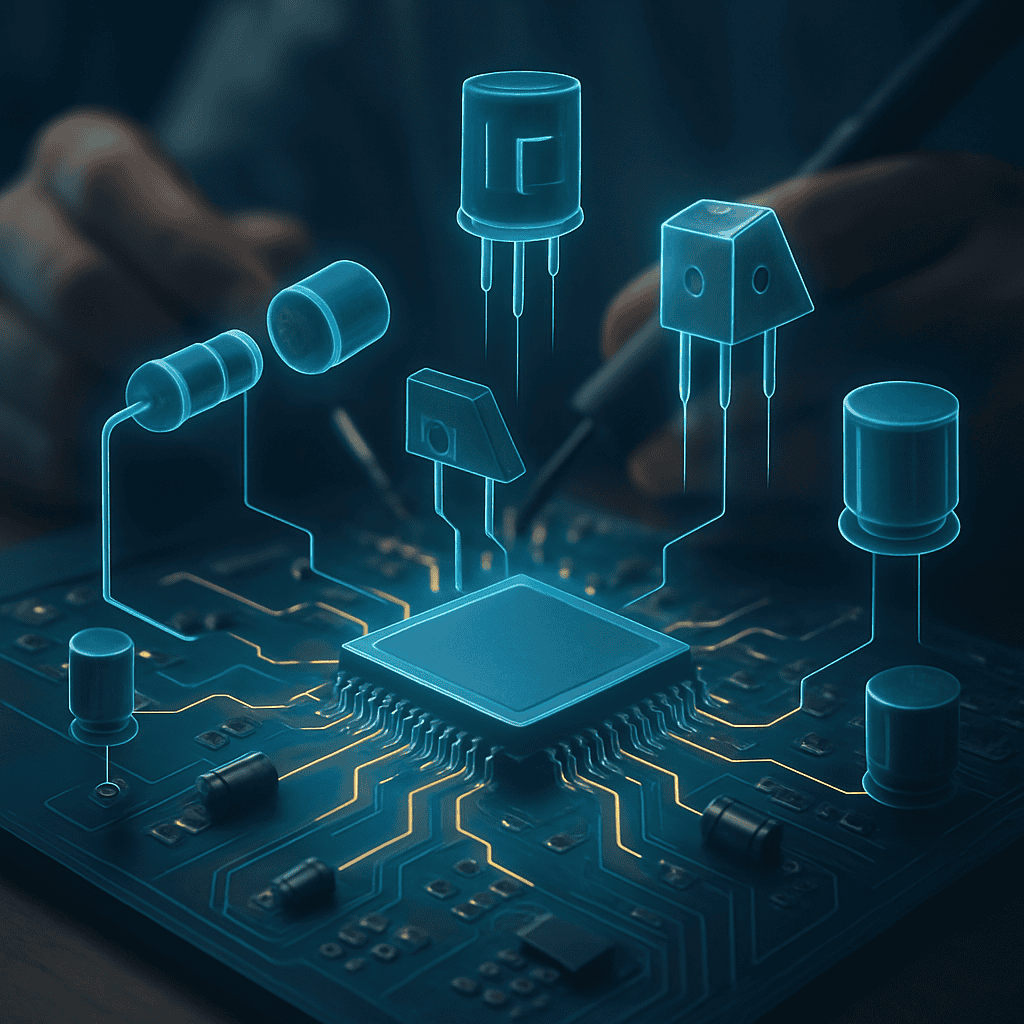
At the heart of every electronic device lies a circuit—a pathway that allows electricity to flow in controlled and purposeful ways. Whether it’s a smartphone, a thermostat, or a satellite, all electronic systems are built from the same foundational principles and components. Understanding these basics is the key to unlocking the language of modern technology.
Electricity, Voltage, and Current
Electronics begins with electricity: the movement of electrons through a conductor. Voltage is the force that pushes electrons, current is the flow of those electrons, and resistance is what opposes the flow. These three are governed by Ohm’s Law—a simple but powerful equation:
V = I × R
(Voltage = Current × Resistance)
This relationship forms the backbone of every electronic design, from the simplest flashlight to the most advanced supercomputer.
Key Components in a Circuit
- Resistors control the flow of current, protecting components or shaping signals.
- Capacitors store and release electrical energy, often used for filtering or timing.
- Inductors resist changes in current and are common in power supplies and radio circuits.
- Diodes allow current to flow in one direction only, acting as electrical gatekeepers.
- Transistors, the true heroes of modern electronics, act as switches and amplifiers. Billions of them are etched onto microchips in even the smallest smartphones.
- Integrated Circuits (ICs) combine thousands or millions of components into a single chip, powering everything from digital watches to artificial intelligence systems.
Analog vs. Digital Electronics
Analog circuits deal with continuously varying signals—like the waveforms in a microphone or speaker. Digital circuits, by contrast, process discrete binary data (0s and 1s). Most modern electronics use a combination of both: analog-to-digital converters transform real-world inputs into data, which digital processors then compute, store, or transmit.
Signals, Logic, and Control
Electronic circuits are designed to respond to inputs, follow logical rules, and produce outputs. In digital electronics, logic gates—like AND, OR, and NOT—form the building blocks of computation. These gates are combined into microcontrollers and microprocessors, which form the brains of virtually every smart device.
In the end, electronics is a fusion of physics and logic—of raw energy and refined intelligence. With just a few basic components and principles, we can build astonishingly complex systems that listen, see, think, and act.
4. A Brief History of Electricity and Electronics
The story of electronics is one of discovery, invention, and acceleration—a journey from sparks of curiosity to the digital fabric of modern civilization. Understanding this history reveals how each breakthrough laid the groundwork for today’s hyper-connected world.
Early Discoveries of Electricity
The fascination with electricity dates back to antiquity, when Greek philosophers noted how amber could attract small objects when rubbed—an early observation of static electricity. But it wasn’t until the 17th and 18th centuries that scientific exploration began in earnest.
In the 1600s, William Gilbert coined the term electricus and studied magnetic and electric forces. In 1752, Benjamin Franklin famously flew a kite during a thunderstorm, proving that lightning was a form of electrical discharge. These early experiments laid the conceptual groundwork for understanding electric force and energy.
The 19th Century – Harnessing Power
The 1800s saw electricity leap from theory to utility. Alessandro Volta invented the battery in 1800, enabling the sustained flow of electric current. André-Marie Ampère, Georg Ohm, and Michael Faraday followed with discoveries that linked electricity, magnetism, and motion—paving the way for electric motors, generators, and transformers.
By the late 19th century, inventors like Thomas Edison and Nikola Tesla were battling over how electricity should be distributed—direct current (DC) vs. alternating current (AC). Their rivalry fueled rapid developments in electric lighting, communication, and industrial power.
The Birth of Electronics – The 20th Century Revolution
Electronics, as distinct from general electricity, began with the vacuum tube. In 1904, John Ambrose Fleming created the first diode tube, and in 1906, Lee De Forest added a third element to produce the triode, the first electronic amplifier. These devices enabled early radios, televisions, and the first computers.
Then came a revolution: the transistor, invented in 1947 at Bell Labs by John Bardeen, Walter Brattain, and William Shockley. Transistors were smaller, more efficient, and longer-lasting than vacuum tubes. They marked the birth of modern electronics.
The Silicon Era and the Rise of the Microchip
In the 1950s and 60s, engineers began combining multiple transistors into integrated circuits (ICs)—compact chips that performed complex functions. Silicon Valley was born, and with it, the first personal computers, calculators, and digital watches.
The invention of the microprocessor in 1971—essentially a full CPU on a single chip—launched the digital age. Intel’s 4004 chip changed everything. Suddenly, computers could shrink and spread, becoming personal, portable, and eventually wearable.
The 21st Century – Connectivity and Convergence
Today, electronics are embedded in everything: from smartphones and cars to factories and homes. The convergence of electronics with computing, telecommunications, and artificial intelligence has created a global web of intelligent devices—the Internet of Things (IoT).
At the same time, electronics companies have become some of the most powerful organizations on Earth, shaping global economies, culture, and even geopolitics.
From amber and lightning to chips with billions of transistors, the history of electronics is the story of how humans learned to tame and encode energy—not just to illuminate the world, but to give it voice, memory, and mind.
5. The Evolution of the Electronics Industry
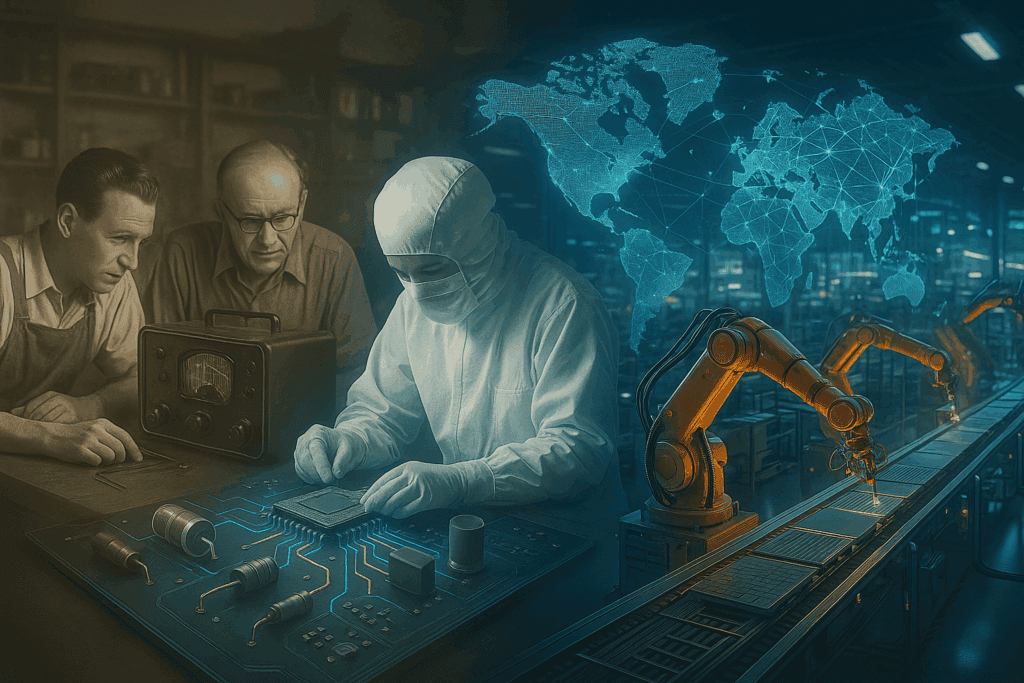
The electronics industry is one of the fastest-evolving and most influential sectors in human history. What began as a handful of scientific curiosities and military applications has transformed into a global, trillion-dollar ecosystem that drives innovation across every field—from consumer technology and transportation to medicine and space exploration.
Post-War Boom and the Birth of Consumer Electronics
The electronics industry found its first explosive growth after World War II. Wartime research had led to rapid advances in radar, communication systems, and electronic computing. In the aftermath, these technologies spilled into civilian life.
By the 1950s, radios, televisions, and early computers began entering homes and offices. Japan, heavily investing in post-war recovery, began to emerge as a leader in compact, high-quality consumer electronics, with companies like Sony and Panasonic leading the charge.
The Silicon Valley Phenomenon
Meanwhile in the United States, a revolution was brewing in California. The invention of the integrated circuit, and later the microprocessor, laid the groundwork for Silicon Valley—a hub of technological innovation built on the growing power of semiconductors. Startups and giants alike began producing personal computers, networking equipment, and software, sparking the digital age.
Apple, Intel, and Hewlett-Packard were among the early stars. Their success showed that electronics wasn’t just hardware—it was a platform for whole new ways of thinking, working, and living.
Globalization and the Rise of East Asia
By the 1980s and 1990s, electronics manufacturing began shifting to Asia, particularly Taiwan, South Korea, and later China. This shift created vast global supply chains that combined design and branding in the West with mass production and innovation in the East.
Companies like Samsung, Foxconn, and Huawei became global leaders, building the devices designed by Apple, Google, and Microsoft. Taiwan became the nerve center of semiconductor fabrication, led by TSMC (Taiwan Semiconductor Manufacturing Company).
China’s emergence as a global electronics hub was driven by government support, infrastructure investment, and sheer scale. Shenzhen, once a fishing village, became the electronics capital of the world.
The Age of Smartphones and Smart Systems
The launch of the iPhone in 2007 redefined consumer electronics. Suddenly, a single device could be a phone, a camera, a computer, and a personal assistant. Smartphones triggered new waves of innovation in sensors, displays, batteries, wireless communication, and software ecosystems.
At the same time, the electronics industry expanded into cloud infrastructure, smart homes, wearables, and autonomous vehicles—sectors that depend on continuous electronic feedback and machine learning.
Today’s Industry – Complex, Competitive, and Crucial
Today’s electronics industry is a vast, layered system that includes:
- Chip designers and manufacturers (like Intel, AMD, Nvidia, TSMC)
- Contract manufacturers (like Foxconn, Pegatron)
- Consumer electronics brands (like Apple, Samsung, Sony, Xiaomi)
- Component and material suppliers (like Corning, Leoni, Texas Instruments)
- Software and services companies (like Google, Microsoft, Amazon Web Services)
The industry is marked by intense competition, global interdependence, and constant innovation. Supply chain disruptions, geopolitical tensions, and environmental concerns are major challenges—but so are the opportunities: 5G, green tech, edge computing, and quantum electronics are already reshaping the next frontier.
From war machines to pocket-sized supercomputers, the evolution of the electronics industry is the story of how we made the invisible circuits of logic and energy into the visible structures of modern civilization.
6. Global Leaders in Electronics – A Survey of Top Companies
The electronics industry is shaped not only by science and innovation but also by the global titans that design, manufacture, and distribute its technologies. These companies—spanning consumer electronics, semiconductors, manufacturing, and infrastructure—define the pace and direction of progress.
Below is a survey of some of the most influential players across major sectors of the electronics industry.
A. Consumer Electronics Giants
These are the brands that consumers know and trust—leaders in smartphones, entertainment systems, and personal tech.
- Apple (USA)
Famous for its sleek design and seamless ecosystem, Apple revolutionized personal electronics with the iPhone, iPad, Mac, and Apple Watch. Its hardware is deeply integrated with its software, enabling unmatched user experiences. - Samsung (South Korea)
A powerhouse in multiple sectors, Samsung is a global leader in smartphones, semiconductors, and display technologies. Its Galaxy line and OLED screens set industry benchmarks. - Sony (Japan)
A pioneer in entertainment tech, Sony is renowned for its audio systems, TVs, cameras, and the wildly successful PlayStation gaming consoles. It also plays a significant role in image sensors and content production. - Panasonic (Japan)
With a diverse portfolio, Panasonic produces home appliances, audio-visual systems, automotive electronics, and energy solutions. It also collaborates on electric vehicle battery systems. - Xiaomi (China)
Known for high-performance products at accessible prices, Xiaomi manufactures smartphones, smart home devices, and wearables. It rapidly rose to become one of the top smartphone makers in the world.
B. Electronics Manufacturing and Semiconductors
These companies operate largely behind the scenes—building the guts of modern technology.
- Foxconn (Taiwan/China)
Officially Hon Hai Precision Industry Co., Foxconn is the largest electronics contract manufacturer globally. It assembles products for Apple, Sony, Nintendo, and many others, acting as the engine of global tech production. - Intel (USA)
A pioneer in microprocessors, Intel remains a major supplier of CPUs for PCs and servers. It is also investing heavily in AI chips, edge computing, and autonomous vehicle technologies. - Huawei (China)
Once best known for its smartphones, Huawei is also a major force in telecommunications infrastructure. Despite geopolitical headwinds, it continues to push forward in 5G, AI, and chip design. - Plexus (USA)
A key player in the defense, medical, and aerospace sectors, Plexus provides electronics design and manufacturing services for high-reliability applications. - Leoni (Germany)
Specializing in cable systems and fiber optics, Leoni supports a wide range of industries including automotive, data communications, and healthcare.
C. Infrastructure and Energy Technology Firms
These companies bridge electronics with industrial power, automation, and smart systems.
- Siemens (Germany)
A technology leader in industrial automation, energy systems, and medical equipment. Siemens is at the forefront of the smart infrastructure and digital industry revolution. - ABB (Switzerland)
Known for its work in electrification, robotics, and industrial control systems. ABB is a global player in smart grid technologies and factory automation. - Eaton (Ireland/USA)
Specializing in power management and energy-efficient electronics, Eaton produces a range of products for electrical, hydraulic, and mechanical power systems.
D. Other Notable Companies
- TCL (China): A major television and display manufacturer expanding into smartphones and smart appliances.
- Duracell (USA): A household name in battery technology, powering countless portable devices for decades.
These companies form the beating heart of the electronics industry, from the processors in our laptops to the networks connecting entire cities. Their innovations—and their strategies—will determine what the next generation of electronics looks like.
7. The Future of Electronics – What’s Next?
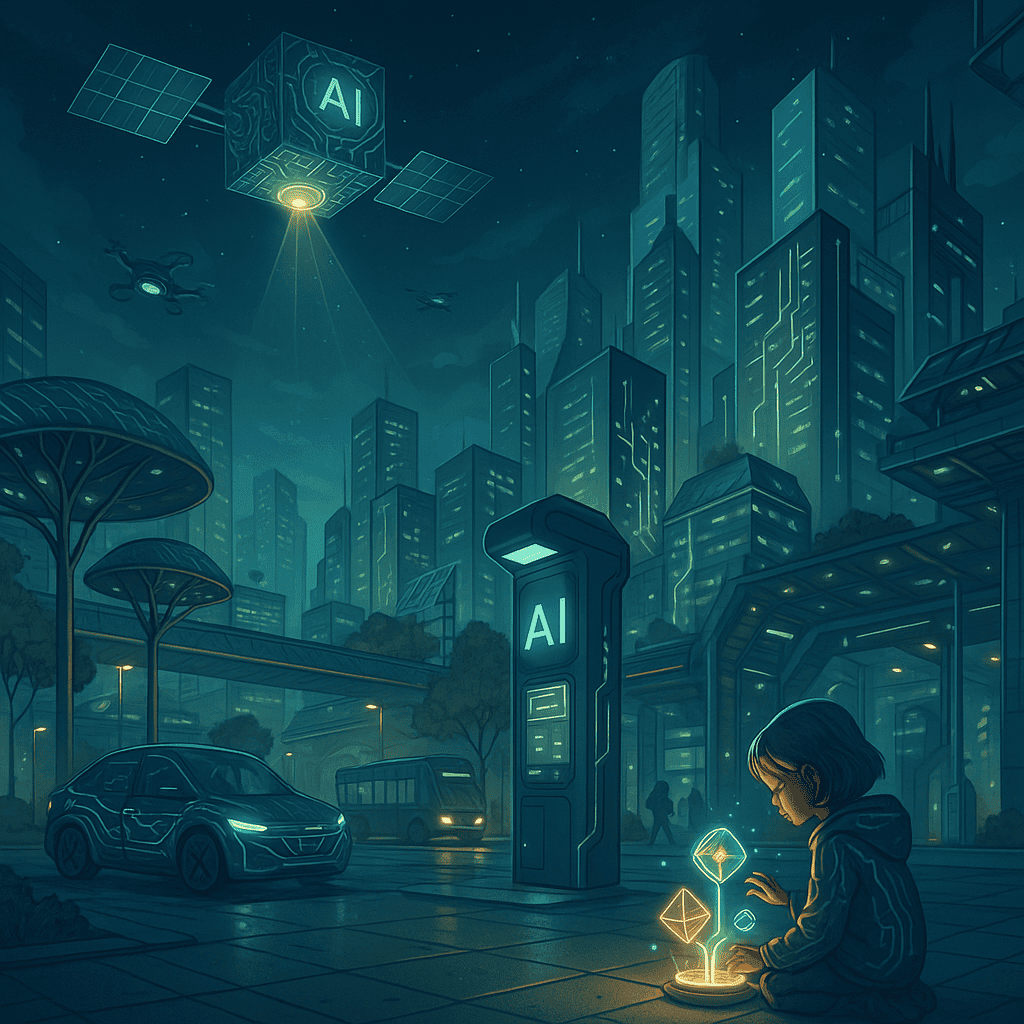
As we move deeper into the 21st century, electronics is entering a transformative era—marked by convergence, miniaturization, intelligence, and sustainability. The future of electronics is not just faster and smaller; it is smarter, more connected, and more deeply embedded in the fabric of human life and planetary systems.
Smaller, Smarter, Stronger
Electronics continues to follow Moore’s Law—but just barely. As transistors approach atomic scale, engineers are turning to new materials like graphene, carbon nanotubes, and compound semiconductors to extend the limits of miniaturization and performance.
Emerging areas include:
- Flexible and wearable electronics, enabling smart textiles and unobtrusive health monitoring
- Neuromorphic chips, which mimic the architecture of the brain for more efficient AI
- Photonic computing, which uses light rather than electrons to process information at near-light speed
The Internet of Things (IoT) and Ambient Intelligence
IoT is transitioning from buzzword to infrastructure. Billions of connected devices—from smart thermostats and traffic sensors to factory robots and farm monitors—are forming a decentralized web of data.
This leads to ambient intelligence: environments that sense, interpret, and respond without user commands. Homes, hospitals, and cities will soon be embedded with electronic systems that quietly enhance safety, energy efficiency, and quality of life.
Green Electronics and Sustainable Design
The electronics industry faces a growing environmental imperative. E-waste is one of the world’s fastest-growing waste streams. The mining of rare-earth metals and energy-intensive manufacturing processes also raise ethical and ecological concerns.
Future electronics must prioritize:
- Eco-friendly materials and recyclable components
- Low-power computing and energy-efficient circuits
- Circular design, encouraging repair, reuse, and regeneration over disposability
The Role of Artificial Intelligence
AI is both a product of electronics and a driver of its evolution. Electronics powers AI chips; AI, in turn, optimizes circuit design, manages supply chains, enhances quality control, and creates adaptive systems.
Expect future devices to be:
- Self-optimizing: learning to conserve energy, manage usage, or repair themselves
- Context-aware: understanding human emotions, gestures, and needs
- Collaborative: forming networks that solve problems together, like swarms of drones or fleets of autonomous vehicles
Quantum Electronics and the Next Frontier
Beyond classical electronics lies quantum technology. Quantum computers and sensors promise exponential increases in computing power and sensitivity, enabled by phenomena like superposition and entanglement.
While still in early development, quantum electronics could eventually revolutionize:
- Cryptography and cybersecurity
- Drug discovery and protein folding
- Climate modeling and advanced materials science
The future of electronics will not merely improve our tools—it will change the way we live, relate, heal, learn, and think. It is a future built not just from silicon, but from imagination, ethics, and global collaboration.
8. Publications and Media in Electronics – Knowledge, News, and Innovation
In a field as dynamic and fast-evolving as electronics, staying informed is essential. Whether you’re a hobbyist wiring your first circuit, a professional engineer designing high-speed chips, or an industry analyst tracking innovation trends, access to quality publications is key. Electronics media spans a rich landscape—from DIY project guides to academic research, trade journals, and global tech news.
Below is a survey of leading publications and platforms across the electronics ecosystem.
A. For Hobbyists and Beginners
These publications make electronics approachable for self-learners, students, and tinkerers.
- Practical Electronics (UK)
A long-running magazine known for its hands-on projects, tutorials, and schematics. Perfect for enthusiasts building everything from amplifiers to robotic arms. - Electronics for You (India)
A comprehensive monthly magazine covering DIY projects, student competitions, tutorials, and beginner-level theory, with a strong educational focus. - Popular Electronics (Historical, USA)
While no longer published, this mid-20th-century magazine helped inspire a generation of engineers and makers. It played a major role in the personal computing revolution.
B. For Engineers and Industry Professionals
These sources are geared toward design engineers, R&D professionals, and industry insiders.
- Elektor Magazine
Published in multiple languages, Elektor delivers deep dives into circuit design, embedded systems, and electronics engineering trends. It combines practical builds with theoretical rigor. - IEEE Spectrum
The flagship magazine of the Institute of Electrical and Electronics Engineers, covering cutting-edge topics in engineering, computing, energy, and AI. Articles range from scholarly overviews to global industry reporting. - Electronics Weekly (UK)
A trade journal providing news, component updates, white papers, and job listings. Its focus is on market trends, product launches, and semiconductor supply chains. - Electronic Specifier
A publication focused on helping engineers choose, apply, and optimize components in their designs. Covers power management, embedded systems, and test equipment.
C. Specialized and Manufacturing-Focused Publications
For professionals in production, quality control, and SMT (Surface Mount Technology), these are key sources.
- SMT Today
Focused on manufacturing processes, supply chain optimization, and surface-mount assembly technologies. - Circuits Assembly Magazine
Offers insights into PCB (printed circuit board) assembly, automation, rework techniques, and production-line best practices. - Global SMT & Packaging
Covers advanced electronics packaging, interconnects, 3D stacking, and testing technologies. - Circuitnet
A fast-moving platform for news, interviews, and Q&A from the electronics manufacturing sector.
D. Broader Media and Academic Sources
Some mainstream or hybrid publications offer essential context on how electronics intersects with economics, politics, and global development.
- The Economist (Technology Section)
While not exclusively focused on electronics, its reporting on innovation, chip shortages, green tech, and policy is widely respected and influential. - Academic Journals & Conferences
- IEEE Transactions on Electronics, Solid-State Circuits, and Nanotechnology
- Nature Electronics
- ACM Journal on Emerging Technologies
These venues offer peer-reviewed studies and leading-edge research in electronics science, materials, and applied theory.
- IEEE Transactions on Electronics, Solid-State Circuits, and Nanotechnology
- Industry-Specific Media
From IoT Now to Semiconductor Digest, specialized publications serve targeted niches—providing professionals with deep insight into AI hardware, EV electronics, 5G infrastructure, and quantum computing.
In a world where technological literacy is becoming as important as reading and writing, high-quality electronics media serves not only to educate, but to inspire and empower. Whether in a maker’s garage, a university lab, or a global R&D center, these publications ensure that ideas continue to flow—just like the electrons that shape our modern world.

Conclusion – Circuits of the Future: Why Electronics Matters
Electronics is more than a field of study, more than an industry. It is the pulse of the modern world—a living network of circuits and systems that shapes how we communicate, learn, heal, move, and imagine. From the hum of power lines to the silent logic of microprocessors, electronics translates the physical world into signals, decisions, and meaning.
In just over a century, it has evolved from vacuum tubes and crackling radio waves to quantum processors and neural networks. It has given rise to global giants, transformed economies, and bridged continents. Yet at its heart, the same elemental forces still flow—voltage, current, resistance—channeled into ever more elegant and intelligent forms.
But with great capability comes great responsibility. As electronics becomes more integrated into our lives, it raises new questions: How do we design for sustainability? Who controls the data and devices that shape our choices? Can we ensure access to technology is equitable and empowering?
To answer these questions, we must not only understand electronics—we must guide its future. Scientists, engineers, educators, consumers, and policymakers all have a role to play in shaping how this vital field continues to evolve.
The next generation of electronics will not be limited to faster phones or smarter homes. It will be woven into the environments we live in, the bodies we care for, and the tools we use to explore the cosmos. It will help define the ethics, culture, and possibilities of the digital age.
So let us not take it for granted. Let us study it, improve it, and use it wisely. Because in every circuit lies not just a spark of energy—but the design of tomorrow.
Bibliography
ABB. (2024). About ABB. [online] Available at: https://global.abb [Accessed 10 Jun. 2025].
Apple Inc. (2025). Company Overview. [online] Available at: https://www.apple.com/about/ [Accessed 10 Jun. 2025].
Bardeen, J., Brattain, W.H. and Shockley, W. (1948). Three-electrode circuit element utilizing semiconductive materials. Bell Telephone Laboratories.
Electronics Weekly. (2025). Latest News and Analysis in the Electronics Industry. [online] Available at: https://www.electronicsweekly.com [Accessed 10 Jun. 2025].
Elektor Magazine. (2025). Electronics Innovation and Design. [online] Available at: https://www.elektormagazine.com [Accessed 10 Jun. 2025].
Foxconn Technology Group. (2025). Corporate Profile. [online] Available at: https://www.honhai.com [Accessed 10 Jun. 2025].
IEEE Spectrum. (2025). Technology, Engineering, and Science News. [online] Available at: https://spectrum.ieee.org [Accessed 10 Jun. 2025].
Intel Corporation. (2025). Intel at a Glance. [online] Available at: https://www.intel.com [Accessed 10 Jun. 2025].
Leoni AG. (2025). Company Overview and Products. [online] Available at: https://www.leoni.com [Accessed 10 Jun. 2025].
Nature Electronics. (2025). Research in Electronic Science and Technology. [online] Available at: https://www.nature.com/natelectron/ [Accessed 10 Jun. 2025].
Panasonic Corporation. (2025). Corporate Information. [online] Available at: https://www.panasonic.com/global [Accessed 10 Jun. 2025].
Plexus Corp. (2025). Innovative Electronics Manufacturing Solutions. [online] Available at: https://www.plexus.com [Accessed 10 Jun. 2025].
Samsung Electronics Co. Ltd. (2025). About Us. [online] Available at: https://www.samsung.com/global [Accessed 10 Jun. 2025].
Siemens AG. (2025). Smart Infrastructure and Automation. [online] Available at: https://www.siemens.com [Accessed 10 Jun. 2025].
Sony Group Corporation. (2025). Corporate Information and Products. [online] Available at: https://www.sony.com [Accessed 10 Jun. 2025].
Xiaomi Corporation. (2025). Corporate Profile. [online] Available at: https://www.mi.com/global [Accessed 10 Jun. 2025].