

Table of Contents
- Introduction – The Meaning and Power of Communication
- What Is Communication?
- Definitions
- Pros and Cons of Communication
- Definitions
- Communication in Nature
- Animal Communication
- Plant and Fungal Networks
- Biosemiotics and Interconnectivity
- Animal Communication
- The Principles of Communication
- Sender, Message, Receiver, Medium
- Noise, Feedback, and Context
- Sender, Message, Receiver, Medium
- Early Human Communication
- Body Language, Grunts, Gestures
- Cave Art, Music, Symbolism
- Body Language, Grunts, Gestures
- The Invention of Language and Writing
- Oral Traditions
- Writing Systems: From Pictographs to Alphabets
- Materials: Clay, Papyri, Parchment, Paper
- Oral Traditions
- The Media Revolution Begins
- Printing Press and Books
- Newspapers and Periodicals
- Letters, Telegraph, and the Birth of Long-Distance Messaging
- Printing Press and Books
- The Age of Electronic Communication
- Telephone, Radio, Phonographs
- Television and Film
- Magnetic Tapes, Boomboxes, Walkmans
- Telephone, Radio, Phonographs
- The Digital Age
- Computers, Email, the Internet
- Cell Phones, Apps, Social Media, AI
- Data, Encryption, and Surveillance
- Computers, Email, the Internet
- Modern Innovations and the Future of Communication
- Quantum Communication
- Brain–Computer Interfaces
- Neural Implants and Cybernetic Language
- Ethical Frontiers of Communication Technology
- Quantum Communication
- Communication in Military, Intelligence, and Governance
- Espionage, Codebreaking, and Propaganda
- Public Address and Civic Dialogue
- Civic Tech for Transparency and Inclusion
- Espionage, Codebreaking, and Propaganda
- Conclusion – Toward a Conscious Planetary Dialogue
- Appendix – 50 of the Greatest Speeches of All Time
- Speakers, Titles, and Context
- Speakers, Titles, and Context
1. Introduction – The Meaning and Power of Communication
Communication is the lifeblood of civilization. From the first spark of recognition in a mother’s eyes to a scientist decoding the mysteries of the cosmos, every exchange of information—spoken or silent, symbolic or digital—is a bridge between minds.
In the broadest sense, communication is the transmission of meaning across time and space. It is the process by which organisms, machines, and societies coordinate action, build relationships, share knowledge, and form culture.
The history of communication is also the history of human advancement. Each major leap in our ability to communicate—whether the development of speech, the invention of writing, the printing press, or the internet—has reshaped the structure of societies and the scale of human cooperation. But communication is not always benign. It can enlighten or mislead, liberate or manipulate, connect or divide.
In this article, we explore communication as both a biological instinct and a technological force. We examine its evolution in nature, its refinement in culture, and its transformation through science. We also look forward, into a future where communication may occur not just through language, but through thoughts themselves.
We conclude with a curated appendix of the most impactful speeches in world history, selected for their alignment with human dignity, rational progress, and ethical courage—the values at the heart of the Integrated Humanist philosophy.

2. What Is Communication?
Definition
At its core, communication is the act of transmitting information from one entity to another. It involves a sender, a message, a medium, and a receiver. In most cases, it also includes feedback—a response that completes the loop of understanding.
In human terms, communication is not limited to spoken or written language. It encompasses gestures, facial expressions, tone of voice, symbolic acts, visual art, digital signals, and even silence. It is both an instinct and a cultivated art, both a biological necessity and a sociocultural achievement.
In scientific contexts, communication also applies to the signaling systems of non-human animals, plants, fungi, machines, and even quantum particles. From bees dancing to indicate nectar locations to mycorrhizal fungi transmitting chemical signals across root networks, communication is one of the fundamental organizing principles of complex systems.
The Dual Nature of Communication: Benefits and Risks
Pros of Communication
- Connection and Belonging
Communication enables emotional intimacy and social bonding. It allows humans to share joys, fears, sorrows, and aspirations, fostering empathy and unity. - Knowledge and Progress
Through communication, knowledge is preserved and transmitted across generations. Scientific discoveries, philosophical insights, and historical experiences become collective memory. - Coordination and Civilization
From hunting in groups to building cities, complex human cooperation is impossible without communication. It enables planning, division of labor, and the enforcement of social norms. - Creativity and Expression
Art, music, literature, and ritual are all communicative acts that give form to the inner life. They elevate the human experience beyond mere survival. - Problem-Solving and Conflict Resolution
Effective dialogue can resolve disputes, forge consensus, and generate solutions to shared problems—crucial for democratic life and diplomacy.
Cons of Communication
- Manipulation and Misinformation
Language can deceive as easily as it can enlighten. From propaganda to disinformation campaigns, communication can be used to mislead, control, or radicalize. - Noise and Misunderstanding
Differences in language, culture, tone, or intent often result in confusion, offense, or error. The same message may be interpreted in radically different ways. - Invasion of Privacy
Communication technologies—especially digital surveillance, social media, and AI—raise concerns about privacy, autonomy, and exploitation of personal data. - Overload and Fragmentation
In the digital age, the sheer volume of messages can cause mental fatigue, reduce attention span, and fragment collective focus. - Weaponization of Speech
Hate speech, incitement, cyberbullying, and ideological extremism are potent examples of how communication can become a tool of violence.
The Rise of Communications Technology
Human ingenuity has continuously expanded the tools of communication. These technologies enhance speed, reach, clarity, permanence, and sensory richness—but they also amplify the risks.
Uses and Advantages of Communications Technology
- Speed and Reach: Messages can be delivered instantaneously across continents.
- Archiving: Written, recorded, or digital formats preserve knowledge indefinitely.
- Multimedia: Combining audio, visual, and interactive elements enhances engagement and understanding.
- Global Connection: Technologies enable transnational collaboration, education, and activism.
- Automation and Efficiency: AI-driven communication reduces friction in commerce, logistics, and administration.
Challenges and Dangers
- Echo Chambers: Algorithms can reinforce ideological silos.
- Disinformation Ecosystems: False narratives spread rapidly through viral media.
- Loss of Human Contact: Digital convenience may reduce empathy and authentic presence.
- Dependence on Infrastructure: Communication systems are vulnerable to outages, cyberattacks, and political censorship.
- Ethical Ambiguity: AI-generated messages raise questions about authorship, authenticity, and trust.
3. Communication in Nature
Communication is not a uniquely human trait. It is an evolutionary advantage shared across the kingdoms of life—from animals and insects to plants, fungi, and even microorganisms. Although non-human organisms do not use words, they transmit information in a variety of sophisticated ways: through chemical signals, gestures, colors, vibrations, and electrical impulses. This field of study is known as biosemiotics—the science of signs and communication in living systems.
Animal Communication
Animals use communication to attract mates, warn of danger, establish territory, coordinate behavior, and maintain social hierarchies. Each species has evolved its own system, often combining multiple modes of signaling.
- Visual Signals: Peacocks fan their feathers to attract mates; dogs bare their teeth to signal aggression; cephalopods change color patterns to camouflage or intimidate.
- Auditory Signals: Birds sing to mark territory and attract mates; elephants communicate through low-frequency rumbles that travel miles; dolphins use unique signature whistles to identify one another.
- Chemical Signals (Pheromones): Ants lay down pheromone trails to lead colony members to food; bees release alarm pheromones when threatened.
- Tactile Signals: Grooming in primates strengthens social bonds; bees perform the waggle dance to indicate the direction and distance of nectar sources.
- Electromagnetic Signals: Electric eels and some fish use electric fields to navigate or communicate in dark or murky waters.
Some animal communications show the complexity of rudimentary language. Primates like chimpanzees and bonobos use gesture-based systems that resemble syntax. Songbirds demonstrate learning and dialect transmission akin to human cultural exchange. In these systems, intention, context, and learned behavior play crucial roles—reminding us that communication is not just mechanical but also relational.
Plant and Fungal Communication
Though lacking brains or nervous systems, plants and fungi engage in communication networks that have astonished scientists.
Chemical Communication
- Volatile Organic Compounds (VOCs): When attacked by herbivores, plants like acacia trees release airborne signals warning nearby plants to bolster their defenses.
- Root Exudates: Plants excrete chemicals into the soil to attract beneficial microbes, deter competitors, or signal stress.
Mycorrhizal Networks (The “Wood Wide Web”)
Fungi form symbiotic relationships with tree roots, creating vast underground networks. Through these mycorrhizal connections, trees can:
- Share nutrients (especially from older to younger or shaded trees)
- Send chemical signals about pests or drought
- Inhibit growth of rival plants (allelopathy)
- Coordinate behavior in what resembles a forest-level intelligence
This decentralized, fungal-plant communication network suggests a form of collective resilience, even “altruism,” at the ecosystem level—challenging human assumptions about individuality and cooperation.
Insect and Microbial Signaling
- Honeybees use vibration and dance to coordinate colony activity.
- Termites build intricate mounds based on feedback from pheromone gradients.
- Bacteria communicate using quorum sensing—a chemical signaling method to gauge population density and trigger coordinated behavior, such as biofilm formation or virulence.
The Universality of Meaning-Making
Across all forms of life, communication systems share three essential features:
- Encoding and Decoding: A signal must be produced in a way the receiver can interpret.
- Context Sensitivity: Signals often mean different things depending on the surrounding environment or state of the organism.
- Adaptive Purpose: Communication enhances survival—whether by avoiding danger, reproducing, finding food, or maintaining symbiosis.
In this light, communication appears not as an abstract human invention, but as a fundamental principle of life itself. From the hum of bees to the silent chemical pulses of trees, nature is always talking—if we know how to listen.

4. The Principles of Communication
Despite its countless forms—from songbirds to satellites, tribal chants to quantum pulses—the act of communication rests on several foundational principles. These principles structure the process by which meaning is created, transmitted, interpreted, and responded to. Understanding these components helps us decode not only human interaction, but also the inner workings of social systems, technology, and life itself.
1. Sender, Message, Receiver
At the core of communication is a triadic structure:
- Sender (or Encoder): The originator of the message—whether a person, organism, or device—who selects and encodes information for transmission.
- Message: The content being transmitted—an idea, emotion, signal, instruction, or question—organized into a communicable form.
- Receiver (or Decoder): The individual or system that receives the signal, interprets it, and potentially responds.
This basic model underlies communication across all contexts, but it is far from static. In most human communication, roles alternate fluidly as feedback is exchanged and interpretations shift.
2. Medium and Channel
The medium is the form through which the message travels. This could be:
- Air (speech, bird calls)
- Light (visual signs, gestures, fiber optics)
- Paper (books, letters)
- Electromagnetic waves (radio, television, Wi-Fi)
- Neural signals (brain-machine interface)
The channel is the specific pathway within that medium—e.g., a particular radio frequency, phone line, or bandwidth. The quality, reliability, and accessibility of the channel deeply affect how clearly the message is received.
3. Code and Convention
Communication depends on shared codes—agreed-upon systems of meaning:
- Language (spoken or written)
- Mathematics and logic
- Morse code or binary code
- Facial expressions or body postures
- Rituals, symbols, or etiquette
Codes can be natural (such as emotional expressions) or artificial (such as programming languages). Miscommunication often arises when sender and receiver do not share the same codebase or when cultural context changes the interpretation.
4. Noise
Noise refers to anything that disrupts or distorts the message:
- Physical Noise: Static on a phone call, poor handwriting, loud background sounds
- Psychological Noise: Prejudices, emotional states, or distractions in the minds of sender or receiver
- Semantic Noise: Use of ambiguous or unfamiliar language
- Technical Noise: System failure, lag, compression artifacts, lost data packets
Understanding and minimizing noise is essential for clarity, especially in high-stakes or high-volume communication environments.
5. Feedback
No communication is complete without feedback—a response from the receiver indicating reception, understanding, or reaction:
- A nod or verbal “yes”
- An email reply
- A chemical reaction in a microbial colony
- A returned radio signal
Feedback allows the sender to adjust the message, clarify intent, or confirm success. In dynamic systems, it enables learning and adaptation.
6. Context
All communication takes place in a context—the surrounding situation that shapes meaning:
- Cultural background
- Social status and roles
- Historical moment
- Physical environment
- Emotional atmosphere
For instance, a silence in a courtroom means something very different than a silence at a funeral. The same gesture, word, or expression can change in tone or meaning based on context.
7. Purpose and Ethics
Communication is never neutral—it always serves a purpose:
- To inform
- To persuade
- To express
- To command
- To build relationships
With purpose comes responsibility. The ethics of communication—honesty, transparency, compassion, and accountability—are especially vital in the age of mass media and AI. Ethical communication builds trust and resilience; unethical communication erodes democratic institutions, relationships, and truth itself.
Understanding these principles equips us not only to analyze communication more deeply but to improve it—making our interactions more mindful, meaningful, and humane.
5. Early Human Communication
Long before humans carved symbols into stone or wrote poetry on papyrus, we communicated. The roots of human communication lie deep in our evolutionary past—expressed through movement, sound, sensation, and shared experience. These early methods laid the groundwork for language, culture, and civilization itself.
Body Language and Gesture
One of the most primal forms of communication is body language—the silent orchestra of posture, facial expression, and gesture. Even today, much of our meaning is conveyed nonverbally:
- Raised eyebrows signal curiosity or surprise
- Open arms express welcome or vulnerability
- Postural shifts indicate confidence, fear, or aggression
In early human communities, where vocal language was still developing, gestures may have formed the first structured system of intentional meaning. Many primates, including chimpanzees and gorillas, use hand gestures that closely resemble those used by human infants—suggesting that gesture may be the evolutionary precursor to spoken language.
Vocalizations and Grunts
Before structured language, humans likely used a rich array of grunts, cries, hums, and intonations. These sounds expressed emotion, warned of danger, called for help, or coordinated group efforts. While not symbolic in the modern linguistic sense, they carried immediate and potent meaning.
Prosodic communication—the emotional tone and rhythm of sound—still underlies human speech. The universal ability to detect sarcasm, affection, or anger from tone alone is a remnant of these earlier modes of expression.
Music and Rhythm
The discovery of early flutes made from bird bones—over 40,000 years old—suggests that music emerged very early in human history. Rhythm, melody, and group drumming may have served social, ritualistic, and mnemonic functions:
- Synchronizing movement in collective tasks
- Fostering emotional bonding
- Encoding memory through song
Music predates writing and even language in its capacity to evoke shared feeling. It remains a universal mode of communication across cultures and epochs.
Cave Art and Symbolic Imagery
Around 30,000–40,000 years ago, humans began painting on cave walls in places such as Chauvet (France), Lascaux (France), and Sulawesi (Indonesia). These early images—of animals, handprints, geometric forms, and hunting scenes—were more than decoration. They were messages.
The emergence of symbolic communication in visual form marks a profound cognitive leap:
- Abstract thinking
- Narrative construction
- Cultural continuity
These paintings communicated identity, mythology, danger, or seasonal knowledge to future generations. They represent the dawn of visual language.
Early Symbols and Proto-Writing
Over time, humans began developing symbols with consistent meanings—simple marks that stood for objects, ideas, or sounds. From tally marks to sun and moon glyphs, these proto-languages laid the foundation for true writing systems.
Some of the earliest known systems include:
- Neolithic tokens (used in Mesopotamia for accounting)
- Petroglyphs and pictographs across Africa and Australia
- The Vinča symbols (Balkans, ~5500 BCE)
- Tortoise shell inscriptions in ancient China
While not yet phonetic or fully grammatical, these symbolic codes were an evolutionary bridge between image and text.
The Significance of Early Communication
Early human communication systems were:
- Embodied: using the body as instrument and canvas
- Multi-sensory: combining sound, movement, touch, and sight
- Community-oriented: focused on survival, ritual, and belonging
They allowed knowledge to be passed without writing, created bonds without words, and laid the neural and cultural groundwork for the explosion of language and writing that followed.
These early tools of meaning-making show that communication is not merely transactional—it is a deeply creative, communal, and spiritual act that shapes how we see the world and each other.

6. The Invention of Language and Writing
The invention of language and writing marks one of the most significant turning points in the history of human communication. Where gesture, art, and sound laid the groundwork, language introduced precision and abstraction, and writing offered permanence and distance. Together, they transformed human consciousness, memory, governance, science, and culture.
The Birth of Language
The exact origins of spoken language remain obscured by prehistory, as language leaves no fossil record. However, most linguists agree that it likely emerged between 100,000 and 50,000 years ago as humans developed more complex vocal tracts, neural structures, and social organizations.
Key features of human language that distinguish it from animal communication include:
- Symbolism: Words stand in for things, actions, and concepts.
- Syntax: Rules govern the order and relationship of words.
- Recursion: Phrases can be nested and expanded infinitely.
- Displacement: We can talk about things not immediately present.
Language enabled humans to teach across generations, form abstract plans, and create shared myths—laying the foundation for civilizations.
Oral Tradition and Memory
For tens of thousands of years, human culture was preserved orally. Bards, priests, elders, and storytellers passed down knowledge, law, genealogies, and rituals. Oral cultures used mnemonic devices such as:
- Rhythm and rhyme (e.g., epic poetry)
- Formulaic phrasing (e.g., Homeric epithets)
- Story cycles and repetition
These techniques encoded massive amounts of information in memory, allowing complex societies to function without written texts. Even today, many Indigenous cultures maintain powerful oral traditions.
The Invention of Writing
Around 3200 BCE, the first true writing systems appeared almost simultaneously in Mesopotamia (Sumer) and Egypt, followed by developments in the Indus Valley, China, and Mesoamerica. Writing arose primarily to record transactions and preserve authority—but it quickly expanded into religious, literary, and scientific use.
Major Early Writing Systems
| Civilization | Script Type | Approx. Date | Medium Used |
| Sumerians | Cuneiform | c. 3200 BCE | Clay tablets |
| Egyptians | Hieroglyphs | c. 3100 BCE | Papyrus scrolls, stone walls |
| Chinese | Oracle Bone Script | c. 1250 BCE | Ox scapulae and turtle shells |
| Mayans | Logosyllabic Glyphs | c. 300 BCE | Stone stelae, bark books |
These systems often began as pictographic or ideographic scripts (symbols representing objects or ideas) and evolved toward phonetic writing (symbols representing sounds), which vastly expanded expressive capacity.
From Papyri to Books
The choice of medium deeply influenced the spread of written communication:
- Clay tablets were durable but heavy
- Papyrus (Egypt) was lightweight and ideal for scrolls
- Parchment (from animal skins) was durable and reusable
- Paper (invented in China c. 100 CE) revolutionized accessibility
With the rise of books (codices) around the 1st century CE, writing became portable and easier to reference than scrolls. Libraries, scriptoria, and schools emerged to house and duplicate knowledge.
The Power and Consequences of Writing
Writing brought enormous advantages:
- Preservation: Memory extended across generations.
- Precision: Complex laws, contracts, rituals, and calculations became reliable.
- Authority: Kings, priests, and states could standardize religion, history, and law.
- Abstraction: Philosophy, science, and mathematics flourished with written reasoning.
But writing also introduced challenges:
- Inequality: Literacy often became a tool of elite control.
- Dogma: Written texts could be frozen in time, limiting revision.
- Alienation: Some oral cultures viewed writing as impersonal and intrusive.
As Socrates warned, writing could “give not truth but only the semblance of truth.” It shifts memory from internal to external, from human relationship to static text. Yet it also makes civilization, science, and global knowledge networks possible.
In the next era—the media revolution—these written tools would explode in scope and impact, laying the foundation for mass communication and the modern world.
7. The Media Revolution Begins
The invention of writing laid the foundation—but it was the development of mass media that truly democratized communication. Beginning with the printing press in the 15th century, the media revolution gave rise to public discourse, scientific progress, religious reformation, and the formation of modern political consciousness. It also enabled a new relationship between information, technology, and power.
The Printing Press and the Age of Books
In 1440, Johannes Gutenberg introduced movable metal type printing to Europe, revolutionizing the reproduction of written material. Though woodblock printing had existed in China since the Tang Dynasty, Gutenberg’s innovation made mass production fast, reliable, and scalable.
Key effects of the printing press:
- Information Explosion: Books, pamphlets, and tracts became affordable and widespread.
- The Scientific Revolution: Findings could be shared, peer-reviewed, and built upon.
- Religious Reformation: Martin Luther’s 95 Theses (1517) spread rapidly, challenging Church authority.
- Standardization: Language, spelling, and knowledge became more uniform.
- Literacy Growth: Reading extended beyond clergy and nobility to the emerging middle class.
By 1500, over 20 million books had been printed in Europe. By 1600, over 200 million. The era of manuscript exclusivity was over.
Newspapers and the Rise of Public Opinion
By the 17th century, newspapers and periodicals emerged, especially in urban Europe. These printed bulletins—covering trade, war, politics, and scandal—gave rise to the public sphere: a conceptual space where citizens engaged in civic discourse.
- London Gazette (1665), The Spectator (1711), and others shaped early journalism.
- Editorials and essays spread Enlightenment ideals and criticism of monarchs.
- Coffeehouses became centers of public debate, fueled by the printed word.
The press was now a political force, central to revolutions and reforms.
Letters, Post, and the Globalization of Written Communication
Parallel to printed media, the growth of postal systems extended personal communication across continents. Letter writing—both formal and intimate—became a cultural norm:
- Philosophers and scientists corresponded across borders (e.g., Voltaire, Leibniz, Newton).
- Governments developed reliable national postal services (e.g., British Royal Mail, 1516).
- The epistolary novel emerged, blending narrative fiction with the letter form.
The postal network was the internet of its day: a slow but expansive system connecting ideas, emotions, and institutions.
The Telegraph and the Death of Distance
The 19th century saw the first true electronic communication: the telegraph.
- Invented by Samuel Morse in the 1830s
- Used electromagnetic signals to send messages instantly over wires
- Introduced Morse code (dots and dashes) as a new symbolic language
By the mid-1800s, telegraph cables stretched across continents and oceans. News, business transactions, and military commands could be issued in real time. This marked the collapse of geographic time barriers.
The telegraph also introduced a new concept: abstraction of presence. No voice, no face—just code. This paved the way for a world where information would move faster than people.
Photography, Recordings, and the Capture of Reality
The invention of photography (1839) and sound recording (1877) added new dimensions to communication:
- Photography: Captured visual truth, used in journalism, science, and personal memory.
- Phonograph (Edison, 1877): Enabled voices and music to be replayed, archived, and commercialized.
- Gramophones, vinyl records, and later radio and film extended these effects.
These technologies allowed information to be replicated sensorially, not just symbolically. One could now see and hear events one never witnessed—expanding the sense of a shared human experience.
The Transition to Mass Culture
By the early 20th century, a new media environment emerged:
- Radio broadcasting: News and entertainment transmitted to millions simultaneously.
- Cinema: Silent films, then talkies, created a visual and emotional language shared across nations.
- Advertising: Mass messaging fused commerce and psychology to influence behavior.
- Propaganda: Governments used media to shape national narratives and mobilize populations.
Mass media reshaped identity, time, and authority. The world became not only connected, but increasingly synchronized—watching, reading, and listening to the same things, often at the same time.
This media revolution was only the beginning. The 20th century would see communication leaping into the airwaves, computers, and global networks—laying the foundation for the digital age that followed.
8. The Age of Electronic Communication
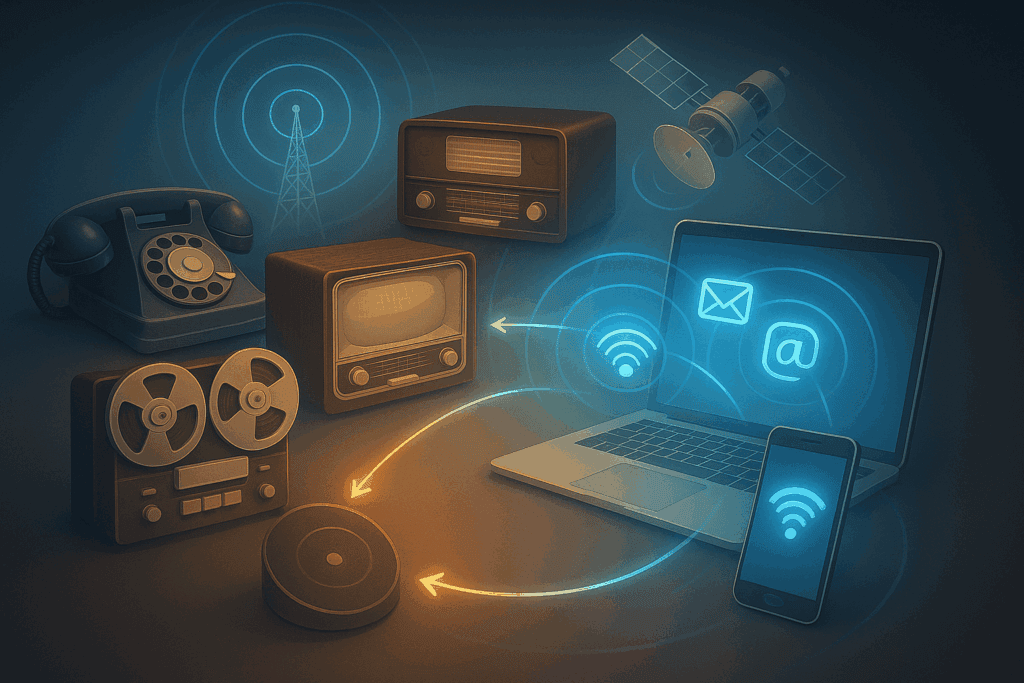
The 20th century witnessed the rise of electronic communication—an era that transformed not only how fast information could travel, but how immersive, global, and integrated communication could become. With the rise of radio, telephone, television, and audio-visual media, human voices, images, and stories now flowed across borders, into homes, and through time itself.
This was the birth of the wired world—and later, the wireless world.
The Telephone: Voice Across Distance
Patented by Alexander Graham Bell in 1876, the telephone turned electrical signals into real-time vocal communication.
- Revolutionized business: Instant coordination across cities and countries
- Transformed relationships: Personal connection without physical presence
- Expanded networks: Switchboards, party lines, and eventually private home phones
Telephony created the infrastructure for synchronous, long-distance dialogue and laid the groundwork for the digital networks to come.
Radio: The First Broadcast Medium
By the 1920s, radio broadcasting had entered the mainstream. Invented through a series of discoveries by Marconi, Tesla, and others, radio used electromagnetic waves to transmit sound across vast distances without wires.
- Live events: Speeches, music, sports, and news could be shared in real time
- Mass influence: Political leaders (like Roosevelt’s “Fireside Chats”) could speak directly to millions
- Cultural fusion: Jazz, world music, and language diversity entered the public imagination
Radio was intimate yet public, uniting people across class and geography through a single, shared medium.
The Golden Age of Television
Television combined sound and image, creating a powerful new medium for storytelling, entertainment, and education.
- First public broadcasts began in the 1930s, with explosive growth after World War II
- Became the dominant household technology by the 1950s and 60s
- Introduced shared global moments: moon landings, Olympic Games, presidential debates
TV changed perception itself—creating a visual grammar of narrative, emotion, and authority. It also became a battleground for ideological control, advertising influence, and state propaganda.
Magnetic Media and Portability
The mid-to-late 20th century saw the proliferation of personalized media:
- Vinyl records, 8-tracks, and cassette tapes: Enabled personal music libraries and mixtapes
- Walkman and boomboxes: Gave mobility to sound, shaping culture and identity
- VCRs, laserdiscs, DVDs: Brought cinema into the living room
- Copy machines: Democratized the ability to reproduce and distribute written ideas
These technologies gave people unprecedented access to, and control over, the production and consumption of media.
Cable, Satellites, and Global TV
By the 1980s:
- Cable TV offered dozens to hundreds of channels
- Satellite transmission connected global audiences
- Call waiting, answering machines, and cordless phones made home telecommunication more flexible and continuous
Mass media became fragmented, specialized, and competitive—offering more voices, but also more noise.
Digital Beginnings: The Personal Computer
By the 1980s and early 90s, the personal computer emerged as a new communication hub.
- Word processors replaced typewriters
- Email began to replace physical mail
- Computer games and chat applications introduced interactivity
- Bulletin board systems (BBS) and early internet protocols enabled user forums
Computers turned users from passive consumers into active participants, setting the stage for the internet age.
The Psychological and Cultural Shift
Electronic communication changed more than infrastructure—it transformed identity, attention, and trust:
- People now expected instant responses
- Visual and auditory media shaped emotion and memory
- Media environments became simulated realities (e.g., reality TV, curated online personas)
- Trust in traditional sources (books, elders, institutions) declined in favor of immediacy and visibility
This electronic era gave rise to mass consciousness, but also mass distraction—and began to erode the boundaries between truth and entertainment.
The stage was now set for the next paradigm: a world where information would not just be broadcast, but networked, searched, shared, and personalized in real time—the digital age.
9. The Digital Age
The Digital Age, beginning in the late 20th century and accelerating through the 21st, transformed communication into a global, real-time, personalized, and algorithmic phenomenon. It marked the convergence of media, computation, and connectivity—compressing space and time, collapsing boundaries between senders and receivers, and reshaping how humanity shares, searches, and stores meaning.
Where the telegraph killed distance, and the radio reached millions, the internet created a hyperlinked world, where every user became a node in a global network of thought, language, commerce, and culture.
The Internet and the Web
Invented in stages by scientists and engineers—including J.C.R. Licklider, Vint Cerf, and Tim Berners-Lee—the internet evolved from a Cold War military network (ARPANET) into a decentralized, civilian superhighway of information.
- 1990s: Emergence of the World Wide Web, email, and search engines (like Yahoo! and Google)
- 2000s: Rise of broadband, Wi-Fi, and e-commerce
- 2010s–2020s: Cloud computing, real-time apps, big data, and the internet of things (IoT)
The internet changed communication by enabling:
- Instantaneous global sharing (text, images, video, live streaming)
- Decentralized publishing (blogs, forums, citizen journalism)
- Collective knowledge production (Wikipedia, open-source collaboration)
- Searchable memory: Humanity’s growing archive of thought became indexed, tagged, and retrievable
The result: a planetary-scale nervous system for human expression and inquiry.
Email, Chat, and the Written Word Reborn
Though visual and audio media dominated the 20th century, the internet revived the written word in new forms:
- Email replaced letters and faxes with asynchronous global dialogue.
- Instant messaging and chat apps (AIM, WhatsApp, Telegram) enabled real-time textual intimacy.
- Forums, bulletin boards, and Reddit fostered community-based discourse.
These formats accelerated thought, but also contributed to:
- Attention fragmentation
- Miscommunication without tone or context
- Troll culture and online anonymity abuse
Yet they also made global conversations possible—across languages, continents, and ideologies.
Social Media and the Age of the Feed
In the 2000s, social media changed the logic of communication itself:
- MySpace, Facebook, Twitter, Instagram, TikTok created “feeds” where content is not sought, but delivered algorithmically.
- Individuals became broadcasters, brands, and influencers.
- Communication became performative, quantified (likes, shares, followers), and curated.
Pros:
- Empowered grassroots movements (#MeToo, Arab Spring)
- Enabled real-time global witnessing
- Fostered creative collaboration
Cons:
- Created echo chambers and polarization
- Amplified disinformation and propaganda
- Increased anxiety, comparison, and identity fragmentation
Smartphones: The Pocket Portal
With the launch of the iPhone (2007) and Android ecosystem, the world entered the mobile-first era:
- Phones became cameras, GPS devices, libraries, and studios
- Push notifications turned communication into a continuous stream
- Voice assistants (Siri, Alexa) introduced conversational computing
- Apps made every industry—finance, romance, education, politics—into a communication interface
The smartphone is now the most ubiquitous communications device in human history, integrating the physical and digital into a hybrid reality.
AI, Algorithms, and the End of the Human Author?
The 2020s brought machine-generated communication to the forefront:
- AI models like GPT and DALL·E produce human-like text and imagery
- Recommendation engines decide what people see, think, and buy
- Bots influence elections, trends, and public opinion
Communication is no longer purely human—it is algorithmically shaped, and increasingly machine-mediated.
This raises profound questions:
- What is authorship?
- Can machines communicate meaningfully?
- Who controls the narrative?
Encryption, Surveillance, and the Ethics of the Digital Word
As communication went digital, it also became:
- Trackable: Data trails are collected, bought, and sold
- Hackable: State and corporate espionage threaten autonomy
- Encryptable: Technologies like Signal, Tor, and blockchain offer privacy and security
We now live in a tension between openness and control, convenience and consent.
The Human Cost and the Human Potential
Benefits:
- Universal access to education and expression
- Global empathy and awareness
- New languages of art, activism, and intimacy
Challenges:
- Distraction, loneliness, and information fatigue
- Tribalism and surveillance capitalism
- Loss of silence, slowness, and embodied presence
Yet the digital age also offers the tools for global enlightenment—if used wisely. It demands not just new technologies, but new philosophies of attention, compassion, and truth.
In the next section, we explore where communication might be heading—into realms of neural interfaces, quantum entanglement, and planetary consciousness.

10. Modern Innovations and the Future of Communication
As we move deeper into the 21st century, communication continues to evolve at an accelerating pace. The lines between human, machine, and network are increasingly blurred. New tools not only enhance our ability to share ideas—but challenge our understanding of what it means to communicate at all. The future of communication is no longer limited to speech or symbols—it may involve thought itself, shared directly, securely, and across unimaginable distances.
Brain–Computer Interfaces (BCIs)
The frontier of neurotechnology is enabling direct communication between the brain and digital systems:
- Neural implants from companies like Neuralink aim to allow paralyzed individuals to type or move robotic limbs using thought alone.
- Non-invasive BCIs are exploring ways to detect intention or emotion via EEG (electroencephalogram) signals.
- Future systems could allow brain-to-brain communication, telepathy-like data transfer, or collaborative thinking environments.
Potential benefits:
- Radical accessibility for disabled users
- Direct learning or memory sharing
- Emotionally attuned AI companions
Risks and concerns:
- Cognitive hacking
- Surveillance of thought
- Consent and cognitive privacy
Quantum Communication and Entangled Information
Quantum physics may revolutionize the security and speed of communication:
- Quantum entanglement allows for the instantaneous correlation of information between particles, potentially enabling near-instant data exchange.
- Quantum key distribution (QKD) offers theoretically unbreakable encryption.
Although still in experimental stages, quantum networks may form the foundation for ultra-secure global communication systems in science, diplomacy, and intelligence.
Augmented and Mixed Reality
Technologies like augmented reality (AR) and mixed reality (MR) blend the digital with the physical:
- AR glasses overlay real-time data, captions, or navigation in one’s field of vision.
- MR environments allow people to interact with 3D holograms and distant collaborators as if physically present.
- Future classrooms, meetings, and therapy sessions may occur in shared virtual spaces with tactile, visual, and auditory fidelity.
Communication in these environments becomes multisensory, co-spatial, and interactive in real-time.
AI-Mediated and AI-Generated Communication
Artificial intelligence is no longer just a tool—it is becoming a communication partner:
- AI translators enable multilingual conversation in real time.
- Chatbots and digital companions offer emotional support, counseling, and companionship.
- AI-generated art, speeches, and writing challenge human uniqueness in creative communication.
This raises essential questions:
- What is the role of authenticity?
- Can machines be moral or empathetic communicators?
- How do we preserve human dignity and agency in a world of synthetic voices?
Civic and Ethical Communication Futures
As communication technologies reshape how we relate to one another, societies face major ethical dilemmas:
- Who owns communication platforms—and who sets their norms?
- How do we regulate deepfakes, bots, and misinformation?
- Can we build communication systems that foster empathy, equity, and collective intelligence?
Emerging civic technologies aim to:
- Improve government transparency through open data and secure platforms
- Enhance public participation via deliberative forums and citizen feedback tools
- Create inclusive digital environments through ethical design and accessibility standards
The Rise of Metacommunication and Conscious Dialogue
In an age of increasing speed and automation, one of the most important innovations may be the return to conscious communication:
- Metacommunication: Talking about how we communicate (tone, intention, power dynamics)
- Mindful discourse: Slowing down to listen, reflect, and speak with clarity
- Global dialogue: Platforms for intercultural, interreligious, and interdisciplinary exchange
This points toward a future in which communication is not just more advanced, but also more aware, deliberate, and humanely designed.
Visionary Possibilities
If current trajectories continue, the future may bring:
- Interplanetary communication: Coordinating between Earth, Moon, Mars, and beyond
- Genetic messaging: Using DNA as a storage medium or code language
- Collective consciousness interfaces: Group decision-making through shared neural networks
- Inter-species communication: Real-time translation of animal signals into human-readable formats
These possibilities are speculative—but they reflect a deeper truth: communication is not just a tool. It is the interface between consciousness and cosmos.
In the next section, we explore how these technologies shape—and are shaped by—governments, militaries, and intelligence systems, and how Science Abbey’s humanist principles call for a new ethics of planetary communication.
11. Communication in Military, Intelligence, and Governance
Throughout history, communication has not only served the needs of individuals and cultures—it has been a decisive force in warfare, statecraft, and social control. From coded messages carried by runners to AI-enhanced surveillance systems, the evolution of communication has shaped the balance of power between nations, rulers, and the public. As technologies evolve, so too do the stakes—for security, freedom, and democracy.
Military Communication: From Drums to Drones
In battle, communication is the difference between chaos and coordination, victory and defeat.
Historical forms:
- Signal drums, horns, and flags used in ancient and medieval warfare
- Semaphore towers in Napoleonic France
- Carrier pigeons, telegraphs, and field radios in World Wars
Modern militaries now use:
- Encrypted satellite systems
- Secure radio and digital command networks
- Drones and unmanned vehicles, relaying live video and telemetry
- Cyberweapons that disrupt or intercept communications
Modern warfare is as much about informational superiority as physical force. The concept of the OODA loop—Observe, Orient, Decide, Act—places communication at the center of military decision-making.
Espionage, Cryptography, and Surveillance
From ancient ciphers to quantum encryption, intelligence has long relied on the control of secret communication.
- The Spartan scytale and Caesar cipher were early tools of covert messaging.
- World War II cryptography, including the work of Alan Turing and the cracking of the Nazi Enigma code, proved pivotal to Allied success.
- The Cold War brought advanced signal intelligence (SIGINT) and human intelligence (HUMINT), including vast networks of spies, bugs, and wiretaps.
Today, intelligence communication includes:
- Mass data mining by agencies like the NSA or GCHQ
- Cyberespionage and AI-based decryption
- Quantum-secure messaging prototypes in use by national security agencies
The challenge: How to balance national security with individual rights in an age where every device is a potential microphone.
Governance and Public Communication
Governments rely on communication to inform, unify, and persuade the public. But they also wield it to control, distract, or obscure.
Positive functions:
- Public health messaging
- Emergency alerts
- Diplomatic negotiation
- Civic education and elections
Dangers:
- Propaganda: Weaponized narratives for manipulation
- Censorship: State control over media and dissent
- Disinformation: Deliberate confusion to erode trust
The rise of state-sponsored troll farms, deepfake videos, and AI-generated forgeries adds new complexity to public trust.
Deliberative Democracy and Transparent Systems
Against these dangers, transparent and participatory communication systems are essential for ethical governance.
Science Abbey and other humanist institutions advocate:
- Open-source civic platforms: Where citizens help shape policy and report corruption
- Data ethics in AI systems: Ensuring algorithms serve democratic goals
- Universal access: Bridging the digital divide to ensure equity in political participation
- Clear language laws: Mandating accessibility and honesty in legal and bureaucratic communication
This vision aligns with Integrated Humanism—a global ethics that sees communication not as a weapon or commodity, but as a sacred trust among free and equal beings.
The Role of Communication in Social Movements
Revolutions and reforms are born in the streets—but also in the pamphlet, the poster, the tweet, the chant.
Historical examples:
- Common Sense by Thomas Paine (1776)
- The Declaration of the Rights of Man and of the Citizen (1789)
- The Letter from Birmingham Jail by Martin Luther King Jr.
- The internet-fueled uprisings of the Arab Spring
In each case, communication was not just a tool—it was the medium through which freedom came into being.
Global Governance and Planetary Dialogue
As planetary crises—from climate change to pandemics—demand coordinated action, the need for intergovernmental, intercultural communication becomes urgent.
Needed innovations include:
- Multilingual global forums with automatic translation
- Participatory global ethics networks
- AI systems trained on diverse cultural perspectives
- Planetary codes of digital conduct—rooted in human rights, ecological wisdom, and scientific integrity
Communication is now the nervous system of civilization. If used wisely, it can unify humanity for survival and flourishing. If abused, it can undermine truth, fragment societies, and automate oppression.
In the final section of this article, we turn from history and systems to vision—toward a world where communication becomes not only faster and smarter, but also wiser and more compassionate.

12. Conclusion – Toward a Conscious Planetary Dialogue
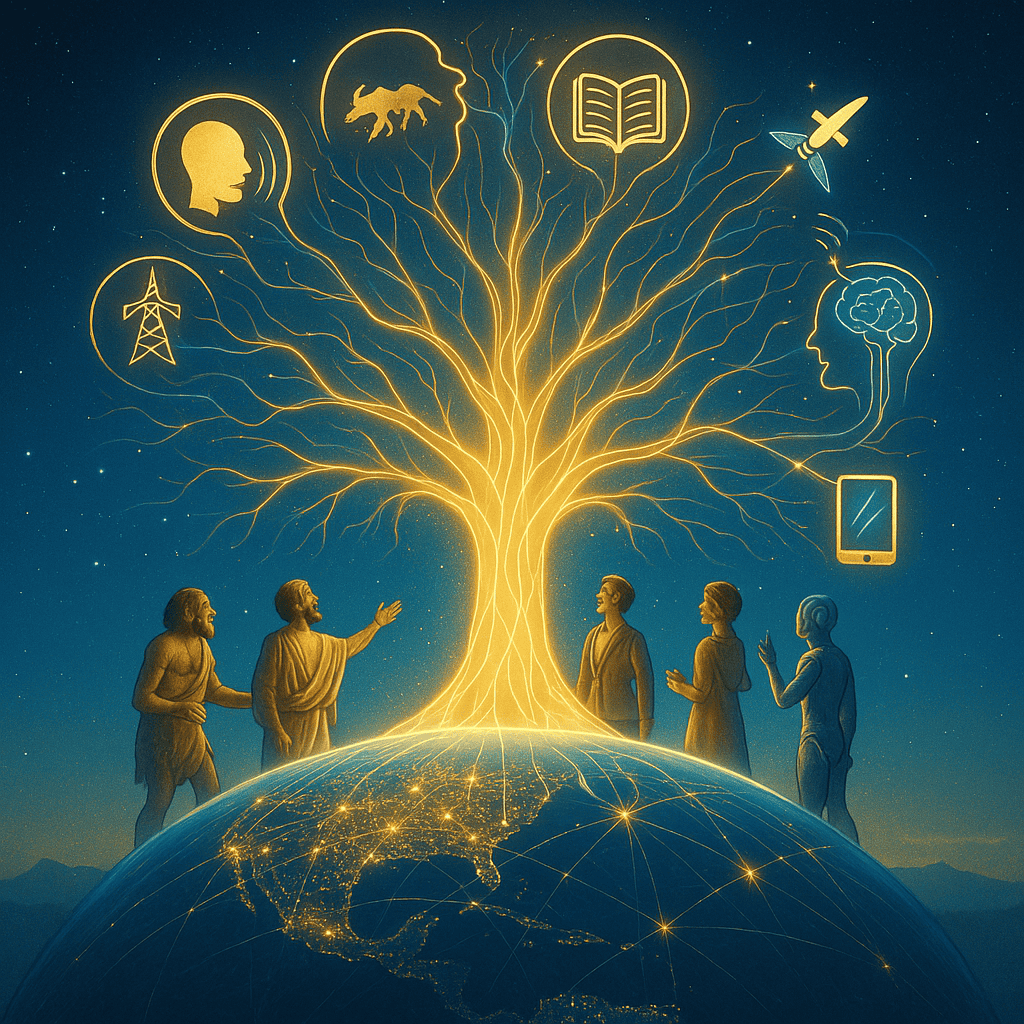
Communication has always been more than a tool. It is the expression of life’s drive to connect, to organize, to understand, and to evolve. From the murmur of the forest canopy to the whisper of a neural impulse, from the first gestures of early humans to the symphonic pulse of the internet, communication is the thread that weaves all sentient life together.
We now stand at a crossroads in the evolution of this thread. Never before have so many people spoken, written, streamed, and signaled across borders. And never before has the power to connect also carried such profound risks: misinformation, alienation, addiction, fragmentation, surveillance, and manipulation.
Yet these dangers arise not from communication itself—but from its misuse, its unconscious acceleration, and its ethical void. What is needed now is not just more communication, but conscious communication—deliberate, ethical, inclusive, and regenerative.
From Noise to Meaning
In a world saturated with messages, true communication is no longer about volume—it is about meaning, intention, and presence. We must learn to ask:
- What am I really saying?
- Why am I saying it?
- To whom, and with what consequence?
In this new era, slowness may become a radical act. Silence may become sacred space. And listening—deep, unguarded, empathetic listening—may be the most revolutionary form of speech.
Toward a Planetary Ethic of Communication
Science Abbey and Integrated Humanism call for a new global ethic rooted in:
- Truthfulness over spin
- Compassion over provocation
- Wisdom over reaction
- Inclusion over dominance
- Interconnection over fragmentation
In practice, this means designing communication systems—technological, institutional, educational—that reflect the best of human values:
- Transparency, accountability, and digital literacy
- Rights to privacy, autonomy, and authentic identity
- Tools for healing dialogue, intercultural understanding, and conflict resolution
- Platforms that uplift truth, beauty, and justice
The Conversation Ahead
Imagine a world in which:
- Governments conduct open deliberations with citizens in real time.
- Children learn not only how to speak and write, but how to listen and question ethically.
- AI systems amplify not just engagement, but understanding and truth.
- A shared digital commons becomes the fertile ground for peace, education, and planetary resilience.
Communication in such a world is no longer a product or transaction. It is a sacred human faculty—a collective act of vision, truth-telling, and care.
We are all communicators. We are all recipients.
And we are all authors of the next chapter of human meaning.
In the appendix that follows, we honor 50 of the most powerful public speeches in human history—words that helped shape our moral compass and collective future.
Appendix: 50 of the Greatest Speeches of All Time
| # | Speaker | Speech Title | Year | Context |
| 1 | Pericles | Funeral Oration | 431 BCE | Defense of Athenian democracy during the Peloponnesian War |
| 2 | Socrates (via Plato) | Apology | 399 BCE | Defense of truth and intellectual freedom in Athenian court |
| 3 | Ashoka the Great | Edicts on Dhamma | c. 260 BCE | Promotion of tolerance, nonviolence, and human welfare |
| 4 | Jesus of Nazareth | Sermon on the Mount | c. 30 CE | Radical ethics of compassion, forgiveness, and inner virtue |
| 5 | Abd al-Rahman I | Mosque Inauguration Speech | 786 | Vision of cultural integration and learning in Al-Andalus |
| 6 | Alcuin of York | Address to Charlemagne on Learning | c. 800 | Vision of education and reason guiding Christian governance |
| 7 | Charlie Chaplin | Final Speech from ‘The Great Dictator” | 1940 | Statement against greed, hate, intolerance, and fascism |
| 8 | Girolamo Savonarola | Sermon on Civic Renewal | 1495 | Call for moral reform and justice amid Florentine corruption |
| 9 | Martin Luther | Speech at the Diet of Worms | 1521 | Defiance of ecclesiastical tyranny in defense of conscience |
| 10 | Elizabeth I of England | Speech to the Troops at Tilbury | 1588 | Inspirational defense of nation, dignity, and unity |
| 11 | Galileo Galilei | Abjuration Before the Inquisition | 1633 | Veiled defense of scientific truth under persecution |
| 12 | Frederick Douglass | What to the Slave Is the Fourth of July? | 1852 | Scathing moral critique of American hypocrisy and racism |
| 13 | Sojourner Truth | Ain’t I a Woman? | 1851 | Call for equality, intersectionality, and moral recognition |
| 14 | Abraham Lincoln | Gettysburg Address | 1863 | Elevation of democratic ideals and sacrifice |
| 15 | John Stuart Mill | Speech on Free Expression | 1869 | Defense of liberty, reason, and democratic dissent |
| 16 | Emmeline Pankhurst | Freedom or Death | 1913 | Feminist call to arms for suffrage and equal dignity |
| 17 | Mahatma Gandhi | Quit India Speech | 1942 | Nonviolent resistance against imperialism |
| 18 | Franklin D. Roosevelt | The Four Freedoms | 1941 | Vision of universal human rights and democratic peace |
| 19 | Charles de Gaulle | Appeal of 18 June | 1940 | Rallying cry for the Free French and anti-fascist resistance |
| 20 | Albert Einstein | The War Is Won, But Peace Is Not | 1945 | Warning against nuclear arms and call for global governance |
| 21 | Winston Churchill | We Shall Fight on the Beaches | 1940 | Endurance and moral courage in the face of tyranny |
| 22 | Jawaharlal Nehru | Tryst with Destiny | 1947 | Celebration of Indian independence and responsibility |
| 23 | Eleanor Roosevelt | On the Universal Declaration of Human Rights | 1948 | Global call for dignity, freedom, and international cooperation |
| 24 | Martin Luther King Jr. | I Have a Dream | 1963 | Hopeful moral vision of racial equality and justice |
| 25 | Malcolm X | The Ballot or the Bullet | 1964 | Assertive defense of civil rights and political agency |
Appendix (continued): 50 of the Greatest Speeches of All Time
| # | Speaker | Speech Title | Year | Context |
| 26 | Bertrand Russell | Man’s Peril | 1955 | Anti-nuclear appeal for global unity and scientific responsibility |
| 27 | John F. Kennedy | We Choose to Go to the Moon | 1962 | Vision of scientific exploration and human aspiration |
| 28 | Rachel Carson | The Obligation to Endure (adapted from Silent Spring) | 1962 | Call to ecological awareness and scientific stewardship |
| 29 | Robert F. Kennedy | On the Death of Martin Luther King Jr. | 1968 | Compassionate public grieving and call to moral courage |
| 30 | César Chávez | The Wrath of Grapes | 1986 | Labor justice, environmental ethics, and nonviolent protest |
| 31 | Vaclav Havel | New Year’s Address to the Nation | 1990 | Post-totalitarian hope grounded in truth and civic morality |
| 32 | Nelson Mandela | Inaugural Address as President of South Africa | 1994 | Reconciliation and human dignity after apartheid |
| 33 | Carl Sagan | Pale Blue Dot | 1994 | Cosmic humility and a planetary perspective on human ethics |
| 34 | Aung San Suu Kyi | Freedom from Fear | 1990 | Moral clarity and resistance in the face of military oppression |
| 35 | Richard Dawkins | Militant Atheism | 2002 | Support for the separation of church and state |
| 36 | Sam Harris | Death and the Present Moment | 2012 | Meditation and a contemplation on life and death |
| 37 | Malala Yousafzai | UN Youth Assembly Speech | 2013 | Girls’ education, courage, and the universality of learning |
| 38 | Greta Thunberg | How Dare You | 2019 | Fierce critique of climate denial and intergenerational injustice |
| 39 | David Attenborough | COP26 Address | 2021 | Deep-time perspective on environmental action and human legacy |
| 40 | Dan Dennett | Responding to Pastor Rick Warren | 2007 | Teaching religion, morality beyond religious belief |
| 41 | Yuval Noah Harari | The Future of Humanity (WEF) | 2018 | Warnings on AI, data colonialism, and ethical responsibility |
| 42 | Christopher Hitchens | God is Not Great (Google Talk) | 2007 | Promoting irreligion for peace and understanding |
| 43 | Amartya Sen | Development as Freedom (Lecture) | 1999 | Linking economics, human rights, and capability theory |
| 44 | Margaret Atwood | Spotlight Speech | 2017 | On the power of language, myth, and women’s voices |
| 45 | Stephen Hawking | Brief Answers to Big Questions (adapted lecture) | 2018 | Science, awe, and the ethical frontier of human progress |
| 46 | Ban Ki-moon | UN Climate Summit Opening | 2014 | Multilateral urgency for climate coordination and justice |
| 47 | Julius Nyerere | Speech on Ujamaa and African Socialism | 1967 | Vision of community-centered development and dignity |
| 48 | Samantha Power | Remarks at the UN on Human Rights | 2013 | Moral responsibility in global diplomacy |
| 49 | Julia Sweeney | Letting Go of God | 2004 | Heartfelt personal journey from faith to reason |
| 50 | Fred Rogers | Senate Subcommittee on Communications | 1969 | Defending public education |
These speeches reflect the values of truth, justice, scientific insight, freedom, compassion, and planetary stewardship. They are drawn from diverse traditions, geographies, and eras, but each in its way has shaped the evolving moral and intellectual compass of humanity.