

Table of Contents
I. Introduction
- The Danger of Believing Falsehoods in the Age of Intelligence
II. The History of Conspiracy Theories
- From Ancient Plots to Modern Disinformation
- How Conspiracy Thinking Crossed from Fringe to Mainstream
III. How Conspiracy Theories Start and Spread
- Catalysts: Fear, Uncertainty, and Social Crisis
- Mechanisms: Echo Chambers, Algorithms, and Opportunists
- The Feedback Loop Between Media, Politics, and Public Fear
IV. Who Believes Them, and Why?
- Psychological Susceptibility and Cognitive Bias
- Demographics and Education
- Emotional Needs and Social Identity
V. The Most Outrageous and Ridiculous Conspiracy Theories Today
- Absurdity in the Age of Information
VI. The Most Malicious and Dangerous Conspiracy Theories Today
- When Lies Kill: Real-World Harm from False Beliefs
VII. An Integrated Humanist Approach to Conspiracy Thinking
- Compassion, Clarity, and a Commitment to Truth
- Understanding Without Shaming
- The Moral Cost of False Beliefs
- Replacing Fear with Empirical Curiosity
VIII. The Role of Science Abbey and the Neutral Analytical Vigilance Institute (NAVI)
- Independent Intelligence in the Age of Deception
- Science Abbey: A Sanctuary for Truth and Inquiry
- NAVI: The Intelligence Agency for the People
IX. How to Do Your Own Research and Debunk Claims
- A Practical Guide for Navigating Information in the Age of Noise
X. Conclusion
- Truth as a Public Good: Building Immunity Against the Next Big Lie
XI. Appendix
- The 25 Best Known Conspiracy Theories
I. Introduction: The Danger of Believing Falsehoods in the Age of Intelligence
In an age defined by instant information, global networks, and unprecedented scientific progress, one might assume that ignorance and deception would wither under the light of reason. Instead, the opposite often occurs: conspiracy theories—once relegated to the fringes of public discourse—now infect mainstream conversation, influence policy, and threaten public health, security, and democracy itself.
Why do so many intelligent people fall prey to obvious falsehoods? Why are misinformation and fabricated narratives often more persuasive than truth? And what can be done to confront this crisis—not with censorship or ridicule, but with understanding, education, and empowered inquiry?
The stakes are not abstract. From the resurgence of measles due to anti-vaccine conspiracies, to the storming of capitol buildings fueled by political lies, to the erosion of climate science in the face of manufactured doubt, we are witnessing the consequences of epistemic breakdown: a failure of societies to agree on reality itself.
This article explores the roots, mechanisms, and dangers of conspiracy theories. We will examine how they begin, why they persist, who they target, and which ones pose the gravest threat. Some are absurd—entertaining, even. Others are lethal. Through the lens of Integrated Humanism, we’ll consider how a society committed to truth, dignity, and rational discourse can respond. And through the tools of Science Abbey and the Neutral Analytical Vigilance Institute (NAVI), we offer a vision of how to build a resilient and intelligent public—a society inoculated not just against disease, but against deception.
II. The History of Conspiracy Theories
From Ancient Plots to Modern Disinformation
Conspiracy theories are not new. From the earliest empires to the digital age, they have flourished wherever mystery, fear, and power intersect. In ancient Rome, Nero falsely accused Christians of setting fire to the city to divert blame from himself. In medieval Europe, waves of plague were blamed on Jewish communities accused of poisoning wells—a conspiracy myth that fueled horrific violence. Across centuries and continents, perceived enemies—foreigners, intellectuals, minorities, the wealthy—have been cast as secret puppet-masters behind society’s ills.
The Age of Revolutions gave rise to new forms of conspiracy thought. In post-Enlightenment France and the newly formed United States, the Illuminati were blamed for fomenting revolution, atheism, and social collapse. Freemasonry, often misunderstood and cloaked in symbolism, became the focus of paranoia and scapegoating—a trend that would endure well into the 20th century.
The modern age, however, brought a change in scale. With the rise of mass media and the geopolitical tensions of the Cold War, conspiracy theories multiplied. The JFK assassination, the moon landing, the origins of HIV/AIDS, and the 9/11 attacks all spawned countless theories, each claiming to reveal the “truth” behind official narratives. These weren’t merely idle speculations—they shaped public opinion, policy, and trust in institutions.
How Conspiracy Thinking Crossed from Fringe to Mainstream
In the past, conspiracy theories remained mostly at the margins, passed through pamphlets, radio broadcasts, or niche subcultures. But the internet has collapsed those margins. With the emergence of social media, algorithms now reward the sensational over the sober, the emotional over the accurate. As a result, unverified speculation can go viral within hours, while correction—if it arrives at all—follows too late.
At the same time, populist political movements have weaponized conspiracy thinking. Once the preserve of outliers, conspiracy rhetoric is now common in mainstream politics, often invoked to delegitimize opposition, discredit the press, or sow distrust in democratic institutions.
The trajectory is clear: conspiracy theories are no longer isolated curiosities. They are instruments of persuasion and power. To understand their modern potency, we must begin by studying their ancient roots.
III. How Conspiracy Theories Start and Spread
Catalysts: Fear, Uncertainty, and Social Crisis
Conspiracy theories thrive in the shadows of uncertainty. When people face events they cannot easily explain—economic collapse, terrorist attacks, pandemics—they seek clarity, causality, and someone to blame. In these moments, the human brain craves narrative cohesion, even if it must invent it. Fear makes us vulnerable to false certainty, and conspiracy theories offer emotionally satisfying answers where reality is complex or unresolved.
Crises exacerbate this vulnerability. The 14th-century Black Death saw pogroms against Jews. The aftermath of 9/11 saw Muslims and immigrants cast as threats. The COVID-19 pandemic gave rise to a global storm of misinformation—about vaccines, 5G, and shadowy elites—fueled by collective anxiety and a desperate need to feel in control.
Mechanisms: Echo Chambers, Algorithms, and Opportunists
In the past, conspiracy theories spread by word of mouth or print media. Today, they are propelled by algorithms. Social media platforms—engineered to maximize engagement—prioritize shocking, emotionally provocative content. This means conspiracy posts often rise to the top, spreading far faster than corrections or sober analysis.
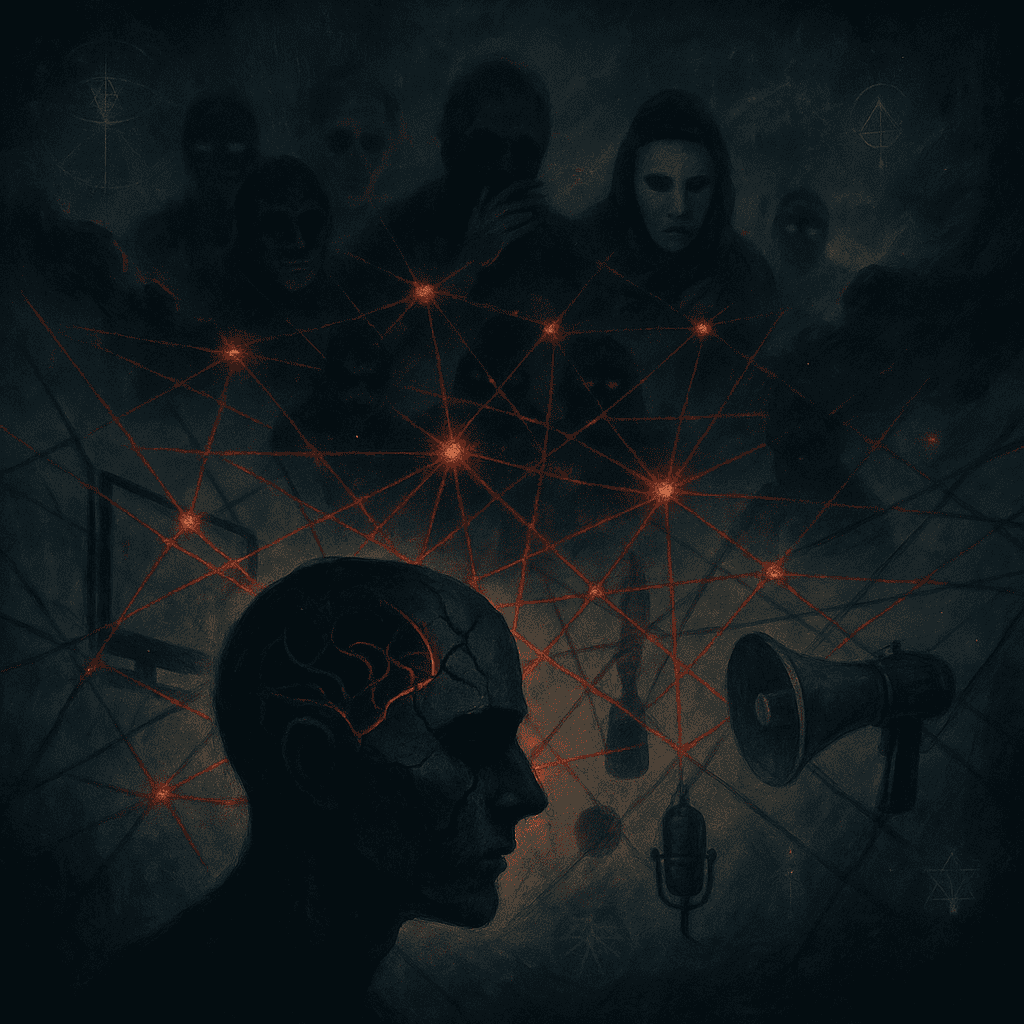
What begins as a fringe theory on Reddit or Telegram can reach millions through Facebook or YouTube. “Echo chambers” form, isolating users in self-reinforcing circles where dissenting views are silenced or ridiculed. Once inside, conspiracy believers are often radicalized further, absorbing increasingly extreme claims.
Meanwhile, opportunists—whether political actors, disinformation agents, or grifters—capitalize on these dynamics. Some peddle conspiracies for profit, through merchandise, books, and monetized channels. Others use them to polarize, destabilize, or manipulate populations. In both cases, the truth is secondary to the power that falsehoods can yield.
The Feedback Loop Between Media, Politics, and Public Fear
Once a conspiracy theory gains traction, it often enters a feedback loop. Media outlets—sometimes unwittingly—amplify it by covering its spread. Politicians may reference it to signal alignment with a base or to discredit opponents. Public figures repeating it lends it legitimacy, and each new endorsement recruits fresh believers.
This cycle erodes trust not only in facts, but in the very idea that facts matter. Objective reality becomes optional—just another narrative among many. In this post-truth environment, conspiracy theories are no longer fringe distractions; they are engines of division.
IV. Who Believes Them, and Why?
Psychological Susceptibility and Cognitive Bias
Belief in conspiracy theories is not limited to the uneducated or unwell. It is, at its core, a cognitive vulnerability rooted in how all humans process information. Several psychological biases contribute to the allure of conspiratorial thinking:
- Pattern recognition: Humans evolved to see patterns—even when none exist. Conspiracy theories offer a false sense of structure, turning chaos into coherence.
- Confirmation bias: People seek out information that confirms what they already believe and ignore contrary evidence.
- Proportionality bias: We assume that big events must have big causes. The idea that a lone gunman or random virus could upend the world feels inadequate to the psyche.
- Agency bias: We prefer to believe events are caused by intentional actors rather than accidents or systems.
Conspiracy theories also serve emotional needs. They can help people feel unique (“I know the real story”), righteous (“I’m on the side of truth”), and safe (“I can predict and defend against hidden threats”). For those disempowered or marginalized, conspiracies offer a seductive narrative: You are not alone. They are doing this to you. And now you know.
Demographics and Education
While anyone can fall into conspiratorial thinking, certain demographic patterns do emerge. Research shows that belief in conspiracy theories is more prevalent among those who:
- Experience political or economic disempowerment
- Have lower trust in institutions (government, media, science)
- Identify strongly with ideological or identity-based groups
- Lack access to quality education or scientific literacy
But higher education does not always confer immunity. In some cases, well-educated individuals may use their intelligence to rationalize conspiracies more elegantly or selectively cite sources to support a desired narrative. In other words, intelligence alone is no defense against motivated reasoning.
Emotional Needs and Social Identity
Conspiracy theories often fill a social void. In polarized societies, they offer belonging to in-groups defined by opposition to mainstream narratives. They become markers of tribal loyalty, rallying cries for those who feel alienated from dominant culture.
Some theories provide scapegoats for economic or social anxieties: immigrants, billionaires, scientists, minorities. Others wrap their followers in a sense of heroic purpose, imagining themselves as part of a righteous resistance against an evil machine. These stories are emotionally powerful—and dangerously compelling.
In this light, conspiracy thinking is not just a failure of reason; it is a cry for meaning, identity, and control in a world perceived as unjust and overwhelming.
V. The Most Outrageous and Ridiculous Conspiracy Theories Today
Absurdity in the Age of Information
Some conspiracy theories are so bizarre they border on satire—yet each has real followers, forums, merchandise, and in some cases, organized events. These theories may appear humorous on the surface, but they also reveal how deeply people can detach from empirical reality when motivated by mistrust, alienation, or the allure of secret knowledge.
Below are several of the most outrageous conspiracy theories still circulating widely today:
1. Flat Earth
Despite centuries of astronomical evidence, some people continue to claim the Earth is a flat disc surrounded by an ice wall and covered by a dome. NASA, they argue, is lying to the world, using doctored photos and secret science to maintain the illusion of a globe. Flat Earth meetups, YouTube channels, and even “research cruises” continue to promote the theory. For believers, it isn’t just about the shape of the Earth—it’s about distrusting everything official.
2. Reptilian Overlords
Popularized by David Icke, this theory claims that shape-shifting reptilian aliens secretly control world governments, the media, and the economy. These lizard people supposedly disguise themselves as human elites—politicians, royalty, CEOs—manipulating humanity for their own ends. The theory mixes sci-fi with ancient mythology and anti-Semitic tropes, revealing how nonsense and hatred can coexist.
3. Birds Aren’t Real
What began as a parody has taken on a life of its own. The satirical “Birds Aren’t Real” movement claims that all birds were exterminated by the U.S. government in the 20th century and replaced with drone replicas to surveil citizens. Though the movement was founded to mock and highlight the absurdity of real conspiracy thinking, some followers have reportedly embraced it unironically—an ironic ouroboros of misinformation.
4. CERN and the Portal to Hell
According to this theory, the CERN particle accelerator is not a scientific instrument, but a tool to open interdimensional portals or summon ancient deities. Some claim it already destroyed the Earth in 2012 and we now live in a parallel timeline. The mixture of scientific complexity and fear of the unknown makes CERN a frequent target for supernatural speculation.
5. The Mandela Effect and Alternate Realities
Some conspiracy theorists claim that discrepancies in memory—like whether the children’s book was called “Berenstein Bears” or “Berenstain Bears”—prove that our universe has shifted timelines. This “Mandela Effect” is interpreted as evidence of parallel dimensions, government manipulation, or even divine intervention. Rather than consider memory fallibility, believers posit global-level interference with reality itself.
6. Time-Traveling Celebrities and Immortal Elites
From Keanu Reeves to Nicolas Cage, numerous celebrities are accused of being time travelers or immortal beings. Side-by-side photos of historical figures and modern stars are presented as “evidence.” In some cases, this dovetails with bloodline conspiracies, claiming secret immortality among elite families. At best, it’s tabloid whimsy. At worst, it reflects deep mistrust of success and fame.
These theories are wildly implausible. Yet each demonstrates how irrational beliefs can flourish in the absence of trusted information, sound education, and a shared standard of truth. While these examples may seem harmless, they often serve as gateways into darker and more dangerous ideologies.
VI. The Most Malicious and Dangerous Conspiracy Theories Today
When Lies Kill: Real-World Harm from False Beliefs
While some conspiracy theories are merely strange or amusing, others are deadly. Malicious conspiracy theories spread not just ignorance but hate, fear, and violence. They undermine public health, destabilize democracies, and incite real-world harm against individuals and communities. They are not just “opinions”—they are strategic distortions of reality, often weaponized by bad actors for political or financial gain.
Below are several of the most dangerous conspiracy theories still in circulation today:
1. Anti-Vaccine Movements
The idea that vaccines are part of a sinister plot—whether to cause autism, implant microchips, or alter DNA—has led to a resurgence of preventable diseases, such as measles and polio, in countries once thought to have eradicated them. The anti-vaccine movement thrives on social media and has been amplified by celebrities, politicians, and foreign disinformation campaigns. According to a Guardian report (2025), measles cases are now surging in Europe and the U.S. due to anti-vaccine conspiracies and organized disinformation【source】. The cost is measurable in lives lost and public health systems strained.
2. QAnon and the Satanic Pedophile Panic
QAnon is a sprawling conspiracy claiming that a secret cabal of Satan-worshipping elites (including politicians, celebrities, and academics) are trafficking children and controlling world events. While fantastical, QAnon has inspired real-world violence—including armed standoffs, kidnappings, and the storming of the U.S. Capitol on January 6, 2021. It blends apocalyptic Christian fundamentalism, political paranoia, and social alienation into a toxic brew that radicalizes its followers and delegitimizes democracy.
3. Holocaust Denial and Historical Revisionism
Denying the Holocaust is one of the oldest and most insidious forms of conspiracy theory. It is often rooted in anti-Semitism and political extremism. Such denial not only disrespects the memory of victims—it serves to erase, excuse, and repeat crimes against humanity. In many countries, Holocaust denial is not just dangerous, but illegal. Yet it continues to circulate through fringe websites, underground publications, and coded language in extremist circles.
4. Climate Change Denial
Despite overwhelming scientific consensus, climate change denial persists, often funded by fossil fuel interests and spread by media personalities and political figures. This theory casts climate science as a hoax, a scam, or a plot to impose global socialism. The result is delayed action, polarized policy, and irreversible ecological harm. Climate denial is a conspiracy with planetary consequences.
5. The “Great Replacement” Theory
Popular in far-right circles, this racist conspiracy claims that white populations are being deliberately “replaced” through immigration, multiculturalism, or birth rate manipulation. This theory has inspired multiple mass shootings, including in Christchurch, El Paso, and Buffalo. It draws on longstanding xenophobic and anti-Semitic tropes, presenting demographic change as an existential war.
6. Deep State and Electoral Fraud Narratives
The belief in a hidden, unelected “deep state” manipulating elections, governance, and media has destabilized democratic institutions around the world. In the United States, the lie that the 2020 election was “stolen” incited an insurrection and continues to erode trust in electoral integrity. Around the globe, similar narratives have fueled political violence, coups, and authoritarian crackdowns.
These theories do not merely mislead—they destroy. They destroy trust, civility, safety, and sometimes life itself. In a global society increasingly defined by the spread of digital information, these forms of viral deceit must be countered not just with facts, but with ethical vigilance, civic education, and a shared commitment to truth as a public good.
VII. An Integrated Humanist Approach to Conspiracy Thinking
Compassion, Clarity, and a Commitment to Truth
Integrated Humanism begins with a simple but powerful premise: every person has the right—and the responsibility—to live in alignment with truth, dignity, and collective well-being. In a world flooded with falsehoods, this is not a passive stance. It is an active discipline. An Integrated Humanist response to conspiracy theories must go beyond ridicule and fact-checking. It must address the deeper moral and psychological dimensions of belief.
Understanding Without Shaming
People believe in conspiracy theories for a reason. Often that reason is fear—of losing control, status, identity, or meaning. Sometimes it is loneliness or grief. Sometimes it is the learned behavior of growing up in a system that rewards distrust. An Integrated Humanist does not mock the believer, but seeks to understand the emotional architecture of the belief.
This does not mean validating falsehoods. It means distinguishing between the person and the story they have internalized. Healing begins with dialogue, not derision. Dismantling deception requires more than pointing to evidence—it requires creating an environment where people feel safe enough to change their minds.
The Moral Cost of False Beliefs
Conspiracy theories may feel harmless at first—amusing, curious, even thrilling. But beliefs guide actions, and actions have consequences. If someone believes vaccines are a weapon, they may refuse immunization—and spread disease. If someone believes an ethnic group is plotting to replace them, they may act with hate or violence. If someone believes democracy is a lie, they may abandon or attack it.
The Integrated Humanist affirms that truth is not just a scientific standard—it is a moral necessity. A society cannot function without a common epistemic ground. Without it, compassion becomes naïve, justice becomes partisan, and progress becomes impossible.
Replacing Fear with Empirical Curiosity
Instead of suppressing questions, Integrated Humanism teaches how to investigate them rigorously. We don’t silence doubt—we retrain it. When a person wonders, “Could this be a conspiracy?” we offer the tools to evaluate the claim: What is the evidence? What are the sources? What would it take to prove or disprove this? Who benefits if I believe it?
This is the opposite of indoctrination—it is empowerment. It is helping people cultivate the tools of critical thinking, emotional regulation, and civic responsibility. The goal is not to force belief, but to restore autonomy and discernment in a world of manipulative noise.
VIII. The Role of Science Abbey and the Neutral Analytical Vigilance Institute (NAVI)
Independent Intelligence in the Age of Deception
In an era where misinformation spreads faster than wildfire, the need for trusted, apolitical, evidence-based institutions is critical. Science Abbey and its research arm, the Neutral Analytical Vigilance Institute (NAVI), were created precisely for this challenge: to restore clarity and trust in public understanding by combining rigorous analysis with humanist ethics.
Science Abbey: A Sanctuary for Truth and Inquiry
Science Abbey is more than an educational platform—it is a global initiative devoted to promoting science, ethics, and contemplative wisdom as foundations of a healthy society. It trains citizens, educators, and leaders in the arts of critical thinking, compassionate communication, and scientific reasoning. In the context of conspiracy thinking, Science Abbey:
- Publishes accessible, high-quality explanations of complex issues
- Offers frameworks for understanding scientific consensus and uncertainty
- Builds emotional resilience against manipulation through meditation, reflection, and philosophical insight
- Defends the moral and democratic value of truth in the public square
Rather than merely “debunking” claims, Science Abbey encourages deeper engagement with how knowledge works—how it is built, tested, and shared across communities.
NAVI: The Intelligence Agency for the People
The Neutral Analytical Vigilance Institute (NAVI) is an independent, non-governmental research and analysis institute dedicated to tracking, evaluating, and contextualizing global information flows. It acts as a watchdog for democracy, a clarifier of facts, and a model for nonpartisan investigation. NAVI’s work includes:
- Monitoring and mapping the spread of harmful misinformation
- Creating independent democracy, science, and media ratings
- Publishing neutral intelligence reports accessible to both experts and the public
- Training citizens in “vigilant literacy”—the skills to discern truth, bias, and propaganda
- Partnering with educators, scientists, journalists, and civil society to fortify the shared fabric of truth
NAVI is committed to neutrality, but not to moral ambiguity. It names lies for what they are and offers a transparent standard by which any claim, from any side, can be evaluated. It does not seek to control belief, but to empower judgment.
IX. How to Do Your Own Research and Debunk Claims
A Practical Guide for Navigating Information in the Age of Noise
One of the most common responses from conspiracy theorists is: “Do your own research.” And indeed, this is excellent advice—if it is understood properly. True research is not about watching a few YouTube videos or browsing social media echo chambers. It is a disciplined process of verifying, comparing, and critically evaluating claims through credible sources, scientific reasoning, and ethical responsibility.
Below is a practical framework for anyone seeking to independently evaluate claims and guard against deception:
1. Source Credibility: Who Is Telling You This?
- Check credentials: Is the source a subject matter expert? Are they affiliated with a reputable institution?
- Investigate the platform: Is the claim published in a peer-reviewed journal or a fringe blog?
- Watch for bias: Does the author or outlet have a known ideological agenda? Are they trying to persuade or to inform?
Red flag: Anonymous sources, unverifiable claims, and emotionally charged headlines are signs of propaganda, not research.
2. Cross-Verification: Is This Claim Repeated in Trusted Channels?
- Seek multiple independent confirmations from reputable sources.
- Compare how different outlets cover the same issue.
- Use tools like Media Bias/Fact Check, AllSides, and Snopes to identify bias and evaluate truthfulness.
If only one corner of the internet is discussing something sensational, be skeptical.
3. Scientific Consensus: What Does the Expert Community Say?
- Science is not about one study—it’s about patterns across many studies.
- Refer to meta-analyses, systematic reviews, and statements by professional associations (e.g., WHO, CDC, NAS).
- Don’t confuse debate at the frontiers of science with denial of its well-established foundations.
When in doubt, look to the weight of peer-reviewed literature—not to isolated outliers.
4. Analyze the Logic: Is This Claim Coherent and Probable?
Ask yourself:
- Does the claim rely on grand assumptions (e.g., “thousands of scientists are lying”)?
- Would a conspiracy of this magnitude realistically be kept secret?
- Is there a simpler, evidence-based explanation that doesn’t require inventing villains?
Use tools like Occam’s Razor, logical fallacy checklists, and the scientific method as filters.
5. Emotional Awareness: Why Do I Want This to Be True (or False)?
- Be honest about your own biases and emotional reactions.
- Ask: Am I being drawn in by fear, anger, or identity loyalty?
- Intellectual humility is the foundation of real understanding.
Mindfulness and emotional regulation help you pause before reacting—or sharing.
6. Social Responsibility: Should I Share This?
Before reposting a claim:
- Verify it with at least two reliable sources.
- Ask whether it could do harm if it’s false.
- Reflect on your role in shaping collective understanding.
Remember: freedom of speech is not freedom from consequence.
The ability to research wisely, think critically, and speak responsibly is not just a personal virtue—it is a civic duty. It is how we preserve democracy, protect the vulnerable, and ensure that truth remains a shared foundation for society.
X. The 25 Best Known Conspiracy Theories
Here are 25 of the best-known conspiracy theories, ranging from historical to modern, and spanning the absurd, the political, the dangerous, and the persistent:
Classic and Historical Conspiracy Theories
- The JFK Assassination
Claims that Lee Harvey Oswald was not the lone gunman; theories include CIA, Mafia, or foreign involvement. - Moon Landing Was Faked
Suggests NASA staged the 1969 Apollo moon landing in a Hollywood studio. - 9/11 Was an Inside Job
Argues the U.S. government orchestrated or allowed the 9/11 attacks for geopolitical gain. - The Death of Princess Diana
Allegations that the British royal family plotted Diana’s death to silence her. - The Illuminati and New World Order
Claims a secret global elite is controlling world events to establish totalitarian rule. - Roswell UFO Crash & Area 51
Belief that the U.S. military recovered alien spacecraft and hides extraterrestrial technology. - Paul McCartney Is Dead
Theorists claim McCartney died in 1966 and was secretly replaced by a lookalike. - The Freemasons Control the World
Based on the idea that Freemasonry is a secret global power network manipulating politics. - The Assassination of Martin Luther King Jr.
Alternative theories claim U.S. government or organized crime involvement, not just James Earl Ray. - The CIA Invented AIDS
A Cold War-era claim that the U.S. government engineered HIV/AIDS to target minorities or foreign populations.
Science and Health Conspiracies
- Anti-Vaccine Theories
Claims vaccines cause autism, contain tracking chips, or are tools of population control. - COVID-19 Was Engineered
Theorizes that the virus was created in a lab—either as a bioweapon or population control measure. - 5G Causes Illness
Allegations that 5G mobile networks spread COVID-19 or cause cancer. - Fluoride in Water Controls Minds
Claims that fluoridation is a government tactic to dull public intellect or behavior. - Chemtrails
Belief that airplanes spray chemicals to control weather, mood, or fertility.
Modern Political Conspiracy Theories
- QAnon
Asserts that a global cabal of Satan-worshipping elites is trafficking children and that Trump is secretly fighting them. - The “Deep State” Controls Governments
Suggests a hidden, unelected bureaucracy manipulates global politics behind the scenes. - The “Stolen” 2020 U.S. Election
Claims widespread electoral fraud delivered a false presidential victory. - The Great Replacement Theory
A racist narrative that Western populations are being replaced through immigration and multiculturalism. - George Soros Is Behind Everything
Claims that Soros funds revolutions, media, and migrants as part of a globalist agenda.
Psychological and Absurdist Theories
- Flat Earth
The belief that Earth is flat and NASA fakes all space exploration. - Reptilian Shape-Shifters Rule the World
David Icke’s theory that alien reptilian beings pose as world leaders. - The Mandela Effect / Timeline Shift
Belief that collective false memories are proof of altered timelines or alternate realities. - Birds Aren’t Real
A satirical conspiracy that claims all birds are government surveillance drones. - CERN Opened a Portal to Hell
Allegations that the particle collider triggered interdimensional shifts or unleashed demons.
X. Conclusion: Truth as a Public Good
Building Immunity Against the Next Big Lie
Conspiracy theories may masquerade as curiosity or skepticism, but at their core, they are corrosive: to trust, to truth, and to the social fabric that binds us together. They exploit fear and uncertainty to sow division, undermine democracy, and cause real-world harm—from public health crises to political violence. In an interconnected age, the consequences of mass deception are no longer isolated—they are systemic.
And yet, we need not despair. We can inoculate our societies—not with censorship or dogma, but with clarity, compassion, and shared commitment to the pursuit of truth.
Integrated Humanism teaches that truth is not merely a private concern—it is a public good. Like clean air or safe streets, it must be protected, maintained, and made accessible to all. This requires education systems that nurture critical thinking and emotional maturity. It requires media institutions that value verification over sensation. It requires civic spaces—like Science Abbey and NAVI—that help people ask better questions, not just consume louder answers.
Most of all, it requires a culture shift: away from tribal identity politics and toward intellectual humility, dialogue, and moral courage.
We cannot stop every falsehood. But we can build a world where fewer people fall for them. A world where knowledge is a tool of empowerment, not a weapon of manipulation. A world where the search for understanding is not mocked or monetized—but honored.
In the Age of Intelligence, this is not a luxury. It is our shared responsibility.