

Table of Contents
- Introduction
How flight transformed humanity and why it still captures our imagination - From Myth to Mechanics: Early Visions and Pre-Flight Innovations
Ancient dreams, Leonardo’s sketches, balloons, and the path to powered flight - The Wright Brothers and the Birth of Modern Aviation
The breakthrough at Kitty Hawk and the science that made it possible - The Physics of Flight
Aerodynamics, lift, thrust, drag, propulsion, and the evolution of aircraft design - Golden Age to Jet Age: Aviation Between the World Wars and Beyond
Innovation in wartime, commercial airlines, and the rise of the jet engine - Military Aviation and Air Power
The science and strategy of air superiority, bombers, drones, and stealth - Civil Aviation: Commercial, Private, and Human Mobility
Airlines, logistics, private jets, global infrastructure, and tourism - The Geography of Aviation
Major airports, flight corridors, air traffic control systems, and aerospace hubs - Environmental and Health Impact of Aviation
Climate change, noise pollution, fuel emissions, and sustainable design - The Future of Flight: AI, Electrification, and Hypersonics
Electric planes, pilotless craft, vertical takeoff, and the dream of sustainable aviation - Air Law and International Regulations
Sovereignty, safety, liability, international agreements, and ICAO guidelines - The Integrated Humanist Perspective on Aviation
Access, equity, safety, sustainability, and global cooperation in the skies - Conclusion
The sky is no longer the limit — but the future is our responsibility
Introduction
How flight transformed humanity and why it still captures our imagination
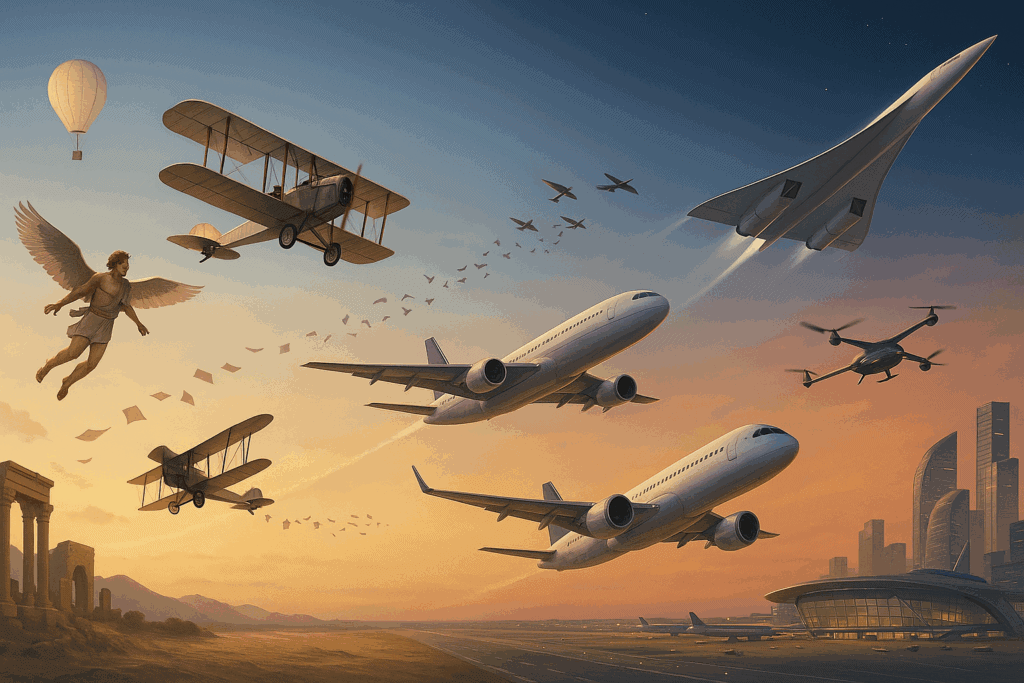
From the earliest stories carved into temple walls and etched into myths, humanity has dreamed of flight. We imagined wings of wax, chariots in the sky, and feathered gods ascending into the clouds. The desire to take to the air — to rise above the Earth, to defy gravity, to see the world from the heavens — has been both a spiritual yearning and a scientific challenge.
For most of human history, flight remained metaphor: a symbol of freedom, power, or divinity. But in the past 150 years, that symbol became reality. From the Wright brothers’ wind-whipped takeoff in 1903 to today’s intercontinental airliners and hypersonic research craft, aviation has transformed how we move, how we fight, how we trade, and how we see the planet itself.
Aviation is not simply the act of flying. It is a nexus of physics, engineering, biology, materials science, communication, and geospatial navigation. It touches everything from tourism and agriculture to global logistics, geopolitics, and the climate crisis. To study aviation is to study one of the most significant forces of the modern era — one that collapses distances and forges new possibilities, but also carries risks, costs, and inequalities.
In this article, we will trace the arc of aviation from ancient dreams to scientific breakthroughs, from wartime urgency to peacetime infrastructure, from fossil-fueled engines to electric vertical takeoff prototypes. Along the way, we will explore the physics that makes flight possible, the evolution of airpower, the geopolitical control of the skies, and the rapidly accelerating future of aviation in the age of artificial intelligence and climate urgency.
In the final section, we will ask what it means to fly — not just as a technical achievement, but as a global human practice. How can aviation serve the whole of humanity, rather than merely the wealthy or the militarized? What responsibilities come with such power, and how can we reimagine the skies in line with the principles of sustainability, equity, and scientific humanism?
The story of flight is not over. It is still ascending.
2. From Myth to Mechanics: Early Visions and Pre-Flight Innovations
Ancient dreams, Leonardo’s sketches, balloons, and the path to powered flight
The desire to fly is as old as storytelling itself. In nearly every culture, myth and legend are filled with winged deities, airborne creatures, and humans who dared to rise above the Earth. From the Greek tale of Daedalus and Icarus to the feathered serpent Quetzalcoatl of Mesoamerica, flight was long imagined as a divine or forbidden act — a boundary between heaven and Earth that only the brave or foolhardy would cross.
But mythology eventually gave way to experimentation. As early as the 9th century, Abbas Ibn Firnas in Islamic Spain reportedly designed a glider and briefly took to the air. In China, as early as the 3rd century BCE, children’s kites evolved into man-carrying kites, and by the Song dynasty, inventors were experimenting with gunpowder-powered rockets. Meanwhile, in Renaissance Italy, Leonardo da Vinci sketched detailed plans for ornithopters, rotorcraft, and parachutes. Though he lacked the materials and engines to bring these machines to life, his blend of anatomical study and mechanical imagination laid the intellectual foundation for future generations.
The first successful human flights were not powered, but buoyant. In 1783, the Montgolfier brothers launched the first hot air balloon in France, lifting animals — and soon after, humans — into the sky using the principle of heated air’s lower density. Not long after, hydrogen balloons enabled longer, higher flights and spurred a wave of aerial curiosity and competition across Europe.
Throughout the 19th century, the idea of heavier-than-air flight remained tantalizing but elusive. Engineers like George Cayley in England and Otto Lilienthal in Germany made breakthroughs in understanding lift, control surfaces, and airfoil shapes. Lilienthal, known as the “Glider King,” performed thousands of experimental flights and gathered crucial aerodynamic data before dying in a crash — a tragedy that emphasized the dangers of flight, but also its scientific promise.
By the late 1800s, visionaries such as Octave Chanute and Samuel Langley were refining glider designs and even testing powered models. Yet despite their ingenuity, true powered, sustained, and controlled flight remained just out of reach.
The prelude to modern aviation was a century-long dance of theory, failure, and fearless experimentation. By the dawn of the 20th century, the question was no longer whether humans could fly — but when they would finally take command of the air.
3. The Wright Brothers and the Birth of Modern Aviation
The breakthrough at Kitty Hawk and the science that made it possible
The dawn of powered flight arrived not from a well-funded government lab or a major university, but from the modest bicycle workshop of two self-taught engineers: Orville and Wilbur Wright. Quietly obsessive and meticulously empirical, the Wright brothers exemplified a rare fusion of practical craftsmanship, theoretical insight, and tireless experimentation.
In 1903, after years of developing their own wind tunnel, refining wing shapes, studying control mechanisms, and constructing increasingly advanced gliders, the Wrights made history. On December 17th, near Kitty Hawk, North Carolina — chosen for its strong, steady winds and open dunes — their aircraft Flyer I lifted off the ground and remained aloft for 12 seconds, covering 120 feet. It was the first sustained, controlled, powered flight in human history.
What set the Wrights apart was not just their success but their method. They understood that flight required not only lift and thrust but also stability and control. They pioneered the concept of three-axis control — pitch (via the elevator), roll (via wing-warping, later ailerons), and yaw (via a rudder) — which remains fundamental to aviation today.
Their engine was custom-built and rudimentary, but it served the purpose: a lightweight internal combustion motor connected to two wooden propellers, driven by bicycle chain. Their wings were carefully tested for shape and lift using their own wind tunnel — an innovation that gave them a crucial advantage over rivals who relied on guesswork or faulty theory.
While their achievement was initially met with skepticism, especially in Europe, they quickly proved the feat through improved designs and longer flights. By 1905, they had developed the Flyer III, capable of staying aloft for over half an hour. By 1908, their flights in France and the U.S. astonished the world and attracted investors, military interest, and public acclaim.
The Wright brothers’ success marked a tipping point: aviation had left the realm of speculation and entered the realm of applied science and engineering. The skies were no longer reserved for gods and birds. The era of human flight had begun — and with it, the acceleration of the 20th century.
4. The Physics of Flight
Aerodynamics, lift, thrust, drag, propulsion, and the evolution of aircraft design
To understand flight is to understand how humans can defy gravity — not by magic, but by mastering the laws of physics. At the heart of aviation lies a balance of four fundamental forces: lift, weight, thrust, and drag. Every aircraft, from a paper glider to a supersonic jet, exists within this dynamic system.
Lift and Weight: Up vs. Down
Lift is the upward force that counters gravity (weight). It is generated primarily by the shape of the aircraft’s wings — specifically, the airfoil, a curved profile designed to manipulate airflow. As air moves faster over the top of the wing and slower underneath (according to Bernoulli’s principle and Newton’s third law), a pressure differential is created that lifts the aircraft.
But lift must overcome the downward pull of gravity, which is proportional to the aircraft’s mass. This delicate balance is why aircraft must be both strong and light, and why materials science is critical in aviation design.
Thrust and Drag: Forward vs. Resistance
Thrust propels the aircraft forward. In early planes, it came from piston-driven propellers. Today, it is most often supplied by jet engines, which expel high-speed exhaust gases backward to push the aircraft forward (Newton’s third law again: every action has an equal and opposite reaction).
Counteracting thrust is drag, the aerodynamic resistance caused by air pushing against the aircraft’s surfaces. Streamlined designs, retractable landing gear, and smooth fuselages all help reduce drag and improve fuel efficiency.
Flight Stability and Control
In addition to these forces, aircraft must maintain stability and control in three dimensions:
- Pitch (up and down), controlled by the elevator on the tail
- Roll (tilting wings), controlled by ailerons on the wings
- Yaw (left and right movement), controlled by the rudder
Modern aircraft often use sophisticated computer systems — fly-by-wire — to adjust these controls in real time, enhancing safety and responsiveness.
Advanced Aerodynamics and Innovation
Since the early 20th century, the field of aerodynamics has expanded dramatically. Supersonic and hypersonic flight introduced new challenges, such as shockwaves, heat buildup, and changing airflow behavior. Innovations such as variable-sweep wings, winglets, and composite materials have allowed aircraft to fly faster, farther, and more efficiently.
Emerging technologies like electric propulsion, distributed propulsion, and blended-wing bodies aim to reinvent the aircraft yet again — making them quieter, cleaner, and more adaptable to a future of constrained resources and environmental demands.
The science of flight remains an active frontier. Each breakthrough in physics and engineering reshapes not just how we fly, but how we live, trade, travel, and understand our place in the atmosphere — that thin, fragile shell between Earth and space.
5. Golden Age to Jet Age: Aviation Between the World Wars and Beyond
Innovation in wartime, commercial airlines, and the rise of the jet engine
The early 20th century saw aviation accelerate from daring novelty to indispensable technology — a transformation largely driven by two world wars and the emergence of commercial air travel. This period, often called the Golden Age of Aviation, was not just about progress in speed and altitude, but in reliability, infrastructure, and the public’s relationship with the skies.
The Interwar Boom
In the years after World War I, aviation technology advanced rapidly as former military pilots became barnstormers, mail carriers, and airline pioneers. The 1920s and 30s saw breathtaking feats: Charles Lindbergh crossed the Atlantic solo in 1927, while Amelia Earhart became a symbol of both aviation prowess and women’s equality in the cockpit.
Aircraft design evolved from wood and fabric to metal monoplanes. Radial engines improved power-to-weight ratios. Airports were built. Air traffic control emerged. Commercial airlines like Pan Am and KLM began offering regular routes, turning the sky into a practical — if still elite — mode of transport.
This era also saw increasing nationalism in aviation: many countries viewed their growing fleets as emblems of national pride and power. Aviation was no longer just technical; it was political.
World War II and the Science of Air Power
World War II catapulted aviation into a new realm. The war introduced:
- Strategic bombers (e.g., the B-17 and B-29), capable of long-range destruction
- Fighter aircraft (e.g., the Spitfire, Mustang, and Zero), pushing speed and agility
- Airborne radar and radio navigation, enhancing targeting and coordination
- Aircraft carriers, which redefined naval combat and projection of air power
- And, most dramatically, the first operational jet aircraft, such as the German Messerschmitt Me 262
Aviation became the decisive element in global warfare. Victory increasingly depended on air superiority, logistical supply chains, and scientific innovation — from metallurgy and fuels to ballistics and electronics.
The Jet Age and the Rise of Global Airlines
After 1945, the military surplus of planes, pilots, and airfields fueled a commercial explosion. The 1950s marked the beginning of the Jet Age with the introduction of the de Havilland Comet, the first commercial jetliner, followed by more successful models like the Boeing 707 and Douglas DC-8.
Jets cut travel times dramatically, reduced engine noise and vibration, and could fly higher and faster than their propeller-driven predecessors. Air travel became safer, more accessible, and eventually — with the advent of the jumbo jet (Boeing 747, 1969) — democratized for the growing global middle class.
Airports expanded. International flight routes connected continents. The airline industry became a cornerstone of global commerce, diplomacy, and culture. Aviation helped shape the modern, interconnected world.
By the end of the 20th century, humanity had gone from fragile cloth-winged contraptions to sleek supersonic aircraft and global air networks. But this success came with new questions: environmental costs, noise, inequality of access, and geopolitical vulnerability. These questions would shape the next chapters of aviation — and the future of flight itself.
6. Military Aviation and Air Power
The science and strategy of air superiority, bombers, drones, and stealth
From the moment aircraft took to the skies, their potential for warfare was evident. What began as reconnaissance during World War I quickly escalated into a decisive realm of military dominance: air power — the capacity to observe, strike, transport, and defend from above. In modern warfare, air superiority is often the prerequisite for victory on land and sea.
The Evolution of Combat Aircraft
The 20th century saw the rapid diversification of military aircraft roles:
- Fighter aircraft are designed for speed, agility, and dogfighting dominance. From the Spitfire to the F-22 Raptor, these machines represent the cutting edge of performance and maneuverability.
- Bombers, such as the B-17 in WWII or the stealth B-2 Spirit, deliver payloads across vast distances. Strategic bombing campaigns — controversial and devastating — shifted the calculus of war by targeting infrastructure, cities, and morale.
- Attack aircraft and gunships support ground troops, often flying low and slow. The A-10 Thunderbolt II (“Warthog”) is a modern icon of battlefield support.
- Transport aircraft and air tankers enable global mobility, supply delivery, and air refueling — logistical backbones of modern militaries.
- Surveillance and AWACS (Airborne Warning and Control Systems) gather intelligence, manage battlespace awareness, and coordinate multi-branch operations in real time.
- Helicopters revolutionized close-range mobility, evacuation, and jungle or urban combat, from the Vietnam War to modern counterinsurgency.
Stealth, Supersonics, and the Electronic Battlefield
Late-20th-century innovations pushed military aviation into a new domain: invisibility and digital warfare. Stealth technology, pioneered by the F-117 Nighthawk and advanced in aircraft like the B-2 and F-35, reduces radar and infrared signatures, allowing planes to operate undetected in hostile territory.
Simultaneously, electronic warfare systems, satellite-guided munitions, and data-link communications turned the sky into a tightly integrated battlespace. Pilots now rely as much on computer systems as on physical flight skill.
Unmanned Aerial Vehicles (Drones)
The 21st century has seen the rapid rise of drones in both surveillance and combat roles. From high-altitude predators like the MQ-9 Reaper to palm-sized quadcopters used in urban warfare, unmanned systems have changed the ethics and tactics of war. They offer persistent surveillance, surgical strikes, and reduced risk to pilots — but also raise concerns about accountability, civilian harm, and autonomous targeting.
Strategic Implications and Deterrence
Air power plays a central role in modern deterrence. The ability to rapidly project force — or neutralize threats from the air — shapes international diplomacy. Nuclear-capable bombers, high-speed interceptors, and forward-deployed airbases influence global power balances and military alliances such as NATO.
Yet air supremacy is not invincible. Surface-to-air missiles (SAMs), electronic countermeasures, and next-generation anti-aircraft systems challenge the dominance of even the most advanced air forces.
Military aviation is a paradox of brilliance and brutality — a marvel of engineering shaped by the logic of destruction. Its future lies not only in faster, stealthier, and more intelligent systems, but in how we use — or restrain — this extraordinary power.
7. Civil Aviation: Commercial, Private, and Human Mobility
Airlines, logistics, private jets, global infrastructure, and tourism
While military aviation may dominate headlines, it is civil aviation — the realm of commercial airlines, air cargo, private flight, and passenger mobility — that shapes everyday human experience. It is civil aviation that connects cities, families, economies, and cultures. It is the infrastructure of modern life.
Commercial Airlines and the Democratization of Flight
Commercial air travel has evolved from a luxury of the elite to a near-universal expectation of middle-class life. Once an event marked by glamour and formality, air travel today is embedded into the rhythms of business, vacation, and migration.
The hub-and-spoke model, introduced in the mid-20th century, allowed major airlines to consolidate routes and build mega-airports. Low-cost carriers in the 1990s and 2000s, such as Ryanair and Southwest, further expanded access by slashing prices — often at the cost of comfort or regional service.
Modern fleets use highly efficient aircraft like the Boeing 737 and Airbus A320 for short-haul routes, while the Boeing 777, Airbus A350, and the now-retired 747 have served long-haul international routes for decades. Airports are now vast logistical ecosystems, integrating customs, immigration, security, commerce, and transport services.
Private Aviation and Inequality in the Skies
At the other end of the spectrum, private jets and business aviation offer convenience, speed, and privacy for the world’s wealthiest individuals and corporations. While a vital tool for some industries, this sector also highlights the stark inequalities of modern mobility: private aviation contributes disproportionately to carbon emissions while serving only a fraction of the global population.
Charter services, fractional ownership programs, and even urban air mobility startups are pushing to expand private access to air travel, raising fresh debates about regulation, congestion, and fairness.
Air Freight and Global Logistics
Civil aviation is not only about passengers — it is also the backbone of the global logistics industry. Air freight carriers like FedEx, UPS, and DHL connect factories to consumers across continents in a matter of hours. Cargo holds in passenger aircraft and dedicated freighters move everything from perishable foods to lifesaving medical supplies.
During global crises — from natural disasters to the COVID-19 pandemic — civil aviation has proven indispensable in delivering aid, vaccines, and urgent cargo. Speed, routing flexibility, and vast reach make it unmatched for time-sensitive deliveries.
Tourism, Culture, and Connectivity
Air travel has fueled the global tourism industry, enabling people to experience distant cultures, landscapes, and histories firsthand. It has also fueled diasporic connection — making it easier for migrants to maintain familial and cultural ties across borders.
But this ease of access comes with environmental costs, overcrowded destinations, and challenges to cultural preservation. In the age of mass tourism, aviation serves as both a bridge and a burden.
Civil aviation is a miracle of coordination: thousands of planes in the air at any given time, guided by international agreements, national air traffic control, and invisible corridors of radio signals and radar. And yet, its future will depend on how wisely we manage its growth — how we balance freedom of movement with sustainability, accessibility with equity, and expansion with planetary limits.
8. The Geography of Aviation
Major airports, flight corridors, air traffic control systems, and aerospace hubs
Aviation is not just a global phenomenon — it is a spatial and geopolitical system built on geography. Where planes take off, land, refuel, and route their journeys depends on physical landscapes, economic priorities, political relationships, and airspace rights. The geography of aviation reveals much about how the modern world is organized.
Global Aviation Hubs and Mega-Airports
Some cities have grown into massive aerotropolises — urban centers designed around airport infrastructure. Major hubs such as:
- Atlanta (ATL) – the world’s busiest airport by passenger traffic
- Dubai (DXB) – a global connector between East and West
- Beijing (PEK) and Shanghai (PVG) – fast-growing nodes in Asia’s expanding network
- London Heathrow (LHR), Paris Charles de Gaulle (CDG), and Frankfurt (FRA) – central to European connectivity
- Singapore Changi (SIN) and Doha (DOH) – exemplars of luxury and efficiency
These mega-airports are not just transit points — they are economic engines, diplomatic gateways, and logistical control centers.
Flight Corridors and Airspace Management
The skies are not open highways. Aircraft follow meticulously coordinated air corridors, altitude layers, and waypoints managed by air traffic control (ATC) systems. These invisible lanes are regulated to avoid collisions, manage flow, and optimize routing.
International flights must navigate complex airspace treaties, including:
- Sovereign airspace, typically extending 12 nautical miles from a nation’s coastline
- Flight information regions (FIRs), where countries take responsibility for ATC regardless of sovereign boundaries
- No-fly zones, restricted military airspace, and conflict zones, which must be avoided or negotiated
Satellites, transponders, radar, and communication relays form a vast digital nervous system that enables real-time tracking and safety enforcement — a marvel of international coordination.
Aerospace Manufacturing and Research Clusters
Aviation’s geography also includes the grounded ecosystems that build and maintain flight:
- Seattle and Everett (U.S.) – home to Boeing and a dense network of aerospace suppliers
- Toulouse (France) – headquarters of Airbus
- Montreal, Nagoya, Hamburg, São José dos Campos – major global centers for aircraft manufacturing and design
- Southern California, with its deep aerospace roots and defense contractors
- Emerging hubs in India, China, and the UAE
These regions are home not only to factories, but to flight schools, research institutes, and aerospace universities, forming innovation corridors.
Remote Areas and the Aviation Gap
While many urban centers are served by dozens of flights daily, remote and underserved areas often depend on small regional airports or are left disconnected. The aviation gap reflects broader inequalities in infrastructure investment and access. Some developing nations rely heavily on air links to overcome geographic challenges — for example, archipelagic countries like Indonesia or landlocked regions in Africa.
As climate change and rising fuel costs reshape the economics of air travel, the geographic distribution of access may become even more uneven — unless international collaboration and sustainable technologies intervene.
From global superhubs to forgotten airstrips, the geography of aviation reveals a layered, dynamic, and sometimes fragile architecture of connection. Understanding this map is essential not only for travel and commerce, but for envisioning a more balanced and resilient airspace for the 21st century.
9. Environmental and Health Impact of Aviation
Climate change, noise pollution, fuel emissions, and sustainable design
Aviation has connected the world — but at a cost. As air travel expanded into a global norm, its environmental footprint has grown into one of the most pressing challenges facing the aviation industry and planetary health today. From carbon emissions to community noise, aviation’s impact is both global and local, affecting ecosystems, economies, and human well-being.
Carbon Emissions and Climate Change
Aviation accounts for roughly 2.5–3% of global CO₂ emissions — a seemingly small share, but disproportionately impactful due to its rapid growth and the high-altitude release of pollutants. Aircraft also emit nitrogen oxides (NOₓ), water vapor, soot, and contrails at cruising altitudes, which can amplify radiative forcing and contribute significantly to global warming.
Long-haul flights, in particular, are carbon-intensive. Unlike ground transportation, aviation has few immediate alternatives to fossil fuels, making decarbonization a difficult but critical goal.
Noise and Community Health
Aircraft noise remains a major concern near airports. Chronic exposure to high-decibel flight paths has been linked to:
- Increased risk of hypertension, heart disease, and sleep disturbances
- Impaired cognitive development in children
- Diminished property values and quality of life in affected neighborhoods
Innovations such as quieter engines, noise-abating flight paths, and airport zoning laws aim to mitigate this, but growing air traffic continues to pose public health challenges.
Air Quality and Local Pollution
Beyond climate effects, aviation contributes to localized air pollution, particularly around airports. Jet fuel combustion produces fine particulate matter (PM), volatile organic compounds (VOCs), and other pollutants harmful to respiratory and cardiovascular health. Airport ground operations — from refueling to baggage handling — add further emissions.
Communities near large airports often face cumulative environmental burdens, overlapping with socioeconomically disadvantaged populations and raising concerns about environmental justice.
Resource and Land Use
The aviation sector consumes enormous amounts of:
- Fossil fuels (kerosene-based jet fuel)
- Rare metals for engine and avionics manufacturing
- Water and electricity for airport operations
- Land for runways, hangars, and expansion projects
Airports often displace ecosystems or agricultural land. Runoff from de-icing chemicals and fuel spills can contaminate nearby water systems.
Toward Greener Skies: Innovation and Alternatives
Efforts to reduce aviation’s footprint include:
- Sustainable Aviation Fuels (SAFs) derived from algae, waste oils, or biomass
- Electric and hybrid-electric aircraft for short-haul routes
- Hydrogen-powered prototypes aiming for zero-emissions flight
- Improved flight efficiency through AI routing, lighter materials, and wing design
- Carbon offsetting programs, though controversial, offer short-term mitigation
Industry groups like IATA and ICAO have set net-zero targets for 2050, but implementation is uneven and highly dependent on regulation, investment, and public pressure.
As the skies grow more crowded and the climate more fragile, the aviation sector stands at a crossroads. The question is no longer whether aviation is vital — it is — but whether it can evolve fast enough to serve humanity without endangering the planet we share.
10. The Future of Flight: AI, Electrification, and Hypersonics
Electric planes, pilotless craft, vertical takeoff, and the dream of sustainable aviation
The story of aviation is far from complete. As the world confronts ecological limits, demographic shifts, and technological revolutions, the future of flight is being reimagined in labs, startups, and aerospace consortia around the world. It is a future defined by speed, sustainability, and autonomy — a new chapter driven as much by software and systems as by engines and wings.
Electric and Hybrid-Electric Aircraft
Perhaps the most urgent innovation in aviation is electrification. Lightweight batteries, advanced motors, and novel aircraft architectures are enabling:
- Short-range electric planes, ideal for regional hops under 500 kilometers
- Hybrid-electric propulsion, combining conventional engines with electric thrust
- Reduced noise and emissions, especially important for urban and rural connectivity
Companies like Eviation, Heart Aerospace, and Joby Aviation are leading the charge, alongside industry giants like Airbus and Rolls-Royce. The goal: decarbonize short-haul aviation, once thought impossible.
Urban Air Mobility and Vertical Takeoff
The dream of a flying car — long dismissed as science fiction — is becoming a reality through eVTOLs (electric Vertical Takeoff and Landing vehicles). These small aircraft:
- Take off like helicopters, fly like drones
- Are powered by electric rotors or ducted fans
- Target short-range urban or suburban trips
Startups like Archer, Lilium, and Volocopter, backed by major investors and regulators, are planning aerial rideshare networks. But challenges remain: noise, safety, air traffic integration, and affordability.
AI and Autonomous Flight
Artificial intelligence is transforming aviation in multiple ways:
- Pilot assistance and auto-navigation systems are growing increasingly sophisticated
- Unmanned cargo aircraft are being tested for disaster response, logistics, and military resupply
- AI flight planning reduces delays, fuel burn, and turbulence
The ultimate goal — fully autonomous passenger flight — is on the horizon, but awaits breakthroughs in regulation, trust, and human-machine interaction.
Hypersonic Flight and Reusable Spaceplanes
Beyond conventional aviation, a race is underway to unlock hypersonic speeds (Mach 5 and beyond), enabling:
- Suborbital flights from New York to Tokyo in under 2 hours
- Space tourism and high-altitude research
- New forms of defense and surveillance with extreme speed and unpredictability
Companies like Hermeus, Boom Supersonic, and SpaceX are exploring the fusion of aviation and rocketry. These technologies may also birth a new generation of reusable spaceplanes, bridging the atmosphere and outer space.
Materials, Manufacturing, and Design Futures
The next wave of aviation will be shaped by:
- Advanced composites and nanomaterials to reduce weight and increase durability
- 3D printing of aircraft parts, allowing for rapid, local manufacturing
- Blended-wing bodies and radical new fuselage designs that redefine aerodynamics and cabin layout
The aircraft of 2050 may look nothing like today’s — and may fly with no one onboard.
The future of flight is a test of humanity’s imagination and responsibility. We now possess the power to fly faster, cleaner, and smarter than ever before. But whether we do so for the benefit of all — or only for the privileged few — depends on the values we choose to embed in our technologies and our skies.
11. Air Law and International Regulations
Sovereignty, safety, liability, international agreements, and ICAO guidelines
As aviation grew from national novelty to global necessity, it quickly became clear that the skies could not be lawless. Planes fly across borders, enter foreign airspace, and depend on shared infrastructure. To avoid chaos and conflict, the field of air law emerged — a complex system of national, regional, and international rules that govern who controls the skies and how aviation is managed.
Sovereignty and National Airspace
According to the Chicago Convention of 1944, every country has complete sovereignty over the airspace above its territory, including territorial waters. Aircraft must obtain permission to enter another nation’s airspace, and violating that sovereignty can have serious diplomatic or military consequences.
Exceptions exist for emergencies or humanitarian missions, but even then, protocols must be followed. This concept has been central in conflicts, sanctions enforcement, and no-fly zones, such as those imposed during wars or crises.
The Role of the ICAO
The International Civil Aviation Organization (ICAO), a specialized agency of the United Nations founded after WWII, serves as the main coordinator of global civil aviation. Its responsibilities include:
- Setting standards for safety, navigation, communication, and environmental impact
- Issuing flight codes, airport designations, and aviation English guidelines
- Facilitating multilateral air agreements and dispute resolution
- Supporting technical development and regulation in emerging economies
While ICAO cannot enforce its rules, it exerts enormous soft power by shaping norms that most countries voluntarily follow to remain integrated into the global aviation network.
Liability and Safety Regulations
Aviation law also addresses liability for accidents, both in the air and on the ground. Agreements like the Montreal Convention standardize compensation for injury, death, or lost baggage on international flights. Aircraft manufacturers, airlines, and maintenance firms must follow strict safety protocols — enforced by national agencies such as:
- The FAA (Federal Aviation Administration) in the United States
- EASA (European Union Aviation Safety Agency) in the EU
- CAAC, DGCA, and others in Asia and Latin America
These agencies certify aircraft, license pilots, investigate accidents, and issue directives in response to safety threats.
Security and the War on Terror
Since 2001, aviation security has become a defining feature of the travel experience. Passengers now undergo screening, planes are reinforced with bulletproof cockpit doors, and international rules on liquids, electronics, and identification have tightened. New biometric technologies aim to streamline — or further surveil — border crossings.
Security also includes managing threats such as:
- Hijackings and terrorism
- Cyberattacks on air traffic control and airline databases
- Drone incursions and interference with flight paths
As technology advances, so too must the law.
Emerging Frontiers and Legal Challenges
The rapid evolution of aviation technology is outpacing legal frameworks. Key issues now include:
- Autonomous aircraft and who is liable in a crash
- Commercial spaceflight and suborbital travel
- Urban air mobility (UAM) regulation at the municipal level
- Green policy incentives and emission trading systems for airlines
Aviation law must navigate a delicate balance: ensuring safety and fairness while not stifling innovation. It must also address equity, ensuring that access to airspace and air travel is not limited to rich nations and powerful corporations.
The sky belongs to all — but it must be governed wisely. As aircraft evolve and the boundary between Earth and space blurs, international cooperation and ethical foresight will be essential to keeping the skies open, fair, and safe.
12. The Integrated Humanist Perspective on Aviation
Access, equity, safety, sustainability, and global cooperation in the skies
Aviation is one of humanity’s most extraordinary achievements — a triumph of imagination, engineering, and international coordination. It has turned oceans into hours, deserts into gateways, and distant cultures into neighbors. But like all great technologies, aviation must now evolve with the full weight of its consequences and responsibilities in view.
From an Integrated Humanist perspective, aviation is not merely a tool for profit or power. It is a shared public infrastructure, a cultural and economic bridge, and a planetary trust that must serve all of humanity — not just the privileged few.
Equity in the Skies
Access to flight remains deeply unequal. Billions of people have never set foot on an aircraft. Rural regions, island nations, and the Global South often rely on fragile, underfunded air links — if they exist at all. Meanwhile, wealthy individuals and nations dominate airspace with private jets, luxury terminals, and preferential policies.
An Integrated Humanist aviation ethic demands:
- Subsidized regional access in underserved areas
- Public-interest regulation of commercial airline monopolies
- Equitable innovation funding, especially for clean technologies adaptable to low-income regions
- Air travel as a right of global connection, not an exclusive luxury
Sustainability and Stewardship
Aviation must confront its environmental impact head-on. It cannot simply offload responsibility through carbon offsets or green branding. Integrated Humanism calls for:
- Aggressive decarbonization of short- and medium-haul routes
- Rapid phase-out of unnecessary private jet use
- Global research collaborations on battery, hydrogen, and hybrid systems
- Transparent reporting of airline emissions and impacts
Flying should never come at the cost of the planet’s health. Nor should it serve only the fastest route, if slower, more sustainable options are possible.
Safety, Dignity, and Peace
Integrated Humanism also affirms the dignity and safety of every traveler. This means:
- Ensuring universal safety standards regardless of country or airline
- Protecting passenger rights in delay, denial, or crisis
- Demilitarizing the skies where possible, and working toward international disarmament of airborne weapons systems
- Investing in civil aviation diplomacy, especially where conflict threatens airspace and transit rights
The sky should be a place of peace — not a launchpad for war.
Aviation as a Unifier of Humanity
At its best, aviation brings us closer: to our families, to new ideas, to different ways of life. It reminds us that we share one fragile planet. An Integrated Humanist aviation future envisions:
- Pan-regional flight corridors that emphasize cooperation over competition
- Humanitarian airlift systems ready to deploy in crisis zones
- Cross-cultural air programs, connecting students, scientists, and artists
- And perhaps, one day, a global public airline serving humanity itself
Flight is not just a mechanical act — it is a moral one. As we soar higher and move faster, we must also look inward and act wisely. The future of aviation depends on more than innovation. It depends on compassion, foresight, and a commitment to serve the whole human family.
Conclusion
The sky is no longer the limit — but the future is our responsibility
From the myths of Icarus and the sketches of da Vinci to the roaring engines of jetliners and the silent glide of solar drones, the history of aviation is a story of daring, discovery, and transformation. It is the story of a species that refused to stay grounded — that looked to the skies not only for answers, but for freedom, for speed, for unity, and for hope.
Aviation has changed how we live and think. It has compressed geography, accelerated globalization, and brought the farthest corners of the Earth within a day’s reach. It has saved lives, delivered aid, fought wars, and inspired generations of scientists, artists, and dreamers.
But flight has also mirrored our contradictions. It has been used for conquest as well as cooperation. It has deepened inequality even as it promised mobility for all. And as the climate crisis intensifies, the environmental cost of our movement through the air weighs heavily on the conscience of our age.
What comes next is not simply a question of technology — though innovation will be essential. It is a question of vision, of governance, and of shared ethical direction.
Can we create a global aviation system that is equitable, sustainable, and safe? Can we make access to flight a right rather than a privilege? Can we decarbonize the skies while preserving the freedom to explore them? These are not only technical problems. They are philosophical ones. They require a human-centered compass, grounded in science, justice, and compassion.
The sky is no longer the limit. But as we push toward hypersonic speeds and autonomous aerial cities, we must remember that flight — at its core — is not about escaping the Earth. It is about understanding it better, connecting it more deeply, and caring for it as the one shared world we all inhabit.
Let us fly wisely. Let us fly together. And let us build an aviation future that serves not just the privileged or the powerful — but all of humanity.