

Subtitle: A Survival Guide for the Newly Independent Citizen
Table of Contents
- Introduction: Why This Wasn’t Taught in School
The critical gap in traditional education and why this matters now. - Section 1: Money 101 — Budgeting, Banking, and Thrift
How to track your income, plan expenses, save money, and avoid debt. - Section 2: Understanding and Filing Your Taxes
What taxes are, why they matter, and how to do them without panic. - Section 3: Insurance — What You Need and What You Don’t
Health, auto, renters, life, and disability insurance explained in plain English. - Section 4: Bills, Rent, and Utilities
How to choose housing, set up accounts, and avoid getting shut off. - Section 5: Food and Home Economics
Grocery shopping, cooking, basic nutrition, and cleaning hacks for real life. - Section 6: Employment Basics
How to find jobs, understand paychecks, deal with HR, and navigate benefits. - Section 7: Credit, Debt, and Loans
Understanding credit scores, credit cards, student loans, and how to protect yourself. - Section 8: Transportation and Mobility
Owning vs. leasing a car, public transport, insurance, and basic maintenance. - Section 9: Basic Legal and Civic Responsibilities
Your rights, responsibilities, voting, jury duty, and avoiding legal trouble. - Section 10: Personal Safety and Health
Emergency readiness, mental health, basic first aid, and dealing with hospitals. - Conclusion: Becoming a Capable, Confident Adult
Encouragement, mindset, and the journey of continuous learning. - Appendix: Tools, Templates, and Resources
Budget templates, tax filing tools, insurance comparison charts, and more.
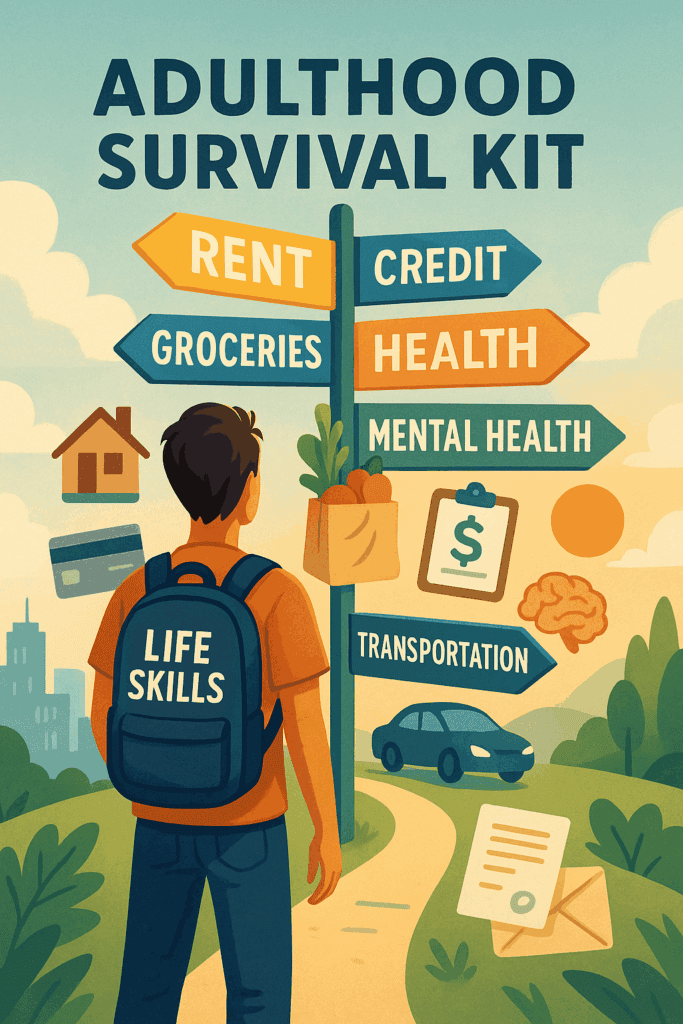
Introduction: Why This Wasn’t Taught in School
Imagine you’ve just turned eighteen. You can vote, work full-time, rent an apartment, apply for credit, buy a car, and maybe even live on your own. But there’s a problem: no one ever showed you how. You’re legally an adult, but no one handed you a guidebook for being one.
If this feels familiar, you’re not alone.
Many young people graduate high school with years of algebra, essays, and exams behind them—but still don’t know how to pay a bill, file taxes, choose an insurance plan, or cook a healthy meal. You may know what an isosceles triangle is but have no idea how to read a credit report. You can analyze Shakespeare but not a pay stub. You were tested on the periodic table—but never on budgeting, housing, or dealing with real-life emergencies.
This isn’t your fault. It’s the result of an outdated education system that prioritizes abstract academics and standardized test scores over the practical skills every adult needs. Schools often sideline civic education and almost completely ignore home economics—once a staple of secondary schooling. While STEM fields and college preparation dominate classroom time, life outside the classroom is left to chance.
But here’s the truth: it doesn’t have to be that way.
This guide is designed to fill the gap. It’s not just a “how-to” on paying bills or filing taxes. It’s a survival guide for adulthood—one rooted in common sense, real-world application, and long-overdue honesty. It’s part of the Global Civic Curriculum (GCC), a movement dedicated to giving young people the tools they need to navigate society intelligently, independently, and ethically.
Whether you’re heading to college, trade school, a job, or just trying to figure out what’s next, this is your starting point. You don’t need to have it all figured out. You just need a map—and this guide aims to be one.
Let’s begin with the most important foundation of all: understanding your money.
Section 1: Money 101 — Budgeting, Banking, and Thrift
Money may not be the most important thing in life, but it touches almost everything that is. Learning how to manage it is one of the most essential skills of adulthood—and one that many people never fully master. But it’s not rocket science. With a few basic habits and tools, you can avoid the most common financial traps and build a life that feels safe and free.
1.1 Budgeting: Where It All Begins
A budget is simply a plan for your money. It tells your money where to go instead of wondering where it went.
The simplest budget is the 50-30-20 rule:
- 50% for essentials: rent, food, utilities, transportation.
- 30% for lifestyle: clothes, dining out, entertainment.
- 20% for savings and debt repayment.
Write it down. Use a spreadsheet, an app like Mint or YNAB (You Need A Budget), or even a notebook. Track every dollar that comes in and every dollar that goes out. You’ll be amazed at what you learn about yourself.
Pro tip: Review your budget once a week, not just at the end of the month.
1.2 Banking: Choosing and Using a Bank or Credit Union
Your money needs a home—ideally one that doesn’t rob you blind with fees.
- Checking account: For everyday spending. Comes with a debit card.
- Savings account: For short-term savings and emergencies. Pays a little interest.
- Credit union vs. bank: Credit unions are nonprofit and often have lower fees. Big banks have more ATMs and online features.
Look for:
- No monthly maintenance fees
- No minimum balance requirement
- Free mobile banking and direct deposit
Warning: Avoid payday loans, check cashing services, and high-interest “instant cash” apps. They’re legal traps.
1.3 Thrift: Living Below Your Means
Thrift is the old-fashioned word for something very modern: financial freedom. It doesn’t mean being cheap—it means being smart.
- Cook more, eat out less.
- Buy used when you can.
- Avoid buying to impress.
- Plan for big expenses ahead of time.
What you don’t spend is just as important as what you earn. Start saving something—even if it’s only $5 a week. That habit alone builds a powerful mindset.
In the next section, we’ll tackle something most people fear but everyone has to face: Taxes.
Section 2: Understanding and Filing Your Taxes
Most people hear the word taxes and feel a wave of dread. But understanding taxes is not as hard as it’s made out to be. Once you learn the basics, it becomes another routine adult task—like brushing your teeth, but once a year.
2.1 What Are Taxes and Why Do We Pay Them?
Taxes are the money we pay to keep society functioning. They fund roads, schools, public hospitals, emergency services, national defense, and much more. In most democratic societies, taxes are part of a shared responsibility: you contribute to the system that keeps the country running.
If you earn money in the U.S., for example, you’ll likely pay:
- Federal income tax — Paid to the national government
- State income tax — Depending on where you live
- Social Security and Medicare taxes (FICA) — For retirement and healthcare in old age
- Sales tax — On purchases (automatically added at checkout)
- Property tax — If you own real estate
- Others — Depending on your business, location, or vehicle
2.2 When and How Do You File?
In most countries, including the U.S., you file taxes once a year. In the U.S., the deadline is usually April 15.
Here’s what the process looks like:
- Gather your documents:
- W-2 form (if employed)
- 1099 form (if freelancing or doing gig work)
- Receipts or documents for student loan interest, education expenses, charity donations, or healthcare costs
- W-2 form (if employed)
- Choose your filing method:
- Use free online services (like IRS Free File, Credit Karma, or TurboTax Free Edition)
- Hire a tax preparer/accountant (worth it if you have multiple jobs, are self-employed, or own property)
- Some communities offer free tax help clinics for students or low-income earners
- Use free online services (like IRS Free File, Credit Karma, or TurboTax Free Edition)
- Submit your tax return:
- You may owe money or get a refund. If you overpaid during the year, the government pays you back.
- You may owe money or get a refund. If you overpaid during the year, the government pays you back.
Pro tip: Even if you made very little money, it’s still worth filing—you might get money back.
2.3 Avoiding Tax Trouble
- Don’t lie. The IRS (or your country’s tax authority) has ways of verifying your income.
- File on time. Late fees and interest add up fast.
- Keep digital copies of your tax returns and forms for at least three years.
- If you can’t pay what you owe, you can often set up a payment plan.
2.4 Special Cases for Young Adults
- Students: You may qualify for education credits like the American Opportunity Credit.
- Freelancers or gig workers: You’re considered self-employed and must report all income, even if no one gave you a tax form.
- Dependents: If someone (like a parent) claims you as a dependent, you may not qualify for certain deductions.
In the next section, we’ll tackle another mystery of adulthood: Insurance—what it is, why it matters, and what kind you actually need.
Section 3: Insurance — What You Need and What You Don’t
Insurance may seem like a scam when you’re young and healthy. Why pay every month for something you might never use? But here’s the truth: insurance isn’t for things that are likely—it’s for things that would be financially devastating if they happened. Think of it like a fire extinguisher: you hope to never use it, but when you do, it can save everything.
Let’s break it down.
3.1 What Is Insurance, Anyway?
Insurance is a way of sharing risk. You (and lots of other people) pay a company a small amount each month (a premium). In exchange, the company agrees to cover large expenses if certain bad things happen to you—like a car crash, a serious illness, or a flooded apartment.
Each type of insurance has:
- Premium — What you pay each month
- Deductible — What you pay out of pocket before insurance kicks in
- Coverage limit — The max the company will pay
3.2 The Big Four You Should Know
Health Insurance
- Covers doctor visits, emergencies, prescriptions, and surgeries.
- In the U.S., you can get it through:
- An employer (most common)
- Healthcare.gov (if unemployed or self-employed)
- A parent’s plan (until age 26)
- An employer (most common)
- Always review your plan’s deductible and what it covers before using it.
Tip: Avoid skipping insurance just because you’re young. A broken leg can cost $10,000.
Auto Insurance
- Required by law if you own a car.
- Covers:
- Liability (if you hurt someone or damage property)
- Collision (repairs to your car)
- Comprehensive (theft, fire, storm damage, etc.)
- Liability (if you hurt someone or damage property)
- Your driving record and credit score affect your rates.
Tip: If you don’t drive much, ask about low mileage discounts or usage-based insurance.
Renters Insurance
- Dirt cheap (usually $10–20/month) and covers your stuff if there’s a fire, theft, or flood.
- Also protects you if someone gets hurt in your apartment.
- Required by some landlords.
Tip: Take photos of your valuables and keep them in cloud storage—it helps if you ever need to make a claim.
Life and Disability Insurance
- Only needed if others depend on your income (kids, spouse, etc.).
- Otherwise, skip it for now.
3.3 What You Can (Probably) Skip
- Pet insurance (unless your pet is expensive or prone to illness)
- Travel insurance (unless it’s a non-refundable international trip)
- Extended warranties on electronics (read the fine print—they often overlap with manufacturer warranties)
In the next section, we’ll talk about what it really takes to live on your own—bills, rent, utilities, and how to avoid nasty surprises.
Section 4: Bills, Rent, and Utilities
Living on your own comes with a lot of freedom—and a lot of bills. Rent, electricity, water, internet, trash, gas—it adds up fast. This section walks you through how to set up a place to live, keep it running, and stay out of financial (and legal) trouble.
4.1 Finding and Renting a Place to Live
When looking for housing, keep these four questions in mind:
- What’s my budget? Use no more than 30–40% of your monthly income on rent.
- Is it safe? Check crime maps, lighting, locks, and local reviews.
- What’s included? Some places include utilities like water or internet. Others don’t.
- What’s the lease like? Read the lease. Seriously. Look for:
- Length (month-to-month vs. one-year lease)
- Move-out notice period
- Rules about guests, noise, or pets
- Penalties for breaking the lease
- Length (month-to-month vs. one-year lease)
Pro tip: Document everything before moving in—photos of damages, dirty appliances, or broken fixtures. It can save your security deposit later.
4.2 Understanding and Paying Your Bills
Here are the most common monthly bills you’ll encounter:
- Rent — Usually due on the 1st of the month.
- Electricity — Powers lights, appliances, and AC. (Can spike in summer/winter.)
- Water/Sewer — Often bundled with trash. Watch your usage.
- Gas — Heats water and homes in colder climates.
- Internet/Wi-Fi — Often bundled with cable. Compare plans.
- Trash Collection — Included in rent in apartments, billed separately in houses.
- Renter’s Insurance — Protects your stuff and liability.
Tips to stay organized:
- Set up autopay where possible.
- Mark due dates on your phone calendar.
- Keep digital copies of bills and receipts.
Warning: Missed payments can lead to late fees, utility shut-offs, or eviction. Always communicate early with your landlord or provider if you’re struggling.
4.3 Household Setup and Essentials
Moving into your first place? Here’s a quick checklist of the most commonly forgotten but essential items:
- Trash bins and bags
- Toilet plunger and cleaner
- Extension cords and light bulbs
- Laundry basket and detergent
- Basic cooking tools (knife, pan, spatula)
- Fire extinguisher and smoke alarm
Buy second-hand when you can. Ask around—friends and family often have extras.
Up next: let’s talk about the life skill everyone needs but few are taught—feeding yourself well and running a household.
Section 5: Food and Home Economics
One of the biggest shocks of living on your own is realizing how much time, money, and energy goes into feeding yourself—and keeping your space livable. Cooking, cleaning, and managing a household may seem old-fashioned, but mastering these basics gives you confidence, saves money, and improves your health.
5.1 Grocery Shopping: Smarts Over Snacks
Start with a simple weekly plan:
- Choose 3–4 main meals you can rotate
- Base them on cheap staples: rice, pasta, beans, eggs, potatoes, fresh fruit and vegetables (grow your own if you have a patch of dirt, and herbs can be grown indoors: basil, parsley, cilantro/coriander, mint, rosemary, thyme, oregano, sage, chives, dill, tarragon, and even garlic and ginger). Pro tip – never pay for iceberg lettuce, which has no nutrients; grow your own romaine variety
- Make a list—and don’t shop hungry
Tips for staying on budget:
- Shop with cash or debit to avoid overspending
- Buy store brands, not name brands
- Check unit prices to compare value
- Avoid impulse buys near the checkout
Bonus: Learn the “perimeter rule”—most real food is around the edges of the store (produce, dairy, bread, meat); processed stuff is in the middle aisles.
5.2 Cooking: Easy, Healthy, and Cheap
You don’t need to be a chef. You just need a few basic meals you can make on autopilot. Learn how to:
- Boil pasta and add sauce or veggies
- Make eggs five ways (scrambled, boiled, fried, baked, omelet)
- Stir-fry veggies and rice or noodles
- Cook a one-pot soup or stew
Start with a few go-to meals and master them. You’ll eat better, feel better, and save hundreds per month.
5.3 Cleaning and Laundry: You’re the Adult Now
A clean space is good for your health and mental state.
Basic cleaning supplies:
- All-purpose spray
- Dish soap and sponge
- Broom, dustpan, mop or vacuum
- Toilet brush and bathroom cleaner
- Microfiber cloths or paper towels
Cleaning schedule:
- Daily: dishes, surfaces
- Weekly: bathroom, floors, trash
- Monthly: fridge, deep clean, dusting
Laundry tips:
- Sort by color and fabric (light vs. dark, cold vs. hot wash)
- Don’t overload the machine
- Use the correct amount of detergent
- Hang dry delicate items to make them last longer
Life hack: Clean as you go. Small habits beat occasional deep-cleaning marathons.
5.4 Saving Time and Money at Home
- Batch cook and freeze meals.
- Use leftovers creatively (wraps, soups, fried rice).
- Don’t overbuy perishables—food waste is wasted money.
- Use energy-efficient light bulbs and unplug devices when not in use.
In the next section, we’ll shift from household basics to the working world: how to get and keep a job, understand your paycheck, and navigate workplace benefits.
Here is the draft for Section 6: Employment Basics:
Section 6: Employment Basics
Getting your first job—and keeping it—is a big step into adulthood. Whether you’re working part-time, full-time, freelance, or side-hustling, it helps to understand how employment actually works: how to find work, read your paycheck, and make the most of your benefits.
6.1 How to Find a Job (and Actually Get It)
Step 1: Prepare Your Tools
- Write a clear, one-page resume with your skills, education, and past experience—even volunteer work counts.
- Create a simple, professional email address and LinkedIn profile.
- Practice your interview answers for questions like: “Tell me about yourself,” “What are your strengths/weaknesses?” and “Why do you want this job?”
Step 2: Start Applying
- Use job boards like Indeed, Glassdoor, or LinkedIn.
- Ask friends, family, or school contacts—many jobs come from referrals.
- Apply early, follow instructions carefully, and don’t get discouraged by silence. It’s a numbers game.
- Dress well for the interview and pay attention to your hygiene: at the very least, prevent body odor, brush your teeth and fix your hair
Step 3: After You’re Hired
- Show up on time, dress appropriately, and ask questions.
- Take notes during training and be polite to everyone—not just your boss.
Tip: You don’t need a dream job right now. Focus on learning, growing, and getting experience.
6.2 Understanding Your Paycheck
Once you start working, you’ll get paid either:
- Hourly (based on hours worked)
- Salary (a fixed yearly rate, often paid biweekly)
Your paycheck will have deductions, such as:
- Federal and state income taxes
- FICA (Social Security and Medicare)
- Health insurance (if through employer)
- Retirement contributions (optional, but a good idea)
You’ll receive a pay stub or online statement that shows:
- Gross pay (before taxes)
- Net pay (what you actually take home)
- YTD (year-to-date earnings)
Pro tip: Always review your pay stub to catch errors or unexpected deductions.
6.3 Workplace Basics: Rights, Benefits, and Etiquette
Know your rights:
- You’re entitled to fair wages, a safe workplace, and freedom from discrimination.
- In most places, you can’t be fired for race, religion, gender, or reporting illegal behavior.
Understand your benefits (if offered):
- Health insurance
- Paid time off (vacation, sick leave, holidays)
- 401(k) or retirement plan
- Professional development opportunities
Be a good employee:
- Communicate clearly and professionally.
- Be reliable. Do what you say you’ll do.
- Learn how to give and receive feedback.
- If there’s a problem, speak to a manager respectfully and with solutions in mind.
Next, we’ll look at something you’ve likely heard about—but maybe don’t fully understand yet: credit, debt, and loans. How do you use them wisely, and how do you avoid getting trapped?
Section 7: Credit, Debt, and Loans
Used wisely, credit can open doors: it helps you buy a car, rent an apartment, or one day own a home. Used poorly, it can trap you in a cycle of stress and financial chaos. This section will teach you how credit works, what debt to avoid, and how to borrow responsibly.
7.1 What Is Credit?
Credit is the ability to borrow money and pay it back later—with interest.
Your credit score is a number between 300 and 850 that tells lenders how risky it is to lend to you. It’s based on:
- Payment history (always pay on time!)
- Amounts owed (don’t max out your cards)
- Length of credit history
- Types of credit used
- New credit inquiries
Tip: A score over 700 is considered good. Over 750 is excellent. You can check your score for free using sites like Credit Karma or your bank app.
7.2 Credit Cards: Friend or Foe?
A credit card is a tool—not free money.
- It lets you borrow up to a set limit and repay monthly.
- If you don’t pay in full, interest (often 20%+ APR) stacks up fast.
- Late payments hurt your credit score and trigger fees.
Best practices:
- Only use what you can afford to repay in full each month.
- Set up autopay for at least the minimum payment.
- Don’t get more than one card until you’ve mastered the first.
Pro tip: Use your first card for one small recurring bill (like Netflix), pay it off monthly, and build credit safely.
7.3 Good Debt vs. Bad Debt
Not all debt is evil. Some types of debt are investments—others are traps.
Good debt (when managed wisely):
- Student loans — Can increase lifetime earnings (but research before borrowing!)
- Car loan — If you need it to get to work and can afford the payments
- Home mortgage — Often cheaper long-term than renting
Bad debt:
- Credit card balances — Especially when used for wants, not needs
- Payday loans — Extremely high interest rates and short repayment times
- Buy Now, Pay Later apps — Easy to overuse and hard to track
Warning: Just because someone will lend you money doesn’t mean you should borrow it.
7.4 Paying Off Debt
If you have multiple debts, two common strategies are:
- Snowball method: Pay off the smallest debt first, then move to the next.
- Avalanche method: Pay off the debt with the highest interest rate first.
Always pay at least the minimum to avoid penalties.
Up next: how do you get around when you’re newly independent—especially when transportation eats up so much of your time and money?
Section 8: Transportation and Mobility
Getting from point A to point B is a basic part of life—but how you do it can greatly affect your time, budget, and stress levels. Whether you’re driving, biking, or riding public transit, this section covers your options and what to watch out for.
8.1 Public Transportation: Affordable and Efficient
If you live in a city or large town, public transportation might be your cheapest and most practical option.
- Buses, subways, light rail, or trams are often available daily.
- You may qualify for student or low-income discounts.
- Apps like Google Maps, Moovit, or local transit apps help you plan routes and track delays.
Tip: Learn your route before you need it. Know peak hours and backup options.
8.2 Owning a Car: Convenience with Hidden Costs
Owning a car offers flexibility, but it comes with major expenses:
- Car payment (if financed or leased)
- Insurance
- Gas
- Maintenance and repairs
- Registration and inspection fees
When buying:
- Research used cars for affordability.
- Check fuel economy and reliability.
- Always get a mechanic to inspect a used car before you buy.
Warning: Avoid “buy here, pay here” lots or loans with extremely high interest rates. These often target young and low-credit buyers.
8.3 Leasing vs. Buying a Car
- Leasing is like renting a car for a few years—lower monthly payments, but you don’t own it, and mileage is limited.
- Buying means it’s yours to keep (once paid off), but costs more upfront or over a loan period.
If money is tight, buying a reliable used car outright (even an older one) is often the smartest move.
8.4 Biking, Walking, and Rideshare
- Biking is great for health and budget—just invest in a good lock and helmet.
- Walking is free, often underrated, and excellent for short distances and mental clarity.
- Rideshare apps (Uber, Lyft) are convenient but expensive over time. Use them sparingly or for late-night safety.
Life hack: Calculate what you spend monthly on rideshare—it may be cheaper to buy a cheap used car or get a transit pass.
Coming up next: understanding your legal responsibilities as a citizen—how to stay out of trouble, know your rights, and take part in society.
Section 9: Basic Legal and Civic Responsibilities
Adulthood isn’t just about paying bills—it’s also about understanding your rights and responsibilities as a member of society. You don’t need a law degree to stay on the right side of the law or to be an informed citizen, but you do need to know the basics.
9.1 Know Your Rights (and When to Use Them)
Everyone has basic rights—these vary by country, but in most democracies you have:
- Freedom of speech, religion, and peaceful protest
- Right to remain silent if arrested or questioned by police
- Right to legal counsel
- Right to vote (if of age and properly registered)
- Protection from discrimination based on race, sex, religion, disability, and more
Tip: If you’re ever stopped by police, be respectful but clear:
“I’m exercising my right to remain silent. I want a lawyer.”
9.2 Staying Out of Legal Trouble
Most legal problems come from everyday actions. Stay safe and smart by remembering:
- Don’t drink and drive. Ever. One decision can wreck lives—and your record.
- Don’t sign contracts without reading them.
- Respect privacy—recording others without consent may be illegal in your area.
- Don’t mess with other people’s property (even as a “joke”).
Pro tip: If it feels shady, it probably is. Trust your gut—and walk away.
9.3 Voting and Civic Participation
Voting is the most basic form of civic power. You’re not “just one vote.” You’re one of many who decides how your city, country, and future will be shaped.
- Register to vote as soon as you’re eligible (often at 18)
- Learn about local elections—not just presidential ones
- Read about the issues that affect you: education, taxes, healthcare, the environment
Other forms of civic participation:
- Signing petitions
- Contacting your local representatives
- Attending city council or school board meetings
- Volunteering or community organizing
Democracy isn’t automatic. It runs on people who show up.
9.4 Jury Duty and Legal Obligations
If you’re called for jury duty, you’re being asked to help decide the outcome of a legal case. It’s not always convenient, but it’s a key part of a fair justice system. Skipping it can result in legal penalties.
Other legal obligations to keep in mind:
- Paying taxes
- Obeying laws and regulations
- Keeping your identification documents current (e.g. driver’s license, ID card, voter registration)
Next, we’ll get into something every adult should take seriously: your personal health and safety, both physical and mental.
Section 10: Personal Safety and Health
You only get one body and one mind. Taking care of both is not just for “later”—it’s essential for navigating independence now. This section covers the basics of staying safe, staying sane, and knowing what to do when things go wrong.
10.1 Emergency Preparedness
Accidents, blackouts, injuries, even natural disasters—they happen. A little preparation goes a long way.
Essentials to keep on hand:
- Flashlight and spare batteries
- First aid kit
- Copies of IDs and emergency contacts
- Bottled water and some non-perishable food
- Phone charger or backup power bank
- Emergency cash ($20–$100 if possible)
Know your exits: In any new home or public place, always take 10 seconds to locate exits and fire extinguishers.
911 or local emergency number: Don’t hesitate to call for serious medical, fire, or safety emergencies. You won’t get in trouble for “wasting their time” if you have a real concern.
Tip: Add “ICE” (In Case of Emergency) contacts in your phone. Emergency responders often check for this.
10.2 Physical Health Basics
- See a doctor once a year if possible. Preventative care matters.
- Sleep, exercise, and hydration are more powerful than any supplement.
- Don’t ignore symptoms that get worse or last more than a few days.
- Learn your family’s medical history. It helps doctors treat you better.
Preventative habits:
- Wash hands regularly.
- Use sunscreen.
- Get vaccinated.
- Don’t share drinks, razors, or needles.
- Practice safe sex. Use condoms or other protection.
10.3 Mental Health Matters
You’re not weak if you feel anxious, stressed, lonely, or overwhelmed. You’re human.
Common signs of mental health strain:
- Trouble sleeping or sleeping too much
- Loss of interest in things you enjoy
- Withdrawing from friends or responsibilities
- Thoughts of hopelessness or self-harm
What to do:
- Talk to someone you trust.
- Call a helpline or access mental health services—many are free or sliding scale.
- Seek therapy. You don’t need to be in crisis to benefit.
Tip: Your college, employer, or local clinic may offer free or low-cost counseling. Look into it before you need it.
10.4 Basic First Aid and Self-Care Skills
Know how to:
- Treat minor burns and cuts
- Perform the Heimlich maneuver
- Recognize signs of a stroke or heart attack
- Care for yourself when sick (rest, fluids, medications, when to see a doctor)
Consider taking a CPR or basic first aid class—skills that could save a life.
You’ve now covered the essentials of survival and self-sufficiency. But what comes next?
Conclusion: Becoming a Capable, Confident Adult
If you’ve made it this far, take a breath—and give yourself some credit. You’re doing the thing. You’re learning how to be a capable, independent adult in a world that too often leaves young people unprepared and unsupported.
No one emerges from high school knowing how to do everything. And the truth is, even many “grown-ups” are still figuring it out. Adulthood is not a switch that flips—it’s a skill set, built one decision, one bill, one mistake, one small victory at a time.
Here’s what matters most going forward:
- Stay curious. Keep learning new tools and life hacks.
- Ask questions. No one knows everything, but someone can help.
- Make mistakes. Then learn from them. That’s not failure—it’s growth.
- Take responsibility. Not just for your bills, but for your behavior, your community, and your future.
- Take care of yourself. Burnout, isolation, and anxiety are real. So are self-worth, laughter, and community.
You don’t need to have it all together. You just need to keep going.
This guide is part of the Global Civic Curriculum (GCC)—a long-overdue, science-based, human-centered educational initiative that believes every young person deserves not just academic facts, but real preparation for real life.
Now that you’ve read this, you’re already ahead of the game. You have a map. You have tools. You’ve begun.
Welcome to adulthood. You’ve got this.
Appendix: Tools, Templates, and Resources
This appendix includes practical resources to help you take real action in each area covered by the guide.
🔧 Budgeting Tools
- Mint – Free budgeting and account tracking
- YNAB (You Need a Budget) – Subscription-based but powerful
- EveryDollar – Easy budgeting with a zero-based method
- Printable template: Simple Monthly Budget Sheet (PDF)
🏦 Banking and Credit
- Credit Karma – Free credit score and monitoring
- AnnualCreditReport.com – Get your official free credit reports once a year
- NerdWallet – Compare banks, cards, and loans
🧾 Tax Resources
🛡️ Insurance Comparison
- Policygenius – Compare quotes for renters, health, life, and more
- Healthcare.gov – U.S. health insurance marketplace
- The Zebra – Car and renters insurance comparison
🛒 Grocery and Meal Planning
- Budget Bytes – Delicious meals that won’t break the bank
- Mealime – Free app for meal planning and grocery lists
- Supercook – Find recipes based on what you already have
🧰 First Aid and Health
- Red Cross First Aid App
- CDC Health Tips
- Mental Health America – Free mental health screening and resources
- 988 Lifeline – 24/7 mental health crisis support (U.S.)
💼 Jobs and Work
🗳️ Civic and Legal
- Vote.org – Register to vote and check your registration
- ACLU Know Your Rights
- LawHelp.org – Free legal aid resources by state