

Table of Contents
I. Introduction
The Rise of the Information Battlefield
II. The Components of Information Warfare
Control, Manipulation, and Disruption
III. Modalities of Information Warfare
Cyber, Psychological, and Electromagnetic Operations
IV. Strategic Examples in Global Context
Case Studies of Information Warfare in Action
V. The Evolution and Importance of Information Warfare
From Physical Territory to Cognitive Terrain
VI. The Intelligence Dimension
National Agencies, Legal Ambiguities, and Civilian Vigilance
VII. The Role of NAVI
Neutral Intelligence for a World at War with Information
VIII. Ethical and Legal Challenges
Free Speech, Misinformation, and the Fight for Cognitive Sovereignty
IX. Science Abbey’s Vision
From Weaponized Narrative to Enlightened Discourse
X. Conclusion
Winning Minds, Not Just Wars
XI. Bibliography
I. Introduction: The Rise of the Information Battlefield
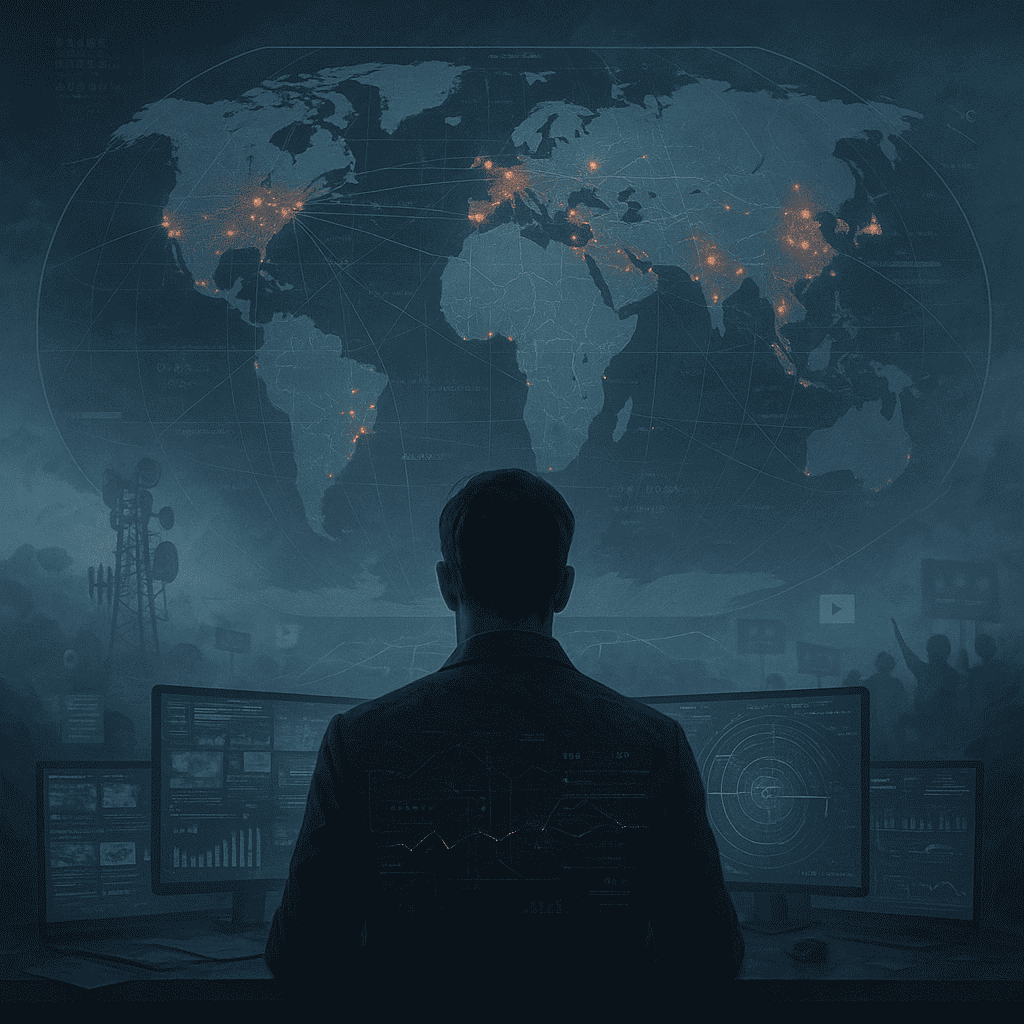
In the 21st century, war is no longer waged solely with bombs and bullets—it is waged with bytes, beliefs, and the battles for public perception. While the history of warfare has always included the control of information, the modern era has witnessed the elevation of information itself as the battlefield. Governments, corporations, militant groups, and lone actors now engage in silent, borderless conflicts aimed not just at territory, but at minds, moods, and machines.
Information Warfare (IW) is the strategic use of data, communication technologies, and psychological operations to gain competitive advantage. It spans a spectrum from benign influence to destructive cyberattacks, from subtle narrative framing to outright digital sabotage. In its most advanced forms, it erodes the foundations of democratic society: trust, transparency, and truth.
Information warfare encompasses far more than hacking—it includes the coordinated spread of disinformation, the manipulation of social media, the deployment of deepfakes, the weaponization of satire and propaganda, and the deliberate sowing of discord and confusion in populations. As societies become more interconnected and reliant on digital infrastructure, they become increasingly vulnerable to exploitation by actors who operate in the shadows of ambiguity.
This transformation has outpaced law, ethics, and education. The distinctions between peace and war, civilian and combatant, truth and fiction, have been profoundly blurred. Entire populations can now be targeted with precision psychological operations; institutions can be destabilized not through tanks, but tweets. What was once the realm of military deception is now a civilian battleground, fought on smartphones and search engines.
In response to these challenges, Science Abbey’s Neutral Analytical Vigilance Institute (NAVI) was founded to champion a new form of intelligence: one that is scientific, ethical, transparent, and neutral. NAVI does not engage in espionage or propaganda—it analyzes, educates, and illuminates. By tracking global disinformation trends, evaluating the integrity of national information systems, and promoting digital literacy, NAVI provides the world with a non-partisan compass in the fog of information war.
This article offers a comprehensive look into the science, strategies, and stakes of information warfare—from the structure of cyber operations and psychological campaigns to real-world case studies and the evolving role of intelligence institutions. It also introduces NAVI’s work and Science Abbey’s long-term vision: to secure the future of truth in the Age of Intelligence.
II. The Components of Information Warfare
Information warfare (IW) is not a single tool or tactic—it is an evolving system of interlinked strategies that exploit vulnerabilities in the human mind, digital infrastructure, and social ecosystem. Its effectiveness lies not in brute force, but in subtlety, ambiguity, and precision. Below are the primary operational components that define modern IW:
A. Control of Information Domains
At the core of information warfare is the battle to control information spaces—both one’s own and the adversary’s. This includes:
- Securing national digital infrastructure, government communications, and sensitive data repositories
- Acquiring and exploiting enemy information via espionage, leaks, and surveillance
- Silencing dissenting or inconvenient narratives through censorship, blocking, or overwhelming noise
- Maintaining dominance in the “infosphere”, the shared environment where data flows, decisions are made, and belief systems are shaped
In this context, the “high ground” is no longer a hill—it is the ability to own, curate, and weaponize information.
B. Manipulation and Narrative Warfare
Information warfare thrives on narrative control. Whoever shapes the story shapes the perception—of legitimacy, of blame, of victory.
- Disinformation campaigns spread deliberately false information to sow confusion or mislead
- Misinformation—falsehoods spread without intent—becomes a fertile breeding ground for chaos
- Propaganda and memetic warfare seek to trigger emotional responses, reinforce ideological divides, and reduce critical thinking
- False equivalencies and selective truth are used to blur moral clarity and dilute public trust
These manipulations are often camouflaged as journalism, humor, citizen opinion, or entertainment, making detection and counteraction difficult without trained, neutral analysis.
C. Disruption, Denial, and Degradation
In kinetic warfare, one disables roads, runways, or supply lines. In information warfare, the goal is to disable the target’s access to accurate, timely, and coherent information.
- Distributed denial-of-service (DDoS) attacks flood systems, disrupting access to online services
- Signal jamming and spoofing interfere with communications, GPS, and radio navigation
- Infrastructure sabotage targets electrical grids, telecom networks, and emergency systems
- Cloud poisoning and data corruption degrade the quality or trustworthiness of critical data
The intent is often not to destroy, but to confuse, delay, or paralyze.
Together, these components form a matrix of manipulation—a non-linear, cross-domain conflict where perception is as real as power, and truth itself becomes contested terrain.
III. Modalities of Information Warfare
The tools of information warfare span a diverse spectrum of technologies, psychological tactics, and electromagnetic operations. Each modality serves a different function—some are designed to influence thought, others to disable infrastructure, and others still to harvest intelligence or sow chaos. Below are the principal modalities through which information warfare is executed:
A. Cyber Operations
Cyber operations represent the technical engine of information warfare. These tactics exploit vulnerabilities in digital systems to gain access, gather intelligence, or cause disruption.
- Hacking and Cyber Espionage: Gaining unauthorized access to networks to steal information (e.g., government documents, trade secrets, electoral data).
- Malware and Ransomware Attacks: Infecting systems with software designed to damage or disable infrastructure, often for strategic coercion or financial gain.
- Supply Chain Infiltration: Compromising software or hardware providers to infiltrate broader systems, as seen in the SolarWinds hack.
- Cyber Reconnaissance: Mapping digital assets and vulnerabilities of an adversary, akin to intelligence surveillance.
These operations are increasingly state-sponsored, but also executed by non-state actors, contractors, criminal syndicates, and ideologically motivated groups.
B. Psychological Operations (PsyOps)
Where cyber operations target machines, PsyOps target minds. These campaigns aim to influence emotions, reasoning, and behavior in ways that serve strategic goals.
- Demoralization of Opponents: Spreading fear, uncertainty, or apathy to reduce resistance or loyalty.
- Persuasion and Mobilization: Shaping opinions to align with political agendas or incite specific actions (protests, votes, violence).
- Staged Events and False Flags: Orchestrating events to manipulate perception and assign blame.
- Amplification of Existing Divides: Exploiting cultural, racial, political, or religious tensions to polarize society.
Modern PsyOps increasingly leverage microtargeting algorithms, neurolinguistic design, and influencer infiltration to craft seemingly organic narratives that bypass skepticism.
C. Electronic and Electromagnetic Warfare
This modality focuses on the control or disruption of the electromagnetic spectrum, particularly radio, satellite, and GPS communications.
- Signal Jamming: Deliberately obstructing radio or cellular frequencies to disrupt communication.
- Spoofing: Sending false GPS or signal data to mislead systems and operators (e.g., navigation of military drones or ships).
- Directed Energy Attacks: Experimental but real, involving high-frequency microwaves or other non-lethal electromagnetic weapons.
- Anti-Satellite Operations: Blinding or disabling orbital communication and observation platforms.
These techniques are often deployed silently, with no clear warning, and can be difficult to attribute—making retaliation or legal recourse a complex geopolitical puzzle.
Taken together, these modalities show that information warfare is not bound by geography, uniforms, or traditional rules of engagement. It is a multi-domain, persistent, and adaptive form of conflict that unfolds simultaneously in code, cognition, and current.
IV. Strategic Examples in Global Context
The abstract principles and modalities of information warfare take on sharp clarity when examined through real-world case studies. These examples demonstrate how nations, groups, and individuals have wielded information as a weapon—undermining institutions, destabilizing societies, and reshaping global politics. What follows is a curated set of case studies highlighting the reach and consequences of IW in practice.
A. The 2016 U.S. Election and the DNC Hack
Perhaps the most publicly known and studied incident of modern IW, the 2016 U.S. election was significantly influenced by foreign information operations.
- Russian-affiliated groups, notably Fancy Bear (GRU) and Cozy Bear (FSB), breached Democratic National Committee (DNC) servers and leaked internal emails through WikiLeaks and other platforms.
- Simultaneously, botnets and troll farms spread divisive content via Facebook, Twitter, and YouTube, targeting American voters with custom-tailored propaganda.
- The campaign aimed to erode trust in democratic institutions, discredit political figures, and amplify polarization—all without firing a single shot.
This case became a wake-up call to democratic nations that electoral integrity is no longer just about ballots, but about bandwidth and belief.
B. Russian Disinformation in Ukraine and Europe
Russia’s strategy in Ukraine offers a textbook example of long-term narrative warfare:
- Before the 2014 annexation of Crimea, Russian state media seeded stories justifying intervention through claims of ethnic persecution and fascist uprisings.
- During the 2022 full-scale invasion, Russia deployed false flag operations, staged videos, and online bots to misrepresent battlefield realities.
- In Eastern Europe, Russia has run “firehose of falsehood” campaigns—deluging audiences with rapid, repeating, contradictory messages to exhaust attention and obscure truth.
- Beyond Ukraine, Russian media outlets (RT, Sputnik) continue to operate in Western nations, often spreading anti-NATO, anti-EU, and pro-autocracy narratives under the guise of alternative journalism.
C. China’s Global Influence Operations and Domestic Censorship
China employs a dual information warfare model: strict internal control and expansive external persuasion.
- The Great Firewall filters and suppresses domestic dissent, while surveillance systems monitor speech, thought, and online behavior.
- Externally, China funds media partnerships, invests in influencer networks, and uses state-backed troll accounts to shape international narratives on Xinjiang, Taiwan, and global governance.
- Initiatives like Belt and Road propaganda promote China’s model of economic order, subtly discrediting Western democracy as chaotic or obsolete.
- China’s “wolf warrior diplomacy” aggressively counters criticism while advancing nationalism, often through viral digital campaigns.
D. Deepfakes, Botnets, and the War for Social Media
Social media platforms have become the primary battlefield for IW, where deepfakes, bot swarms, and algorithmic manipulation are the new arsenal:
- Deepfake videos—such as synthetic speeches or doctored war footage—are increasingly realistic and harder to verify in real-time.
- Automated bots amplify targeted content, distort trending topics, and suppress opposition through mass reporting.
- Hashtag flooding techniques drown out movements like #MeToo, #FreeHongKong, or pro-democracy protests by seeding spam or hijacked narratives.
- Disinformation campaigns now often target diaspora groups, ethnic minorities, or ideological outliers to radicalize and recruit.
E. Electoral Interference Across Continents
While much focus has centered on U.S. and European elections, IW is a global phenomenon:
- In India, WhatsApp has been used to spread viral falsehoods ahead of elections, sometimes inciting violence.
- In Brazil, social media misinformation played a major role in political polarization and electoral manipulation in 2018 and 2022.
- Kenya’s 2013 and 2017 elections saw the deployment of British consulting firm Cambridge Analytica, which conducted personality-based microtargeting with harvested Facebook data.
- In Southeast Asia, state-sponsored troll armies have suppressed opposition movements using hate speech, astroturfing, and disinformation.
These examples confirm that information warfare is not the future—it is the present. It is a silent war without borders, uniforms, or ceasefires, capable of subverting nations and reshaping reality.
V. The Evolution and Importance of Information Warfare
The role of information in warfare is not new—deception, propaganda, and surveillance have long accompanied physical conflict. What distinguishes information warfare (IW) today is the scale, speed, precision, and ambiguity enabled by modern digital technologies. From radio broadcasts in World War II to algorithmic influence in the Age of Intelligence, information has evolved from a support tool to the primary theater of strategic competition.
A. The Information Domain as a New Theatre of War
In classic military theory, battlespaces were categorized into land, sea, air, and space. The 21st century has added a fifth domain: information. This domain is not defined by geography but by connectivity, cognition, and communication.
- Unlike traditional domains, information space is persistent and borderless, with battles unfolding continuously across time zones.
- Targets can be military, civilian, institutional, or even conceptual (e.g., democracy, science, or truth itself).
- Actors range from nation-states and terrorist organizations to corporations, hacktivists, and rogue influencers.
- Control of information—not just access to it—defines strategic dominance in this new landscape.
B. Blurring Civil-Military Boundaries
One of the most alarming features of modern IW is the disappearance of clear distinctions between combatants and civilians.
- A single viral tweet, meme, or misleading headline can achieve effects comparable to physical attacks—without the legal framework of conventional war.
- Civilian infrastructure such as social media platforms, news outlets, and internet service providers have become critical battlegrounds.
- Non-state actors (e.g., trolls, influencers, or activist groups) often become unwilling or unaware participants in strategic influence operations.
- False attribution or anonymous attack vectors make retaliation difficult, enabling adversaries to act with plausible deniability.
This hybridization of warfare has created a world where the battlefield is everywhere, and everyone is potentially a combatant—wittingly or not.
C. The Infosphere as Strategic Territory
Much like oil or territory in past centuries, the infosphere—the global system of knowledge, media, data, and perception—is now a strategic asset.
- Nations that dominate the narrative can gain diplomatic leverage, justify aggression, suppress dissent, and expand influence.
- Control over search engines, social media algorithms, and content platforms grants power over what populations see, believe, and do.
- The competition is no longer just over truth, but over the definition of reality itself.
In this new world, power flows through perception, and reality is contested, not conceded.
D. Information Superiority as Strategic Advantage
Success in modern conflict—and increasingly in diplomacy and economics—depends on information superiority:
- The ability to sense, interpret, decide, and act faster and more accurately than one’s adversaries.
- The ability to project coherent narratives, suppress confusion, and inoculate populations against disinformation.
- The ability to combine cyber, psychological, and electromagnetic operations into integrated strategic outcomes.
For national security, public trust, and civil stability, achieving and defending information superiority is now as vital as defending physical borders.
In summary, the importance of information warfare has eclipsed conventional assumptions about what war is. In a world shaped by data, distracted by noise, and vulnerable to manipulation, those who master the science of information wield disproportionate power. Understanding IW is no longer optional—it is essential for survival and sovereignty in the digital age.
VI. The Intelligence Dimension
Information warfare cannot be understood apart from the institutions tasked with understanding, detecting, and responding to it: the intelligence community. In many ways, the front line of IW is not a battlefield, but a data stream—and the defenders are not soldiers, but analysts, coders, linguists, and digital sleuths.
Modern intelligence agencies are both participants in and guardians against information warfare. Yet the ethics, transparency, and strategy of their operations remain under global scrutiny. This section explores the evolving role of intelligence in the IW era—both as a shield and a sword.
A. Role of National Intelligence Agencies
From the United States’ NSA and Cyber Command to the UK’s GCHQ, Israel’s Unit 8200, and Russia’s GRU, national intelligence agencies have increasingly embraced cyber and cognitive warfare capacities as central pillars of statecraft.
Their functions in the IW context include:
- Detection and Attribution: Identifying the source of cyberattacks or disinformation campaigns—often through complex forensic and behavioral analysis.
- Counter-Disinformation and Cyber Defense: Developing defensive technologies to protect data, democracy, and critical infrastructure.
- Offensive Cyber Operations: Disrupting enemy systems, planting false data, or manipulating adversary perceptions.
- Election Security and Public Trust: Working with domestic institutions to secure voting infrastructure and combat foreign influence.
These agencies now operate in “gray zones” of legality and attribution, where action must often be swift despite ambiguous rules of engagement.
B. Attribution, Retaliation, and Legal Ambiguities
A major challenge of IW is that attacks often come anonymously, through decentralized proxies or spoofed identities. This creates three core dilemmas:
- Attribution is slow and often uncertain. Without definitive proof of origin, political response becomes fraught.
- Retaliation risks escalation or unintended consequences, especially when the attack is digital and the response is kinetic.
- Legal frameworks lag behind: International law has not kept pace with non-kinetic, informational acts of aggression.
The result is a strategic atmosphere where states may hesitate to act, or may act preemptively on partial intelligence—a risky game with high global stakes.
C. Multilateral Cooperation: NATO, Five Eyes, and Beyond
To combat transnational information threats, alliances and data-sharing agreements have become indispensable:
- The Five Eyes alliance (U.S., UK, Canada, Australia, New Zealand) has expanded cyber intelligence collaboration, particularly on detecting and countering disinformation and foreign interference.
- NATO’s Cooperative Cyber Defence Centre of Excellence coordinates training, simulations, and legal research on IW defense.
- The EU’s East StratCom Task Force monitors Russian disinformation and produces the EUvsDisinfo database.
- Bilateral and trilateral pacts increasingly include clauses for mutual information warfare response protocols and cybersecurity guarantees.
Despite progress, political divergence, data sovereignty concerns, and asymmetrical capabilities complicate truly global coordination.
D. Civilian Intelligence: The Need for Transparency and Literacy
While traditional intelligence is classified and institutional, a new form of civilian intelligence is emerging:
- Investigative journalists, data scientists, and academic researchers now track IW in near-real-time.
- Open-source intelligence (OSINT) allows ordinary citizens and NGOs to expose state-sponsored propaganda, deepfakes, and electoral meddling.
- Public literacy campaigns aim to teach citizens how to recognize manipulation, verify facts, and resist polarization.
Yet this democratization of intelligence also raises questions: How do we ensure accuracy, neutrality, and safety in crowdsourced vigilance? How do we balance secrecy for security with transparency for democracy?
In short, intelligence is no longer just about knowing secrets—it is about defending shared reality. The next section will explore how NAVI (Neutral Analytical Vigilance Institute) provides a science-based, ethical, and neutral approach to information monitoring in this contested space.
Here is the draft for Section VII: The Role of NAVI (Neutral Analytical Vigilance Institute):
VII. The Role of NAVI: Neutral Analytical Vigilance Institute
In an age where truth is fragmented, trust is strained, and data is weaponized, the world needs more than traditional intelligence agencies. It needs an institution committed to ethical observation, scientific analysis, and public empowerment—a neutral force standing outside partisan conflict, offering clarity amid the chaos. This is the role of the Neutral Analytical Vigilance Institute (NAVI), a flagship initiative of Science Abbey.
Where government intelligence acts in the interest of national security, NAVI operates in the interest of global civic security—defending the integrity of democratic discourse, safeguarding public understanding, and mapping the battlefield of information with transparency, neutrality, and rigor.
A. Monitoring Information Warfare Globally
NAVI continuously tracks and analyzes state and non-state information operations across regions, using:
- Open-source intelligence (OSINT)
- AI-powered pattern recognition of disinformation networks
- Cross-platform media monitoring across traditional, digital, and encrypted ecosystems
- Election integrity assessments and media trust audits
These efforts produce real-time and retrospective reports identifying not only individual campaigns, but long-term trends and structural vulnerabilities in democratic information systems.
B. Disinformation Detection and Narrative Analysis
NAVI does not censor or editorialize. Instead, it dissects narratives scientifically:
- Classifies content by source type, emotional load, and ideological alignment
- Detects linguistic patterns common to propaganda, such as fear priming, scapegoating, and logical fallacies
- Compares narratives across languages, platforms, and regions to detect coordinated influence efforts
- Identifies semantic weapons—terms and memes used to manipulate or mobilize populations
By making these dynamics visible, NAVI empowers citizens, educators, journalists, and policymakers to understand the terrain before reacting to it.
C. The Media Trust Index and Public Literacy Tools
One of NAVI’s most powerful offerings is its Media Trust Index—a dynamic, evidence-based rating system for assessing the credibility, bias, and transparency of news and information sources worldwide.
- Evaluates editorial standards, ownership transparency, correction policies, and conflict-of-interest disclosure
- Measures signal-to-noise ratio, frequency of verifiable retractions, and disinformation vulnerability
- Enables users to visualize influence networks and trace how narratives spread and mutate
In parallel, NAVI produces public literacy modules—short, accessible guides that teach individuals how to:
- Identify misinformation
- Cross-verify facts
- Avoid emotional manipulation
- Navigate the cognitive stress of polarized media environments
D. Ethical AI for Truth Detection and Transparency
To remain impartial and scalable, NAVI relies on AI tools rooted in ethical principles:
- No black-box models—all algorithms used for classification or detection are transparent and auditable
- AI is trained not on partisan labels but on epistemological principles (e.g., evidence strength, logical coherence, source traceability)
- Algorithms flag manipulative content patterns, not opinions or ideologies
In this way, NAVI’s tools become civic infrastructure—not for suppressing speech, but for elevating understanding.
E. Global Partnerships and Democratic Resilience
NAVI consults:
- Independent media watchdogs and fact-checkers
- Election monitoring groups and electoral commissions
- Academic institutions studying communication, political science, and cognitive security
- Teachers, activists, and cultural leaders advancing civic literacy and dialogue
Together, they build a resilient global information ecosystem—capable not only of withstanding IW attacks, but of evolving beyond them into healthier, wiser, and more unified societies.
In summary, NAVI is not an agency of power, but of perception—a neutral mirror held up to the global infosphere. Its mission is to help humanity navigate the battlefield of information with discernment, dignity, and discipline.
VIII. Ethical and Legal Challenges
Information warfare not only reshapes conflict—it challenges the very ethical foundations and legal frameworks of modern society. As the boundary between manipulation and persuasion erodes, and as actions once exclusive to militaries are wielded by civilians and algorithms, the world faces urgent questions: What is just? What is legal? Who decides?
This section explores the ethical dilemmas and legal ambiguities that define the dark edge of the information age.
A. The Weaponization of Speech and Free Expression
One of the most difficult tensions in information warfare lies in the conflict between free speech and information security.
- Democratic societies value the freedom to speak, publish, and protest—but these same freedoms are exploited by hostile actors to sow chaos.
- False information is not always illegal, and defining harmful content can risk state overreach or censorship.
- Regulating speech online raises constitutional and human rights concerns, especially when governments pressure platforms to remove content.
- Even well-intentioned counter-disinformation efforts may suppress legitimate dissent, creating a feedback loop of mistrust.
This raises an essential ethical challenge: How do we defend truth without becoming authoritarians in the process?
B. Misinformation vs. Censorship: Navigating the Line
Governments, platforms, and watchdogs face a dangerous dilemma: act too slowly, and harmful disinformation spreads; act too quickly, and accusations of censorship erupt.
- Labeling content as false can backfire, reinforcing beliefs through psychological reactance.
- Banning accounts or shadow-banning users may alienate populations and push them into radical echo chambers.
- Legal action against disinformation spreaders must respect due process, jurisdictional limitations, and international law.
- Autocracies often use “fake news” laws as tools of repression, targeting journalists, NGOs, or opposition figures.
Thus, solutions must be transparent, accountable, and rights-based—with oversight mechanisms to prevent abuse.
C. International Law and the Call for an IW Convention
The current laws of armed conflict—rooted in the Geneva Conventions—were written for kinetic warfare. They lack clear applicability to:
- Digital sabotage and cyberattacks
- Non-lethal influence campaigns
- State-sponsored narrative manipulation
- Deepfakes and electoral interference
Efforts are underway through the United Nations, NATO, and the Tallinn Manual project to draft cyber norms, but progress is slow and uneven.
There is growing demand for an International Convention on Information Warfare, which could:
- Define and prohibit certain classes of manipulative behavior
- Establish international norms for attribution and response
- Create a legal framework for the ethical use of influence and persuasion tools
- Protect cognitive sovereignty as a new category of human rights
Until such frameworks exist, ambiguity remains the rule, and trust suffers.
D. Protecting Human Rights in a Digitally Manipulated World
As IW techniques grow more invasive—targeting not just populations but individual beliefs, identities, and behaviors—fundamental rights are at stake:
- Freedom of thought: Influencing beliefs through coercive data harvesting or subconscious manipulation
- Right to privacy: Weaponizing personal data to predict and shape decision-making
- Right to accurate information: A potential new right in the age of disinformation
- Right to self-governance: Undermined when democratic decisions are made under engineered falsehoods
These challenges demand a new ethic of digital personhood, one that treats information as an extension of agency, and perception as part of the human experience worth defending.
In sum, the ethical and legal dimensions of information warfare are not peripheral—they are foundational. Without clear standards, transparent oversight, and global cooperation, the future of freedom itself hangs in the balance.
IX. Science Abbey’s Vision: From Weaponized Narrative to Enlightened Discourse
In the face of rising disinformation, manipulated perception, and strategic deceit, Science Abbey stands for something radical yet ancient: truth as a sacred civic principle. We believe that the future of civilization depends not just on what we know, but on how we come to know it—and whom we trust in that process.
Where information warfare seeks to divide, obscure, and dominate, Science Abbey works to illuminate, integrate, and liberate. We do not fight propaganda with propaganda. Instead, we propose a new framework for global discourse—grounded in science, ethics, and democratic humanism.
A. Truth as a Public Good
Science Abbey affirms that truth is not a weapon to wield but a good to share. In the Age of Intelligence, access to accurate, contextual, and verified information is as essential as clean air or safe water.
We advocate for:
- Global standards of epistemological literacy—the science of knowing, taught in schools and embedded in media
- Transparent AI systems designed to support public reasoning, not manipulate it
- Shared open data infrastructures that empower civil society and journalism to independently verify claims
Information cannot be entrusted to profit motives or unchecked algorithms. It must be treated as civic infrastructure, subject to ethical stewardship.
B. Ethical Intelligence in a Fragmented World
Science Abbey, through NAVI, is pioneering the model of neutral, analytical intelligence—a third way between state secrecy and media partisanship.
This includes:
- Intelligence tools built on scientific methodology, not ideology
- Global transparency indices measuring narrative ecosystems
- Cross-cultural platforms for understanding, where conflicting worldviews can be compared with empathy and logic
Rather than choosing sides in political or national conflicts, we aim to map the battlefields of belief with integrity and neutrality—giving citizens the tools to decide for themselves.
C. Transparent Institutions in the Age of Intelligence
Just as the 20th century demanded industrial institutions, the 21st requires cognitive institutions—structures that safeguard the collective mind of humanity.
Science Abbey supports:
- Media accountability frameworks based on source transparency, not censorship
- Open-source digital civics curricula that teach media navigation, online ethics, and argument analysis
- Democracy-enhancing technology platforms that privilege dialogue over engagement farming, and deliberation over division
We imagine a world in which platforms are built not to hijack attention, but to elevate understanding.
D. A Call to Global Enlightenment
In response to the dark arts of disinformation, Science Abbey calls for a new Age of Enlightenment—not nostalgic, but reborn for the digital century.
This enlightenment must be:
- Interdisciplinary: drawing on neuroscience, philosophy, computer science, and history
- Intercultural: including Indigenous, Eastern, and Global South wisdom on storytelling, perception, and communication
- International: building coalitions that transcend borders to defend democratic perception worldwide
We envision a future where wisdom is not rare, but institutionalized—and where societies train their citizens to be not just informed, but discerning, compassionate, and courageous.
In this spirit, Science Abbey and NAVI do not fight with lies, but with light. Against the chaos of information warfare, we offer the clarity of scientific humanism and the vision of a world where truth does not need to be shouted—it only needs to be seen.
X. Conclusion: Winning Minds, Not Just Wars
Information warfare is not a shadow conflict—it is the central struggle of our age. It unfolds not in trenches, but in timelines; not in explosions, but in impressions. It exploits the vulnerabilities of open societies, networked technologies, and the human psyche. And it does so without regard for borders, law, or conscience.
Yet amidst this fog of cognitive war, there is hope—hope grounded in clarity, ethics, and science.
To confront the challenges of information warfare, we must move beyond reactive defenses and toward proactive systems of understanding. This is the mission of the Neutral Analytical Vigilance Institute (NAVI): to chart the battlefield of belief with neutrality, to detect deception with rigor, and to protect democracy with integrity.
Victory in this arena will not come from outshouting our adversaries, but from outthinking them—from raising a generation that can recognize manipulation, question what it hears, and search for truth with both humility and courage. The true aim of information warfare is to break the human spirit’s capacity to reason and relate. Our aim must be to heal it.
Science Abbey offers a vision of enlightenment that is not idealistic—it is necessary. In a world where reality is contested and perception weaponized, the most powerful defense is not silence, but discernment. Not propaganda, but principle. Not domination, but dialogue.
In the end, wars for land may scar the earth, but wars for the mind shape the future of civilization. And if we are to endure—not merely as nations, but as a species—we must learn not just how to fight for truth, but how to live with it.
Bibliography
- Jensen, B., & Ramjee, D. (2023). Beyond Bullets and Bombs: The Rising Tide of Information War in International Affairs. Center for Strategic and International Studies (CSIS). Retrieved from https://www.csis.org/analysis/beyond-bullets-and-bombs-rising-tide-information-war-international-affairs(publicnow.com)
- RAND Corporation. (1996). Strategic Information Warfare: A New Face of War. Retrieved from https://www.rand.org/pubs/monograph_reports/MR661.html(rand.org)
- Royal Air Force. (n.d.). Air and Space Power Review, Vol. 3, Issue 2. Centre for Air and Space Power Studies. Retrieved from https://www.raf.mod.uk/what-we-do/centre-for-air-and-space-power-studies/aspr/apr-vol3-iss2-5-pdf/(raf.mod.uk)
- United Nations Office on Drugs and Crime (UNODC). (n.d.). Cybercrime Module 14: Information Warfare, Disinformation and Electoral Fraud. Retrieved from https://www.unodc.org/e4j/en/cybercrime/module-14/key-issues/information-warfare–disinformation-and-electoral-fraud.html
- Giles, K. (2022). Information Warfare: Lessons in Inoculation to Disinformation. Parameters, 52(1). U.S. Army War College. Retrieved from https://press.armywarcollege.edu/parameters/vol52/iss1/9/(press.armywarcollege.edu)
- Snyder, D. C. (n.d.). Information Warfare. Federation of American Scientists. Retrieved from https://irp.fas.org/eprint/snyder/infowarfare.htm(irp.fas.org)
- Council of Europe. (n.d.). Dealing with Propaganda, Misinformation and Fake News. Retrieved from https://www.coe.int/en/web/campaign-free-to-speak-safe-to-learn/dealing-with-propaganda-misinformation-and-fake-news
- European Commission. (n.d.). Online Disinformation. Digital Strategy. Retrieved from https://digital-strategy.ec.europa.eu/en/policies/online-disinformation
- Giacomello, G. (2007). Information Warfare and Cyber Warfare: The Future of Warfare?. SANS Institute. Retrieved from https://www.giac.org/paper/gsec/3873/information-warfare-cyber-warfare-future-warfare/106165
- World Economic Forum. (2015). What is Information Warfare?. Retrieved from https://www.weforum.org/stories/2015/12/what-is-information-warfare/
- U.S. Naval Institute. (1996). What Is Info Warfare?. Proceedings, 122(2). Retrieved from https://www.usni.org/magazines/proceedings/1996/february/what-info-warfare(usni.org)
- United Nations. (n.d.). Countering Disinformation. Retrieved from https://www.un.org/en/countering-disinformation(un.org)
- Jensen, B., & Ramjee, D. (2023). Beyond Bullets and Bombs: The Rising Tide of Information War in International Affairs. Center for Strategic and International Studies (CSIS). Retrieved from https://www.csis.org/analysis/beyond-bullets-and-bombs-rising-tide-information-war-international-affairs(csis.org)