

Contents
- Introduction
Why Advisers and Consultants Shape the Modern World - Definitions and Key Distinctions
Understanding the Roles, Functions, and Differences Between Advising and Consulting - The Science of Advising
Mentorship, Trust, and the Psychology of Guidance - The Science of Consulting
Structured Expertise in Business, Politics, and Security
- A. Management Consulting
Strategy, Operations, and the Influence of the Big Three - B. Political Consulting
Campaigns, Messaging, and the Battle for Public Opinion - C. National Security and Defense Consulting
Strategic Insight and Ethical Tensions in a High-Stakes Field - D. Intelligence Consulting
From Data to Decision: Forecasting, Foresight, and Global Risk
- A. Management Consulting
- Global Oversight, Transparency, and the Role of NAVI
Mapping Influence and Holding Expert Power to Account - Conclusion: The Future of Advising and Consulting
A Scientific Humanist Vision of Ethical Expertise in the Age of Intelligence
I. Introduction
In an increasingly complex and interconnected world, individuals, organizations, and governments are more reliant than ever on specialized knowledge to navigate challenges and make informed decisions. From guiding students through academic choices to steering multinational corporations through economic turbulence, the roles of advisers and consultants have become integral to decision-making processes across nearly every sector of society.
Yet despite their shared function as sources of expertise, advising and consulting represent distinct traditions, models, and mindsets. One is often personal, long-term, and integrative; the other, professional, targeted, and analytical. One may be rooted in trust and mentorship, while the other is based on deliverables, contracts, and measurable outcomes.
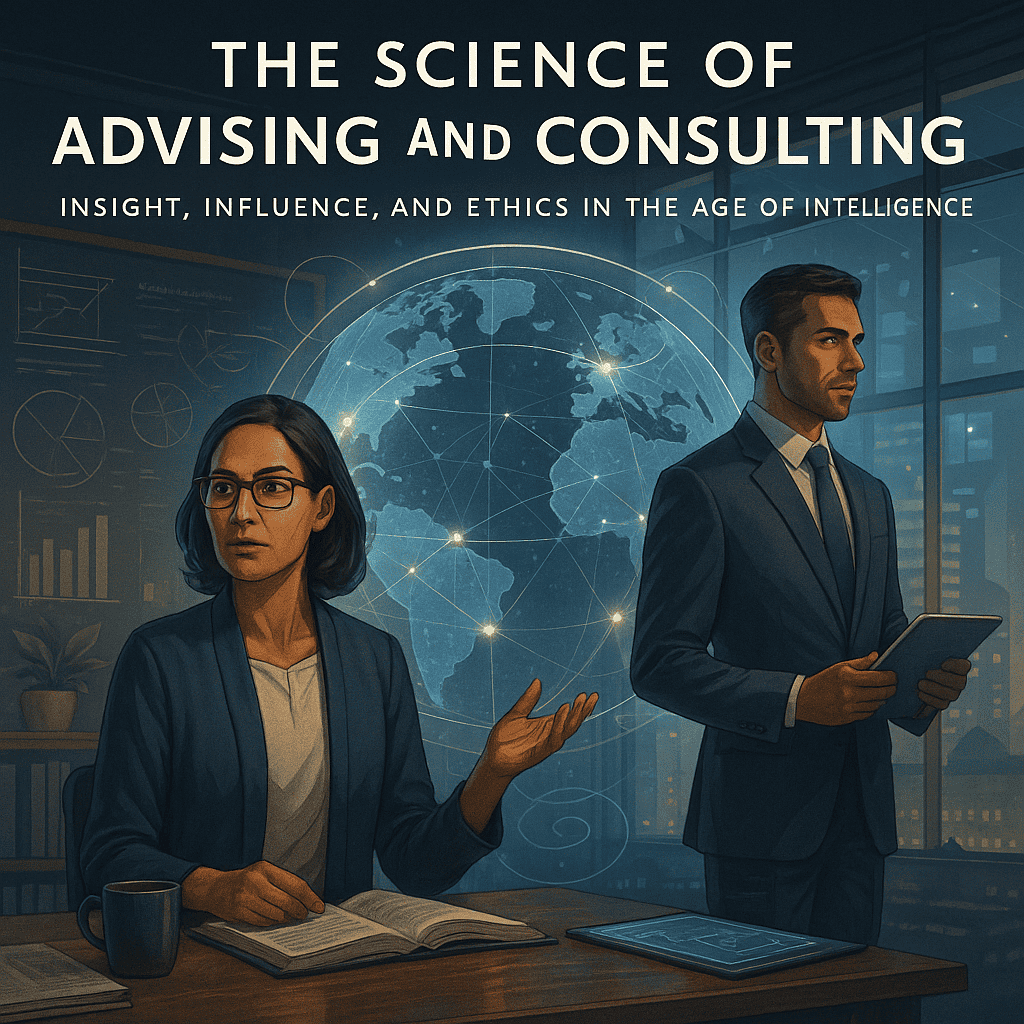
The Science of Advising and Consulting explores these two critical modes of expertise through a secular, scientific, and global lens. It investigates their origins, principles, and applications—from the ivory tower to the boardroom, the campaign trail to the war room. It examines how advisers and consultants shape power, influence outcomes, and transmit intelligence in ways both beneficial and problematic.
This article is part of Science Abbey’s larger mission: to illuminate the workings of the modern world through evidence-based inquiry, ethical reflection, and public accountability. It also forms part of the NAVI (Neutral Analytical Vigilance Institute) intelligence effort, which monitors global systems of governance, expertise, and influence.
In the following sections, we will define advising and consulting, distinguish their core attributes, and examine the major sectors where they operate. By analyzing both the science and the structure of these roles, we aim to understand how society can better use expertise—not merely to profit or persuade, but to serve truth, justice, and the well-being of all.
II. Definitions and Key Distinctions
What Is Advising?
An adviser (or advisor, a variant spelling) is someone who offers informed guidance, typically in a personal or professional capacity, with the goal of helping another party—an individual, group, or institution—make decisions, navigate complexity, or achieve long-term goals. Advisers are often embedded within organizations (e.g., universities, governments, corporations), and their relationships with advisees tend to be ongoing, trust-based, and integrated into the decision-making culture.
Examples of advisers include:
- Academic advisers in universities
- Policy advisers in government ministries
- Financial or legal advisers for families or businesses
- Scientific or public health advisers on national task forces
Advising is frequently rooted in mentorship, domain knowledge, and interpersonal rapport, and may or may not involve formal contracts or fees.
What Is Consulting?
A consultant is a professional expert hired to provide specialized advice, analysis, or problem-solving for a client—typically an organization or government—on a project or contractual basis. Unlike advisers, consultants are usually external to the organization, and their engagement is goal-oriented, time-limited, and deliverables-driven.
Consultants may operate as individuals, small practices, or members of large firms, and they are typically compensated based on defined outcomes or performance. They often employ structured methodologies and data analysis tools to offer insights and solutions.
Examples of consulting areas include:
- Strategy consulting for corporate restructuring
- Management consulting for operational efficiency
- Political consulting for electoral campaigns
- Cybersecurity consulting for digital threat mitigation
Advising vs. Consulting: A Summary of Differences
| Feature | Advising | Consulting |
| Relationship | Long-term, trust-based | Short- to medium-term, contract-based |
| Position | Internal or semi-integrated | External |
| Focus | General guidance, personal mentorship | Specific problems, actionable solutions |
| Approach | Open-ended, contextual | Structured, analytic, result-focused |
| Compensation | Often salaried or informal | Typically fee-based, project or hourly |
| Examples | Policy advisers, academic mentors | McKinsey consultants, digital media strategists |
Both roles share a commitment to informed decision-making, but their structure and psychology differ. Advisers often serve as sounding boards, helping clients weigh options and build competence. Consultants are solution architects, brought in for diagnosis, strategy, and transformation.
As we will see in the following sections, the real world often blurs these boundaries—especially in fields like politics and security, where the adviser-consultant dynamic can shift based on circumstance, influence, and access.
III. The Science of Advising
Advising is one of the oldest human social functions—rooted in wisdom traditions, educational mentorship, and the complex navigation of power. From the royal courts of ancient empires to the halls of modern academia and the think tanks of government ministries, advisers have played an indispensable role in shaping decisions not by commanding outcomes, but by guiding thought.
Historical Roots and Enduring Roles
The archetype of the adviser appears in nearly every culture:
- Confucius advised rulers on virtue and statecraft.
- Aristotle tutored Alexander the Great.
- Chanakya (Kautilya) served as the political and economic adviser to India’s Mauryan dynasty.
- John Dee, prophet of the British Empire, was an official adviser to Queen Elizabeth I.
- In the modern world, scientific, legal, policy, and ethics advisers work at all levels of society to support decision-makers.
Advisers occupy a space of influence without authority. They are expected to possess deep knowledge, sound judgment, and emotional intelligence, offering insight while respecting the autonomy of the decision-maker.
Core Principles of Advising
Effective advising draws upon principles from psychology, cognitive science, ethics, and communication. Key characteristics include:
- Listening and understanding context: Advisers must be attuned to the background, values, and constraints of the person or system they are advising.
- Helping clarify goals and values: Advisers often serve as mirrors, helping clients articulate what they truly want or need.
- Offering options and implications: Rather than prescribing solutions, advisers present choices and forecast likely outcomes.
- Maintaining confidentiality and trust: Trust is the foundation of enduring advisory relationships.
- Encouraging independence: The best advisers cultivate decision-making ability in others.
These functions mirror the Socratic method, motivational interviewing, and modern coaching approaches in psychology. Neuroscientific studies also support the effectiveness of reflection-based dialogue in activating executive function and metacognition in the brain.
Types of Advisers and Their Contexts
| Sector | Typical Adviser Role |
| Academia | Academic advisers guiding student progress and career development |
| Government | Policy advisers shaping legislation and executive decision-making |
| Health and Science | Scientific and public health advisers providing expert analysis and risk guidance |
| Finance and Law | Legal and financial advisers supporting wealth, compliance, and estate planning |
| Nonprofits and Philanthropy | Mission-based advisers focused on strategy and ethical impact |
In all these contexts, advisers must balance loyalty, impartiality, and foresight—often in environments of ambiguity, urgency, or competing interests.
Ethics and Challenges in Advising
Advising carries ethical weight, particularly when high stakes or vulnerable populations are involved. Common dilemmas include:
- Conflict of interest: Advisers may be pulled between loyalty to their client and to broader ethical standards.
- Dependency: Poor advising can create over-reliance or manipulation.
- Silence vs. candor: Advisers must decide when to speak up, even at risk to their own position.
Scientific Humanism suggests that good advising should be governed by reason, compassion, evidence, and integrity. The goal is not to dominate decisions, but to illuminate them—to serve as an intelligent and honest companion in the pursuit of truth.
IV. The Science of Consulting
While advising is rooted in mentorship and trust, consulting is a more formalized and commodified form of expertise. It emerged alongside modern capitalism, industrial management, and bureaucratic governance. Today, consulting firms advise not just companies, but governments, militaries, and NGOs across all major sectors of life.
At its best, consulting provides high-quality, data-driven insight to complex problems. At its worst, it enables expensive groupthink or unaccountable influence over policy and markets. Understanding consulting scientifically involves looking at its structures, methodologies, key sectors, and ethical implications.
The Consulting Firm: Origins and Function
Consulting as an industry began to coalesce in the late 19th and early 20th centuries, notably with Arthur D. Little and McKinsey & Company. These firms offered expert advice to businesses navigating industrialization, strategy, and organizational management.
Modern consulting firms are typically:
- Project-based: Consultants are brought in to solve a specific problem or implement a solution.
- Method-driven: Many firms use proprietary frameworks or data models.
- Client-centric: Deliverables are tailored to specific client needs.
- Team-oriented: Projects are handled by a rotating team of specialists, analysts, and partners.
Consultants are not hired to become part of the client’s system—they are external troubleshooters, strategists, and transformation agents.
A. Management Consulting
Definition and Role
Management consulting focuses on improving a client’s business performance, strategy, structure, and operations. These firms help organizations:
- Enter new markets
- Reduce costs or increase efficiency
- Reorganize leadership structures
- Navigate mergers or digital transformation
The Big Three (MBB)
The top three firms in global management consulting are:
- McKinsey & Company – known for its analytic rigor and strategic influence
- Boston Consulting Group (BCG) – known for innovation frameworks like the BCG matrix
- Bain & Company – known for client loyalty and results-focused consulting
Collectively referred to as MBB, these firms set industry benchmarks and often influence entire national policies through corporate and government partnerships.
Ethical and Strategic Questions
Management consultants have faced growing scrutiny for:
- Overpricing and inefficiency
- Encouraging layoffs and austerity measures
- Participating in privatization of public services
- Advising authoritarian regimes
Critics argue that firms sometimes impose ideologies of profit-maximization or efficiency without regard to human impact, democratic accountability, or sustainability. Scientific Humanism calls for a deeper evaluation of consulting’s influence, especially when private consultants shape public futures.
IV.B. Political Consulting
What Is Political Consulting?
Political consulting is a specialized branch of consulting focused on campaign strategy, public image, messaging, polling, media, and policy influence. Political consultants work with candidates, parties, advocacy groups, and governments to shape how power is attained, maintained, or challenged.
While political advisers often work from within (e.g., chiefs of staff, national security advisers), political consultants are typically external professionals or firms who operate within specific campaign cycles or legislative initiatives.
They are paid to win, persuade, or influence—not necessarily to tell the truth. This raises powerful ethical questions about their role in democratic systems.
Functions of Political Consultants
Political consultants may specialize in:
- Campaign strategy – developing slogans, framing issues, opposition research
- Polling and data analysis – tracking public opinion and voter demographics
- Media and communications – shaping public perception via TV, social media, and PR
- Debate and speech prep – helping clients craft messages and avoid missteps
- Fundraising and PAC alignment – navigating financial support networks
- Lobbying and legislative consulting – advancing or blocking policy agendas
The field draws on behavioral psychology, marketing science, media theory, and data analytics to influence public consciousness and electoral behavior.
Top Firms in the UK and US
United Kingdom
- CTF Partners: A political strategy firm known for controversial campaigns and its influence in Conservative Party politics.
- MHP Group: A global communications firm focused on public affairs, reputation management, and crisis response.
United States
- Bully Pulpit Interactive (BPI): A digital strategy powerhouse known for its Democratic-aligned campaigns and advanced use of data and social media.
- The% (Placeholder): Firms of influence in Republican campaign circles, often known for polling, micro-targeting, or negative campaigning. [Note: placeholder firm names “The%” to be replaced with specifics.]
These firms often employ teams of pollsters, data scientists, media consultants, opposition researchers, and strategic communicators. They wield vast influence in shaping both electoral outcomes and public discourse.
Risks and Critiques
Political consulting is powerful—but controversial. Critics cite several dangers:
- Disinformation and manipulation: The rise of deepfakes, bots, and meme warfare.
- Short-termism: Consultants aim to win elections, not govern responsibly.
- Polarization and negativity: Many campaigns rely on fear or outrage.
- Opacity: Firms are not accountable to the public, even when shaping national outcomes.
From a Scientific Humanist perspective, political consulting must be reformed to serve democratic integrity. This includes transparency standards, truth-in-advertising regulations, and public funding for verified information platforms.
IV.C. National Security and Defense Consulting
Overview
National security and defense consulting brings together strategic insight, technical expertise, and classified knowledge to advise governments, military agencies, and defense contractors. These consultants help shape military planning, cyber operations, intelligence gathering, threat modeling, procurement, and homeland security systems.
This field is uniquely sensitive. The stakes are high: consultants operate at the intersection of policy, warfare, ethics, and global security. The tools they deploy—AI, surveillance, simulations, weapons systems—can determine peace or catastrophe.
Major Consulting Firms and Their Focus
Tier-1 Strategy Firms with Defense Experience
- McKinsey & Company
- Boston Consulting Group (BCG)
- Bain & Company
These firms, collectively known as MBB, have advised the Pentagon, defense ministries, and intelligence agencies—sometimes controversially—on transformation strategies, budget allocations, and procurement reform.
Specialized Defense and Tech Consulting Firms
- Accenture: Known for digital modernization in defense sectors, supply chain systems, and secure cloud operations.
- Deloitte: Offers comprehensive national security and public sector services, including analytics and risk assessment.
- Roke: UK-based defense innovator in cyber, electronic warfare, and missile systems.
- Cambridge Consultants: Develops AI-based simulation platforms and autonomous system testing for military use.
- CACI: Focused on government and military software, surveillance, and intelligence infrastructure.
- WSP: Provides physical and cyber infrastructure planning, including for critical defense facilities.
- IBM Security: Delivers enterprise-level cybersecurity services, including threat detection and national threat response.
Independent Consultants and Expert Networks
Some of the most agile and specialized advice comes from independent consultants and niche firms:
- Association of Security Consultants (ASC): UK-based network offering tailored security advice for both private and public sectors.
- ISSEE: A consultancy specializing in explosives and munitions management across defense and commercial sectors.
- Notable individuals:
- Gérôme Billois (Wavestone): Cybersecurity strategist
- Marcela Denniston (Salesforce): Threat management specialist
- Michael Leiter (Skadden Arps): Expert in national security law and the Committee on Foreign Investment in the United States (CFIUS)
- Gérôme Billois (Wavestone): Cybersecurity strategist
These individuals often possess deep experience in military operations, intelligence, cyber conflict, and legal frameworks.
Emerging Areas: Cybersecurity and Talent Intelligence
As warfare increasingly moves to cyberspace, national security consultants are expanding into:
- Cyber risk modeling
- Incident response planning
- Security audits for AI systems
- Recruitment of security-cleared personnel
Initiatives like the NCSC’s Assured Cyber Security Consultancy in the UK and platforms like Searchability National Security and Defense help organizations access vetted expertise in these high-risk domains.
Ethical and Strategic Tensions
The influence of national security consultants raises vital concerns:
- Privatization of defense intelligence
- Moral ambiguity in advising on drone warfare, surveillance, and espionage
- Revolving door between government and industry
- Lack of civilian oversight
From a Scientific Humanist perspective, the field must prioritize defense of life, human rights, international law, and the prevention of war. Consultants must be held to ethical standards that transcend narrow client loyalty and uphold the safety and dignity of all people.
IV.D. Intelligence Consulting
What Is Intelligence Consulting?
Intelligence consulting involves providing expert analysis, forecasting, and strategic recommendations based on the collection and interpretation of data—often sensitive, classified, or geostrategic in nature. It bridges the gap between information and action for governments, militaries, corporations, and NGOs operating in volatile or competitive environments.
Unlike espionage or operational intelligence, intelligence consulting focuses on decision support, simulation, strategic foresight, and organizational resilience.
Key Functions of Intelligence Consultants
- Threat analysis (e.g., terrorism, economic instability, geopolitical tensions)
- Risk assessment and mitigation
- Competitive intelligence and market positioning
- Scenario modeling and war-gaming
- Information assurance and secure data strategy
- Policy and strategy development for defense, trade, and international affairs
Consultants in this space often work on interdisciplinary teams blending political science, military experience, cybersecurity, behavioral economics, and systems modeling.
Top Intelligence and Strategy Consulting Firms
Tier-1 Strategy Consultants (MBB)
- McKinsey & Company
- Boston Consulting Group (BCG)
- Bain & Company
These firms operate at the top level of national and global strategy consulting, working with defense ministries, national security councils, and multinational entities.
Tier-2 and Big Four Firms
- Deloitte, EY (Ernst & Young), PwC, and KPMG – These global accounting and consulting firms provide intelligence services through their advisory branches, particularly in:
- Digital risk and cybersecurity
- Economic intelligence
- Forensic analysis
- Crisis response and resilience planning
- Digital risk and cybersecurity
- Accenture – Focused on AI-powered threat modeling, digital defense, and cybersecurity architecture.
- Kearney and Oliver Wyman – Offer geopolitical analysis, international logistics planning, and strategic foresight.
Specialized Divisions
- Strategy& (PwC) and EY-Parthenon focus on advanced strategy for both corporate and government clients.
- Northrop Grumman – Though primarily a defense contractor, it offers high-level IT and AI consultancy to U.S. intelligence clients.
- IBM Consulting – Specializes in AI ethics, data science, and intelligence system design.
- SAP Services – Provides enterprise solutions for intelligence workflow and secure communications.
Notable Research-Based Intelligence Projects
- Critical Threats Project (American Enterprise Institute): A nonpartisan research initiative analyzing threats from authoritarian states, jihadist groups, and geopolitical instability.
- Institute for the Study of War (ISW): A nonprofit providing real-time intelligence analysis and maps on global conflicts—frequently cited by governments and news agencies.
These organizations blend consulting, public education, and real-time intelligence dissemination—an emerging hybrid model in the Age of Information.
Ethical Dimensions and Public Oversight
As with national security consulting, intelligence consulting faces serious challenges:
- Opacity and proprietary secrecy
- Potential manipulation of information for client goals
- Alignment with private or ideological agendas over democratic values
From a Scientific Humanist standpoint, intelligence must be used to prevent conflict, protect rights, and inform rational governance—not to serve propaganda or secrecy. Public accountability and open science tools should be extended wherever possible to the domain of strategic intelligence.
V. Global Oversight, Transparency, and the Role of NAVI
As advisers and consultants increasingly shape the most critical decisions in politics, business, defense, and global health, a paradox emerges: the more influential they become, the less publicly accountable they are. This creates a shadow realm of strategic influence—highly intellectual, well-compensated, often invisible to democratic oversight.
The Neutral Analytical Vigilance Institute (NAVI), a Science Abbey initiative, was created to address precisely this dilemma. NAVI studies the influence of advisers and consultants across global systems of governance, offering public-facing intelligence, comparative ratings, and ethical analysis to strengthen democracy and transparency in the Age of Intelligence.
The Challenge of Consultant Power
Consultants and advisers may act without:
- Public consent
- Electoral mandate
- Long-term accountability for the consequences of their advice
While many operate in good faith, others exploit systemic blind spots:
- Revolving doors between government and private industry
- Unregulated access to policymakers
- Secrecy clauses in contracts and NDAs
- Capture of decision-making processes by elite, fee-based networks
These risks are magnified when consulting intersects with national security, election campaigns, or international conflict—areas in which a single recommendation may alter the course of history.
Toward Ethical and Transparent Expertise
Science Abbey and NAVI support a vision of intelligence with integrity. This means:
- Promoting open models of public-interest consulting
- Supporting whistleblower protections and truth-in-consulting standards
- Mapping influence networks and consultant-policymaker relationships
- Creating transparency indexes for national and global consultancy systems
- Advocating for independent science advisers in governments worldwide
- Building public literacy in identifying and questioning influence
NAVI’s comparative democracy and consulting indices will help journalists, educators, policymakers, and citizens understand:
- Who is advising power?
- What methods are being used?
- What systems of accountability are in place?
- What outcomes follow from that influence?
Consulting in the Public Interest
Consultants and advisers will remain central to modern civilization—but their alignment must shift. Science Abbey promotes a new ideal: consulting not merely as a service industry, but as a form of civic contribution. Consultants should be:
- Ethically bound to truth
- Guided by science and humanitarian values
- Transparent in method
- Accountable in influence
In an age of AI-generated misinformation and global crises, consulting must become a beacon of clarity, not a machine of manipulation. NAVI exists to help society distinguish between the two.
VI. Conclusion: The Future of Advising and Consulting
In a time of accelerating complexity—where the stakes of every decision ripple globally and the margins for error shrink—the roles of advisers and consultants have never been more essential, nor more contested.
Advising and consulting are not merely professions; they are functions of wisdom, insight, and responsible influence. When practiced with integrity, they help individuals, institutions, and nations think clearly, act strategically, and serve the common good. But when compromised by ideology, secrecy, or self-interest, they become mechanisms of distortion, privilege, and manipulation.
The future demands a new culture of expertise: one that unites the emotional intelligence of the adviser with the analytical rigor of the consultant, and subordinates both to the principles of science, ethics, and human dignity.
The Humanist Vision of Expertise
Science Abbey calls for a transformation in how society views and uses expertise:
- Advisers should be mentors of moral clarity—cultivators of human development who speak not just to outcomes, but to meaning.
- Consultants should be servants of truth—bringing tools, data, and systems thinking to the world’s most difficult problems, free from corruption or partisan distortion.
- Both should be held to standards of transparency, accountability, and public value.
In this future, consulting is no longer a private club for the powerful, but a global commons of open knowledge, accessible methods, and ethical action. Advising is no longer informal or arbitrary, but a recognized discipline of reflective judgment and civic responsibility.
Science Abbey and NAVI’s Contribution
Through its research, education, and transparency initiatives, Science Abbey—alongside NAVI—aims to:
- Train future generations of ethical consultants and advisers
- Inform public understanding of influence networks
- Hold elite consulting systems to account
- Promote a planetary intelligence rooted in wisdom, not just knowledge
Ultimately, the character of a society is determined not only by its knowledge, but by the voices it chooses to heed.