
The Evolution of Wealth and the Rise of Humanist Finance
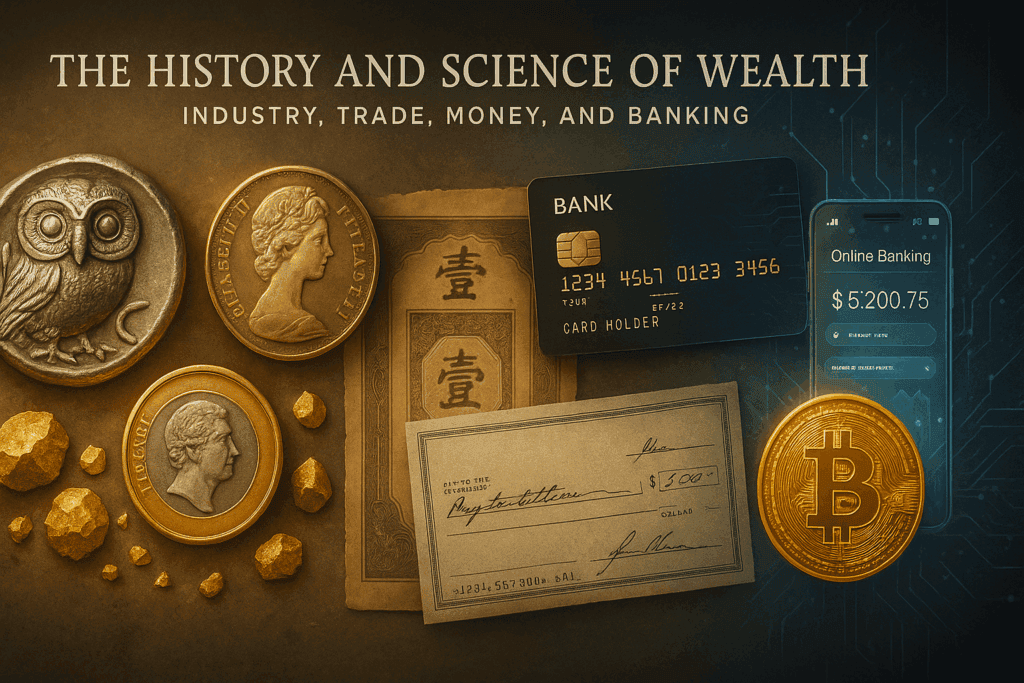
Table of Contents
- Introduction – What Is Wealth?
Reframing wealth as more than money: its meanings, functions, and role in human civilization. - Early Wealth – Trade and Possession Before Money
From gift economies and barter to land ownership, labor, and early accounting systems. - The Invention and Evolution of Money
The rise of symbolic currency, coinage, paper money, credit, and digital assets. - Professions, Labor, and the Rise of Industry
The history of labor division, industrialization, corporate structures, and automation. - A Taxonomy of Industry
The five economic sectors—primary to quinary—and how they shape wealth and society. - The Evolution of Banking
From temples and merchant houses to modern central banks and algorithmic finance. - The Technological Evolution of Wealth Management
How accounting, computing, fintech, and AI have transformed financial systems. - Nonprofits, Philanthropy, and Ethical Wealth
Charity, foundations, evidence-based giving, and the moral role of surplus wealth. - National Banks, International Finance, and the Global Monetary Order
Central banks, the IMF, World Bank, currency hierarchies, and reform proposals. - The Science of Economics and the Disciplines of Wealth
Defining economics and its branches: finance, statistics, management, and law. - A Humanist Financial Strategy
Proposal for a lifelong, ethical, science-based investment and empowerment system. - Conclusion – Reimagining Wealth in the Age of Intelligence
Final synthesis: toward a moral, intelligent, and cooperative economic future.
1. Introduction – What Is Wealth?
Wealth is one of the most powerful forces in human history—at once a material reality and a symbolic expression of value, security, and influence. It is not merely the accumulation of money or assets, but a complex phenomenon that reflects human labor, natural resources, social relationships, technological innovation, and ethical frameworks. To understand wealth is to understand the very structures that sustain or undermine civilizations.
From the first surplus of grain stored in ancient river valleys to the digital currencies of the 21st century, wealth has taken many forms: land, livestock, gold, coinage, credit, stocks, patents, and data. Each form reflects the technological capacities and philosophical assumptions of the society that generated it. In pre-agricultural communities, wealth was embedded in communal kinship systems. In feudal societies, it was tied to land and inheritance. In capitalist modernity, it is often measured in abstract numerical units—currency, equity, and credit ratings—detached from the physical goods they once represented.
But wealth is not just a private matter. It is foundational to the structure of societies. The ability to acquire, control, and transfer wealth determines access to food, shelter, healthcare, education, and political power. Systems of taxation, redistribution, and investment are all mediated through economic models, whether democratic or authoritarian, scientific or ideological.
This article explores the history and science of wealth from a Scientific Humanist perspective—a worldview that integrates empirical inquiry, ethical reasoning, and human dignity into economic thought. We aim to investigate not only how wealth has evolved across cultures and epochs, but how it can be understood, cultivated, and deployed today to serve the long-term flourishing of individuals, communities, and the global environment.
In the context of this inquiry, we will cover:
- The ancient origins of trade and early forms of wealth;
- The invention of money and its technological transformations;
- The rise of industry, business, and financial institutions;
- The evolution of banking and global economic systems;
- The science of wealth creation across disciplines such as economics, finance, and information technology;
- The ethical use of wealth in philanthropy, nonprofit sectors, and future planning.
Most importantly, this article provides the conceptual foundation for a future humanist financial collective—an integrated group designed to help people of all backgrounds and ages manage lifetime wealth, invest in science and technology, and fund global initiatives in education, health, sustainability, and social justice.
In an age increasingly defined by financial complexity and technological disruption, understanding the origins, functions, and future of wealth is not a luxury—it is a civic and moral necessity.
2. Early Wealth – Trade and Possession Before Money
Long before coins were minted or banks were founded, human beings engaged in complex systems of exchange rooted in trust, reciprocity, and survival. The foundations of wealth were not monetary but material, relational, and communal. Early wealth was tied to environmental mastery, cooperative labor, and social prestige. This section explores the forms of wealth that predate formal economics, tracing their evolution from the Paleolithic to early agrarian societies.
2.1. The Barter Economy and Gift Exchange
In prehistoric hunter-gatherer bands, there was no formal marketplace, yet systems of value and trade still existed. Anthropological studies of surviving tribal societies, such as the !Kung of the Kalahari or the Trobriand Islanders, reveal that gift economies and barter systems were prevalent. Trade was often informal, based on direct exchange of goods—meat for tools, medicinal plants for pottery—or services like hunting assistance or shelter-building.
Rather than being purely transactional, these exchanges were often embedded in social relationships and ritual obligations. The value of a gift might lie more in the relationship it affirms than in its material worth. Such systems laid the groundwork for early understandings of reciprocity, debt, and obligation—concepts still central to economic life today.
2.2. Tangible Assets and Early Notions of Ownership
As humans began to domesticate animals and cultivate land during the Neolithic Revolution (c. 10,000 BCE), wealth became more tangible, accumulable, and disputable. Livestock, grain stores, tools, and ornaments became symbols of prosperity, and eventually, inequality. Those who owned more could trade more, store more, and protect more. Wealth began to confer not just survival advantages, but social status and political power.
The earliest known permanent settlements, such as Çatalhöyük in Anatolia and Jericho in the Levant, show clear evidence of wealth stratification—larger houses, exclusive access to trade goods, and buried valuables. With the rise of agrarian societies came new ideas: inheritance, taxation, surplus management, and the distinction between private and communal property.
2.3. Land, Labor, and Control
In Mesopotamia, Egypt, and early China, land became the primary indicator of wealth. Ownership or control of land granted access to food production, laborers, and tax revenues. In many cases, land was considered to belong to the king or state, with individuals granted temporary use rights, often in exchange for tribute, military service, or fealty.
Enslaved people and forced laborers, tragically, were also counted as property in many ancient economies. The concept of humans as wealth carriers became institutionalized in empires across Africa, Asia, and Europe, and persisted into the modern era. In this sense, wealth was increasingly associated with domination—over land, people, and the environment.
2.4. Proto-Finance: Lease, Rent, and Tribute
By the Bronze Age (c. 3000–1200 BCE), legal systems had begun to recognize contracts of lease and rent, particularly for agricultural land, animals, and equipment. Ancient Mesopotamian clay tablets detail the terms of loans, leases, and repayment schedules—often with interest. Temples and palaces served as early financial centers, storing grain, issuing rations, and collecting tribute in kind.
Wealth thus shifted from something possessed to something exchanged, invested, and managed. The earliest forms of debt and finance emerged not from coinage, but from written recordkeeping and institutional trust.
Conclusion: Foundations for Future Wealth Systems
The prehistoric and ancient systems of trade, ownership, and resource control were not merely primitive versions of modern capitalism; they were adaptive solutions to real human challenges: scarcity, risk, social cohesion, and interdependence. They reveal that wealth has always been more than material—it is embedded in our social fabric and shaped by our values.
As we proceed to explore the invention and evolution of money in Section 3, we will see how these early systems laid the groundwork for economic abstraction, specialization, and the rise of formal institutions.

3. The Invention and Evolution of Money
Money is one of the most transformative inventions in human history. It enabled societies to transcend the limitations of barter, coordinate complex economies, and store abstract value across time and space. More than a medium of exchange, money became a tool of governance, identity, technology, and even faith. This section traces the evolution of money from its symbolic origins to the digital revolutions of the 21st century, with emphasis on technological innovations and the cultural frameworks that shaped them.
3.1. Pre-Monetary Currencies: Symbolic and Practical Value
Before coins and banknotes, many societies developed commodity currencies—objects with intrinsic or culturally agreed-upon value that served as units of account. These included:
- Cowry shells (Africa, Asia, Pacific Islands)
- Salt bricks (Tibet, West Africa)
- Livestock, grain, and metal ingots
- Beads, feathers, and obsidian blades
Such items functioned within local systems of trust, often supplemented by ritual or social status. In these societies, money was not just economic—it was social and spiritual, often used in marriage contracts, dowries, and burial rites.
3.2. Coinage and the Birth of State-Controlled Money
The first standardized coins appeared in Lydia (modern-day Turkey) around the 7th century BCE, made of electrum, a naturally occurring alloy of gold and silver. These were soon followed by:
- Greek drachmas and Athenian owls
- Persian darics
- Roman denarii
- Chinese knife and spade coins, followed by round cash coins
What distinguished coins from earlier currency forms was their official minting and guaranteed weight—a technological and political innovation. Coins served as instruments of statecraft, bearing royal symbols or divine images that promoted national identity and imperial authority. They enabled taxation, soldier pay, market regulation, and long-distance trade.
Coinage also required new technologies: smelting, minting presses, die engraving, and metallurgical standardization. These advances were pivotal in linking political legitimacy with monetary stability.
3.3. The Rise of Paper Money and Credit Instruments
As trade expanded, coins became inconvenient for large transactions. In response, promissory notes, letters of credit, and bills of exchange emerged across cultures:
- Tang Dynasty China (7th century CE) was the first to issue government-backed paper money, called jiaozi.
- In Islamic finance, merchants used written contracts and credit partnerships (mudaraba, sukuk).
- Medieval Jewish and Italian bankers created intercity credit networks using written drafts and double-entry bookkeeping.
- The Templar Order in Europe developed an early international remittance system for pilgrims, safeguarding valuables while enabling secure withdrawal at destination.
Paper money eventually became state-issued and legally enforced, beginning in Song Dynasty China (11th century), and centuries later in Sweden (1661) and France and England (17th–18th centuries). These notes were initially redeemable for metal reserves, but over time evolved into fiat currencies—money backed by law, not substance.
3.4. Modern Financial Instruments: From Checks to Cryptocurrencies
The industrial and post-industrial eras brought dramatic changes in money’s form and function:
- Checks and bank drafts allowed flexible payments.
- Credit cards (1950s) and ATM networks (1970s–80s) introduced plastic-based digital access to accounts.
- Online banking and mobile payment apps (2000s–present) digitized money entirely, enabling near-instant global transfers.
Perhaps most revolutionary is the emergence of blockchain-based cryptocurrencies, starting with Bitcoin in 2009. These decentralized digital tokens use cryptographic algorithms and distributed ledgers to guarantee trust without central authorities.
Though volatile, cryptocurrencies represent a fundamental shift in the philosophy of money:
- From centralized issuance to peer-to-peer consensus
- From state-backed authority to mathematical trust
- From physical to digital scarcity
Alongside cryptocurrencies, the rise of Central Bank Digital Currencies (CBDCs) signals a hybrid future, where sovereign control and cryptographic infrastructure converge.
3.5. Money as Technology and Symbol
Across history, money has evolved not just through cultural invention but through technological transformation. From coinage presses to cloud-based banking algorithms, every leap in monetary form has required material innovation and conceptual trust. But money is not merely a neutral tool—it reflects values, systems of power, and collective imagination.
- Ancient coins bore gods and emperors.
- Medieval notes invoked divine or royal guarantees.
- Today’s cryptocurrencies rely on mathematics and networks, but are often tied to ideologies of decentralization, privacy, or liberation from fiat control.
Money is both an artifact and an idea. It is real, yet abstract; measurable, yet symbolic.
Conclusion: From Cowries to Code
The invention of money was not a single event, but a long arc of adaptation—a continuous human response to the challenges of exchange, storage, and coordination. Each phase of monetary evolution reflects deeper shifts in how societies organize trust, manage risk, and conceptualize value.
As we transition into a data-driven and dematerialized economy, understanding this history becomes crucial—not just to navigate complexity, but to design a future where wealth serves humanity, not the reverse.
We now turn to Section 4: Professions, Labor, and the Rise of Industry, where money meets labor, production, and the organization of economic life.
4. Professions, Labor, and the Rise of Industry
The creation of wealth is inseparable from the organization of labor. From the earliest specialization of tasks to the global industrial economies of today, labor has been the primary engine of value. The ways in which human beings have structured work, developed professions, and built enterprises reveal not only technological progress, but also shifts in moral, social, and political priorities. This section examines the evolution of labor and industry, highlighting the birth of professions, the legal and economic forms of business, and the technological systems that revolutionized production.
4.1. Early Division of Labor and the Birth of Professions
In prehistoric and early agrarian societies, labor was divided primarily along lines of gender, age, and physical capacity. Women often gathered, prepared food, and managed domestic tasks, while men hunted or defended the tribe. As societies advanced, specialization increased.
By the time of ancient Mesopotamia, Egypt, and the Indus Valley, we see clear evidence of specialized craftspeople, scribes, priests, merchants, healers, and builders—early professions defined by skill, training, and often heredity. Guilds and apprenticeships emerged to protect knowledge, regulate quality, and maintain social order.
In many cultures, professional status conferred both privilege and responsibility. The physician in Egypt, the lawkeeper in Babylon, and the scholar-official in China were all figures whose labor was both functional and symbolic.
4.2. The Industrial Revolution and the Nature of Wealth
The Industrial Revolution was not only a technological and social transformation—it redefined the very meaning of wealth. With the mechanization of labor, the rise of factories, and the growth of financial institutions, new forms of capital were created, while old measures of wealth (like land ownership) were gradually supplemented or replaced by industrial output, investment capacity, and financial instruments.
But to fully grasp this transformation, one must look through the lens of economic theory, which offers precise definitions and distinctions critical to understanding how wealth functions in both historical and modern contexts.
A. Wealth vs. Income: A Foundational Distinction
In economics, wealth is typically defined as the net worth of an individual, household, or nation at a given moment in time—calculated as the total value of all assets owned minus all liabilities owed. It is a stock variable, representing an accumulated quantity.
By contrast, income is a flow variable—it refers to the money received over a period of time (e.g., wages, dividends, rents). A person can have a high income but little wealth, or substantial wealth with little active income.
For example:
- The value of an orchard on January 1st (minus any debt owed on it) is wealth.
- The apples harvested and sold from that orchard over the year represent income.
This distinction is vital in evaluating economic well-being, public policy, and the structure of inequality.
B. The Economic Functions of Wealth
Economically, wealth serves several key functions:
- Savings and security – It allows individuals to withstand economic shocks or retire with dignity.
- Capital for investment – Wealth can be used to fund enterprises, education, or research.
- Consumption smoothing – Households can use wealth to maintain living standards during periods of unemployment or crisis.
- Political power and access – Wealth often correlates with greater influence in policymaking and social agenda-setting.
Macroeconomically, the wealth effect refers to the observation that as national or household wealth increases, so does aggregate consumption. When people perceive themselves to be wealthier (e.g., rising stock prices or home values), they are more likely to spend, boosting demand across the economy.
C. Historical and Philosophical Views on Wealth
Classical economists offered competing interpretations of wealth’s origins and legitimacy:
- Adam Smith, in The Wealth of Nations, viewed wealth as the outcome of labor, specialization, and efficient markets. He emphasized productivity and trade.
- John Stuart Mill saw wealth as both material and moral—its distribution a matter of ethical concern and policy design.
- Karl Marx, in Das Kapital, argued that wealth accumulation under capitalism was inherently exploitative, based on the appropriation of surplus labor.
- Later thinkers emphasized human knowledge, technological innovation, and institutional frameworks as the primary engines of long-term wealth creation.
Across traditions, one theme recurs: wealth is not only a material condition—it is a system of relationships embedded in labor, law, class, and power.
D. Wealth, Class, and Social Stratification
While social class is not synonymous with wealth, the two are intimately linked. Wealth offers intergenerational stability, social mobility, and access to education and capital—factors that structure class membership across generations.
According to sociological frameworks:
- The upper class holds concentrated wealth, often inherited and institutionalized through elite education, estate law, and investment vehicles.
- The middle class typically owns homes, contributes to retirement plans, and holds moderate financial assets, but often relies on steady income rather than passive capital.
- The working class and poor may lack not only wealth but also the conditions—stable employment, affordable credit, secure housing—necessary to build it.
In both Marxist and Weberian theory, class is a determinant of economic opportunity, social expectations, and political agency.
E. Wealth Distribution: Patterns and Inequality
Global wealth is highly concentrated. As of 2020:
- The bottom 50% of the global population held less than 2% of total wealth.
- The top 1% owned over 40%.
- North America and Europe accounted for the majority of global household wealth, with most of the world’s poor residing in Africa, South Asia, and parts of Latin America.
In the United States:
- The top 10% of households hold nearly 70% of all household wealth.
- Educational attainment and marital status are strong predictors of median wealth.
- Married couples tend to have higher net worth than singles, across all age groups.
These disparities are reinforced by:
- Unequal access to quality education and healthcare
- Discriminatory lending and housing practices
- Inherited advantage and tax policy
- Global patterns of resource extraction and labor exploitation
F. The Measurement of Wealth
Economists measure wealth in:
- Nominal terms – using current market prices
- Real terms – adjusted for inflation
- Tangible assets – land, machinery, property
- Financial assets – cash, stocks, bonds
- Excluded forms – human capital, environmental resources, social capital
National wealth accounts (as used by the World Bank or OECD) also factor in produced capital, natural capital, and (in some frameworks) human capital.
Modern approaches like environmental or green accounting attempt to integrate the value of ecosystems and sustainability, arguing that conventional economic systems undervalue or ignore the very resources upon which long-term wealth depends.
Conclusion
The Industrial Revolution marked a turning point in how wealth was generated, measured, and understood. But even as wealth became more abstract—reflected in stocks, machines, and credit systems—its consequences remained concrete: shaping class structure, economic opportunity, and human well-being.
By weaving together labor history, economic theory, and social analysis, we gain a more complete understanding of wealth—not merely as capital accumulation, but as a powerful system that can either reproduce inequality or empower human potential.
4.3. Legal Forms of Economic Enterprise
As work and production scaled up, new forms of legal organization were required to manage risk, responsibility, and investment. These include:
| Form of Business | Description |
| Sole Proprietorship | Single owner bears all risk and profit. Simple to create but limited in scale. |
| Partnership | Two or more individuals share profits and liabilities, governed by contracts. |
| Limited Liability Company (LLC) | Protects owners’ personal assets from company liabilities. Combines flexibility with legal safety. |
| Corporation (Public or Private) | A legal entity separate from its owners. Public corporations issue shares and are traded on stock exchanges. |
The corporation—first formalized in the Dutch East India Company (1602)—allowed massive capital accumulation, resource coordination, and risk dispersion. It enabled modern capitalism to operate at national and global scales, but also created new forms of detachment between ownership, labor, and accountability.
4.4. The Stock Market: History, Mechanics, and Modern Form
The stock market is a foundational institution of modern capitalism. It allows companies to raise capital from the public and gives investors a way to own a share of economic growth. But the stock market is more than a financial mechanism—it is a mirror of technological advancement, investor psychology, and political-economic structure.
A. The Origins and History of the Stock Market
The concept of collective investment and shareholding dates back over 400 years.
- 1602: The Dutch East India Company (VOC) became the first enterprise to issue shares to the public, traded on the Amsterdam Stock Exchange—widely considered the world’s first official stock market.
- 17th–18th centuries: London and Paris followed with their own exchanges. During this period, joint-stock companies funded colonial expansion, maritime trade, and military ventures.
- 1720: The South Sea Bubble in Britain and the Mississippi Bubble in France demonstrated the dangers of speculation and lack of transparency.
- 1792: The New York Stock Exchange (NYSE) was founded under the Buttonwood Agreement, eventually becoming the largest stock exchange in the world.
- 19th–20th centuries: Industrial growth and national expansion fueled the rise of regional stock exchanges (Tokyo, Bombay, Frankfurt). Stock ownership spread from elite circles to the growing middle class.
Over time, the stock market evolved into a symbol of national prosperity and public participation in corporate growth.
B. How the Stock Market Works
At its core, a stock market is a secondary market—a place where existing shares of publicly traded companies are bought and sold. Here’s how it functions:
- Initial Public Offering (IPO): A private company offers shares to the public for the first time to raise capital. This is the primary market.
- Public Trading: After the IPO, shares are traded between investors on exchanges like the NYSE, NASDAQ, London Stock Exchange, or Shanghai Stock Exchange.
- Market Participants:
- Retail investors (individuals)
- Institutional investors (pension funds, hedge funds, banks)
- Market makers and brokers (facilitate transactions and maintain liquidity)
- Exchanges and clearinghouses (regulate, record, and settle trades)
- Retail investors (individuals)
- Price Determination: Share prices are determined by supply and demand, influenced by:
- Company performance (earnings, dividends)
- Investor expectations
- Macroeconomic indicators (interest rates, inflation)
- News, innovation, and geopolitical events
- Company performance (earnings, dividends)
- Indices: Indexes like the S&P 500, Dow Jones, FTSE 100, and Nikkei 225 track performance across a representative basket of companies, serving as benchmarks for economic health.
- Types of Stocks:
- Common stock (voting rights, potential dividends)
- Preferred stock (priority dividends, typically no voting rights)
- Growth vs. value stocks, blue-chip, penny stocks, and ESG-focused shares
- Common stock (voting rights, potential dividends)
C. The Modern Stock Market
Today’s stock market is global, algorithmic, and data-driven:
- Global Capitalization: As of 2024, total global stock market capitalization exceeds $100 trillion. The largest markets include:
- United States (NYSE, NASDAQ)
- China (Shanghai, Shenzhen)
- Japan, United Kingdom, Germany, and India
- United States (NYSE, NASDAQ)
- Digital Trading: Most trades are now executed electronically in milliseconds via high-speed infrastructure. Retail investors use apps like Robinhood, E*TRADE, and interactive platforms to buy fractional shares or entire portfolios.
- Exchange-Traded Funds (ETFs): Allow investors to buy bundles of stocks tracking specific indices, sectors, or themes—making diversification more accessible.
- High-Frequency Trading (HFT): Institutions use AI and algorithms to identify micro-opportunities, raising ethical questions about fairness and volatility.
- Sustainability and Ethics: ESG (Environmental, Social, and Governance) investing now commands trillions in assets, reflecting public demand for value-driven finance.
D. Risks and Rewards of Stock Market Participation
Benefits:
- Democratized wealth building
- Liquidity and transparency
- Incentives for innovation and entrepreneurship
Risks:
- Volatility and bubbles
- Asymmetric access to information
- Overfinancialization and speculative distortion of real economies
The 2008 global financial crisis, the 2021 GameStop short squeeze, and the rise of crypto-financial hybrids underscore that the stock market is as much psychological and social as it is technical.
Conclusion
The stock market is not just an economic institution—it is a cultural, technological, and moral force. It reflects our hopes for growth, our fear of collapse, and our collective attempts to share risk and reward. In a humanist future, the goal is not simply to gain from the market, but to shape it consciously—aligning investment with science, sustainability, and inclusive prosperity.
4.5. The Knowledge Economy and the Future of Labor
Since the late 20th century, a major transformation has been underway: the shift from industrial labor to knowledge-based work. The Information Age introduced new forms of wealth generation:
- Software development
- Data science
- Digital media production
- Biotech and clean energy innovation
- Remote and freelance economies
Automation and artificial intelligence are further redefining labor—enhancing productivity but also threatening traditional job categories. The rise of “gig work”, platform capitalism, and algorithmic management calls for new frameworks of labor rights and human dignity.
Conclusion: Work as Value, Dignity, and Design
The rise of industry and modern professions reveals the deep interdependence between labor, technology, and the human condition. Work is not merely a means of subsistence—it is a source of identity, contribution, and meaning. Scientific Humanism affirms that labor systems must be designed not only for efficiency and profit, but for justice, sustainability, and personal development.
In the next section, we will turn to a taxonomical overview of industry, clarifying the various economic sectors and their roles in generating wealth and organizing society.
5. A Taxonomy of Industry
The structure of any economy is shaped by its industries—the coordinated systems through which resources are extracted, goods produced, services delivered, and knowledge advanced. Categorizing these industries allows economists, governments, investors, and citizens to understand how wealth is generated, how labor is distributed, and how societies evolve. This section offers a taxonomy of industry, organized by function and historical emergence, with reflections on each sector’s role in human development and its relevance to a Scientific Humanist future.
5.1. The Five Sectors of Economic Activity
Economists typically classify industries into five broad sectors, based on their role in the value chain from natural resources to advanced services:
| Sector | Focus | Examples |
| Primary | Extraction of natural resources | Agriculture, fishing, forestry, mining |
| Secondary | Manufacturing and construction | Factories, energy plants, textile production, building industries |
| Tertiary | Service-based economic activity | Retail, transportation, hospitality, healthcare |
| Quaternary | Knowledge and information services | Education, finance, research, software, consulting |
| Quinary | High-level decision-making, nonprofit, cultural sectors | Government, NGOs, universities, think tanks, philanthropy |
Each sector builds upon the one before it. Without agriculture and mining, there is no manufacturing; without manufacturing, no trade or service economies; and without services, no platform for knowledge, governance, or innovation.
5.2. Historical Emergence of Economic Sectors
- Primary Sector: Dominated all early human societies; centered on survival, land use, and resource access. Most humans until the Industrial Revolution worked in farming, fishing, or mining.
- Secondary Sector: Grew with the rise of metallurgy, artisan crafts, and eventually industrial production. The Industrial Revolution (18th–19th centuries) made this sector central to national power and colonial expansion.
- Tertiary Sector: Emerged alongside urbanization, transportation, and mercantile capitalism. Service jobs expanded rapidly in the 20th century with the growth of consumer economies.
- Quaternary Sector: Became dominant in post-industrial societies. Knowledge work—especially in finance, IT, education, and biotech—now generates the majority of GDP in many high-income nations.
- Quinary Sector: Includes the institutions that guide or regulate the rest—policymaking, education, global coordination, arts and ethics. It is here that the values of a society shape how wealth is used.
5.3. Cross-Sectoral and Hybrid Industries
Many modern industries cross sectoral lines:
- Green Energy: Extracts natural elements (primary), manufactures infrastructure (secondary), distributes and services systems (tertiary), uses research (quaternary), and influences policy (quinary).
- Healthcare: Combines tertiary (care services), secondary (medical equipment), quaternary (biotech research), and quinary (public health policy).
- Education: A quaternary function, but shaped by infrastructure, economic policy, and social philosophy.
Understanding these overlaps is essential for designing holistic investment strategies and public policies.
5.4. Implications for Investment and Human Development
Each economic sector has its own logic of capital flow, labor needs, and ethical concerns:
- Primary industries raise questions about environmental sustainability and indigenous rights.
- Secondary industries confront automation, labor exploitation, and resource depletion.
- Tertiary industries face inequality in access to services and fair labor practices.
- Quaternary industries must grapple with knowledge ethics, data security, and educational equity.
- Quinary industries carry the responsibility for ensuring that wealth generation aligns with human dignity, justice, and global well-being.
From a Scientific Humanist perspective, this taxonomy is not just a framework for classification—it is a map of economic stewardship. Each sector holds unique potential to contribute to a healthier, more rational, and more compassionate civilization.
Conclusion: From Extraction to Enlightenment
The taxonomy of industry reflects not only economic evolution but moral progression—from exploiting nature to understanding it, from physical labor to intellectual collaboration, from solitary gain to shared benefit. In a mature society, every sector of industry must be guided not only by efficiency and profit, but by long-term human and ecological flourishing.
We now turn to the financial systems that both underpin and enable industry: the history of banking and financial infrastructure, from ancient lenders to modern international finance.

6. The Evolution of Banking
Banking is among the oldest and most influential institutions in the architecture of human civilization. At its core, banking evolved to solve two critical problems: the safe storage of wealth and the allocation of credit. From ancient temples and merchant houses to modern multinational banks and algorithmic financial platforms, the development of banking reflects the increasing complexity of economic life—and the deep human need for trust, continuity, and systemic regulation.
This section traces the origins, transformations, and technologies of banking, with a special focus on the systems that manage risk, credit, and exchange across time and borders.
6.1. Ancient Banking: Temples, Ledgers, and Loans
Banking as a practice predates coinage. In ancient Mesopotamia (c. 3000 BCE), temples and palaces acted as depositories for grain and silver, issuing clay tablets as receipts. These records allowed for early systems of credit, debt, and interest.
- In Babylon, the Code of Hammurabi (c. 1750 BCE) legally regulated loans, interest rates, and debt forgiveness.
- Egyptian temples stored wealth and administered loans, especially to farmers during seasonal shortages.
- Indian and Chinese civilizations developed similar mechanisms for storing valuables and facilitating exchange.
These proto-banks did not operate for profit, but as economic and religious authorities, interlinking divine legitimacy and financial trust.
6.2. Classical and Medieval Innovations
The Greeks and Romans formalized banking as a private profession. Roman argentarii (money-changers) offered deposit, transfer, and lending services. Records were kept meticulously in ink on wax tablets and papyrus, and court systems enforced contracts.
After the fall of Rome, banking survived in fragmented forms across Byzantium, the Islamic world, and monastic institutions. Notably:
- Islamic finance developed interest-free lending models (based on mudarabah and murabaha), avoiding usury while encouraging shared investment and ethical enterprise.
- Jewish financiers, often excluded from landholding and guild professions, became prominent in moneylending during medieval Europe.
- In the 12th century, the Knights Templar created one of the first international banking systems, issuing promissory notes that pilgrims could redeem across vast distances, reducing the need to carry coin.
These institutions introduced the principle of secure, transregional transfer of wealth—a concept that would shape the future of global finance.
6.3. Renaissance Banking: The Rise of Merchant Families
The economic revival of Europe in the High Middle Ages saw the rise of merchant-bankers:
- The Medici Bank (14th–15th centuries) pioneered double-entry bookkeeping, bills of exchange, and branch networks across Europe.
- Fugger and Rothschild dynasties became kingmakers, financing wars and governments.
Banks evolved into complex entities providing:
- Loans to sovereigns and merchants
- Letters of credit for trade
- Currency exchange and speculation
- Early investment instruments
Banking became both an economic engine and a political force. With it came increasing calls for regulation, transparency, and separation between public finance and private speculation—debates that continue today.
6.4. The Birth of Central and National Banks
The modern era of state-directed banking began in the 17th century:
- The Bank of England (founded 1694) was created to manage public debt and finance war efforts. It introduced standardized banknotes and acted as lender of last resort.
- Banque de France, Reichsbank, and First Bank of the United States followed, forming the institutional backbone of national monetary systems.
Central banks eventually assumed three major roles:
- Issuing currency
- Setting interest rates and managing inflation
- Stabilizing the financial system through regulation and reserves
The 20th century introduced federal banking systems, deposit insurance, and monetary policy as tools of macroeconomic management—evident in the work of central banks during crises like the Great Depression or the 2008 financial collapse.
6.5. Global Banking and International Institutions
After World War II, new institutions were created to oversee international finance:
- The International Monetary Fund (IMF): Manages global financial stability, provides emergency funding, and advises on economic policy.
- The World Bank: Funds development projects, infrastructure, and poverty alleviation in lower-income countries.
- The Bank for International Settlements (BIS): Coordinates between central banks and promotes international banking standards.
These institutions play a powerful—if often controversial—role in global development, debt relief, and economic restructuring.
At the same time, private global banks (e.g., JPMorgan Chase, HSBC, Citigroup, Deutsche Bank) operate across dozens of nations, managing trillions of dollars in assets and wielding immense influence over capital flows, investment trends, and policy.
6.6. Digital Finance and the Transformation of Trust
Today’s banking landscape is being reshaped by technology-driven disruption:
- Online banking and mobile payment apps have replaced physical branches for millions.
- Fintech startups offer algorithm-driven lending, insurance, and wealth management.
- Blockchain technology allows for decentralized transactions, secure digital identity, and smart contracts—threatening traditional banking monopolies.
Trust, once grounded in architecture, clerks, and physical ledgers, now rests in algorithms, encryption, and user experience.
Digital banking also presents serious challenges:
- Data security and identity theft
- Financial inclusion in underserved regions
- Regulatory gaps and systemic risk
A Scientific Humanist approach to banking emphasizes ethical innovation, accessibility, and the development of tools that serve both individuals and the common good.
Conclusion: The Soul of the System
Banking, at its best, is not a tool of greed, but a means of economic coordination and long-term planning. It connects people across time and space, enables shared risk, and provides stability in uncertainty. But left unchecked, it can foster inequality, speculation, and collapse.
As we move toward an age where digital platforms, AI, and global networks govern much of financial life, we must ask not only what banks can do—but what they should do.
In the next section, we explore the technological evolution of money and finance, examining the tools and infrastructures that have enabled wealth creation, wealth transfer, and wealth concentration.
7. The Technological Evolution of Wealth Management
Technology is not merely a tool of commerce—it is the architecture through which modern wealth is created, stored, accessed, and multiplied. From ancient ledgers carved in clay to the algorithmic platforms of today, each leap in wealth management technology has redefined who participates in the economy, how value is measured, and what financial freedom means.
This section explores the major phases and innovations that have shaped the infrastructure of wealth management, with emphasis on how digital tools are democratizing—and complicating—access to financial security.
7.1. From Clay Tablets to Cloud Ledgers
In early economies, wealth management was recordkeeping. Mesopotamian scribes tracked loans and land rights on clay tablets. Egyptian temple stewards kept papyrus rolls detailing grain deposits. In ancient China and India, wooden tally sticks and palm-leaf manuscripts were used to track debts and tribute.
With the rise of banks and commerce in the Middle Ages and Renaissance, bookkeeping technologies advanced:
- The development of double-entry accounting (popularized by Luca Pacioli in 1494) revolutionized the ability to track income, expenditures, assets, and liabilities.
- Paper instruments such as promissory notes, bills of exchange, and checks allowed value to circulate efficiently while reducing the need for physical currency.
These were more than clerical advances—they allowed businesses to scale, assess creditworthiness, and forecast growth.
7.2. Analog to Digital: The Age of Financial Computing
The 20th century saw wealth management transformed by computing:
- Mainframes and punch cards in the 1950s enabled large banks to automate accounts.
- The creation of Automated Teller Machines (ATMs) in the 1970s gave individuals unprecedented access to personal funds.
- Spreadsheets (especially with the rise of Microsoft Excel in the 1980s) empowered small businesses and financial analysts to model budgets, forecast earnings, and track portfolios.
These tools introduced data-driven decision-making, ushering in an era of quantitative finance.
7.3. Online and Mobile Banking
In the 1990s and 2000s, the internet brought banking into homes and then pockets:
- Online banking portals enabled 24/7 account management, bill payment, and transfers.
- Mobile banking apps, coupled with smartphones, allowed people to bank on the go, increasing financial literacy and autonomy.
- Micro-investing apps and robo-advisors offered algorithmically optimized portfolios for users with minimal capital.
These platforms radically lowered the barriers to entry for savings, investing, and wealth growth—though digital divides still persist for many marginalized groups.
7.4. High-Frequency Trading and Algorithmic Finance
In institutional finance, the pursuit of microsecond advantage gave rise to:
- High-Frequency Trading (HFT): Firms use ultra-fast computers and complex algorithms to exploit small price movements across global markets.
- Dark pools and quant funds now manage trillions of dollars using mathematical models that often defy human comprehension.
While profitable, this system has raised concerns about:
- Market volatility
- Reduced transparency
- Concentration of wealth and power in non-democratic systems
Scientific Humanism demands scrutiny: Should we entrust economic stability to black-box systems built for speed, not justice?
7.5. Blockchain, Cryptocurrency, and Smart Contracts
The most disruptive recent innovation is blockchain technology, which enables decentralized recordkeeping without the need for trusted third parties.
- Bitcoin (2009) introduced the idea of a scarce, digital, peer-to-peer currency.
- Ethereum (2015) enabled programmable finance through smart contracts, allowing for automated transactions, loans, and insurance.
- Decentralized Finance (DeFi) platforms now offer lending, trading, and savings protocols without banks or brokers.
Pros:
- Increased transparency
- Global accessibility
- Censorship resistance
Cons:
- High volatility
- Regulatory uncertainty
- Environmental costs (now mitigated by proof-of-stake systems)
Crypto is more than speculation—it represents a philosophical challenge to centralized systems, with implications for personal sovereignty, government regulation, and financial identity.
7.6. Artificial Intelligence and Personalized Wealth Strategies
AI is rapidly changing how individuals and institutions manage wealth:
- Chatbots and virtual advisors assist with budgeting, debt repayment, and investing.
- Predictive analytics identify financial risks and opportunities before they appear in markets.
- Customized portfolios adapt to a user’s age, goals, ethics, and risk profile.
This is a turning point: wealth management is becoming personalized, adaptive, and continuous, rather than episodic and advisory.
A Scientific Humanist system would go further—integrating ethical priorities, social impact, and civic contribution into the algorithms that govern financial planning.
7.7. Digital Identity, Access, and the Ethics of Inclusion
Technology can empower—but also exclude:
- Over a billion people globally lack formal banking access.
- Without stable internet, digital finance is inaccessible.
- AI systems may reflect biases, widening inequality.
Humanist wealth management must prioritize:
- Digital equity (access to tools and infrastructure)
- Financial education (understanding of systems and options)
- Data protection and consent (ownership of financial identity)
The aim is not just to expand access—but to ensure that access leads to empowerment, not exploitation.
Conclusion: Tools of Liberation or Instruments of Control?
The technologies of wealth management are not neutral. They reflect the intentions and values of their designers. In an era where a smartphone can be a bank, broker, and vault, we face a choice: Will we use these tools to build equitable, sustainable futures—or to amplify inequality and exclusion?
Scientific Humanism asserts that the technologies we build must serve the whole human, not merely the markets. Wealth, rightly managed, is not just a store of value—it is a lever for dignity, discovery, and democratic flourishing.
In the next section, we will examine nonprofit systems, philanthropy, and ethical frameworks—exploring how wealth can be reinvested into the social and moral advancement of humanity.
8. Nonprofits, Philanthropy, and Ethical Wealth
Wealth is not only a means of personal security or national power—it is also a profound ethical responsibility. Throughout history, individuals and institutions have recognized that the accumulation of wealth carries with it an obligation to serve the public good.
Nonprofit organizations and philanthropic endeavors have emerged as key mechanisms for translating financial capital into social value. This section explores the historical and scientific foundations of philanthropy, the evolution of nonprofit systems, and their role in advancing a just and flourishing global society.
8.1. The Origins of Philanthropy
Philanthropy, from the Greek philos (love) and anthropos (human), literally means “love of humanity.” It has deep roots in both spiritual and secular traditions:
- Ancient civilizations such as Egypt, Babylon, and China institutionalized charity through temples, grain reserves, and communal rituals.
- Religious traditions including Buddhism, Christianity, Islam, Judaism, and Hinduism all emphasize almsgiving (zakat, tzedakah, dāna) as a moral imperative.
- In classical Athens, wealthy citizens were expected to contribute through liturgies—public expenditures for festivals, defense, or infrastructure.
While these forms were often voluntary, they reflected a recognition that wealth is inseparable from the well-being of the wider community.
8.2. The Rise of the Modern Nonprofit Sector
The modern nonprofit organization emerged alongside industrial capitalism and democratic governance:
- In the 19th and early 20th centuries, philanthropists like Andrew Carnegie, John D. Rockefeller, and Jane Addams founded libraries, universities, hospitals, and social reform movements.
- The Carnegie Foundation’s “Gospel of Wealth” argued that the rich have a moral duty to redistribute their wealth during their lifetimes for the betterment of society.
- Post-WWII: The rise of tax-exempt foundations, civil society organizations, and development NGOs allowed institutional philanthropy to scale globally.
Today, the nonprofit sector includes a wide range of entities:
- Foundations (e.g., Gates Foundation, Wellcome Trust)
- Charities and Relief Agencies
- Educational and Research Institutions
- Advocacy Groups (human rights, environmental, public health)
- Cooperative and Mutual Organizations
These entities operate without profit motives, reinvesting surplus into their missions rather than distributing earnings to shareholders.
8.3. Scientific Philanthropy and Rational Altruism
Scientific Humanism calls for a new kind of philanthropy: one rooted in evidence, ethics, and strategic impact.
This approach includes:
- Evidence-based philanthropy: Supporting programs proven to work through data (e.g., anti-malaria nets, cash transfer systems).
- Effective altruism: A philosophical and strategic movement that evaluates causes based on cost-effectiveness, scalability, and neglectedness.
- Open science and education: Funding initiatives that democratize knowledge and remove barriers to research, learning, and public understanding.
Examples include:
- GiveWell and The Life You Can Save, which analyze charitable organizations for effectiveness.
- OpenAI and other mission-driven tech institutions seeking to align artificial intelligence with human interests.
These models encourage donors to think like scientists: to measure, question, adapt, and remain accountable for outcomes—not just intentions.
8.4. Ethics of Giving: Power, Participation, and Postcolonial Critiques
Despite its benefits, philanthropy is not immune to critique:
- Wealth concentration can enable elite donors to unduly shape public policy, education, or global health without democratic oversight.
- Postcolonial critiques argue that some aid programs perpetuate dependency, overlook local knowledge, or replicate neocolonial power dynamics.
- Donor-centric models can overshadow the agency of communities being served.
Ethical wealth management requires more than generosity—it requires humility, participatory design, and an orientation toward justice, not just charity.
Philanthropy in a Scientific Humanist framework must ask:
- Who sets the agenda?
- Who benefits, and how?
- How can power be shared, not hoarded?
8.5. Nonprofit Finance and Technology
Nonprofits today are increasingly adopting advanced tools to improve transparency, efficiency, and reach:
- Impact measurement frameworks (e.g., Social Return on Investment)
- Blockchain for transparent donations
- Crowdfunding platforms for small-scale democratic giving
- AI-driven grantmaking and needs assessment
These tools enable ethical finance to operate with the same sophistication as for-profit systems—without abandoning the mission-driven core.
Conclusion: Wealth with Purpose
Nonprofits and philanthropy embody the principle that wealth is not an end in itself, but a means of ethical action. In a world facing overlapping crises—ecological, educational, medical, and political—the capacity to mobilize resources for the common good is more urgent than ever.
Scientific Humanism affirms that wealth, when consciously directed, becomes a catalyst for global responsibility and human awakening. As we seek to design a financial system that balances individual prosperity with collective thriving, the nonprofit and philanthropic sectors offer vital models of service, stewardship, and solidarity.
We now turn to Section 9: National and International Financial Institutions, examining the large-scale frameworks that govern economic flows across borders and generations.
9. National Banks, International Finance, and the Global Monetary Order
In the modern world, no nation’s wealth exists in isolation. Currencies fluctuate against each other, financial crises cascade across continents, and development depends on transnational capital flows. To manage these interdependencies, national and international institutions have evolved to oversee monetary policy, economic stability, debt management, and developmental financing.
This section examines the history, purpose, and implications of these powerful financial bodies, with particular focus on their technological infrastructure, ethical responsibilities, and relevance to a Scientific Humanist vision of economic justice.
9.1. Central Banks and National Monetary Policy
Central banks are public institutions responsible for managing a nation’s monetary system. Their primary duties include:
- Issuing currency
- Controlling interest rates
- Regulating the money supply
- Ensuring financial stability
- Acting as lender of last resort in crises
Examples include:
- Federal Reserve (United States)
- European Central Bank
- Bank of Japan
- People’s Bank of China
- Bank of England
Central banks operate independently of short-term political pressure, yet their decisions have profound implications for employment, inflation, exchange rates, and investment.
Modern central banks also engage in:
- Quantitative easing (buying assets to inject liquidity)
- Open market operations (buying/selling government securities)
- Macroprudential regulation (reducing systemic risk)
Central banking has become both technically sophisticated and politically contested, especially in response to financial shocks (e.g., the 2008 crisis, COVID-19, global inflation surges).
9.2. National Development and Investment Banks
Many countries also operate development banks or sovereign wealth funds to invest in infrastructure, technology, and strategic sectors.
Examples:
- KfW Bank (Germany): Finances renewable energy and SMEs.
- Development Bank of Brazil (BNDES): Supports industry, innovation, and equity.
- Singapore’s Temasek Holdings and Norway’s Sovereign Wealth Fund: Invest national resource profits for long-term citizen benefit.
These institutions demonstrate how public capital can be strategically deployed to support both profit and public good—a model aligned with Scientific Humanist financial principles.
9.3. The Bretton Woods Institutions: IMF and World Bank
The international financial system was restructured after World War II at the Bretton Woods Conference (1944), leading to the creation of two major institutions:
International Monetary Fund (IMF)
- Purpose: Maintain global financial stability by offering loans to countries facing balance-of-payments crises.
- Tools: Surveillance, technical assistance, conditional lending.
- Criticisms: Imposes austerity and structural adjustment programs that may worsen inequality or erode sovereignty.
World Bank Group
- Purpose: Finance development projects in infrastructure, health, education, and governance.
- Divisions: IBRD (loans to governments), IDA (concessional loans), IFC (private sector development).
- Criticisms: Project impacts on indigenous communities, environment, and debt sustainability.
Despite criticism, both institutions play pivotal roles in global health (e.g., vaccine distribution), climate finance, and poverty reduction. Scientific Humanists advocate for reform—making these bodies more democratic, evidence-based, and attuned to long-term human development.
9.4. Other Global Financial Institutions and Agreements
A network of additional international actors coordinates global finance:
- Bank for International Settlements (BIS): A central bank for central banks, facilitating cooperation and data sharing.
- World Trade Organization (WTO): Sets global trade rules, indirectly shaping finance via tariff and investment treaties.
- Financial Stability Board (FSB): Monitors global systemic risks.
- Regional development banks (e.g., Asian Development Bank, African Development Bank, Inter-American Development Bank)
Alongside these are informal power blocs like the G7, G20, and BRICS, where finance ministers and leaders coordinate on fiscal policy, climate investment, and emergency responses.
9.5. Currency Hierarchies and Financial Sovereignty
The global economy is not level. Some currencies—such as the US Dollar, Euro, and increasingly the Chinese Yuan—act as reserve currencies, giving their countries disproportionate power in international trade and finance.
This has several effects:
- Developing nations face currency risk and capital flight.
- Debt repayments may be denominated in stronger currencies, increasing the burden.
- Monetary policy in the US can trigger inflation or recessions elsewhere.
Technological tools like digital currencies, mobile payment systems, and regional currency unions (e.g., West African Eco, European Euro) aim to rebalance this system.
The future may involve:
- Central Bank Digital Currencies (CBDCs)
- Multilateral clearing systems
- Decentralized reserve currencies
Scientific Humanism urges a reimagining of financial sovereignty—not as isolation, but as fair participation in a cooperative global order.
9.6. Toward a Just and Transparent Global Economy
A sustainable global monetary order must be:
- Transparent: Open data, clear decision-making
- Equitable: No nation structurally subordinated
- Resilient: Able to absorb crises and climate shocks
- Human-centered: Oriented toward well-being, not just GDP growth
This will require:
- Reforming voting shares in institutions like the IMF and World Bank
- Canceling or restructuring unsustainable sovereign debts
- Funding climate resilience and education as core economic goals
Conclusion: Rebuilding the Architecture of Global Trust
National banks and international financial institutions shape the destinies of billions. They are the engineers of economic possibility—or precarity. To build a more just future, we must treat finance as a planetary system that demands rational governance, democratic legitimacy, and ethical purpose.
In the next section, we explore the theoretical and practical foundations of economics itself—examining the definitions, tools, and sciences behind the management of wealth and value.

10. The Science of Economics and the Disciplines of Wealth
Beneath every act of buying, saving, investing, or governing lies the question: How should we manage our resources? Economics is the formal science that seeks to answer this question. It provides the conceptual, mathematical, and institutional tools to understand human behavior under conditions of scarcity and opportunity. But economics is not a monolith—it is a constellation of disciplines, from pure theory to applied finance, from statistical models to legal frameworks.
In this section, we explore the foundations of economics and the major academic and professional fields that compose the science of wealth.
10.1. Defining Economics
At its core, economics is the study of how individuals, businesses, governments, and societies allocate limited resources to satisfy unlimited wants.
Economics is both:
- Descriptive: Explaining how people actually behave in markets and institutions.
- Prescriptive: Advising how resources should be allocated to optimize outcomes.
10.2. The Two Pillars: Microeconomics and Macroeconomics
| Branch | Focus | Example Questions |
| Microeconomics | Behavior of individuals and firms | How do price changes affect consumer choices? How do businesses decide wages? |
| Macroeconomics | Whole economies and aggregate indicators | What causes inflation? How does government spending affect growth? |
Both are essential for understanding the creation and distribution of wealth—one at the local level, the other at national and global scale.
10.3. Related Disciplines: The Ecosystem of Wealth Management
1. Management
The art and science of coordinating people, processes, and resources to achieve organizational goals. Good management maximizes output while balancing sustainability, morale, and ethics.
2. Accounting
The system of recording, categorizing, and reporting financial transactions. Accounting enables transparency, trust, and compliance—and forms the basis for taxation and investment analysis.
3. Finance
The discipline focused on the allocation of capital over time, under conditions of uncertainty. It includes personal finance, corporate finance, investment analysis, and risk management.
4. Marketing
The study and practice of creating, communicating, and delivering value to customers. Marketing shapes demand, drives innovation, and builds consumer relationships.
5. Statistics and Econometrics
The mathematical foundation of modern economics. These tools allow us to identify trends, test hypotheses, and make data-informed predictions.
6. Information Technology (IT)
Digital systems for storing, processing, and transmitting economic data. From point-of-sale systems to cloud accounting and blockchain, IT is now essential to every economic process.
7. Research and Development (R&D)
The engine of innovation. R&D fuels productivity, competitiveness, and technological evolution across sectors—from pharmaceuticals to green energy.
8. Financial Engineering
The design of new financial instruments and models using quantitative methods. Financial engineers develop derivatives, structured products, and algorithmic trading systems.
9. Business Law
The legal infrastructure that supports economic exchange. Includes contracts, intellectual property, labor law, bankruptcy, antitrust, and international trade law.
10.4. Economics as a Moral and Social Science
While often treated as a neutral science, economics inherently involves values:
- What counts as a cost?
- Who bears a burden?
- What constitutes a “good” outcome?
Scientific Humanism insists that economics must be evaluated not just by efficiency or profitability, but by its contribution to human flourishing. This includes:
- Environmental sustainability
- Health and education access
- Equity and opportunity
- Civic resilience
Integrating moral reasoning into economic systems is essential in an era of automation, ecological stress, and global inequality.
10.5. Economics and the Future of Policy Design
New frontiers in economics include:
- Behavioral economics: Understanding the psychological dimensions of decision-making.
- Development economics: Studying poverty alleviation, growth, and global equity.
- Ecological economics: Modeling the economy as a subset of Earth’s finite systems.
- Digital economics: Addressing value creation in a world of platforms, data, and network effects.
These fields shape everything from universal basic income proposals to carbon pricing, digital taxation, and AI governance.
Conclusion: The Architecture of Rational Prosperity
Economics is not just about money. It is the architecture of rational prosperity—a system of tools and ideas that help us live well, together, under conditions of interdependence.
A Scientific Humanist approach demands that we educate every citizen—not just specialists—on the fundamental principles of economic life. Only then can democracy function effectively, and wealth be pursued not only intelligently, but ethically.
We now turn to Section 11: A Humanist Financial Strategy, where we draw together historical insight, scientific tools, and moral purpose into a vision for individual and collective wealth-building in the 21st century.
11. A Humanist Financial Strategy: Building Wealth with Wisdom and Purpose
The ultimate goal of studying the history and science of wealth is not merely to understand how wealth has been created, exchanged, or accumulated—but to apply that knowledge toward the design of a better, fairer, more sustainable future. In an age defined by inequality, climate disruption, and rapid technological change, it is imperative to develop financial systems and strategies that reflect our highest values—not just our appetites.
Scientific Humanism offers a framework through which wealth can be understood not as an end in itself, but as a means of enhancing human dignity, health, learning, and collective potential. This section outlines a proposed strategy for managing wealth in alignment with that vision—both individually and collectively.
11.1. Wealth as Capacity, Not Just Capital
Traditional finance measures wealth in terms of net worth or monetary value. A Humanist approach redefines wealth in multidimensional terms:
- Lifespan prosperity: The ability to live well across all stages of life.
- Capacity for contribution: Time, health, education, and freedom to give back.
- Shared infrastructure: Clean air, safe cities, digital tools, and knowledge commons.
- Institutional support: Fair legal systems, transparent markets, and ethical tech.
This perspective encourages financial strategies that prioritize resilience, adaptability, equity, and long-term vision.
11.2. A Humanist Wealth Group: Concept and Mission
We propose the development of a Humanist Financial Collective—a global, nonprofit-oriented wealth community designed to:
- Support individuals across all life phases (students, professionals, families, retirees) with customized, long-term investment plans.
- Pool capital for shared investment in projects aligned with Science Abbey principles: science, education, public health, sustainability, open technology, and civil society.
- Create funds for community causes, disaster relief, scholarships, and scientific research.
- Offer financial literacy, planning tools, and ethical wealth education to empower members regardless of background.
This initiative would combine the best of:
- Credit unions (democratic finance)
- Index investing (long-term market growth)
- Effective altruism (impact-driven giving)
- Mission-driven venture capital (aligned innovation)
It would exist not only as an investment tool—but as a moral institution, transparent and participatory, governed by scientific-humanist principles and directed toward public good.
11.3. Guiding Principles of the Strategy
- Maximize Lifetime Well-Being
Design investment and savings plans that anticipate human needs across the arc of life—from early education to late-life care. - Ethical Capital Allocation
Avoid investment in extractive or exploitative industries. Prioritize renewable energy, health, open science, education, and digital equity. - Diversified Resilience
Combine conservative, diversified long-term investments with a strategic portion allocated to innovative ventures and frontier science. - Democratic Participation
All members should have access to decision-making processes regarding collective funds, educational programs, and policy directions. - Integrated Measurement of Value
Track not only ROI, but also social return on investment—environmental, educational, and ethical outcomes. - Reinvestment in the Commons
Profits not needed for individual support should be directed to scientific and humanitarian causes chosen by the community.
11.4. Tools and Technologies
The Humanist strategy would leverage modern fintech and governance tools:
- Mobile apps and dashboards for financial tracking, goal-setting, and education.
- Blockchain for transparent community-led budgeting and fund disbursement.
- AI-assisted advisory systems tuned to user preferences, ethics, and risk profiles.
- Collaborative investment platforms with member input and shared portfolios.
All systems would be open-source, privacy-respecting, and designed for financial literacy, not just automation.
11.5. Education as the Foundation
No financial strategy can succeed without understanding. The Humanist approach includes:
- A Global Civic Curriculum in economics, wealth, labor, and sustainability.
- Community workshops on budgeting, investing, philanthropy, and business ethics.
- Youth programs to prepare students for both careers and civic stewardship of capital.
- Resources on critical thinking and digital security to protect against financial manipulation or misinformation.
This is not just about making people richer—it’s about making people smarter, freer, and more capable of shaping the future.
11.6. Investing in the Future of Humanity
Key investment domains aligned with Scientific Humanism include:
- Public health and medicine
- Clean energy and climate adaptation
- Educational technology and global access to knowledge
- Basic scientific research
- Universal digital infrastructure
- Democratic governance systems and transparency platforms
- Peacebuilding and international cooperation
By investing in these sectors, we not only seek returns—we shape the world our children will inherit.
Conclusion: Toward a Prosperity Worth Having
A Humanist Financial Strategy is not utopian—it is pragmatic idealism. It recognizes that while we must work within markets, we can shape them. While we must grow wealth, we can grow it with integrity. And while financial systems have often been tools of exclusion and domination, they can be redesigned—scientifically, democratically, ethically—to serve the flourishing of all.
Let this strategy serve as a seed—not only for individual prosperity, but for the emergence of a new financial paradigm rooted in reason, cooperation, and care for future generations.
We now turn to the final section: Section 12: Conclusion – Reimagining Wealth in the Age of Intelligence, where we reflect on the journey and future vision of human financial evolution.
12. Conclusion – Reimagining Wealth in the Age of Intelligence
Wealth is not a static condition. It is a dynamic process—an ever-evolving relationship between resources, knowledge, power, and purpose. As we enter the Age of Intelligence—an era shaped by artificial intelligence, biotechnology, planetary interdependence, and digital transformation—we must fundamentally reimagine what wealth is, whom it serves, and how it is measured.
This article has traced the long arc of human economic evolution: from early barter to digital currencies, from temples and tally sticks to blockchain and algorithmic trading. We have explored the birth of money, the rise of industry, the structure of professions, the architecture of global finance, and the scientific tools that guide modern wealth management. But the purpose of this journey has not been simply to catalog history—it has been to illuminate a path forward.
12.1. From Extraction to Contribution
The dominant model of wealth in recent centuries has been extractive: exploiting land, labor, and attention to accumulate capital. This has brought extraordinary material advances, but also deep ecological damage, widening inequality, and spiritual alienation.
Scientific Humanism proposes a shift—from extraction to contribution. From hoarding wealth to circulating it intelligently and ethically. From wealth as domination to wealth as dignity, education, and shared possibility.
This reorientation demands that we stop asking “What is the maximum profit?” and start asking “What is the maximum human flourishing this wealth can support?”
12.2. Intelligence Is the New Currency
In the Age of Intelligence, the most valuable resource is not gold or oil—it is applied knowledge:
- The ability to make wise decisions under uncertainty.
- The capacity to learn, adapt, and cooperate across systems and cultures.
- The will to integrate truth-seeking with compassion.
Wealth in this age must be designed not only to reward capital, but to cultivate intelligence—personal, institutional, and civilizational.
That includes:
- Educating every person in the principles of economics and digital citizenship.
- Funding open science and free knowledge infrastructures.
- Creating wealth systems that learn and evolve in tandem with humanity.
12.3. A Human Treasury for the Planetary Future
The Humanist Financial Collective proposed in this article is not merely a fund—it is a prototype for a new kind of human institution: one that integrates science, ethics, and shared governance into the architecture of economic life.
Its mission is not to serve the markets, but to serve humanity:
- To grow individual prosperity across a lifetime.
- To invest in technologies and systems that uplift the species.
- To foster local resilience while coordinating global responses.
- To bridge economic freedom and social responsibility.
In a time when many feel powerless before invisible financial systems, this collective can model transparency, accountability, and cooperation.
12.4. Wealth as a Moral Art
The future of wealth is not merely technical—it is philosophical. It is about redefining what we value, what we honor, what we protect, and what we share.
To be wealthy in the deepest sense is to:
- Be secure in one’s needs.
- Be generous in one’s gifts.
- Be conscious in one’s choices.
- Be connected to something greater than oneself.
In this way, wealth becomes a moral art: the skillful stewardship of energy, attention, time, and treasure for the good of the world.
Final Reflection
Wealth is a force. It can isolate or empower. It can accumulate in towers or circulate in communities. It can corrupt—or liberate.
The history and science of wealth tell us that the choice is ours. With wisdom, solidarity, and vision, we can build a new economy—one that serves life, honors truth, and amplifies the best of what we are.
Let this be our offering. Let this be our investment in the future.