
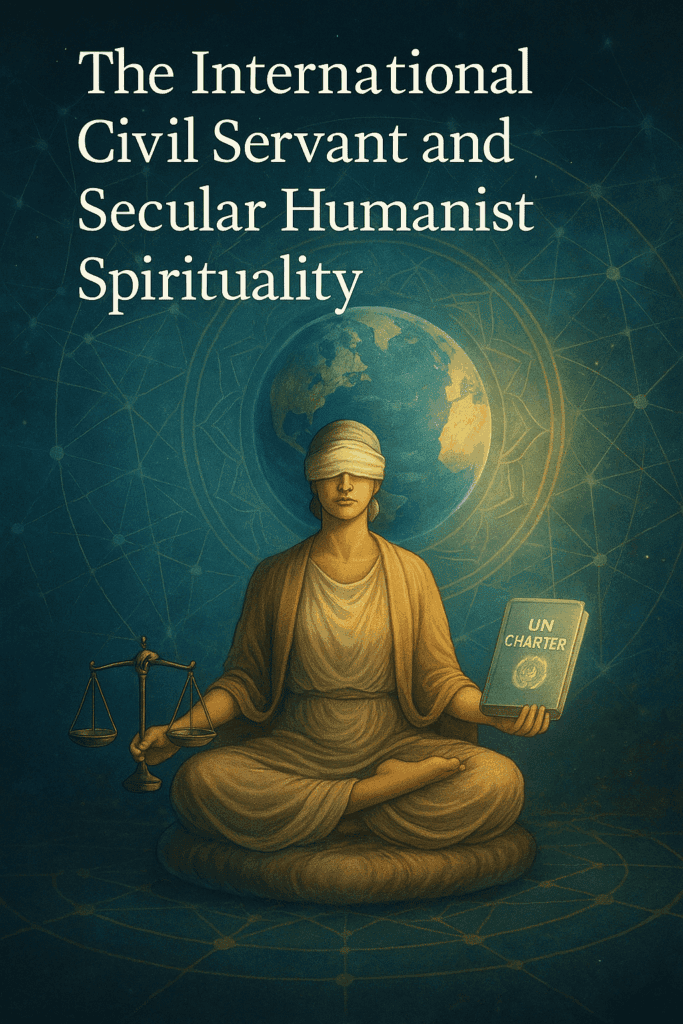
Table of Contents
- Introduction: A Funny Thing Happened on the Way to the General Assembly
- Global Spirituality and the Emergence of the International Civil Servant
- The Birth of the United Nations and the Foundations of Global Cooperation
- Secular Humanist Spirituality and the Ethos of International Law
- Educating the International Civil Servant: Ethics, Discernment, and Human Maturity
- Toward a Universal Spirituality and the Temple of Science
- Conclusion: The Dawn of a Planetary Conscience
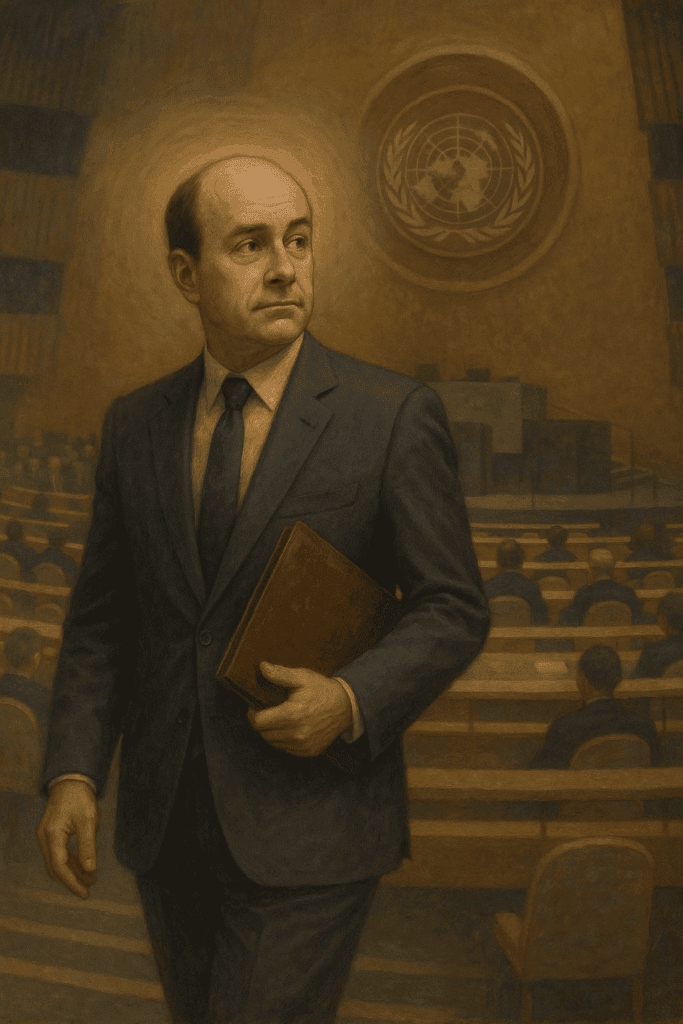
Introduction: A Funny Thing Happened on the Way to the General Assembly
It turns out that building world peace is only slightly more complicated than planning a family reunion—except instead of forgotten cousins and mismatched casseroles, you have 193 sovereign states, 7,000 languages, 4,000 religions, and at least three different definitions of the word “truth.”
And yet, in the aftermath of two world wars, humankind had the audacity to try.
This is the story not only of the United Nations, but of the international civil servant—that curious species of human who, while often clad in gray suits and fluent in acronyms, may be the quiet bearer of humanity’s highest hopes. Beneath the procedural language and diplomatic formality, there is a vision: of law above power, of service beyond borders, of unity without uniformity. It is, in essence, a spiritual calling disguised as a career.
In the pages that follow, we explore the subtle but profound spiritual dimension of global governance. We trace the legacy of figures like Dag Hammarskjöld and U Thant, who reimagined diplomacy as a contemplative path. We introduce Science Abbey as a modern sanctuary for secular wisdom and global conscience. We consider the ethical formation needed to prepare stewards of a fragile, interdependent world.
And we ask: what kind of inner life, what kind of “soul,” is needed to serve the whole of humanity?
This article is a meditation on the convergence of policy and purpose, law and love, reason and reverence. It is a call to view the international civil servant not merely as a functionary of systems, but as a bridge between the pragmatic and the transcendent.
If the Earth is to endure, we will need more than treaties. We will need visionaries in plain clothes, working behind the scenes—not to conquer the world, but to quietly keep it from coming apart.
Let us begin.
Global Spirituality and the Emergence of the International Civil Servant
Throughout history, political authority has often cloaked itself in mysticism. From the divine mandates of the Chinese emperor, which endured until the abdication of Puyi in 1909, to Japan’s Meiji Restoration and its revival of emperor-worship, to the sacred thrones of Europe and the Caliphates of the Islamic world, political mysticism provided a metaphysical legitimacy to worldly rule. Kings were not just rulers; they were demiurges, ordained by heaven, upholding cosmic order.
The Enlightenment challenged this worldview in the West, displacing divine right with the sovereignty of the individual and the supremacy of “reason.” Yet even here, the ideal of reason was subtly intertwined with the sanctification of self-interest, rationalized imperialism, and national egoism. Realpolitik replaced sacred kingship, but it too relied on a mythology—the mythology of the nation-state, of progress defined by power, and of economic utility as the measure of human worth.
Into this moral void stepped Dag Hammarskjöld (1905–1961), the second Secretary-General of the United Nations. A Swedish diplomat, economist, and mystic, Hammarskjöld brought a radically different ethos to global politics—what he called “a secular sanctity.” He believed that spiritual insight, inner discipline, and reverence for the human whole could and must underlie the emerging system of global governance.
Though a devout Christian, he spoke in a language that transcended denomination, drawing from a universal well of wisdom. His private journal, Markings, posthumously published after his tragic death in a plane crash, reveals a man who saw his political work as a form of service to a higher spiritual law.
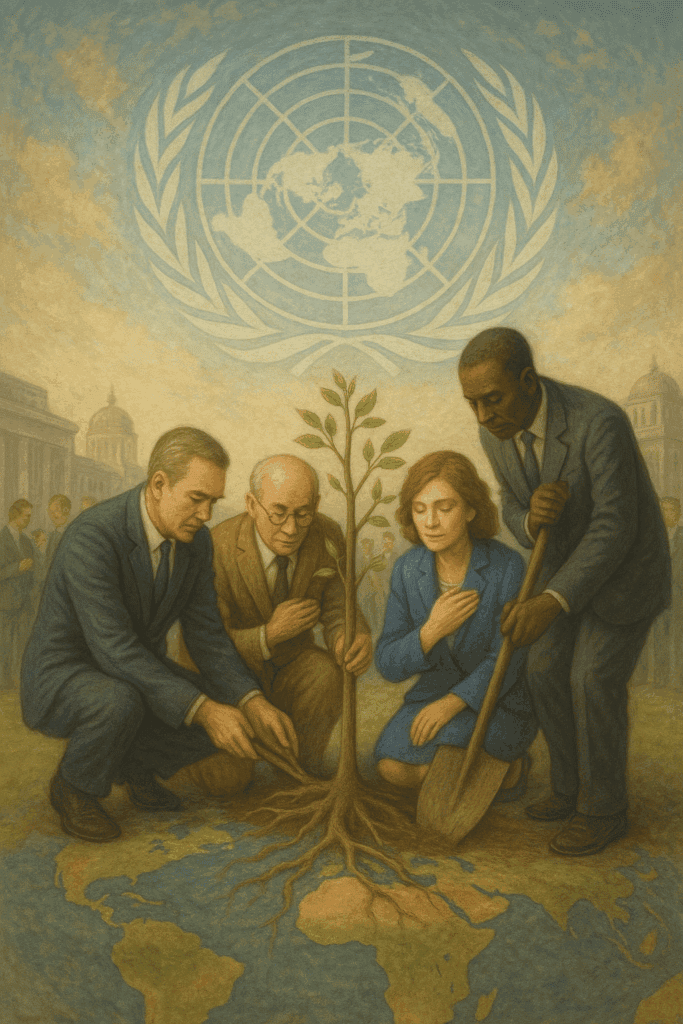
Hammarskjöld redefined the role of the international civil servant not as a bureaucrat or technocrat, but as a moral custodian of the global commons. He envisioned the United Nations as the first true step toward an organized, conscious, and unified human civilization.
In service of this vision, he established the Meditation Room at the U.N. Headquarters—a stark, symbol-free space containing only a massive block of iron ore illuminated by a shaft of light. This “altar to the God of all,” in his words, stood not for any religion, but for that shared spiritual essence common to all: the search for unity, stillness, and truth.
Following Hammarskjöld’s legacy, Burmese diplomat U Thant—a devout Buddhist—took up the post of Secretary-General. He continued this spiritualized vision of international service, emphasizing the importance of meditation, humility, and moral courage in global leadership. For both men, the United Nations was not merely a geopolitical platform—it was a crucible for a new consciousness.
One of Hammarskjöld’s intellectual and spiritual heirs, Robert Muller, who served in various leadership roles at the U.N., advanced this vision even further. Muller articulated a worldview in which humanity’s evolution was not merely biological or technological, but spiritual—a conscious unfolding toward planetary harmony. He saw the United Nations as a sacred experiment in human cooperation, and believed that it pointed toward the future realization of world peace, not as a political convenience, but as a spiritual necessity.
Muller advocated for a nonsectarian, universal spirituality that honored the insights of all the world’s religions while also transcending them. This new spirituality—what we might call Secular Humanist Spirituality—promoted reason, science, and human dignity, yet also embraced meditation, reverence for nature, and the mystical sense of interconnection. It recognized no chosen people or exclusive truths. Rather, it called on all peoples to contribute their highest insights to the shared project of civilization.
Thus was born a new archetype: the International Civil Servant as Mystic-Realist—a figure who remains rooted in law, reason, and institutional duty, yet also sees beyond nation and creed to a planetary destiny. This figure operates with dispassion but not detachment; with neutrality, but never with moral indifference. His or her loyalty is not to flag or faction, but to the human race and to the Earth itself.
In this vision, the global civil servant becomes not just a manager of crises or mediator of conflicts, but a bearer of planetary consciousness—one who works quietly and skillfully to bring order, justice, and peace into a world still trembling on the edge of chaos. Their spirituality is not a matter of doctrine, but of action rooted in compassion, clarity, and the deep recognition that humanity is one.
The Birth of the United Nations and the Foundations of Global Cooperation
The United Nations was not born in peace but in the aftermath of war—conceived as the world’s response to the catastrophic failures of nationalism, militarism, and imperial rivalry that culminated in two global wars within a single generation.
Its roots stretch back to a lineage of international humanitarian organizations, such as the International Committee of the Red Cross, formed in the 19th century to mitigate the suffering caused by war. Yet it was the unprecedented devastation of World War I that first sparked the vision for a lasting global peace architecture.
U.S. President Woodrow Wilson, among others, advocated for a new international order based on collective security and dialogue. This vision led to the formation of the League of Nations, officially established on 10 January 1920 by 42 nations.
While groundbreaking in its aspirations, the League failed to fulfill its promise. Critically weakened by the absence of the United States and hampered by its inability to prevent aggression by major powers, the League ultimately proved ineffective in stopping the descent into World War II.
From this failure rose the necessity—and opportunity—for a stronger, more unified institution. On 25 April 1945, as the fires of the Second World War began to die down, delegates from 50 nations convened in San Francisco to draft the charter of what would become the United Nations.
On 24 October 1945, with the Charter ratified and in force, the UN officially came into being. Its mission was broader and more ambitious than its predecessor’s: not only to prevent war, but also to promote human rights, deliver humanitarian aid, advance sustainable development, and uphold international law.
The UN was built as both symbol and structure: a common table where nations could meet, deliberate, and, at best, cooperate for the benefit of humankind. Its General Assembly and Security Council held their first sessions in London in early 1946. Among the first topics of debate were urgent geopolitical tensions—Russian troops in Iranian Azerbaijan, British presence in Greece—signaling the new organization’s central role in managing the balance of power in the atomic age.
The organization quickly established its permanent headquarters in New York City, occupying land designated as international territory—symbolic of the UN’s supranational character. The site was selected by the General Assembly, and construction began in 1948, culminating in 1952 with the completion of the now-iconic Secretariat building overlooking the East River.
The UN Secretary-General, envisioned as the world’s chief diplomat and moral spokesperson, was first held by Norwegian foreign minister Trygve Lie, with British diplomat Gladwyn Jebb serving as interim Secretary-General before him. Yet it would be Dag Hammarskjöld, the second Secretary-General, who would most profoundly infuse the office with a sense of sacred responsibility and humanistic spirituality, redefining the role of the international civil servant as a new archetype in global governance.
Today, the UN stands as the largest and most comprehensive international organization in human history. From its original 51 founding members, it has grown to include 193 sovereign states, nearly the entire political map of the world.
The UN System extends far beyond diplomacy. It includes specialized agencies such as the World Bank Group, World Health Organization (WHO), World Food Programme (WFP), UNESCO, and UNICEF—each contributing to the economic, educational, humanitarian, and health dimensions of the global commons.
In its conception, charter, and mission, the United Nations represents not merely an alliance of states, but the beginning of planetary civilization: an effort to build a cooperative world order based not on domination, but on dialogue; not on the balance of terror, but on mutual understanding and shared development.
It is within this structure—still fragile, still imperfect—that the international civil servant emerges as a bearer of the world’s conscience. And it is within this global institution that a secular humanist spirituality—neither religious nor materialistic, but inclusive, reasoned, and morally serious—has begun to find form.
Secular Humanist Spirituality and the Ethos of International Law
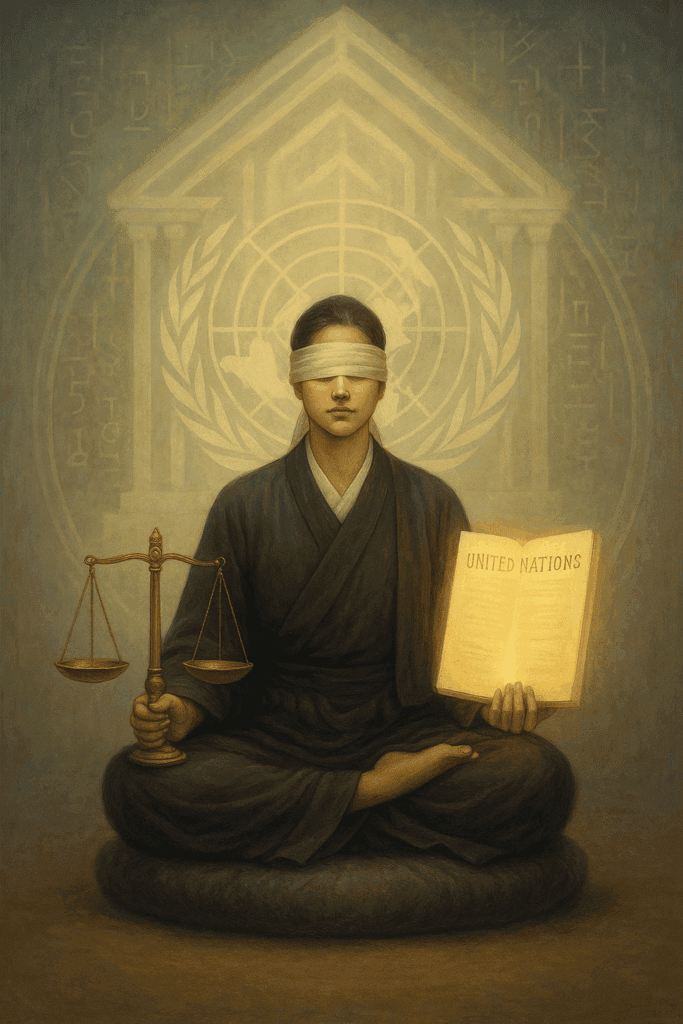
The United Nations Charter, adopted in 1945, is more than a political document—it is a moral and philosophical declaration of the human community’s highest aspirations. Although its language is legal, its vision is spiritual: to end the scourge of war, reaffirm human dignity, promote justice, and foster conditions under which all people may live in freedom.
In this sense, the Charter represents one of the earliest and most universal expressions of secular humanist spirituality—a worldview that honors reason and law while invoking the sacredness of human life and global solidarity.
This spirit continues in the Universal Declaration of Human Rights (1948), which asserts the inherent dignity and equal rights of all members of the human family. Drafted by a diverse committee including Eleanor Roosevelt, René Cassin, Charles Malik, and Peng Chun Chang, the declaration synthesized principles from Western liberalism, Confucian ethics, Islamic jurisprudence, and socialist thought. Its universality is not religious but moral and rational—grounded in the shared human capacity for empathy, justice, and mutual recognition.
Through these documents, the UN system enshrined a spiritual principle in secular form: the dignity of every human being as the foundation of peace and justice. Unlike the old theological dogmas that conferred dignity through divine election or tribal identity, this new dignity was unconditional—it extended to every person, everywhere, regardless of nationality, race, creed, or condition.
From this foundation arose a body of international law designed to govern not only relations between states, but increasingly the conduct of states toward their own citizens. Institutions such as the International Court of Justice, the International Criminal Court, and the Office of the High Commissioner for Human Rights represent the slow but steady emergence of a planetary legal conscience—one that seeks to hold all accountable, including the powerful, and to offer redress to the voiceless.
In its application, international law has often been hindered by political interests and the vetoes of great powers. Yet its symbolic and normative force remains profound. It represents a new kind of scripture: one not revealed by prophets, but crafted by nations in dialogue; not handed down by gods, but reasoned through by men and women committed to a higher common good. It is the law of human interdependence.
Herein lies the spiritual dimension of global governance. Secular humanist spirituality—far from being an abstraction—manifests as the lived ethic of service without domination, power without violence, and peace without subjugation. It is embodied in the calm rationality of the diplomat, the moral conviction of the human rights worker, the humanitarian who feeds refugees without regard to borders, and the jurist who invokes law as a universal shield.
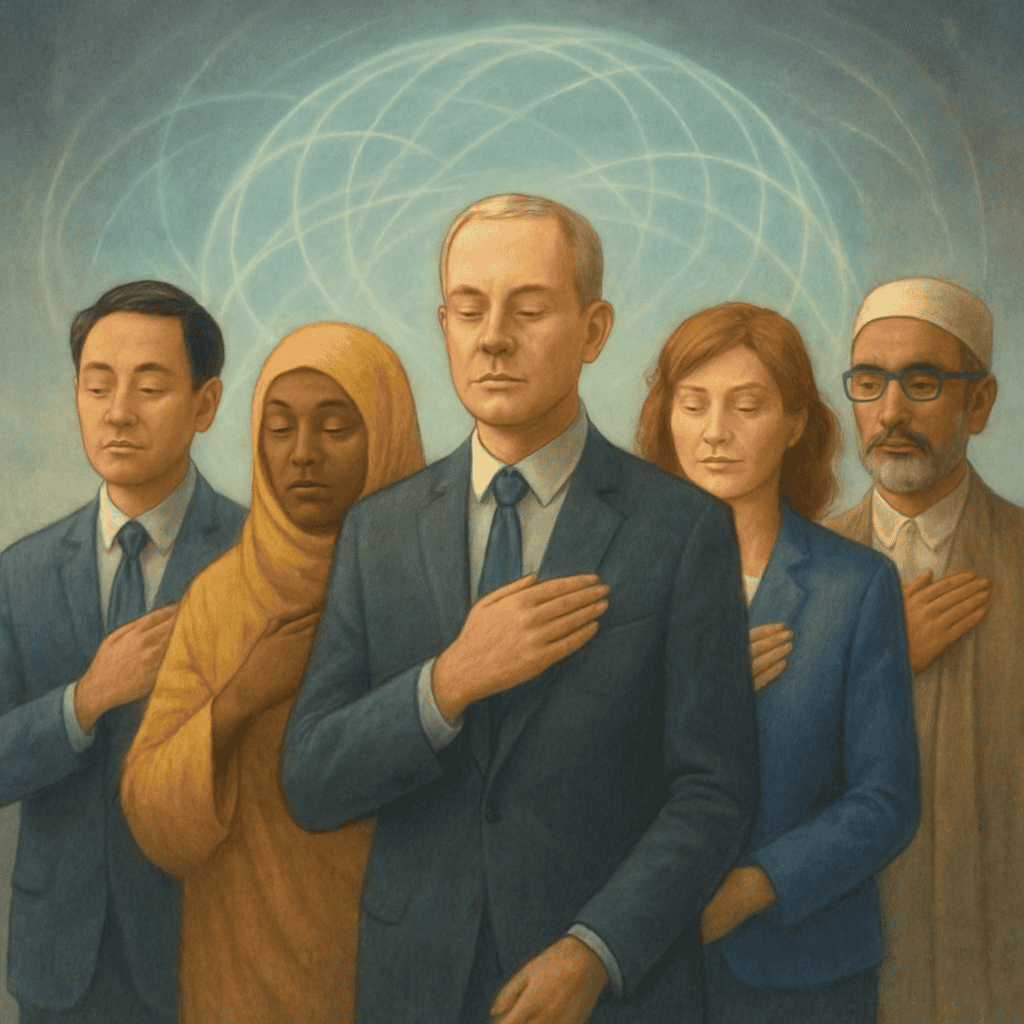
In this light, the international civil servant is not a mere agent of procedural governance. He or she becomes a secular priest of human unity—tasked with applying the principles of dignity, equality, and global responsibility to the evolving challenges of civilization. The impartiality expected of the international civil servant is not emotional indifference but spiritual equanimity—a balanced awareness that sees all peoples as kin and all governments as fallible.
This moral framework is essential, for the challenges of the 21st century—climate crisis, forced migration, technological disruption, and rising authoritarianism—are global in scope and spiritual in implication. They demand more than technical solutions; they require an ethic of planetary stewardship, a renewed reverence for truth, justice, and the interdependence of all life on Earth.
Thus, international law and global policy, when infused with humanist values, become instruments of spiritual evolution. Not in the metaphysical sense of salvation, but in the practical and ethical sense of cultivating a civilization in which the highest human potentials—compassion, cooperation, wisdom, and courage—can flourish on a global scale.
Educating the International Civil Servant: Ethics, Discernment, and Human Maturity
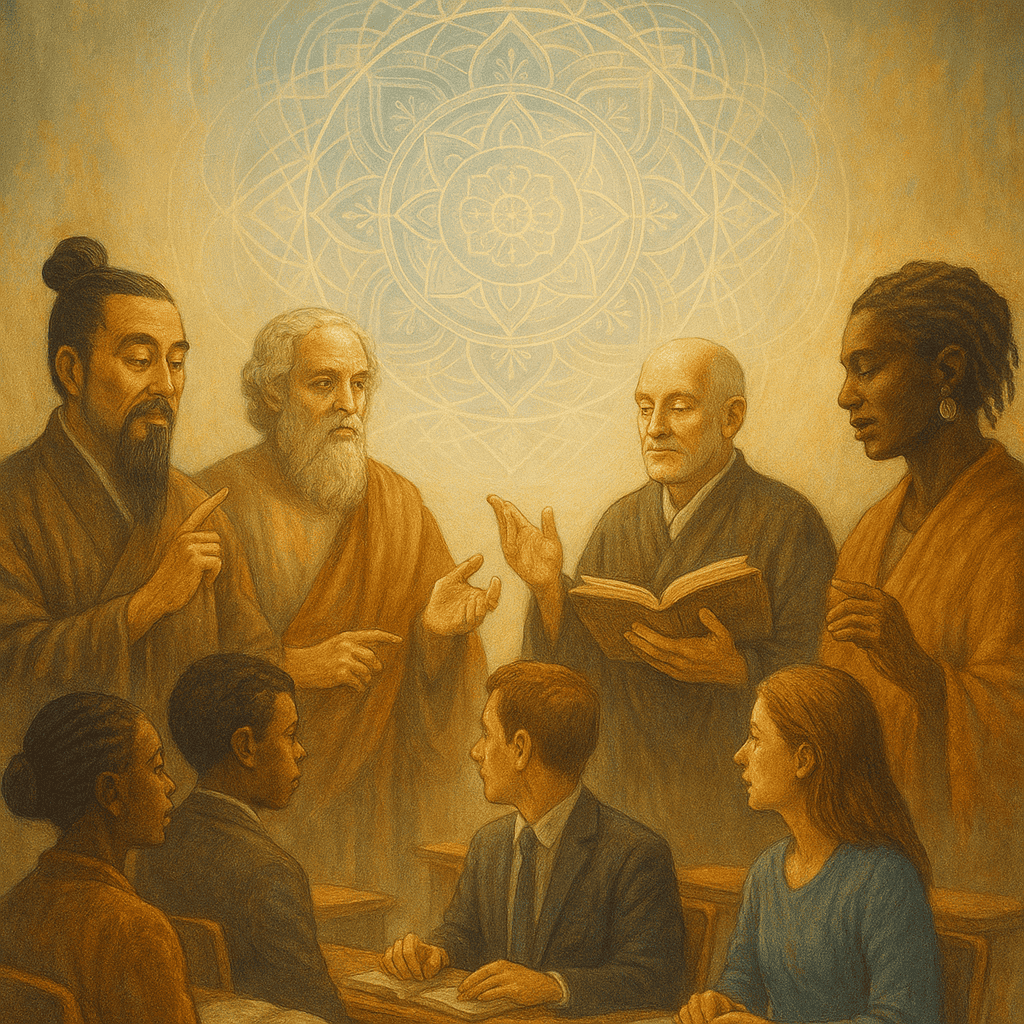
If the United Nations is the institutional heart of global cooperation, then the international civil servant is its living spirit—a steward of world order whose influence flows not from arms or wealth, but from trust, impartiality, and inner integrity. Yet such a role cannot be assumed lightly, nor can it be fulfilled by technical training alone. It requires a disciplined education of the whole human being, combining intellectual rigor with emotional maturity and moral clarity.
The modern civil servant must be educated not only in international law, diplomacy, and policy, but also in ethics, intercultural understanding, and the psychology of human behavior.
In a world shaped by the trauma of war, colonialism, environmental collapse, and inequality, global leadership demands profound sensitivity to suffering and a conscious effort to transcend inherited biases. The international civil servant must be able to hold complexity, remain composed under pressure, and respond with both competence and compassion.
This vision calls for a Global Civic Curriculum—a new kind of education that trains not simply citizens of nation-states, but citizens of the world. Such a curriculum would include:
- World History and Comparative Philosophy: cultivating historical awareness and philosophical literacy across cultures and epochs.
- Human Rights and International Law: grounding students in the legal and moral foundations of the global order.
- Environmental Science and Ethics: fostering ecological awareness and stewardship in service to planetary sustainability.
- Conflict Resolution and Preventive Diplomacy: teaching practical tools for de-escalation, negotiation, and reconciliation.
- Psychology and Emotional Intelligence: developing self-awareness, empathy, and interpersonal wisdom.
- Spiritual Literacy: encouraging the study of global religious and humanist traditions with respect and critical understanding.
This is not education for elitism—it is education for responsibility. For the civil servant must navigate power without being corrupted by it; must wield authority without losing humility. As Dag Hammarskjöld observed, “Only he who keeps his eye fixed on the far horizon will find the right road.” That horizon is both ethical and spiritual: the dignity of humankind, the flourishing of life, and the peace of the Earth.
To prepare individuals for such service is to prepare guardians of the human future. These are not bureaucrats of the old order, but initiates of a new world civilization—skilled in systems, yes, but also rooted in conscience and community. They are practical idealists, neither utopian dreamers nor cynical functionaries, but those who recognize that the fate of humanity is a shared fate, and act accordingly.
This kind of formation requires institutional support. Universities, international academies, and UN-affiliated programs must not only teach skills, but nurture character. Mentorship, dialogue, meditative practice, and service learning can all help instill the inner poise and clarity required for global leadership. The aim is not perfection, but human maturity—the rarest and most essential resource in public life.
And so, just as the temple was once the training ground for priest-kings and philosopher-rulers, the institutions of global education must now become temples of peace and planetary responsibility. The civil servant of the future is not simply a manager of global systems, but a quiet architect of human unity, disciplined in mind, open in heart, and resilient in spirit.
Toward a Universal Spirituality and the Temple of Science
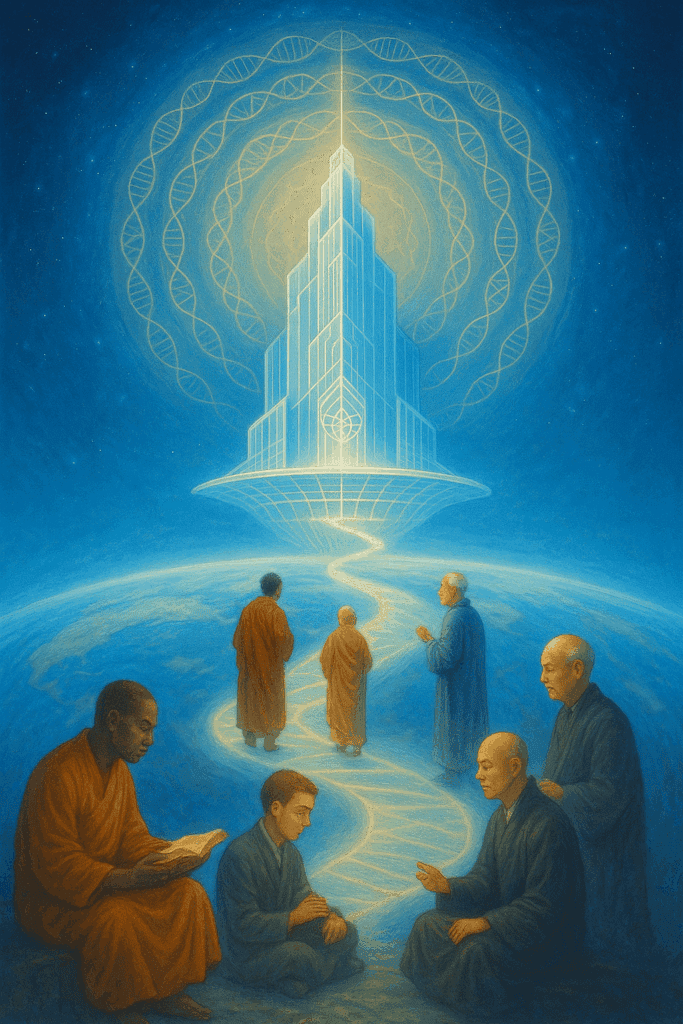
Global spirituality, as it quietly emerges through the institutions of global governance and international cooperation, transcends the boundaries of creed and dogma. It is not a new religion, nor a syncretic blend of old traditions, but a shared ethos—a unifying current that honors the deepest insights of humanity’s diverse spiritual heritages while remaining open to science, experience, and reason.
It favors no religion and excludes none. Instead, it recognizes the pluralism of paths, encouraging each person to seek wisdom in accordance with their own temperament, tradition, and understanding.
This universal spirituality affirms religion not as a static inheritance, but as a living inquiry. It blesses the devout who follow the rituals of their ancestors. It welcomes the seekers who blend traditions in a spirit of synthesis. It includes the quietly contemplative, the mystical naturalists, the philosophers of inner space.
It also supports a growing number of people drawn to creedless spirituality—those who practice meditation, cultivate virtue, or seek awe and clarity without subscribing to a fixed theology. The alchemical metaphor is apt: this new spirituality seeks to distill the essence of the world’s religions—the gold hidden within the ore—without clinging to the outer form.
From this impulse arises Science Abbey, a modern “temple” for the contemplative and intellectual future of the human species. Science Abbey is not a religion. It makes no metaphysical claims that contradict the methods or findings of scientific inquiry. Rather, it is a secular sanctuary for exploration—of consciousness, ethics, education, and collective flourishing. In an age when truth is too often manipulated and wonder privatized, Science Abbey reclaims both through a synthesis of science, philosophy, and contemplative practice.
Today there are over 4,000 religions and spiritual systems across the world, each offering its own insights and practices. Some claims are benign, others beautiful; some are misguided, and a few, dangerous. Science Abbey acknowledges this spectrum while committing to the principles of critical investigation, humanistic ethics, and experiential knowledge. We do not teach what to believe—we invite people to inquire, test, and see for themselves.
Among the many approaches explored, Illumination Meditation—a method of focused awareness combined with ethical lifestyle practices—has shown, in both traditional teachings and modern studies, to support physical health, psychological resilience, and profound inner clarity. Yet reading about it is not the same as experiencing it. Science Abbey offers opportunities to engage directly and rigorously with such practices, within a framework grounded in scientific integrity and philosophical humility.
This form of secular spiritual development aligns deeply with the moral ambitions of global governance. Many theistic international civil servants view the United Nations itself as a fulfillment of divine purpose—what some have even called the first manifestation of the Kingdom of Heaven on Earth.
From a secular humanist view, the UN is a temple of human reason and global conscience, whose sacred text is international law, written not by prophets, but by nations, and inspired not by revelation, but by the shared needs and aspirations of the human family. It is not infallible, however, and must be corrected when it fails to uphold its core principles.
As technologies of travel and communication shrink the globe, national isolationism becomes not just impractical, but dangerous. The complex systems of climate, trade, migration, health, and security require an integrated and cooperative world order. The United Nations functions as the central nervous system of this new organism, coordinating across borders and languages, promoting peace, and weaving the fabric of international responsibility.
This emerging global culture demands more than policy; it demands human solidarity. It calls for the wisdom of religious leaders, the clarity of scientists, and the courage of educators—all united in a common effort to uplift the human condition. Each tradition contributes a unique gift, and each must evolve to meet the challenges of our planetary age.
The UN and its affiliated agencies must particularly focus on two fronts: the natural environment and the economic and social well-being of all people. Scientists must be empowered to lead the discourse on climate and sustainability. Economists, jurists, and social architects must reimagine systems of finance, labor, and governance under global coordination—through institutions like the International Court of Justice, the World Bank, and a strengthened UN General Assembly.
Of course, tensions and contradictions remain. Double standards plague the international system. Western powers often fail to practice what they preach, while emerging powers like China present both peril and promise—simultaneously the world’s greatest polluter and a leader in renewable energy, urban planning, and population stabilization.
Movements like the World Constitution and Parliament Association and other global federalist initiatives continue to call for a legally binding world constitution, signaling a growing appetite for a unified legal and political order.
Across this landscape, a cosmopolitan class is emerging—those who see beyond national identity, who recognize the interdependence of all people, and who advocate for a holistic model of education, diplomacy, and global commerce. These individuals understand that what the world needs is not more weapons, fossil fuels, pharmaceutical dependency, or mass-produced consumerism—but instead, wise governance, sustainable economics, ethical technology, and a reverence for life.
Within the UN milieu, we can distinguish three archetypes of engagement with this evolving global spirituality:
- The Rational Administrator: Supports the UN’s operations and principles but avoids spiritual language or personal practices.
- The Mystical Observer: Embraces a universal spiritual worldview inspired by the UN ethos but does not engage in its political or institutional work.
- The Integrated Practitioner: Combines spiritual clarity with civic action, embodying a unified path of inner transformation and outer service.
It is the third type—the integrated servant of humanity—that Science Abbey seeks to support and cultivate. In this synthesis lies the future: a global society in which science and spirituality no longer oppose one another, but converge in the service of peace, justice, and human flourishing.
Conclusion: The Dawn of a Planetary Conscience
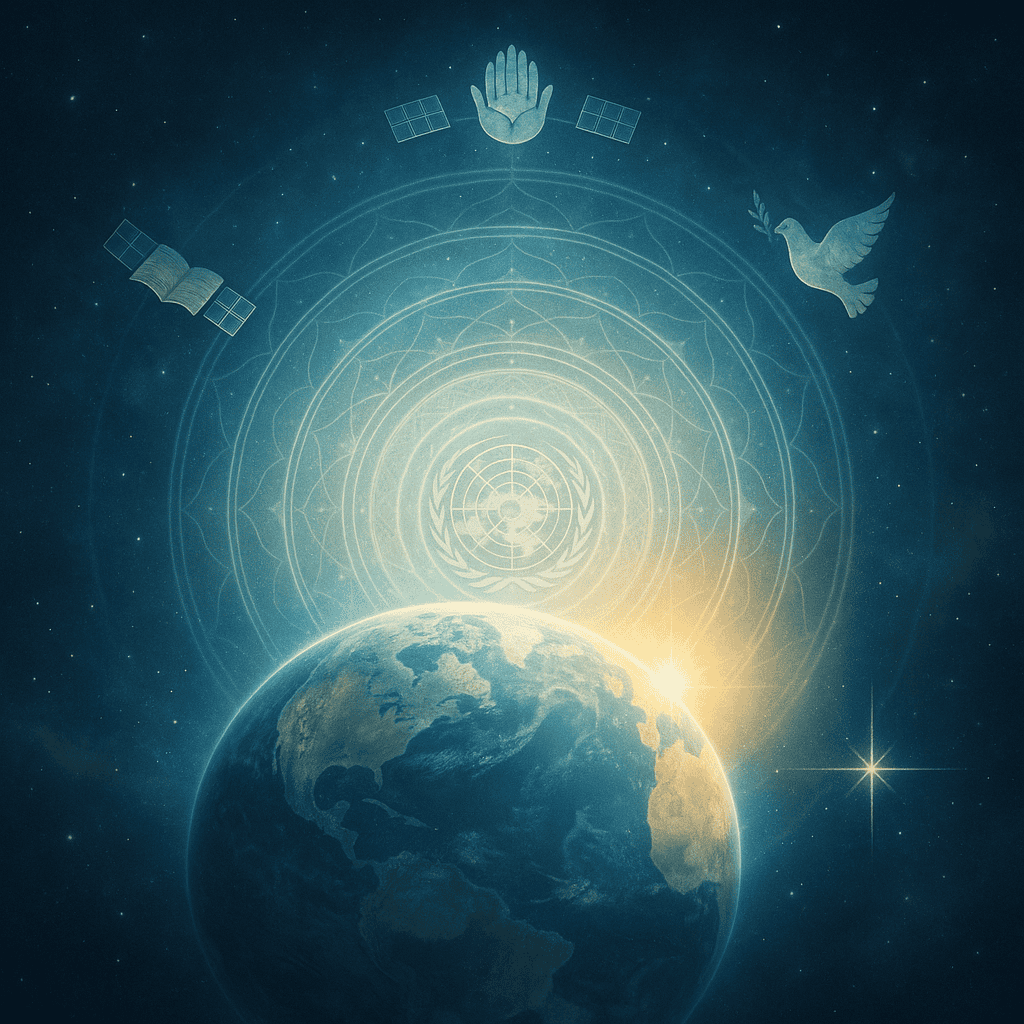
At the intersection of diplomacy and mysticism, law and ethics, reason and reverence, a new archetype is quietly taking shape—the international civil servant as agent of planetary evolution. No longer merely a bureaucrat of nation-states, this figure belongs to a future in which humanity finally begins to live as one species on one Earth, with shared responsibilities and a common destiny.
The path to such a civilization is neither inevitable nor easy. The dangers of nationalism, ecological collapse, technological overreach, and authoritarian resurgence still threaten to unravel the fragile threads of global cooperation. But just as the United Nations was born from the ashes of war, so too might a new world order emerge—not as a central tyranny, but as a decentralized, ethical, and spiritual network of humanity.
This future will require a new kind of governance rooted not in domination, but in service; not in ideology, but in insight. It will be built by people who have cultivated maturity of mind and depth of heart—people who are not owned by the systems they manage, but who serve with humility, courage, and clarity.
These global servants will act from the wisdom that all people are kin, that the biosphere is sacred, and that peace is not the absence of war, but the presence of justice. They will carry forward the dream of Hammarskjöld, U Thant, and Robert Muller: that the United Nations might be more than a geopolitical tool—it might be the embryo of a conscious civilization.
In this light, Science Abbey and kindred movements arise as sanctuaries for the next phase of human growth—not temples of belief, but temples of inquiry and illumination. Here, the mysticism of unity meets the clarity of science. Here, seekers of peace and truth may train not only the intellect, but the will and the spirit. Here, global citizens may be formed—not in the image of empire or creed, but in the image of universal responsibility.
The task ahead is immense. But the vision is clear. Humanity must become whole. It must build a world in which power serves compassion, in which institutions reflect the inner dignity of the human being, and in which the wisdom of our spiritual traditions is distilled through the discipline of reason and service.
Let this be the calling of the international civil servant in the age of global awakening:
To uphold justice,
To cultivate truth,
To embody peace,
And to serve the Earth and all its peoples
As one body, one spirit, and one future.