
Nature’s Rhythm, Human Health, and Monastic Reform
- Introduction: Why Sleep Matters
The biological and spiritual necessity of rest - Natural Rhythms – Evolution and the Sleep-Wake Cycle
How sleep patterns evolved across species and human history - What Is Sleep? A Scientific View
The neuroscience and physiology of rest and renewal - The Benefits of Adequate Sleep
How sufficient sleep supports health, cognition, and emotion - The Dangers of Sleep Deprivation
The profound risks of sleep loss, from illness to impaired judgment - Monastic Wisdom and Sleep
Historical and modern perspectives on rest in spiritual life - A Buddhist Defense of Sleep – Bankei’s Teachings
Zen teachings on the dignity of rest and the illusion of spiritual pride - A Scientific and Ethical Rebuttal of Monastic Sleep Deprivation
Why religious rules must align with biology and compassion - Toward a Science-Based Monastic Rule
Recommendations for a sleep-positive reform in spiritual communities - Conclusion: Awakening Through Rest
Letting rest and rhythm lead the way to clarity, health, and peace
Introduction: Why Sleep Matters
Sleep is one of the most mysterious and essential functions of life. Every creature that moves with a nervous system—from the tiniest insect to the human being—must sleep. Some sleep in short bursts, some in long uninterrupted stretches. Some sleep during the day, others at night. But sleep is universal, and its absence is dangerous.
Modern science has revealed what ancient wisdom has long intuited: without sleep, the body falters, the mind fragments, and the spirit suffers. It is not optional. It is foundational.
Yet in modern societies—and even in some spiritual communities—sleep is treated as expendable. Productivity is prized over rest. Sleep is minimized, interrupted, or denied. This has consequences not only for physical health but for psychological clarity, emotional regulation, ethical decision-making, and long-term well-being.
This article explores the science of sleep and the dangers of sleep deprivation from multiple angles: evolutionary biology, neuroscience, psychology, public health, and spiritual practice. It also challenges old assumptions—especially in religious contexts—that conflate self-denial with sanctity. Where tradition conflicts with scientific truth and human thriving, it is tradition that must evolve.
To understand sleep is to understand how the body heals, how the brain remembers, how the soul finds stillness—and how we can best live in tune with the rhythms of nature.
Let us begin with where sleep begins: the natural world.
1. Natural Rhythms – Evolution and the Sleep-Wake Cycle
Before artificial light, before alarm clocks, before industrial timekeeping, sleep followed the rhythms of the Earth. The rising and setting of the sun governed the behavior of all living things. From this foundation emerged the biological clock—the circadian rhythm—that regulates when we sleep, when we wake, and how our bodies function throughout the day.
Sleep in the Animal Kingdom
Sleep is not exclusive to humans. It is a behavior observed across species, including mammals, birds, reptiles, amphibians, fish, and even some invertebrates.
- Diurnal creatures (such as humans, many birds, and primates) are active during the day and sleep at night.
- Nocturnal animals (such as owls, bats, and many rodents) are active at night and rest during the day.
- Crepuscular species are most active during dawn and dusk.
Each pattern is a survival adaptation: predation, temperature, feeding habits, and social structures all influence how and when an animal sleeps. Dolphins and some migratory birds, for example, exhibit unihemispheric sleep—sleeping with one half of the brain at a time—so they can continue moving or surfacing for air even while resting.
The Human Clock
Human beings evolved as diurnal creatures, and our internal biology still reflects this. Light-sensitive cells in the eye send signals to the brain’s suprachiasmatic nucleus (SCN), located in the hypothalamus. This “master clock” regulates the release of melatonin, a hormone that promotes sleepiness as light fades.
For most of human history, sleep was governed by the sun and moon. In pre-industrial societies, humans often slept in two distinct phases:
- First sleep began shortly after nightfall and lasted several hours.
- Second sleep followed a wakeful period in the middle of the night, often used for prayer, writing, quiet conversation, or even intimacy.
This biphasic or two-phase sleep pattern has been documented in European, African, and Middle Eastern historical records. It was natural, unforced, and healthy—until artificial lighting and the demands of modern life compressed sleep into a single block.
Rethinking Sleep Today
Contemporary research has begun to revisit and validate these older sleep patterns:
- Biphasic and segmented sleep can improve rest in some individuals, especially when aligned with natural light exposure and daily rhythms.
- Short daytime naps (polyphasic sleep) can support alertness and memory, particularly in cultures where siestas are part of daily life.
- The ideal sleep structure may not be universal—but it is almost always regular, aligned with the natural circadian cycle, and respectful of individual biological needs.
As we move forward, understanding how sleep evolved—and how modern environments interfere with it—is essential to healing both our bodies and our cultures.
2. What Is Sleep? A Scientific View
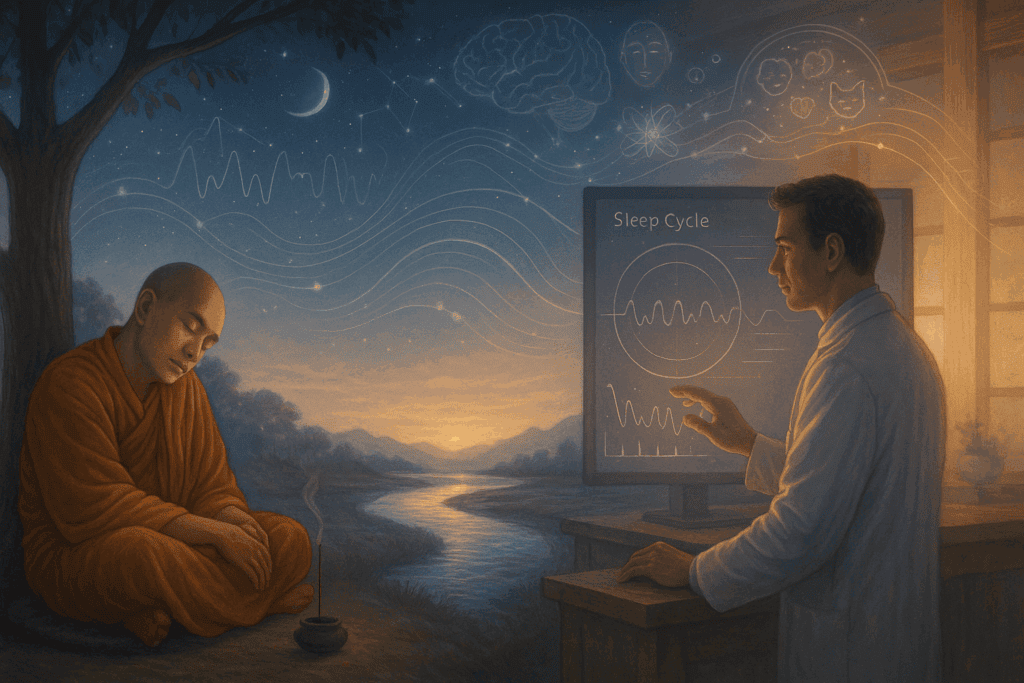
Sleep is not merely the absence of wakefulness. It is a dynamic, biologically complex state governed by precise neurological and hormonal processes. During sleep, the body slows down—but the brain becomes incredibly active, orchestrating cycles that repair, regulate, and renew.
The Architecture of Sleep
Sleep unfolds in repeating cycles, each lasting approximately 90 minutes, composed of distinct stages:
- Stage 1 (NREM 1): Light sleep; a transition from wakefulness. Muscles relax, and brainwaves begin to slow.
- Stage 2 (NREM 2): The onset of true sleep. Body temperature drops, heart rate slows, and brain activity shows bursts of rapid waves called sleep spindles.
- Stage 3 (NREM 3): Deep or slow-wave sleep. This is the most restorative stage, when tissue repair, immune function, and growth hormone release occur.
- REM Sleep (Rapid Eye Movement): Brain activity spikes, resembling wakefulness. Most dreaming occurs here. REM is critical for memory consolidation, learning, and emotional processing.
These stages repeat throughout the night, with REM periods becoming longer in later cycles. A full night of sleep usually includes 4–6 of these cycles.
Why Sleep Matters Biologically
- Brain Maintenance: During sleep, the brain clears metabolic waste through the glymphatic system, a recently discovered cleansing mechanism that may play a role in preventing neurodegenerative diseases.
- Memory Consolidation: Sleep transforms short-term memories into long-term storage, helping integrate new learning.
- Emotional Regulation: Sleep deprivation makes emotional centers of the brain more reactive, particularly the amygdala, leading to impulsivity, irritability, and anxiety.
- Immune and Hormonal Function: Sleep boosts immune responses and regulates critical hormones including insulin, leptin (which controls hunger), cortisol (stress), and melatonin.
The Mind in Sleep
Psychologically, sleep is when the unconscious mind becomes most active:
- Dreaming allows the processing of difficult emotions and unresolved experiences.
- Lucid dreaming, sleepwalking, and sleep paralysis are examples of altered states occurring at the borderlands of consciousness.
While the body rests, the brain explores, integrates, and heals.
Sleep, then, is not wasted time. It is sacred biological work. Just as we must eat to live, we must sleep to be whole—physically, mentally, and emotionally.
3. The Benefits of Adequate Sleep
A good night’s sleep is one of the most powerful and accessible forms of self-care. Though often overlooked in favor of productivity or stimulation, adequate sleep is foundational to nearly every aspect of human health. The benefits are broad, deep, and scientifically well-documented.
1. Physical Health and Healing
- Immune Function: Sleep strengthens the body’s ability to fight infection. Even partial sleep deprivation can reduce immune responses, making us more vulnerable to illness.
- Cellular Repair and Growth: During deep sleep, the body repairs tissues, builds bone and muscle, and regenerates cells.
- Hormonal Regulation: Sleep regulates hormones that control appetite (ghrelin and leptin), metabolism, growth, and stress. Consistent sleep supports balanced blood sugar and cardiovascular health.
- Longevity: Regular, sufficient sleep is associated with a longer, healthier life.
2. Mental and Cognitive Function
- Memory Formation: The brain uses sleep to consolidate new memories and strengthen neural connections.
- Learning and Problem-Solving: Sleep improves concentration, learning, decision-making, and creative insight.
- Focus and Reaction Time: Well-rested individuals perform better on tests, in sports, and behind the wheel.
3. Emotional and Psychological Well-being
- Mood Regulation: Adequate sleep reduces the risk of depression, anxiety, and emotional volatility. It strengthens the prefrontal cortex’s control over the amygdala—the brain’s emotional center.
- Resilience to Stress: Sleep equips us to handle emotional challenges with greater patience, clarity, and compassion.
- Social Functioning: People who sleep well are more empathic, less irritable, and better able to sustain relationships.
4. Performance and Productivity
Contrary to the myth that less sleep means more output, studies show:
- Well-rested workers are more efficient, accurate, and creative.
- Athletes recover faster and perform better with optimal sleep.
- Students retain more information and score higher when they sleep well.
In essence, sleep is not a break from life—it is what enables life to thrive. It prepares the body to heal, the mind to focus, and the spirit to meet the day with energy and peace.
4. The Dangers of Sleep Deprivation
If adequate sleep is a cornerstone of well-being, sleep deprivation is its saboteur. Far from being a harmless inconvenience or a badge of honor in high-pressure cultures, chronic sleep loss is a severe health hazard—physically, psychologically, and even spiritually.
1. Sleep Deprivation as a Form of Torture
Sleep deprivation is not just unhealthy—it is officially recognized as a method of psychological torture. Prolonged denial of sleep causes:
- Disorientation and confusion
- Hallucinations and paranoia
- Emotional breakdowns
- Loss of sense of self and agency
Governments and military regimes have used sleep deprivation to break the will of prisoners. That alone should warn us of its destructive power.
2. Physical and Neurological Damage
Modern medical research shows that chronic sleep loss causes or accelerates:
- Heart Disease – including hypertension, heart attacks, and strokes
- Obesity and Type 2 Diabetes – due to disrupted appetite hormones and insulin resistance
- Suppressed Immune System – increasing vulnerability to viruses and infections
- Chronic Inflammation – contributing to cancer and autoimmune diseases
- Alzheimer’s and Dementia – through buildup of amyloid-beta and other neurotoxic waste not properly cleared during sleep
3. Mental and Emotional Instability
Sleep is essential to brain function. Without it, the following symptoms are common:
- Impaired memory and concentration
- Poor judgment and decision-making
- Anxiety, depression, and mood swings
- Increased risk of suicide
- Reduced emotional regulation (especially in teens and children)
A tired brain cannot think clearly or feel stably. Over time, chronic sleep deprivation mimics the symptoms of serious mental illness.
4. Performance and Public Safety Risks
The effects of sleep deprivation ripple far beyond the individual:
- Drowsy Driving causes thousands of fatal car crashes each year, comparable to alcohol impairment.
- Medical Errors increase significantly among sleep-deprived healthcare workers.
- Workplace Accidents are more likely when employees are sleep-deprived or working night shifts.
- Student Underperformance rises with later bedtimes and insufficient rest.
5. Social and Moral Consequences
A society that does not value rest is a society prone to cruelty, haste, and burnout. Emotional numbness, impulsive behavior, and lack of empathy all increase when sleep is insufficient. These effects erode the foundations of trust, safety, and compassion in schools, families, and communities.
“Sleep deprivation is not a sign of virtue. It is a sign of imbalance.”
—
Sources:
5. How Much Sleep Do We Need?
There is no single number that works for everyone, but science gives us clear guidelines. Sleep needs vary by age, genetics, lifestyle, and health—but nearly all human beings require sustained, high-quality sleep each night to function well.
Recommended Sleep by Age
| Age Group | Recommended Sleep |
| Newborns (0–3 mo) | 14–17 hours/day |
| Infants (4–11 mo) | 12–15 hours/day |
| Toddlers (1–2 yrs) | 11–14 hours/day |
| Preschoolers (3–5) | 10–13 hours/day |
| Children (6–13) | 9–11 hours/night |
| Teenagers (14–17) | 8–10 hours/night |
| Adults (18–64) | 7–9 hours/night |
| Older Adults (65+) | 7–8 hours/night |
Children and teens need more sleep to support brain development, emotional regulation, growth, and learning. Adults may differ slightly, but consistently getting less than 6 hours per night is strongly associated with increased health risks and cognitive decline.
The Science of Napping
Naps can be highly beneficial when used wisely:
- Short naps (10–20 minutes): Improve alertness and mood without interfering with nighttime sleep.
- Medium naps (30–60 minutes): May lead to grogginess (sleep inertia), but improve memory.
- Long naps (90 minutes): Include a full sleep cycle and benefit creativity, learning, and emotional health.
Naps are especially helpful in cultures or work settings where total sleep at night is insufficient. Some workplaces and schools are beginning to recognize this, incorporating nap pods or rest breaks into daily schedules.
Individual Variation
Some people function well on slightly less sleep, while others need more. Key signs that you’re getting enough sleep:
- You wake feeling refreshed (without needing multiple alarms).
- You stay alert throughout the day.
- You fall asleep within 15–30 minutes at night.
- Your mood, memory, and immune function remain stable.
Sleep needs are not a matter of willpower or toughness—they are a matter of biology. Listening to your body is the first step toward sustainable health.
6. Monastic Wisdom and Sleep
Monastic traditions have long shaped human thought about the body and spirit. In both East and West, monasticism offers insight into simplicity, discipline, and the cultivation of the mind. But what role does sleep play in this sacred framework?
The answer is complex. Some monastic communities honor the natural need for sleep, while others embrace deprivation as a spiritual test. Yet as science advances and health is better understood, a reevaluation of sleep in religious life is both timely and necessary.
Sleep in the Rule of Saint Benedict
The Rule of Saint Benedict—a foundational guide for Western Christian monasticism—does not prescribe sleep deprivation. On the contrary, it allows for approximately 6 to 8 hours of rest per night, often divided between nighttime sleep and a midday nap (siesta).
- Monks were instructed to rise early for Vigils or Matins, but the Rule balanced this with earlier bedtimes and periods of rest.
- Benedict emphasized moderation in all things—a principle often forgotten in extreme expressions of discipline.
Variation Among Communities
Monastic sleep schedules vary widely across traditions:
- Some contemplative Christian and Buddhist orders restrict sleep to emphasize alertness, vigilance, or self-denial.
- Others follow balanced schedules, incorporating naps or early bedtimes.
- Some monks and nuns intentionally practice sleep deprivation as a form of asceticism—akin to fasting, silence, or solitude.
But while self-discipline can be meaningful, it must be distinguished from harmful neglect of the body. The purpose of monastic life is not to punish the body, but to free the mind from attachment and illusion. Sacrificing sleep at the expense of health can distort this goal.
Thich Nhat Hanh and the Zen Shift
Modern teachers like Thich Nhat Hanh have encouraged practitioners to listen to their bodies and prioritize well-being. He emphasized:
“Mindfulness must include rest. Sleep is essential. We cannot practice effectively with an exhausted body.”
His guidance reflects a growing awareness that spiritual life does not require deprivation—it requires clarity, which arises from a well-cared-for mind and body.
Meditation and Rest Are Not the Same
Some monastics claim that meditation can replace sleep. While meditation offers rest and clarity, it does not replicate the deep physiological processes of sleep. Brain scans show that even skilled meditators cannot eliminate the need for slow-wave and REM sleep, especially over the long term.
- Meditation complements sleep—it does not replace it.
- Pushing the body too far in pursuit of enlightenment may result in physical and emotional harm.
The spiritual path does not require the denial of nature. It requires alignment with it. And nature teaches us this clearly: all living beings need rest. Even the Buddha slept.
7. A Buddhist Defense of Sleep – Bankei’s Teachings
Centuries before neuroscience revealed the devastating effects of sleep deprivation, the Zen Master Bankei Yōtaku (1622–1693) offered a radical and compassionate perspective: that sleep is not separate from awakening, and the Buddha Mind does not vanish when the eyes are closed.
In a sermon given during Rohatsu (the Zen retreat commemorating the Buddha’s enlightenment), Bankei addressed a common scene in monastic life: a sleeping monk struck by another for dozing off in meditation. Bankei’s response was uncompromising:
“Why should you hit someone who’s pleasantly sleeping?
When that monk is sleeping, do you think he’s a different person?”
The Unborn Buddha Mind Does Not Sleep
Bankei taught that each person inherently possesses what he called the Unborn Buddha Mind—a natural, awake, and pure awareness not contingent upon effort or technique. This mind does not disappear when one is asleep. Sleep is not a fall from grace.
“When they’re asleep, they’re sleeping in the Buddha Mind they were awake in; when they’re awake, they’re awake in the Buddha Mind they were sleeping in.
They’re always abiding in the Buddha Mind, and there’s not a moment when they’re ever abiding in anything else.”
No Praise, No Blame
Bankei refused to praise those who stayed awake all night or blame those who fell asleep. He rejected punishment and ego-driven striving. Instead, he advocated a spiritual path rooted in radical acceptance of what is.
This was not an invitation to laziness—but a rejection of the violence we do to ourselves in the name of awakening. His message was simple:
- Sleep is natural.
- Awareness persists in all states.
- Forcing or shaming others into artificial “awakened” behavior only creates delusion.
The Zen of Letting Be
“You’re a buddha all the time… there’s no other special buddhahood for you to realize.”
Bankei’s wisdom remains startlingly modern. It echoes what science confirms: sleep is not a flaw in human design—it is a foundational expression of life’s rhythm. And our spiritual dignity is not diminished by rest, nor enhanced by denial.
In an age where exhaustion is worn like a badge and self-worth is tethered to output, Bankei reminds us: even when we sleep, we are whole. Even when we rest, we are buddhas.
8. A Scientific and Ethical Rebuttal of Monastic Sleep Deprivation
Within some monastic cultures, sleep deprivation has been seen as a badge of spiritual dedication. But modern science has made it impossible to ignore the consequences. Sleep deprivation impairs memory, damages organs, erodes mood, and eventually shortens life. To maintain it as a spiritual discipline without re-evaluation is no longer morally or scientifically tenable.
Asceticism vs. Delusion
Throughout history, religious communities have embraced discipline and self-denial to train the mind and weaken the ego. Fasting, silence, celibacy, and simplicity all have their place when practiced mindfully.
But depriving oneself of sleep is not the same as fasting. Sleep is not optional—it is required for the very clarity that spiritual life demands.
Sleep deprivation, like intoxication, is inimical to a healthy and clear mind.
To take pride in sleep deprivation is like taking pride in being drunk. Both are forms of mental impairment. Both contradict the ethical and meditative clarity required for serious practice.
Monastic Rules Must Evolve with Science
If a monastery holds its monks or nuns to strict sleep limitations, it must now justify this practice through clear evidence of benefit—and weigh those benefits against well-documented harms.
Where is the cost-benefit analysis of sleep deprivation as a spiritual discipline?
- If the harm includes cognitive decline, immune dysfunction, emotional instability, and shortened life expectancy…
- And the only “benefit” is a vague spiritual status or the reduction of libido…
…then the practice fails any rational ethical review. It becomes not a path to awakening, but a relic of outdated thinking—one that harms the very people it claims to elevate.
The Monastic Responsibility to Protect
If you are an abbot, teacher, or elder responsible for others, you bear the burden of care. Outdated traditions that harm health and shorten lives must be revised.
- Allow each monastic sufficient sleep—not by rigid prescription, but through self-regulation, guided by health and attentiveness.
- Encourage 6–9 hours per night, depending on individual needs. Some may need more; others may thrive on less. There must never be pressure to conform to unnatural expectations.
- Support clarity, not exhaustion. Monks and nuns must be helped—not harmed—by their environment.
The Ethical Opportunity
This is not just a private matter. Monasteries are cultural models. If monks reform their sleep practices, they may inspire:
- Schools to push back against early start times that harm adolescent health
- Employers to allow rest breaks and encourage healthy work schedules
- Parents and communities to treat rest not as weakness, but as wisdom
When spiritual centers model health, society follows.
9. Toward a Science-Based Monastic Rule
If monastic life is to remain relevant in the modern world—not merely as a relic of devotion but as a living beacon of wisdom—it must align itself with both ethical clarity and scientific understanding. Sleep, long treated as secondary or even suspicious in some traditions, deserves restoration to its rightful role: a pillar of human health, consciousness, and spiritual clarity.
A New Rule for a New Age
Let us propose a simple but transformative principle:
Adequate sleep is not a spiritual obstacle. It is a spiritual requirement.
This principle does not undermine monastic discipline. It enhances it. It restores the practitioner’s vitality, deepens meditative insight, and fosters ethical stability. Sleep-deprived monks are not better monks—they are impaired monks, spiritually and biologically.
A science-based monastic Rule might include:
- Respect for individual variation: Allow monks to sleep 6 to 9 hours per night based on their unique constitution, age, and health.
- Freedom from rigid sleep deprivation schedules: Eliminate blanket rules that impose less than 6 hours per night as normative.
- Incorporation of naps or siesta time: Especially in early morning rising orders, include a midday rest period to restore equilibrium.
- Support for healthy circadian rhythms: Align waking hours as much as possible with the natural light cycle.
- Rest as part of spiritual formation: Frame rest, not as idleness, but as part of the ethical and meditative path.
Leadership Matters
If you are an abbot, Zen teacher, or monastic administrator, your influence shapes the lives—and the health—of your students and sangha.
Now is the time to evolve the Rule.
- Be the first in your lineage to protect monks’ rest.
- Be the first to formally renounce ego-driven sleep denial.
- Be the first to say: “In this temple, we follow the law of nature, not just the law of tradition.”
Spiritual Reform and Social Impact
Reforming monastic sleep schedules may seem a small matter—but it is not. Monastic institutions often serve as moral and educational examples. If monks sleep wisely:
- Educators may rethink school start times for growing adolescents.
- Employers may adopt humane work-hour policies.
- Families may stop glorifying exhaustion and rediscover the value of rest.
Monasteries can lead by example—bridging science and spirituality in service of a healthier, more compassionate world.
Let monks rest. Let teachers rest. Let the world rest, and rise again whole.
Conclusion: Awakening Through Rest
Sleep is not the enemy of discipline. It is the foundation of clarity. In every tradition, every culture, and every body, rest is woven into the design of life itself. To deny it is to deny our nature. To honor it is to return to our source.
We now know—beyond tradition, beyond theory—that the well-rested brain is more alert, more ethical, more compassionate, and more capable of insight. Whether one is a student, a laborer, a parent, or a monk, sleep is a sacred ally on the path of learning, healing, and awakening.
Monasteries can be leaders in this understanding. Let the new spiritual vow be not one of self-harm through sleep deprivation, but one of harmony with nature’s law. Let us rest with dignity, awaken with joy, and serve the world from a place of full presence and health.
“Sleep when it is time to sleep. Sit when it is time to sit. Work when it is time to work. The Buddha Path is the path of natural rhythm.”
— Integrated Humanist Zen Teaching
In a world overrun by burnout and noise, monasteries, schools, and homes alike can become sanctuaries of renewal. When we allow the body to rest, the spirit returns. When we sleep well, we live well. And when we live well, the whole Earth breathes easier.
So let us not treat sleep as a spiritual failing, but as a sacred trust.
Sleep deeply. Wake fully. Walk the path.