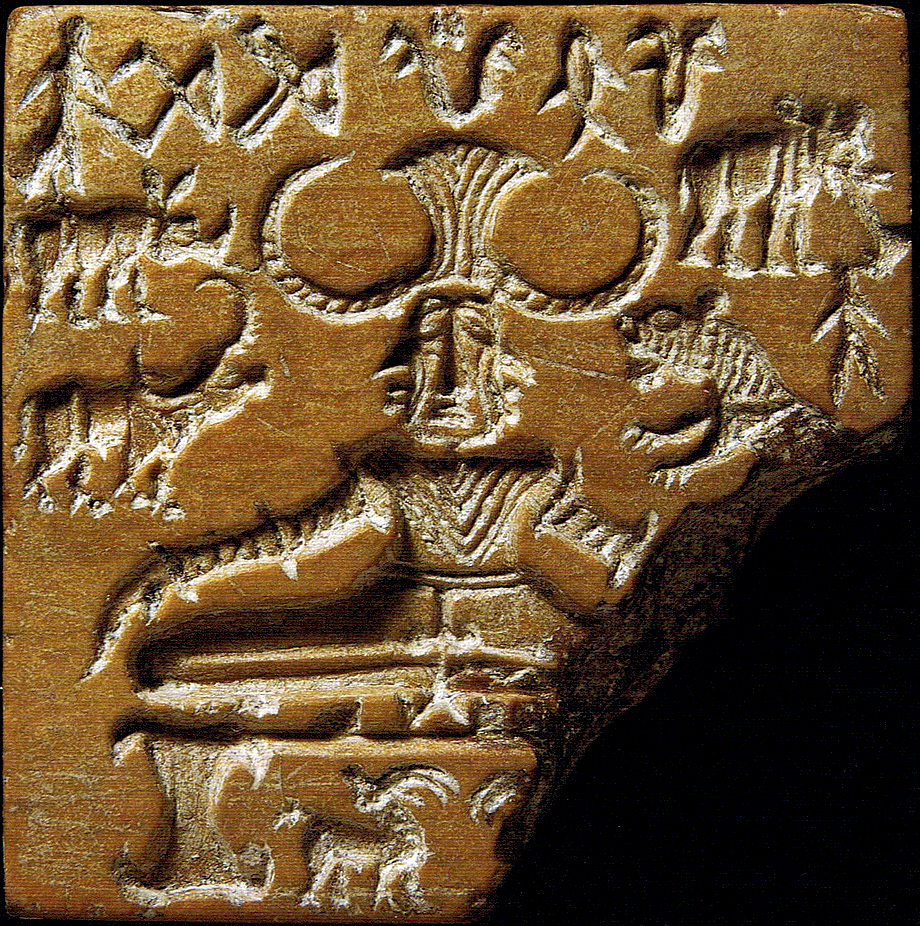

A Journey Through the Mind-Only School and the Meditative Heart of Buddhism
Contents
- Yoga: The Ancient Art of Union
- Yogic Meditation: The Inner Science of Transformation
- The Buddha’s Yoga: Meditation and the Path to Awakening
- The Buddhist Canon: The Tipiṭaka
- The Schools of Buddhism
- The Middle Way School: Madhyamaka Philosophy
- The Yoga Practice School: Yogācāra Philosophy and Meditation
- Chinese Chan Yoga Practice
- Japanese and American Zen Yoga Practice
- Conclusion: Returning to the Source
Introduction: The Way of Mind
What is this mind that seeks, questions, and aspires? What is this body that breathes, sits, and suffers? For more than two millennia, the disciplines of yoga and meditation have offered human beings a method — not merely for escape or relief, but for understanding the deep causes of suffering and realizing the nature of self, mind, and world.
This article explores a particular stream within that long and winding river: Zen Yoga, the practice of meditative inquiry grounded in the Yogācāra school of Mahāyāna Buddhism.
Emerging from the Indian crucible of early yoga and Buddhist insight, Yogācāra — the “Practice of Yoga” school — systematized a path based on consciousness-only, mental purification, and contemplative transformation. Its teachings shaped not only the doctrinal landscape of East Asian Buddhism but also the lived experience of Chinese Chan and Japanese Zen, and continue to resonate through modern practice in the West.
At its core, Yogācāra does not point to something external or abstract. It points to the very process of experience itself — to how we perceive, how we fabricate meaning, and how we project “self” and “world” upon the luminous screen of awareness.
It is both a map of the mind and a mirror for the practitioner. The final realization of this path is not the acquisition of new beliefs but the letting go of illusion, including the illusion of the “I” who lets go.
Through the stages of this article, we follow this teaching from its origins in Indian yoga to its flowering in Chinese meditation, to its silent depth in Japanese Zen, and finally to its enduring relevance in contemporary American practice. Each section is a window into a lineage of meditation, philosophy, and quiet revolution — a tradition that teaches not how to think better, but how to see more clearly.
May this journey help us return, again and again, to the still point of direct experience — where no separation exists, and the true yoga of the mind begins.
I. Yoga: The Ancient Art of Union
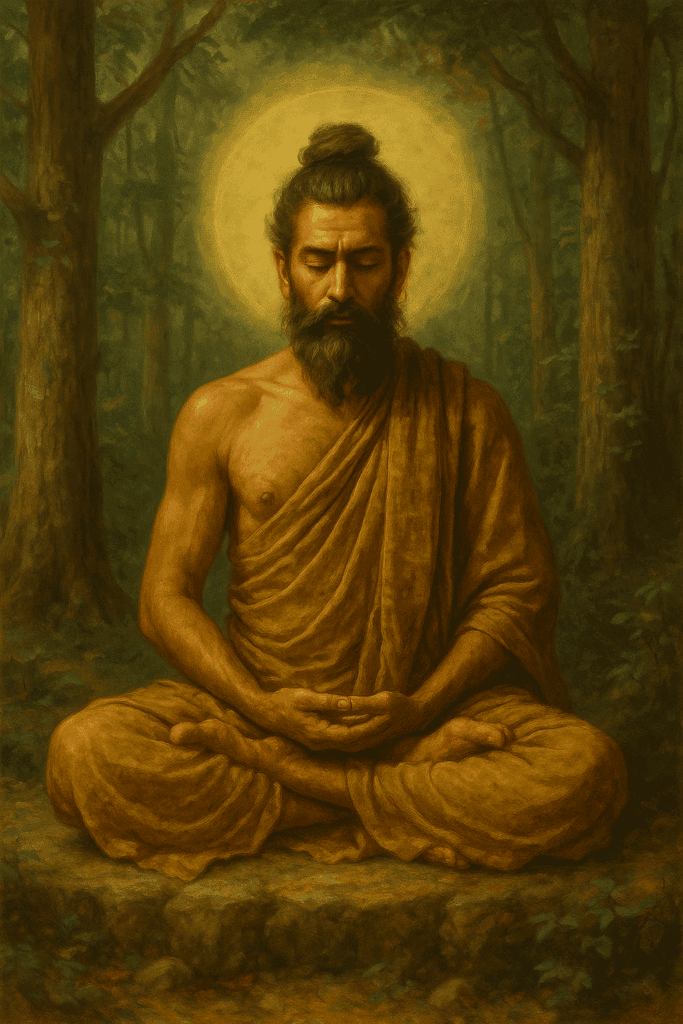
From the earliest times, Indian sages practiced yoga, a profound discipline dedicated to the union of the divine and the earthly, the eternal and the mortal. In their understanding, the Creator god Brahman was not a distant being but the very breath and substance of all existence — prāṇa, the life force that animated the cosmos. To live in harmony with this divine breath was the purpose of human life.
Yoga emerged as the practical method for this harmonization. Through sacred study, ritual, breath control (prāṇāyāma), physical postures (āsana), mental concentration (dhyāna), disciplined diet, holistic medicine, and a natural way of life, the yogin sought to cultivate the inner connection with Brahman. In this tradition, a male practitioner is called a yogi, and a female practitioner a yoginī.
The word yoga is derived from the Sanskrit roots yujir yoga, meaning “to yoke,” and yuj samādhau, meaning “to concentrate.” Thus, at its essence, yoga means “union” or “integration.” It is the act of bringing together the scattered energies of body, mind, and spirit into a single, focused, luminous whole.
The supreme goal of yogic practice is samādhi — a state of mindful absorption where the distinction between the observer and the observed dissolves. In samādhi, the practitioner transcends the illusion of duality and realizes their essential unity with all existence. This transcendent state is revered not only in Hinduism but also in the traditions of Jainism, Sikhism, Yoga itself, and Buddhism, where samādhi marks the apex of meditative realization.
In this way, yoga became both a science and an art of spiritual transformation — the living bridge between the temporal and the timeless.
II. Yogic Meditation: The Inner Science of Transformation
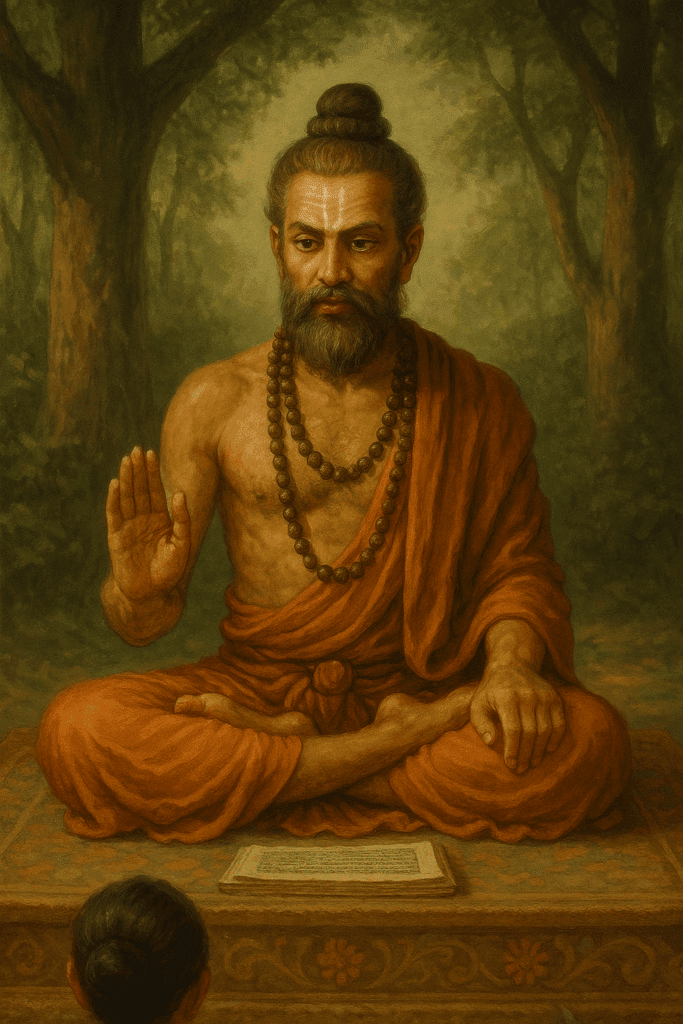
The art of yogic meditation reached new heights in the teachings of Patañjali, revered as the father of classical yoga. In his vision, reality was composed of two fundamental principles: puruṣa, the eternal spirit or true Self, and prakṛti, the dynamic realm of nature and matter. The task of yoga was the purification of consciousness — the disentanglement of the spirit from the illusions of nature — so that puruṣa might shine forth in its original, luminous freedom.
Yoga was thus not merely a physical regimen but primarily a mental and spiritual discipline — a profound practice of concentrated contemplation or trance, aimed at the union of the finite mind with the infinite divine. Patañjali defined his method as samyama, or inner discipline, comprised of three ascending stages:
- Dhāraṇā: concentration, the fixing of attention on a single object,
- Dhyāna: meditation, the uninterrupted flow of awareness toward the object,
- Samādhi: mindful trance, the complete absorption of the mind into the object, culminating in the transcendence of duality.
His seminal text, the Yoga Sūtra (c. 200 BCE – 200 CE), presents a highly methodical system of enlightenment — even more systematic in certain respects than that developed by the Buddha. Patañjali recommended meditating upon various objects and concepts to stabilize the mind: friendliness, compassion, the sun, the moon, the polestar, the navel, the throat, the heart, the mysteries of time and space, and the deep relationship between the body and the cosmos.
Interestingly, Patañjali gave little direct instruction regarding postures (āsana) or breath control (prāṇāyāma) — aspects that would later be elaborated by the traditions of Haṭha Yoga and Tantric practice. His focus remained the purification of consciousness through disciplined inner inquiry.
All forms of classical yoga are rooted in Aṣṭāṅga — the “Eight Limbs” — a comprehensive structure preparing the yogin for true meditation. In the Yoga Sūtra, these Eight Limbs of Rāja Yoga (“Royal Yoga”) are not separate exercises but facets of a single organic process leading toward complete samādhi and, ultimately, enlightenment.
Ethical conduct (yama and niyama), physical health (āsana and prāṇāyāma), sense withdrawal (pratyāhāra), concentration, meditation, and absorption together form a gradual ascent from worldly distraction to spiritual awakening.
Patañjali recognized that ethical purification and a degree of bodily health were necessary supports for deep meditation. Thus, yoga was conceived as an integrated way of life — an ethical code, a health regimen, and a meditative discipline, all harmonized toward the supreme goal of realization.
It was in this rich tradition that, around the sixth century BCE, Siddhārtha Gautama was born into the Śākya clan in the region of Lumbinī, in present-day Nepal. Raised in the capital city of Kapilavastu, Siddhārtha was destined for rulership but instead chose a spiritual path.
Renouncing the life of a secular leader, he trained with yogic ascetics, mastering meditative techniques before transcending them to formulate his own luminous path of awakening. He came to be known simply as the Buddha — “the Awakened One” — whose teachings would forever shape the destiny of yoga, meditation, and human spiritual inquiry.
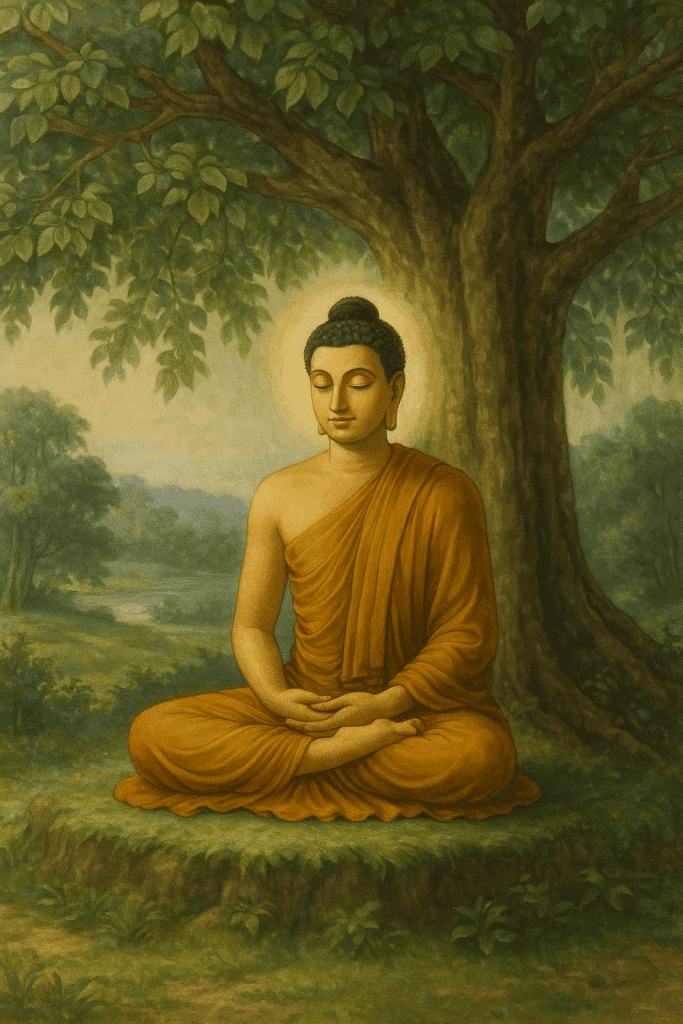
III. The Buddha’s Yoga: Meditation and the Path to Awakening
The Buddha — born Siddhārtha Gautama in the sixth century BCE — began his spiritual journey within the traditions of yogic meditation practiced by India’s ascetic sages.
His first teachers were Āḷāra Kālāma and Uddaka Rāmaputta, renowned masters of meditation and subtle states of consciousness. Under their instruction, Siddhārtha learned to attain profound absorptions (jhānas) — refined meditative trances culminating in the formless states of neither-perception-nor-non-perception.
Yet even in these exalted states, Siddhārtha perceived that final liberation had not been attained. The bliss of absorption was impermanent. Thus, he left his teachers and pursued a deeper path of his own, integrating the yogic discipline with an unrelenting investigation of the nature of suffering, impermanence, and the self.
Buddhist meditation, known as bhāvanā — meaning “mental cultivation” — was at the heart of this new way. As recorded in the Dhammapada (Chapter 20, “The Path,” verse 282), the Buddha taught:
“Wisdom is born of meditation (yoga). Without meditation, wisdom decays. Knowing this twofold path of gain and loss, conduct yourself so that wisdom grows.”
This foundational insight illustrated that meditation was not an accessory to wisdom, but its very source. Even the learned monk Potthila, a scholar of the Tipiṭaka, was reminded that scriptural knowledge without meditation was hollow.
According to the Aṅguttara Nikāya of the Pāli Canon, the Buddha systematically taught the progression through nine stages of jhāna — absorptive meditative states.
Sitting cross-legged in a yogic posture, the practitioner would first concentrate awareness upon the breath, ānāpānasati, before proceeding through increasingly subtle states of mental unification and bliss. Beginners might spend hours striving to settle the mind into the first absorption, but with practice, the process became smoother and more natural.
In early Buddhism, bhāvanā encompassed both:
- Samatha: the calming and stabilization of the mind,
- Vipassanā: the insight into the impermanent, unsatisfactory, and non-self nature of all phenomena.
Theravāda Buddhist meditation involved concentration on one of forty classical subjects — such as fire, earth, water, air, space, consciousness itself, the qualities of the Buddha, the Sangha (the monastic community), the breath, death, or the nature of emptiness.
Through these exercises, the practitioner cultivated tranquility, compassion, discernment, memory, concentration, and ultimately the penetrative wisdom that leads to nibbāna (nirvāṇa).
As in yoga, these practices both calmed and energized the body-mind system, allowing for a deeper inquiry into the roots of disturbance and suffering. But the Buddha emphasized a distinctive integration: insight into the very nature of craving, attachment, and identity.

At the heart of the Buddha’s teaching were the Four Noble Truths:
- Life inevitably involves suffering (dukkha),
- Suffering is caused by craving and attachment,
- Suffering can be overcome,
- There is a path leading to the cessation of suffering — the Noble Eightfold Path.
The Eightfold Path is a practical method of inner cultivation, consisting of:
- Right Understanding,
- Right Purpose,
- Right Speech,
- Right Conduct,
- Right Livelihood,
- Right Effort,
- Right Mindfulness (sammā-sati),
- Right Concentration (sammā-samādhi).
The culmination of this path is nirvāṇa, the “blowing out” or extinguishing of the illusion of a separate self. When this delusion is seen through, what remains is the direct realization of emptiness (śūnyatā) — the interconnectedness and underlying unity of all things.
The Buddha’s method was, at its essence, a yoga of silent illumination: seated meditation (dhyāna) leading to awakening (bodhi). Through this path, he cultivated a vast following of mendicant monks, nuns, and lay practitioners. Yet after his death, Buddhism — like early yoga — diversified into many schools and lineages, each interpreting and developing his teachings in different ways.

IV. The Buddhist Canon: The Tipiṭaka
The teachings of the Buddha were preserved and transmitted in the Tipiṭaka (Sanskrit: Tripiṭaka), meaning “Three Baskets,” a vast corpus of Buddhist scripture compiled between approximately 500 BCE and the first century BCE. Organized systematically for both monastic and lay practitioners, the Tipiṭaka forms the foundation of Buddhist tradition across the Theravāda and Mahāyāna schools.
The Pāli Tipiṭaka is divided into three major sections:
- Vinaya Piṭaka: The “Basket of Discipline,” outlining the ethical code and monastic rules for monks and nuns (compiled sixth century BCE).
- Sutta Piṭaka: The “Basket of Discourses,” containing around 10,000 suttas (Sanskrit: sūtras) — sermons and dialogues attributed to the Buddha and his direct disciples (compiled fifth century BCE).
- Abhidhamma Piṭaka: The “Basket of Higher Teaching,” offering philosophical and psychological analysis of the teachings contained in the suttas (compiled third century BCE).
Each “basket” serves a distinct purpose:
- The Vinaya Piṭaka not only records the moral precepts and disciplinary procedures of the Sangha (monastic community) but also narrates mythic accounts of the Buddha’s enlightenment, the ordination of his first disciples, and the establishment of the early monastic order.
- The Sutta Piṭaka is the rich heart of the canon, containing the Buddha’s practical instructions on meditation, ethics, insight, and liberation, often conveyed through vivid parables and dialogues.
- The Abhidhamma Piṭaka — or Abhidharma in Sanskrit — systematizes and expands upon the teachings, providing a detailed scholastic analysis of mind, reality, and the processes of experience. It is sometimes called the first great “Buddhist psychology.”
The Abhidhamma would later exert a profound influence on the philosophical evolution of Buddhism, inspiring both the Madhyamaka (“Middle Way”) and Yogācāra (“Yoga Practice”) schools of thought within early Mahāyāna.
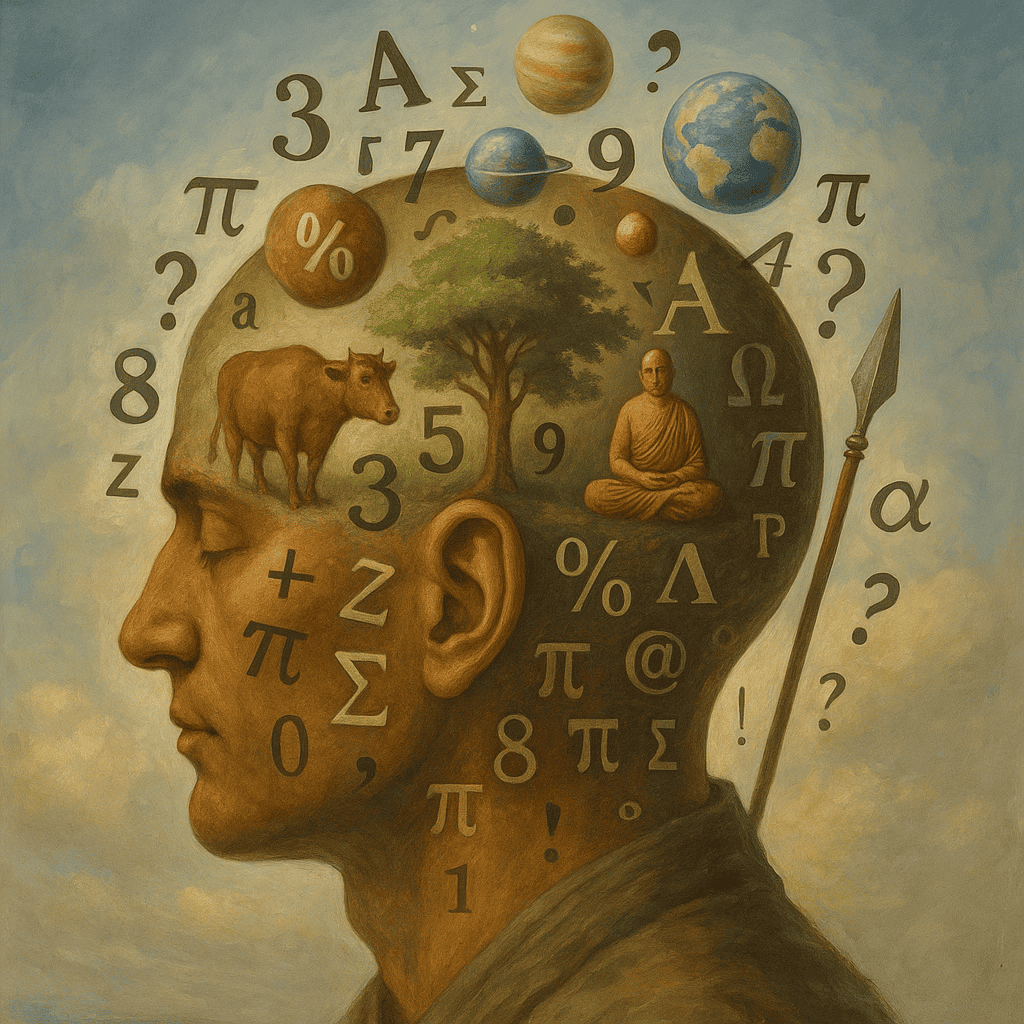
Early Buddhist Psychology: The Abhidharma
The Abhidharma, the third division of the Tipiṭaka, moves beyond practical instruction into the realm of theoretical analysis. It offers a “map of the mind,” exploring the intricate processes of consciousness, cognition, and phenomena with unparalleled precision.
Rather than focusing on philosophical speculation, early Buddhist psychology was empirical, grounded in direct introspection and observation of subjective experience. The goal was to deconstruct the mental factors (cetasikas) and processes (cittas) that produce suffering and delusion.
In the Mahāyāna tradition, the Abhidharma was further refined and expanded. In Tibet, the principal Mahāyāna Abhidharma text became the Compendium of Higher Teaching (Abhidharmasamuccaya) by the Indian master Asaṅga (fourth–fifth centuries CE), a former Brahmin from the Gandhāra region (modern-day Kashmir). Asaṅga’s model categorized existence into:
- 28 physical phenomena,
- 52 mental factors,
- 24 types of causal relations,
- 17 mental processes,
- 89 distinct types of consciousness.
His half-brother, Vasubandhu, originally trained in the Śrāvakayāna (early Buddhist) tradition, synthesized earlier Abhidharma traditions into a concise and influential summary:
- Treasury of Higher Dharma (Abhidharmakośa), composed in compact four-line verses (kārikā), followed by his own extensive commentary.
Asaṅga and Vasubandhu, both luminaries of early Buddhist philosophy, went on to establish the Yogācāra school, advancing a revolutionary approach to mind and reality.
Today, particularly in Theravāda and Tibetan Buddhism, the Abhidharma remains a living tradition, used for analyzing the mind’s operations and cultivating insight into the nature of subjective experience and reality itself.
(For further reading, see: The Buddhist Psychology of Awakening by Steven D. Goodman.)
Faithful to the Buddha’s original emphasis on skepticism and evidence-based inquiry, Buddhist psychology closely aligns with the spirit of modern scientific psychology — though it regards even scientific knowledge as provisional in relation to ultimate reality.
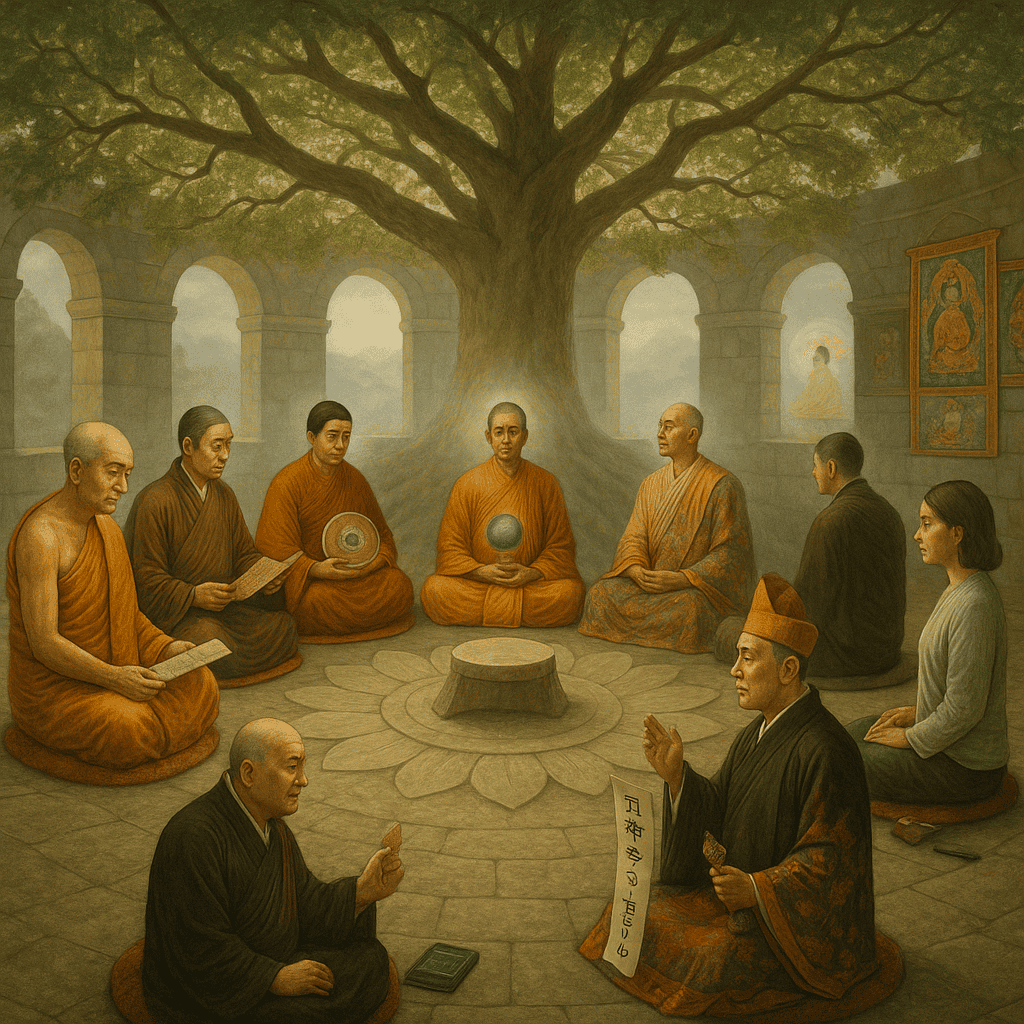
V. The Schools of Buddhism
From the earliest days of the Buddhist community, differences in interpretation and practice gave rise to distinct schools or nikāyas (literally, “volumes” or “collections”). Of the approximately twenty original sects that developed during early Indian Buddhism, only three monastic lineages remain extant today:
- Mūlasarvāstivāda: the lineage preserved in Tibetan Vajrayāna Buddhism,
- Dharmaguptaka: the ordination lineage of East Asian Mahāyāna (China, Korea, Japan, and Vietnam),
- Theravāda: the oldest and most continuous school, still thriving in Sri Lanka and mainland Southeast Asia.
From this early diversity, two primary branches of Buddhism emerged:
- Nikāya Buddhism (a modern term referring to early monastic schools, particularly Theravāda),
- Mahāyāna Buddhism (“Great Vehicle”), a more expansive movement that emerged in the first century CE.
In the early centuries, monastics from both traditions often lived within the same monasteries, with shared rituals and common practices. Over time, doctrinal and philosophical distinctions led to increasingly distinct identities.
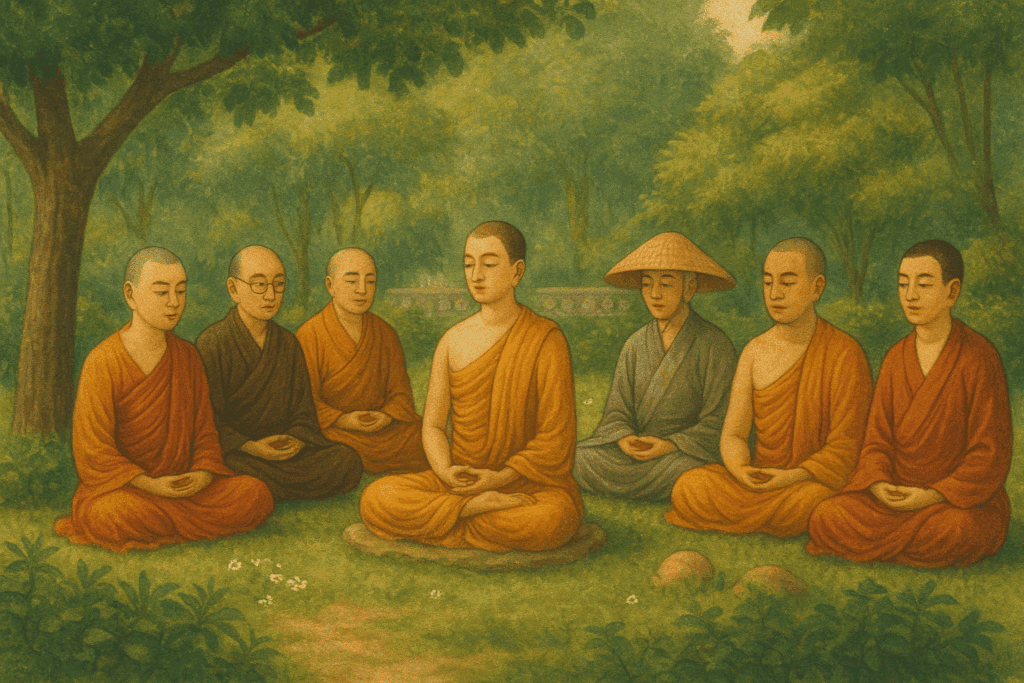
Theravāda: The Way of the Elders
Theravāda Buddhism, the “Doctrine of the Elders,” traces an unbroken lineage to the historical Buddha and his original disciples. Grounded in the Pāli Canon (Tipiṭaka), it emphasizes early Buddhist teachings, meditative discipline, and monastic life. Theravāda Buddhism was first codified in India and Sri Lanka in the third century BCE and later spread throughout Myanmar (Burma), Cambodia, Laos, Thailand, and the broader Southeast Asian region.
Theravāda meditation focuses on personal liberation through direct insight into the impermanence and non-self nature of reality. Its approach to mental cultivation is exemplified by the development of jhāna (meditative absorptions) and vipassanā (insight meditation).
Mahāyāna: The Great Vehicle
Mahāyāna Buddhism arose in India around the first century CE, spreading quickly to Central Asia, China, Korea, and Japan. The term “Mahāyāna,” or “Great Vehicle,” was coined by its adherents to differentiate it from what they termed “Hīnayāna” or “Lesser Vehicle” — a label now considered inaccurate or pejorative when applied to early Buddhist schools like Theravāda. Modern scholars instead use “Nikāya Buddhism” as a neutral and accurate term for these traditions.
Mahāyāna teachings introduced key innovations:
- The doctrine of emptiness (śūnyatā), which holds that all phenomena are ultimately devoid of independent essence,
- The bodhisattva ideal: an enlightened being who vows to delay personal nirvāṇa in order to help all sentient beings achieve liberation.
Mahāyāna sutras — many composed between 100 BCE and 300 CE — were often visionary or poetic texts, claiming origin in the Buddha’s hidden or esoteric teachings. Though not historical in origin, these sutras were treated as spiritually authentic by the communities that received them.
Early Mahāyāna gave rise to several important schools:
- Madhyamaka: The “Middle Way” school founded by Nāgārjuna,
- Yogācāra: The “Consciousness-Only” or “Practice of Yoga” school founded by Asaṅga and Vasubandhu,
- Avataṃsaka: The Flower Garland tradition, emphasizing the interpenetration of all phenomena,
- Lotus Sutra schools: such as Tiantai in China and Tendai in Japan.
Mahāyāna later developed regional traditions, including:
- Chan (China), Seon (Korea), Zen (Japan), and Thiền (Vietnam), all emphasizing meditative direct experience;
- Pure Land Buddhism, a devotional path centered on Amitābha Buddha and rebirth in a realm conducive to enlightenment;
- Huayan/Kegon, a visionary metaphysical system emphasizing cosmic unity.
Vajrayāna: The Diamond Vehicle
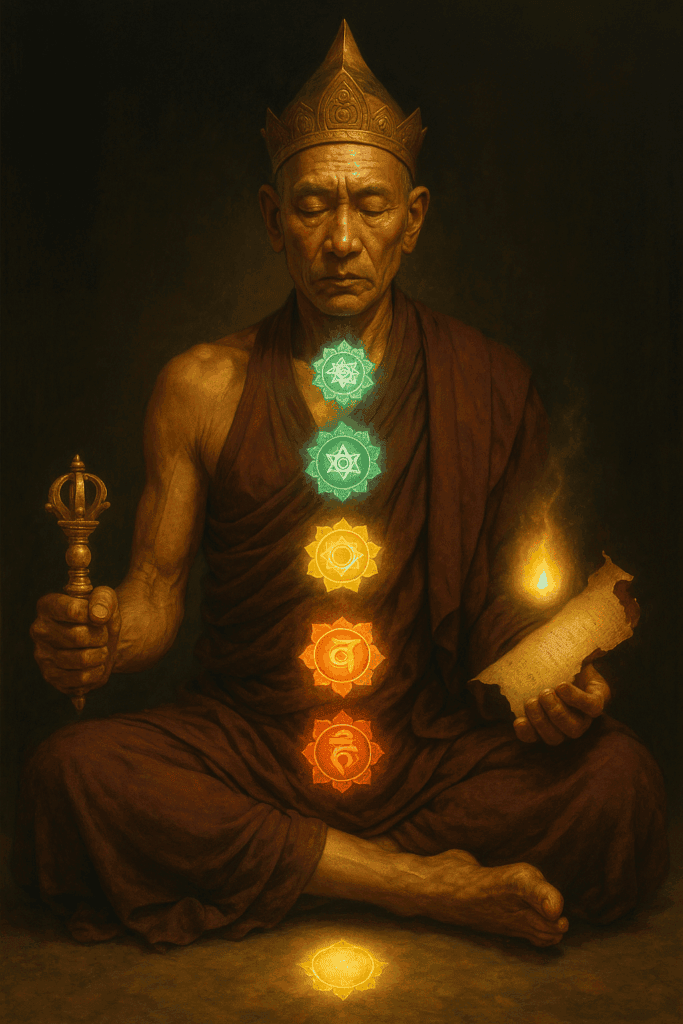
Sometimes considered a subset of Mahāyāna, Vajrayāna Buddhism developed as a distinct third vehicle emphasizing ritual, symbolism, and esoteric knowledge. It is also known as:
- Mantrayāna, for its use of sacred chants,
- Tantric Buddhism, for its transformative ritual system rooted in symbolic alchemy.
Vajrayāna found its fullest development in Tibetan Buddhism and in Japanese schools such as Shingon and esoteric Tendai. Through its vivid use of visualization, mantra, mudrā (ritual gesture), and mandala, Vajrayāna seeks to rapidly accelerate the path to enlightenment, transforming ordinary perception into divine realization.
Together, these three great vehicles — Theravāda, Mahāyāna, and Vajrayāna — preserve the living diversity of the Buddha’s legacy. They represent different expressions of the same universal insight: that liberation from suffering is possible through the purification of the mind, the cultivation of wisdom, and the realization of selflessness.
The Schools of Early Mahāyāna Philosophy
The philosophical flowering of early Mahāyāna Buddhism gave rise to two principal schools, both deeply influenced by Abhidharma analysis and the emerging Mahāyāna scriptures such as the Prajñāpāramitā Sūtras (“Perfection of Wisdom” literature):
- Madhyamaka (“Middle Way”): Founded by Nāgārjuna, this school focused on rigorous ontological analysis, demonstrating that all phenomena (dharmas) are empty (śūnya) of inherent existence. Ultimate reality, therefore, is beyond all conceptualization.
- Yogācāra (“Yoga Practice” or “Practice of Consciousness”): Developed by Asaṅga and Vasubandhu, Yogācāra explored reality through the lens of consciousness, perception, and cognitive processes, positing that our experience of a dualistic world is a construction of the mind.
Both schools, while differing in approach — Madhyamaka through dialectical deconstruction and Yogācāra through psychological analysis — ultimately converge on the same realization: the emptiness of self and phenomena, and the interconnected, dynamic nature of reality.
Thus, the philosophical evolution of Buddhism maintained a continuity with its roots in meditation and mindful inquiry, while simultaneously advancing profound insights into mind, knowledge, and existence.
VI. The Middle Way School: Madhyamaka Philosophy
The Madhyamaka school, or “Middle Way,” represents one of the two principal philosophical systems of Mahāyāna Buddhism. Rooted in the profound writings of the Indian philosopher and alchemist Nāgārjuna (c. 150–250 CE), Madhyamaka presents a radical and transformative view of reality.
Nāgārjuna’s most influential works include the Mūla-madhyamaka-kārikā (Fundamental Verses on the Middle Way) and the Vigraha-vyāvartanī (The Dispeller of Disputes). These texts became the foundation for a school of thought that would reshape Buddhist doctrine across Asia.
The term Madhyamaka refers to the “Middle Path” — not merely a path of moderation, but a philosophical stance that avoids the twin extremes of eternalism (the belief in unchanging, eternal essences) and nihilism (the belief that nothing exists or matters).
This echoes the Buddha’s original teaching that the self is neither a permanent, unchanging soul nor a thing that is created and annihilated. Instead, all things are in a constant state of transformation, arising and ceasing through causes and conditions.
By Nāgārjuna’s time, Buddhist scholars were deeply engaged with the Abhidharma — the analytical classification of phenomena into distinct categories. While valuable as tools for contemplation, Nāgārjuna saw these classifications as potentially misleading. He argued that treating the Abhidharma’s categories as objective realities rather than mental constructions reinforced dualistic thinking and perpetuated the illusion of independent existence.
Nāgārjuna’s method was dialectical: through systematic reasoning, he would analyze and deconstruct any given proposition, revealing it to be based on assumptions that collapse under scrutiny. His goal was not to replace one view of reality with another, but to show that all conceptual frameworks are empty — devoid of inherent existence. This insight, known as śūnyatā or “emptiness,” became central to the Mahāyāna understanding of liberation.
The Two Truths
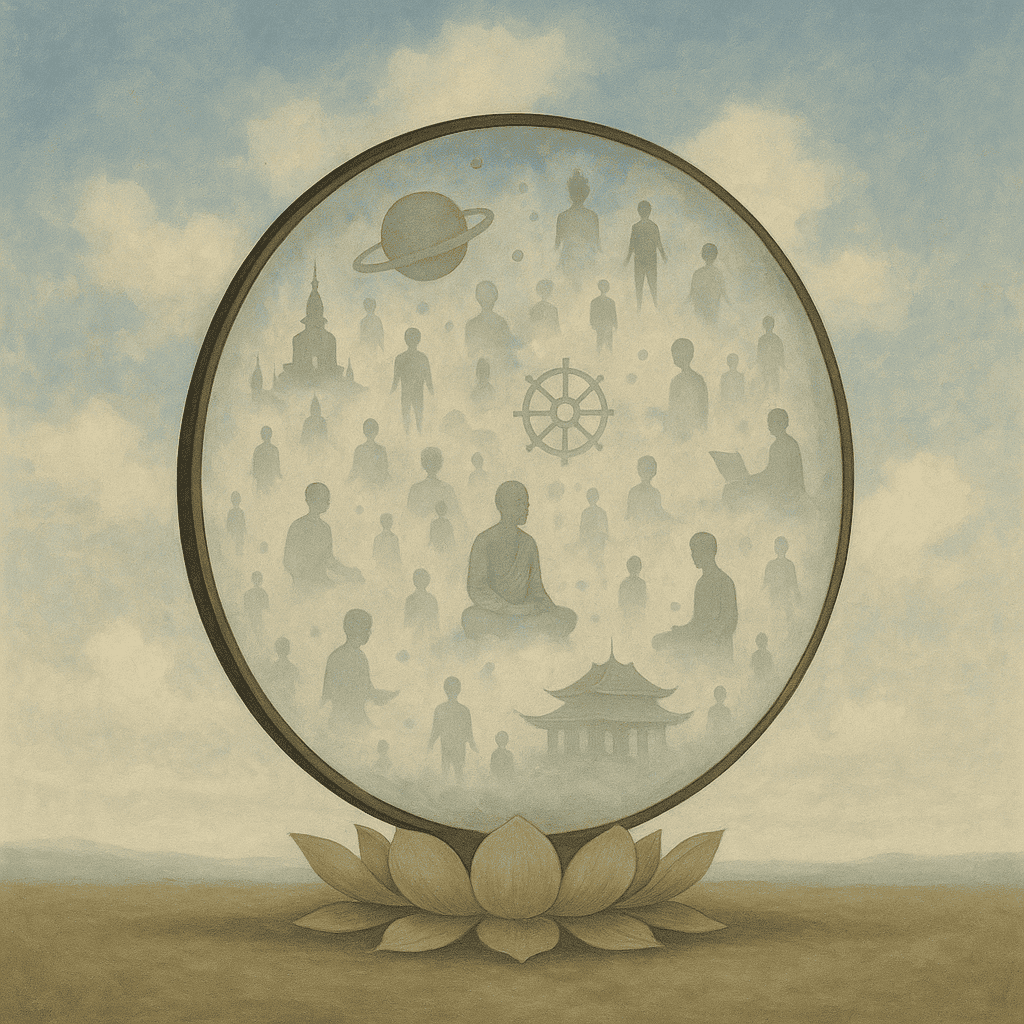
Madhyamaka philosophy articulates a key distinction between:
- Conventional truth (saṁvṛti-satya): the world as we perceive it, full of relative truths and practical designations,
- Ultimate truth (paramārtha-satya): the understanding that all phenomena are empty of inherent, independent existence.
These two truths are not separate realities but different levels of describing the same world. Realizing their unity is part of awakening.
Liberation Through Emptiness
For Madhyamaka, the realization of emptiness does not lead to nihilism but to non-attachment. Since all things — including the self, emotions, beliefs, and even Buddhist teachings — are ultimately empty, clinging to them is the root of suffering. Letting go of this clinging, and resting in the insight of emptiness, is the foundation of true liberation.
Lasting Influence
The Madhyamaka school flourished in India from the fifth through the eighth centuries CE, with its core texts translated into both Chinese and Tibetan. While the sect did not establish a lasting institutional presence in China, its philosophical influence was profound. It shaped the development of:
- Tibetan Vajrayāna, particularly in the Gelug and Kagyu traditions,
- Chinese Chan, and by extension,
- Korean Seon, Japanese Zen, and Vietnamese Thiền.
Madhyamaka’s skepticism about conceptual certainty and emphasis on direct realization echoes strongly in the Zen tradition of koans — paradoxical sayings and dialogues designed to break the grip of logical thinking and trigger sudden insight into the nature of mind and reality.
In this way, Nāgārjuna’s Middle Way remains not only a cornerstone of Mahāyāna philosophy but also a living influence within meditative traditions committed to the direct experience of awakening.
VII. The Yoga Practice School: Yogācāra Philosophy and Meditation
As Buddhism evolved within the Indian subcontinent, it naturally absorbed and responded to the rich yogic and philosophical milieu of Brahmanic culture. By the early centuries of the Common Era, Indian Buddhists had begun to develop their own distinctly Buddhist form of yoga — one that merged rigorous philosophical inquiry with a meditative discipline grounded in introspective awareness. This new path became known as Yogācāra, the “Yoga Practice School.”
Where the Madhyamaka school of Nāgārjuna emphasized the deconstruction of all conceptual views to reveal emptiness, Yogācāra turned inward, developing a detailed map of consciousness itself. If Madhyamaka could be seen as Buddhist ontology, Yogācāra was Buddhist psychology.
Origins and Textual Foundation
Yogācāra emerged as a coherent system in the third to fifth centuries CE. Its earliest expression is found in the Saṃdhinirmocana Sūtra (“Discourse Unraveling the Intent of the Buddha”), which interpreted the Buddha’s teachings as having multiple levels of meaning, culminating in a final, definitive truth. Other key texts include:
- The Yogācārabhūmi Śāstra (“Treatise on the Stages of Yogic Practice”), an encyclopedic manual on Buddhist meditation,
- The Laṅkāvatāra Sūtra, a seminal Mahāyāna scripture linking Yogācāra with Zen,
- The philosophical writings of Asaṅga and Vasubandhu, half-brothers and the formal founders of the school.
These thinkers transformed Yogācāra into a sophisticated theory of mind and meditative development.
Core Doctrines of Yogācāra
Yogācāra advanced several central ideas:
1. Consciousness-Only (Vijñaptimātra)
The hallmark of Yogācāra thought is the assertion that all experience is mind-only or consciousness-only. What we perceive as an external, objective world is actually a projection of our own consciousness. There is no way to step outside of mind to verify the existence of a separate reality — thus, all appearances are illusory constructs generated by mental processes.
This is not solipsism, but a call to recognize the subjective filtering of experience and the karmic imprints that shape perception.
2. The Three Natures (Trisvabhāva)
Yogācāra classifies all phenomena according to three interdependent modes of being:
- Parikalpita (Imaginary Nature): Things as they appear, distorted by projection and delusion.
- Paratantra (Dependent Nature): Things as they arise through causal interdependence.
- Pariniṣpanna (Perfected Nature): The ultimate, non-conceptual reality beyond dualistic thinking.
These three natures help the practitioner understand the layers of illusion and the gradual unveiling of truth.
3. The Storehouse Consciousness (Ālaya-vijñāna)
Unique to Yogācāra is the doctrine of the ālayavijñāna, or storehouse consciousness — a deep, unconscious stratum of mind where karmic seeds are stored. These seeds, planted by intentional actions, ripen into future experiences, shaping perception, thought, and behavior.
Originally pure, the ālayavijñāna becomes defiled by ignorance and karma. Upon awakening, this storehouse is transformed into luminous wisdom — the mind of a Buddha. This concept elegantly bridges the psychological with the karmic, linking present experience to past conditioning and future freedom.
Practice: Meditative Yogācāra
Yogācāra is not merely a philosophy but a path of direct meditative realization. Its practices emphasize quiet, sustained reflection, often compared to Daoist stillness and non-action (wu wei). This silent interiorization would find its purest expression in the meditation traditions of Chinese Chan and Japanese Zen.
Indeed, Silent Illumination (mozhao) and Sōtō Zen’s shikantaza (“just sitting”), as taught by Eihei Dōgen, reflect Yogācāra’s emphasis on non-dual awareness. In these traditions, the goal is not to manipulate the mind, but to rest in the mind’s natural clarity — to sit, observe, and allow reality to reveal itself as it truly is.
From this profound union of introspective psychology and meditative discipline, Yogācāra gave birth to a new vision of the spiritual path — one in which mind itself was the field of transformation, and liberation arose through understanding, not of what the world is, but of how we experience it.
VIII. Chinese Chan Yoga Practice (East Asian Yogacara)
The philosophy and meditation practices of Yogācāra Buddhism were formally introduced to China and Tibet in the sixth century CE, where they quickly began to evolve in new directions. In China, Yogācāra Buddhism developed in two distinct historical stages. The early phase was represented by the Dilun and Shelun schools, while the later and more influential stage was known as the Faxiang (法相, “Dharma Characteristics”) or Weishi (唯識, “Consciousness-Only”) school.
This latter school — the most systematized form of Chinese Yogācāra — was founded by the renowned seventh-century pilgrim and scholar Xuanzang (玄奘) and his principal disciple Kuiji (窺基).
Xuanzang had studied at the great Yogācāra centers in India, particularly under Dharmapāla, and upon his return to China he translated key Yogācāra texts, including the Vijñaptimātratāsiddhi (“Establishment of Consciousness-Only”), forming the core doctrinal basis of the Faxiang school. His efforts, along with earlier translators such as Paramārtha, Bodhiruci, and Ratnamati, laid the textual foundation for East Asian Yogācāra thought.
Key Translators and Philosophers of Chinese Yogācāra
The development of Chinese Yogācāra and its integration into Chan Buddhism was shaped not only by Xuanzang and Kuiji but also by earlier and contemporaneous scholar-monks who laid the groundwork for the tradition’s transmission and interpretation in East Asia.
Xuanzang (602–664) was one of the most celebrated pilgrim-scholars in Buddhist history. A devout monk of the Tang dynasty, he undertook a legendary 17-year journey to India, where he studied at Nālandā University under the Yogācāra master Dharmapāla.
On returning to China, Xuanzang established the Faxiang school (Dharma Characteristics School) and translated more than 1,300 volumes of scripture, including the Vijñaptimātratāsiddhi and the Yogācārabhūmi. His systematization of consciousness-only philosophy profoundly influenced Chinese, Korean, and Japanese Buddhism and laid the scholastic foundation for Chan’s engagement with Yogācāra.
Zhiyan (602–668) was the second patriarch of the Huayan school of Chinese Buddhism but also played a significant role in the early reception of Yogācāra thought. A contemporary of Xuanzang, Zhiyan studied both Yogācāra and Madhyamaka before dedicating himself to the metaphysical synthesis found in the Avataṃsaka Sūtra.
His early exposure to Yogācāra concepts — particularly regarding mind and interdependent arising — subtly informed Huayan’s visionary view of the cosmos as an interpenetrating web of phenomena, not unlike Yogācāra’s own vision of dependent origination within consciousness.
Woncheuk (613–696), also known in Chinese as Yuáncè, was a Korean-born monk who became one of Xuanzang’s foremost students and commentators. He lived and taught in Chang’an, contributing to the Chinese understanding of Yogācāra through detailed commentaries on texts such as the Saṃdhinirmocana Sūtra.
Woncheuk offered a more inclusive and syncretic interpretation of Yogācāra than Kuiji, bridging aspects of Madhyamaka and Tathāgatagarbha thought. His writings influenced both Chinese and Korean Buddhist philosophy.
Dōshō (c. 638–700) was a Japanese monk who studied in China under Xuanzang. Upon returning to Japan, he became the first to introduce Yogācāra Buddhism to the Japanese archipelago, planting the seeds for later developments in Hossō, the Japanese counterpart of the Faxiang school. Dōshō was not only a transmitter of scripture but also a practitioner and teacher of meditation, helping to establish a lineage of Buddhist mind-training that would eventually merge with native Japanese sensibilities in Zen.
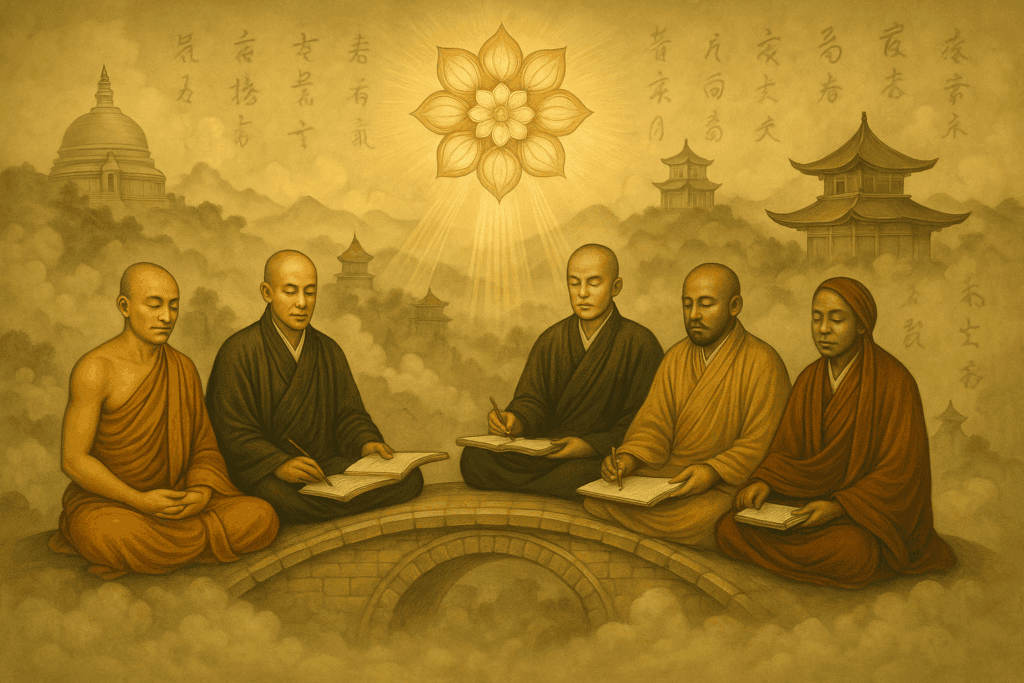
Ratnamati (fl. early 6th century), a Central Asian monk, collaborated with the Chinese translator Bodhiruci to render several foundational Yogācāra texts into Chinese. He was especially instrumental in introducing Maitreya’s Treatise on the Stages of Yogic Practice (Yogācārabhūmi) to Chinese audiences, helping to initiate the Shelun school, which represented an early wave of Yogācāra thought in China.
Bodhiruci (d. 527), a key Indian missionary and translator, worked extensively in the Northern Wei capital of Luoyang. He translated numerous Mahāyāna and Yogācāra scriptures, including Vasubandhu’s Commentary on the Ten Stages Sutra (Dashabhūmika Sūtraśāstra). His translations deeply influenced the Dilun and Shelun schools and laid a strong doctrinal foundation for the later Faxiang school.
Paramārtha (499–569) was a South Indian monk, translator, and missionary who played a pivotal role in the early transmission of Yogācāra thought to China. Invited to China during the Liang dynasty, he settled in southern China and produced over 240 volumes of translations, many of which deeply influenced Chinese interpretations of Mahāyāna Buddhism. Among his most influential works was the Mahāyānasaṁgraha, a foundational Yogācāra treatise by Asaṅga, which became the central text of the Shelun school.
Paramārtha is notable for his distinctive integration of Yogācāra philosophy with the emerging Chinese concept of Buddha-nature (tathāgatagarbha), which he interpreted as synonymous with the storehouse consciousness (ālaya-vijñāna). This fusion of psychological and ontological models left a lasting mark on Chinese Buddhist metaphysics and helped bridge Indian and East Asian understandings of mind, purity, and liberation.
Jingying Huiyuan (523–592), a Chinese scholar-monk of the Southern Dynasties, synthesized Indian Yogācāra theory with indigenous Chinese Buddhist thought. He defended the validity of Yogācāra’s “consciousness-only” view while engaging in doctrinal dialogue with other schools. His writings formed a vital link between the early Yogācāra current and the more mature Chinese expressions that would emerge through Xuanzang’s systematic efforts.
Together, these figures played essential roles in shaping a Chinese Yogācāra that was both faithful to its Indian roots and deeply responsive to East Asian philosophical and meditative concerns — ultimately nourishing the soil from which Chan would grow.
Despite its reputation in modern scholarship as a purely scholastic tradition, recent research has revealed that Yogācāra in China also had a practical and meditative dimension, particularly within the early Chan (Zen) tradition.
Scholars such as Nobuyoshi Yamabe and John McRae have demonstrated significant continuity between Yogācāra theory and the meditation techniques of the Northern Chan School, especially the so-called East Mountain Teaching (東山法門) established by the Fourth and Fifth Patriarchs Daoxin and Hongren.

Yogācāra and Chan: A Shared Interior Path
While Chan is often characterized by its intuitive, non-conceptual approach to meditation — exemplified in practices like silent illumination (mozhao) and shikantaza (“just sitting”) — this apparent simplicity conceals deep philosophical roots. In fact, Chan meditation reflects clear influence from Yogācāra’s introspective psychology:
- The “mind-only” doctrine (vijñaptimātra) aligns with Chan’s emphasis on direct awareness of consciousness and its contents.
- The concept of storehouse consciousness (ālaya-vijñāna) informs the understanding that deep meditative insight can purify karmic seeds, transforming delusion into wisdom.
- The practice of observing the arising and passing of thoughts without clinging echoes Yogācāra’s call for non-attachment to mental projections.
Texts such as the Xiuxin Yao Lun (修心要論, “Essentials of Mind Cultivation”) and the Daofan Qusheng Xinjue (導凡趣聖心決, “Mind Instructions for Guiding Ordinary Beings to Sagehood”) reveal a structured meditative method drawn directly from Yogācāra sources. Even the Zhenzong Lun (真宗論), attributed to Master Dazhao and lay practitioner Huiguang, contains detailed discussions of the fourfold Yogācāra wisdoms and meditative transformations.
Such discoveries challenge the common view that Faxiang was purely scholastic while Chan was purely experiential. In fact, the two traditions shared a common foundation in the meditative disciplines of early Yogācāra, with Chan adapting the psychological insights of Yogācāra into a more intuitive, wordless form of practice.
From Yogācāra to Zen
As Chan Buddhism matured, especially through the Northern School, its meditative style retained key elements of Yogācāra’s internal discipline. The act of “just sitting” — simply observing the mind without manipulation — may be seen as the natural application of the Yogācāra project: to purify the mind by understanding its own operations.
In this sense, Chan meditation is Yogācāra in action — not as metaphysics, but as lived, embodied yoga. The emphasis on non-conceptual awareness, non-duality, and the direct experience of Buddha-nature reflects Yogācāra’s philosophical inheritance transformed into a uniquely Chinese expression of Buddhist yoga.
IX. Japanese and American Zen Yoga Practice
As we have seen, Yogācāra — the “Yoga Practice” school of Mahāyāna Buddhism — evolved in India as a form of meditative psychology and blossomed in China as Chan. As the direct heir to Chan, the Japanese Zen tradition naturally inherits Yogācāra’s yogic philosophy, reframing it through the unique lens of Zen’s intuitive and minimalist expression.
Dōgen and the Zen of “Just Sitting”
Among the greatest exponents of Japanese Zen was Eihei Dōgen (1200–1253), founder of the Sōtō school. Dōgen was deeply trained in Mahāyāna philosophy, and well-versed in the principles of Mind-Only (vijñaptimātra). He rigorously upheld the ethical precepts of monastic discipline and practiced ritual and liturgy, but at the heart of his teaching was a singular commitment to zazen only — shikantaza, or “just sitting.”
Upon returning from China, Dōgen wrote the Fukanzazengi, a universal guide to seated meditation. In this foundational text, he distilled the path of liberation into the act of wholehearted presence on the cushion. His practice is not analytic, nor scholastic, but deeply Yogācāra in its essence: a silent turning inward to realize that mind, consciousness, and world are not separate.
Japanese Zen and Yogācāra in America
In the 20th century, Japanese Zen entered the Western world through the dedicated efforts of pioneering masters such as:
- Kōdō Sawaki Rōshi, known for revitalizing lay and monastic zazen,
- Yasutani Rōshi, founder of the Sanbō Kyōdan lineage, which integrated kōan training with seated meditation,
- Shunryū Suzuki Rōshi, who established the San Francisco Zen Center and inspired generations with his classic work Zen Mind, Beginner’s Mind.
These teachers, though known primarily for their simplicity and directness, were also deeply engaged with Yogācāra and its Mind-Only philosophy. Yasutani often explored the dynamic relationship between meditation and the transformation of consciousness, grounding his teachings in both Zen experience and Yogācāra insight.
Suzuki Rōshi emphasized the interconnectedness of all things and the essence of mind as the root of all perception — themes in profound harmony with Yogācāra’s view that the world is a manifestation of consciousness.
His famous emphasis on beginner’s mind (shoshin) — an open, curious, and non-grasping attitude — is aligned with the Yogācāra understanding that liberation arises when we cease clinging to projections and return to the clear light of awareness.
Contemporary Zen and Vasubandhu’s Thirty Verses
Today, Yogācāra continues to inspire modern Zen practitioners, particularly in America. One notable figure is Rev. Ben Connelly, a Sōtō Zen priest in the lineage of Dainin Katagiri Rōshi and a teacher in Minneapolis, Minnesota. His book Inside Vasubandhu’s Yogācāra: A Practitioner’s Guide (Wisdom Publications, 2016) brings Vasubandhu’s seminal text — the Thirty Verses on Consciousness Only — into the context of contemporary Zen training.
Rev. Connelly not only analyzes Vasubandhu’s verses philosophically but also applies them as a living meditative practice, chanting them as part of his priestly role and encouraging practitioners to use them as objects of reflection. The verses themselves, traditionally memorized by Yogācāra students, serve as concise expressions of Buddhist insight into the workings of consciousness and the path to awakening.
Similarly, Thích Nhất Hạnh, the renowned Vietnamese Thiền (Zen) master, also memorized Vasubandhu’s Thirty Verses during his monastic training. His teachings on interbeing, mindfulness, and compassionate awareness are living expressions of Yogācāra principles — not merely understood but embodied through years of silent sitting and mindful action.
In this way, Zen Yoga, as practiced today in both East Asia and the West, is the flowering of centuries of yogic insight — from Indian meditation masters and Mahāyāna philosophers to Chinese Chan sages and Japanese Zen monks.
Through Yogācāra, we inherit not only a map of the mind but a method for transforming it. And through Zen, we realize that this transformation need not be complicated: it begins and ends with just sitting — present, awake, and at peace.
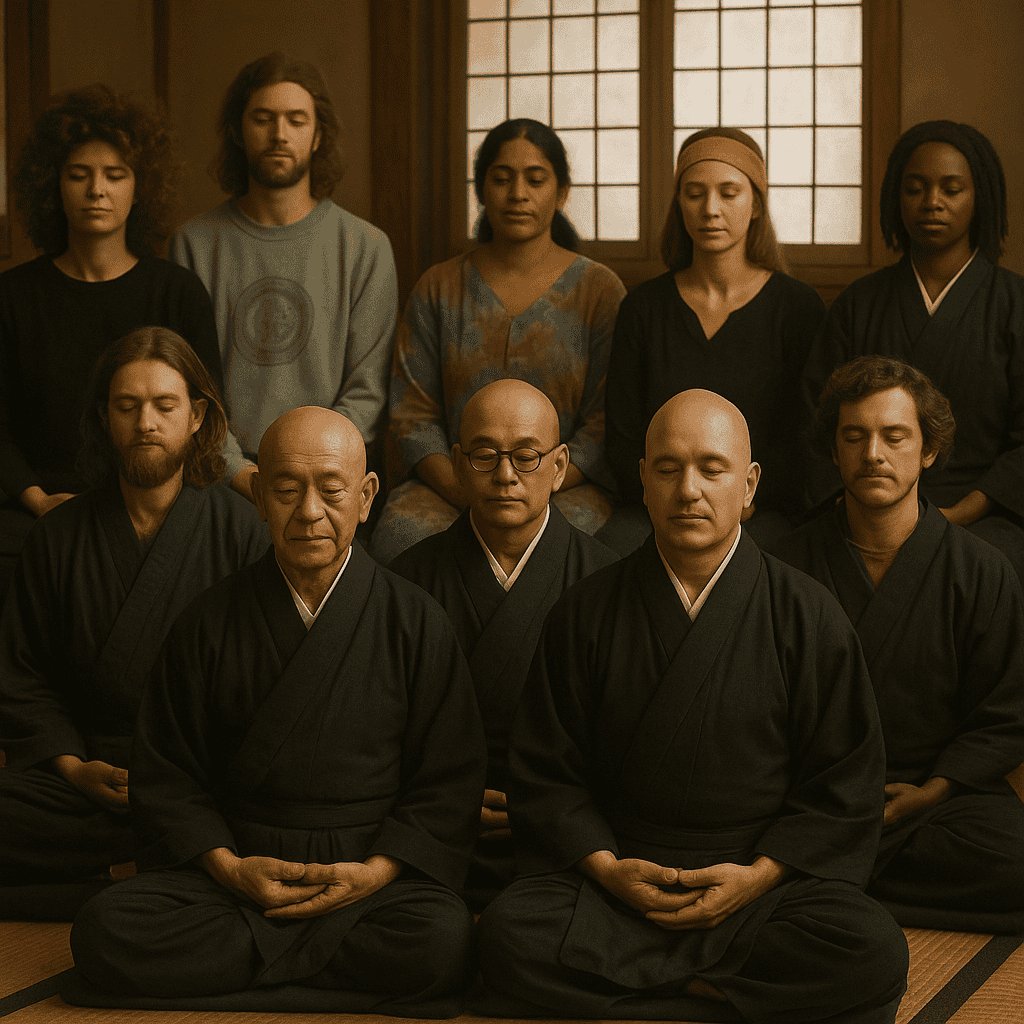
X. Conclusion: Returning to the Source
Throughout the journey of Zen Yoga — from the early yogins of India to the meditative philosophers of Yogācāra, from the silent sages of China to the Zen masters of Japan and the West — we find a single, continuous inquiry: What is the nature of the mind? And how can one awaken to its true, unconditioned clarity?
Living beings, possessed of mind and body, are born into a world of ceaseless transformation. Causes and conditions give rise to sensations, thoughts, emotions, and forms. Naturally, these movements are perceived as comprising a fixed and separate individual — a self, seemingly isolated from the rest of reality. This sense of self arises as a reflex of consciousness identifying with body and mind, the subtle assertion of identity: “I am.”
Rev. Ben Connelly, reflecting on the teachings of Katagiri Rōshi, notes that this layer of consciousness — the awareness that stands back and observes — was called by Katagiri simply “the observer.” It is this observer, this inner narrator, that we often mistake for our true self. Yet this observer, too, is just another appearance within the flow of mind.
According to Yogācāra, this illusion — the belief in an independently existing “I” — is among the most tenacious habits of consciousness. It is conditioned by past karma, reinforced by perception and cognition, and clung to by habit and fear. And yet it is empty — a ghost conjured by the movement of mind.
The method to see through this illusion is mindfulness (smṛti in Sanskrit, sati in Pāli) — a gentle, steady returning to what is actually happening, moment by moment. But even mindfulness, in its most refined form, ripens into Zen meditation: not grasping or judging the contents of consciousness, but sitting still, allowing reality to reveal itself just as it is.
This is the essence of Zen Yoga — not a technique, but a way of being. A return to the luminous ground of awareness before self and other arise. In just sitting, the mind no longer seeks. The illusion of the observer dissolves. There is no longer a division between body and mind, self and other, time and space. There is only presence — vast, silent, and awake.
Such is the practice of the Buddhas. Such is the Yoga of Zen.
AUTHOR
D. B. Smith is an independent historian, ritualist, and comparative religion scholar specializing in the intersections of Western esotericism, Freemasonry, and Eastern contemplative traditions. He formerly served as Librarian and Curator at the George Washington Masonic National Memorial, overseeing historically significant artifacts and manuscripts, including those connected to George Washington’s personal life.
Initiated into The Lodge of the Nine Muses No. 1776, a philosophically focused lodge in Washington, D.C., Smith studied under influential figures in the Anglo-American Masonic tradition. His work has been featured in national and international Masonic publications, and his efforts have helped inform exhibits, lectures, and televised documentaries on the history and symbolism of Freemasonry.
Smith’s parallel study and practice of Soto Zen Buddhism—including ordination as a lay practitioner in the Katagiri-Winecoff lineage—has led him to investigate convergences between ritual, mindfulness, symbolic systems, and the evolving role of spiritual practice in secular societies. He is the founder of Science Abbey, a platform for interdisciplinary inquiry across religion, philosophy, science, and cultural history.