
Table of Contents
- Introduction
Stillness in the Storm: Why Meditation Belongs in Medicine - The Science of Meditation
Evidence-Based Benefits for Body and Mind - For Patients in Pain, Illness, and Recovery
Using Meditation for Relief, Resilience, and Healing - In Hospitals and Hospices
Zen Chaplaincy, Palliative Care, and Dying with Presence - For Caregivers and Clinicians
Mindfulness, Burnout, and the Medicine of Compassion - Changing the Culture of Care
Institutional Support for Mindfulness and Presence - Whole Health Integration
From Meditation to Medicine - Conclusion
Healing Beyond the Body
1. Introduction
Stillness in the Storm: Why Meditation Belongs in Medicine
In the sterile brightness of a hospital hallway, amid beeping machines and clipped footsteps, there is rarely silence—let alone stillness. Yet increasingly, clinicians, patients, and researchers are beginning to ask: What if stillness is exactly what’s needed?
Meditation, long practiced without goals or metrics, is now being rigorously studied by science—and the results are compelling. Meditation has been shown to modulate pain, ease anxiety, reduce inflammation, improve immune response, and foster psychological resilience. These are not just philosophical promises, but measurable, reproducible outcomes. And they matter profoundly—not only for patients suffering from illness and injury, but for the healthcare providers entrusted with their care.
This is not about making hospitals into monasteries, or asking nurses to become sages. It is about recognizing the simple human need for presence—and the power of contemplative practice to support both healing and caregiving in the most stressful environments imaginable.
In a healthcare system dominated by procedures, paperwork, and protocols, meditation brings something urgently needed:
- A space to pause, even briefly, in the face of suffering.
- A tool to return to one’s breath, one’s body, and the reality of the moment.
- A culture of care that honors not only what we do for others—but how we do it, and who we are while doing it.
Meditation is not a cure-all. It does not replace surgery, antibiotics, or emergency intervention. But it restores the terrain in which healing can happen. For patients, it can reduce pain and fear. For providers, it can reduce burnout and emotional exhaustion. For institutions, it can shift the culture of caregiving from one of mechanistic efficiency to one of thoughtful compassion.
This article explores the science and stories behind meditation in healthcare:
- For those in pain, illness, injury, and recovery
- For those at the end of life
- And for those who care for them—in hospitals, hospices, and beyond
It is a call for presence in a profession that too often teaches detachment. A call to recognize that stillness is not the absence of care—it is its deepest expression.
2. The Science of Meditation
Evidence-Based Benefits for Body and Mind
For thousands of years, meditation has been cultivated as a spiritual practice. But today, it also occupies a growing place in scientific literature, where its physiological, psychological, and neurological effects are being measured with increasing rigor.
What Happens in the Body During Meditation?
Meditation, especially mindfulness-based practices, activates the parasympathetic nervous system—the body’s “rest and digest” mode. It counters the chronic activation of the sympathetic nervous system—the “fight or flight” response—which is so common in those experiencing pain, illness, anxiety, or trauma.
Scientific studies have shown that meditation:
- Reduces heart rate and blood pressure
- Lowers cortisol levels, thereby decreasing systemic inflammation
- Boosts immune function, possibly improving the body’s capacity to fight infection and heal wounds
- Increases heart rate variability, an indicator of greater emotional resilience and nervous system balance
What Happens in the Brain?
MRI and EEG studies have demonstrated that meditation can change the structure and function of the brain:
- Thicker gray matter in regions associated with attention, emotional regulation, and self-awareness (such as the prefrontal cortex and anterior cingulate cortex)
- Reduced activity in the default mode network, associated with rumination and self-referential thought (which are common in anxiety and depression)
- Improved connectivity in neural networks that govern focus, empathy, and interoception
One landmark study published in JAMA Internal Medicine found that mindfulness meditation can produce moderate improvement in anxiety, depression, and pain—results comparable to those achieved with certain antidepressants, but without the side effects.
“The evidence is mounting: meditation is not just a placebo or a wellness trend. It is a neurobiological intervention.”
— National Center for Complementary and Integrative Health (NCCIH)
Meditation and Mental Health
According to a 2023 review in Psychology Today, mindfulness-based cognitive therapy (MBCT) and mindfulness-based stress reduction (MBSR) are now widely used for:
- Major depressive disorder
- Generalized anxiety disorder
- PTSD and trauma recovery
- Substance use relapse prevention
In many cases, meditation complements—not replaces—clinical therapy or medication. But its effects are significant. For people with chronic pain or long-term illness, meditation provides not just symptom relief, but a way to relate to suffering differently.
A Bridge Between Mind and Medicine
As the Harvard T.H. Chan School of Public Health noted in a 2022 report, integrating spiritual care—including mindfulness—into medical care can lead to better health outcomes, especially in serious illness and end-of-life care. Meditation helps patients cope with uncertainty, connect to meaning, and reduce feelings of isolation and despair.
What was once considered “alternative” is now increasingly mainstream, and even essential. The scientific case for meditation is no longer speculative—it is established.
In the sections ahead, we will examine how these findings are being applied in hospitals, palliative care settings, and among healthcare workers. But first, we turn to the experience of patients themselves: those facing pain, illness, and the daily weight of recovery—and how meditation offers them a path, not out of suffering, but through it.
3. Meditation for Patients in Pain and Illness
A Gentle Practice in the Midst of Suffering
Pain—whether acute or chronic—can dominate a patient’s life, distorting attention, depleting hope, and isolating the individual from their own body. Illness, injury, and hospitalization often compound this experience with fear, uncertainty, and helplessness. Meditation, while not a painkiller in the traditional sense, offers a different kind of relief: it softens the reactivity around pain, and restores agency within the patient’s experience.
The Science of Pain and Perception
Pain is not purely physical—it is also perceptual. The brain interprets nociceptive signals and constructs the experience of suffering. Meditation modulates this process by:
- Reducing pain intensity through shifts in attention and awareness
- Decoupling the sensory component of pain from emotional distress
- Interrupting the cycle of pain-catastrophizing, in which fear and focus amplify suffering
A 2023 study published in Pain Medicine found that mindfulness meditation consistently outperforms placebo in reducing both pain severity and pain-related distress, with effects sustained even after treatment ends【source†PMC10403447】.
Illness and Injury: Navigating the Unknown
Patients dealing with chronic illnesses—such as cancer, autoimmune disorders, or long COVID—face unpredictable symptoms, complex treatments, and existential anxiety. Meditation can help these individuals:
- Cultivate acceptance without resignation
- Develop non-reactive awareness of fluctuating symptoms
- Find meaning amid uncertainty and mortality
- Reconnect with a sense of inner space and selfhood, often disrupted by medicalization
In injury recovery, where trauma and immobility create frustration and emotional disruption, simple breath-based practices and body scans restore a sense of grounding and control.
“In the midst of what I thought I could not bear, I discovered I could breathe. That changed everything.”
— Cancer patient, UCSF Zen Hospice program
Meditation in the Hospital Bed
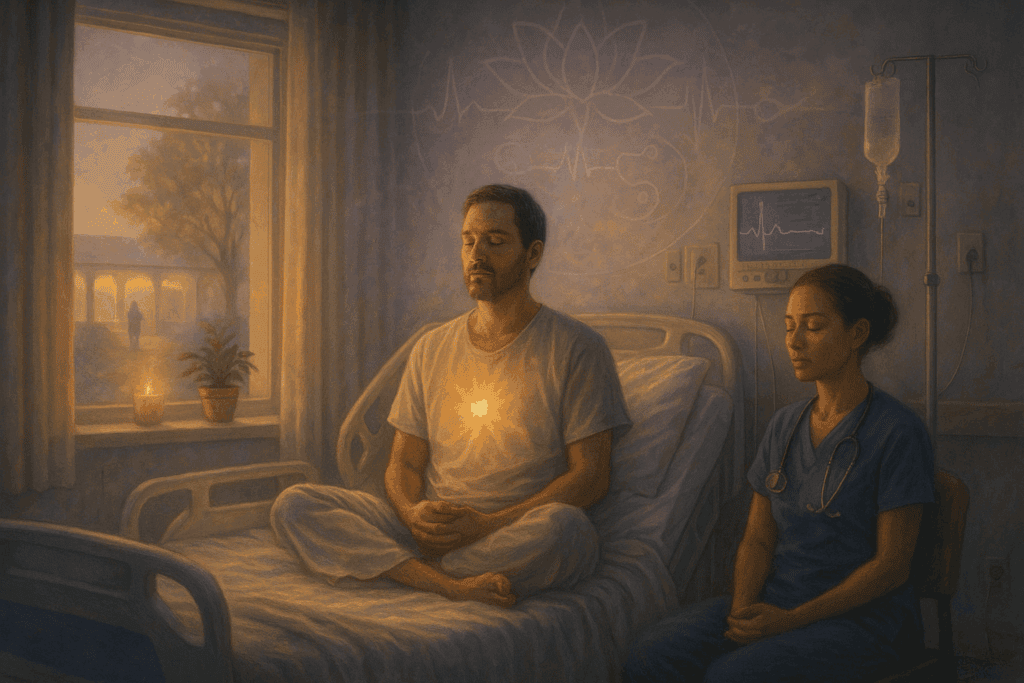
Even in the hospital setting—where noise, interventions, and institutional schedules dominate—brief, guided mindfulness practices can make a difference. Bedside meditation has been shown to:
- Reduce preoperative anxiety and postoperative pain
- Improve sleep and reduce reliance on sedatives
- Support immune function during healing
- Improve satisfaction with care and a sense of dignity
Organizations like Zen Caregiving Project and the UCSF Zen Hospice Project have pioneered the inclusion of contemplative presence in patient care—bringing not only meditation, but also silence, listening, and human touch into high-stress medical environments.
Integrating Meditation with Medical Treatment
Meditation is not a substitute for medical care—but it complements it in ways that restore wholeness to the healing process. It allows patients to meet their pain—not with fear or rejection—but with attention, kindness, and courage.
As we’ll see next, these same qualities are also vital for the caregivers who serve them.
4. Meditation for Doctors, Nurses, and Care Providers
Compassion Without Burnout
The modern healthcare system often demands superhuman endurance from its caregivers. Long hours, emotional labor, institutional stress, and repeated exposure to suffering and death can deplete even the most dedicated professionals. Burnout is now recognized not merely as a personal failure, but as a systemic health crisis within the healthcare profession.
Meditation offers a response—not only to treat burnout after it appears, but to prevent it by cultivating emotional resilience, clarity, and compassion.
The Burnout Epidemic
According to a 2022 review in JAMA, more than 60% of physicians and 70% of nurses report symptoms of burnout, which includes emotional exhaustion, depersonalization, and a reduced sense of personal accomplishment. The consequences are widespread:
- Increased errors and decreased quality of care
- Higher turnover rates and staffing shortages
- Mental health crises including depression, substance abuse, and suicide
But many clinicians feel they have no space to process the emotional toll of their work. As one nurse put it:
“We’re trained to harden ourselves to suffering. But that hardening makes us empty.”
Meditation as a Restorative Practice
Research published in Nursing Administration Quarterly and Journal of Clinical Psychology shows that meditation among healthcare workers can:
- Reduce stress and emotional fatigue
- Improve focus, empathy, and interpersonal communication
- Decrease compassion fatigue
- Cultivate self-awareness, leading to wiser clinical decision-making
- Restore purpose and presence to daily work
Importantly, meditation does not require hours of practice. Just a few minutes of mindful breathing before a shift or brief centering breaks during the day have been shown to significantly reduce stress levels and increase workplace satisfaction【source†PMC8954148】.
Cultural Change in Clinical Institutions
Leading researchers and nurse educators suggest not just teaching meditation to individuals—but embedding contemplative practices into the culture of care:
- Designate quiet spaces for staff reflection and decompression
- Begin staff meetings or shifts with a brief mindfulness pause
- Offer guided meditations or compassionate listening sessions
- Train leaders to model emotional openness and resilience
In the words of a Zen-trained hospice chaplain:
“Compassion doesn’t drain you—it sustains you. But only if you stay present to your own inner life.”
Programs like the Zen Caregiving Project have already demonstrated the transformative potential of training clinicians not only to do their work—but to bring presence, openness, and humanity to their work.
5. A New Culture of Care
Reforming Institutions with Compassion and Presence
If modern healthcare excels in diagnostics, surgery, and pharmaceuticals, it often falls short in human presence and emotional care. In the name of efficiency, hospitals have grown sterile and impersonal—treating bodies instead of beings. But institutions can change. A science-informed culture of mindfulness and compassion is not only possible—it’s essential.
From Task-Based to Human-Centered Care
Contemporary hospitals operate on protocols: vital signs, checklists, drug regimens. While necessary, this approach can overshadow the lived experience of patients—and of staff. Institutional reform begins by recognizing that:
- Patients need more than treatment—they need understanding
- Caregivers need more than skill—they need emotional support
- Health systems need more than funding—they need soul
This vision is supported by growing data showing that mindfulness and compassion-based programs lead to better outcomes not only for individuals, but for institutions as a whole.
Case Study: Zen Chaplaincy and the UCSF Model
One transformative example is the Zen Caregiving Project, originally developed at the Zen Hospice Project in San Francisco. Integrating Zen meditation, contemplative care, and palliative support, it:
- Trains staff and volunteers in deep listening and emotional presence
- Offers patients comfort and connection in their final days
- Brings contemplative wisdom into clinical settings—without religious dogma
This model shows how spiritual practices can enhance, not replace, medical professionalism—offering depth, humanity, and renewal.
Institutional Strategies for Mindful Reform
To build a culture that supports both medical excellence and emotional wellness, healthcare institutions can:
- Establish quiet rooms or “still points” on every unit for staff and patients
- Implement daily mindfulness check-ins for care teams
- Offer resilience training and stress management rooted in evidence-based contemplative methods
- Promote empathy and self-awareness as leadership competencies
- Encourage interdisciplinary dialogue about suffering, death, and meaning
These reforms do not require massive budgets. They require vision, sincerity, and willingness to change the culture of care.
“The future of medicine will not be only technological—it must be ethical, emotional, and whole.”
— Clinical Educator, Boston Medical Center
Why It Matters
By institutionalizing mindfulness, compassion, and reflection—not as add-ons but as core values—we move toward a healthcare system that heals the person, not just the pathology. We recognize that medicine is not just about curing disease. It is about being with people through life’s most vulnerable moments—with courage, clarity, and care.
Here is the draft for Section 6: Meditation as Preventative Healthcare – Wholeness Before Illness from Meditation in Healthcare: For Pain, Illness, Injury, and Hospitalization:
6. Meditation as Preventative Healthcare
Wholeness Before Illness
In medicine, the most powerful interventions are not always dramatic. The most profound act of healing is often prevention. Yet modern healthcare remains disproportionately focused on crises—on what to do after disease strikes. Meditation, long used for introspection and spiritual development, is emerging as a scientifically supported practice for preventing illness and promoting holistic health.
A Preventative Medicine for the Whole Person
Preventative medicine typically includes vaccinations, screenings, diet, and exercise. Meditation adds something deeper:
- Stress reduction, which lowers the risk of chronic disease
- Improved emotional regulation, reducing risk of anxiety and depression
- Enhanced immune function through parasympathetic nervous system activation
- Healthier lifestyle choices, as mindfulness supports better decision-making
Over time, regular meditation has been associated with lower blood pressure, reduced inflammation, improved sleep, and better glycemic control in diabetics【source†PMC10403447】.
As one Harvard study concluded, mindfulness and spiritual well-being are strong predictors of long-term health outcomes—sometimes more than genetics or income【source†hsph.harvard.edu】.
Daily Practice, Lifelong Benefits
Even short, consistent meditation practices—10 to 20 minutes a day—can:
- Increase heart rate variability (a measure of stress resilience)
- Reduce cortisol levels and pro-inflammatory markers
- Improve mood stability, reducing healthcare visits for psychosomatic issues
- Promote early detection of emotional and physical imbalances
These effects are cumulative, subtle, and sometimes invisible—until they’re not. A person who learns to sit with difficult emotions is less likely to self-medicate. A healthcare provider who takes five minutes for mindful breathing may prevent a future error—or emotional collapse.
From Intervention to Cultivation
Preventative medicine requires a cultural shift: from reactive treatment to proactive cultivation of well-being. This includes:
- Teaching mindfulness in schools as part of public health
- Encouraging stress literacy and emotional awareness in communities
- Offering meditation resources in clinics and wellness programs
- Integrating whole health education in medical training
“If we wait for illness to begin caring for our bodies and minds, we have waited too long.”
— Preventive Medicine Physician
Meditation in this light becomes not a mystical hobby—but a public health tool. A kind of quiet vaccine for the soul.
7. Whole Health Integration
From Meditation to Medicine
What if healthcare treated not only the illness, but the human being as a whole? That is the question driving a revolution in modern medicine—one where contemplative practices like meditation are no longer fringe, but foundational. This emerging model, sometimes called “whole health” or “integrative care,” seeks not to replace conventional medicine, but to embed it within a wider framework of human flourishing.
The Whole Health Model
Whole Health approaches define well-being not merely as the absence of disease, but as:
- Physical vitality
- Emotional balance
- Social connection
- Spiritual fulfillment
- Purpose and meaning in life
The U.S. Veterans Health Administration (VHA), one of the world’s largest healthcare systems, is pioneering a model that places the patient’s mission, aspiration, and purpose at the center of care. From this foundation, interventions—including meditation—are selected not only to treat, but to align the whole being【source†bannerhealth.com】.
The Role of Meditation in Whole Health
Meditation and mindfulness training are increasingly used:
- As first-line approaches for stress-related disorders and insomnia
- As complementary therapies in chronic illness and cancer care
- As supportive tools for surgery preparation, recovery, and grief
- To foster self-awareness, empowering patients in lifestyle change
- In clinician training to reduce burnout and enhance empathy
Institutions from Johns Hopkins to the Cleveland Clinic now offer mindfulness-based programs as part of integrated care packages.
Bridging Practice and Policy
For true whole health integration, changes are needed on multiple levels:
- Medical education must include contemplative sciences and human development
- Public health policy must fund preventive programs, including meditation and stress education
- Healthcare delivery models must create space—both physical and psychological—for stillness, reflection, and care rooted in presence
This does not mean rejecting science. On the contrary, it means applying science to all aspects of human nature, including the inner world. It means recognizing that data and diagnostics must be paired with compassion and meaning.
From Fragmentation to Coherence
Modern medicine, for all its achievements, often suffers from fragmentation: one specialist for the liver, another for the mind, none for the self. Meditation, when used skillfully, helps weave these parts back into a coherent whole.
“The goal of medicine is not simply to prolong life, but to restore wholeness.”
— Integrative Health Vision Statement
When meditation is integrated into medicine—not as a luxury, but as a tool of awakening—the healthcare system becomes more than a place of treatment. It becomes a site of transformation.
7. Whole Health Integration
From Meditation to Medicine
What if healthcare treated not only the illness, but the human being as a whole? That is the question driving a revolution in modern medicine—one where contemplative practices like meditation are no longer fringe, but foundational. This emerging model, sometimes called “whole health” or “integrative care,” seeks not to replace conventional medicine, but to embed it within a wider framework of human flourishing.
The Whole Health Model
Whole Health approaches define well-being not merely as the absence of disease, but as:
- Physical vitality
- Emotional balance
- Social connection
- Spiritual fulfillment
- Purpose and meaning in life
The U.S. Veterans Health Administration (VHA), one of the world’s largest healthcare systems, is pioneering a model that places the patient’s mission, aspiration, and purpose at the center of care. From this foundation, interventions—including meditation—are selected not only to treat, but to align the whole being【source†bannerhealth.com】.
The Role of Meditation in Whole Health
Meditation and mindfulness training are increasingly used:
- As first-line approaches for stress-related disorders and insomnia
- As complementary therapies in chronic illness and cancer care
- As supportive tools for surgery preparation, recovery, and grief
- To foster self-awareness, empowering patients in lifestyle change
- In clinician training to reduce burnout and enhance empathy
Institutions from Johns Hopkins to the Cleveland Clinic now offer mindfulness-based programs as part of integrated care packages.
Bridging Practice and Policy
For true whole health integration, changes are needed on multiple levels:
- Medical education must include contemplative sciences and human development
- Public health policy must fund preventive programs, including meditation and stress education
- Healthcare delivery models must create space—both physical and psychological—for stillness, reflection, and care rooted in presence
This does not mean rejecting science. On the contrary, it means applying science to all aspects of human nature, including the inner world. It means recognizing that data and diagnostics must be paired with compassion and meaning.
From Fragmentation to Coherence
Modern medicine, for all its achievements, often suffers from fragmentation: one specialist for the liver, another for the mind, none for the self. Meditation, when used skillfully, helps weave these parts back into a coherent whole.
“The goal of medicine is not simply to prolong life, but to restore wholeness.”
— Integrative Health Vision Statement
When meditation is integrated into medicine—not as a luxury, but as a tool of awakening—the healthcare system becomes more than a place of treatment. It becomes a site of transformation.